
Followership Bn RPeng ManajemenChap09 1 Followership Ability to
Followership Bn. R-Peng. Manajemen-Chap-09 1
• • Followership Ability to place organization ahead of personal ambition Allegiance and loyalty up and down the chain of command Ability to recognize they share responsibility to help organization to succeed Ability to know when and how to challenge the status quo Importance of Followers • Followers’ actions/attitudes influence their leader – For better or worse • Qualities of effective followers are same ones we want in leaders • We tend to focus too much on the leader: – Performance of leaders & followers are variables that depend upon one another – Followers often have the information, expertise, and ideas that are essential for success Styles of Followership Part 1 • Five styles, categorized by two dimensions – Independent/critical vs. Dependent/uncritical thinking – Active vs. Passive behavior Bn. R-Peng. Manajemen-Chap-09 2
First Dimension • Independent thinkers: – Aware of the significance of their actions – Offer constructive criticism/innovation • Dependent/uncritical thinkers: – Do not consider possibilities – Accepts leader’s ideas without thinking Second Dimension • Active Behavior: – Participates fully (Often beyond limits of job) – Demonstrates sense of ownership – Initiates problem-solving and decision-making • Passive Behavior: – Does what’s told – Avoids responsibility – Requires constant supervision and prodding Bn. R-Peng. Manajemen-Chap-09 3
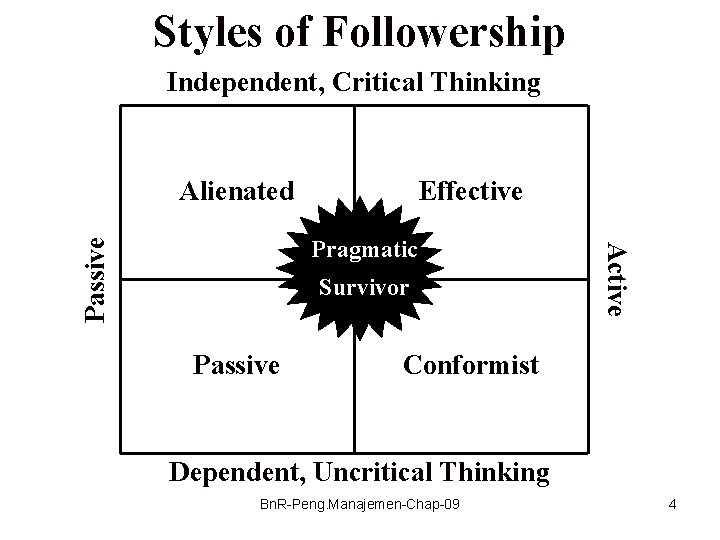
Styles of Followership Independent, Critical Thinking Alienated Effective Passive Survivor Passive Active Pragmatic Conformist Dependent, Uncritical Thinking Bn. R-Peng. Manajemen-Chap-09 4
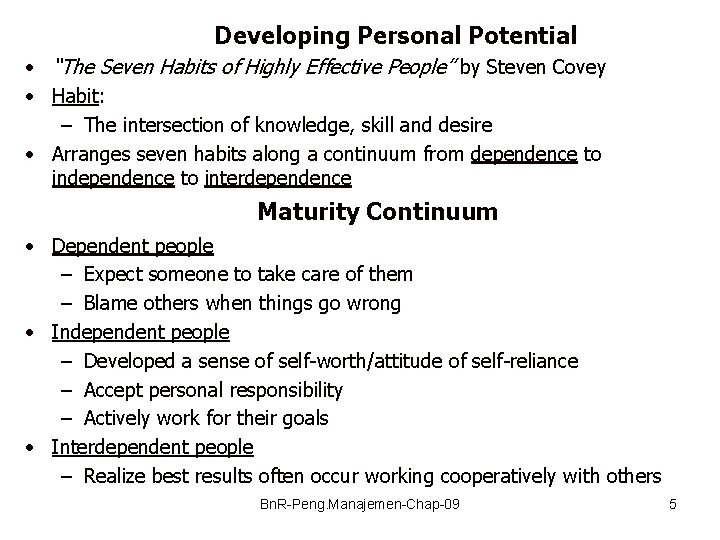
Developing Personal Potential • “The Seven Habits of Highly Effective People” by Steven Covey • Habit: – The intersection of knowledge, skill and desire • Arranges seven habits along a continuum from dependence to interdependence Maturity Continuum • Dependent people – Expect someone to take care of them – Blame others when things go wrong • Independent people – Developed a sense of self-worth/attitude of self-reliance – Accept personal responsibility – Actively work for their goals • Interdependent people – Realize best results often occur working cooperatively with others Bn. R-Peng. Manajemen-Chap-09 5
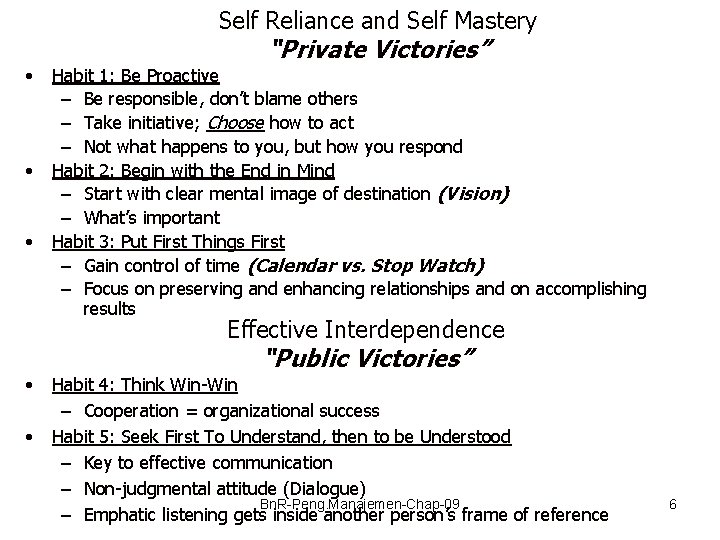
Self Reliance and Self Mastery “Private Victories” • • • Habit 1: Be Proactive – Be responsible, don’t blame others – Take initiative; Choose how to act – Not what happens to you, but how you respond Habit 2: Begin with the End in Mind – Start with clear mental image of destination (Vision) – What’s important Habit 3: Put First Things First – Gain control of time (Calendar vs. Stop Watch) – Focus on preserving and enhancing relationships and on accomplishing results Effective Interdependence “Public Victories” • • Habit 4: Think Win-Win – Cooperation = organizational success Habit 5: Seek First To Understand, then to be Understood – Key to effective communication – Non-judgmental attitude (Dialogue) Bn. R-Peng. Manajemen-Chap-09 – Emphatic listening gets inside another person’s frame of reference 6
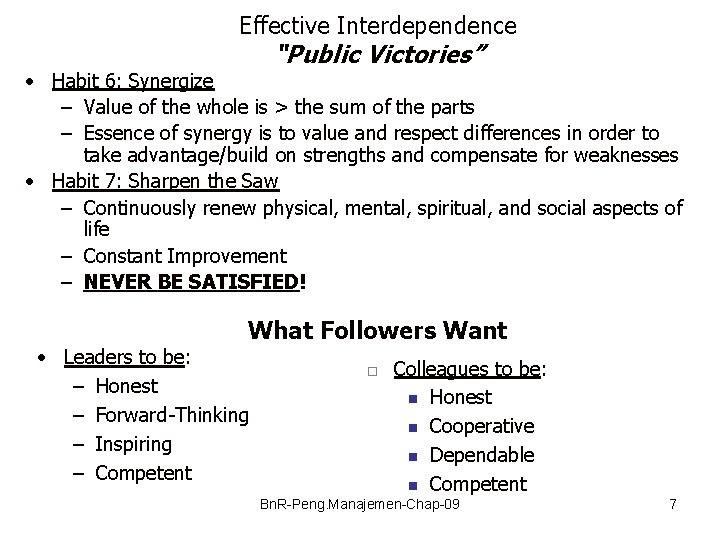
Effective Interdependence “Public Victories” • Habit 6: Synergize – Value of the whole is > the sum of the parts – Essence of synergy is to value and respect differences in order to take advantage/build on strengths and compensate for weaknesses • Habit 7: Sharpen the Saw – Continuously renew physical, mental, spiritual, and social aspects of life – Constant Improvement – NEVER BE SATISFIED! What Followers Want • Leaders to be: – Honest – Forward-Thinking – Inspiring – Competent o Colleagues to be: n Honest n Cooperative n Dependable n Competent Bn. R-Peng. Manajemen-Chap-09 7
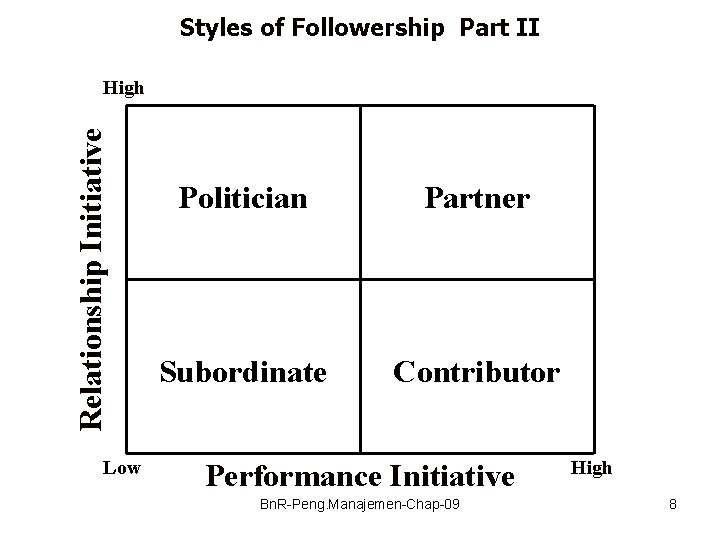
Styles of Followership Part II Relationship Initiative High Low Politician Partner Subordinate Contributor Performance Initiative Bn. R-Peng. Manajemen-Chap-09 High 8
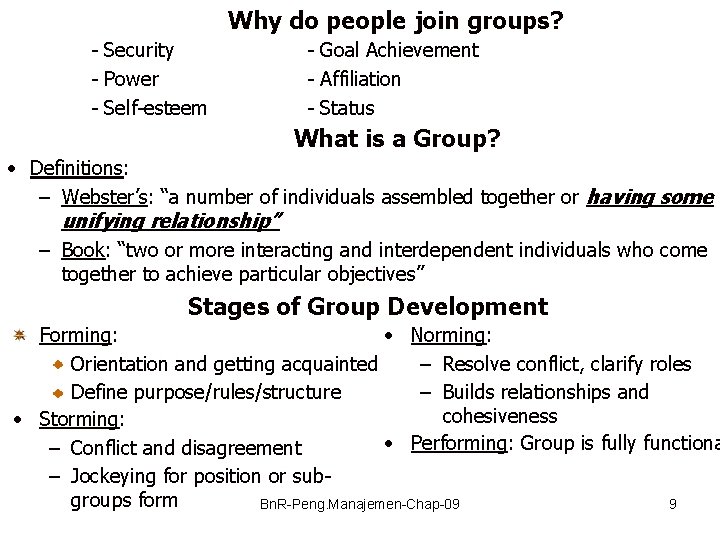
Why do people join groups? - Security - Power - Self-esteem - Goal Achievement - Affiliation - Status What is a Group? • Definitions: – Webster’s: “a number of individuals assembled together or having some unifying relationship” – Book: “two or more interacting and interdependent individuals who come together to achieve particular objectives” Stages of Group Development Forming: • Norming: Orientation and getting acquainted – Resolve conflict, clarify roles Define purpose/rules/structure – Builds relationships and cohesiveness • Storming: • Performing: Group is fully functiona – Conflict and disagreement – Jockeying for position or subgroups form Bn. R-Peng. Manajemen-Chap-09 9
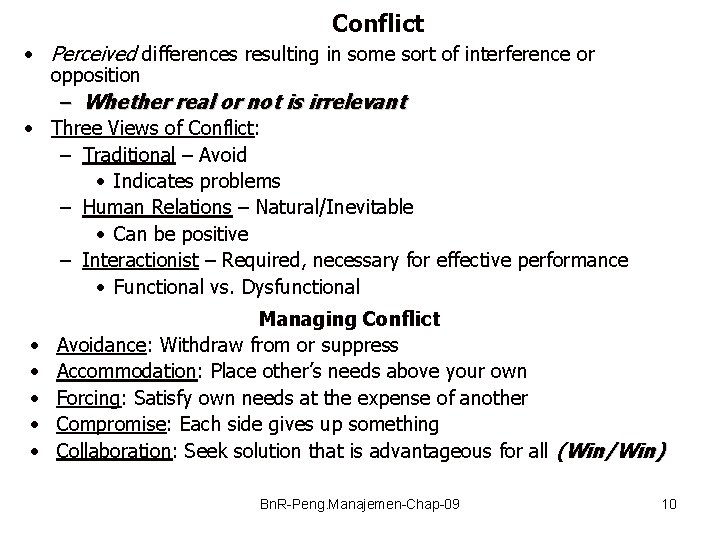
Conflict • Perceived differences resulting in some sort of interference or opposition – Whether real or not is irrelevant • Three Views of Conflict: – Traditional – Avoid • Indicates problems – Human Relations – Natural/Inevitable • Can be positive – Interactionist – Required, necessary for effective performance • Functional vs. Dysfunctional • • • Managing Conflict Avoidance: Withdraw from or suppress Accommodation: Place other’s needs above your own Forcing: Satisfy own needs at the expense of another Compromise: Each side gives up something Collaboration: Seek solution that is advantageous for all (Win/Win) Bn. R-Peng. Manajemen-Chap-09 10
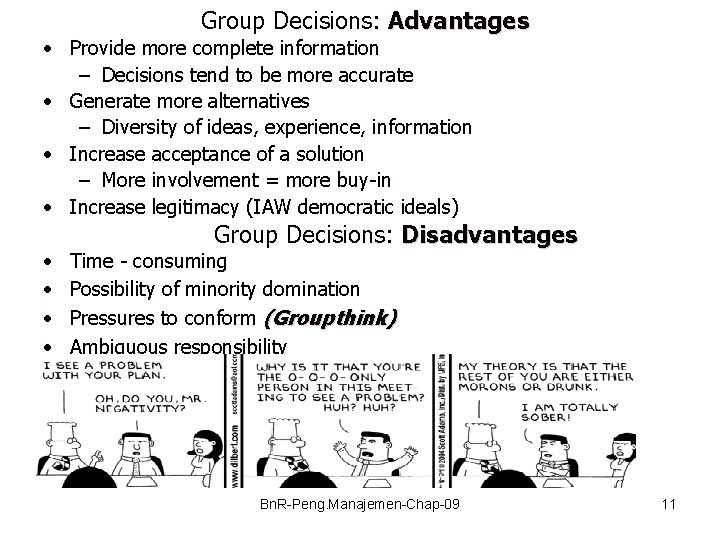
Group Decisions: Advantages • Provide more complete information – Decisions tend to be more accurate • Generate more alternatives – Diversity of ideas, experience, information • Increase acceptance of a solution – More involvement = more buy-in • Increase legitimacy (IAW democratic ideals) • • Group Decisions: Disadvantages Time - consuming Possibility of minority domination Pressures to conform (Groupthink) Ambiguous responsibility Bn. R-Peng. Manajemen-Chap-09 11
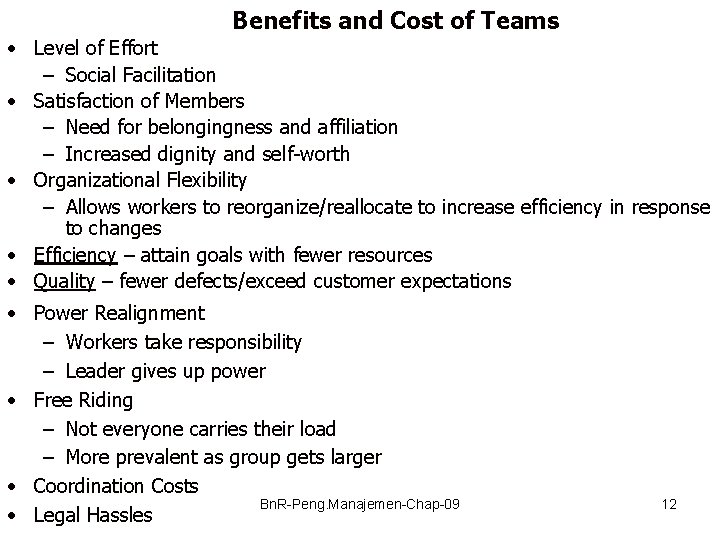
Benefits and Cost of Teams • Level of Effort – Social Facilitation • Satisfaction of Members – Need for belongingness and affiliation – Increased dignity and self-worth • Organizational Flexibility – Allows workers to reorganize/reallocate to increase efficiency in response to changes • Efficiency – attain goals with fewer resources • Quality – fewer defects/exceed customer expectations • Power Realignment – Workers take responsibility – Leader gives up power • Free Riding – Not everyone carries their load – More prevalent as group gets larger • Coordination Costs Bn. R-Peng. Manajemen-Chap-09 • Legal Hassles 12
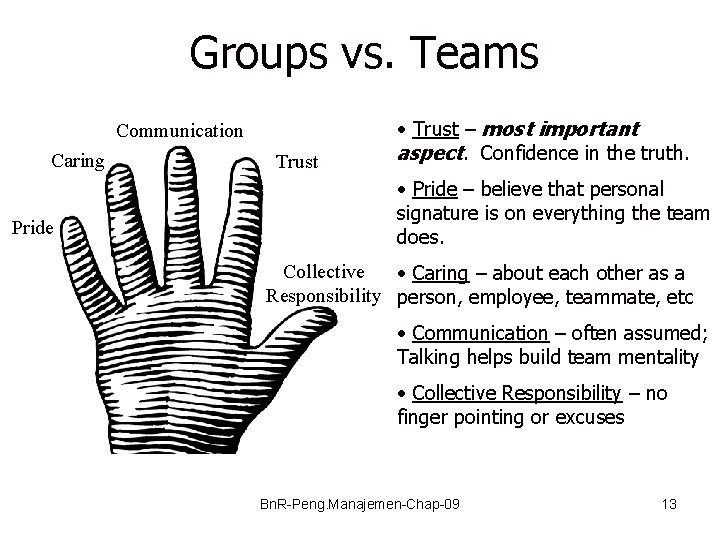
Groups vs. Teams Communication Caring Pride Trust • Trust – most important aspect. Confidence in the truth. • Pride – believe that personal signature is on everything the team does. Collective • Caring – about each other as a Responsibility person, employee, teammate, etc • Communication – often assumed; Talking helps build team mentality • Collective Responsibility – no finger pointing or excuses Bn. R-Peng. Manajemen-Chap-09 13
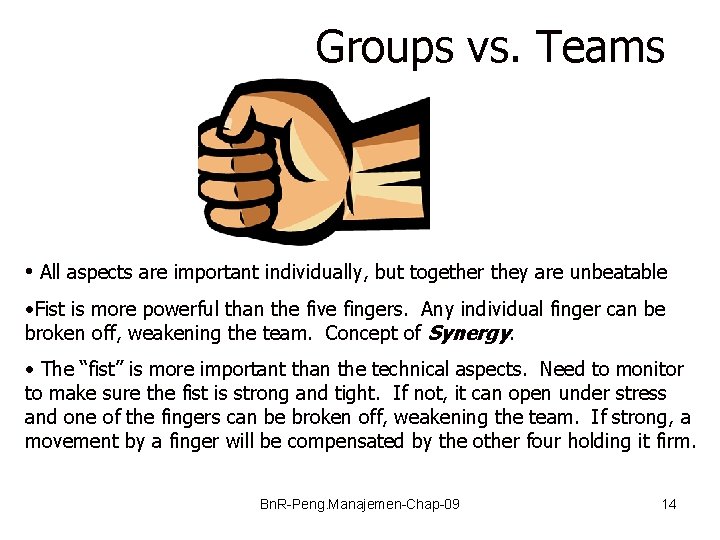
Groups vs. Teams • All aspects are important individually, but together they are unbeatable • Fist is more powerful than the five fingers. Any individual finger can be broken off, weakening the team. Concept of Synergy. • The “fist” is more important than the technical aspects. Need to monitor to make sure the fist is strong and tight. If not, it can open under stress and one of the fingers can be broken off, weakening the team. If strong, a movement by a finger will be compensated by the other four holding it firm. Bn. R-Peng. Manajemen-Chap-09 14
- Slides: 14