
Fodder production Introduction Fodder crops are cultivated plant
- Slides: 14
Fodder production Introduction Fodder crops are cultivated plant species that are utilized as livestock feed. Fodder refers mostly the crops which are harvested and used for stall feeding. On the other hand forages refer to the vegetative matter, fresh or preserved, utilized as feed for animals and include all fodders such as grasses, legumes, crucifers and other crops cultivated and used as hay or silage in a preserved form or utilized through grazing.
WHY GREEN FODDER? The feeding of green fodder (grass, legume or cereal fodder) is always economical. The feeding of concentrates or compounded feed may give high output per unit of feed may not be economically viable always for the countries like where grains, oilcakes and milling byproducts are scarce and costly. In most of the farming situations, feeding concentrates or compounded feed will increase the cost of feeding which in turn raise the cost of production. On the other hand, an animal yielding on average of 5 -6 liters of milk per day can be comfortably maintained with feeding of green fodder only (grass or cereal fodder and legumes) without any supplementation of concentrates. It is not economical for the farmer to have intensive dairy, sheep or goat farm without sufficient provision for green fodder or dry fodder throughout the year. If the land resource is scarce, a farmer can have suitable agroforestry models to increase the forage production per unit area.
HOW FODDERS ARE CLASSIFIED? There are different types of classification available. However, the following two classifications are more easy to understand adopt. Classification of fodder on the basis of season of cultivation Kharif fodder (June – September) : Eg. Cowpea, Field bean, Bajra, Sorghum, Maize Rabi fodder (October – Dec/Jan) : Eg. Berseem, Lucerne, Oats, Barley etc. , Summer fodders (April – June) : Eg. cowpea, Maize, Field bean, Sorghum, Bajra etc. Classification based on Plant family and duration of the crop Legumes (Annual and Perennial) : Eg. Berseem, Cowpea, Stylo, Hedge. Lucerne Non – legumes (Annual and Perenial) : Eg. Hybrid Napier, Guinea grass, Fodder maize, Fodder sorghum etc.
Legumes are the most important component of animal fodder in view of their high content of crude protein (20 – 25%) compared to fodder cereals (8 – 12%) and fodder grasses (5 – 10%). Non leguminous fodders (Cereal and grass) provided much of the required energy (carbohydrates) for livestock while legumes improve the quality of fodders when mixed with non-leguminous fodders. Green fodders of non-legumes are fed in bulk quantities (about 10% of body weight of the animal) whereas that of legumes are fed in small quantities (1 -2% of body weight). If legumes are fed in bulk, it may create problems like bloat in animals.
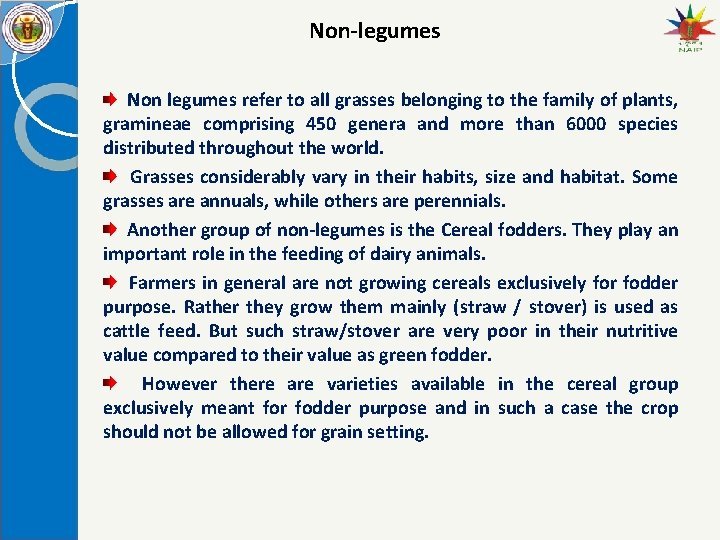
Non-legumes Non legumes refer to all grasses belonging to the family of plants, gramineae comprising 450 genera and more than 6000 species distributed throughout the world. Grasses considerably vary in their habits, size and habitat. Some grasses are annuals, while others are perennials. Another group of non-legumes is the Cereal fodders. They play an important role in the feeding of dairy animals. Farmers in general are not growing cereals exclusively for fodder purpose. Rather they grow them mainly (straw / stover) is used as cattle feed. But such straw/stover are very poor in their nutritive value compared to their value as green fodder. However there are varieties available in the cereal group exclusively meant for fodder purpose and in such a case the crop should not be allowed for grain setting.
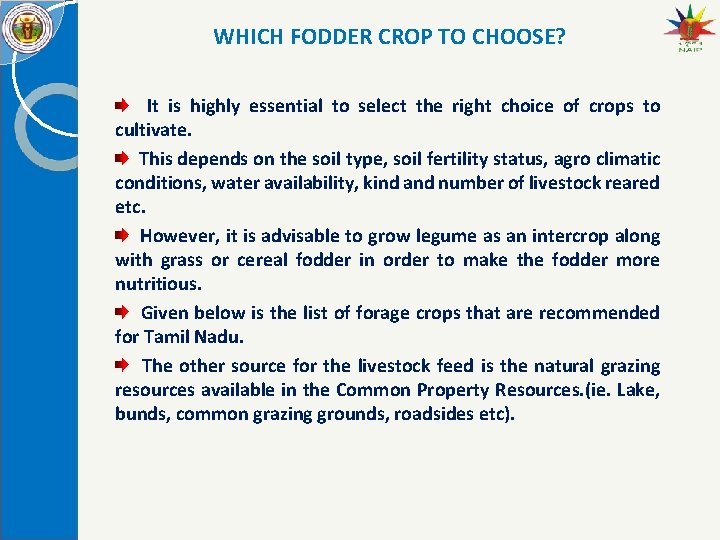
WHICH FODDER CROP TO CHOOSE? It is highly essential to select the right choice of crops to cultivate. This depends on the soil type, soil fertility status, agro climatic conditions, water availability, kind and number of livestock reared etc. However, it is advisable to grow legume as an intercrop along with grass or cereal fodder in order to make the fodder more nutritious. Given below is the list of forage crops that are recommended for Tamil Nadu. The other source for the livestock feed is the natural grazing resources available in the Common Property Resources. (ie. Lake, bunds, common grazing grounds, roadsides etc).
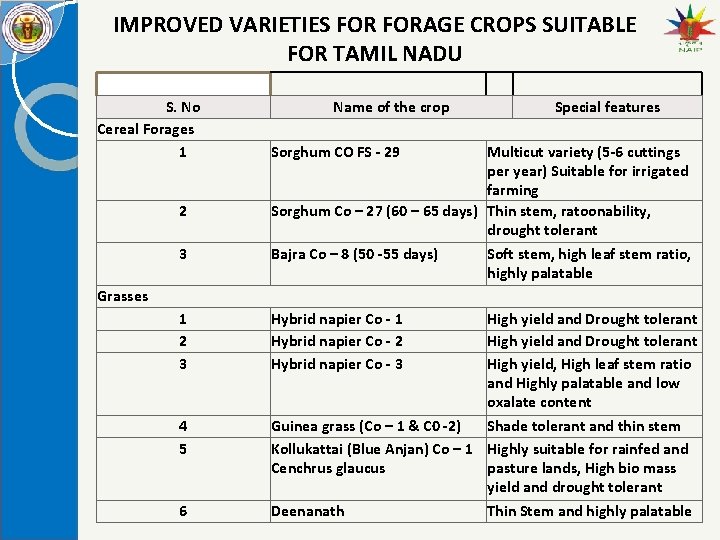
IMPROVED VARIETIES FORAGE CROPS SUITABLE FOR TAMIL NADU S. No Cereal Forages 1 2 3 Name of the crop Special features Sorghum CO FS - 29 Multicut variety (5 -6 cuttings per year) Suitable for irrigated farming Sorghum Co – 27 (60 – 65 days) Thin stem, ratoonability, drought tolerant Bajra Co – 8 (50 -55 days) Soft stem, high leaf stem ratio, highly palatable Grasses 1 2 3 Hybrid napier Co - 1 Hybrid napier Co - 2 Hybrid napier Co - 3 High yield and Drought tolerant High yield, High leaf stem ratio and Highly palatable and low oxalate content 4 5 Guinea grass (Co – 1 & C 0 -2) Shade tolerant and thin stem Kollukattai (Blue Anjan) Co – 1 Highly suitable for rainfed and Cenchrus glaucus pasture lands, High bio mass yield and drought tolerant 6 Deenanath Thin Stem and highly palatable
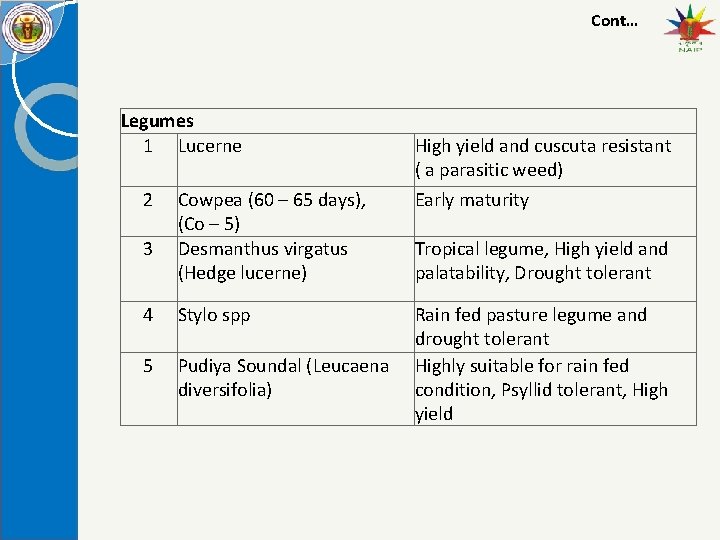
Cont… Legumes 1 Lucerne 2 3 Cowpea (60 – 65 days), (Co – 5) Desmanthus virgatus (Hedge lucerne) 4 Stylo spp 5 Pudiya Soundal (Leucaena diversifolia) High yield and cuscuta resistant ( a parasitic weed) Early maturity Tropical legume, High yield and palatability, Drought tolerant Rain fed pasture legume and drought tolerant Highly suitable for rain fed condition, Psyllid tolerant, High yield
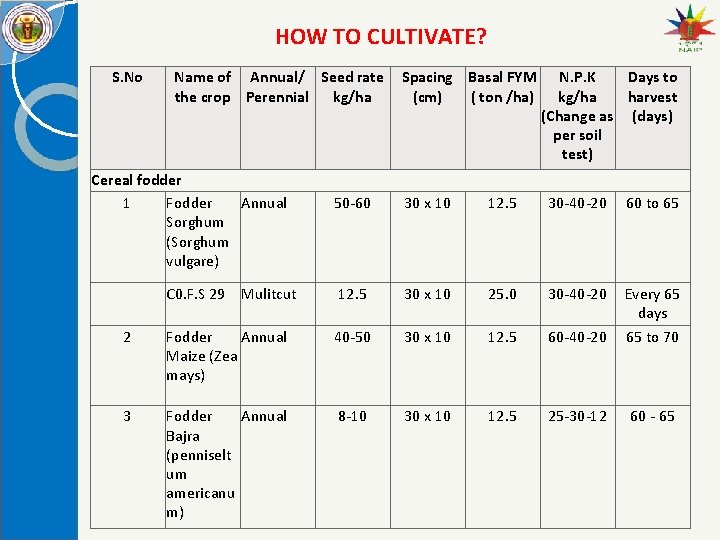
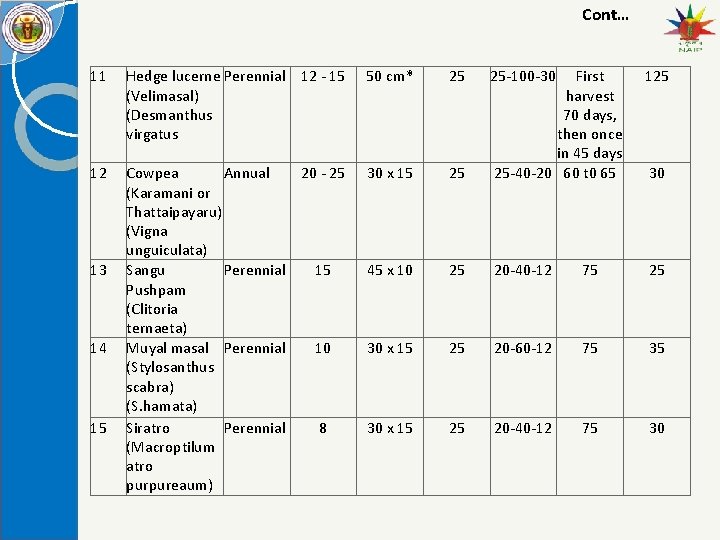
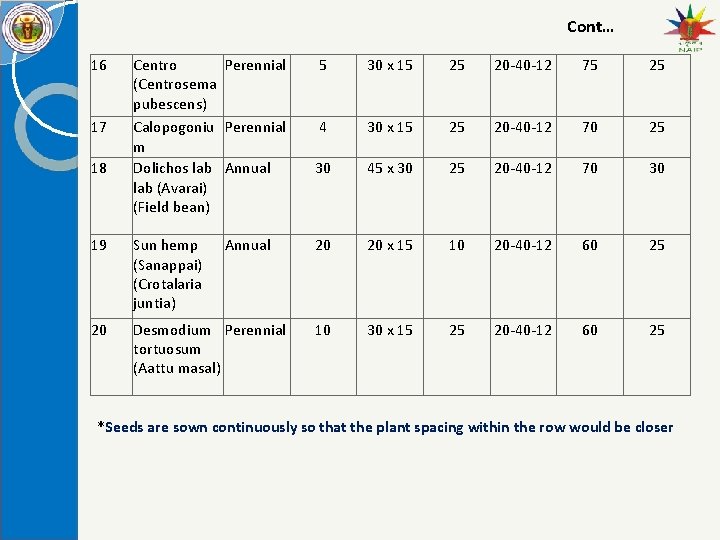
HOW TO CULTIVATE? S. No Name of Annual/ Seed rate the crop Perennial kg/ha Cereal fodder 1 Fodder Annual Sorghum (Sorghum vulgare) Spacing Basal FYM (cm) ( ton /ha) N. P. K Days to kg/ha harvest (Change as (days) per soil test) 50 -60 30 x 10 12. 5 30 -40 -20 60 to 65 C 0. F. S 29 Mulitcut 12. 5 30 x 10 25. 0 30 -40 -20 2 Fodder Annual Maize (Zea mays) 40 -50 30 x 10 12. 5 60 -40 -20 Every 65 days 65 to 70 3 Fodder Annual Bajra (penniselt um americanu m) 8 -10 30 x 10 12. 5 25 -30 -12 60 - 65
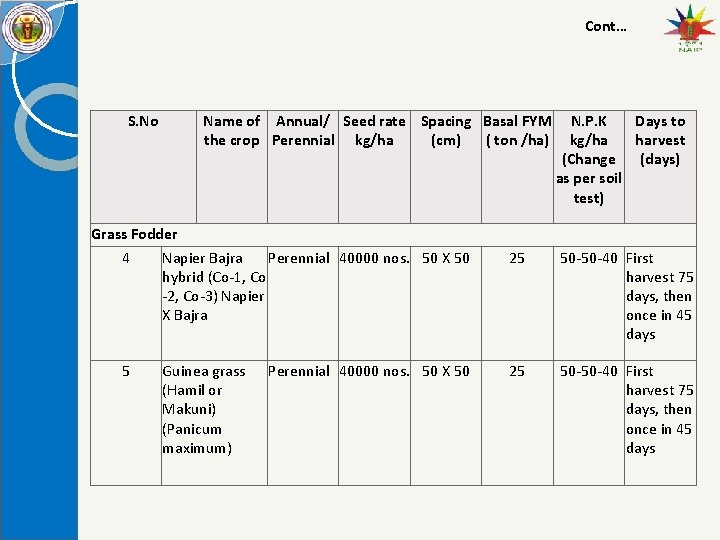
Cont… S. No Name of Annual/ Seed rate Spacing Basal FYM the crop Perennial kg/ha (cm) ( ton /ha) Grass Fodder 4 Napier Bajra Perennial 40000 nos. 50 X 50 hybrid (Co-1, Co -2, Co-3) Napier X Bajra 5 Guinea grass (Hamil or Makuni) (Panicum maximum) Perennial 40000 nos. 50 X 50 N. P. K Days to kg/ha harvest (Change (days) as per soil test) 25 50 -50 -40 First harvest 75 days, then once in 45 days
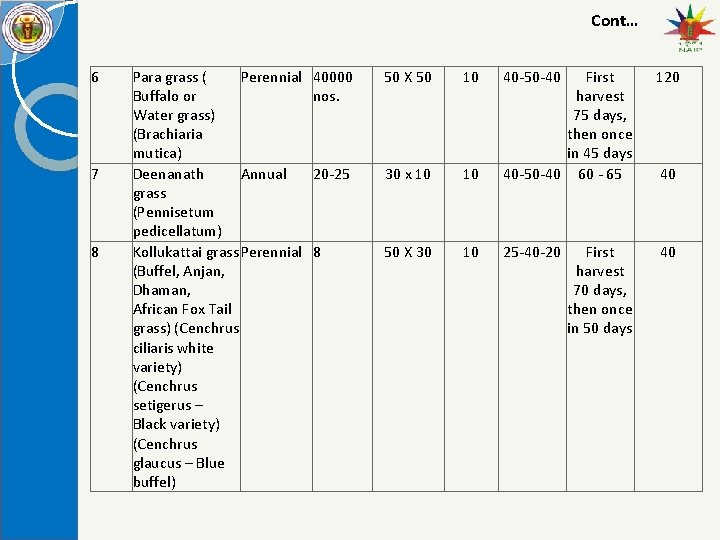
Cont… 6 7 8 Para grass ( Perennial Buffalo or Water grass) (Brachiaria mutica) Deenanath Annual grass (Pennisetum pedicellatum) Kollukattai grass Perennial (Buffel, Anjan, Dhaman, African Fox Tail grass) (Cenchrus ciliaris white variety) (Cenchrus setigerus – Black variety) (Cenchrus glaucus – Blue buffel) 40000 nos. 50 X 50 10 20 -25 30 x 10 8 50 X 30 40 -50 -40 120 10 First harvest 75 days, then once in 45 days 40 -50 -40 60 - 65 10 25 -40 -20 40 First harvest 70 days, then once in 50 days 40
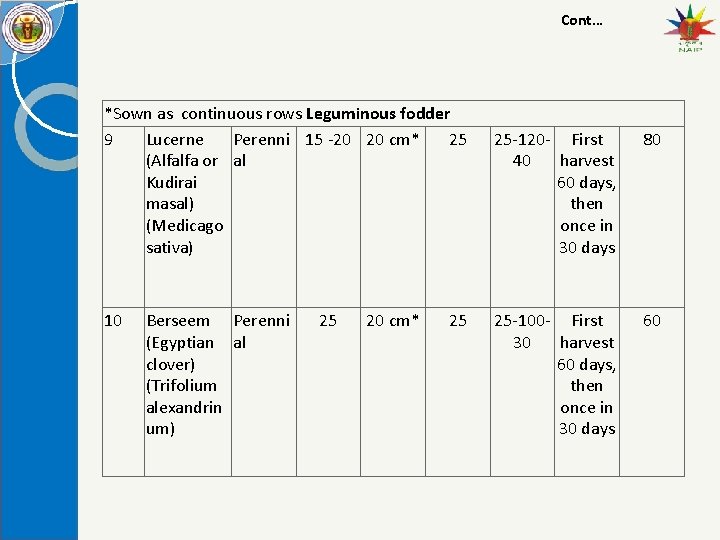
Cont… *Sown as continuous rows Leguminous fodder 9 Lucerne Perenni 15 -20 20 cm* 25 (Alfalfa or al Kudirai masal) (Medicago sativa) 10 Berseem Perenni (Egyptian al clover) (Trifolium alexandrin um) 25 20 cm* 25 25 -120 - First 40 harvest 60 days, then once in 30 days 80 25 -100 - First 30 harvest 60 days, then once in 30 days 60
Cont… 11 Hedge lucerne Perennial 12 - 15 (Velimasal) (Desmanthus virgatus 50 cm* 25 12 Cowpea Annual 20 - 25 (Karamani or Thattaipayaru) (Vigna unguiculata) Sangu Perennial 15 Pushpam (Clitoria ternaeta) Muyal masal Perennial 10 (Stylosanthus scabra) (S. hamata) Siratro Perennial 8 (Macroptilum atro purpureaum) 30 x 15 13 14 15 25 -100 -30 125 25 First harvest 70 days, then once in 45 days 25 -40 -20 60 t 0 65 45 x 10 25 20 -40 -12 75 25 30 x 15 25 20 -60 -12 75 35 30 x 15 25 20 -40 -12 75 30 30
Cont… 16 17 18 Centro Perennial (Centrosema pubescens) Calopogoniu Perennial m Dolichos lab Annual lab (Avarai) (Field bean) 19 Sun hemp (Sanappai) (Crotalaria juntia) Annual 20 Desmodium Perennial tortuosum (Aattu masal) 5 30 x 15 25 20 -40 -12 75 25 4 30 x 15 25 20 -40 -12 70 25 30 45 x 30 25 20 -40 -12 70 30 20 20 x 15 10 20 -40 -12 60 25 10 30 x 15 25 20 -40 -12 60 25 *Seeds are sown continuously so that the plant spacing within the row would be closer