
Focused vs Integrated Health Programs The Conflict between
Focused vs. Integrated Health Programs – The Conflict between the Vertical and the Horizontal Dr. Calvin Wilson University of Colorado Denver
Objectives �By the end of this session, the participants should be able to: ◦ Describe the difference between a horizontal and a vertical health program ◦ List the advantages and disadvantages of both types of programs ◦ Describe the role of Family Medicine in integrating both types of programs in a national Health System ◦ Understand the current and future trends in Health Systems
Definition and Characteristics – Vertical Health Programs �Focused on a specific demographic population, disease, or health issue �Specific, measurable outcome objectives within a defined time-frame �Dual reporting structure – to national health authority and to donor/sponsor �Usually financed by external donor for limited period of time (in developing countries) �Health activities occur parallel to and in addition to normal primary care activities �Often promoted in areas of poverty, epidemic disease, and poor health
Examples of Vertical Health Programs �Maternal Health ◦ Objective – improve women’s health and decrease maternal mortality ◦ Separated from child health to focus on specific needs of women of reproductive age ◦ Programs developed for health clinics, centers, hospitals (antenatal care, TBA training, birthing centers, etc. ) ◦ Financed by large international donors (USAID, World Bank, European Union,

Vertical Health Programs Program Supervision Maternal Health Child Health Tuberculosis HIV/ AIDS Local Health Center

Examples of Vertical Health Programs �HIV/AIDS - Africa ◦ Generously funded by PEPFAR and other programs ◦ Complex, multi-faceted problem requiring high level of technical expertise and infrastructure over long period of time ◦ Add-on facilities to health centers/hospitals �HIV treatment centers �Laboratories for diagnosis of opportunistic infections, CD 4 counts ◦ Training of new cadre of HIV workers dedicated to and funded by HIV/AIDS program
Definition and Characteristics – Horizontal Health Programs �Focused on providing integrated health care for interrelated health problems for entire population �Basic unit for preventive and primary health care of national health system �Usually single reporting responsibility to national health system �Usually financed by national health system

Horizontal Health Programs Ideal Health Center Supervision (MOH) Maternal Health Child Health Malaria Local Health Center HIV/ AIDS
Examples of Horizontal Health Programs �Integrated Management of Childhood Illness (IMCI) ◦ Developed to unify and consolidate management of several common childhood killers – diarrhea, pneumonia, malaria, malnutrition ◦ Each of these problems previously had its own vertical program with its own structure, funding, and reporting system ◦ Occurs at level of village clinic - clinician trained and provided with necessary medications
Examples of Horizontal Health Programs �Health Centers of Peru ◦ Reorganized in late 90’s to integrate all primary health care activities ◦ Organized by life cycle - separate rooms for women, adult men, children, and elderly ◦ Provide acute and chronic care, preventive care, public health monitoring and interventions, health education, deliveries ◦ Funded by Ministry of Health with collaboration of local municipality and reinvestment of local insurance funds
Vertical Programs Advantages �Targeted resources to specific high priority health issues �Defined goals and objectives, with measureable outcomes – high accountability �Often very successful in limited timeframe (smallpox eradiction, malaria, immunization programs- esp. polio, onchocerchiasis, child health, HIV/AIDS) �Develop a sound evidence base for interventions �Good return on investment for donors
Vertical Programs Disadvantages � Weaken local health infrastructure, especially primary care ◦ Competition for health care staff – focused programs pay more (up to 300%) and greater prestige ◦ Complex, multiple reporting structures and requirements ◦ Vertical program infrastructure not available for local, broader use (ie, HIV/AIDS treatment centers) � Fragmented health care, limited communication between programs and local health centers � Competition for limited funding among various vertical programs – pressure to continue program regardless of outcomes and benefits � Lack of sustainability and up-scaling – benefits and outcomes limited to target area and funding cycle.
Horizontal Programs Advantages �Sustainable - staff and facilities already in place in most countries �Greater possibility of patient and familycentered care over spectrum of life-cycle and health problems �Integrated management of multiple determinants of health – nutrition, control of infection, preventive activities, health education, public health measures �Centralized medical records and information �Efficient use of scarce funding and resources
Horizontal Programs Disadvantages �Primary health care system weak in many countries ◦ Poorly funded ◦ Health workers poorly trained for scope of work ◦ Inconstant supply of medications and supplies �May develop deficiencies in some health interventions �Difficult to document health outcomes – poor accountability �Health care workers overwhelmed with multitude of interventions
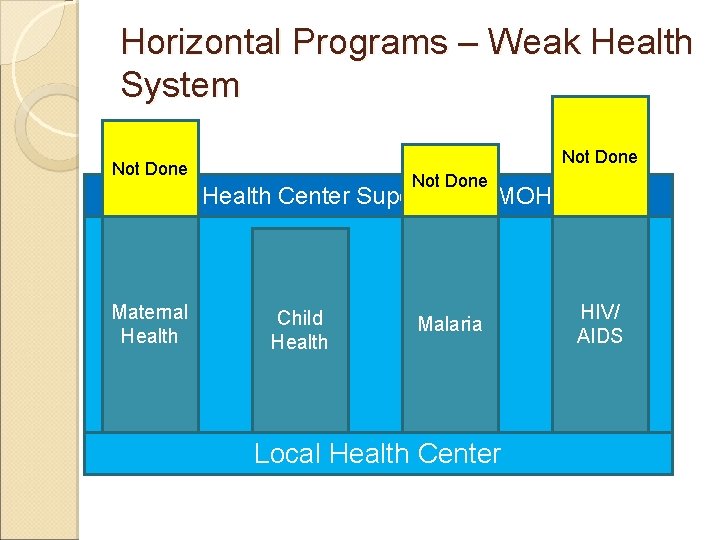
Horizontal Programs – Weak Health System Not Done Health Center Supervision (MOH) Maternal Health Child Health Malaria Local Health Center HIV/ AIDS
Role of Family Medicine �Philosophy of Family Medicine is to integrate activities and interventions as much as possible ◦ “Continuous, Comprehensive Care” ◦ “Patient-Centered Medical Home �Vertical programs often reflect attitudes of specialists ◦ “High quality care must be focused with defined and measurable outcomes”
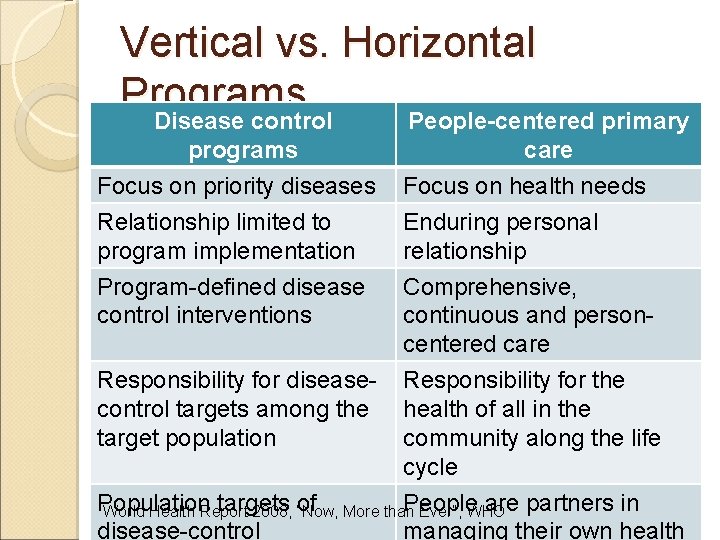
Vertical vs. Horizontal Programs Disease control People-centered primary programs Focus on priority diseases Relationship limited to program implementation Program-defined disease control interventions care Focus on health needs Enduring personal relationship Comprehensive, continuous and personcentered care Responsibility for disease- Responsibility for the control targets among the health of all in the target population community along the life cycle Population targets of More than. People are partners in World Health Report 2008, “Now, Ever”, WHO disease-control managing their own health
Role of Family Medicine The Challenge – Retain the sustainable, patientcentered, integrated nature of a Horizontal structure, but preserve the accountable results and intensive interventions of Vertical programs.
Current Trends in Health Systems �Much of impetus to integrate vertical programs into horizontal structure of local health center coming from national health leaders �Some organizations (WHO) beginning to advocate for a more inclusive, integrated approach ◦ Building capacity of local health systems ◦ Sustainability
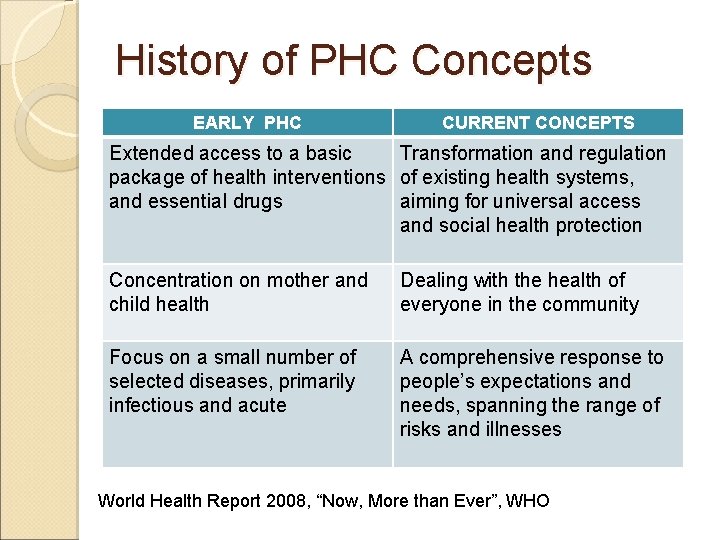
History of PHC Concepts EARLY PHC CURRENT CONCEPTS Extended access to a basic Transformation and regulation package of health interventions of existing health systems, and essential drugs aiming for universal access and social health protection Concentration on mother and child health Dealing with the health of everyone in the community Focus on a small number of selected diseases, primarily infectious and acute A comprehensive response to people’s expectations and needs, spanning the range of risks and illnesses World Health Report 2008, “Now, More than Ever”, WHO
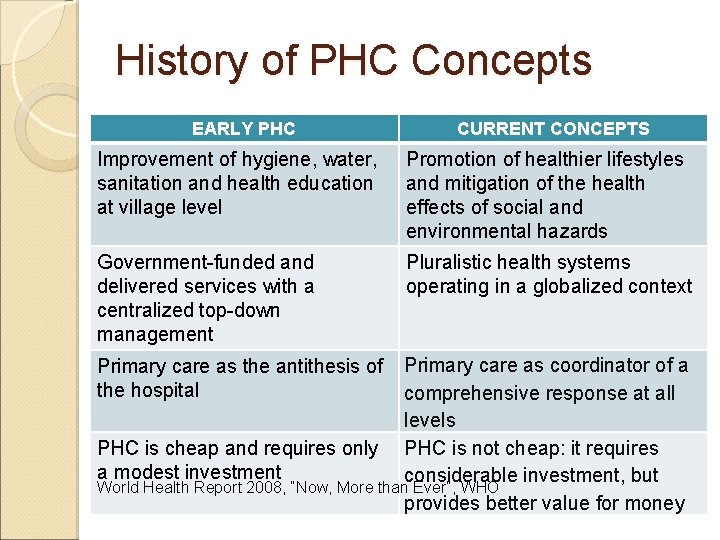
History of PHC Concepts EARLY PHC CURRENT CONCEPTS Improvement of hygiene, water, sanitation and health education at village level Promotion of healthier lifestyles and mitigation of the health effects of social and environmental hazards Government-funded and delivered services with a centralized top-down management Pluralistic health systems operating in a globalized context Primary care as coordinator of a comprehensive response at all levels PHC is cheap and requires only PHC is not cheap: it requires a modest investment considerable investment, but World Health Report 2008, “Now, More than Ever”, WHO provides better value for money Primary care as the antithesis of the hospital
Current Trends �Several possible approaches to program integration: ◦ Focus on local integration of various health interventions, while leaving strategic planning, monitoring, and evaluation more centralized (vertical) ◦ Expand numbers and develop skills and capacity of local healthcare workers
Current Trends “Approaching health workforce strengthening jointly, combining the requirements of programmes that use similar cadres of health worker for the delivery of their interventions, optimizes the chances that programme limitations will be overcome while simultaneously strengthening general health services. ” (Gijs Elzinga, “Vertical-Horizontal Synergy of the Health Workforce”, Bulletin of WHO, April 2005; 83(4))
- Slides: 23