
Focused NoteTaking Five Steps to Success Purpose to
- Slides: 19
Focused Note-Taking Five Steps to Success Purpose – to demonstrate your understanding of the 5 Phases of the Focused Note-Taking process Slide 1
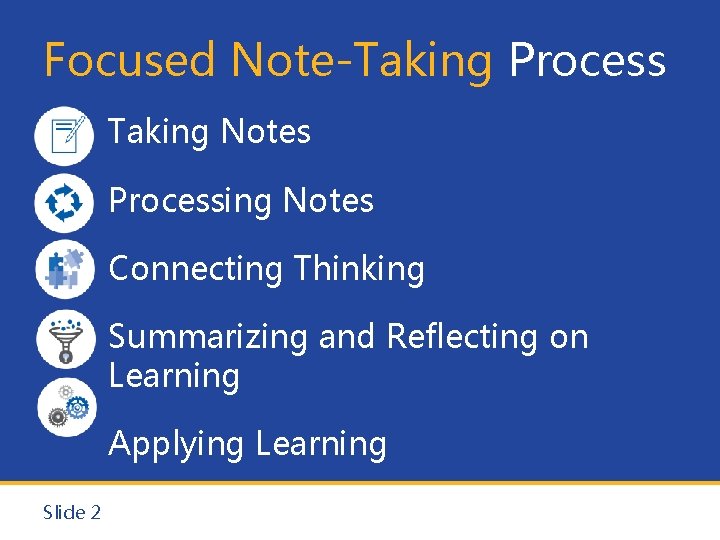
Focused Note-Taking Process Taking Notes Processing Notes Connecting Thinking Summarizing and Reflecting on Learning Applying Learning Slide 2
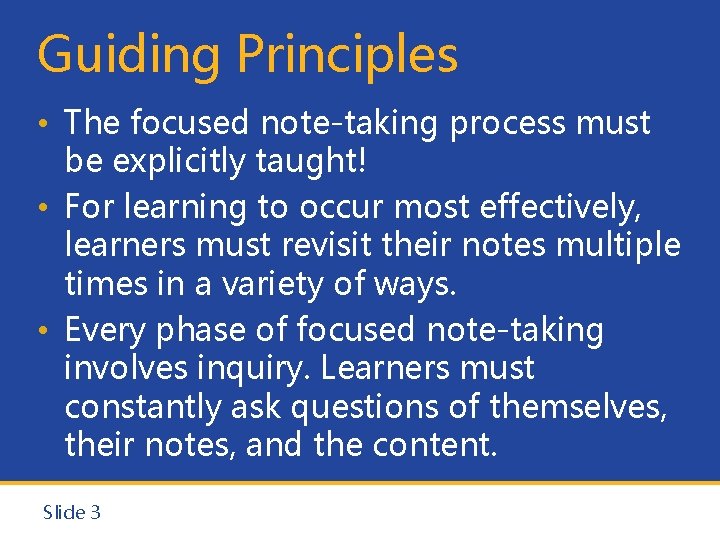
Guiding Principles • The focused note-taking process must be explicitly taught! • For learning to occur most effectively, learners must revisit their notes multiple times in a variety of ways. • Every phase of focused note-taking involves inquiry. Learners must constantly ask questions of themselves, their notes, and the content. Slide 3
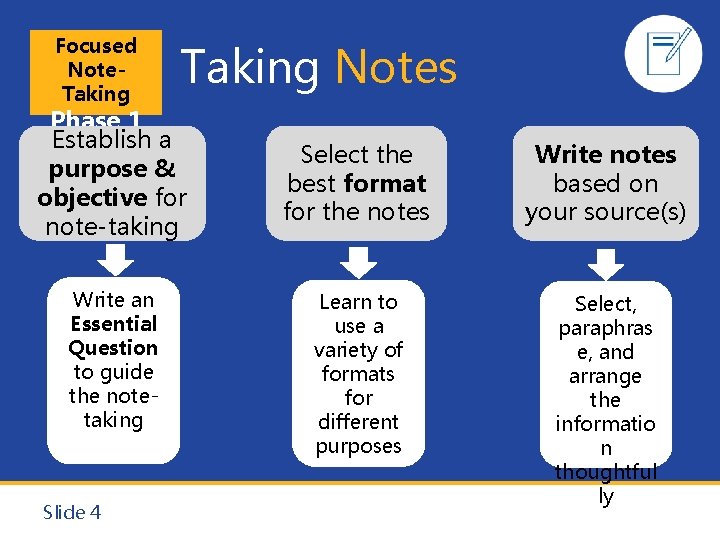
Focused Note. Taking Notes Phase 1 Establish a purpose & objective for note-taking Write an Essential Question to guide the notetaking Slide 4 Select the best format for the notes Write notes based on your source(s) Learn to use a variety of formats for different purposes Select, paraphras e, and arrange the informatio n thoughtful ly
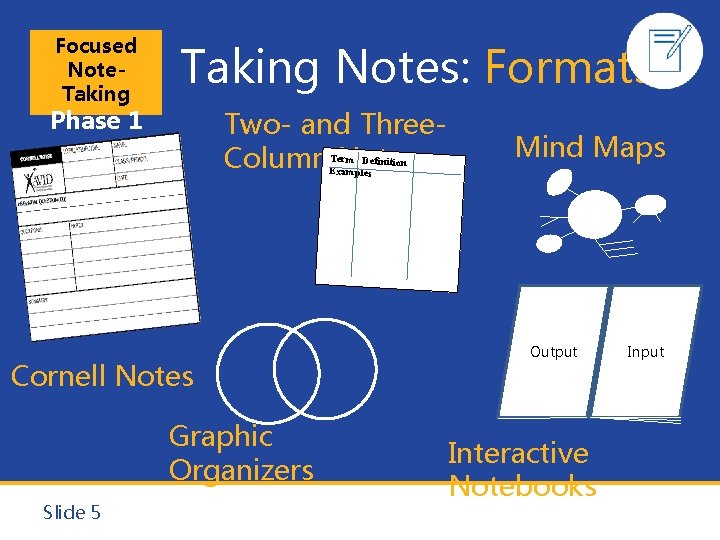
Focused Note. Taking Notes: Formats Phase 1 Two- and Three. Column Notes Term Definition Examples Cornell Notes Graphic Organizers Slide 5 Mind Maps Output Interactive Notebooks Input
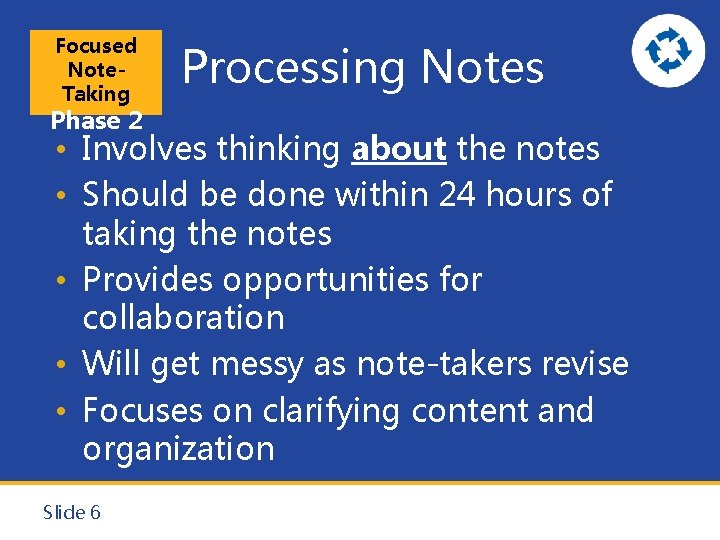
Focused Note. Taking Phase 2 Processing Notes • Involves thinking about the notes • Should be done within 24 hours of taking the notes • Provides opportunities for collaboration • Will get messy as note-takers revise • Focuses on clarifying content and organization Slide 6
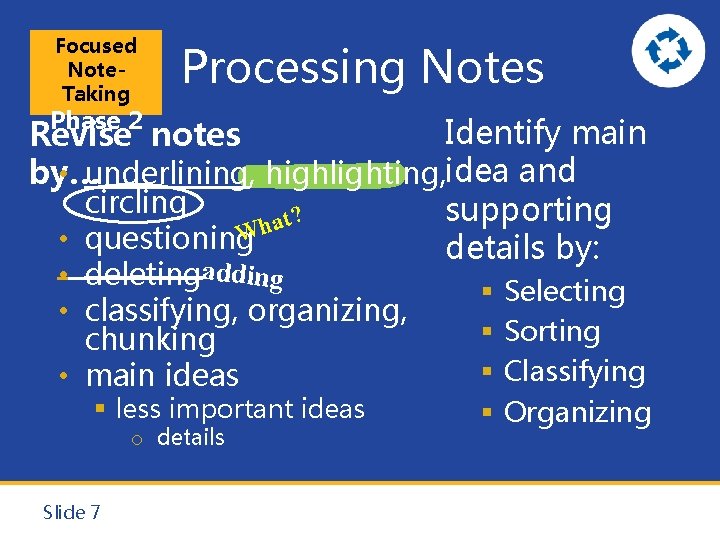
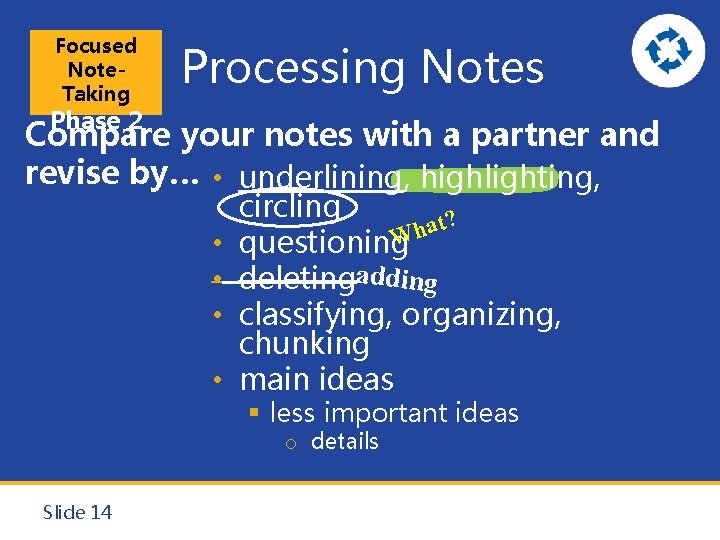
Focused Note. Taking Processing Notes Phase 2 Identify main Revise notes by… • underlining, highlighting, idea and circling supporting t? a h W • questioning details by: • deletingadding § Selecting • classifying, organizing, chunking • main ideas § less important ideas o details Slide 7 § Sorting § Classifying § Organizing
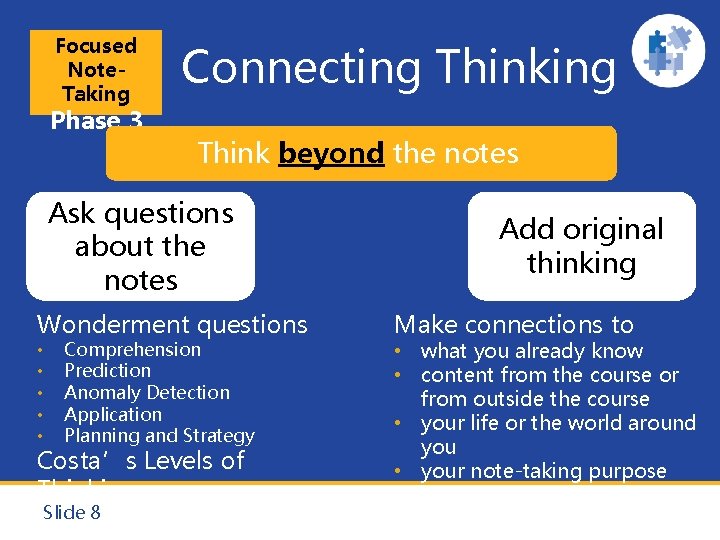
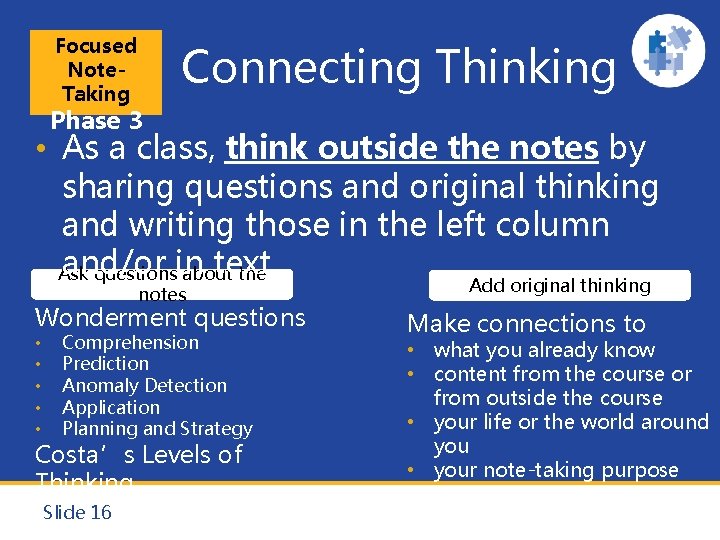
Focused Note. Taking Phase 3 Connecting Think beyond the notes: Ask questions about the notes Wonderment questions • • • Comprehension Prediction Anomaly Detection Application Planning and Strategy Costa’s Levels of Thinking Slide 8 Add original thinking Make connections to • what you already know • content from the course or from outside the course • your life or the world around you • your note-taking purpose
Focused Note. Taking Phase 3 Connecting Thinking Return to the notes with an eye for inquiry: • Learning makes sense when it is connected to what we already know, what we’ve experienced, or how we can use it. • Learners should ask questions they really want to find the answers to and truly want to discuss. Slide 9
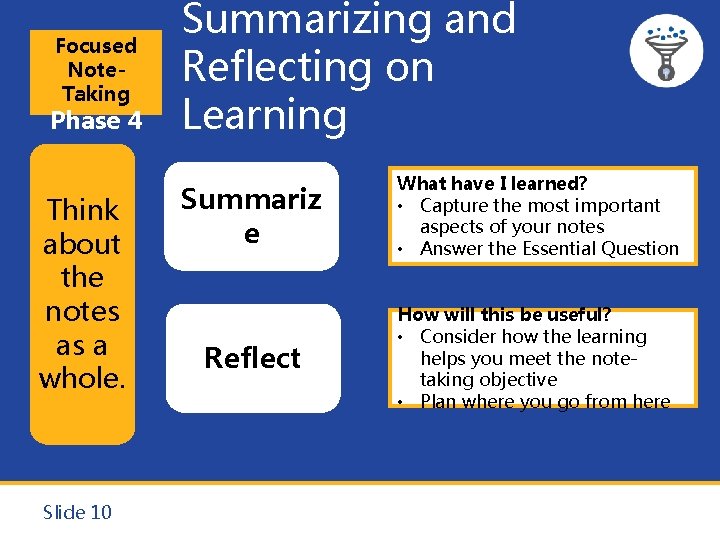
Focused Note. Taking Phase 4 Think about the notes as a whole. Slide 10 Summarizing and Reflecting on Learning Summariz e What have I learned? • Capture the most important aspects of your notes • Answer the Essential Question Reflect How will this be useful? • Consider how the learning helps you meet the notetaking objective • Plan where you go from here
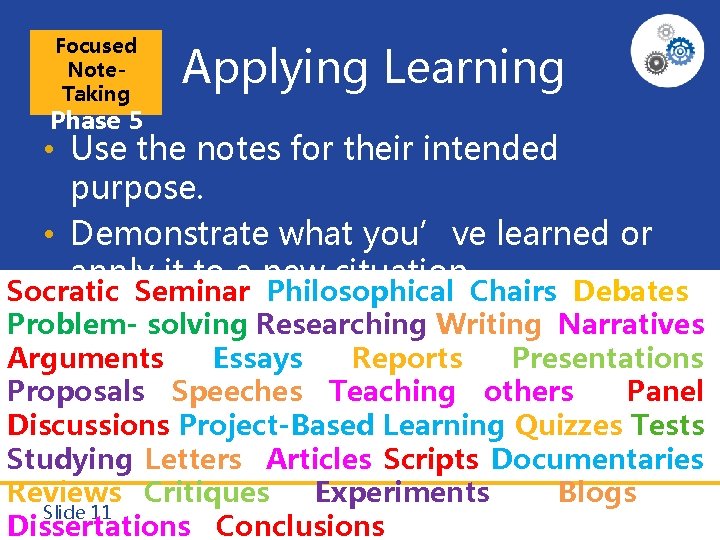
Focused Note. Taking Applying Learning Phase 5 • Use the notes for their intended purpose. • Demonstrate what you’ve learned or apply it to a new situation. Socratic Seminar Philosophical Chairs Debates Problem- solving Researching Writing Narratives Arguments Essays Reports Presentations Proposals Speeches Teaching others Panel Discussions Project-Based Learning Quizzes Tests Studying Letters Articles Scripts Documentaries Reviews Critiques Experiments Blogs Slide 11 Dissertations Conclusions
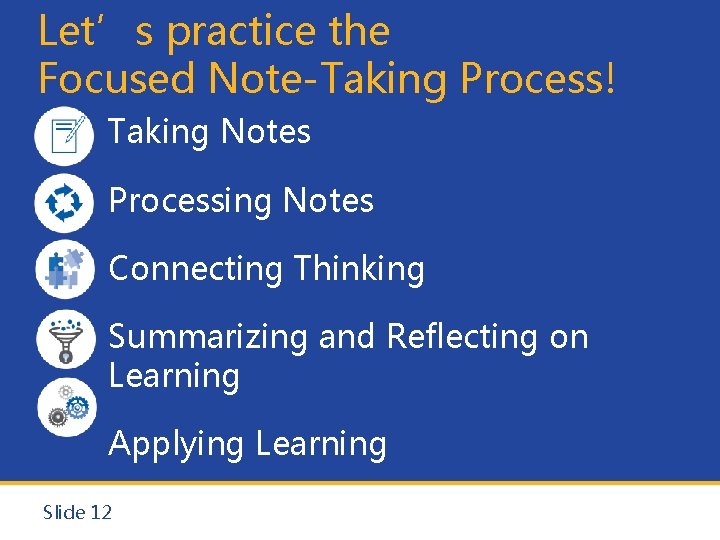
Let’s practice the Focused Note-Taking Process! Taking Notes Processing Notes Connecting Thinking Summarizing and Reflecting on Learning Applying Learning Slide 12
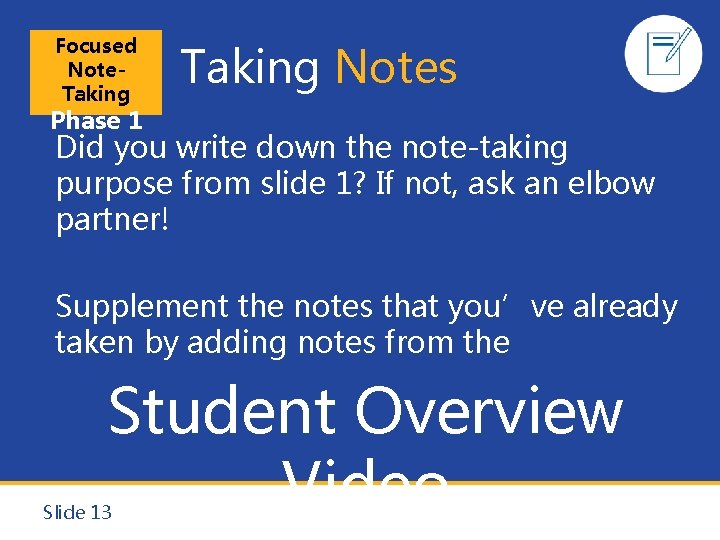
Focused Note. Taking Notes Phase 1 Did you write down the note-taking purpose from slide 1? If not, ask an elbow partner! Supplement the notes that you’ve already taken by adding notes from the Student Overview Video Slide 13
Focused Note. Taking Processing Notes Phase 2 Compare your notes with a partner and revise by… • underlining, highlighting, • • circling t? a h W questioning deletingadding classifying, organizing, chunking main ideas § less important ideas o details Slide 14
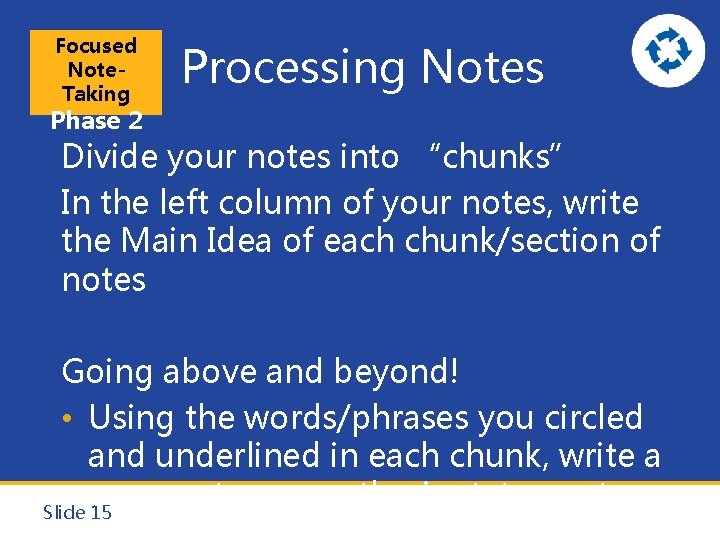
Focused Note. Taking Processing Notes Phase 2 Divide your notes into “chunks” In the left column of your notes, write the Main Idea of each chunk/section of notes Going above and beyond! • Using the words/phrases you circled and underlined in each chunk, write a one-sentence synthesis statement Slide 15
Focused Note. Taking Connecting Thinking Phase 3 • As a class, think outside the notes by sharing questions and original thinking and writing those in the left column and/or text. Ask questionsin about the notes Wonderment questions • • • Comprehension Prediction Anomaly Detection Application Planning and Strategy Costa’s Levels of Thinking Slide 16 Add original thinking Make connections to • what you already know • content from the course or from outside the course • your life or the world around you • your note-taking purpose
Focused Note. Taking Phase 4 Summarizing and Reflecting on Learning • Individually write a Summary Reflection at the bottom of your notes. Summariz e What have I learned? • Capture the most important aspects of your notes • Answer the Essential Question Reflect How will this be useful? • Consider how the learning helps you meet the notetaking objective • Plan where you go from here Slide 17
Focused Note. Taking Applying Learning Phase 5 Use the notes for their intended purpose. § Our Purpose – to demonstrate your understanding of the 5 Phases of the Focused Note-Taking process We will do this through SYNECTICS! § Synectics is the process of making unexpected connections; a form of analogous thinking often used in problem solving; a form of analogy. Slide 18
Focused Note. Taking Applying Learning Phase 5 Explain how the Focused Note-Taking Process is like another process. Creatively demonstrate and present the connection (skit, poster, digital presentation, etc. ) For example: • create a poster showing how the Focused Note. Taking process is like the process of building a house • perform a demonstration of how the Focused Note. Taking process is like learning to properly shoot a jump-shot Slide 19