
Focused Antenatal care FANC 1 What is FANC

- Slides: 64
Focused Antenatal care (FANC) 1 What is FANC? Is health care given to a pregnant woman from conception to the onset of labour. It is personalised care provided to a pregnant woman which emphasises on the woman’s overall health, her preparation for childbirth and readiness for complications (emergency preparedness). It is timely, friendly, simple and safe service to a pregnant woman. ©MOH-DRH/DOMC/NLTP/JHPIEGO
2 AIM OF FANC To achieve a good outcome for the mother and baby and prevent any complications that may occur in pregnancy, labour, delivery and the post partum period. ©MOH-DRH/DOMC/NLTP/JHPIEGO
The approach: 3 The risk approach to ANC has not resulted in significant improvement in maternal survival. Life threatening Complications of pregnancy are difficult to predict with any degree of certainty. Health care providers must, therefore, consider the possibility of complications in every pregnancy and prepare clients accordingly. While risk assessment can help direct counseling and treatment for individuals, it is important to understand that most women who experience complications have no ‘risk factors’ at all. ©MOH-DRH/DOMC/NLTP/JHPIEGO
4 Every pregnant, delivering or postpartum woman is at risk of serious life threatening complications! ©MOH-DRH/DOMC/NLTP/JHPIEGO
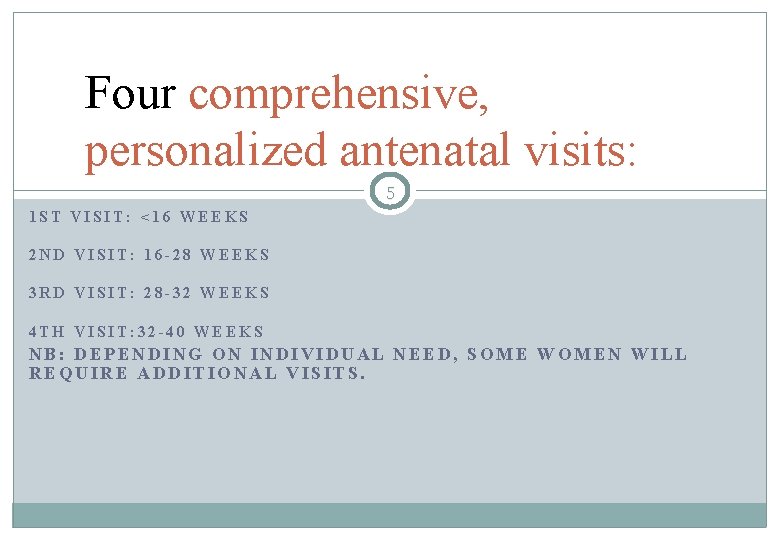
Four comprehensive, personalized antenatal visits: 5 1 ST VISIT: <16 WEEKS 2 ND VISIT: 16 -28 WEEKS 3 RD VISIT: 28 -32 WEEKS 4 TH VISIT: 32 -40 WEEKS NB: DEPENDING ON INDIVIDUAL NEED, SOME WOMEN WILL REQUIRE ADDITIONAL VISITS.
Objectives of Focused Antenatal Care 6 Early detection and treatment of problems Prevention of complications using safe, simple and cost -effective interventions Birth preparedness and complication readiness Health promotion using health messages and counseling Provision of care by a skilled attendant ©MOH-DRH/DOMC/NLTP/JHPIEGO
Objective one: Early detection and treatment of Problems 7 Service providers should identify existing medical, surgical or obstetric conditions during pregnancy. Such as: – Severe anaemia (Hb <7 gm/dl) – Vaginal bleeding – Pre-eclampsia (increased BP, severe oedema) – STI’s, HIV/AIDS, TB and Malaria – Chronic diseases (diabetes, heart or kidney problems) – Decreased/absent foetal movement; – foetal malpresentation after 36 weeks ©MOH-DRH/DOMC/NLTP/JHPIEGO
Why disease detection and not risk assessment? 8 Risk approach is not an efficient or effective strategy for maternal mortality reduction. Every pregnancy is at risk! – Risk factors cannot predict complications: (e. g. young age does not predict eclampsia). – Research showed that the majority of women who experienced complications were considered low risk (90% of women considered to be high risk, gave birth without experiencing a complication). ©MOH-DRH/DOMC/NLTP/JHPIEGO
9 Why disease detection and not risk assessment cont…. . Risk factors do not predict problems. Most high risk women deliver without problems and most women who develop lifethreatening complications belong to the low risk group. Every pregnant woman should be prepared for the possibility of complications. ©MOH-DRH/DOMC/NLTP/JHPIEGO
Objective two: Prevention of complications 10 The service provider should ensure prevention/protection of complications by providing: Tetanus toxoid to prevent maternal and neonatal tetanus Iron/folate supplementation to prevent anaemia Use of IPT and ITNS to prevent malaria/ anaemia Ensure environmental hygiene to prevent intestinal worms v Presumptive treatment of hookworm infection with Mebendazole 500 mg STAT anytime after the first trimester* *Basic Maternal and Newborn Care: A Guide to Skilled Providers, Page 3 -58 ©MOH-DRH/DOMC/NLTP/JHPIEGO
Objective three: Birth preparedness and complications readiness 11 Service providers should discuss components of birth plan which include: Is the EDD known? Has a facility been identified? Has a SBA/professional been identified? Has a means of Transport been identified? Are emergency Funds identified? Who is the custodian of the emergency funds? Has a Birth companion been identified? Are Items for clean safe©MOH-DRH/DOMC/NLTP/JHPIEGO birth and for the newborn been identified?
Objective three cont…Complication Readiness 12 Knowledge of danger signs; what to do if they arise Has a decision maker been identified? Has a Blood donor been identified? ©MOH-DRH/DOMC/NLTP/JHPIEGO
Individual birth plan ensures that the client: 13 Knows when her baby is due Identifies a skilled birth attendant Identifies a health facility for delivery/emergency Can list danger signs in pregnancy and delivery and knows what to do if they occur Identifies a decision-maker in case of emergency Knows how to get money in case of emergency Has a transport plan in case of emergency Has a birth partner/companion for the birth Has collected the basic supplies for the birth ©MOH-DRH/DOMC/NLTP/JHPIEGO
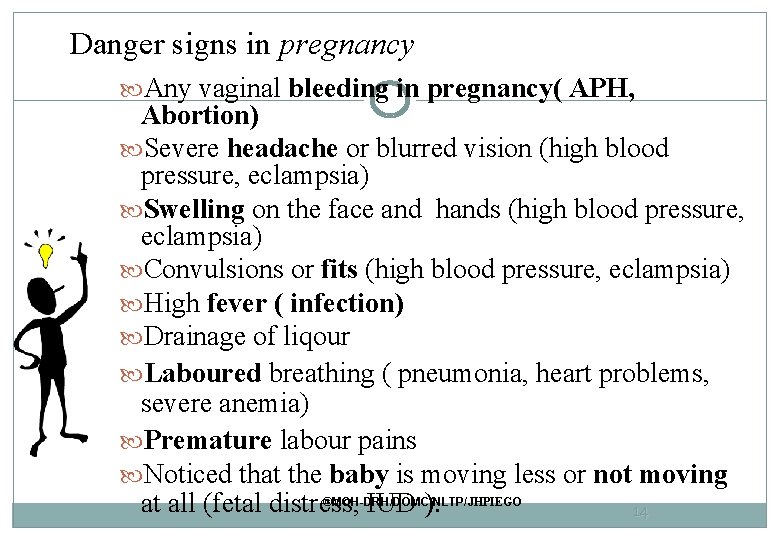
Danger signs in pregnancy Any vaginal bleeding in pregnancy( APH, Abortion) Severe headache or blurred vision (high blood pressure, eclampsia) Swelling on the face and hands (high blood pressure, eclampsia) Convulsions or fits (high blood pressure, eclampsia) High fever ( infection) Drainage of liqour Laboured breathing ( pneumonia, heart problems, severe anemia) Premature labour pains Noticed that the baby is moving less or not moving ©MOH-DRH/DOMC/NLTP/JHPIEGO at all (fetal distress, IUD ). 14
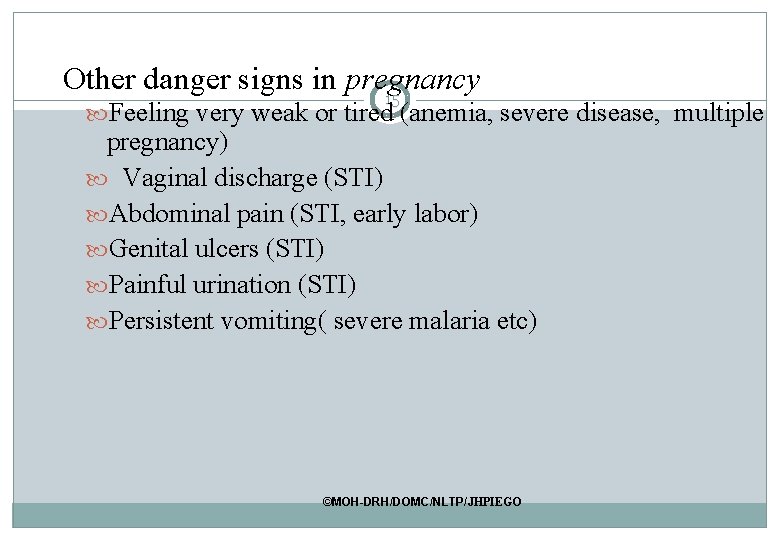
Other danger signs in pregnancy 15 Feeling very weak or tired (anemia, severe disease, multiple pregnancy) Vaginal discharge (STI) Abdominal pain (STI, early labor) Genital ulcers (STI) Painful urination (STI) Persistent vomiting( severe malaria etc) ©MOH-DRH/DOMC/NLTP/JHPIEGO
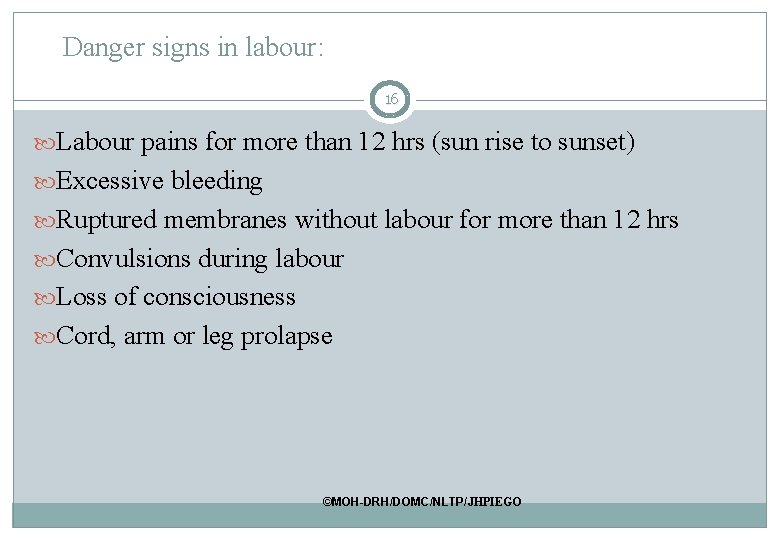
Danger signs in labour: 16 Labour pains for more than 12 hrs (sun rise to sunset) Excessive bleeding Ruptured membranes without labour for more than 12 hrs Convulsions during labour Loss of consciousness Cord, arm or leg prolapse ©MOH-DRH/DOMC/NLTP/JHPIEGO
Danger signs in postpartum period (Mother): Excessive bleeding 17 Fever Foul smelling discharge Abdominal cramps or pains Painful breasts or cracked nipples Mental disturbances Extreme fatigue Facial or hand swelling Headaches Convulsions Painful calf muscles ©MOH-DRH/DOMC/NLTP/JHPIEGO
Danger signs in postpartum period Fast breathing(more than 6018 breaths/minute) Slow breathing less than 30 breaths/minute Severe chest in-drawing Grunting Umbilicus draining pus/redness extending to skin Floppy or stiff Fever (temp 38 degrees celsius and above Convulsions More than 10 skin pustules Bleeding from stump/cut ©MOH-DRH/DOMC/NLTP/JHPIEGO
19 Give advice on whom to call or where to go in case of the above complications/emergencies. ©MOH-DRH/DOMC/NLTP/JHPIEGO
Objective four: Health promotion using health messages and 20 counseling Encourage dialogue on the following: Drug compliance Family planning/ Nutrition Rest and hygiene Safer sex Care for common discomforts Use of IPT and ITNs/LLINs health timing and spacing of pregnancy Early and exclusive Breastfeeding Newborn care ©MOH-DRH/DOMC/NLTP/JHPIEGO
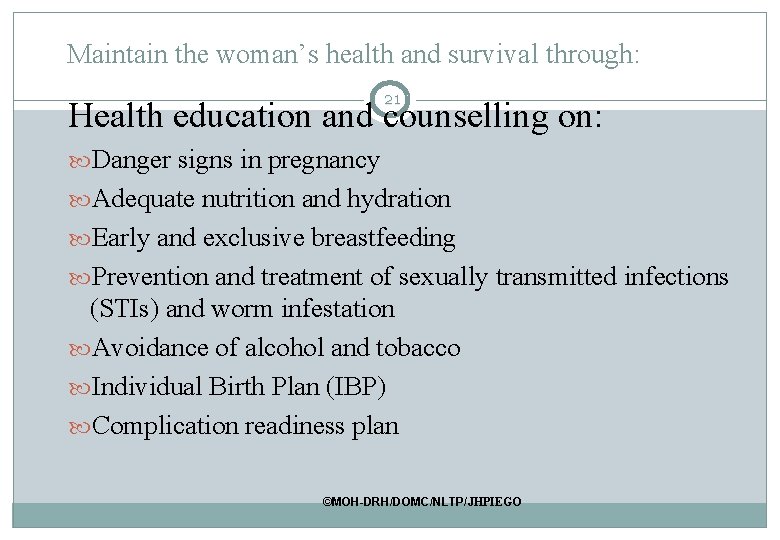
Maintain the woman’s health and survival through: 21 Health education and counselling on: Danger signs in pregnancy Adequate nutrition and hydration Early and exclusive breastfeeding Prevention and treatment of sexually transmitted infections (STIs) and worm infestation Avoidance of alcohol and tobacco Individual Birth Plan (IBP) Complication readiness plan ©MOH-DRH/DOMC/NLTP/JHPIEGO
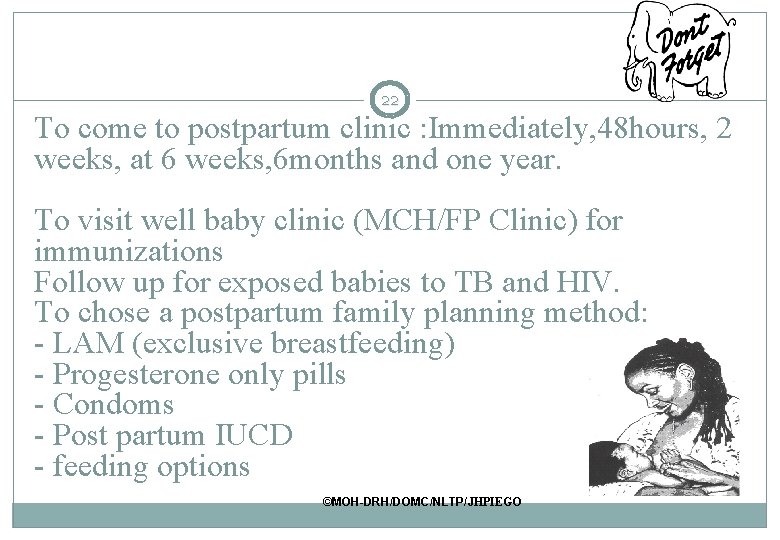
22 To come to postpartum clinic : Immediately, 48 hours, 2 weeks, at 6 weeks, 6 months and one year. To visit well baby clinic (MCH/FP Clinic) for immunizations Follow up for exposed babies to TB and HIV. To chose a postpartum family planning method: - LAM (exclusive breastfeeding) - Progesterone only pills - Condoms - Post partum IUCD - feeding options ©MOH-DRH/DOMC/NLTP/JHPIEGO
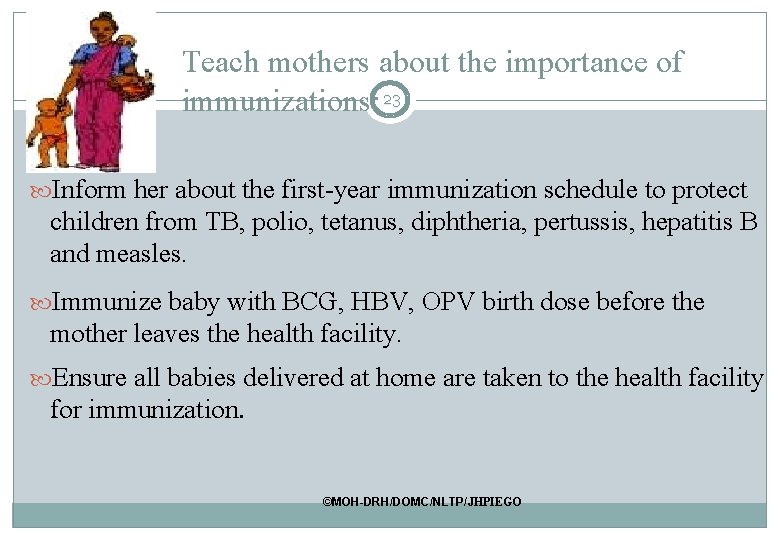
Teach mothers about the importance of immunizations: 23 Inform her about the first-year immunization schedule to protect children from TB, polio, tetanus, diphtheria, pertussis, hepatitis B and measles. Immunize baby with BCG, HBV, OPV birth dose before the mother leaves the health facility. Ensure all babies delivered at home are taken to the health facility for immunization. ©MOH-DRH/DOMC/NLTP/JHPIEGO
National guidelines for IPT is an effective approach to preventing malaria in 24 pregnant women by giving anti malarial drugs in treatment doses at defined intervals after quickening to clear a presumed burden of parasites The MOH Guidelines on Malaria directs us to give SP to pregnant women in endemic malaria areas, at least twice during each pregnancy, even if she has no physical signs and her hemoglobin is within normal range. Administer IPT with each scheduled visit after quickening (16 wks) to ensure women receive at least 2 doses at an interval of at least 4 weeks. IPT should be given under Directly Observed Therapy (DOT) in the ANC and ©MOH-DRH/DOMC/NLTP/JHPIEGO can be given on an empty stomach.
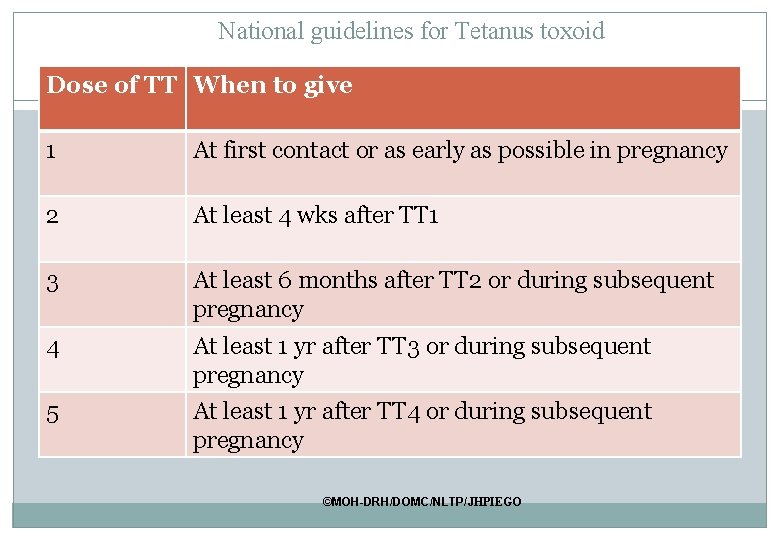
National guidelines for Tetanus toxoid Dose of TT When to give 25 1 At first contact or as early as possible in pregnancy 2 At least 4 wks after TT 1 3 At least 6 months after TT 2 or during subsequent pregnancy 4 At least 1 yr after TT 3 or during subsequent pregnancy 5 At least 1 yr after TT 4 or during subsequent pregnancy ©MOH-DRH/DOMC/NLTP/JHPIEGO
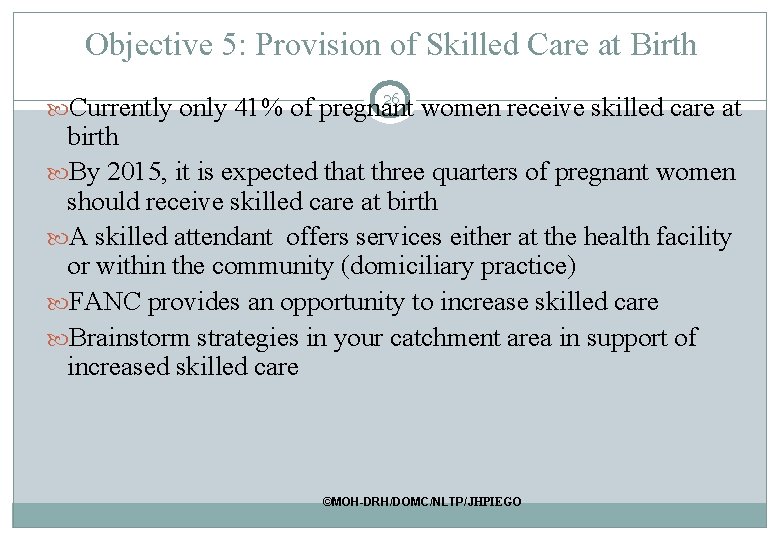
Objective 5: Provision of Skilled Care at Birth 26 Currently only 41% of pregnant women receive skilled care at birth By 2015, it is expected that three quarters of pregnant women should receive skilled care at birth A skilled attendant offers services either at the health facility or within the community (domiciliary practice) FANC provides an opportunity to increase skilled care Brainstorm strategies in your catchment area in support of increased skilled care ©MOH-DRH/DOMC/NLTP/JHPIEGO
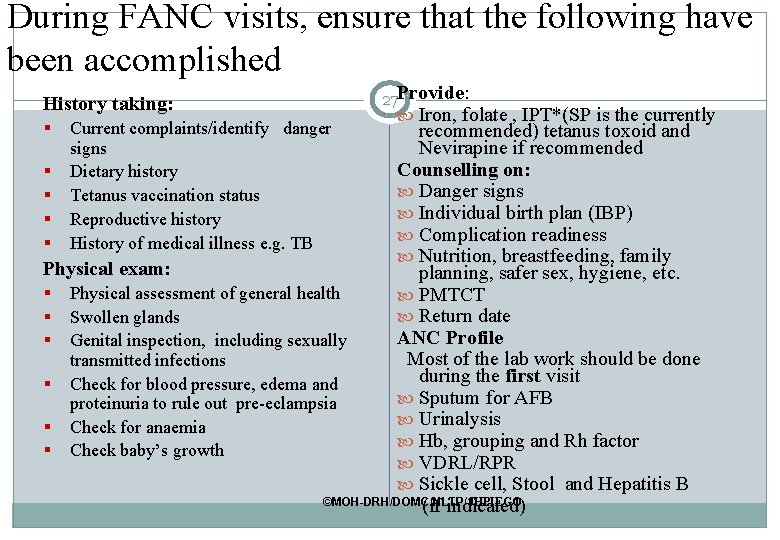
During FANC visits, ensure that the following have been accomplished History taking: § Current complaints/identify danger signs Dietary history Tetanus vaccination status Reproductive history History of medical illness e. g. TB 27 Provide: Iron, folate , IPT*(SP is the currently recommended) tetanus toxoid and Nevirapine if recommended Counselling on: § Danger signs § Individual birth plan (IBP) § Complication readiness § Nutrition, breastfeeding, family Physical exam: planning, safer sex, hygiene, etc. § Physical assessment of general health PMTCT Return date § Swollen glands ANC Profile § Genital inspection, including sexually Most of the lab work should be done transmitted infections during the first visit § Check for blood pressure, edema and Sputum for AFB proteinuria to rule out pre-eclampsia Urinalysis § Check for anaemia Hb, grouping and Rh factor § Check baby’s growth VDRL/RPR Sickle cell, Stool and Hepatitis B ©MOH-DRH/DOMC/NLTP/JHPIEGO (if indicated)
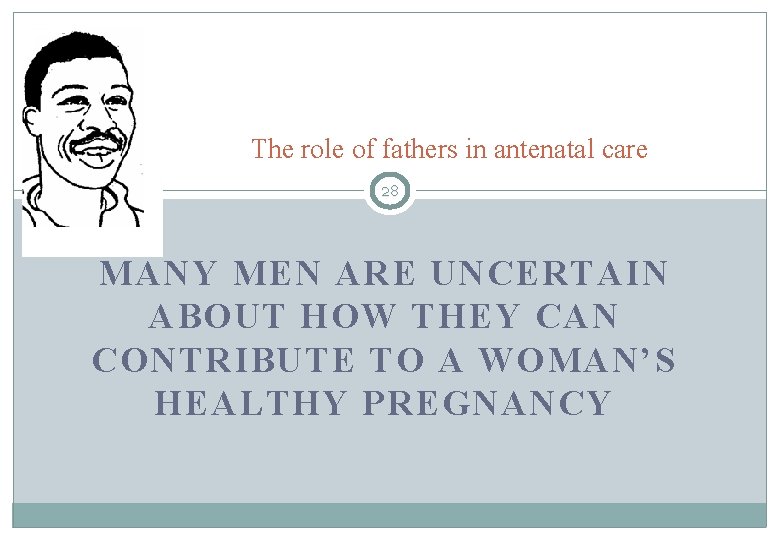
The role of fathers in antenatal care 28 MANY MEN ARE UNCERTAIN ABOUT HOW THEY CAN CONTRIBUTE TO A WOMAN’S HEALTHY PREGNANCY
Service providers should educate fathers about antenatal care 29 Fathers should make sure that the woman: – – – has enough nutritious food to eat and that she has taken iron and folate tablets. is sleeping under a treated net and is able to get plenty of rest. has had 2 doses of SP and tetanus toxoid. Make sure that the couple has an individual birth plan. Make sure that the couple know the danger signs in pregnancy and labour. ©MOH-DRH/DOMC/NLTP/JHPIEGO
Adolescents and pregnancy 30 30 In Kenya, 17 -18% of all births are to women under the age of 20 years* Pregnant youth are entitled to the same quality of care that older women are Research has shown that adolescents tend to delay seeking care due to social and cultural practices and as such more attention should be directed to them Services should be provided in an acceptable, nonjudgmental manner, convenient and offer confidentiality to the adolescents. Note: This will encourage the young women to return for continued antenatal services. ©MOH-DRH/DOMC/NLTP/JHPIEGO *KDHS 1998/2003
31 adolescents /youth on. . Reinforce counseling to the Peer influence Early ANC attendance Safer sex (ABCD) Drug abuse STI, HIV/AIDS/TB Family Planning Dangers of abortion ©MOH-DRH/DOMC/NLTP/JHPIEGO
Before the woman leaves your clinic, STOP and ask her if she: Has a supply of iron and folate tablets. Has taken her SP and has had her tetanus toxoid injection. Knows the danger signs in pregnancy and child birth. Knows her appointment for the next ANC visit and SP dose. Has an individual birth plan. Has been screened for TB Knows the importance of using postpartum family planning. 32 ©MOH-DRH/DOMC/NLTP/JHPIEGO
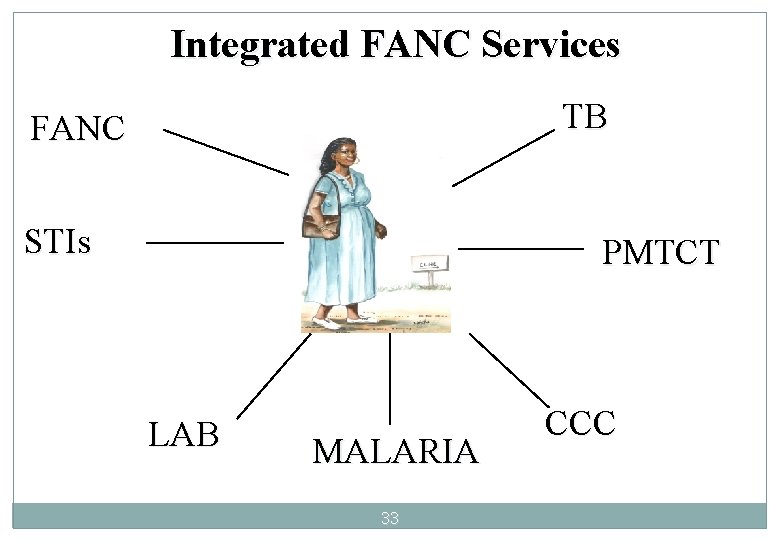
Integrated FANC Services TB FANC STIs PMTCT LAB MALARIA 33 CCC
What is Tuberculosis (TB)? 34 Tuberculosis is a chronic infectious disease caused by an organism called mycobacterium tuberculosis, an acid fast rod shaped bacilli. – Over 90% of new TB cases and deaths occur in developing countries TB is one of the leading infections causing of deaths among women of reproductive age TB has increased by 10 fold over the last 15 years in Kenya ©MOH-DRH/DOMC/NLTP/JHPIEGO
Factors leading to the increase in TB HIV epidemic 35 Poverty Overcrowding Poor nutrition Limited access to health services Chronic diseases e. g. Diabetes, carcinoma etc Immune suppressing therapy ©MOH-DRH/DOMC/NLTP/JHPIEGO
Risk of TB infection 36 The risk of one being infected with the TB bacillus depends on: Exposure to bacilli Intensity of exposure Duration of exposure Presence of undetected smear positive TB Presence of poorly treated previous TB ©MOH-DRH/DOMC/NLTP/JHPIEGO
Types of Tuberculosis Pulmonary Tuberculosis (PTB) 37 is the most common and infectious type of TB. – It affects the lungs and causes 81% of all TB cases in Kenya • Extra Pulmonary Tuberculosis (outside of the lungs) any organ of the body – – such as the kidney, bladder, ovaries, testes, eyes, bones or joints, intestines, skin or glands, and the meninges i. e. TB meningitis The most common extra pulmonary TB is TB of the glands also called TB lymphadenitis The most severe extra pulmonary TB is pleural effusion and meningitis. ©MOH-DRH/DOMC/NLTP/JHPIEGO
Signs and Symptoms of Pulmonary Tuberculosis (PTB) 38 Persistent cough lasting for two or more weeks with or without blood stained sputum Loss of body weight Intermittent fever Excessive night sweats Shortness of breath Loss of appetite Chest pain Excessive tiredness and generally feeling unwell ©MOH-DRH/DOMC/NLTP/JHPIEGO
Signs and symptoms of TB of the glands (TB lymphadenitis*) 39 Slow and painless enlargement of the lymph nodes which then become matted and eventually discharge pus The most common lymph nodes: cervical (neck) lymph nodes Generalised lymph node enlargement is becoming common in HIV related TB *Confirmed during head-to-toe examination ©MOH-DRH/DOMC/NLTP/JHPIEGO
When does TB pass from the 40 mother to the baby? Pregnant women who are infected with TB can pass TB to the baby: § During pregnancy through the placenta barrier causing fetal death or infection (congenital TB is rare) § At birth when the baby inhales or ingests infected amniotic fluid or secretions § After delivery when the baby inhales droplet secretions if the mother is coughing-commonest ©MOH-DRH/DOMC/NLTP/JHPIEGO
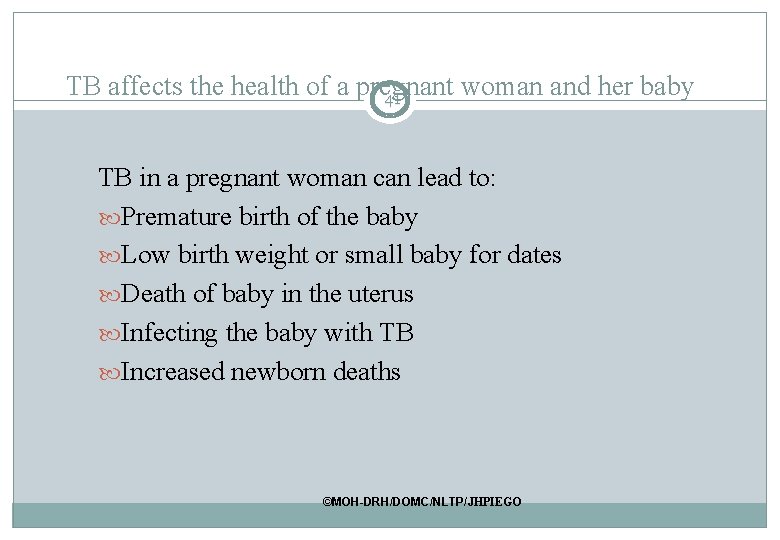
TB affects the health of a pregnant woman and her baby 41 TB in a pregnant woman can lead to: Premature birth of the baby Low birth weight or small baby for dates Death of baby in the uterus Infecting the baby with TB Increased newborn deaths ©MOH-DRH/DOMC/NLTP/JHPIEGO
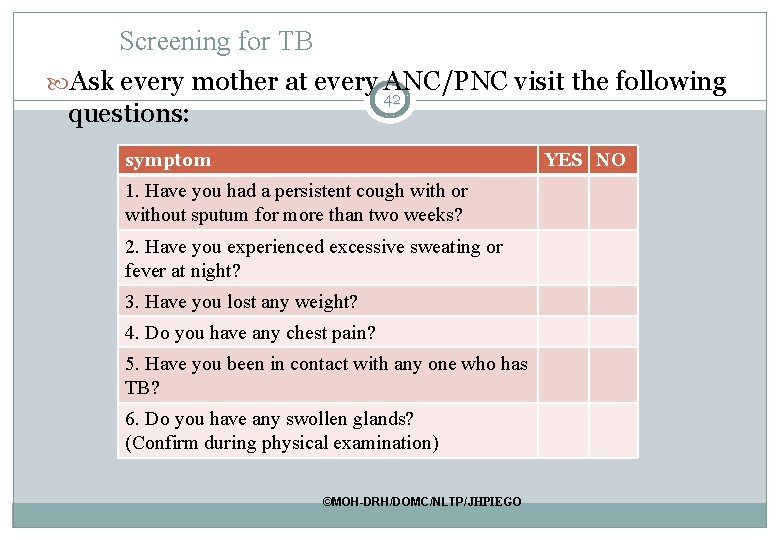
Screening for TB Ask every mother at every ANC/PNC visit the following 42 questions: symptom YES NO 1. Have you had a persistent cough with or without sputum for more than two weeks? 2. Have you experienced excessive sweating or fever at night? 3. Have you lost any weight? 4. Do you have any chest pain? 5. Have you been in contact with any one who has TB? 6. Do you have any swollen glands? (Confirm during physical examination) ©MOH-DRH/DOMC/NLTP/JHPIEGO
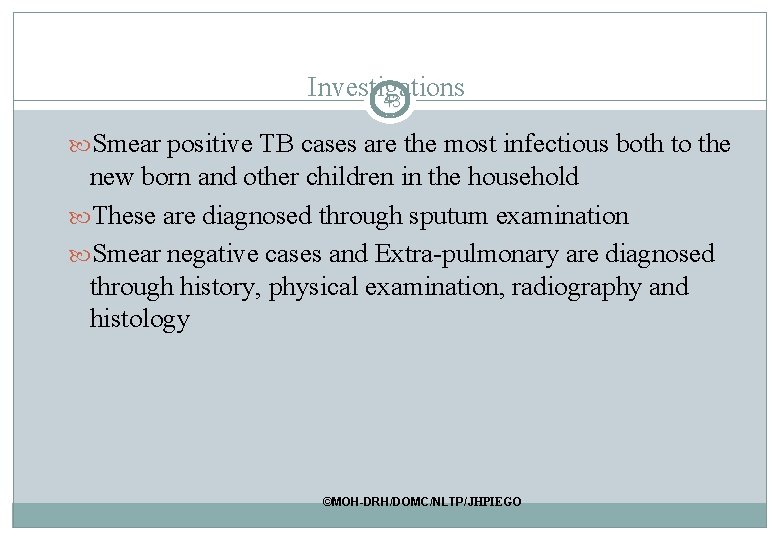
Investigations 43 Smear positive TB cases are the most infectious both to the new born and other children in the household These are diagnosed through sputum examination Smear negative cases and Extra-pulmonary are diagnosed through history, physical examination, radiography and histology ©MOH-DRH/DOMC/NLTP/JHPIEGO
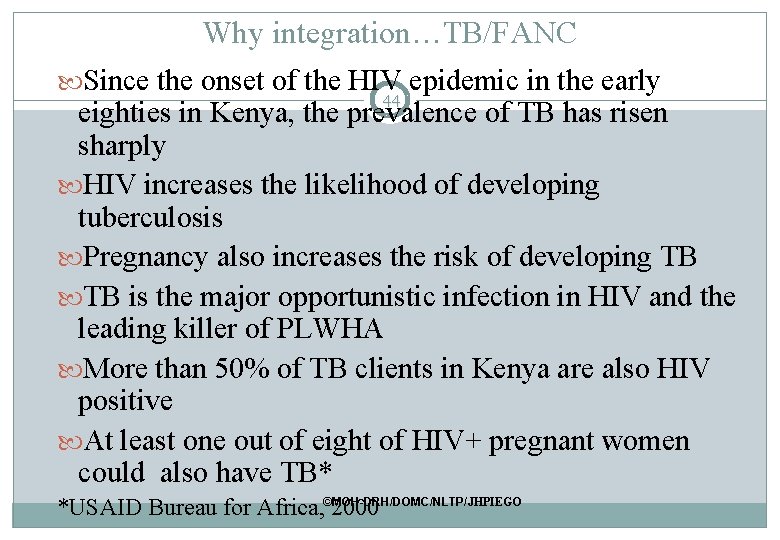
Why integration…TB/FANC Since the onset of the HIV epidemic in the early 44 eighties in Kenya, the prevalence of TB has risen sharply HIV increases the likelihood of developing tuberculosis Pregnancy also increases the risk of developing TB TB is the major opportunistic infection in HIV and the leading killer of PLWHA More than 50% of TB clients in Kenya are also HIV positive At least one out of eight of HIV+ pregnant women could also have TB* *USAID Bureau for Africa, ©MOH-DRH/DOMC/NLTP/JHPIEGO 2000
Integration of HIV, TB and malaria interventions into MCH services: Ensures that women receive targeted care according to their needs with appropriate linkages and referral structures are in place Involves the reorganization and re-orientation of health systems to ensure the delivery of a set of interventions or targeted package as part of the continuum of care Involves integrated procurement of commodities 45
Integration addresses structural , managerial and operational issues at all levels of the health system in order to: Create effective coordination mechanisms between departments, programs and other stakeholders Support integrated training and capacity planning, management and joint supervision Harmonize efforts to support targeted service delivery 46
Intensified TB case finding in FANC 47 All pregnant women should be screened for TB Pregnant women suspected to have TB should have their sputum collected and tested for TB Pregnant women found to have TB should be referred to the TB clinic for treatment NB: Negative Sputum result does not exclude TB! ©MOH-DRH/DOMC/NLTP/JHPIEGO
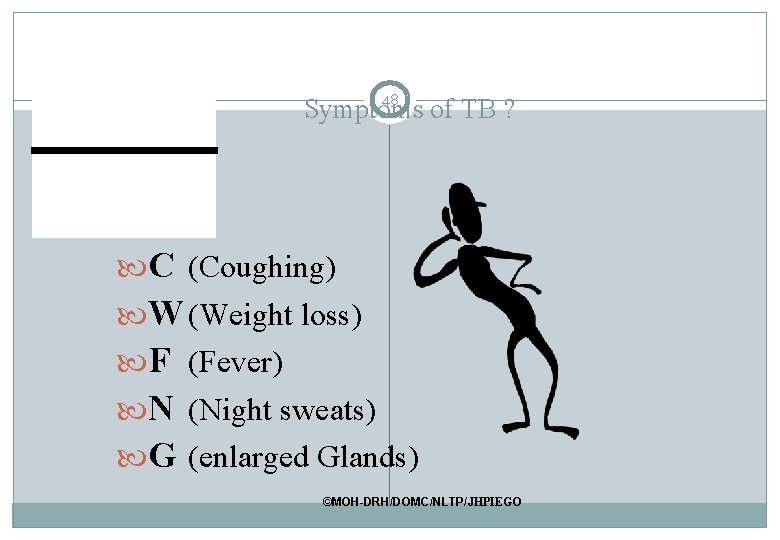
— 48 Symptoms of TB ? C (Coughing) W (Weight loss) F (Fever) N (Night sweats) G (enlarged Glands) ©MOH-DRH/DOMC/NLTP/JHPIEGO
Refer to Lab: 49 If the pregnant woman has a cough for two weeks or more, explain that three specimens of her sputum must be collected to help confirm the presence or absence of TB Explain that testing and treatment for TB is free ©MOH-DRH/DOMC/NLTP/JHPIEGO
Collection of sputum specimen: laboratory 50 Ask the pregnant woman to cough deeply to produce sputum in an open place Ensure that nobody is standing nearby during the cough Avoid contaminating the outside of the container with sputum Ensure that an adequate amount of sputum is collected in the specimen pot ©MOH-DRH/DOMC/NLTP/JHPIEGO
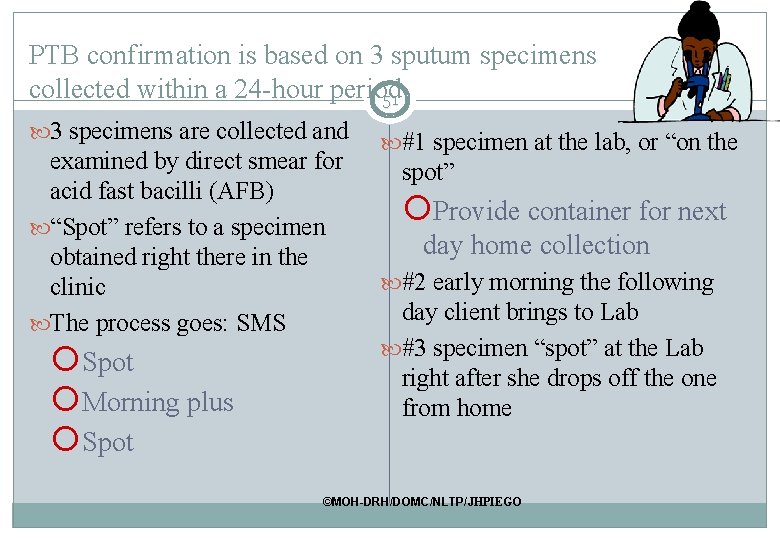
PTB confirmation is based on 3 sputum specimens collected within a 24 -hour period 51 3 specimens are collected and examined by direct smear for acid fast bacilli (AFB) “Spot” refers to a specimen obtained right there in the clinic The process goes: SMS Spot Morning plus Spot #1 specimen at the lab, or “on the spot” Provide container for next day home collection #2 early morning the following day client brings to Lab #3 specimen “spot” at the Lab right after she drops off the one from home ©MOH-DRH/DOMC/NLTP/JHPIEGO
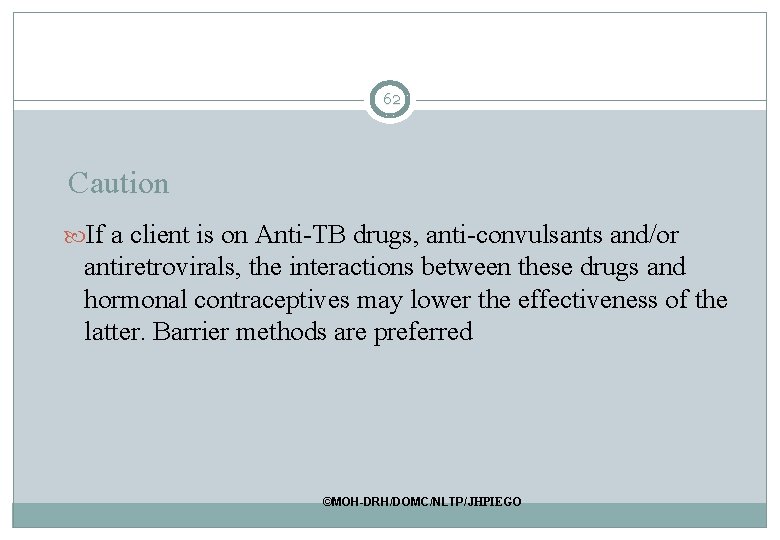
Refer to TB clinic: 52 Explain that TB can be treated over a 6 -8 month period and the drugs are safe to use during pregnancy and breastfeeding If the sputum is positive – Send the woman to the TB clinic directly – Document the positive results in the register If the sputum is negative, but the woman is symptomatic, send her to the TB clinic anyway – Note: Negative smear test for TB does NOT exclude TB – Explain that after delivery, barrier methods of family planning are necessary as some TB drugs interfere with the absorption of hormonal contraceptives. ©MOH-DRH/DOMC/NLTP/JHPIEGO
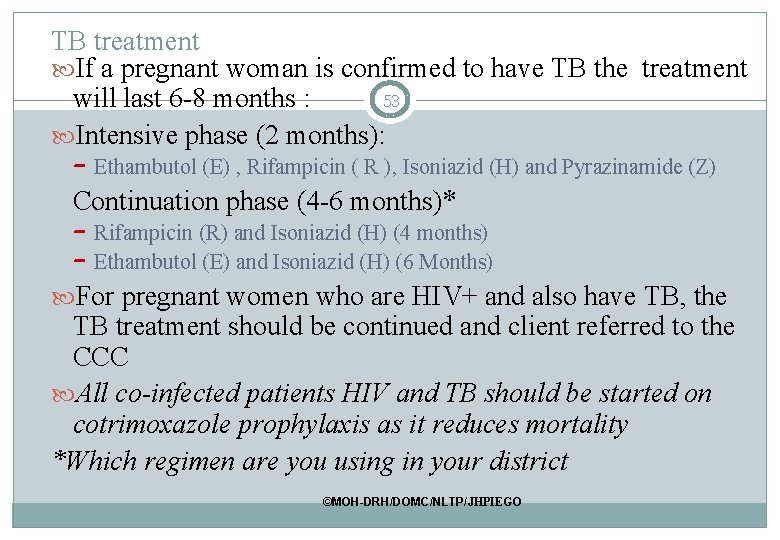
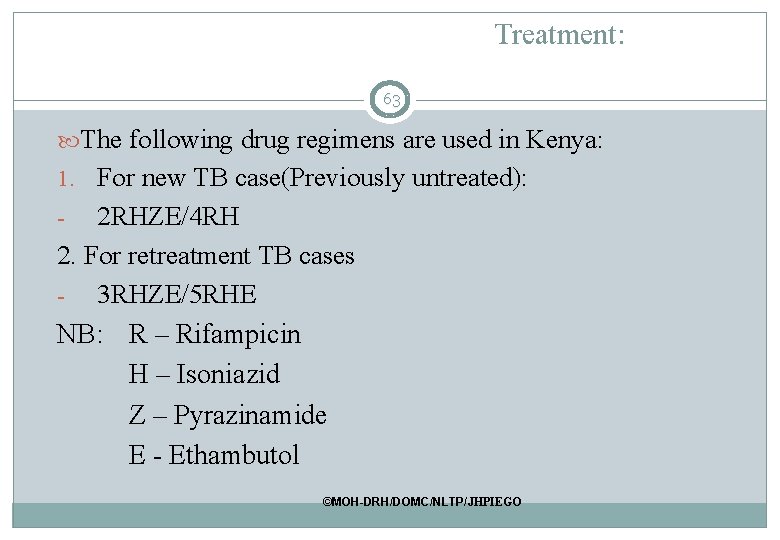
TB treatment If a pregnant woman is confirmed to have TB the treatment 53 will last 6 -8 months : Intensive phase (2 months): – Ethambutol (E) , Rifampicin ( R ), Isoniazid (H) and Pyrazinamide (Z) Continuation phase (4 -6 months)* – Rifampicin (R) and Isoniazid (H) (4 months) – Ethambutol (E) and Isoniazid (H) (6 Months) For pregnant women who are HIV+ and also have TB, the TB treatment should be continued and client referred to the CCC All co-infected patients HIV and TB should be started on cotrimoxazole prophylaxis as it reduces mortality *Which regimen are you using in your district ©MOH-DRH/DOMC/NLTP/JHPIEGO
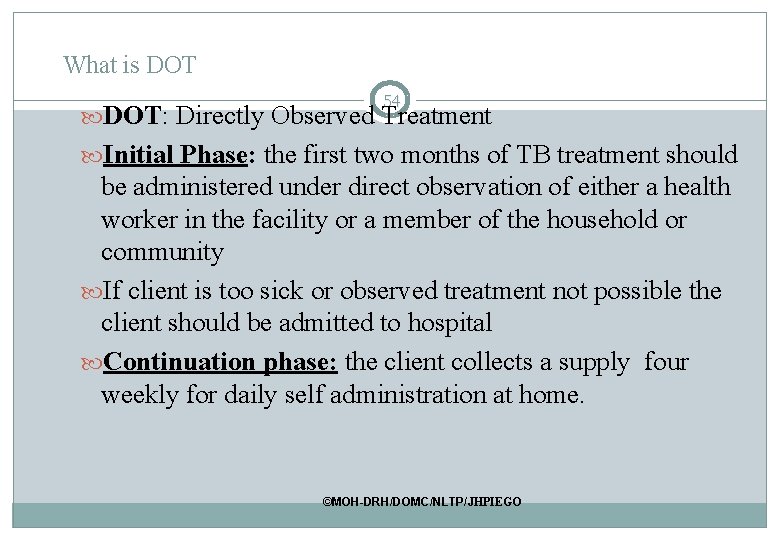
What is DOT 54 DOT: Directly Observed Treatment Initial Phase: the first two months of TB treatment should be administered under direct observation of either a health worker in the facility or a member of the household or community If client is too sick or observed treatment not possible the client should be admitted to hospital Continuation phase: the client collects a supply four weekly for daily self administration at home. ©MOH-DRH/DOMC/NLTP/JHPIEGO
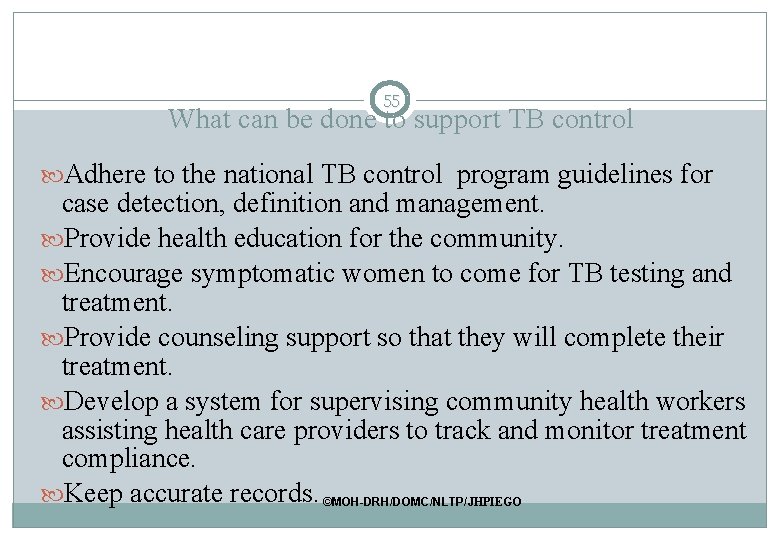
55 What can be done to support TB control Adhere to the national TB control program guidelines for case detection, definition and management. Provide health education for the community. Encourage symptomatic women to come for TB testing and treatment. Provide counseling support so that they will complete their treatment. Develop a system for supervising community health workers assisting health care providers to track and monitor treatment compliance. Keep accurate records. ©MOH-DRH/DOMC/NLTP/JHPIEGO
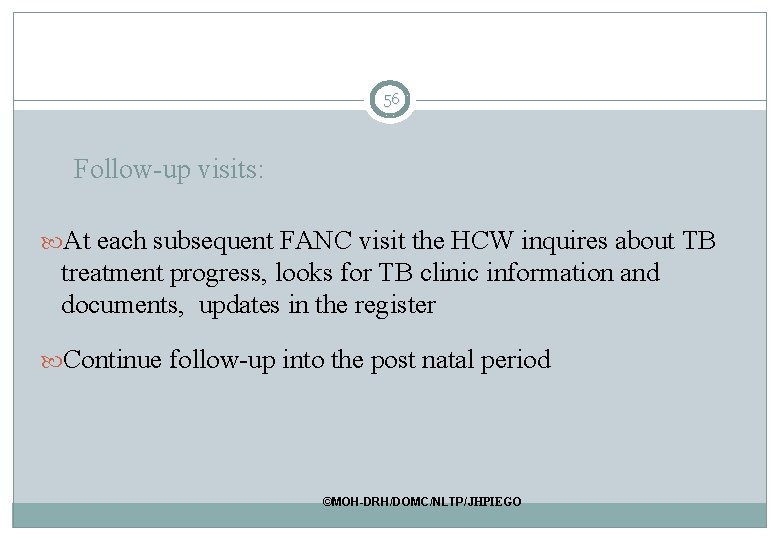
56 Follow-up visits: At each subsequent FANC visit the HCW inquires about TB treatment progress, looks for TB clinic information and documents, updates in the register Continue follow-up into the post natal period ©MOH-DRH/DOMC/NLTP/JHPIEGO
57 At the post partum visit Ask the postpartum mother if contact invitation has been initiated Ask if newborn and others have been assessed and treated for TB Is she still taking medications? Document information in record Explain that barrier methods of family planning are necessary as some TB drugs interfere with the absorption ©MOH-DRH/DOMC/NLTP/JHPIEGO of hormonal contraceptives
TB and the newborn 58 If a mother has TB and has started treatment 2 months or more before the due date, she should have 2 sputum smear tests done before the birth. If she is sputum smear negative just before delivery then she is non-infectious and the infant does not need prophylaxis and BCG is given at birth If she is sputum smear positive then the newborn must receive daily isoniazid (5 mg/kg) for 3 months and if the mothers sputum is negative and mantoux test is non reactive (<5 mm) then isoniazid should be stopped and BCG given (3 days after prophylaxis treatment has stopped) ©MOH-DRH/DOMC/NLTP/JHPIEGO
59 TB and newborn/child care If the Mantoux test is reactive (>5 mm) after 3 months on Isoniazid, then Isoniazid should be continued for another 3 months Breast feeding women on INH should also include diet rich in Vitamin B 6 Any other child under five years old living in the same household must also be given isoniazid prophylaxis if mother is smear positive and child does not have active TB INH given for 6 months ©MOH-DRH/DOMC/NLTP/JHPIEGO
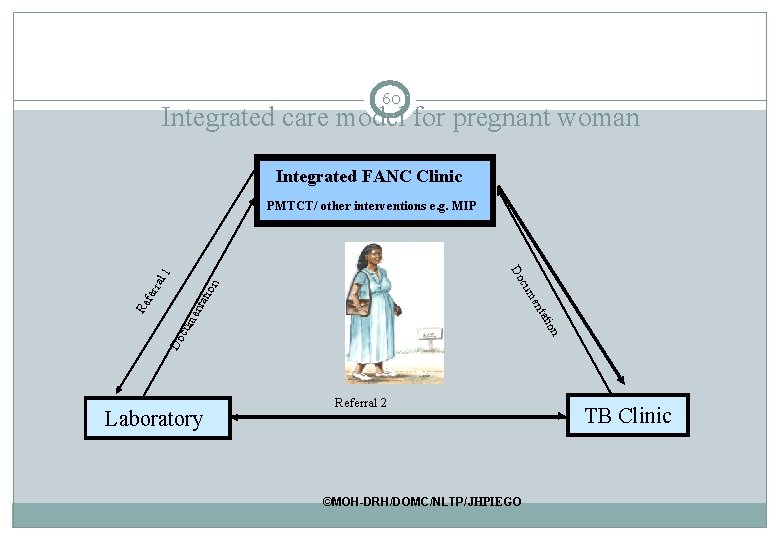
60 Integrated care model for pregnant woman Integrated FANC Clinic PMTCT/ other interventions e. g. MIP ati Do on ati cum ent Re fer on ral 1 cum Do Laboratory Referral 2 ©MOH-DRH/DOMC/NLTP/JHPIEGO TB Clinic
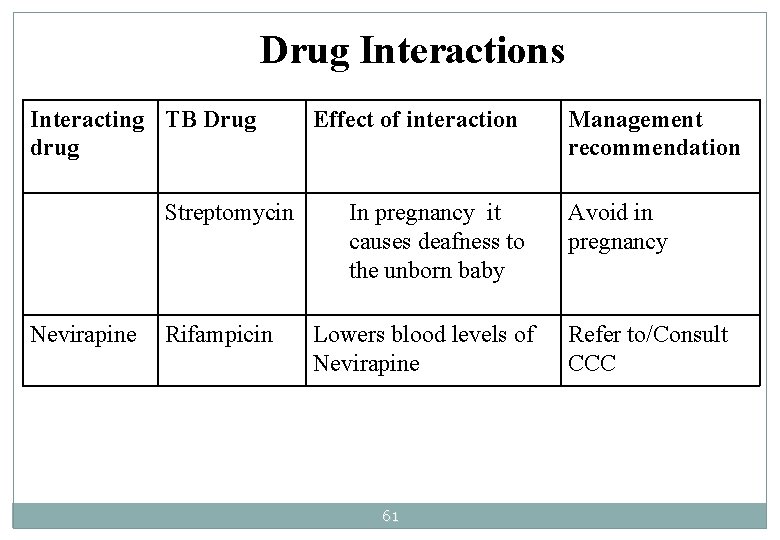
Drug Interactions Interacting TB Drug drug Streptomycin Nevirapine Rifampicin Effect of interaction In pregnancy it causes deafness to the unborn baby Lowers blood levels of Nevirapine 61 Management recommendation Avoid in pregnancy Refer to/Consult CCC
62 Caution If a client is on Anti-TB drugs, anti-convulsants and/or antiretrovirals, the interactions between these drugs and hormonal contraceptives may lower the effectiveness of the latter. Barrier methods are preferred ©MOH-DRH/DOMC/NLTP/JHPIEGO
Treatment: 63 The following drug regimens are used in Kenya: 1. For new TB case(Previously untreated): 2 RHZE/4 RH 2. For retreatment TB cases - 3 RHZE/5 RHE NB: R – Rifampicin H – Isoniazid Z – Pyrazinamide E - Ethambutol - ©MOH-DRH/DOMC/NLTP/JHPIEGO
64 THANK YOU! ©MOH-DRH/DOMC/NLTP/JHPIEGO