
Focus on Theme Lesson objectives I will correctly
Focus on Theme Lesson objectives: ØI will correctly identify theme of a piece of literature 80% of the time. Of the 6 pieces of literature I will read in this lesson, I will correctly identify theme of least 5 stories. ØI will cite evidence from the text to support my analysis of theme of each story. I will justify my answer by using proof from the story.
• Copy blue information into. ISN.
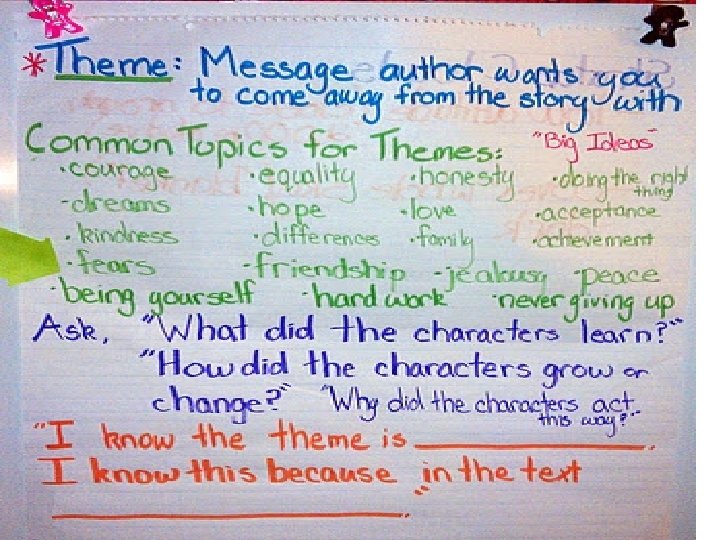
What is a Theme? Theme: Life lesson, moral, or central message in a piece of literature In other words… Theme is what the story teaches the reader.
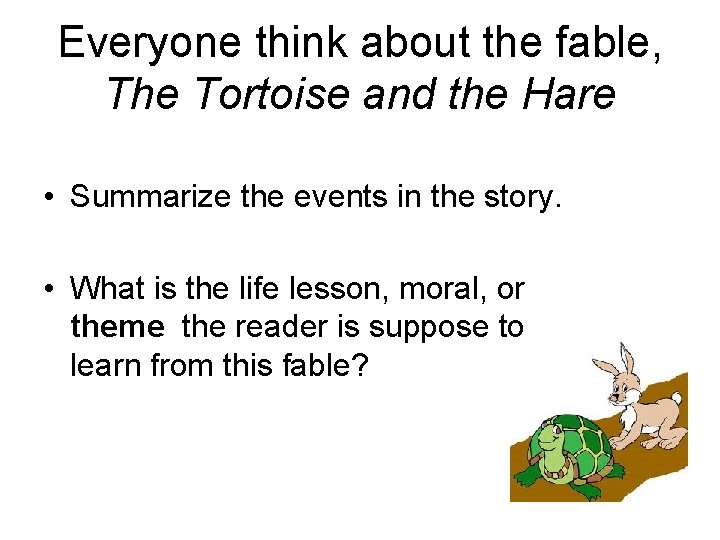
Everyone think about the fable, The Tortoise and the Hare • Summarize the events in the story. • What is the life lesson, moral, or theme the reader is suppose to learn from this fable?
• A tortoise (like a turtle) and a hare (rabbit) race. The hare is bragging about how fast he is. The hare decides to take a nap along the way. The tortoise is very slow, but keeps plugging along and wins the race.
• Themes and morals are similar, but not exactly the same. The moral of a story is usually clearly stated at the end of the fable. • A theme may or may not be stated. Often you must make inferences to determine theme. • Fiction and non-fiction pieces can have themes. In non-fiction pieces, you are looking for the central idea, the author’s main point, of the piece.
Common Topics for Themes • • • Courage Dreams Family Friendship Growing Up Fears Hope Persistence Forgiveness
The theme of a story will NOT be: • The theme is NOT simply a fact from the story. It is NOT an event in the plot or a description of a character. • The theme teaches you a lesson you can apply in your own life in other situations. Examples of Themes: • Do your work first and then play later. • What is on the inside matters more than how you look. • Love can conquer all evil.
Glue notes in ISN now.
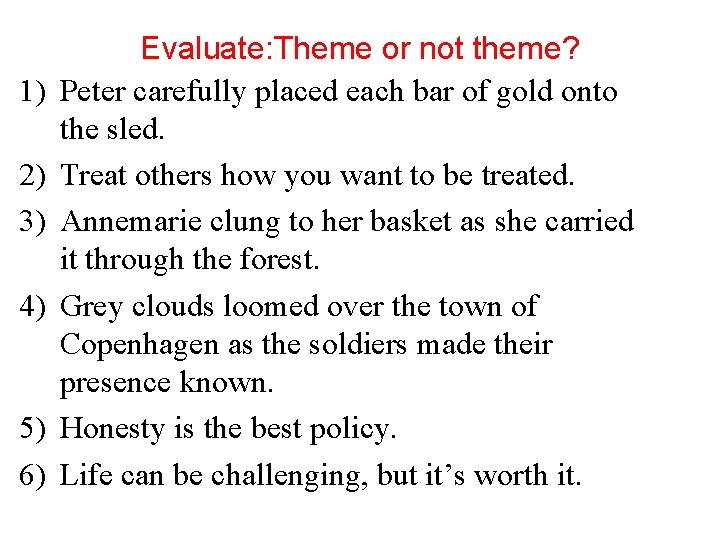
1) 2) 3) 4) 5) 6) Evaluate: Theme or not theme? Peter carefully placed each bar of gold onto the sled. Treat others how you want to be treated. Annemarie clung to her basket as she carried it through the forest. Grey clouds loomed over the town of Copenhagen as the soldiers made their presence known. Honesty is the best policy. Life can be challenging, but it’s worth it.
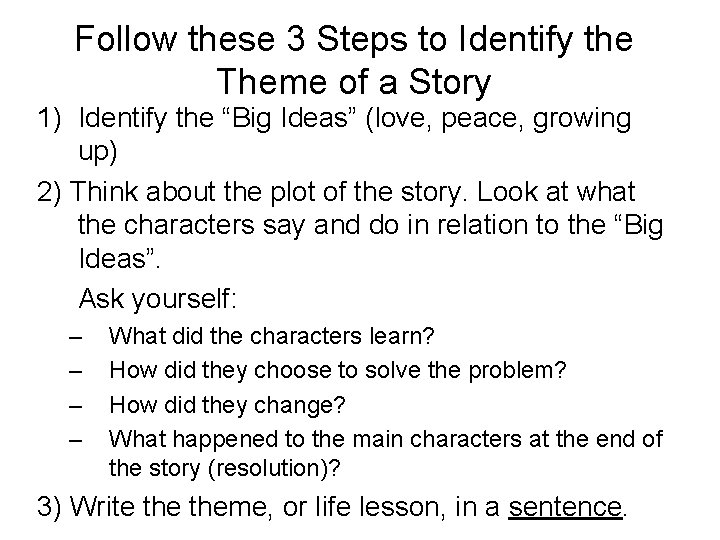
Follow these 3 Steps to Identify the Theme of a Story 1) Identify the “Big Ideas” (love, peace, growing up) 2) Think about the plot of the story. Look at what the characters say and do in relation to the “Big Ideas”. Ask yourself: – – What did the characters learn? How did they choose to solve the problem? How did they change? What happened to the main characters at the end of the story (resolution)? 3) Write theme, or life lesson, in a sentence.
• Let’s watch a short clip from the movie, Willy Wonka and the Chocolate Factory in which one of the characters, Violet Beauregarde, turns into a blueberry. • What do you already know about the character, Violet Beauregarde? • While you watch, focus on determining the life lesson, or theme, that this scene is trying to TEACH the audience.
Now let’s read a short story together and follow the steps to identify theme.
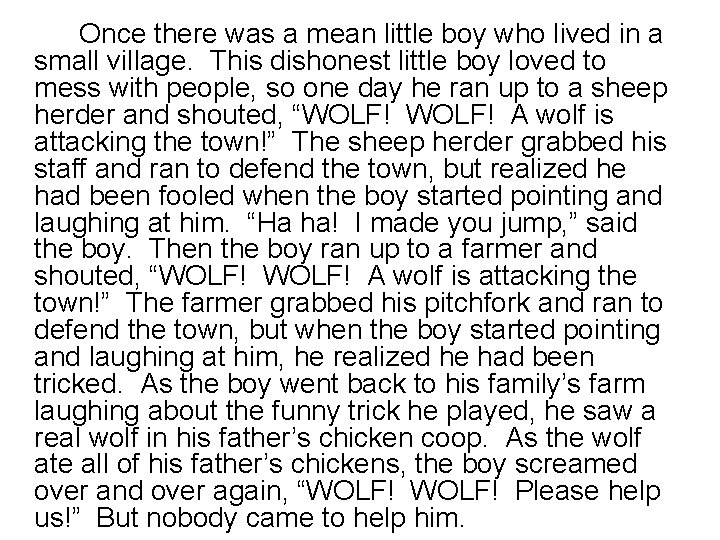
Once there was a mean little boy who lived in a small village. This dishonest little boy loved to mess with people, so one day he ran up to a sheep herder and shouted, “WOLF! A wolf is attacking the town!” The sheep herder grabbed his staff and ran to defend the town, but realized he had been fooled when the boy started pointing and laughing at him. “Ha ha! I made you jump, ” said the boy. Then the boy ran up to a farmer and shouted, “WOLF! A wolf is attacking the town!” The farmer grabbed his pitchfork and ran to defend the town, but when the boy started pointing and laughing at him, he realized he had been tricked. As the boy went back to his family’s farm laughing about the funny trick he played, he saw a real wolf in his father’s chicken coop. As the wolf ate all of his father’s chickens, the boy screamed over and over again, “WOLF! Please help us!” But nobody came to help him.
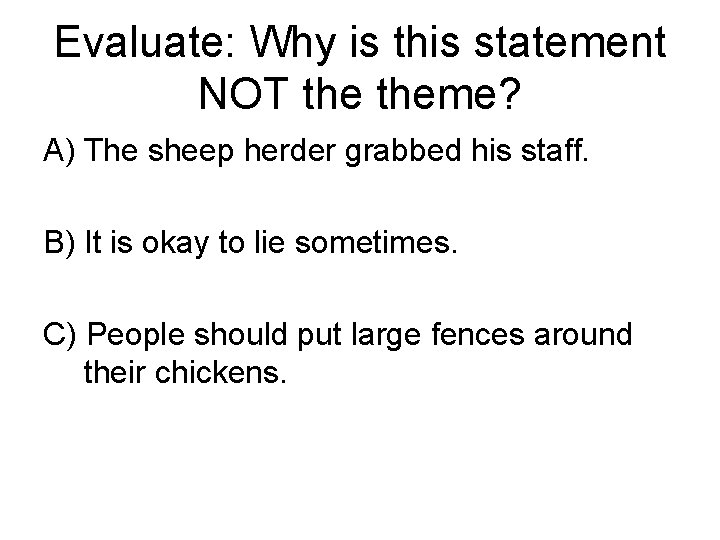
Evaluate: Why is this statement NOT theme? A) The sheep herder grabbed his staff. B) It is okay to lie sometimes. C) People should put large fences around their chickens.
Text-to-Self Connection • Do you have a personal experience that connects to this story’s theme? • Can you think of a time in your life that you could have used a reminder to be honest or think about the outcome of your choices first?
Why is this statement NOT theme of The Rich Man and the Shoemaker A) The shoemaker hid his money in the chicken house. B) Money brings happiness. C) The shoemaker was unhappy when he had the money.
• Let’s reread a story we used earlier this year and find theme.
Step 1 • Identify the general topic , “Big Ideas”. Look for repeated words or ideas. Common Topics for Themes Courage Loneliness Friendship Differences Family Dreams Wealth Suffering Fears Prejudice Love Growing Up
Step 2 Think about the plot and the problem of the story. Look at what the characters say and do in relation to the “Big Ideas”. Ask yourself: – What did the characters learn? – How did they choose to solve the problem? – What did they say and do in the story that relates to the “big ideas”? What did they NOT do? – How did they change? – What happened to the characters at the end of the story?
Step 3 • Write theme as a sentence. The theme is NOT just a WORD, like “judging” or “strength”. • It is a SENTENCE such as: Don’t judge a person by what they look like. You don’t need to be physically strong to make a difference in the world.
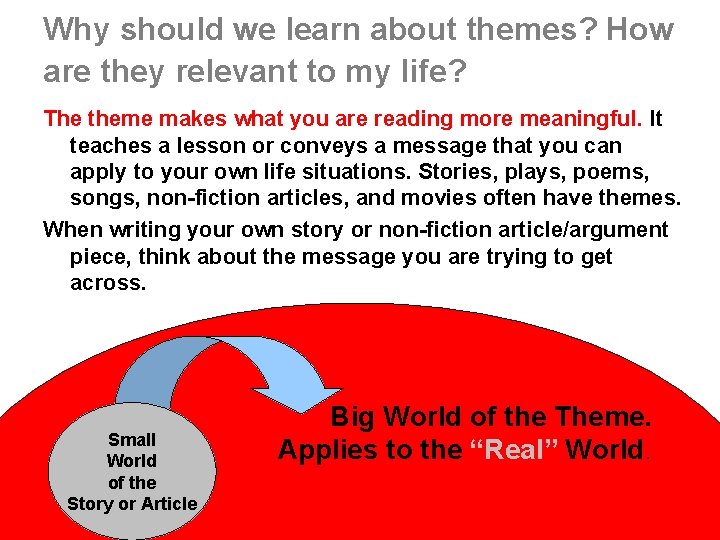
Why should we learn about themes? How are they relevant to my life? The theme makes what you are reading more meaningful. It teaches a lesson or conveys a message that you can apply to your own life situations. Stories, plays, poems, songs, non-fiction articles, and movies often have themes. When writing your own story or non-fiction article/argument piece, think about the message you are trying to get across. Small World of the Story or Article Big World of the Theme. Applies to the “Real” World.
Review 1. What is the difference between a theme and a plot event? 2. If you were explaining theme to a kindergartener, how would you explain it to him?

Assignment 1. Read one of the picture books on your table with the person NEXT to you. 2. Reread the text as needed to analyze theme. Discuss with your partner. 3. Complete the graphic organizer or create a flow map. Use complete sentences. Cite evidence from the text to prove your answer. Use direct quotes and/or list the page numbers and paragraphs.
Watch as I model the steps using a short story.
- Slides: 27