
FOCUS ON PIRFENIDONE Venerino Poletti Ospedale Morgagni Forl


- Slides: 26
FOCUS ON PIRFENIDONE Venerino Poletti Ospedale Morgagni Forlì
Conflicts of Interest • Member of the Advisory Borad of Intermune
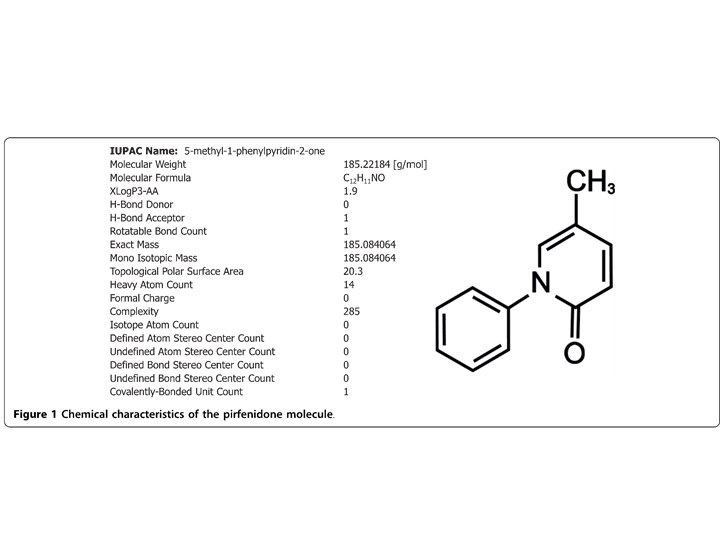
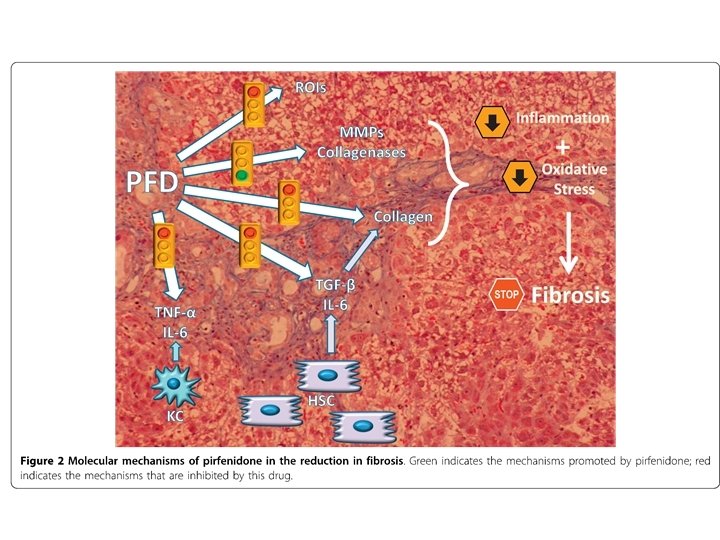
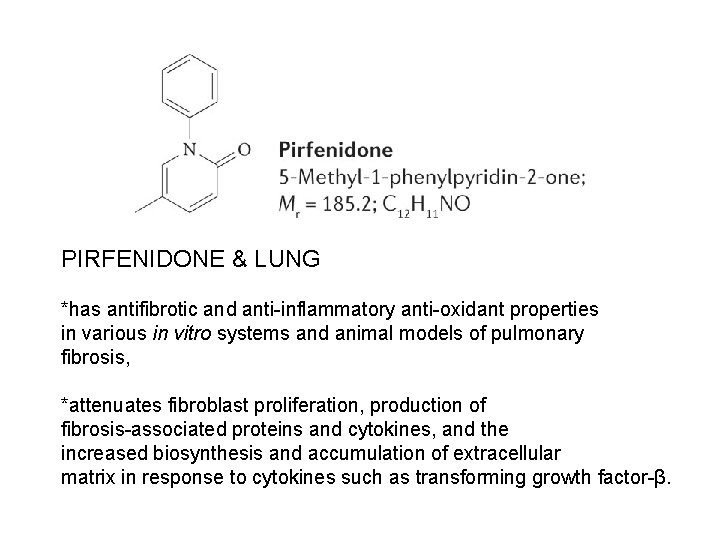
PIRFENIDONE & LUNG *has antifibrotic and anti-inflammatory anti-oxidant properties in various in vitro systems and animal models of pulmonary fibrosis, *attenuates fibroblast proliferation, production of fibrosis-associated proteins and cytokines, and the increased biosynthesis and accumulation of extracellular matrix in response to cytokines such as transforming growth factor-β.
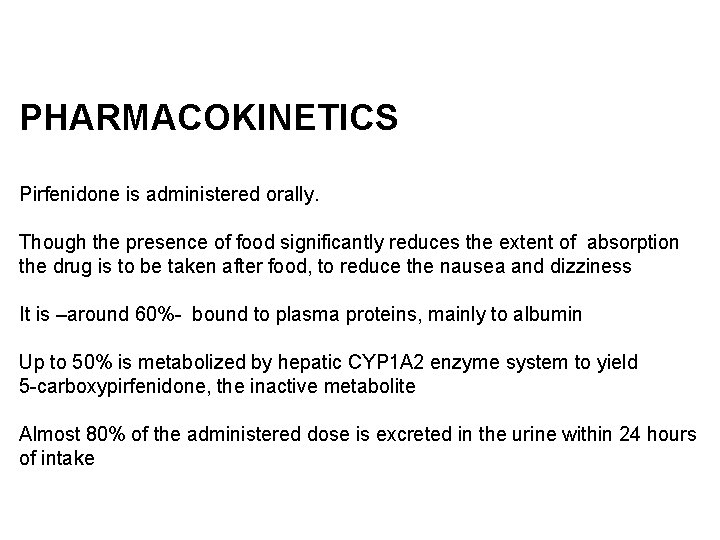
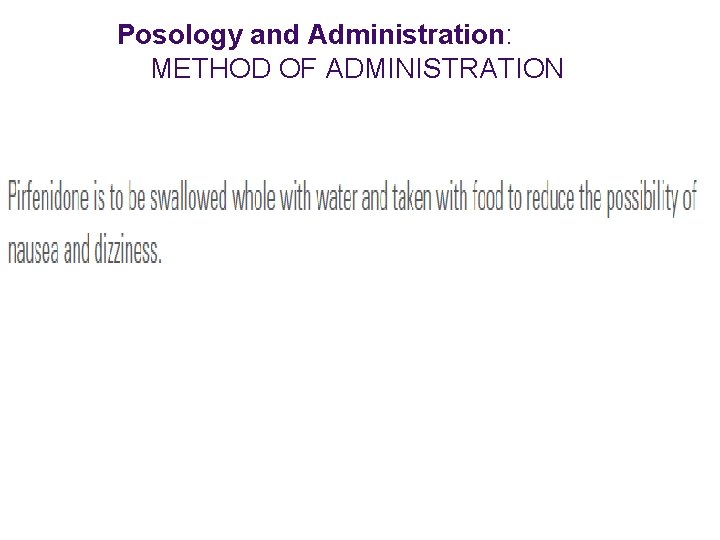
PHARMACOKINETICS Pirfenidone is administered orally. Though the presence of food significantly reduces the extent of absorption the drug is to be taken after food, to reduce the nausea and dizziness It is –around 60%- bound to plasma proteins, mainly to albumin Up to 50% is metabolized by hepatic CYP 1 A 2 enzyme system to yield 5 -carboxypirfenidone, the inactive metabolite Almost 80% of the administered dose is excreted in the urine within 24 hours of intake
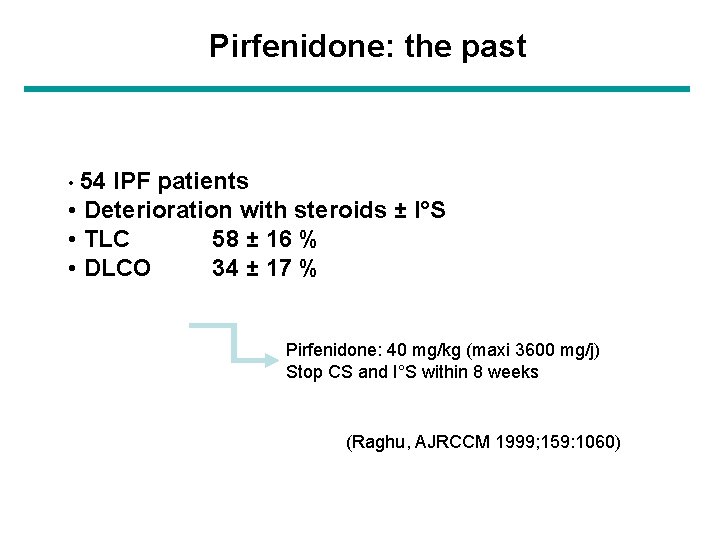
Pirfenidone: the past • 54 IPF patients • Deterioration with steroids ± I°S • TLC 58 ± 16 % • DLCO 34 ± 17 % Pirfenidone: 40 mg/kg (maxi 3600 mg/j) Stop CS and I°S within 8 weeks (Raghu, AJRCCM 1999; 159: 1060)
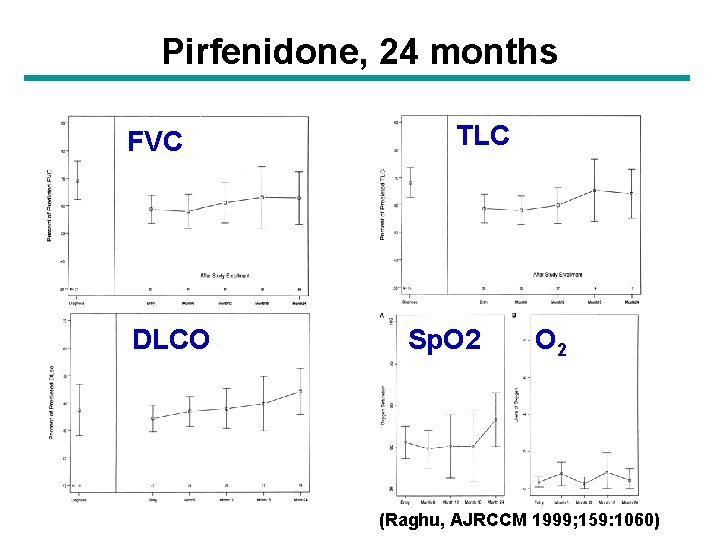
Pirfenidone, 24 months FVC DLCO TLC Sp. O 2 (Raghu, AJRCCM 1999; 159: 1060)
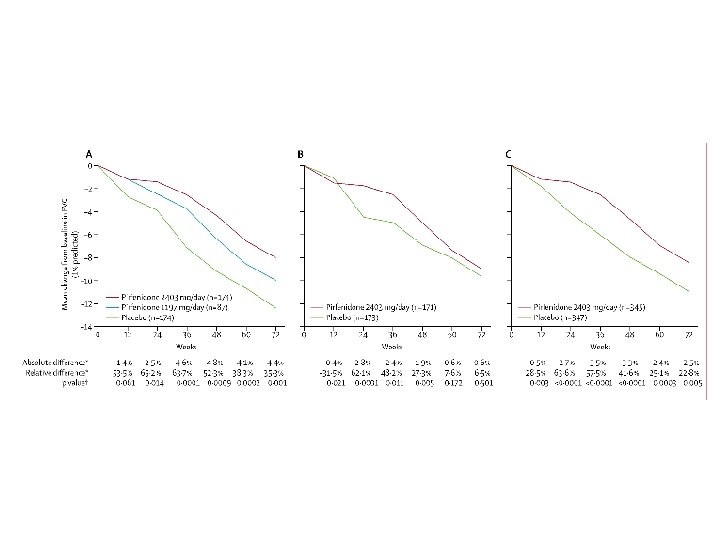
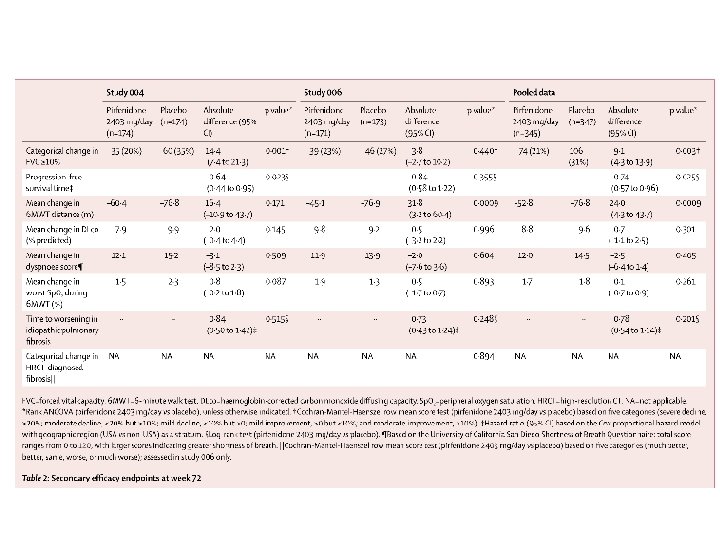
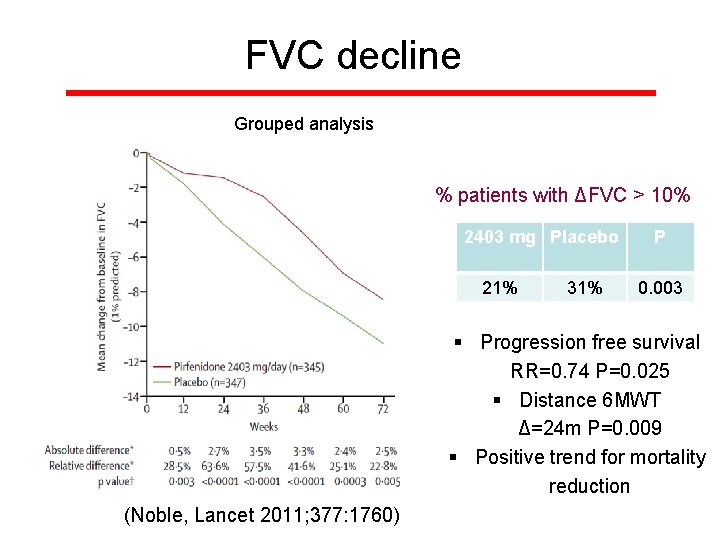
FVC decline Grouped analysis % patients with ΔFVC > 10% 2403 mg Placebo 21% 31% P 0. 003 § Progression free survival RR=0. 74 P=0. 025 § Distance 6 MWT Δ=24 m P=0. 009 § Positive trend for mortality reduction (Noble, Lancet 2011; 377: 1760)
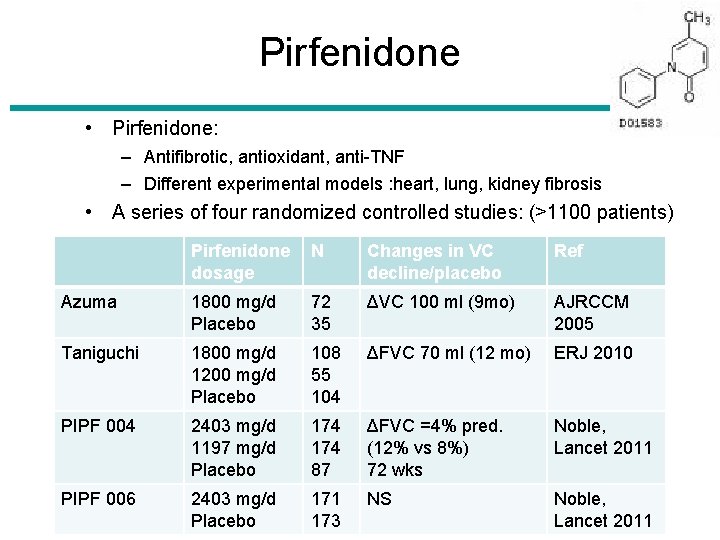
Pirfenidone • Pirfenidone: – Antifibrotic, antioxidant, anti-TNF – Different experimental models : heart, lung, kidney fibrosis • A series of four randomized controlled studies: (>1100 patients) Pirfenidone dosage N Changes in VC decline/placebo Ref Azuma 1800 mg/d Placebo 72 35 ΔVC 100 ml (9 mo) AJRCCM 2005 Taniguchi 1800 mg/d 1200 mg/d Placebo 108 55 104 ΔFVC 70 ml (12 mo) ERJ 2010 PIPF 004 2403 mg/d 1197 mg/d Placebo 174 87 ΔFVC =4% pred. (12% vs 8%) 72 wks Noble, Lancet 2011 PIPF 006 2403 mg/d Placebo 171 173 NS Noble, Lancet 2011
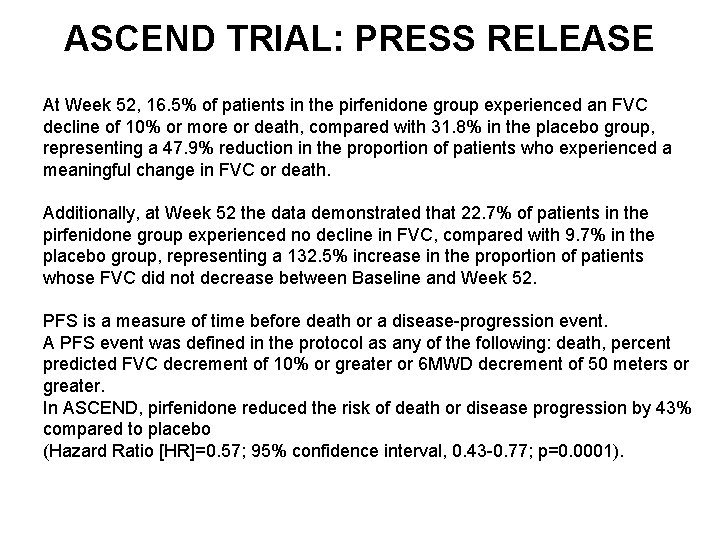
ASCEND TRIAL: PRESS RELEASE At Week 52, 16. 5% of patients in the pirfenidone group experienced an FVC decline of 10% or more or death, compared with 31. 8% in the placebo group, representing a 47. 9% reduction in the proportion of patients who experienced a meaningful change in FVC or death. Additionally, at Week 52 the data demonstrated that 22. 7% of patients in the pirfenidone group experienced no decline in FVC, compared with 9. 7% in the placebo group, representing a 132. 5% increase in the proportion of patients whose FVC did not decrease between Baseline and Week 52. PFS is a measure of time before death or a disease-progression event. A PFS event was defined in the protocol as any of the following: death, percent predicted FVC decrement of 10% or greater or 6 MWD decrement of 50 meters or greater. In ASCEND, pirfenidone reduced the risk of death or disease progression by 43% compared to placebo (Hazard Ratio [HR]=0. 57; 95% confidence interval, 0. 43 -0. 77; p=0. 0001).
PIRFENIDONE IN IPF: PRACTICAL ISSUES
Posology and Administration: METHOD OF ADMINISTRATION
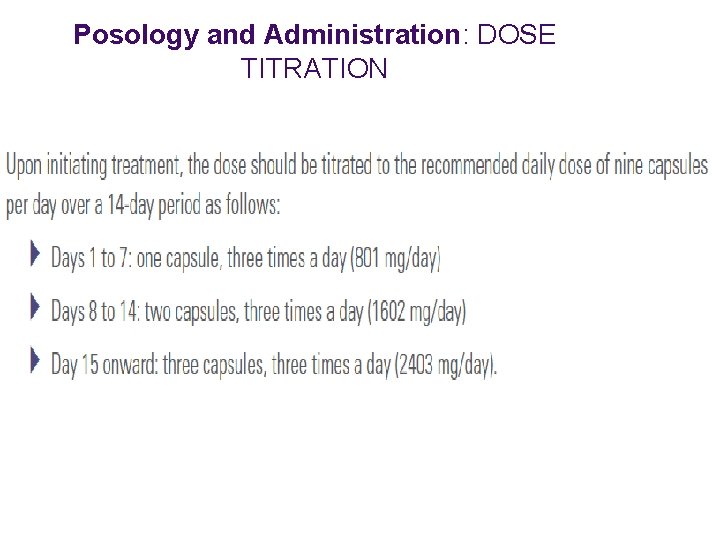
Posology and Administration: DOSE TITRATION
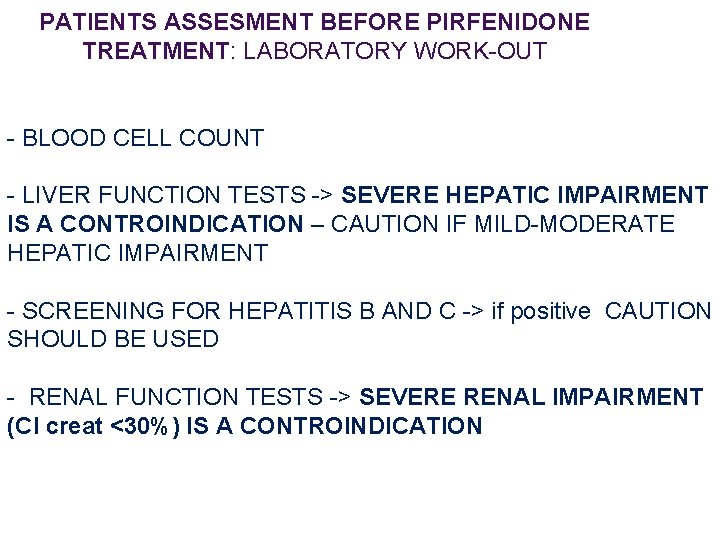
PATIENTS ASSESMENT BEFORE PIRFENIDONE TREATMENT: LABORATORY WORK-OUT - BLOOD CELL COUNT - LIVER FUNCTION TESTS -> SEVERE HEPATIC IMPAIRMENT IS A CONTROINDICATION – CAUTION IF MILD-MODERATE HEPATIC IMPAIRMENT - SCREENING FOR HEPATITIS B AND C -> if positive CAUTION SHOULD BE USED - RENAL FUNCTION TESTS -> SEVERE RENAL IMPAIRMENT (Cl creat <30%) IS A CONTROINDICATION
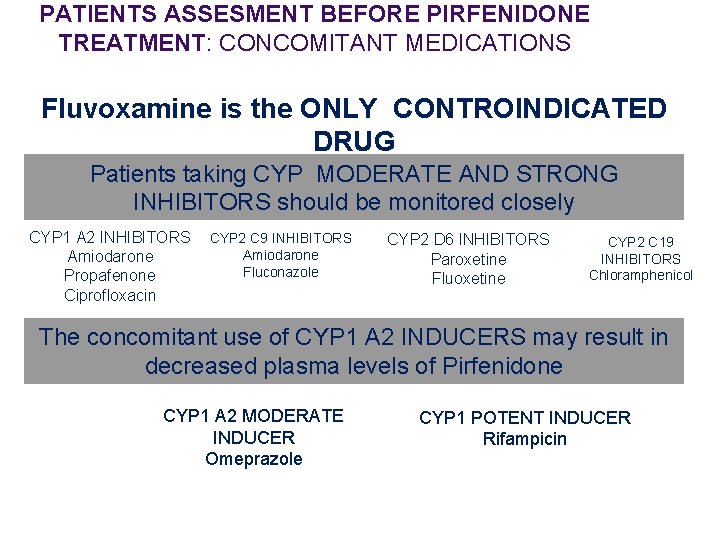
PATIENTS ASSESMENT BEFORE PIRFENIDONE TREATMENT: CONCOMITANT MEDICATIONS Fluvoxamine is the ONLY CONTROINDICATED DRUG Patients taking CYP MODERATE AND STRONG INHIBITORS should be monitored closely CYP 1 A 2 INHIBITORS Amiodarone Propafenone Ciprofloxacin CYP 2 C 9 INHIBITORS Amiodarone Fluconazole CYP 2 D 6 INHIBITORS Paroxetine Fluoxetine CYP 2 C 19 INHIBITORS Chloramphenicol The concomitant use of CYP 1 A 2 INDUCERS may result in decreased plasma levels of Pirfenidone CYP 1 A 2 MODERATE INDUCER Omeprazole CYP 1 POTENT INDUCER Rifampicin
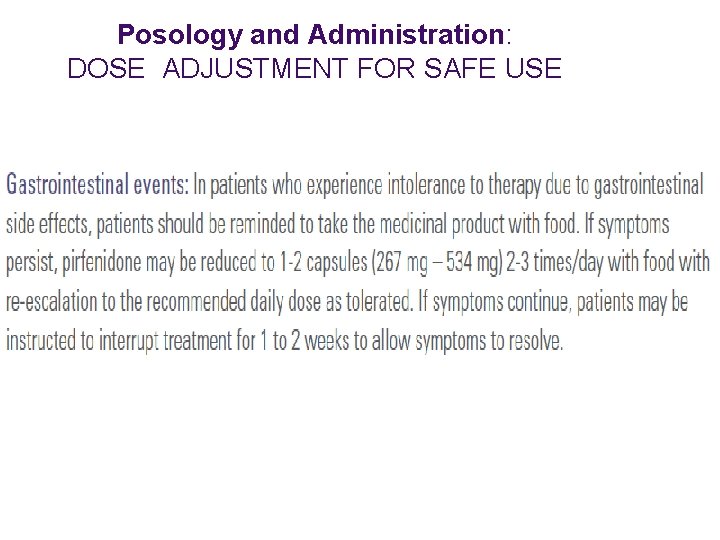
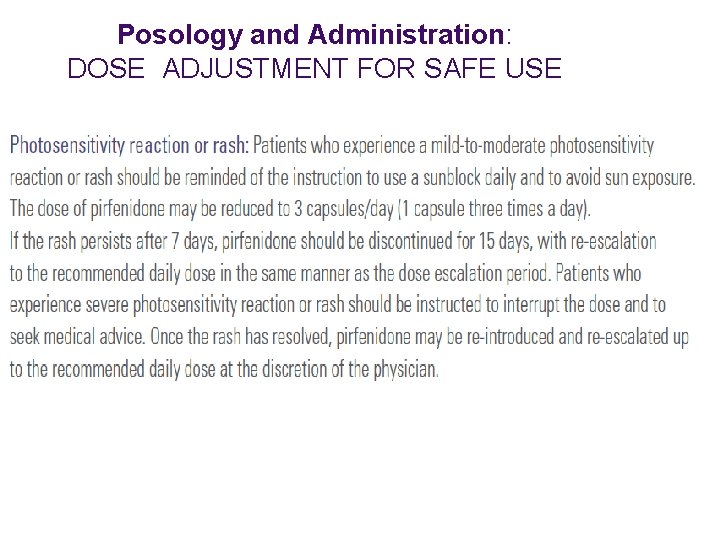
Posology and Administration: DOSE ADJUSTMENT FOR SAFE USE
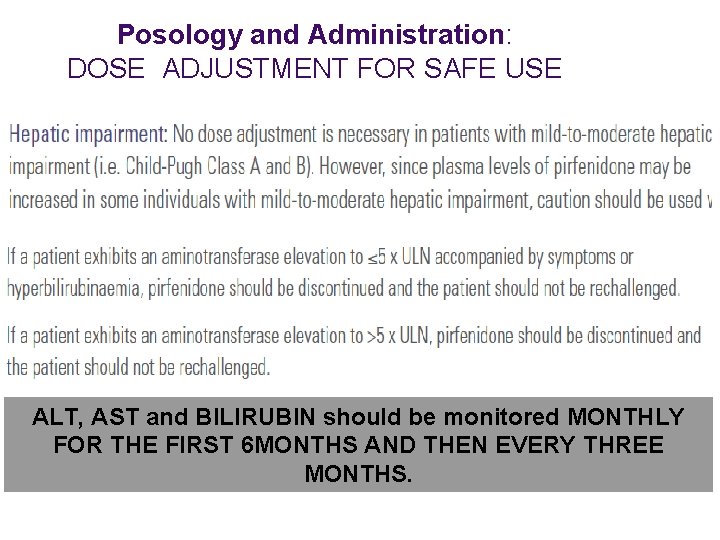
Posology and Administration: DOSE ADJUSTMENT FOR SAFE USE
Posology and Administration: DOSE ADJUSTMENT FOR SAFE USE ALT, AST and BILIRUBIN should be monitored MONTHLY FOR THE FIRST 6 MONTHS AND THEN EVERY THREE MONTHS.
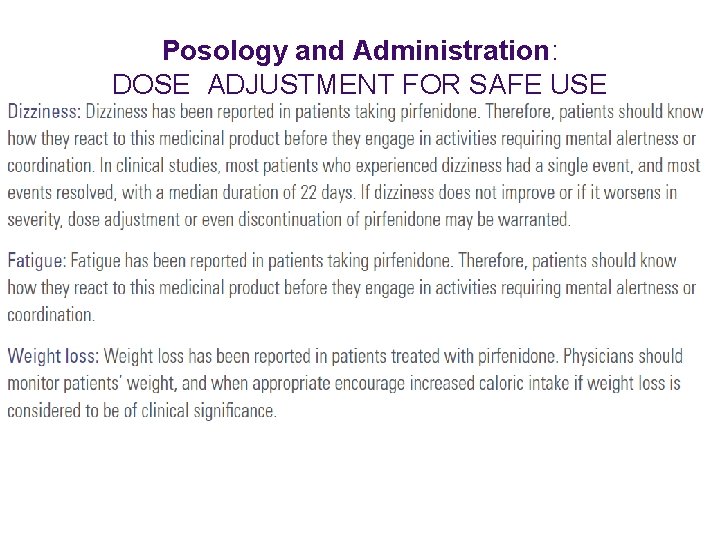
Posology and Administration: DOSE ADJUSTMENT FOR SAFE USE
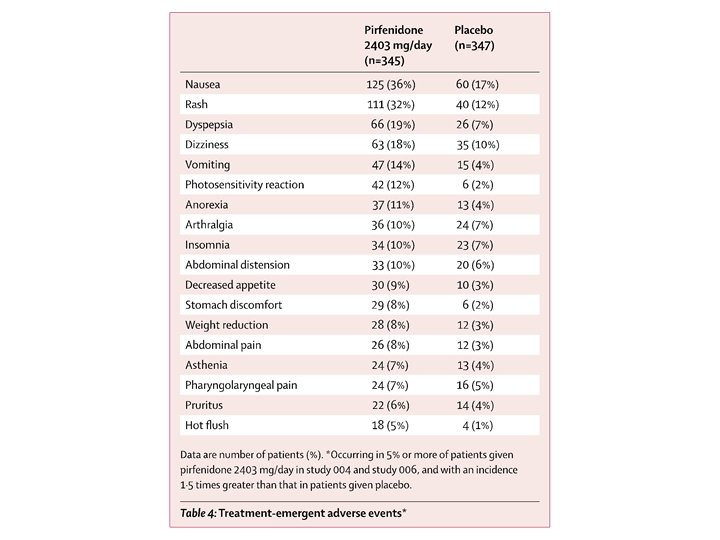
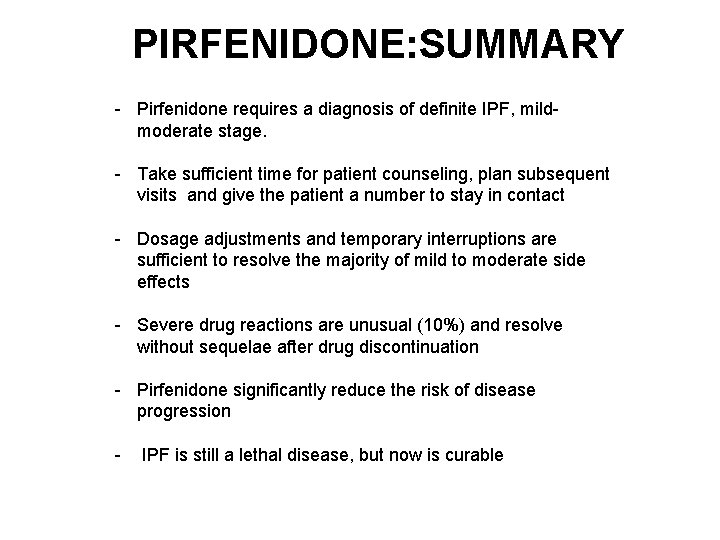
PIRFENIDONE: SUMMARY - Pirfenidone requires a diagnosis of definite IPF, mildmoderate stage. - Take sufficient time for patient counseling, plan subsequent visits and give the patient a number to stay in contact - Dosage adjustments and temporary interruptions are sufficient to resolve the majority of mild to moderate side effects - Severe drug reactions are unusual (10%) and resolve without sequelae after drug discontinuation - Pirfenidone significantly reduce the risk of disease progression - IPF is still a lethal disease, but now is curable