
Focus on Gastroesophageal Reflux Disease GERD Relates to

- Slides: 53
Focus on Gastroesophageal Reflux Disease (GERD) (Relates to Chapter 42, “Nursing Management: Upper Gastrointestinal Problems, ” in the textbook) Copyright © 2011, 2007 by Mosby, Inc. , an affiliate of Elsevier Inc.
Description Not a disease but a syndrome Clinically significant symptomatic condition or histopathologic alteration Secondary to reflux of gastric contents into lower esophagus Copyright © 2011, 2007 by Mosby, Inc. , an affiliate of Elsevier Inc. 2
Etiology and Pathophysiology No single cause Results when Defenses of lower esophagus are overwhelmed by reflux of gastric contents into esophagus Persistent reflux that occurs more than twice a week is considered GERD Assessment : occurs at night, wakes up at night from sleep, associated with Copyright © 2011, 2007 by Mosby, Inc. , an affiliate of Elsevier Inc. 3
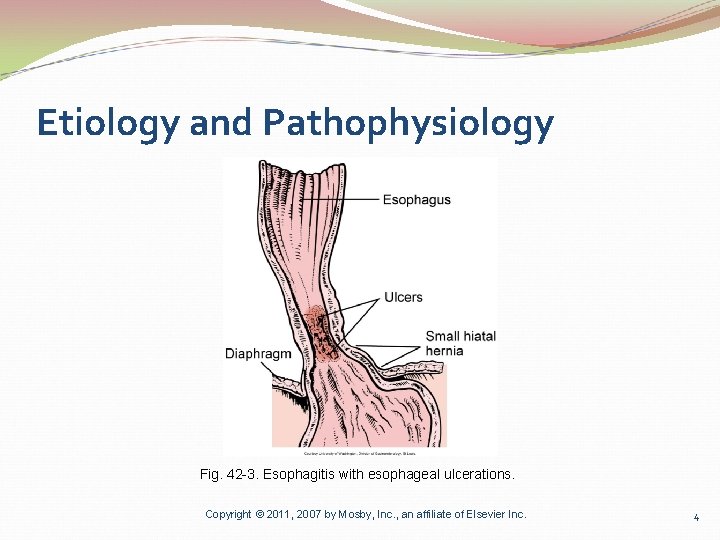
Etiology and Pathophysiology Fig. 42 -3. Esophagitis with esophageal ulcerations. Copyright © 2011, 2007 by Mosby, Inc. , an affiliate of Elsevier Inc. 4
Etiology and Pathophysiology Predisposing factors Hiatal hernia Incompetent lower esophageal sphincter (LES) Antireflux barrier Decreased esophageal clearance Decreased gastric emptying Copyright © 2011, 2007 by Mosby, Inc. , an affiliate of Elsevier Inc. 5
Etiology and Pathophysiology HCl acid and pepsin secretions reflux— cause irritation and inflammation Intestinal proteolytic enzymes and bile salts add to irritation. Primary cause is incompetent LES Copyright © 2011, 2007 by Mosby, Inc. , an affiliate of Elsevier Inc. 6
Etiology and Pathophysiology Incompetent LES Primary factor in GERD Results in ↓ in pressure in distal portion of esophagus Gastric contents move from stomach to esophagus. Can be due to certain foods (caffeine, chocolate) and drugs (anticholinergics) Copyright © 2011, 2007 by Mosby, Inc. , an affiliate of Elsevier Inc. 7
Factors effecting LES Increase pressure : bethanocol, reglan, peppermint, tea, coffee, B blockers. Decrease pressure: ETOH, anti cholinergic, chocolate, fatty acids, nicotine, CA channel blockers, valium, nitrates, progesterone, theophyline. Copyright © 2011, 2007 by Mosby, Inc. , an affiliate of Elsevier Inc. 8
Etiology and Pathophysiology Obesity is a risk factor. Pregnant women are at increased risk. Cigarette and cigar smoking can contribute to GERD. Hiatal hernia is a common cause of GERD. Copyright © 2011, 2007 by Mosby, Inc. , an affiliate of Elsevier Inc. 9
Clinical Manifestations Symptoms of GERD Heartburn (pyrosis) Most common clinical manifestation Burning, tight sensation felt beneath the lower sternum and spreading upward to throat or jaw Felt intermittently Relieved by milk, alkaline substances, or water Copyright © 2011, 2007 by Mosby, Inc. , an affiliate of Elsevier Inc. 10
Clinical Manifestations Symptoms of GERD (cont’d) Dyspepsia Pain or discomfort centered in upper abdomen Hypersalivation Noncardiac chest pain More common in older adults Copyright © 2011, 2007 by Mosby, Inc. , an affiliate of Elsevier Inc. 11
Clinical Manifestations Most individuals have mild symptoms. Heartburn after a meal Occurs once a week No evidence of mucosal damage Copyright © 2011, 2007 by Mosby, Inc. , an affiliate of Elsevier Inc. 12
Clinical Manifestations Health care provider should evaluate Mild symptoms for period of 5 years or longer Symptoms associated with difficulty swallowing Copyright © 2011, 2007 by Mosby, Inc. , an affiliate of Elsevier Inc. 13
Clinical Manifestations Health care provider should evaluate Heartburn occurring more than once a week, rated as severe, or occurring at night and waking patient Older adults with recent onset of heartburn Copyright © 2011, 2007 by Mosby, Inc. , an affiliate of Elsevier Inc. 14
Clinical Manifestations Heartburn occurs Following ingestion of food or drugs that ↓ LES pressure Directly irritates esophageal mucosa Copyright © 2011, 2007 by Mosby, Inc. , an affiliate of Elsevier Inc. 15
Clinical Manifestations Individual may also report Wheezing Coughing Dyspnea Hoarseness Sore throat Lump in throat Choking Regurgitation Copyright © 2011, 2007 by Mosby, Inc. , an affiliate of Elsevier Inc. 16
Clinical Manifestations Regurgitation Effortless return of food or gastric contents from stomach into esophagus or mouth Described as hot, bitter, or sour liquid coming into the mouth or throat Can mimic angina Copyright © 2011, 2007 by Mosby, Inc. , an affiliate of Elsevier Inc. 17
Complications Related to direct local effects of gastric acid on esophageal mucosa Esophagitis Inflammation of esophagus Frequent complication Copyright © 2011, 2007 by Mosby, Inc. , an affiliate of Elsevier Inc. 18
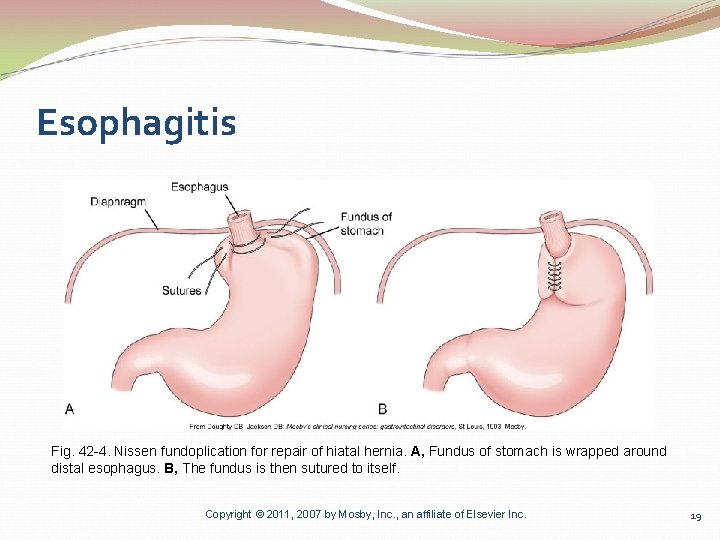
Esophagitis Fig. 42 -4. Nissen fundoplication for repair of hiatal hernia. A, Fundus of stomach is wrapped around distal esophagus. B, The fundus is then sutured to itself. Copyright © 2011, 2007 by Mosby, Inc. , an affiliate of Elsevier Inc. 19
Complications Esophagitis (cont’d) Other risk factors include hiatal hernia, chemical irritation. Repeated exposure—esophageal stricture Resulting in dysphagia Copyright © 2011, 2007 by Mosby, Inc. , an affiliate of Elsevier Inc. 20
Complications Barrett’s esophagus Replacement of normal squamous epithelium with columnar epithelium Precancerous lesion Diagnosed in 5% to 15% of patients with chronic reflux Signs and symptoms: None to perforation Must be monitored every 1 to 3 years by endoscopy Copyright © 2011, 2007 by Mosby, Inc. , an affiliate of Elsevier Inc. 21
Complications Respiratory Due to irritation of upper airway by secretions Cough Bronchospasm Laryngospasm Cricopharyngeal spasm Copyright © 2011, 2007 by Mosby, Inc. , an affiliate of Elsevier Inc. 22
Complications Respiratory (cont’d) Potential for asthma, bronchitis, and pneumonia Dental erosion From acid reflux into mouth Especially posterior teeth Copyright © 2011, 2007 by Mosby, Inc. , an affiliate of Elsevier Inc. 23
Diagnostic Studies History and PE Barium swallow Can detect protrusion of gastric fundus Upper GI endoscopy Useful in assessing LES competence, degree of inflammation, scarring, strictures Copyright © 2011, 2007 by Mosby, Inc. , an affiliate of Elsevier Inc. 24
Diagnostic Studies Biopsy and cytologic specimens Differentiate carcinoma from Barrett’s esophagus Esophageal manometric (motility) studies Measure pressure in esophagus and LES Copyright © 2011, 2007 by Mosby, Inc. , an affiliate of Elsevier Inc. 25
Diagnostic Studies Radionuclide tests Detect reflux of gastric contents Rate of esophageal clearance Copyright © 2011, 2007 by Mosby, Inc. , an affiliate of Elsevier Inc. 26
Diagnostic Studies Monitoring p. H Laboratory or 24 -hour ambulatory Determine esophageal p. H using specially designed probes Copyright © 2011, 2007 by Mosby, Inc. , an affiliate of Elsevier Inc. 27
Collaborative Care Lifestyle modifications Avoid triggers Nutritional therapy Decrease high-fat foods. Take fluids between rather than with meals. Avoid milk products at night. Avoid late-night snacking or meals. Copyright © 2011, 2007 by Mosby, Inc. , an affiliate of Elsevier Inc. 28
Collaborative Care Nutritional therapy (cont’d) Avoid chocolate, peppermint, caffeine, tomato products, orange juice. Weight reduction therapy Copyright © 2011, 2007 by Mosby, Inc. , an affiliate of Elsevier Inc. 29
Collaborative Care Drug therapy Two approaches 1. Step up Start with antacids and OTC H 2 R blockers, and progress to prescription H 2 R blockers and finally PPIs. Copyright © 2011, 2007 by Mosby, Inc. , an affiliate of Elsevier Inc. 30
Collaborative Care Drug therapy Two approaches 2. Step down Start with PPIs, and titrate down to prescription H 2 R blockers and finally OTC H 2 R blockers and antacids. Copyright © 2011, 2007 by Mosby, Inc. , an affiliate of Elsevier Inc. 31
Collaborative Care Drug therapy (cont’d) Histamine (H 2)-receptor blockers Decrease secretion of HCl acid Reduce symptoms and promote esophageal healing in 50% of patients Side effects uncommon Pepcid, Zantac, Tagamet Copyright © 2011, 2007 by Mosby, Inc. , an affiliate of Elsevier Inc. 32
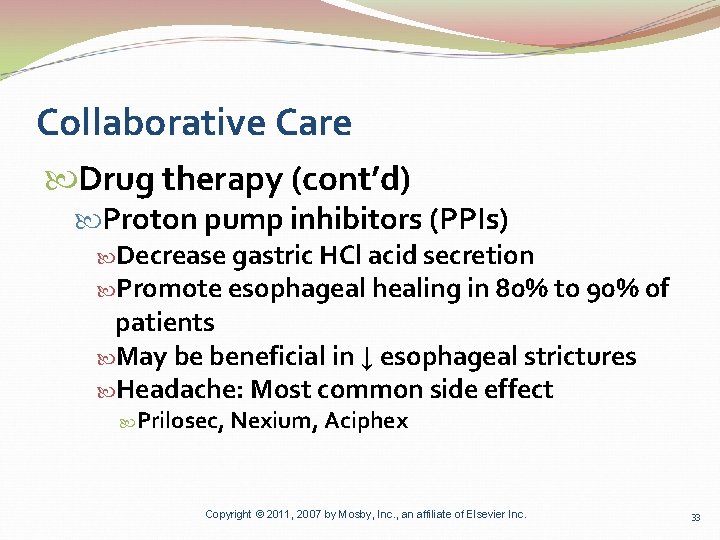
Collaborative Care Drug therapy (cont’d) Proton pump inhibitors (PPIs) Decrease gastric HCl acid secretion Promote esophageal healing in 80% to 90% of patients May be beneficial in ↓ esophageal strictures Headache: Most common side effect Prilosec, Nexium, Aciphex Copyright © 2011, 2007 by Mosby, Inc. , an affiliate of Elsevier Inc. 33
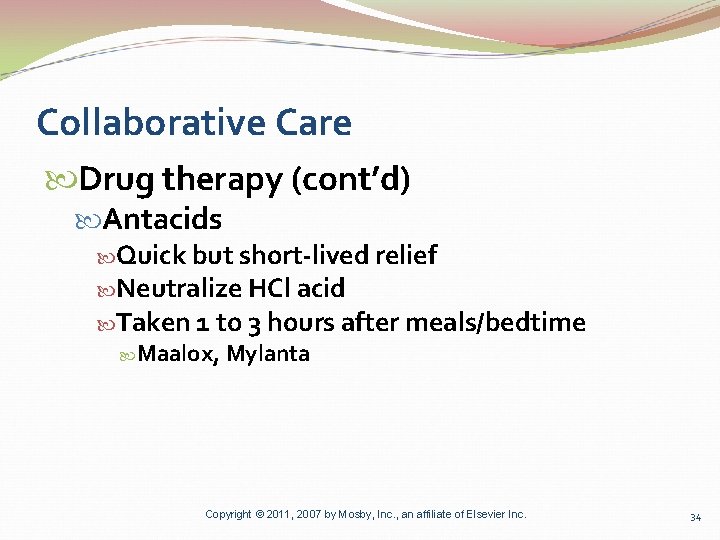
Collaborative Care Drug therapy (cont’d) Antacids Quick but short-lived relief Neutralize HCl acid Taken 1 to 3 hours after meals/bedtime Maalox, Mylanta Copyright © 2011, 2007 by Mosby, Inc. , an affiliate of Elsevier Inc. 34
Collaborative Care Drug therapy (cont’d) Acid protective Used for cytoprotective properties Sucralfate (Carafate) Copyright © 2011, 2007 by Mosby, Inc. , an affiliate of Elsevier Inc. 35
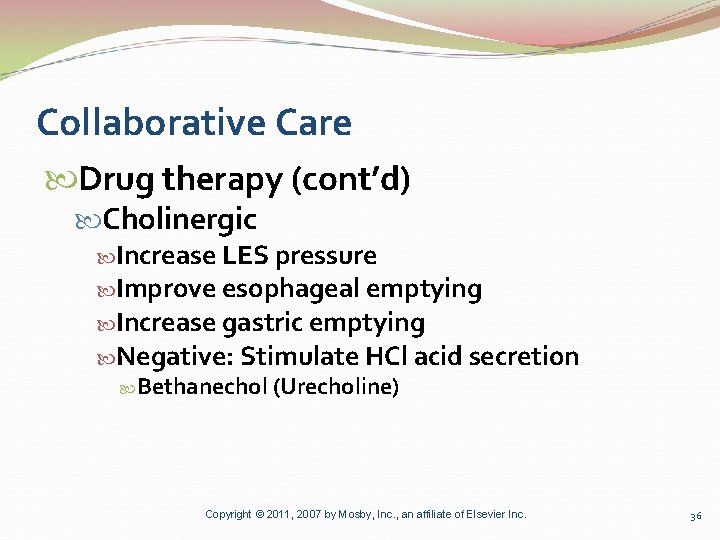
Collaborative Care Drug therapy (cont’d) Cholinergic Increase LES pressure Improve esophageal emptying Increase gastric emptying Negative: Stimulate HCl acid secretion Bethanechol (Urecholine) Copyright © 2011, 2007 by Mosby, Inc. , an affiliate of Elsevier Inc. 36
Collaborative Care Drug therapy (cont’d) Prokinetic drugs Promote gastric emptying Reduce risk of gastric acid reflux Metoclopramide (Reglan) Copyright © 2011, 2007 by Mosby, Inc. , an affiliate of Elsevier Inc. 37
Collaborative Care Surgical therapy Necessary if Conservative therapy fails Medication intolerance Barrett’s metaplasia Esophageal stricture and stenosis Chronic esophagitis Hiatal hernia Nissen and Toupet fundoplications Copyright © 2011, 2007 by Mosby, Inc. , an affiliate of Elsevier Inc. 38
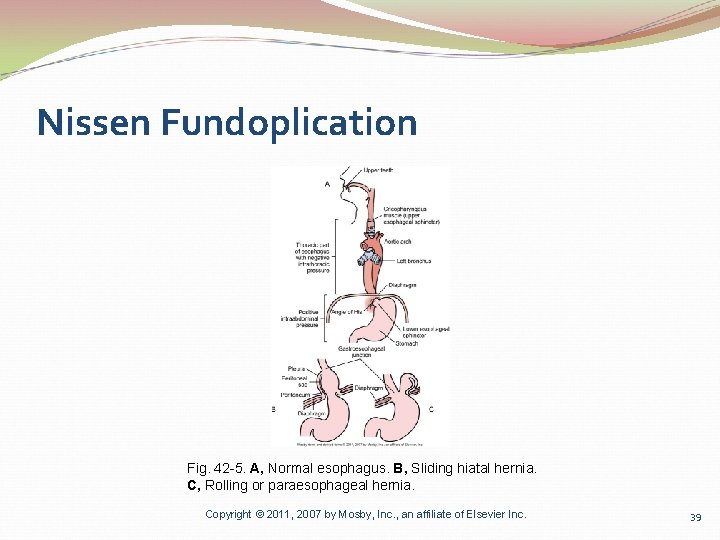
Nissen Fundoplication Fig. 42 -5. A, Normal esophagus. B, Sliding hiatal hernia. C, Rolling or paraesophageal hernia. Copyright © 2011, 2007 by Mosby, Inc. , an affiliate of Elsevier Inc. 39
Collaborative Care Endoscopic therapy Endoscopic mucosal resection Photodynamic therapy Cryotherapy Radiofrequency ablation Copyright © 2011, 2007 by Mosby, Inc. , an affiliate of Elsevier Inc. 40
Nursing Management Avoidance of factors that cause reflux Stop smoking Avoid alcohol and caffeine Avoid acidic foods Stress reduction techniques Weight reduction, if appropriate Small frequent meals Copyright © 2011, 2007 by Mosby, Inc. , an affiliate of Elsevier Inc. 41
Nursing Management Elevation of HOB 30 degrees Not lying down for 2 to 3 hours after eating Avoidance of late-night eating Evaluation of effectiveness of medications Observing for side effects of medications Copyright © 2011, 2007 by Mosby, Inc. , an affiliate of Elsevier Inc. 42
Nursing Management Postoperative care Focus Prevention of respiratory complications Maintenance of fluid/electrolyte balance Prevention of infection Copyright © 2011, 2007 by Mosby, Inc. , an affiliate of Elsevier Inc. 43
Nursing Management Postop care (cont’d) Respiratory assessment Respiratory rate/rhythm Pulse rate/rhythm Signs of pneumothorax Dyspnea Chest pain Cyanosis Copyright © 2011, 2007 by Mosby, Inc. , an affiliate of Elsevier Inc. 44
Nursing Management Postop care (cont’d) Deep breathing techniques Accurate I/O Observing for fluid/electrolyte imbalance Pain medication Medications to prevent nausea/vomiting Copyright © 2011, 2007 by Mosby, Inc. , an affiliate of Elsevier Inc. 45
Nursing Management Postop care (cont’d) When peristalsis returns, only fluids given initially Solids added gradually Normal diet gradually resumed Patient must avoid gas-forming foods and must chew foods thoroughly. Copyright © 2011, 2007 by Mosby, Inc. , an affiliate of Elsevier Inc. 46
Nursing Management Postop care (cont’d) First month after surgery, patient may report mild dysphagia—should resolve after edema subsides Patient should report persistent symptoms such as heartburn and regurgitation. Copyright © 2011, 2007 by Mosby, Inc. , an affiliate of Elsevier Inc. 47
Audience Response Question After the nurse teaches a patient with gastroesophageal reflux disease (GERD) about recommended dietary modifications, which statement by the patient indicates that the teaching has been effective? 1. “I can have a glass of low-fat milk at bedtime. ” 2. “I will have to eliminate all spicy foods from my diet. ” 3. “I will have to use herbal teas instead of caffeinated drinks. ” 4. “I should keep something in my stomach all the time to neutralize the excess acids. ” Copyright © 2011, 2007 by Mosby, Inc. , an affiliate of Elsevier Inc. 48
Case Study Copyright © 2011, 2007 by Mosby, Inc. , an affiliate of Elsevier Inc. 49
Case Study 20 -year-old man complains of loss of appetite and occasional lower sternal chest pain 30 to 60 minutes after meals. He claims symptoms began about 6 months ago. Copyright © 2011, 2007 by Mosby, Inc. , an affiliate of Elsevier Inc. 50
Case Study He has a history of asthma. States he has needed inhaler “more than usual” Does not know what makes it worse or better EGD suggests GERD. Copyright © 2011, 2007 by Mosby, Inc. , an affiliate of Elsevier Inc. 51
Discussion Questions 1. How may factors be affecting his GERD? 2. What nutritional counseling should you do? Copyright © 2011, 2007 by Mosby, Inc. , an affiliate of Elsevier Inc. 52
Discussion Questions 3. He states that he doesn’t want to take any medication. How can you best advise him? 4. What are long-term complications of GERD? Copyright © 2011, 2007 by Mosby, Inc. , an affiliate of Elsevier Inc. 53