
Focus on Basic Food Microbiology Part 1 Bacterial
Focus on… Basic Food Microbiology Part 1 – Bacterial pathogens Nick Cork MAIFST Nick. cork@alsglobal. com 0476 830 459
Focus on Food overview Consultancy support service • Basic membership is free to all ALS food clients • Premium membership is $150/year • Enterprise is $300/year - multiple users per company Premium Member benefits – exclusive content • Monthly webinars • Reduced consultancy rates • Lab tours • Templates and downloads • White papers • Monthly Newsletter/regulatory update • “Ask the expert” forum Focus on Food webinar series – © ALS 2019

Outline Microbiology basics • Characteristics of key organisms • Importance in food manufacturing Bacteria • Structure, classification • Microorganisms of concern Factors affecting microbial growth • Intrinsic • Extrinsic Pathogenic bacteria • Examples • Laboratory analysis Focus on Food webinar series – © ALS 2019
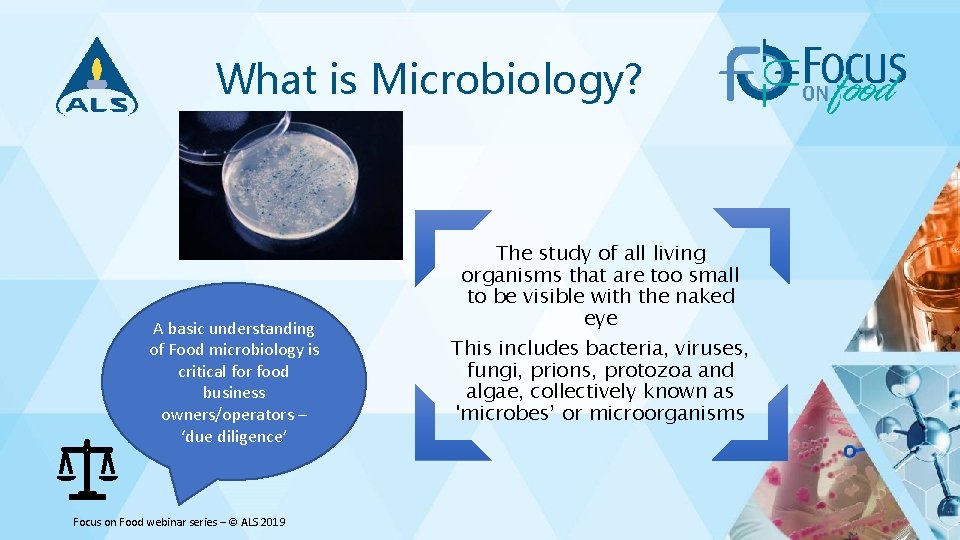
What is Microbiology? A basic understanding of Food microbiology is critical for food business owners/operators – ‘due diligence’ Focus on Food webinar series – © ALS 2019 The study of all living organisms that are too small to be visible with the naked eye This includes bacteria, viruses, fungi, prions, protozoa and algae, collectively known as 'microbes’ or microorganisms
Importance in food production Significant cause of foodborne illness Legal and commercial obligation to protect consumers Recalls and withdrawals Essential knowledge for new product development HACCP planning and Standards compliance Focus on Food webinar series – © ALS 2019
Distribution ‘Ubiquitous’ in the environment • Air – passive and active, HVAC • Water • Soil • Animals – livestock, pests, birds etc • Plants • Humans – hands, mucous membranes (mouth/nose) • Clothing • Tools • Machinery All areas of production can be affected • Raw materials • Packaging • Machinery • Staff • Water and air supply • Storage facilities Formation of ‘biofilms’ in food production facilities • Cracks in machinery • Seals • Pipework, dead legs in water supply • Very difficult to remove once established Focus on Food webinar series – © ALS 2019

Micro-organisms & HACCP ‘Hazards’ Micro Hazard Potential microbiological hazards include: pathogenic and spoilage bacteria, viruses, fungi and parasites Contamination Creates the possibility of a food safety issue – need to prevent or reduce contamination Multiplication Illness is caused by food poisoning organisms having the right conditions to grow following initial contamination – need to control conditions in which they can multiply Survival Failure of a ‘kill step’ may lead to survival of pathogens. Proper validation and verification processes need to be in place Focus on Food webinar series – © ALS 2019
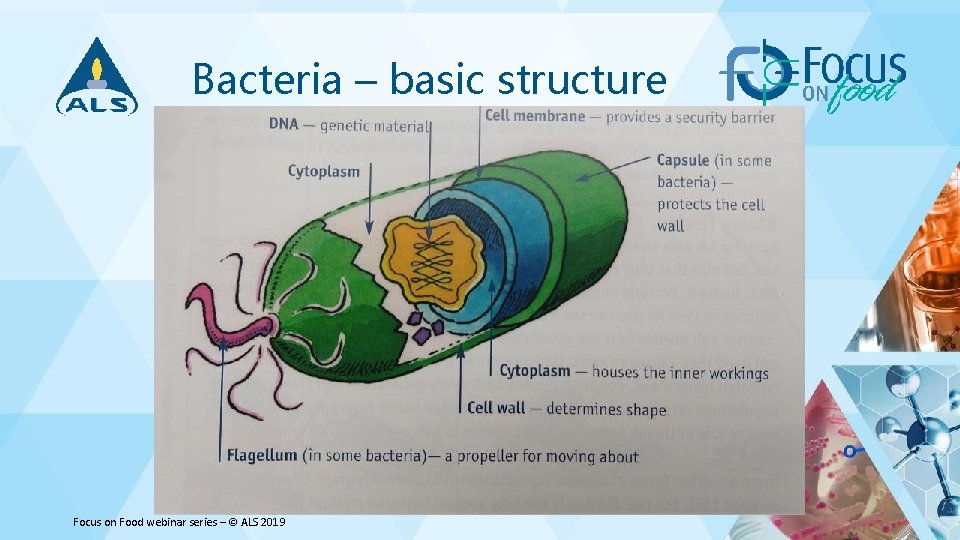
Bacteria – basic structure Focus on Food webinar series – © ALS 2019
Bacteria - classification Pathogenic • Can cause illness or disease • Transmitted in food • Some can cause illness through toxin production Spoilage • Cause degradation of food • “Off” odours and/or rancid taste Commensal • Usually harmless • Some are positively beneficial (eg yogurt production) Focus on Food webinar series – © ALS 2019

Gram positive or negative? Named after Danish physician Hans CJ Gram Detects differences in composition of cell wall Gram –ive (eg Salmonellae) – turn pinkish/red colour Focus on Food webinar series – © ALS 2019 Used crystal violet dye, iodine and alcohol to distinguish 2 groups of bacteria Gram +ive (eg Staphylococci) – retain violet dye colour Differences include cell wall anatomy and types of toxin produced

Classification by shape Rods (Bacilli) – Salmonella, E. coli, Bacillus spp Spherical (cocci) – Staphylococcus aureus. Form clusters Focus on Food webinar series – © ALS 2019 Spiral (helical) – Campylobacter jejuni, Vibrio spp Other shapes – Actinomyces have a branching effect, others are square
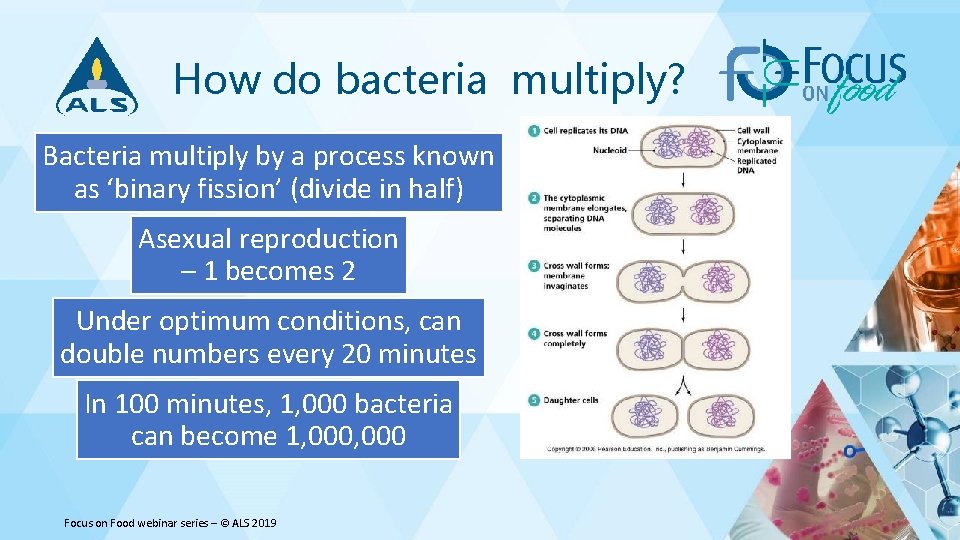
How do bacteria multiply? Bacteria multiply by a process known as ‘binary fission’ (divide in half) Asexual reproduction – 1 becomes 2 Under optimum conditions, can double numbers every 20 minutes In 100 minutes, 1, 000 bacteria can become 1, 000 Focus on Food webinar series – © ALS 2019
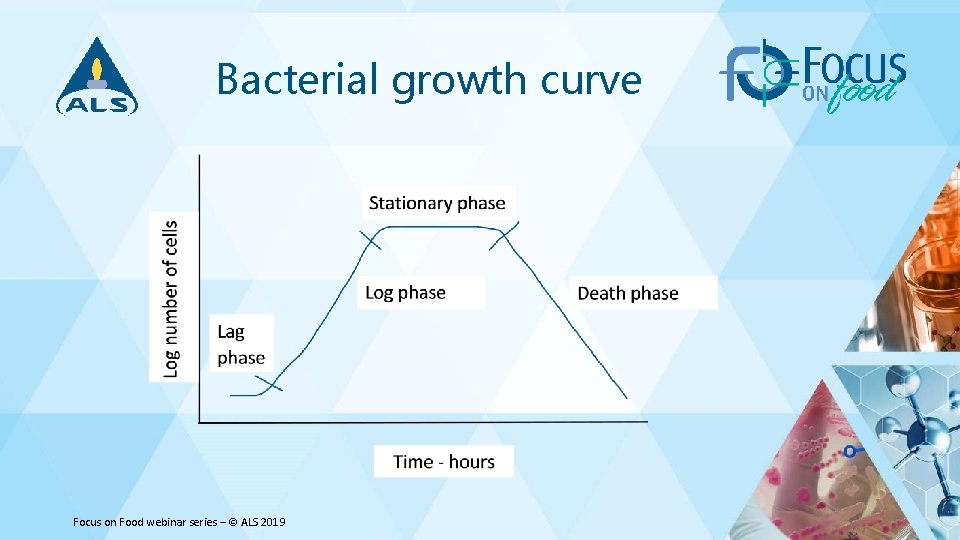
Bacterial growth curve Focus on Food webinar series – © ALS 2019

Growth phases & food safety Lag phase – adjustment to conditions, little growth Log phase – rapid multiplication, exponential growth Food safety measures either prolong the lag phase (refrigeration, p. H, Aw or preservatives) or interrupt the log phase (boiling, HPP, pasteurisation) Focus on Food webinar series – © ALS 2019 Stationary phase – growth matched by death, little increase in numbers Decline phase – nutrients depleted, rapid decline in numbers Can’t wait for decline phase, as by then the food may have no nutritional value and may contain toxins
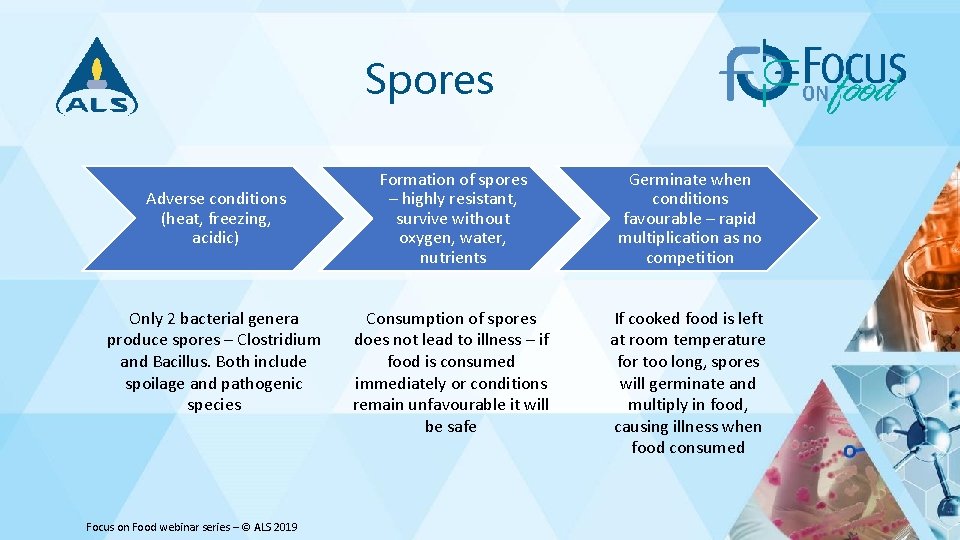
Spores Adverse conditions (heat, freezing, acidic) Only 2 bacterial genera produce spores – Clostridium and Bacillus. Both include spoilage and pathogenic species Focus on Food webinar series – © ALS 2019 Formation of spores – highly resistant, survive without oxygen, water, nutrients Germinate when conditions favourable – rapid multiplication as no competition Consumption of spores does not lead to illness – if food is consumed immediately or conditions remain unfavourable it will be safe If cooked food is left at room temperature for too long, spores will germinate and multiply in food, causing illness when food consumed
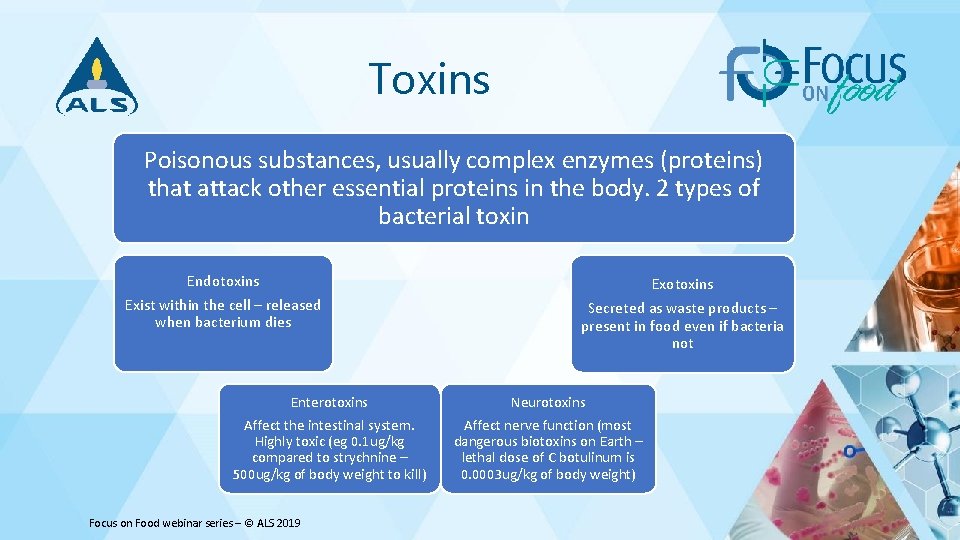
Toxins Poisonous substances, usually complex enzymes (proteins) that attack other essential proteins in the body. 2 types of bacterial toxin Endotoxins Exist within the cell – released when bacterium dies Enterotoxins Affect the intestinal system. Highly toxic (eg 0. 1 ug/kg compared to strychnine – 500 ug/kg of body weight to kill) Focus on Food webinar series – © ALS 2019 Exotoxins Secreted as waste products – present in food even if bacteria not Neurotoxins Affect nerve function (most dangerous biotoxins on Earth – lethal dose of C botulinum is 0. 0003 ug/kg of body weight)
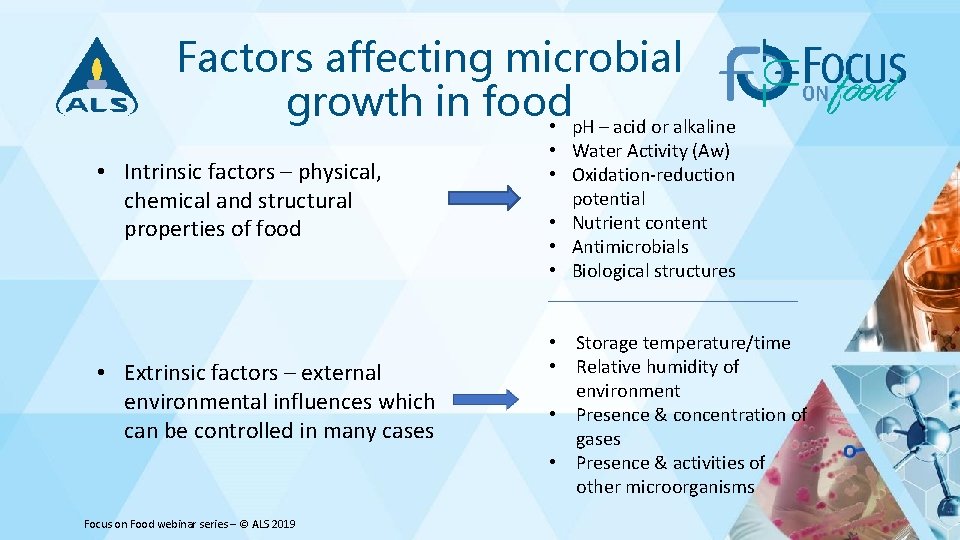
Factors affecting microbial growth in food • p. H – acid or alkaline • Intrinsic factors – physical, chemical and structural properties of food • Extrinsic factors – external environmental influences which can be controlled in many cases Focus on Food webinar series – © ALS 2019 • Water Activity (Aw) • Oxidation-reduction potential • Nutrient content • Antimicrobials • Biological structures • Storage temperature/time • Relative humidity of environment • Presence & concentration of gases • Presence & activities of other microorganisms
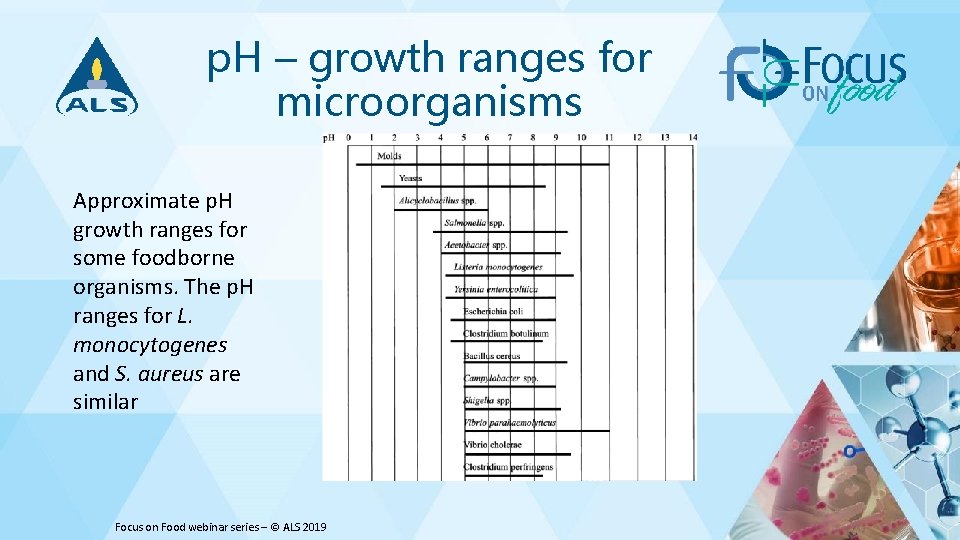
p. H – growth ranges for microorganisms Approximate p. H growth ranges for some foodborne organisms. The p. H ranges for L. monocytogenes and S. aureus are similar Focus on Food webinar series – © ALS 2019
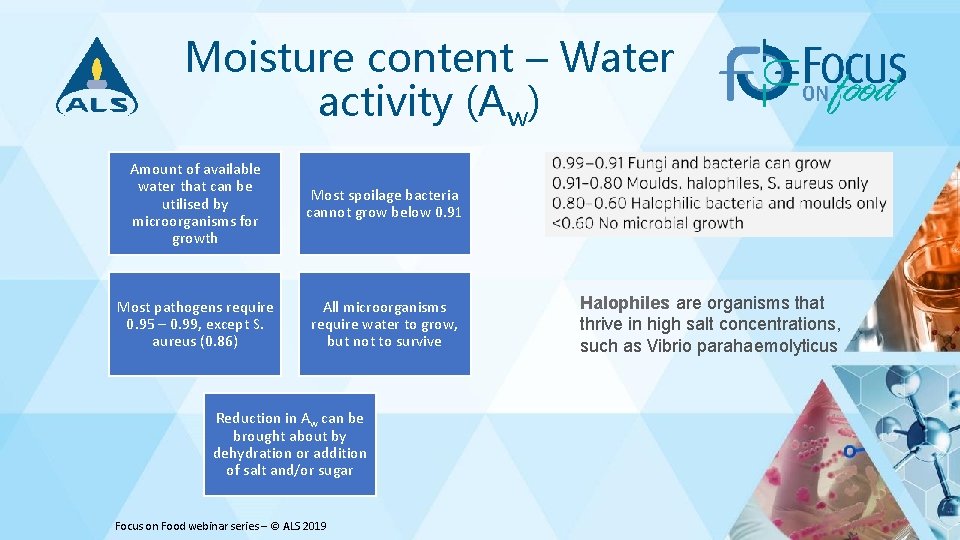
Moisture content – Water activity (Aw) Amount of available water that can be utilised by microorganisms for growth Most spoilage bacteria cannot grow below 0. 91 Most pathogens require 0. 95 – 0. 99, except S. aureus (0. 86) All microorganisms require water to grow, but not to survive Reduction in Aw can be brought about by dehydration or addition of salt and/or sugar Focus on Food webinar series – © ALS 2019 Halophiles are organisms that thrive in high salt concentrations, such as Vibrio parahaemolyticus
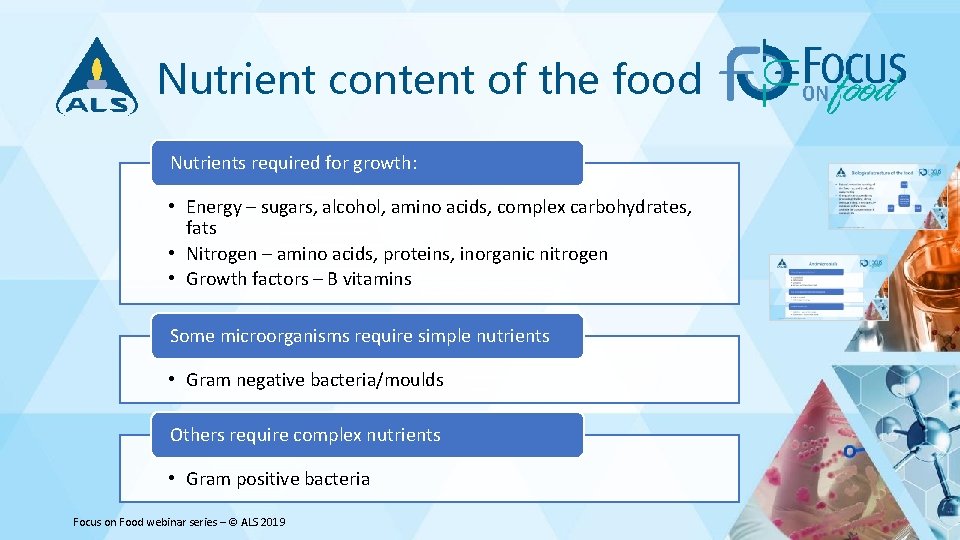
Nutrient content of the food Nutrients required for growth: • Energy – sugars, alcohol, amino acids, complex carbohydrates, fats • Nitrogen – amino acids, proteins, inorganic nitrogen • Growth factors – B vitamins Some microorganisms require simple nutrients • Gram negative bacteria/moulds Others require complex nutrients • Gram positive bacteria Focus on Food webinar series – © ALS 2019
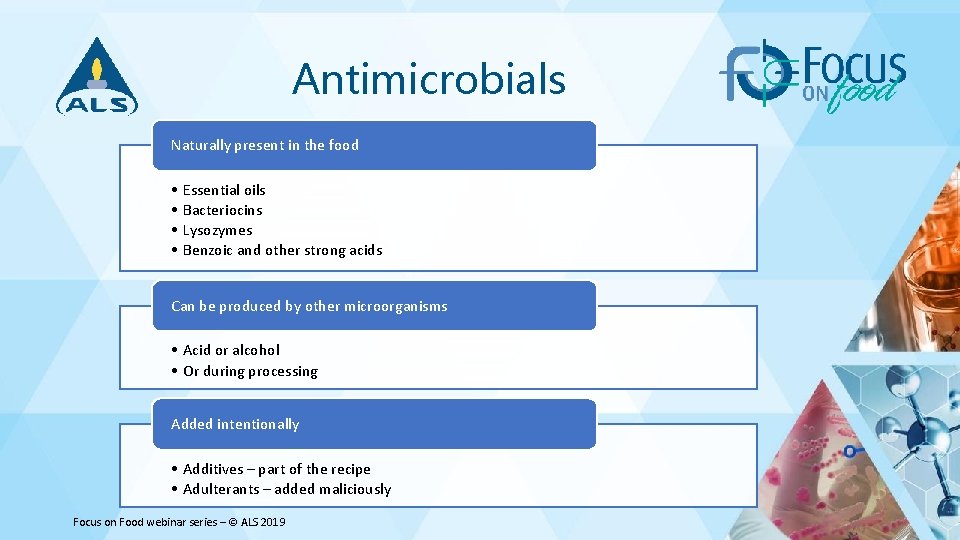
Antimicrobials Naturally present in the food • • Essential oils Bacteriocins Lysozymes Benzoic and other strong acids Can be produced by other microorganisms • Acid or alcohol • Or during processing Added intentionally • Additives – part of the recipe • Adulterants – added maliciously Focus on Food webinar series – © ALS 2019
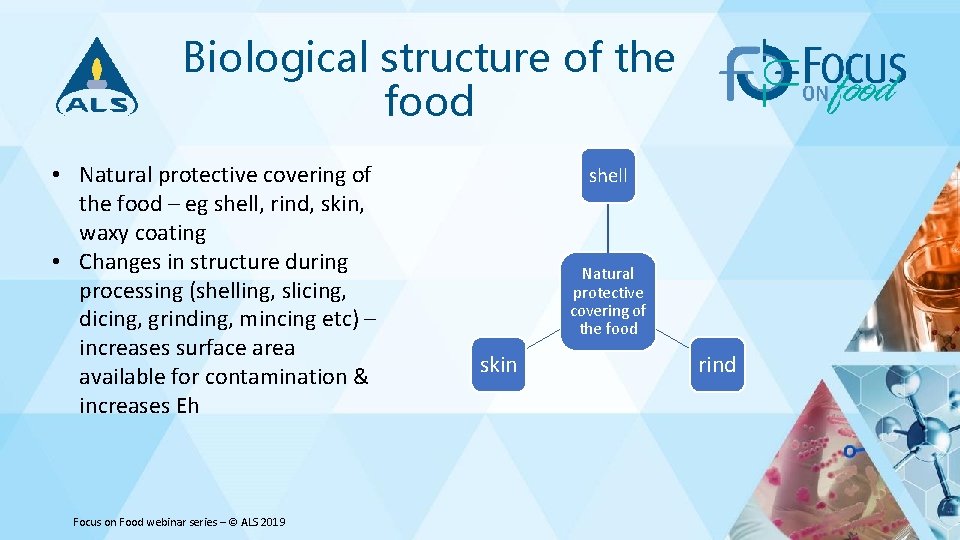
Biological structure of the food • Natural protective covering of the food – eg shell, rind, skin, waxy coating • Changes in structure during processing (shelling, slicing, dicing, grinding, mincing etc) – increases surface area available for contamination & increases Eh Focus on Food webinar series – © ALS 2019 shell Natural protective covering of the food skin rind
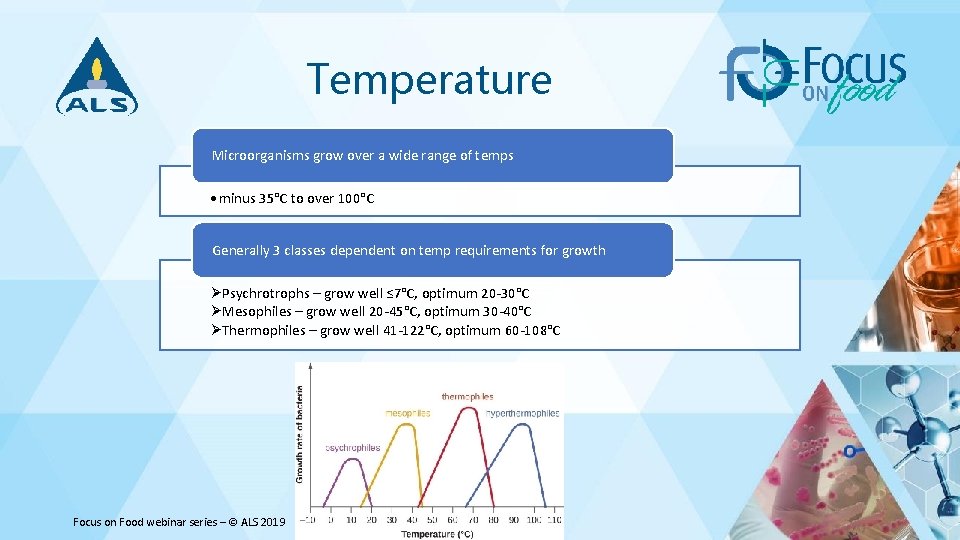
Temperature Microorganisms grow over a wide range of temps • minus 35°C to over 100°C Generally 3 classes dependent on temp requirements for growth ØPsychrotrophs – grow well ≤ 7°C, optimum 20 -30°C ØMesophiles – grow well 20 -45°C, optimum 30 -40°C ØThermophiles – grow well 41 -122°C, optimum 60 -108°C Focus on Food webinar series – © ALS 2019
Time Thawing and cooling • Time is an important control • Need to cool/thaw quickly to prevent multiplication Heat treatment • Important control, especially re core temperature • Pasteurisation, sterilisation Focus on Food webinar series – © ALS 2019
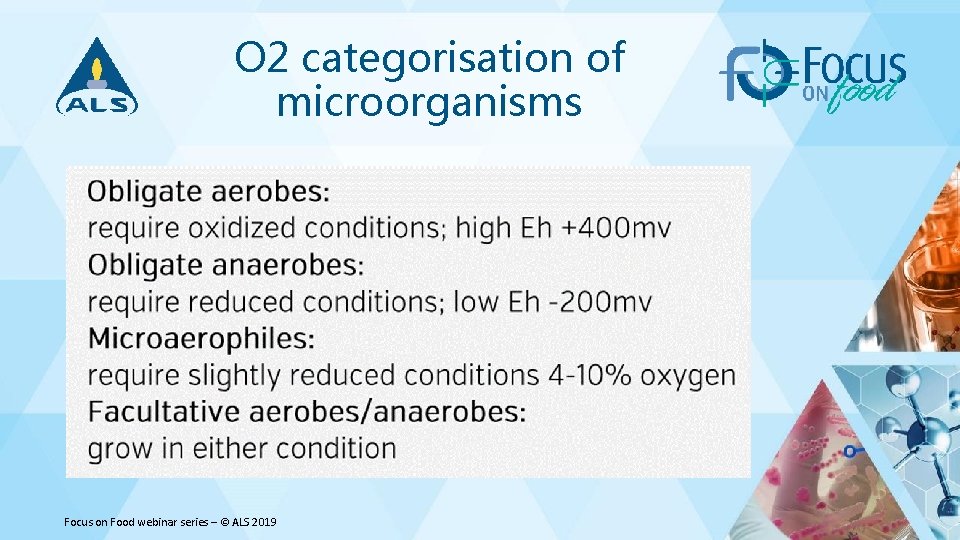
O 2 categorisation of microorganisms Focus on Food webinar series – © ALS 2019
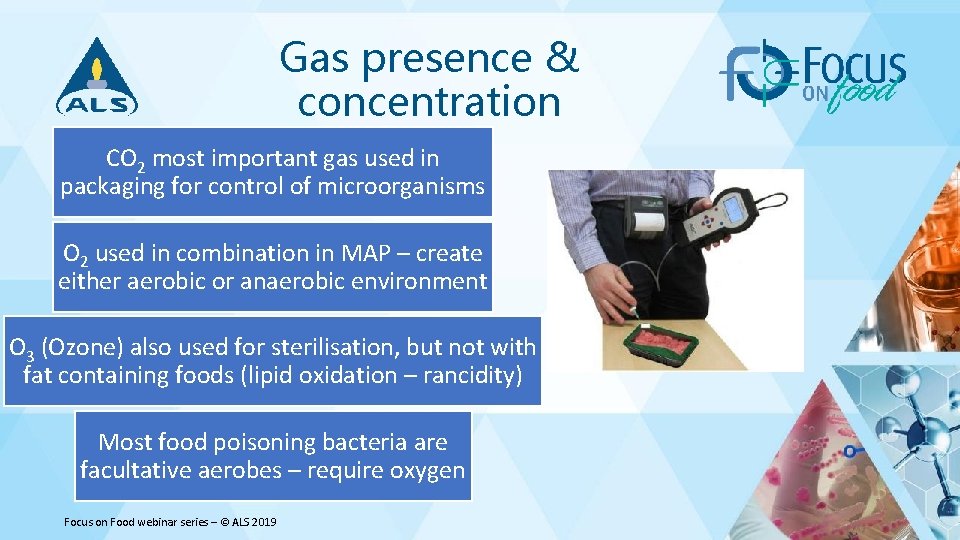
Gas presence & concentration CO 2 most important gas used in packaging for control of microorganisms O 2 used in combination in MAP – create either aerobic or anaerobic environment O 3 (Ozone) also used for sterilisation, but not with fat containing foods (lipid oxidation – rancidity) Most food poisoning bacteria are facultative aerobes – require oxygen Focus on Food webinar series – © ALS 2019
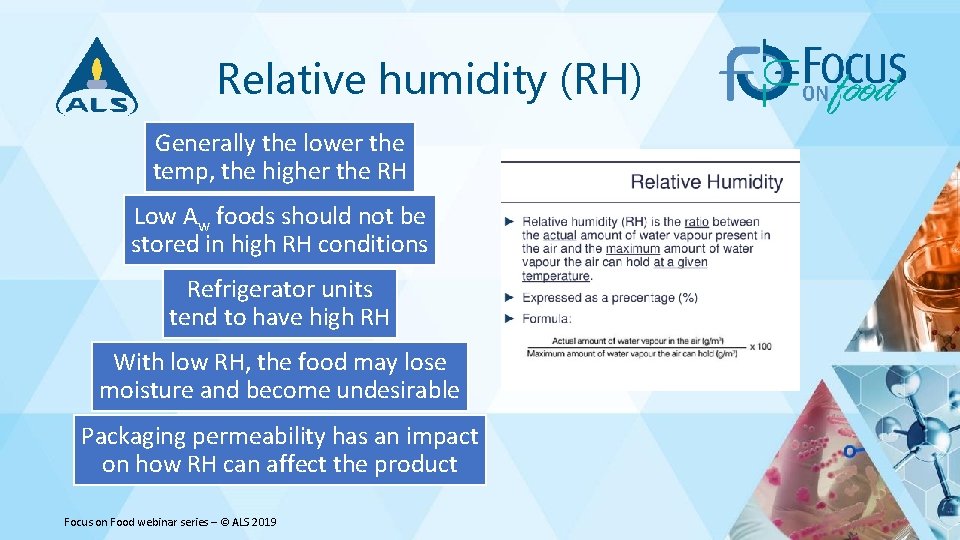
Relative humidity (RH) Generally the lower the temp, the higher the RH Low Aw foods should not be stored in high RH conditions Refrigerator units tend to have high RH With low RH, the food may lose moisture and become undesirable Packaging permeability has an impact on how RH can affect the product Focus on Food webinar series – © ALS 2019
Competition Presence of other microbes • Some produce substances that inhibit growth or kill others • Compete for nutrients and space Safer to have competing microbes • Achieves balance • Stops one species proliferating • Therefore, not just about the total numbers of microbes, but number of species present as well Focus on Food webinar series – © ALS 2019
Bacteria of concern Coliforms and E coli Listeria monocytogenes Salmonella Coagulase positive Staphylococcus aureus Bacillus cereus Clostridium perfringens Clostridium botulinum Focus on Food webinar series – © ALS 2019
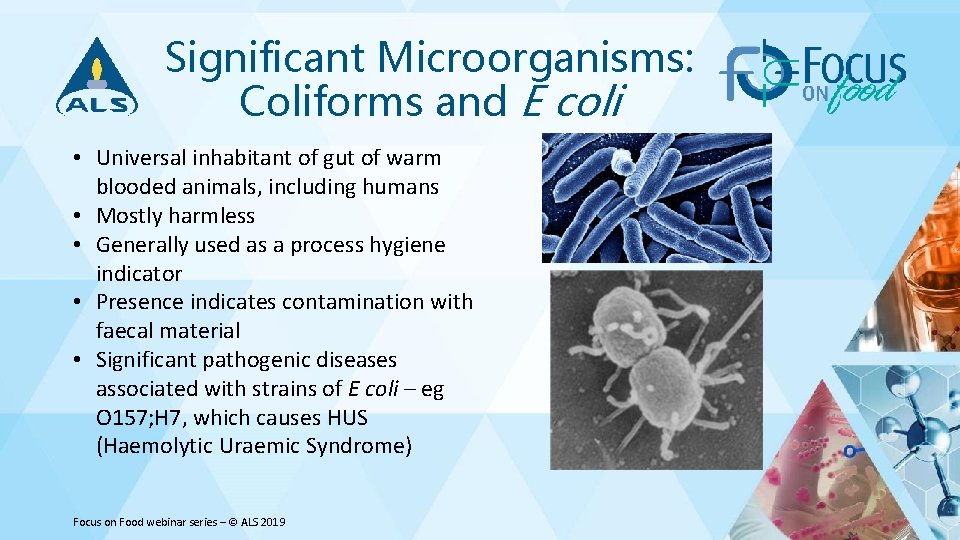
Significant Microorganisms: Coliforms and E coli • Universal inhabitant of gut of warm blooded animals, including humans • Mostly harmless • Generally used as a process hygiene indicator • Presence indicates contamination with faecal material • Significant pathogenic diseases associated with strains of E coli – eg O 157; H 7, which causes HUS (Haemolytic Uraemic Syndrome) Focus on Food webinar series – © ALS 2019
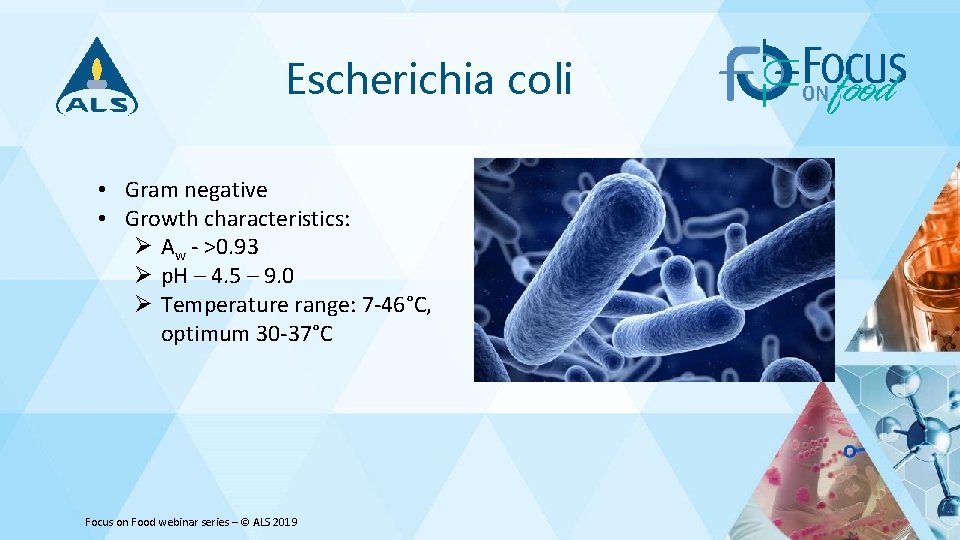
Escherichia coli • Gram negative • Growth characteristics: Ø Aw - >0. 93 Ø p. H – 4. 5 – 9. 0 Ø Temperature range: 7 -46°C, optimum 30 -37°C Focus on Food webinar series – © ALS 2019
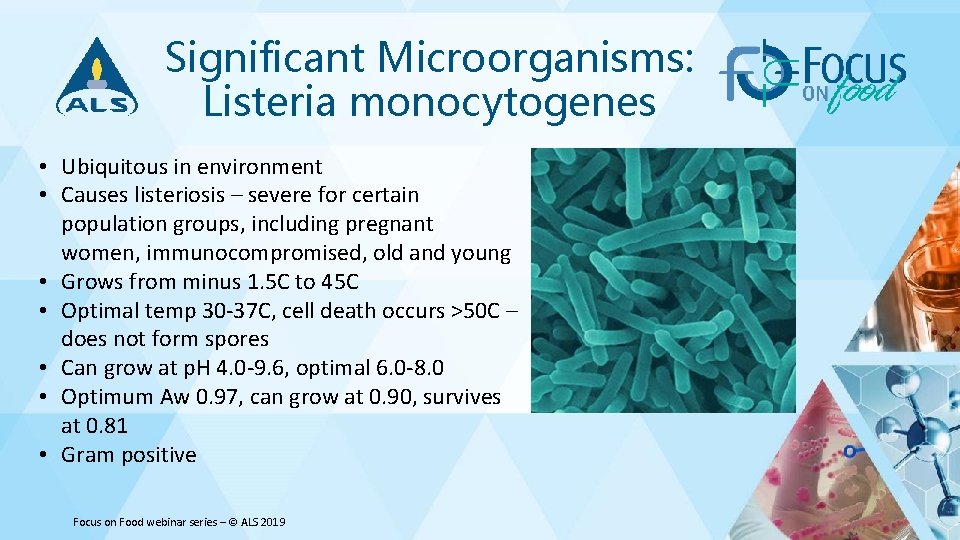
Significant Microorganisms: Listeria monocytogenes • Ubiquitous in environment • Causes listeriosis – severe for certain population groups, including pregnant women, immunocompromised, old and young • Grows from minus 1. 5 C to 45 C • Optimal temp 30 -37 C, cell death occurs >50 C – does not form spores • Can grow at p. H 4. 0 -9. 6, optimal 6. 0 -8. 0 • Optimum Aw 0. 97, can grow at 0. 90, survives at 0. 81 • Gram positive Focus on Food webinar series – © ALS 2019
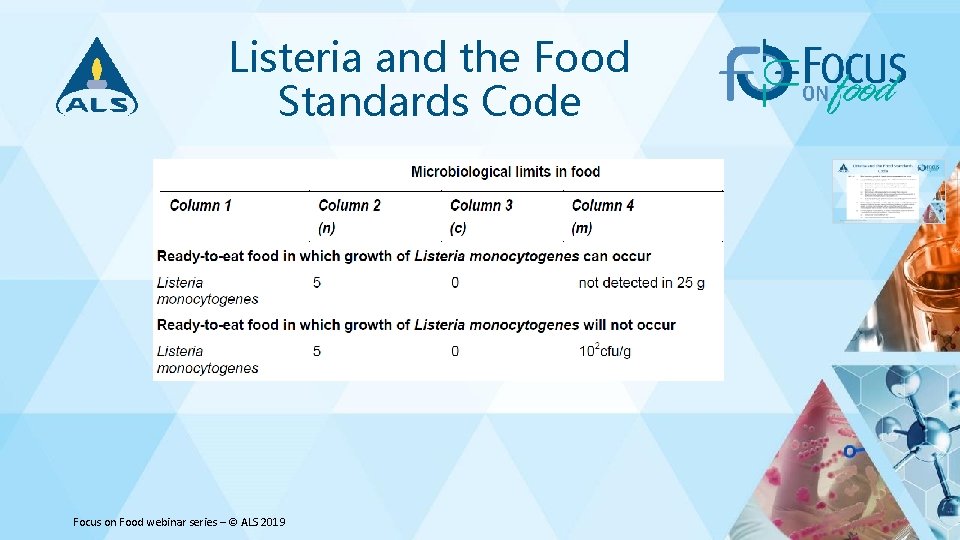
Listeria and the Food Standards Code Focus on Food webinar series – © ALS 2019
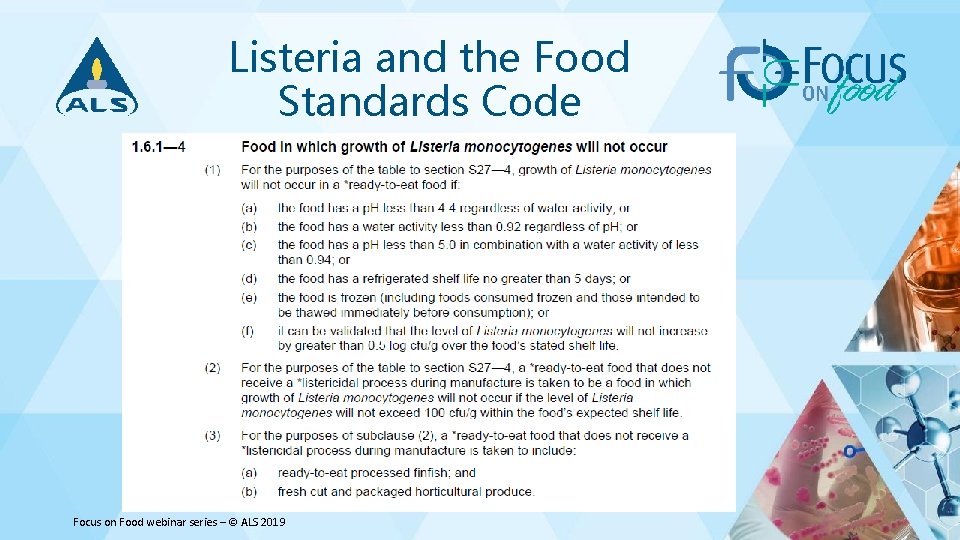
Listeria and the Food Standards Code Focus on Food webinar series – © ALS 2019
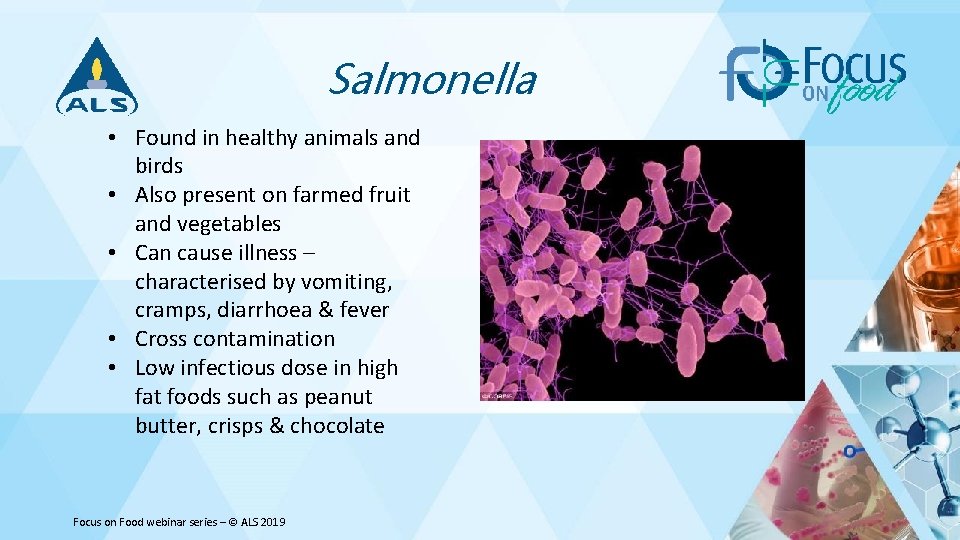
Salmonella • Found in healthy animals and birds • Also present on farmed fruit and vegetables • Can cause illness – characterised by vomiting, cramps, diarrhoea & fever • Cross contamination • Low infectious dose in high fat foods such as peanut butter, crisps & chocolate Focus on Food webinar series – © ALS 2019
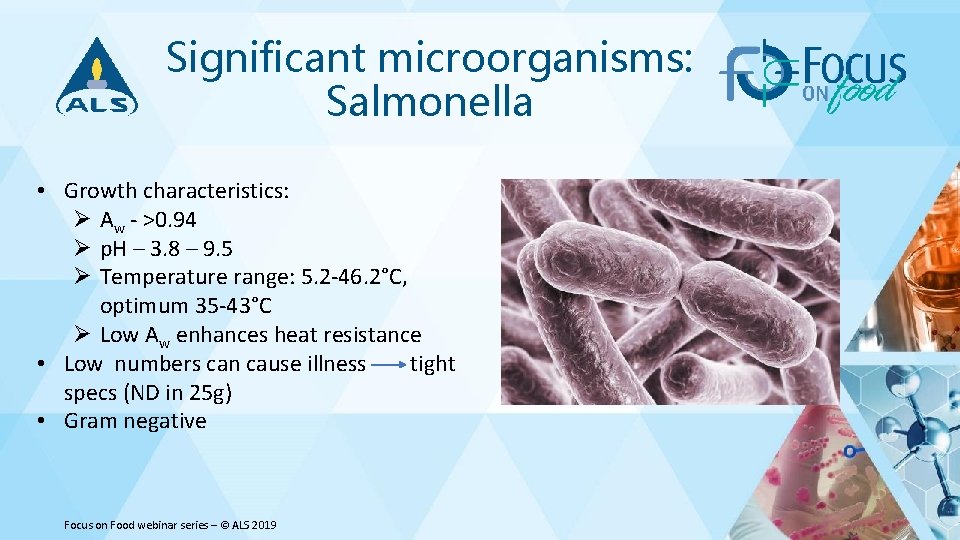
Significant microorganisms: Salmonella • Growth characteristics: Ø Aw - >0. 94 Ø p. H – 3. 8 – 9. 5 Ø Temperature range: 5. 2 -46. 2°C, optimum 35 -43°C Ø Low Aw enhances heat resistance • Low numbers can cause illness tight specs (ND in 25 g) • Gram negative Focus on Food webinar series – © ALS 2019
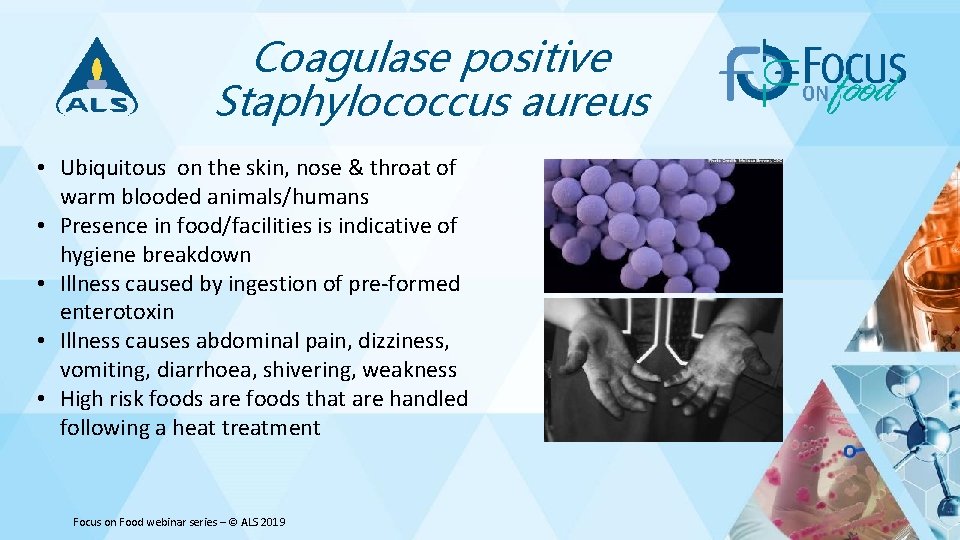
Coagulase positive Staphylococcus aureus • Ubiquitous on the skin, nose & throat of warm blooded animals/humans • Presence in food/facilities is indicative of hygiene breakdown • Illness caused by ingestion of pre-formed enterotoxin • Illness causes abdominal pain, dizziness, vomiting, diarrhoea, shivering, weakness • High risk foods are foods that are handled following a heat treatment Focus on Food webinar series – © ALS 2019
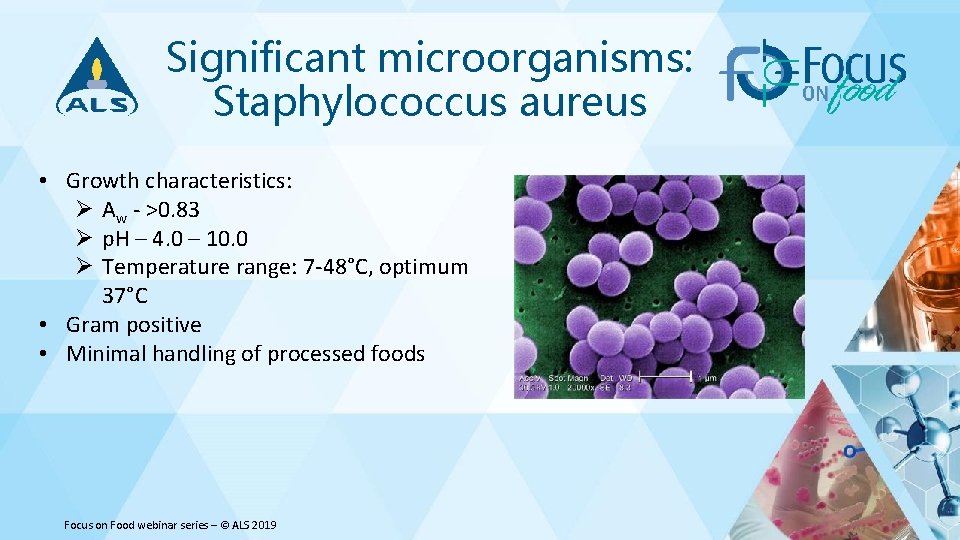
Significant microorganisms: Staphylococcus aureus • Growth characteristics: Ø Aw - >0. 83 Ø p. H – 4. 0 – 10. 0 Ø Temperature range: 7 -48°C, optimum 37°C • Gram positive • Minimal handling of processed foods Focus on Food webinar series – © ALS 2019
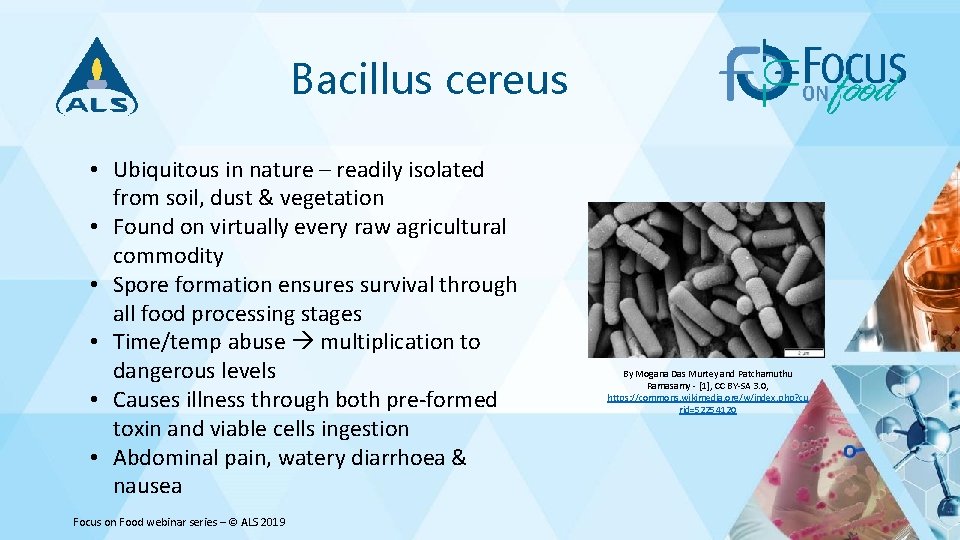
Bacillus cereus • Ubiquitous in nature – readily isolated from soil, dust & vegetation • Found on virtually every raw agricultural commodity • Spore formation ensures survival through all food processing stages • Time/temp abuse multiplication to dangerous levels • Causes illness through both pre-formed toxin and viable cells ingestion • Abdominal pain, watery diarrhoea & nausea Focus on Food webinar series – © ALS 2019 By Mogana Das Murtey and Patchamuthu Ramasamy - [1], CC BY-SA 3. 0, https: //commons. wikimedia. org/w/index. php? cu rid=52254120
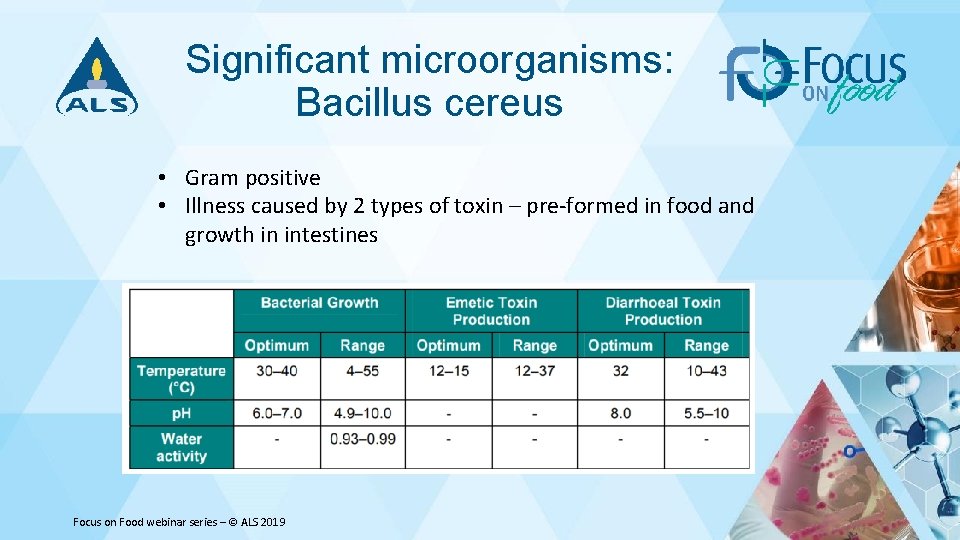
Significant microorganisms: Bacillus cereus • Gram positive • Illness caused by 2 types of toxin – pre-formed in food and growth in intestines Focus on Food webinar series – © ALS 2019
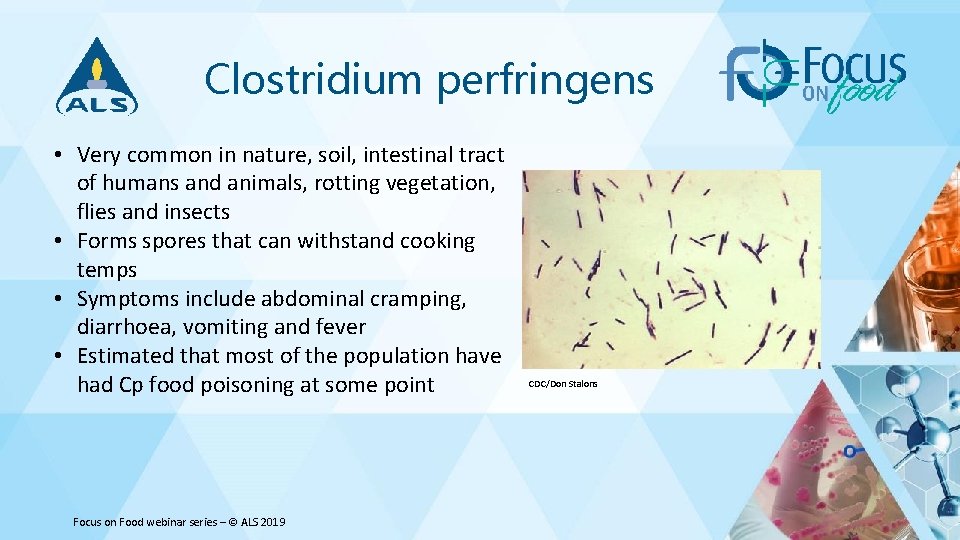
Clostridium perfringens • Very common in nature, soil, intestinal tract of humans and animals, rotting vegetation, flies and insects • Forms spores that can withstand cooking temps • Symptoms include abdominal cramping, diarrhoea, vomiting and fever • Estimated that most of the population have had Cp food poisoning at some point Focus on Food webinar series – © ALS 2019 CDC/Don Stalons
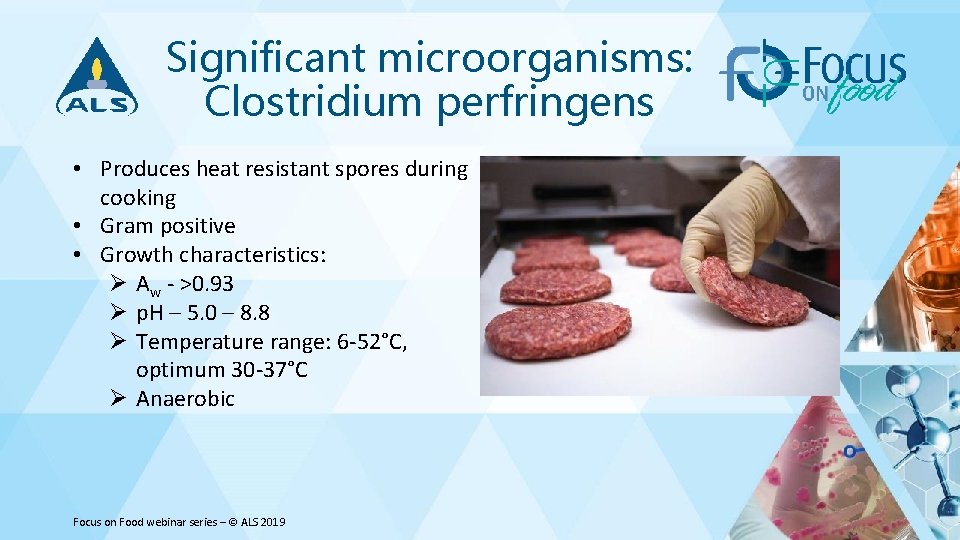
Significant microorganisms: Clostridium perfringens • Produces heat resistant spores during cooking • Gram positive • Growth characteristics: Ø Aw - >0. 93 Ø p. H – 5. 0 – 8. 8 Ø Temperature range: 6 -52°C, optimum 30 -37°C Ø Anaerobic Focus on Food webinar series – © ALS 2019
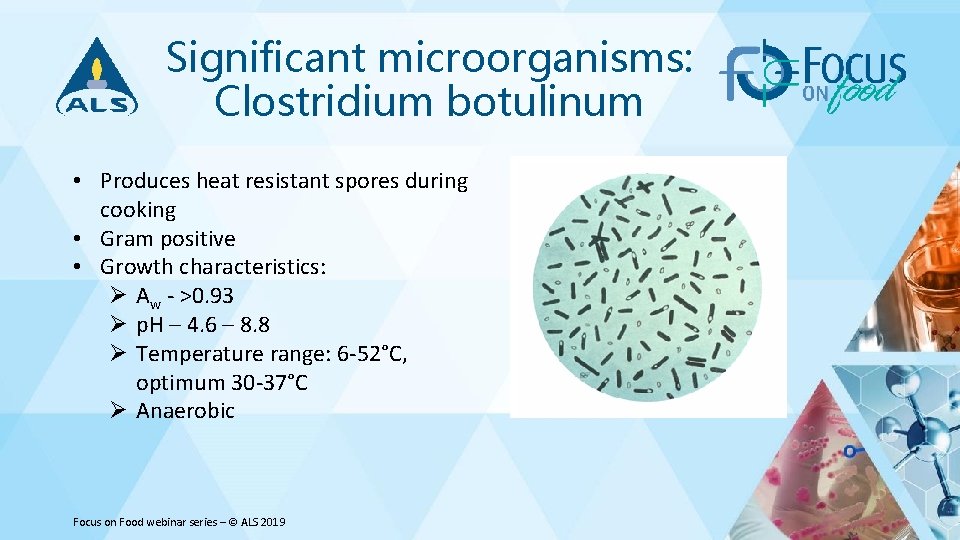
Significant microorganisms: Clostridium botulinum • Produces heat resistant spores during cooking • Gram positive • Growth characteristics: Ø Aw - >0. 93 Ø p. H – 4. 6 – 8. 8 Ø Temperature range: 6 -52°C, optimum 30 -37°C Ø Anaerobic Focus on Food webinar series – © ALS 2019
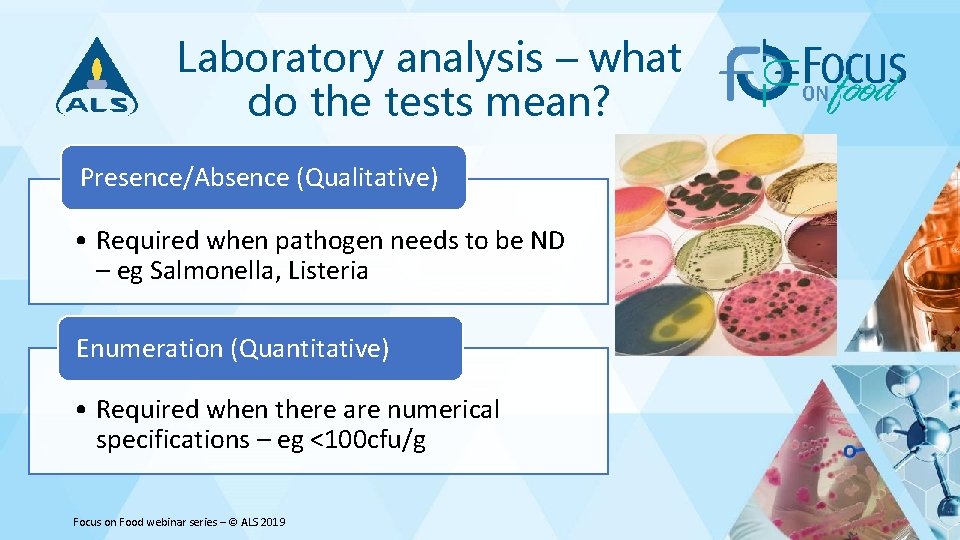
Laboratory analysis – what do the tests mean? Presence/Absence (Qualitative) • Required when pathogen needs to be ND – eg Salmonella, Listeria Enumeration (Quantitative) • Required when there are numerical specifications – eg <100 cfu/g Focus on Food webinar series – © ALS 2019
Lab analysis – rapid vs traditional methods ELISA vs AS • Automation vs labour intensive • 2 day TAT vs 4 day TAT • Both NATA accredited • Automated results interpretation vs labour intensive Focus on Food webinar series – © ALS 2019
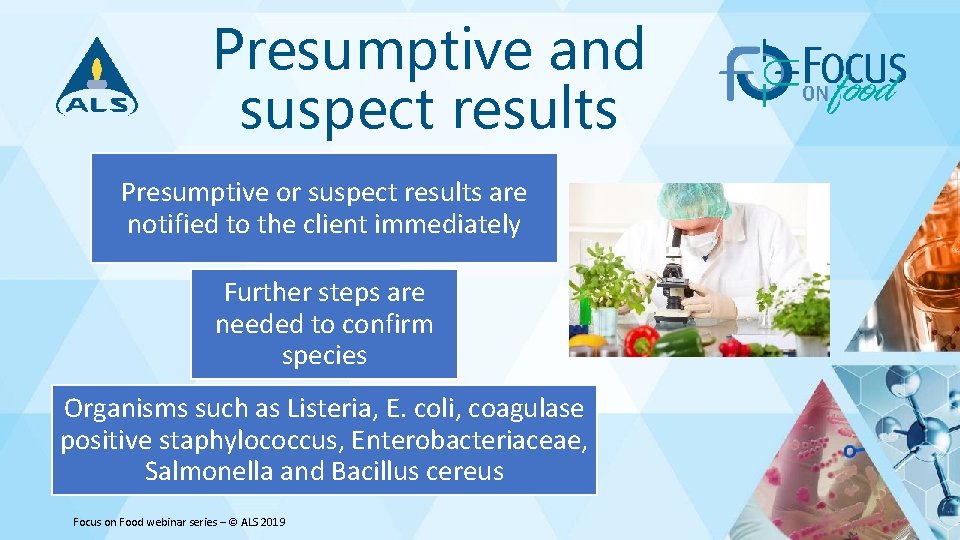
Presumptive and suspect results Presumptive or suspect results are notified to the client immediately Further steps are needed to confirm species Organisms such as Listeria, E. coli, coagulase positive staphylococcus, Enterobacteriaceae, Salmonella and Bacillus cereus Focus on Food webinar series – © ALS 2019
Why conduct micro testing? • POST Contamination down stream Ø If contamination occurs after a kill step, unwanted pathogens, spoilage microorganisms and spores can introduce a hazard to a “Safe” system • We have to verify that: Ø Products are safe, free of pathogens and spoilage microorganisms: no system is 100% safe Ø GMP, HACCP and Safety Systems are working by monitoring Ø Meet Customer requirements & Specifications Focus on Food webinar series – © ALS 2019
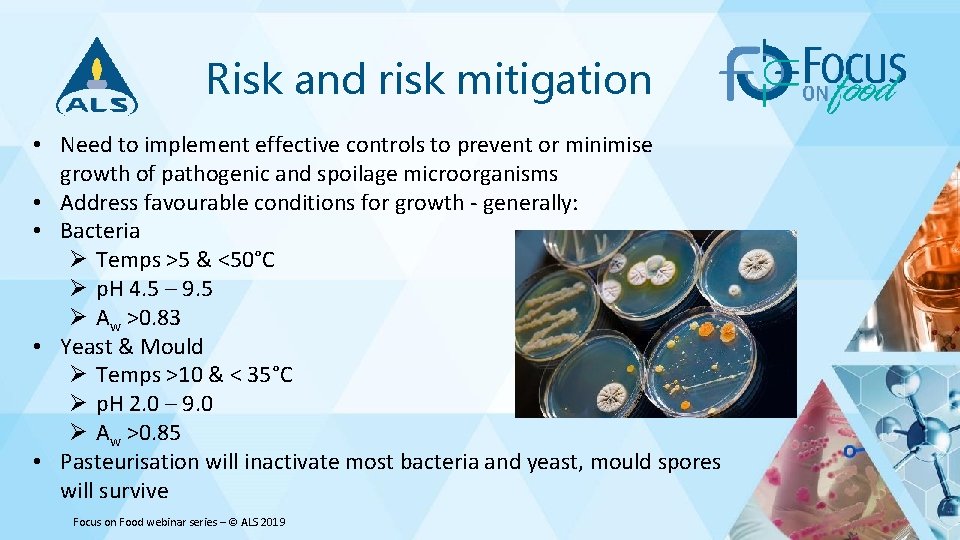
Risk and risk mitigation • Need to implement effective controls to prevent or minimise growth of pathogenic and spoilage microorganisms • Address favourable conditions for growth - generally: • Bacteria Ø Temps >5 & <50°C Ø p. H 4. 5 – 9. 5 Ø Aw >0. 83 • Yeast & Mould Ø Temps >10 & < 35°C Ø p. H 2. 0 – 9. 0 Ø Aw >0. 85 • Pasteurisation will inactivate most bacteria and yeast, mould spores will survive Focus on Food webinar series – © ALS 2019
Next webinar: Focus on … Basic Food Microbiology Part 2: Spoilage organisms and Yeast & Mould Sign up now: Nick Cork MAIFST Nick. cork@alsglobal. com 0476 830 459
- Slides: 49