
Focus Group Discussion Protocol Facilitator Training July 18



- Slides: 54
Focus Group Discussion Protocol Facilitator Training July 18 -19, 2017
TRAINING AGENDA Day 1: 9: 00 – 9: 30 am Coffee and Introductions 9: 30 – 11: 00 am Research Protocol and Study Aims 11: 00 am – 12: 30 pm Facilitation Techniques 12: 30 – 1: 30 pm Lunch Break 1: 30 – 4: 30 pm FGD Questionnaire Day 2: Practice Facilitation Egypt: Qualitative Study on Family Planning November 25, 2020 3
Introductions and ice breaking Egypt: Qualitative Study on Family Planning November 25, 2020 4
Save the Children Who are we? Save The Children • Founded in 1919 by Eglantyne Jebb in the aftermath of World War I. • Currently operating in 120 countries. • Operating in Egypt since 1982 • SCI programs Egypt: Qualitative Study on Family Planning November 25, 2020 5
FP PAC project RH services for refugee population • Mo. H side o Since January 2016, SC Egypt provided capacity building and training for service providers in five facilities in the Greater Cairo in areas with the highest populations of refugees, with the goal of improving family planning services. Four additional PHC facilities were added in March 2017. o SC also supported the creation of a PAC unit within one of these facilities, Imbaba General Hospital, and is currently in the process of advocating for an increase in the utilization of manual vacuum aspiration (MVA) services instead of dilation and curettage (D&C). • Refugee community side o SC Egypt has also recruited and trained community health workers (CHWs) to provide outreach and services to refugee women in the catchment areas where the PHCs are located. Currently SC employs 6 CHWs (refugee women), who are provided with the same training as CHWs employed through the Egyptian MOH. Egypt: Qualitative Study on Family Planning November 25, 2020 6
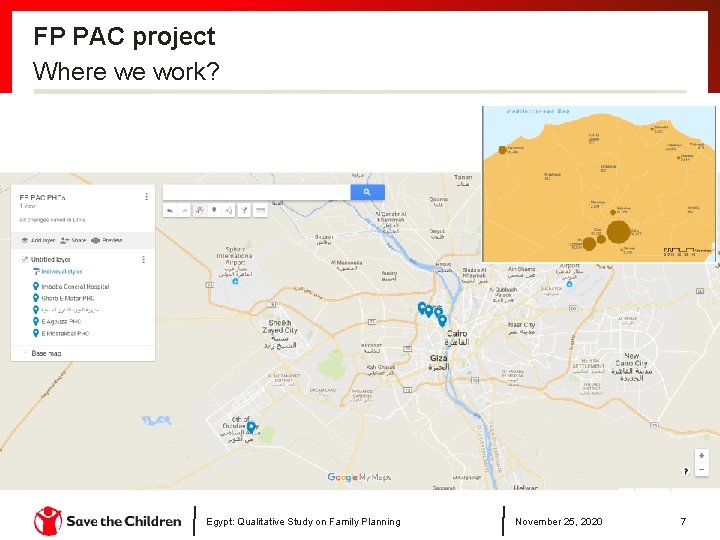
FP PAC project Where we work? Egypt: Qualitative Study on Family Planning November 25, 2020 7
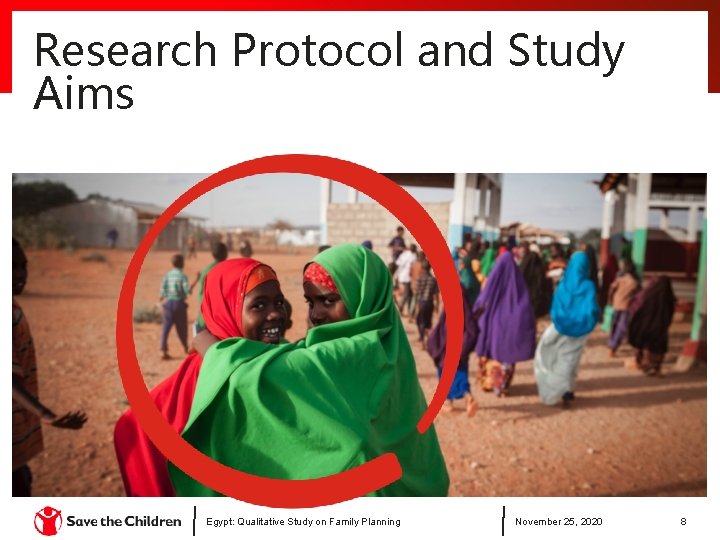
Research Protocol and Study Aims Egypt: Qualitative Study on Family Planning November 25, 2020 8
Study Aims FGD Protocol: FP in Egypt What are the research questions? 1. What are the facilitators and barriers to accessing FP services in greater Cairo? • Do these facilitators and differ between refugee and non -refugee populations? • Do these facilitators and barriers differ among refugee populations with different countries of origin? • Do these facilitators and barriers differ between women of different age groups? Egypt: Qualitative Study on Family Planning November 25, 2020 9
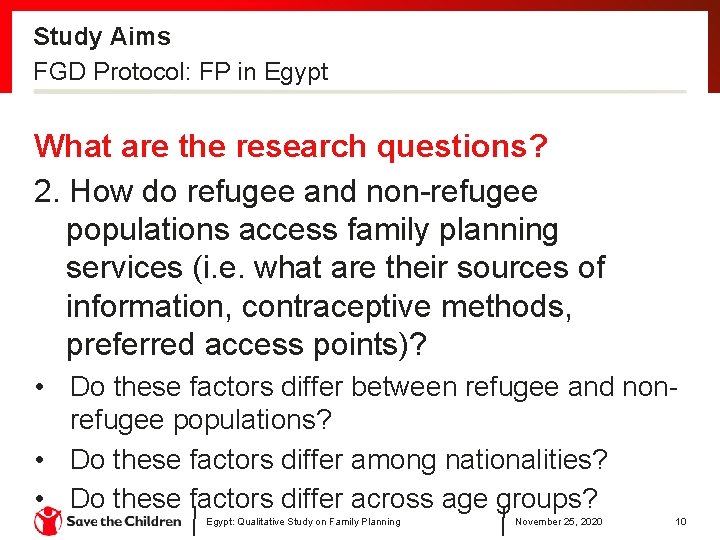
Study Aims FGD Protocol: FP in Egypt What are the research questions? 2. How do refugee and non-refugee populations access family planning services (i. e. what are their sources of information, contraceptive methods, preferred access points)? • Do these factors differ between refugee and nonrefugee populations? • Do these factors differ among nationalities? • Do these factors differ across age groups? Egypt: Qualitative Study on Family Planning November 25, 2020 10
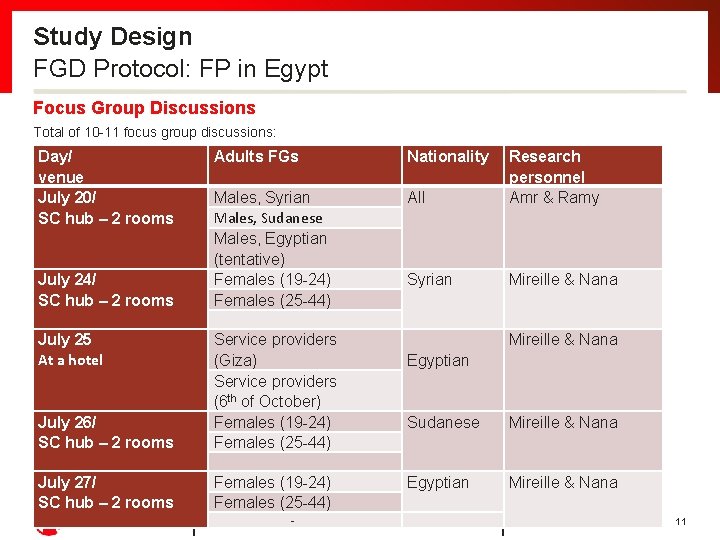
Study Design FGD Protocol: FP in Egypt Focus Group Discussions Total of 10 -11 focus group discussions: Day/ venue July 20/ SC hub – 2 rooms July 24/ SC hub – 2 rooms Adults FGs Males, Syrian Males, Sudanese Males, Egyptian (tentative) Females (19 -24) Females (25 -44) Nationality Research personnel All Amr & Ramy Syrian Mireille & Nana Egyptian Mireille & Nana July 26/ SC hub – 2 rooms Service providers (Giza) Service providers (6 th of October) Females (19 -24) Females (25 -44) Sudanese Mireille & Nana July 27/ SC hub – 2 rooms Females (19 -24) Females (25 -44) Egyptian Mireille & Nana July 25 At a hotel Egypt: Qualitative Study on Family Planning November 25, 2020 11
Hypothesis Biases Egypt: Qualitative Study on Family Planning November 25, 2020 12
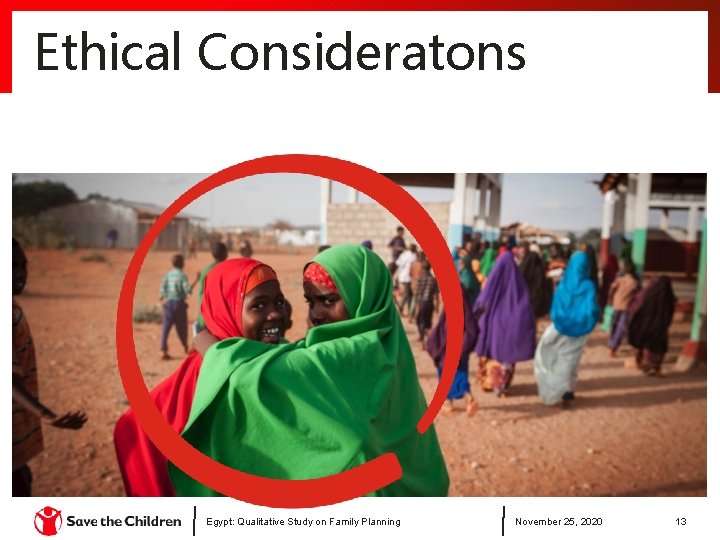
Ethical Consideratons Egypt: Qualitative Study on Family Planning November 25, 2020 13
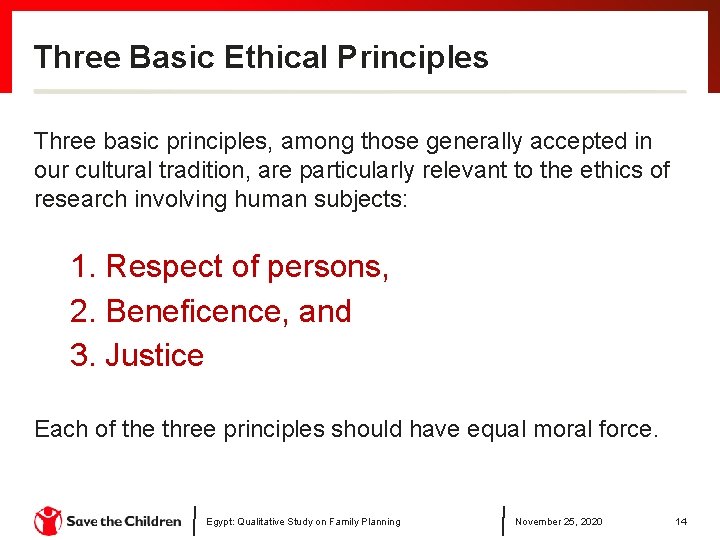
Three Basic Ethical Principles Three basic principles, among those generally accepted in our cultural tradition, are particularly relevant to the ethics of research involving human subjects: 1. Respect of persons, 2. Beneficence, and 3. Justice Each of the three principles should have equal moral force. Egypt: Qualitative Study on Family Planning November 25, 2020 14
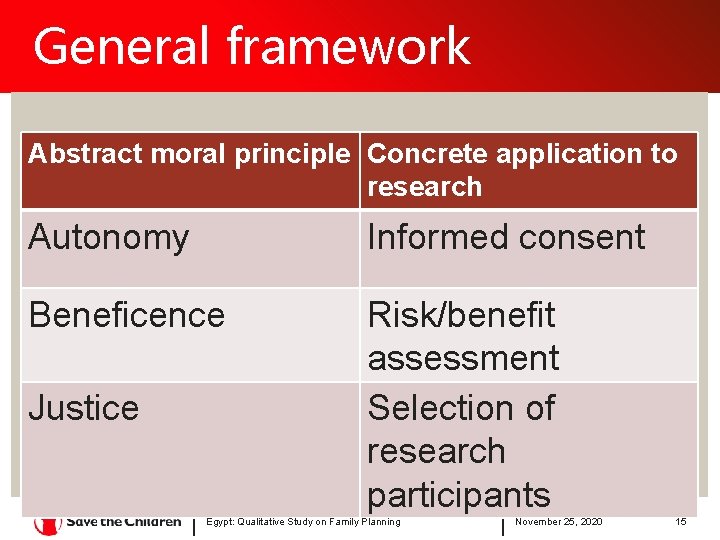
General framework Abstract moral principle Concrete application to research Autonomy Informed consent Beneficence Risk/benefit assessment Selection of research participants Justice Egypt: Qualitative Study on Family Planning November 25, 2020 15
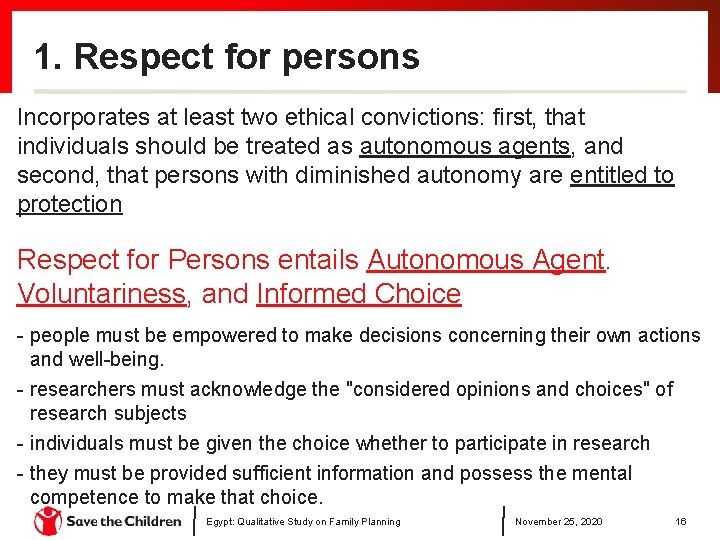
1. Respect for persons Incorporates at least two ethical convictions: first, that individuals should be treated as autonomous agents, and second, that persons with diminished autonomy are entitled to protection Respect for Persons entails Autonomous Agent. Voluntariness, and Informed Choice - people must be empowered to make decisions concerning their own actions and well-being. - researchers must acknowledge the "considered opinions and choices" of research subjects - individuals must be given the choice whether to participate in research - they must be provided sufficient information and possess the mental competence to make that choice. Egypt: Qualitative Study on Family Planning November 25, 2020 16
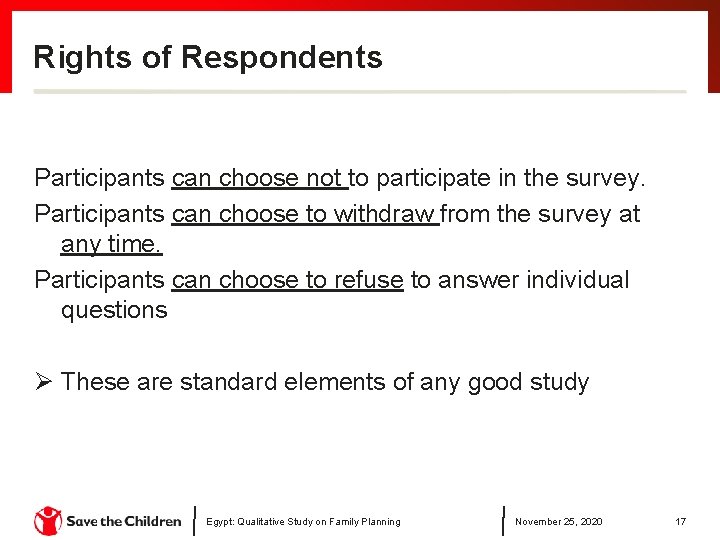
Rights of Respondents Participants can choose not to participate in the survey. Participants can choose to withdraw from the survey at any time. Participants can choose to refuse to answer individual questions Ø These are standard elements of any good study Egypt: Qualitative Study on Family Planning November 25, 2020 17
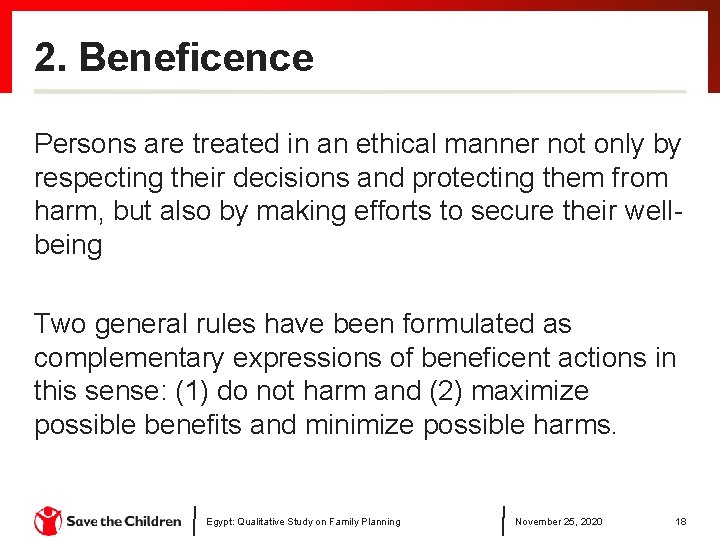
2. Beneficence Persons are treated in an ethical manner not only by respecting their decisions and protecting them from harm, but also by making efforts to secure their wellbeing Two general rules have been formulated as complementary expressions of beneficent actions in this sense: (1) do not harm and (2) maximize possible benefits and minimize possible harms. Egypt: Qualitative Study on Family Planning November 25, 2020 18
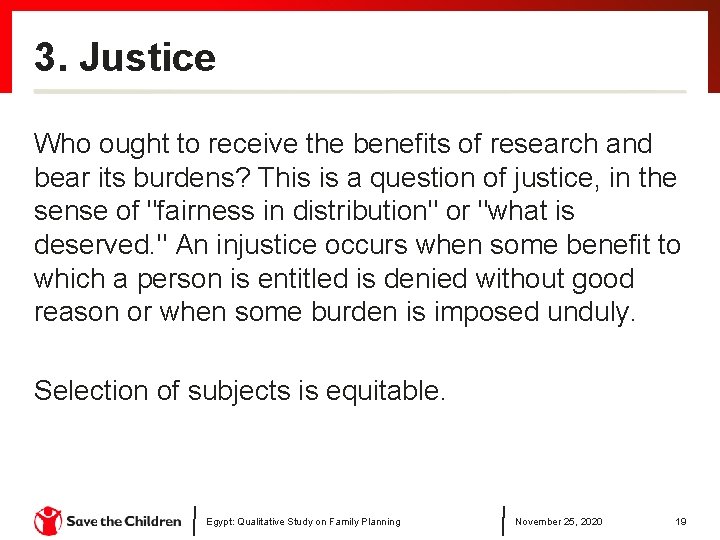
3. Justice Who ought to receive the benefits of research and bear its burdens? This is a question of justice, in the sense of "fairness in distribution" or "what is deserved. " An injustice occurs when some benefit to which a person is entitled is denied without good reason or when some burden is imposed unduly. Selection of subjects is equitable. Egypt: Qualitative Study on Family Planning November 25, 2020 19
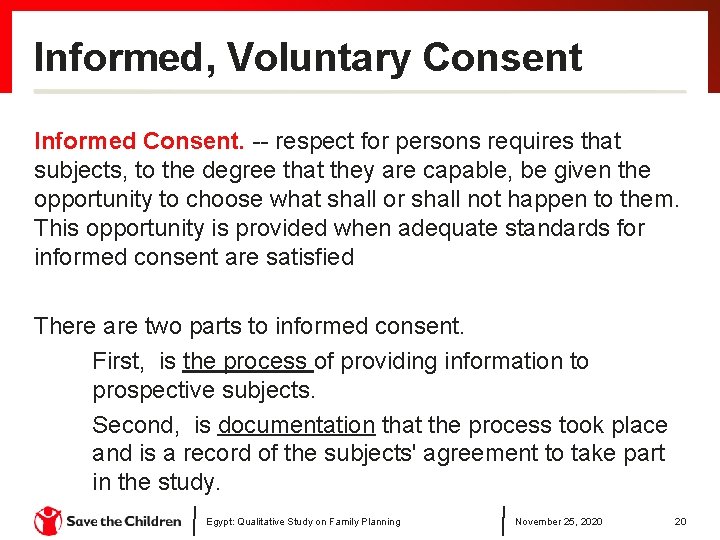
Informed, Voluntary Consent Informed Consent. -- respect for persons requires that subjects, to the degree that they are capable, be given the opportunity to choose what shall or shall not happen to them. This opportunity is provided when adequate standards for informed consent are satisfied There are two parts to informed consent. First, is the process of providing information to prospective subjects. Second, is documentation that the process took place and is a record of the subjects' agreement to take part in the study. Egypt: Qualitative Study on Family Planning November 25, 2020 20
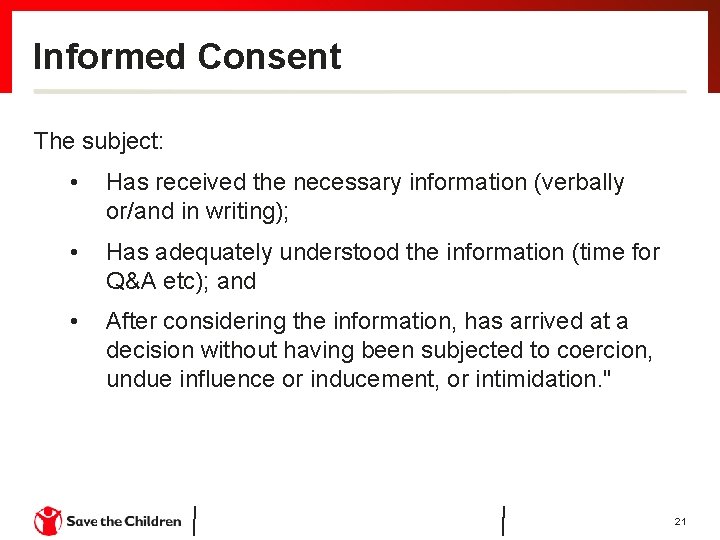
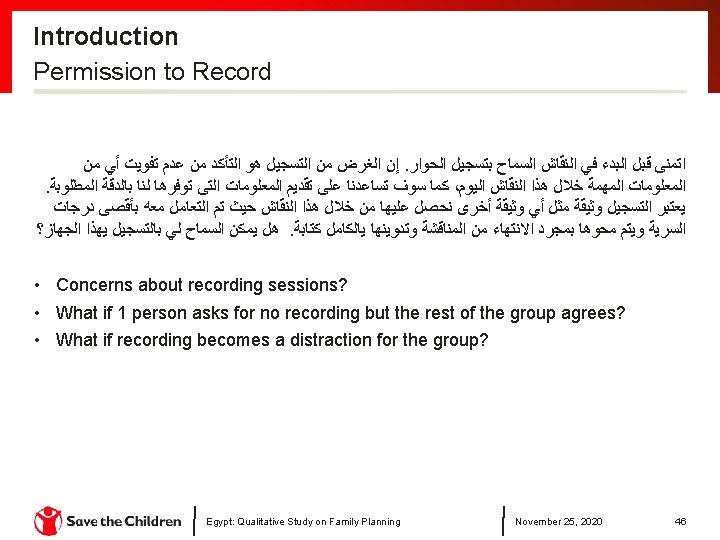
Informed Consent The subject: • Has received the necessary information (verbally or/and in writing); • Has adequately understood the information (time for Q&A etc); and • After considering the information, has arrived at a decision without having been subjected to coercion, undue influence or inducement, or intimidation. " 21
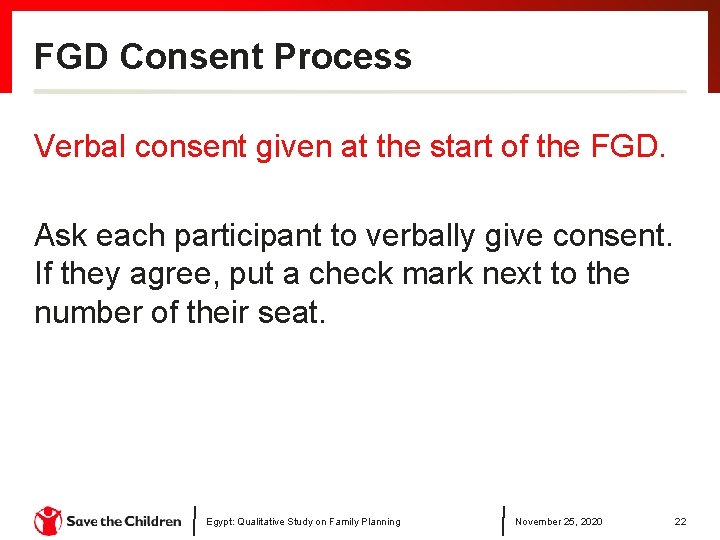
FGD Consent Process Verbal consent given at the start of the FGD. Ask each participant to verbally give consent. If they agree, put a check mark next to the number of their seat. Egypt: Qualitative Study on Family Planning November 25, 2020 22
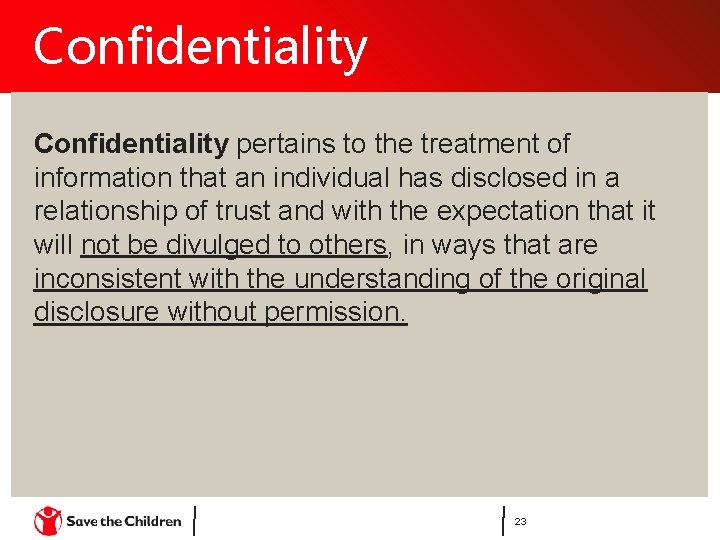
Confidentiality pertains to the treatment of information that an individual has disclosed in a relationship of trust and with the expectation that it will not be divulged to others, in ways that are inconsistent with the understanding of the original disclosure without permission. 23
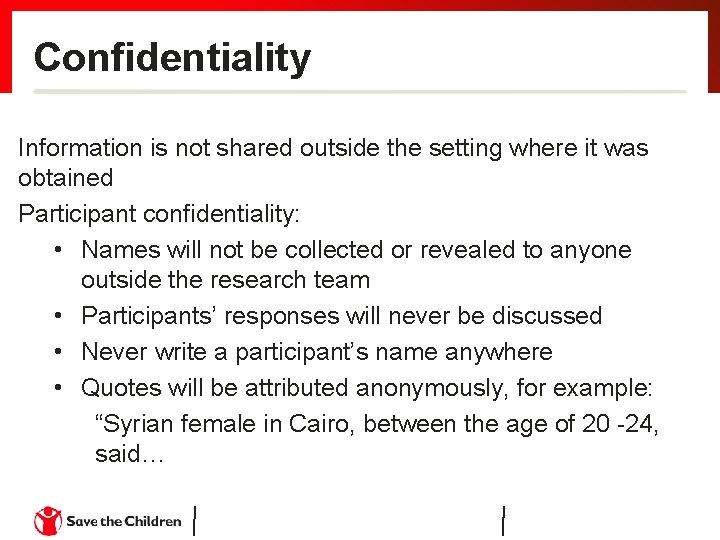
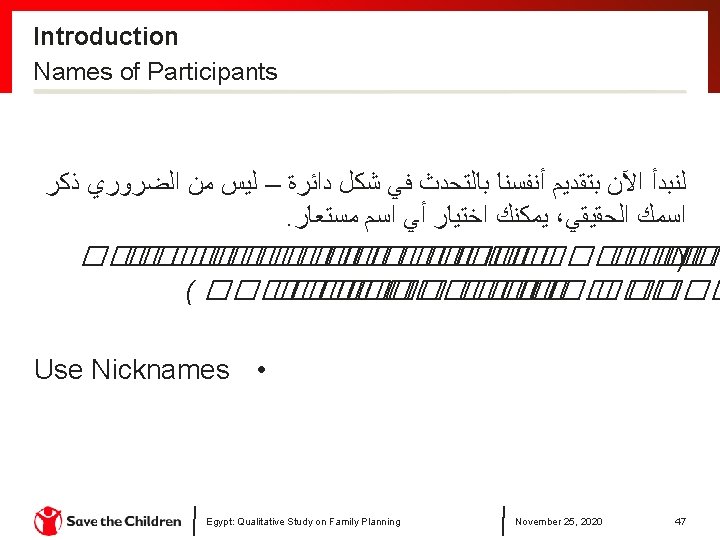
Confidentiality Information is not shared outside the setting where it was obtained Participant confidentiality: • Names will not be collected or revealed to anyone outside the research team • Participants’ responses will never be discussed • Never write a participant’s name anywhere • Quotes will be attributed anonymously, for example: “Syrian female in Cairo, between the age of 20 -24, said…
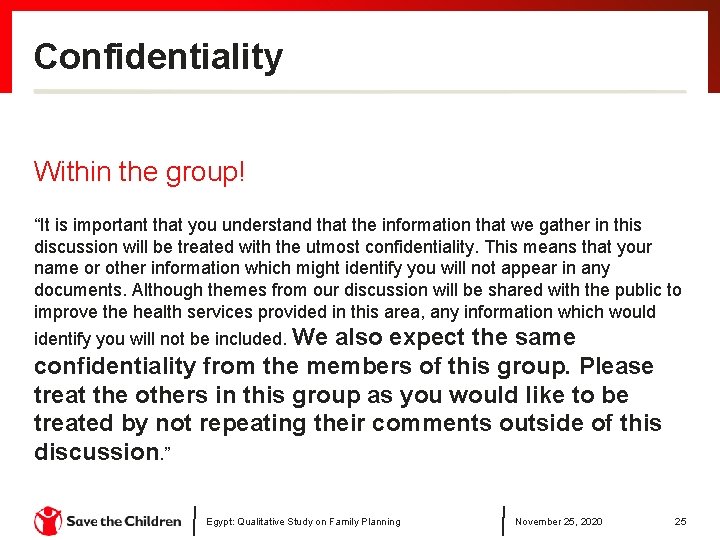
Confidentiality Within the group! “It is important that you understand that the information that we gather in this discussion will be treated with the utmost confidentiality. This means that your name or other information which might identify you will not appear in any documents. Although themes from our discussion will be shared with the public to improve the health services provided in this area, any information which would identify you will not be included. We also expect the same confidentiality from the members of this group. Please treat the others in this group as you would like to be treated by not repeating their comments outside of this discussion. ” Egypt: Qualitative Study on Family Planning November 25, 2020 25
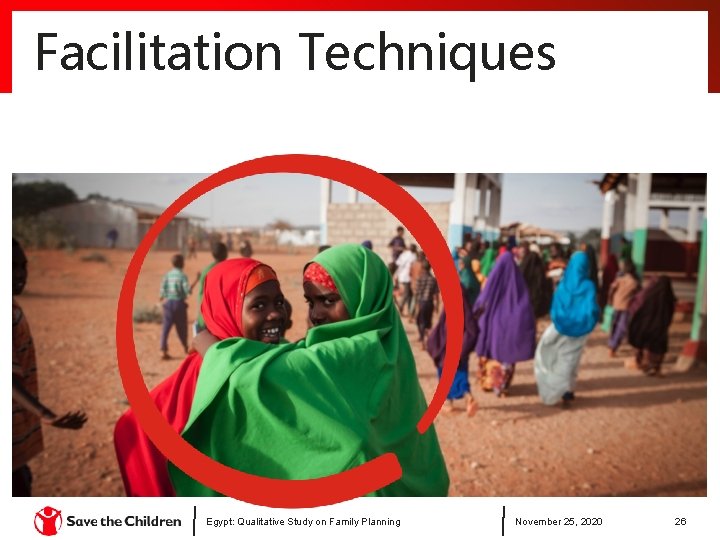
Facilitation Techniques Egypt: Qualitative Study on Family Planning November 25, 2020 26
Qualitative research Focus group discussions • Duration: From one to two hours • Number of participants: usually 8 -10 with a maximum of 12 • Participants recruitment: according to selection criteria/ inclusion questionnaire • Researchers: a moderator and note-taker • Seating: mostly circular, in a private quiet room • Data: audio recordings, notes, transcripts • Analysis: Excel, Nvivo • Consent: participants should be clearly informed by research objectives and implementing organizations, they should give verbal or written consent on participation and audio recording. • Ethical considerations: Participation is always voluntary, if a participant is not comfortable to answer a question or wanted to leave, allow him/her. • Confidentiality • House rules: respect, no judgments, keep it confidential, no side talks, mobiles off, quiet movement if necessary, • No influence: do not answer questions requiring information on services before or during the discussion, maybe after it ends. Egypt: Qualitative Study on Family Planning November 25, 2020 27
Characteristics of a Good Moderator FGD Protocol: FP in Egypt Adequate Knowledge • Facilitators should have basic knowledge of the subject matter in order to direct the conversation • Familiarize yourself with the consent form and discussion guide before data collection. • Practice facilitating a session beforehand to get a good understanding of the questions and topic Effective questioning • Ask open ended questions, avoid leading ones, and always be neutral • Be neutral, avoid using comments like “good”, “interesting”, or give surprised reactions like “no way!”. Instead, you can node, repeat participants comments or use comments like “huuh”, “I see”, “any other comments? ” • Rephrase the question if needed, but keep the meaning • One question at a time • Use follow-up questions and probes effectively Egypt: Qualitative Study on Family Planning November 25, 2020 28
Characteristics of a Good Moderator FGD Protocol: FP in Egypt Listening Skills • Build rapport, smile, be friendly and humble, maintain eye contact • Never judge an opinion or let this happen among participants • The role of the facilitators is to encourage the group to speak rather than to talk through the session • Asking good quality follow-up questions is only possible if you are listening carefully Egypt: Qualitative Study on Family Planning November 25, 2020 29
Characteristics of a Good Moderator FGD Protocol: FP in Egypt Patience and Flexibility • When the discussion does not go as planned or there are interruptions, the facilitator should be able to calmly respond to steer the discussion Egypt: Qualitative Study on Family Planning November 25, 2020 30
Characteristics of a Good Moderator FGD Protocol: FP in Egypt Observation Skills • Listening is not enough, the facilitator should watch for participants’ reactions, which could indicate boredom, anxiety, tiredness or impatience, and be able to respond Egypt: Qualitative Study on Family Planning November 25, 2020 31
Moderator Skills: Asking Good Questions FGD Protocol: FP in Egypt Types of Follow-up Questions to Avoid DON’T ASK: • Yes or No questions: “Are family planning services available in your area? ” • Leading questions: “Don’t you think that the family planning services in your area need improvement? ” • Vague or unclear questions: “What do you think about family planning” Egypt: Qualitative Study on Family Planning November 25, 2020 32
Moderator Skills: Asking Good Questions FGD Protocol: FP in Egypt Types of Follow-up Questions to Use INSTEAD, ASK: • Open-ended questions: ”What types of family planning services are available in your area” • Compare and contrast questions: “How are the family planning services in your area different from the family planning services offered in other areas? How are they the same? ” • Clarifying questions: “What do you mean when you say that you do not believe married women should use family planning? ” – “Explain more about why your husband does not want you to use family planning. ” Egypt: Qualitative Study on Family Planning November 25, 2020 33
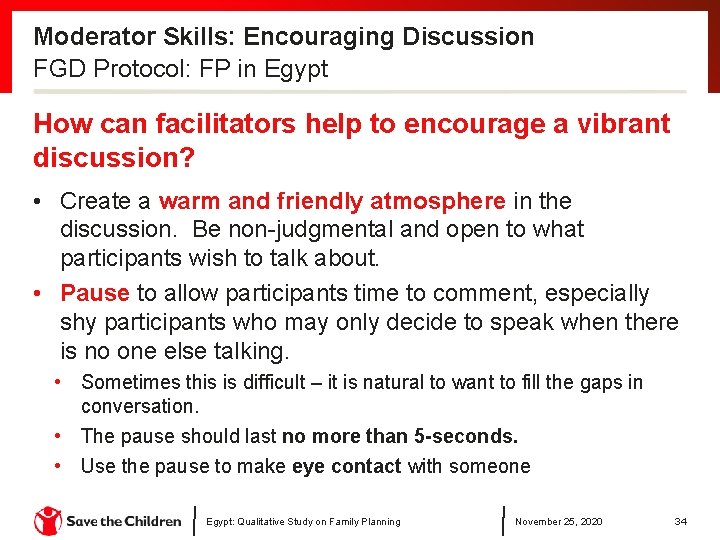
Moderator Skills: Encouraging Discussion FGD Protocol: FP in Egypt How can facilitators help to encourage a vibrant discussion? • Create a warm and friendly atmosphere in the discussion. Be non-judgmental and open to what participants wish to talk about. • Pause to allow participants time to comment, especially shy participants who may only decide to speak when there is no one else talking. • Sometimes this is difficult – it is natural to want to fill the gaps in conversation. • The pause should last no more than 5 -seconds. • Use the pause to make eye contact with someone Egypt: Qualitative Study on Family Planning November 25, 2020 34
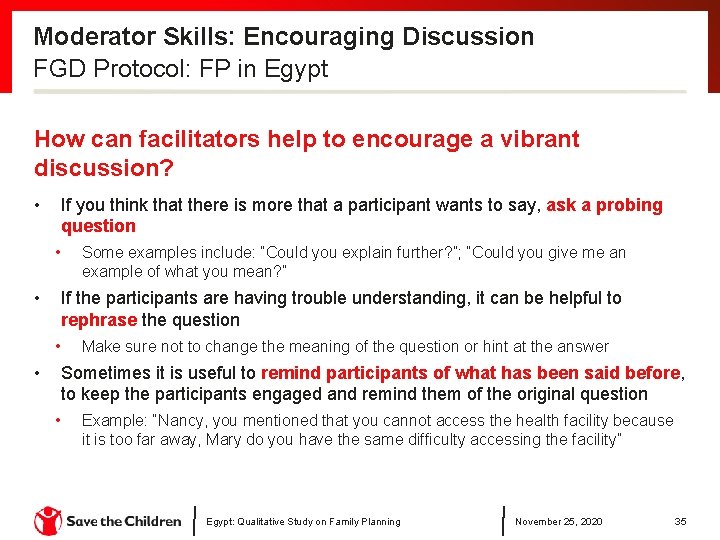
Moderator Skills: Encouraging Discussion FGD Protocol: FP in Egypt How can facilitators help to encourage a vibrant discussion? • If you think that there is more that a participant wants to say, ask a probing question • • Some examples include: “Could you explain further? ”; “Could you give me an example of what you mean? ” If the participants are having trouble understanding, it can be helpful to rephrase the question • • Make sure not to change the meaning of the question or hint at the answer Sometimes it is useful to remind participants of what has been said before, to keep the participants engaged and remind them of the original question • Example: “Nancy, you mentioned that you cannot access the health facility because it is too far away, Mary do you have the same difficulty accessing the facility” Egypt: Qualitative Study on Family Planning November 25, 2020 35
Moderator Skills: Dealing with Specific Individuals FGD Protocol: FP in Egypt “The Expert” • This may be a person who is considered to have a lot of knowledge (either by themselves or by others) • Although this person would have a lot to contribute, they should not be allowed to take over the conversation Egypt: Qualitative Study on Family Planning November 25, 2020 36
Moderator Skills: Dealing with Specific Individuals FGD Protocol: FP in Egypt “The Dominant Talker” • These are the people who want to answer questions for the entire group. They often answer questions immediately and prevent others from speaking • If possible, try to identify the dominant talkers before the discussion begins and seat them next to the facilitator • If the talker continues for a long time, the moderator can use body language (turning away from the talker, avoiding eye contact) to stop them. Or ask others to comment. Egypt: Qualitative Study on Family Planning November 25, 2020 37
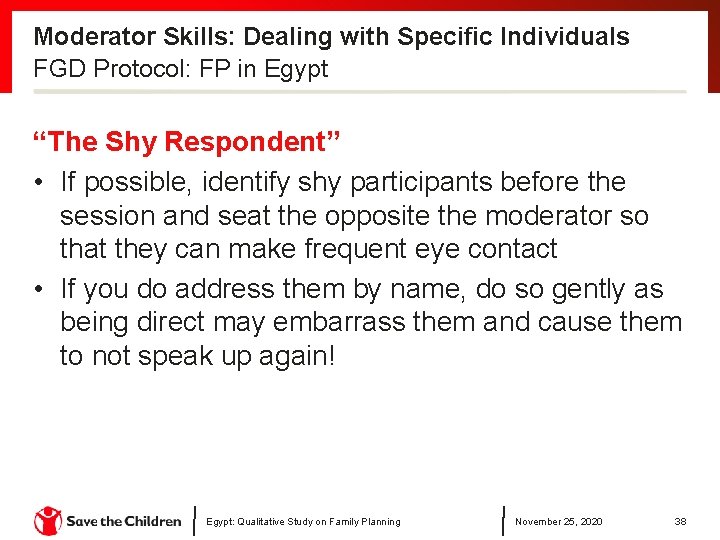
Moderator Skills: Dealing with Specific Individuals FGD Protocol: FP in Egypt “The Shy Respondent” • If possible, identify shy participants before the session and seat the opposite the moderator so that they can make frequent eye contact • If you do address them by name, do so gently as being direct may embarrass them and cause them to not speak up again! Egypt: Qualitative Study on Family Planning November 25, 2020 38
Moderator Skills: Dealing with Specific Individuals FGD Protocol: FP in Egypt “Tired” • If more than one participant begins to appear tired or irritable, it may be time to take a break. Encourage people to get up and move around, use the restroom, and have refreshments. Egypt: Qualitative Study on Family Planning November 25, 2020 39
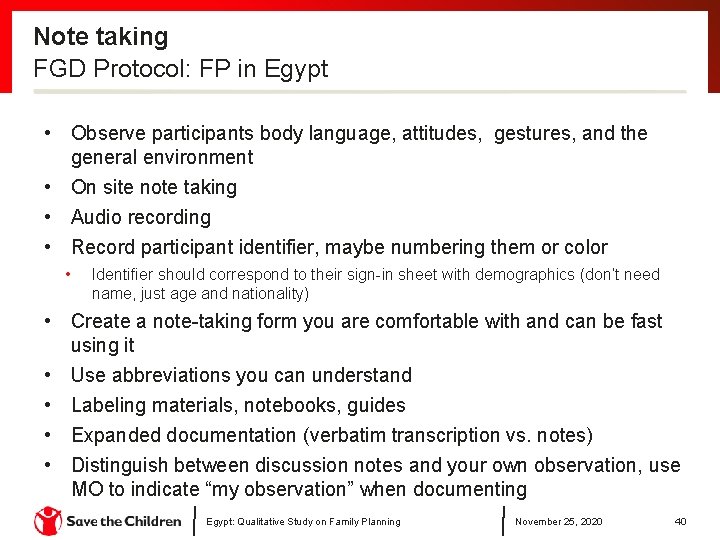
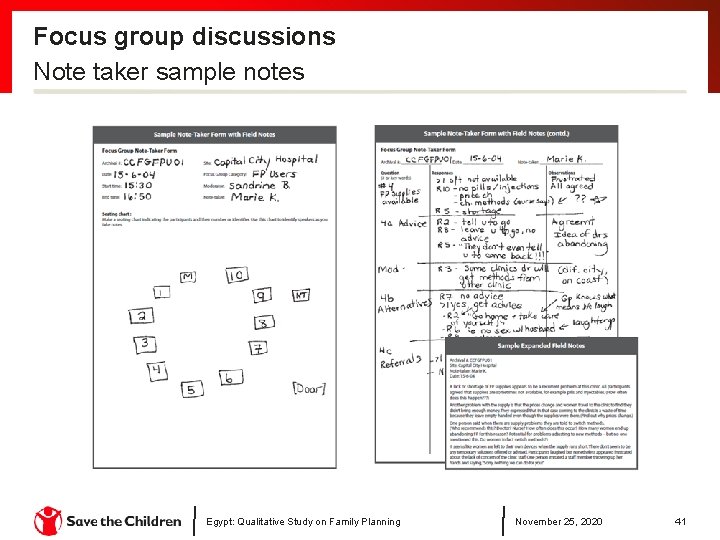
Note taking FGD Protocol: FP in Egypt • Observe participants body language, attitudes, gestures, and the general environment • On site note taking • Audio recording • Record participant identifier, maybe numbering them or color • Identifier should correspond to their sign-in sheet with demographics (don’t need name, just age and nationality) • Create a note-taking form you are comfortable with and can be fast using it • Use abbreviations you can understand • Labeling materials, notebooks, guides • Expanded documentation (verbatim transcription vs. notes) • Distinguish between discussion notes and your own observation, use MO to indicate “my observation” when documenting Egypt: Qualitative Study on Family Planning November 25, 2020 40
Focus group discussions Note taker sample notes Egypt: Qualitative Study on Family Planning November 25, 2020 41
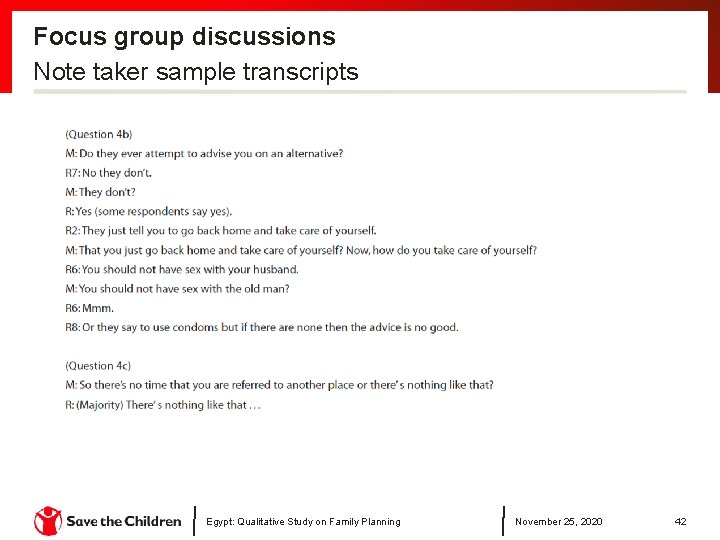
Focus group discussions Note taker sample transcripts Egypt: Qualitative Study on Family Planning November 25, 2020 42
Lunch Break Egypt: Qualitative Study on Family Planning November 25, 2020 43
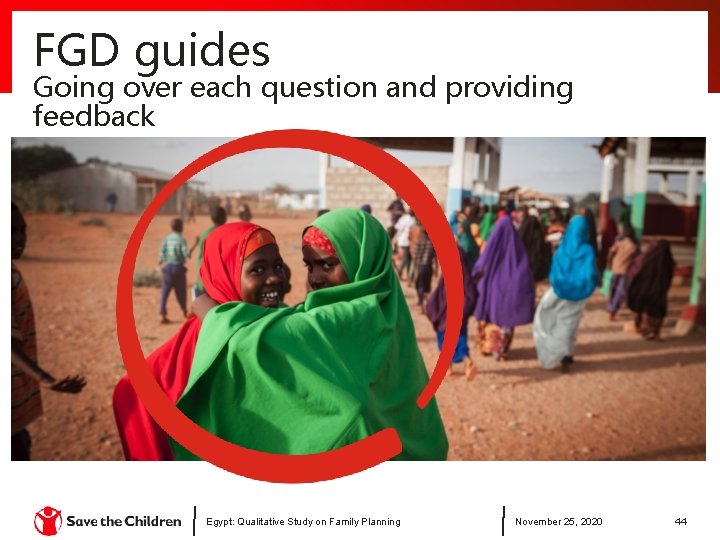
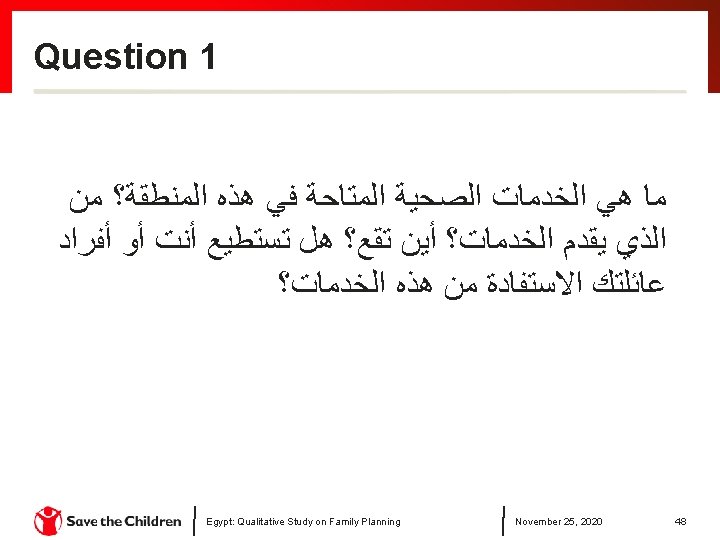
FGD guides Going over each question and providing feedback Egypt: Qualitative Study on Family Planning November 25, 2020 44
Question 2 Egypt: Qualitative Study on Family Planning November 25, 2020 49
Question 3 Egypt: Qualitative Study on Family Planning November 25, 2020 50
Egypt: Qualitative Study on Family Planning November 25, 2020 51
Egypt: Qualitative Study on Family Planning November 25, 2020 52
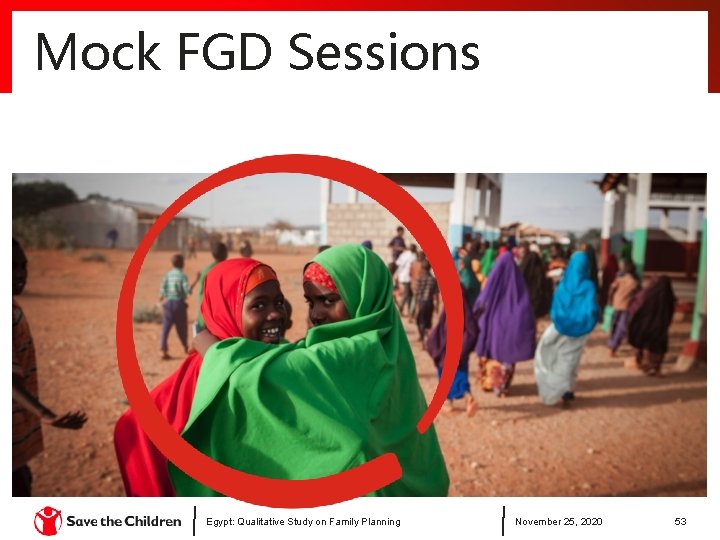
Mock FGD Sessions Egypt: Qualitative Study on Family Planning November 25, 2020 53