
Focal Mechanism Solutions Also called beachball diagrams fault
Focal Mechanism Solutions § § § Also called “beachball diagrams” “fault plane solutions” Tell us the geometry and mechanism of the fault in a simple diagram Generally from the moment tensor (which is more general), but originally calculated using first motions – done here to illustrate the concepts
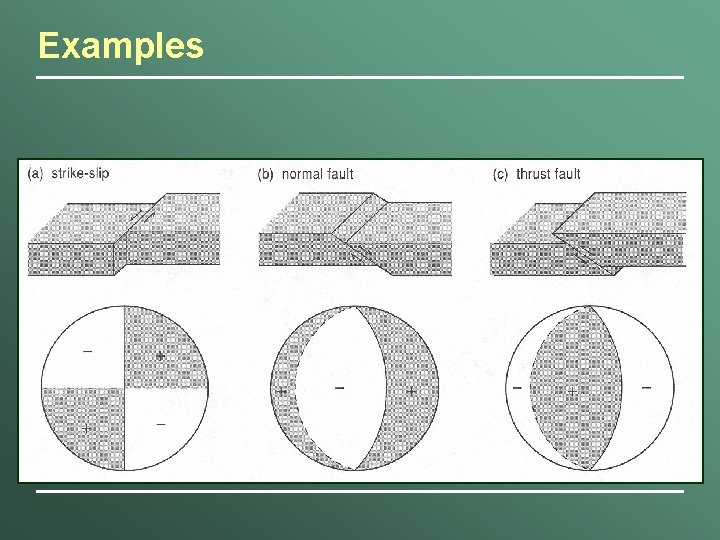
Examples
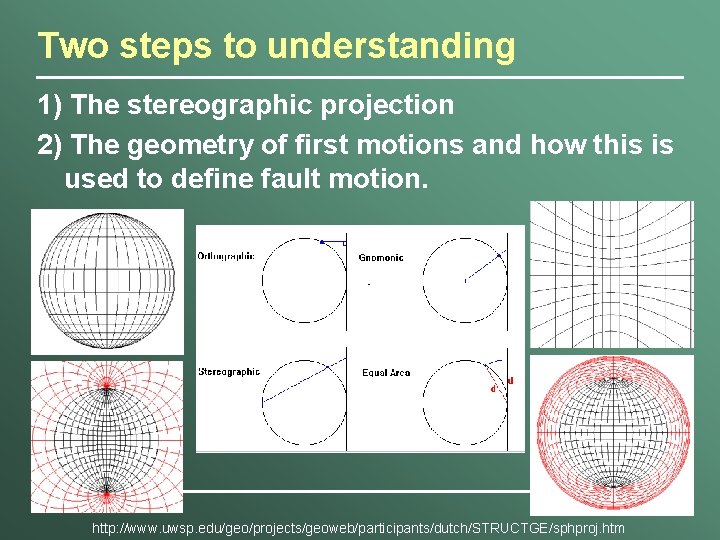
Two steps to understanding 1) The stereographic projection 2) The geometry of first motions and how this is used to define fault motion. http: //www. uwsp. edu/geo/projects/geoweb/participants/dutch/STRUCTGE/sphproj. htm
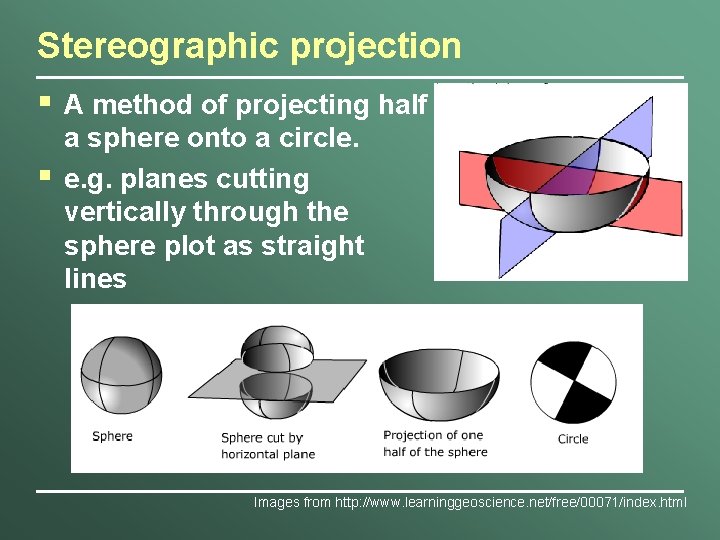
Stereographic projection § § A method of projecting half a sphere onto a circle. e. g. planes cutting vertically through the sphere plot as straight lines Images from http: //www. learninggeoscience. net/free/00071/index. html
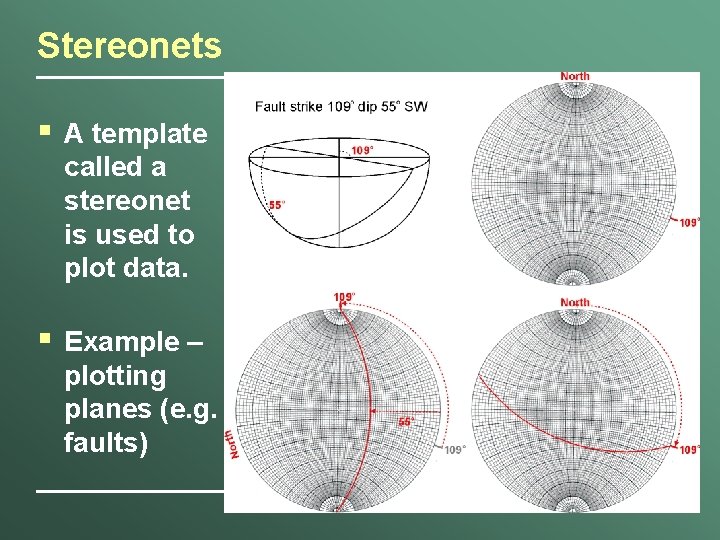
Stereonets § A template called a stereonet is used to plot data. § Example – plotting planes (e. g. faults)
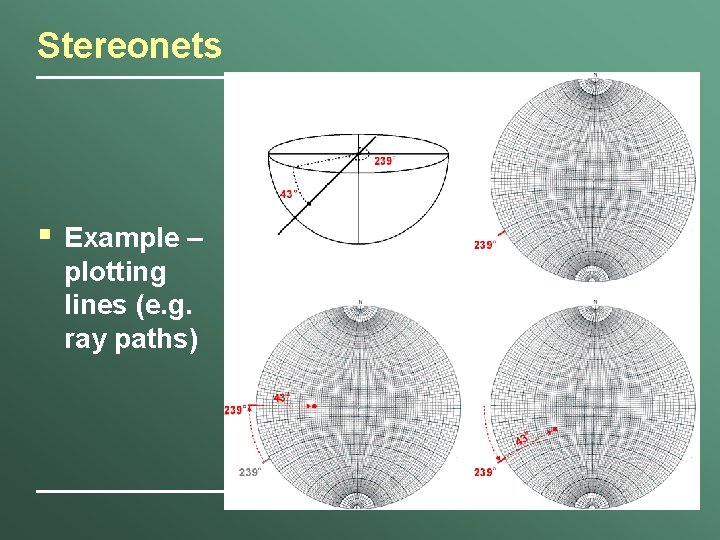
Stereonets § Example – plotting lines (e. g. ray paths)

Stereonets § Example – pitch (or rake) of a line on a plane (e. g. the slip direction on a fault)
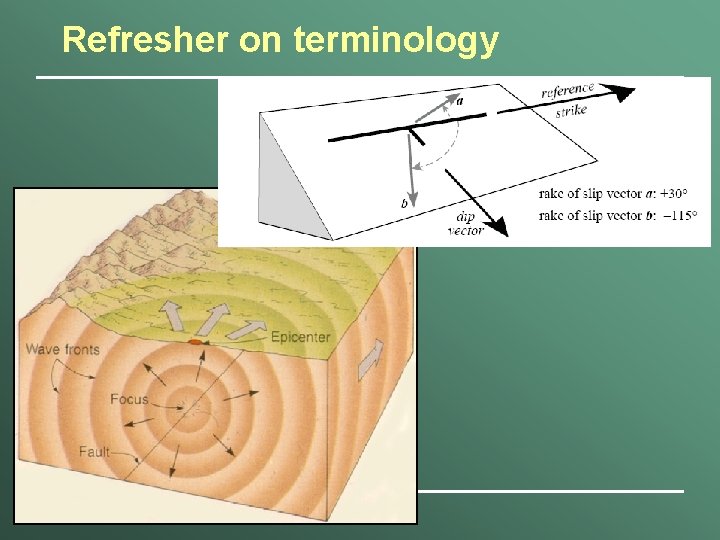
Refresher on terminology
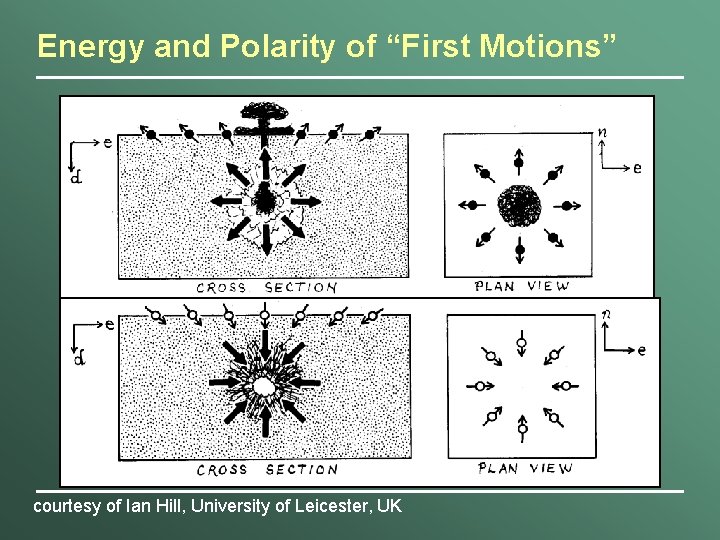
Energy and Polarity of “First Motions” courtesy of Ian Hill, University of Leicester, UK
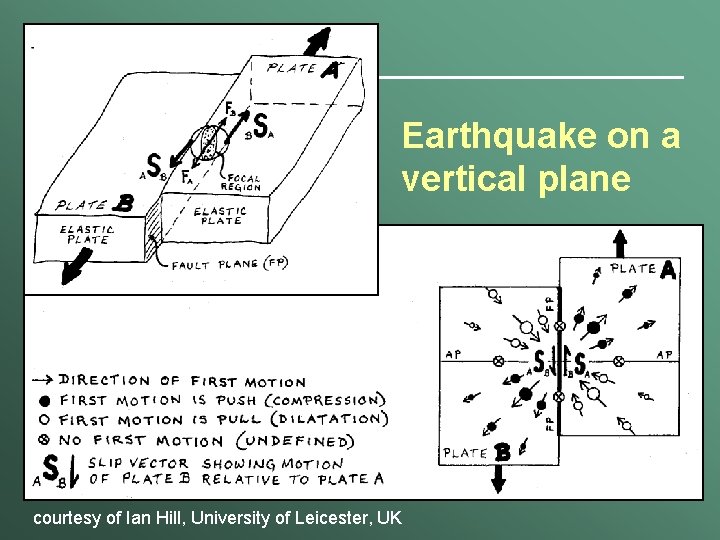
Earthquake on a vertical plane courtesy of Ian Hill, University of Leicester, UK
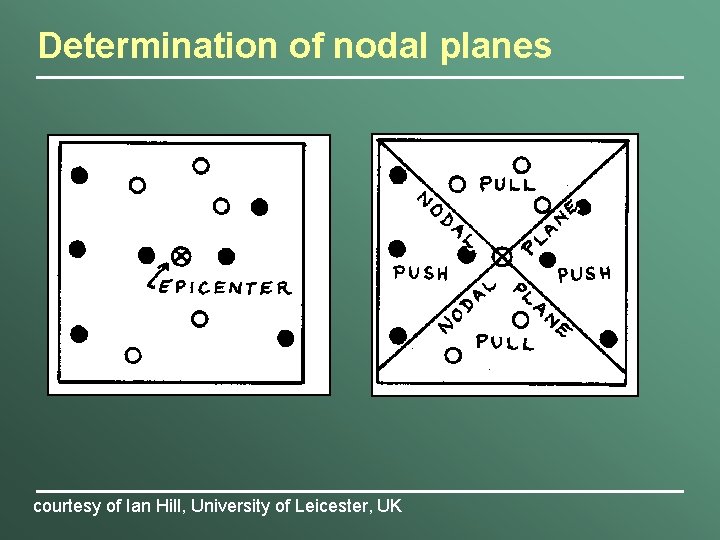
Determination of nodal planes courtesy of Ian Hill, University of Leicester, UK
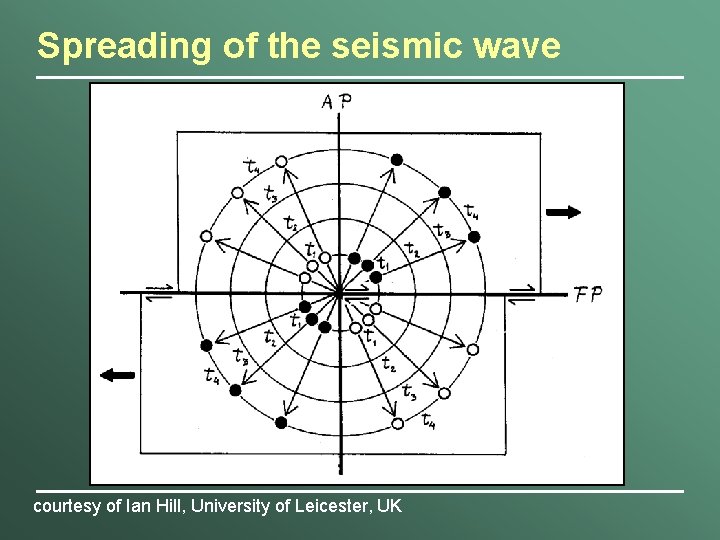
Spreading of the seismic wave courtesy of Ian Hill, University of Leicester, UK
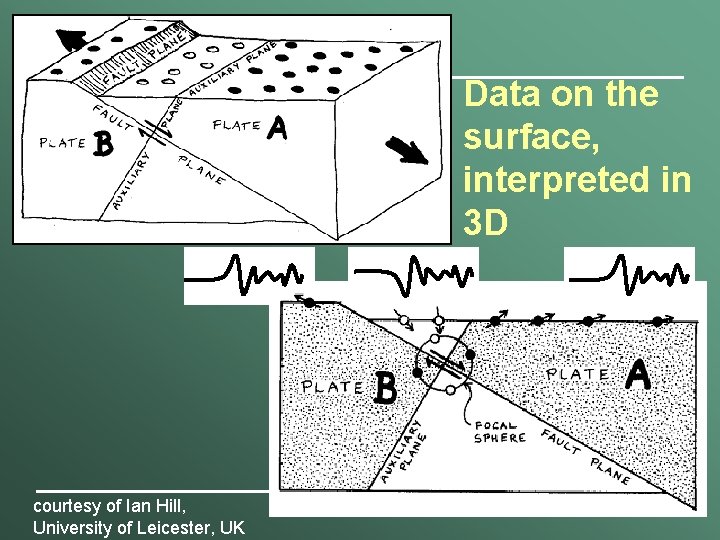
Data on the surface, interpreted in 3 D courtesy of Ian Hill, University of Leicester, UK

Take-off angle § The angle (from vertical) that the ray leaves the earthquake = take-off angle Stein and Wysession, An Introduction to seismology, earthquakes and Earth structure
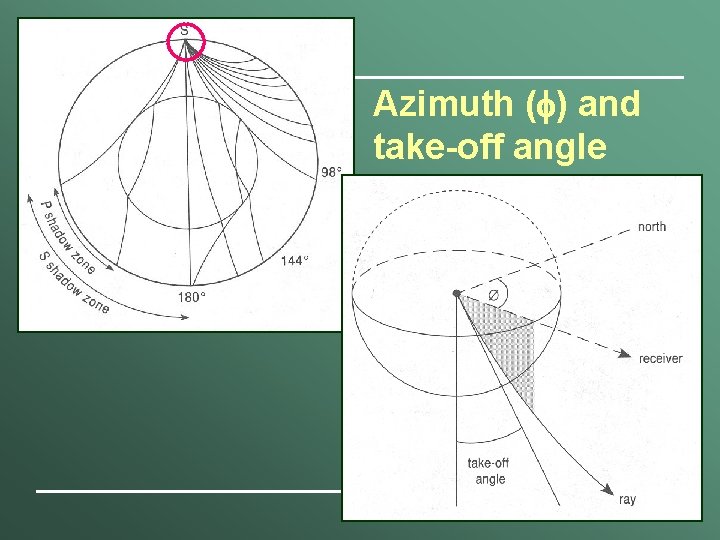
Azimuth (f) and take-off angle
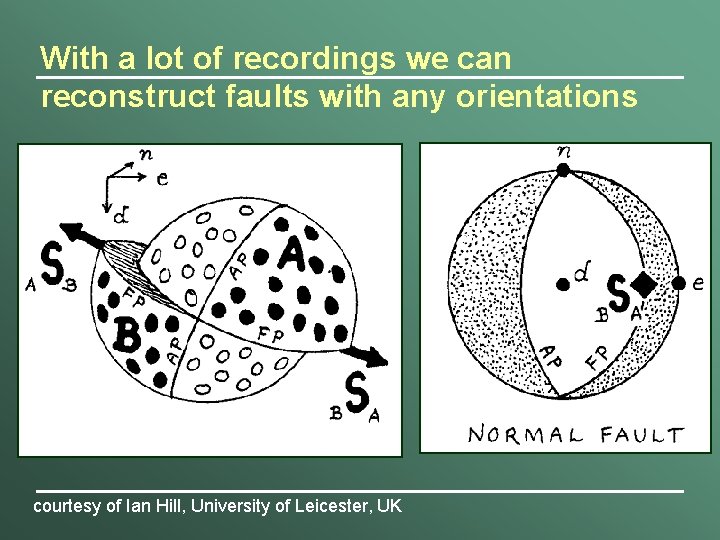
With a lot of recordings we can reconstruct faults with any orientations courtesy of Ian Hill, University of Leicester, UK
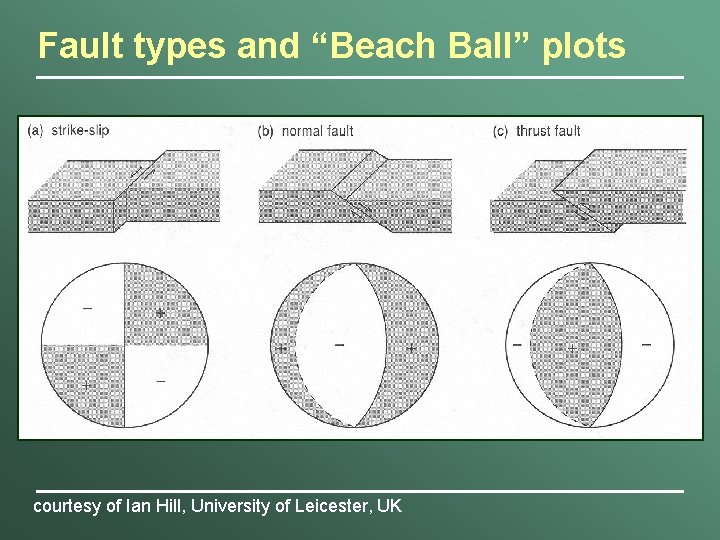
Fault types and “Beach Ball” plots courtesy of Ian Hill, University of Leicester, UK
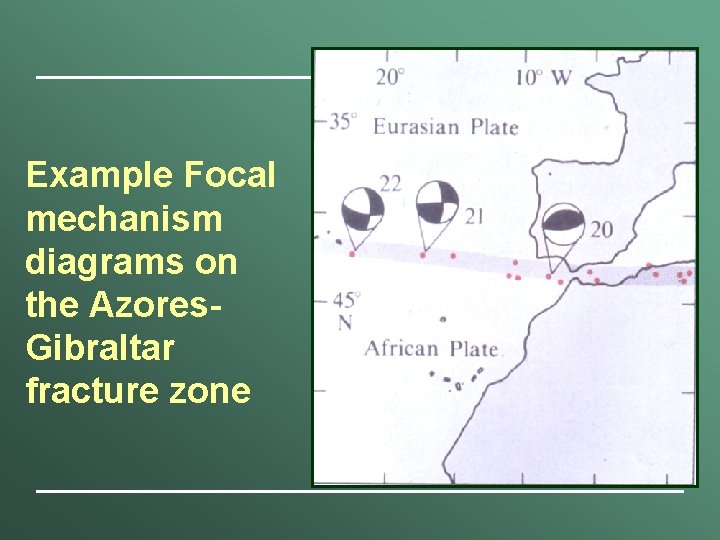
Example Focal mechanism diagrams on the Azores. Gibraltar fracture zone
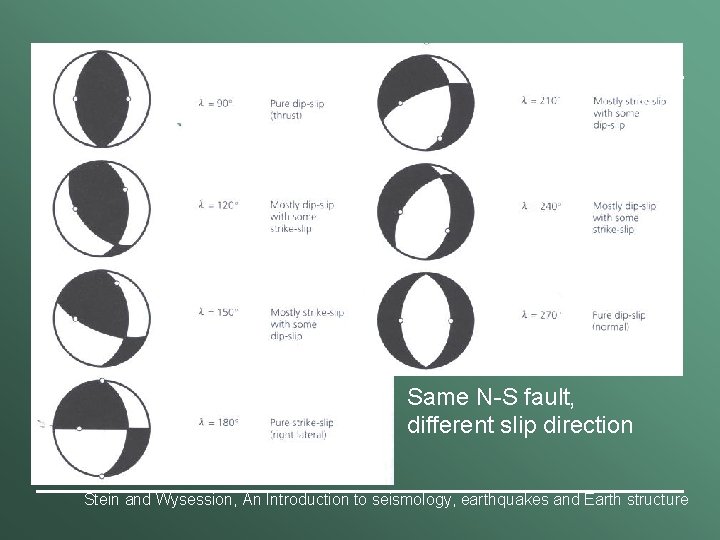
Same N-S fault, different slip direction Stein and Wysession, An Introduction to seismology, earthquakes and Earth structure

Great review on the web at: http: //www. learninggeoscience. net/free/00071/
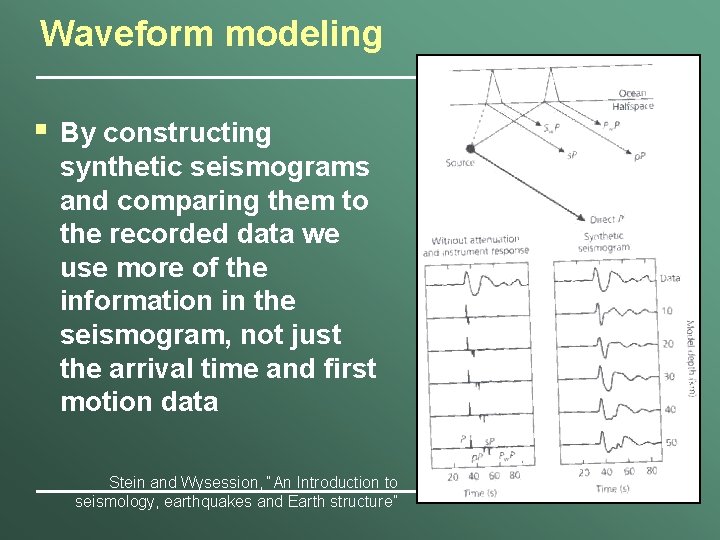
Waveform modeling § By constructing synthetic seismograms and comparing them to the recorded data we use more of the information in the seismogram, not just the arrival time and first motion data Stein and Wysession, “An Introduction to seismology, earthquakes and Earth structure”
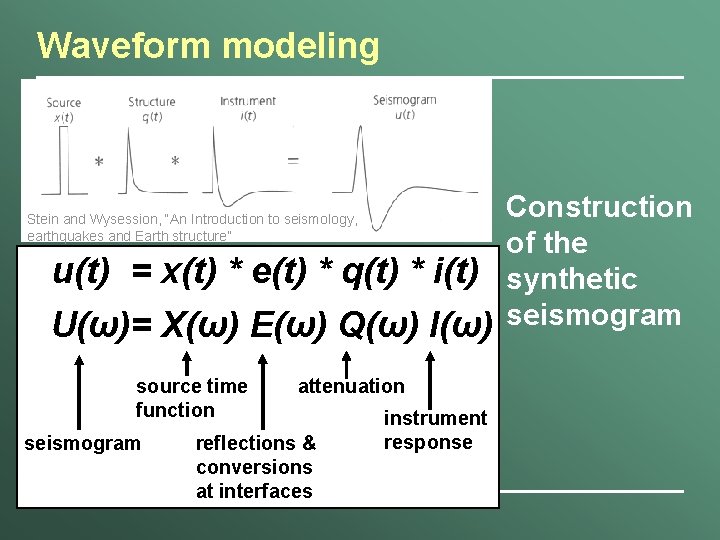
Waveform modeling Stein and Wysession, “An Introduction to seismology, earthquakes and Earth structure” u(t) = x(t) * e(t) * q(t) * i(t) U(ω)= X(ω) E(ω) Q(ω) I(ω) source time function seismogram attenuation reflections & conversions at interfaces instrument response Construction of the synthetic seismogram
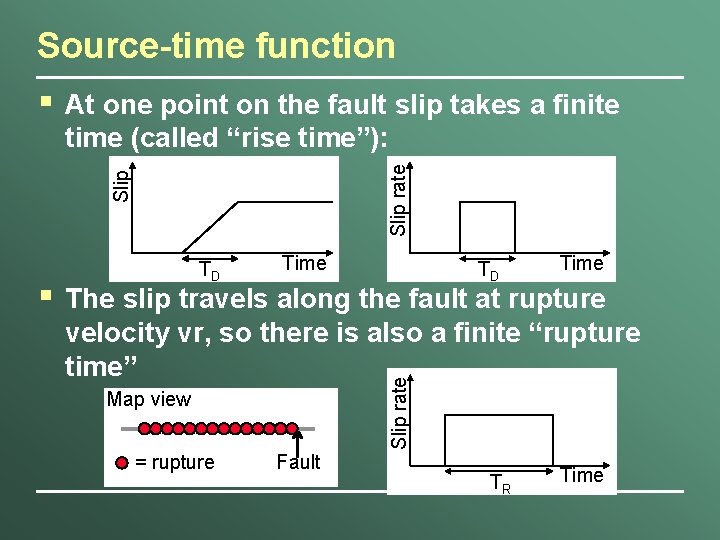
Source-time function Slip rate At one point on the fault slip takes a finite time (called “rise time”): Slip § Time = rupture Fault TD Time The slip travels along the fault at rupture velocity vr, so there is also a finite “rupture time” Slip rate § TD Map view TR Time
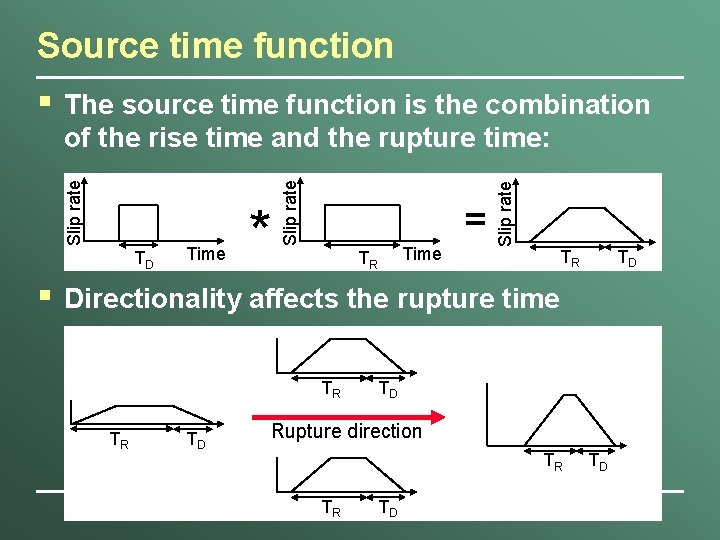
Source time function TD § * = Time TR Slip rate Time Slip rate The source time function is the combination of the rise time and the rupture time: Slip rate § TR TD Directionality affects the rupture time TR TR TD TD Rupture direction TR TR TD TD
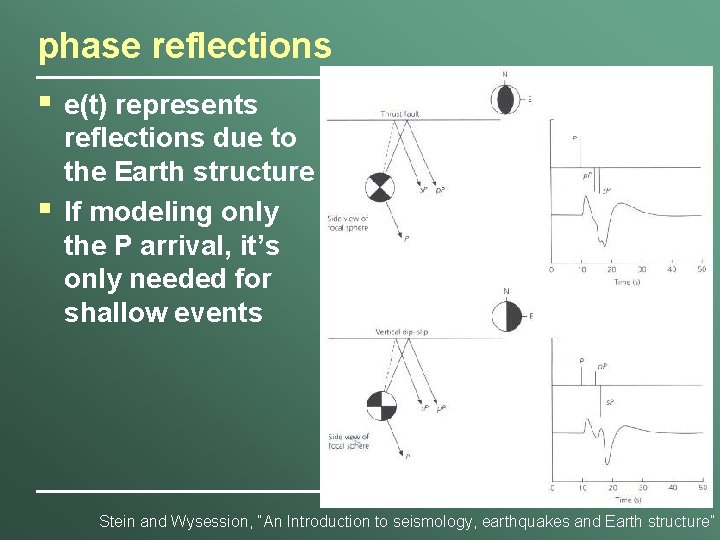
phase reflections § § e(t) represents reflections due to the Earth structure If modeling only the P arrival, it’s only needed for shallow events Stein and Wysession, “An Introduction to seismology, earthquakes and Earth structure”
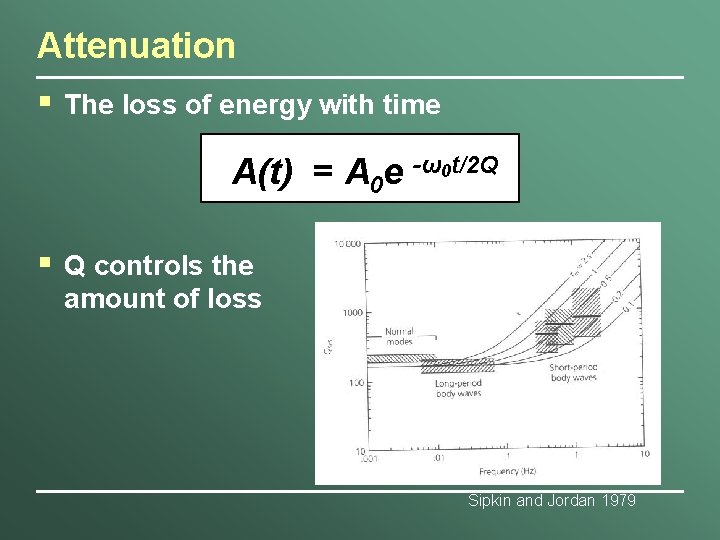
Attenuation § The loss of energy with time A(t) = A 0 e -ω0 t/2 Q § Q controls the amount of loss Sipkin and Jordan 1979
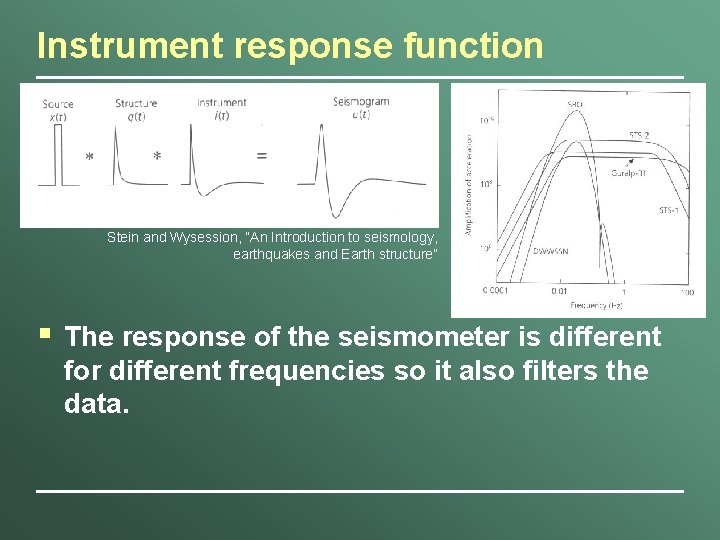
Instrument response function Stein and Wysession, “An Introduction to seismology, earthquakes and Earth structure” § The response of the seismometer is different for different frequencies so it also filters the data.
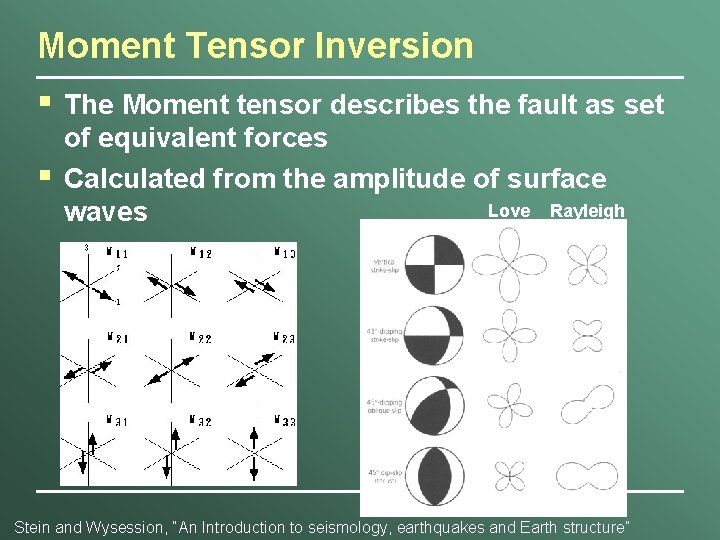
Moment Tensor Inversion § § The Moment tensor describes the fault as set of equivalent forces Calculated from the amplitude of surface Love Rayleigh waves Stein and Wysession, “An Introduction to seismology, earthquakes and Earth structure”
- Slides: 28