
Foam Firefighting Section IV Foam Application and Operations



- Slides: 43
Foam Firefighting Section IV Foam Application and Operations Colleton County Fire-Rescue Training Division
Objectives • Discuss the principals and considerations for fighting Class A fires. • Dispel myths surrounding Class A foam • Discuss Class A Foam for structural fire attack. • Discuss the effectiveness of Class A foam for exposure protection. Colleton County Fire-Rescue Training Division
Objectives • Discuss Class A foam’s benefits during overhaul. • Define the principals of Class B fire attack. • Discuss the techniques of Class B foam application. Colleton County Fire-Rescue Training Division
Objectives • Discuss considerations for after foam is applied • Discuss the strategies for exposure protection for Class B fire incidents. • Discuss water supply considerations. Colleton County Fire-Rescue Training Division
Principals and Considerations for Fighting Class A Fires • Class A foam is biodegradable when used in small ratios of. 01 -1. 0%. • Considerations should still be made to keep runoff out of sewers lakes and streams. • Use proper PPE when handling concentrates. Colleton County Fire-Rescue Training Division
Principals and Considerations for Fighting Class A Fires • Clean PPE thoroughly if it has been soaked in concentrates. • Have backup lines in operation when high energy foam systems are in use. • Foam proportioning ratios can be tailored to suit the job. Colleton County Fire-Rescue Training Division
Class A Foam Common Myth Some people have promoted theory that 200 of a foam solution aspirated to a 10: 1 expansion ration actually gives you the fire protection capability of 2, 000 gallons of water. False Colleton County Fire-Rescue Training Division
Class A Foam Myth Dispelled • Class A foam only makes water more efficient at soaking into the fuel and absorbing heat. • Less water is required to extinguish a fire than if plain water is used. • It does not create more water!!! Colleton County Fire-Rescue Training Division
Class A Foam Common Myth Foam lines may be flowed at lower application rates or from smaller hose lines than those of plain water. False Colleton County Fire-Rescue Training Division
Class A Foam Myth Dispelled • There is no reputable scientific data to prove this point. • Shorter discharge times results in less water being used. • It is recommended that foam solution flow rates and hose sizes be the same as the generally accepted flow rates and hose sizes for plain water. Colleton County Fire-Rescue Training Division
Class A Foam and Structural Fire Attack • Most effective on interior fire attacks. • Must be applied directly to the burning material to be most effective. • Helps maintain visibility due to less steam conversion. Colleton County Fire-Rescue Training Division
Class A Foam and Structural Fire Attack • When using Class A foam for an interior attack use with either a direct or combination attack. • Reduces time a fire stream needs to be applied. Colleton County Fire-Rescue Training Division
Class A Foam and Structural Fire Attack • Fog nozzles should be used on low energy foam lines. • Fog or smoothbore nozzles may be used with CAFS systems. Colleton County Fire-Rescue Training Division
Class A Foam and Structural Fire Attack • CAFS fire streams are well suited for exterior fire attacks. • The extended reach assures that the foam is being delivered deep into the structure. • The fire can be knocked down quickly from a window or a doorway. Colleton County Fire-Rescue Training Division
Class A Foam and exposure Protection • Excellent for protecting exposures. • Insulating properties protect unburned areas. • Type 2 or Type 3 foam is recommended Colleton County Fire-Rescue Training Division
Class A Foam Overhaul Operations • Class A foam exhibits some of it’s greatest benefits during overhaul operations. • Applied in the same fashion as water with standard nozzles and techniques. Colleton County Fire-Rescue Training Division
Class A Foam Overhaul Operations • Drastically reduces the amount of water used. – Limited runoff – Less water damage Colleton County Fire-Rescue Training Division
Class A Foam Overhaul Operations • Thermal blocking occurs when concealed hot spots contain enough heat to turn small amounts of penetrating water into steam. Colleton County Fire-Rescue Training Division
Class A Foam Overhaul Operations • The use of foam helps defeat the phenomenon of thermal blocking by enabling more water to penetrate deeper and speed the cooling process. Colleton County Fire-Rescue Training Division
Principals of Class B Fire Attack. • Size of the fire • Type of fuel • Required application rate • Amount of foam concentrate needed and available • Ability to deliver and sustain the required foam rate Colleton County Fire-Rescue Training Division
Size of the Fire • Almost always involve the entire surface of an exposed fuel. • May remain that size throughout the duration of the incident. • Coincidently the size of the fire is fairly constant throughout the incident. Colleton County Fire-Rescue Training Division
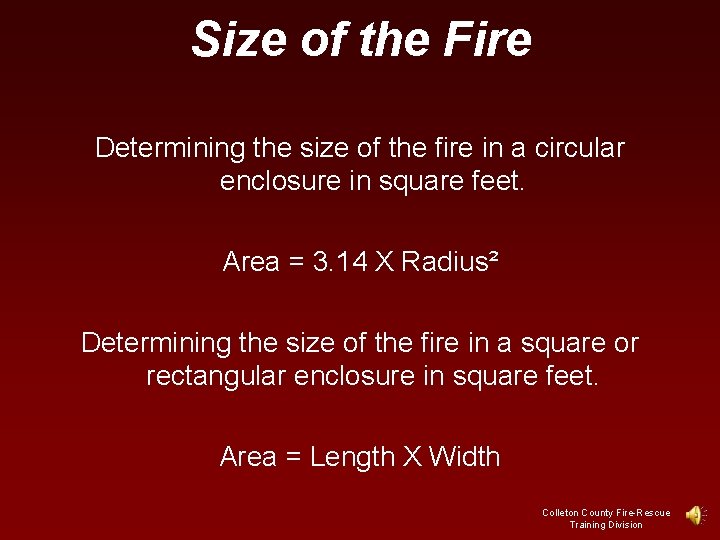
Size of the Fire Determining the size of the fire in a circular enclosure in square feet. Area = 3. 14 X Radius² Determining the size of the fire in a square or rectangular enclosure in square feet. Area = Length X Width Colleton County Fire-Rescue Training Division
Size of the Fire Involves a Spill Area • Determine the maximum length and width of the spill and multiply by those numbers Colleton County Fire-Rescue Training Division
Type of Fuel • Hydrocarbon • Polar Solvent • Toxic or Non Toxic • Water Reactive Colleton County Fire-Rescue Training Division
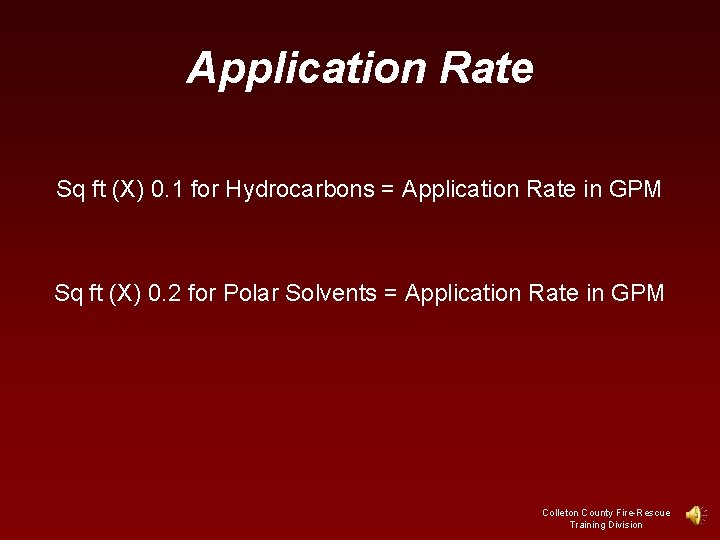
Application Rate Sq ft (X) 0. 1 for Hydrocarbons = Application Rate in GPM Sq ft (X) 0. 2 for Polar Solvents = Application Rate in GPM Colleton County Fire-Rescue Training Division
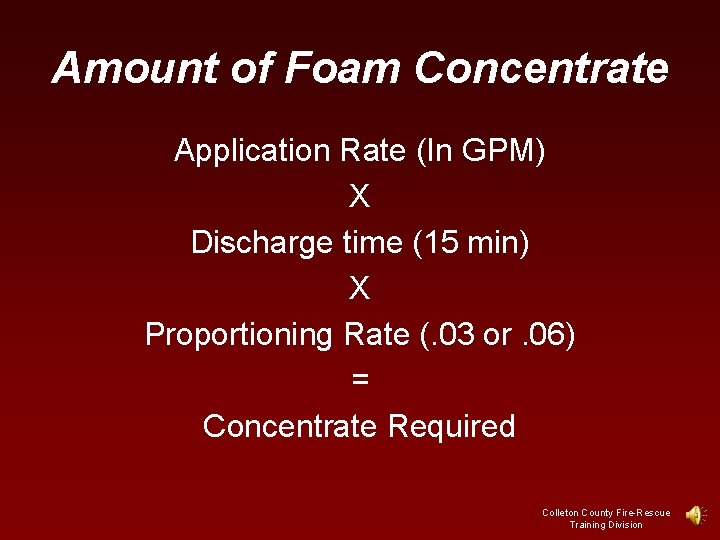
Amount of Foam Concentrate Application Rate (In GPM) X Discharge time (15 min) X Proportioning Rate (. 03 or. 06) = Concentrate Required Colleton County Fire-Rescue Training Division
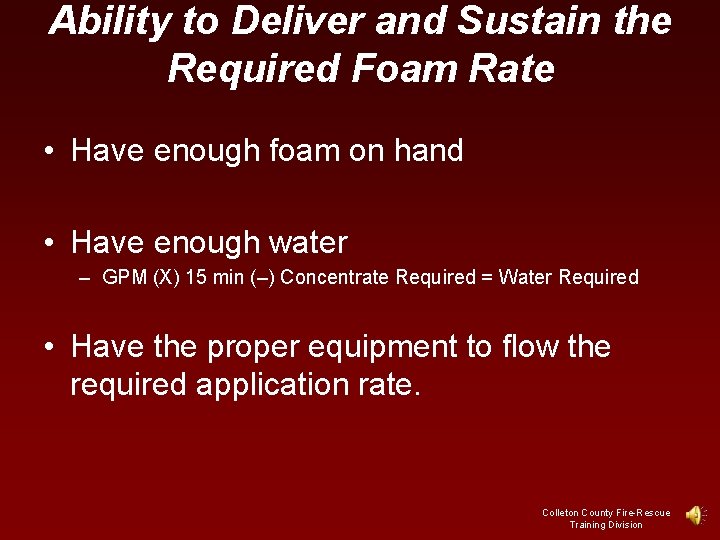
Ability to Deliver and Sustain the Required Foam Rate • Have enough foam on hand • Have enough water – GPM (X) 15 min (–) Concentrate Required = Water Required • Have the proper equipment to flow the required application rate. Colleton County Fire-Rescue Training Division
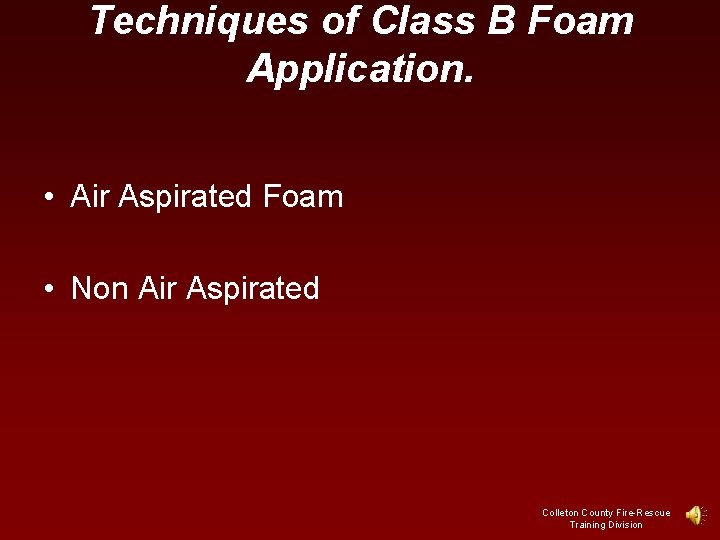
Techniques of Class B Foam Application. • Air Aspirated Foam • Non Air Aspirated Colleton County Fire-Rescue Training Division
Air Aspirated Foam Advantages • Foam is longer lasting. • Longer drainage time. • Highest quality. Colleton County Fire-Rescue Training Division
Air Aspirated Foam Disadvantages • Short Reach • Affected by wind conditions • Nozzles can be bulky and may be single purpose. Colleton County Fire-Rescue Training Division
Non Air Aspirated Foam Advantages • Can be applied through any standard fog nozzle. • Greater reach and penetrating power • Faster knockdown in lab tests. Colleton County Fire-Rescue Training Division
Non Air Aspirated Foam Disadvantages • Will not form as thick of a blanket. • Requires more frequent re-application. Colleton County Fire-Rescue Training Division
Manual Application Techniques • Roll On Method (roll foam onto leading edge of spill or fire and roll foam toward the back). • Bank Down Method (hit an elevated object above the spill or fire). • Rain Down Method (foam is sprayed above and is rained down on spill or fire). Colleton County Fire-Rescue Training Division
Exposure Protection • Not different from structural fire exposure protection. • Judgmental decision based on the situation. Colleton County Fire-Rescue Training Division
After Foam is Applied • Protect your foam blanket at all costs. • Insure that no smoking or other sources of ignition around the blanket. • Insure that blanket is not broken, walked or driven through. • Insure that your hoses are not part of the spill. Colleton County Fire-Rescue Training Division
Situations to Consider Exposure Protection • A large fire that cannot be immediately extinguished. • Employing a nonintervention strategy. • Extremely sensitive structures. (fuel tanks, etc) • Structures in the vicinity showing the effects of exposure to the fire. Colleton County Fire-Rescue Training Division
Factors That Determine the Danger of an Exposure • Amount and intensity of the original fire. • Proximity of the exposure to the fire. • Wind and weather conditions. • Composition of the exterior of the exposure. Colleton County Fire-Rescue Training Division
Water Supply Considerations • Foam operations usually require significant amounts of water. • Have the required water available before beginning foam operations. • Rule of thumb is 1 gallon per min for every 10 sq ft. Colleton County Fire-Rescue Training Division
Water Supply Considerations Questions to ask • What is my water requirements? • What is my water supply available? • Does access to the scene inhibit my ability to deliver the required flow? Colleton County Fire-Rescue Training Division
Summary • Principals and considerations for fighting Class A and Class B fires vary. • There are may myths surrounding Class A foam • Class A Foam is an effective tactic for structural fire attack, exposure protection and overhaul. • Techniques of Class B foam application vary with the prescribed application and take in account many considerations. Colleton County Fire-Rescue Training Division
Summary • What are the considerations after Class B foam is applied? • Exposure protection for Class B fire incidents are integral to an effective incident management strategy. • Water supply considerations for Class B Foam operations. Colleton County Fire-Rescue Training Division
Questions? ? ? Colleton County Fire-Rescue Training Division
Acknowledgements • IFSTA Principals of Foam Firefighting 1 st Edition, 1996 • Dominic Colletti, Class A Foam-Best Practice for Structural Firefighters, 1998 • Various Web Sources • Task Force Tips • Elkhart Brass Manufacturing • Operations Chief David A Greene Colleton County Fire-Rescue Training Division