
FMT 2016 AACN Fall Symposium November 10 2016
FMT 2016 AACN Fall Symposium November 10, 2016 Dave Stolpman, MD Park Nicollet Gastroenterology
Outline • Definitions • History • Uses • • CDI IBD Obesity / Metabolic Syndrome Functional Bowel Disease • Focus on CDI • • • CDI Nuts and Bolts of preparation Delivery options / Methods Outcomes Safety

Background
Microbiome • Microbiotia • Bacteria that share the human body space • Microbiome • The collective genomes of these microorganisms • Much or our understanding of these organisms comes from study of RNA
FMT • Definition • Administration of fecal matter from a donor into the intestinal tract or another person • Goal • Change the intestinal microbiota to confer a health benefit • Importance • Most effective alternative for managing Recurrent C. Diff Infection
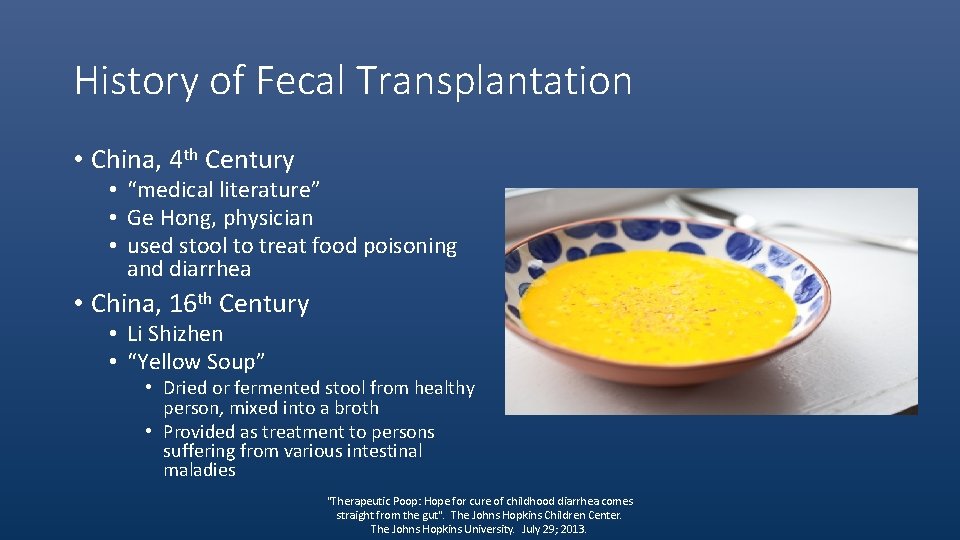
History of Fecal Transplantation • China, 4 th Century • “medical literature” • Ge Hong, physician • used stool to treat food poisoning and diarrhea • China, 16 th Century • Li Shizhen • “Yellow Soup” • Dried or fermented stool from healthy person, mixed into a broth • Provided as treatment to persons suffering from various intestinal maladies "Therapeutic Poop: Hope for cure of childhood diarrhea comes straight from the gut". The Johns Hopkins Children Center. The Johns Hopkins University. July 29; 2013.
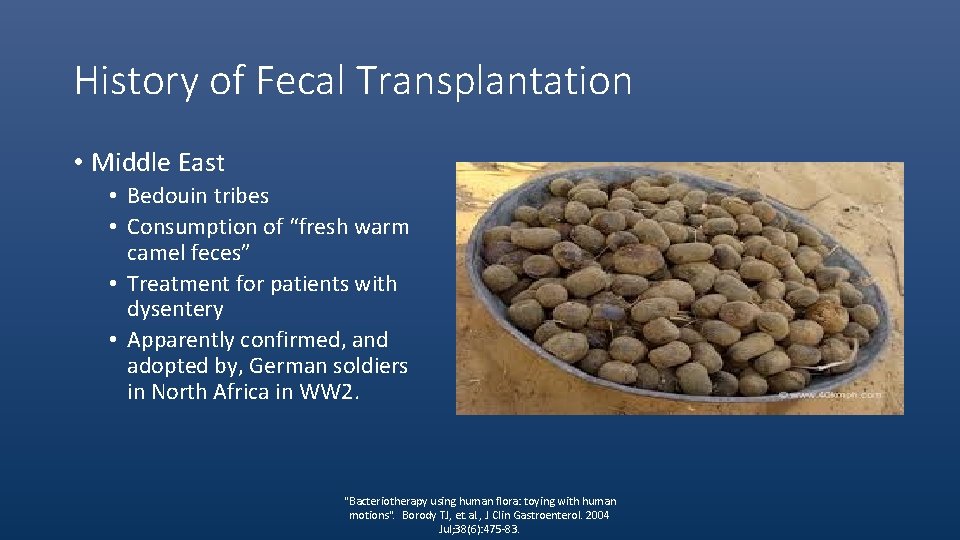
History of Fecal Transplantation • Middle East • Bedouin tribes • Consumption of “fresh warm camel feces” • Treatment for patients with dysentery • Apparently confirmed, and adopted by, German soldiers in North Africa in WW 2. "Bacteriotherapy using human flora: toying with human motions". Borody TJ, et. al. , J Clin Gastroenterol. 2004 Jul; 38(6): 475 -83.
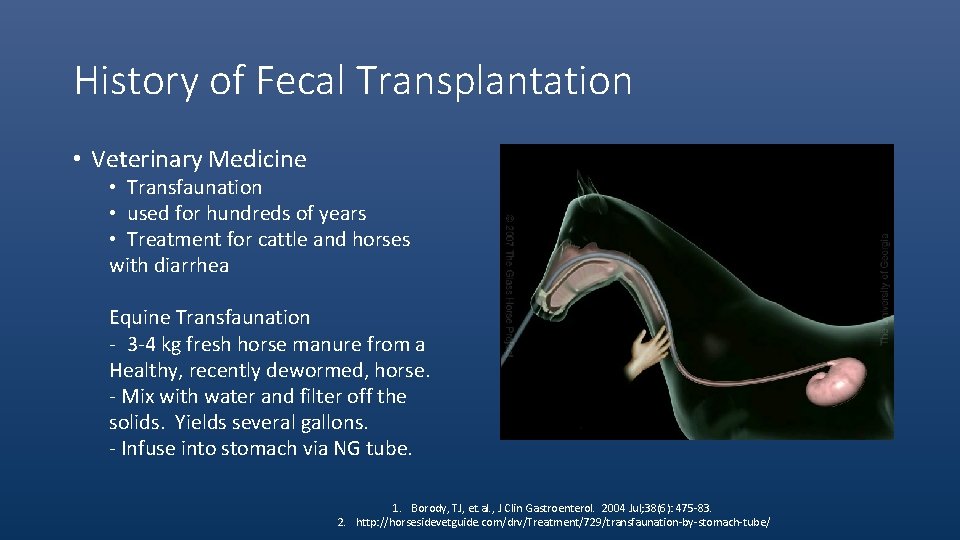
History of Fecal Transplantation • Veterinary Medicine • Transfaunation • used for hundreds of years • Treatment for cattle and horses with diarrhea Equine Transfaunation - 3 -4 kg fresh horse manure from a Healthy, recently dewormed, horse. - Mix with water and filter off the solids. Yields several gallons. - Infuse into stomach via NG tube. 1. Borody, TJ, et. al. , J Clin Gastroenterol. 2004 Jul; 38(6): 475 -83. 2. http: //horsesidevetguide. com/drv/Treatment/729/transfaunation-by-stomach-tube/
History of Fecal Transplantation • Modern Times • Eiseman and colleagues • University of Colorado 1958 • • • Case series 4 patients with “pseudomembranous colitis” (PMC)*, 3 critically ill Treated with enemas of healthy human stool Symptom improvement within hours All recovered Eiseman B, Silen W, Bascom GS, Kauvar AJ. Surgery. 1958 Nov; 44(5): 854 -9.
PMC • Pseudomembranous Colitis • Often seen with colitis of any cause • Infectious • Ischemic • IBD (Crohns / UC) • Often used synonymously with C. Difficile Colitis • C. Difficile Colitis • Not recognized as cause of PMC until 1978 • Early proponents of Fecal Transplant (FMT) did not realize they were treating C. Difficile
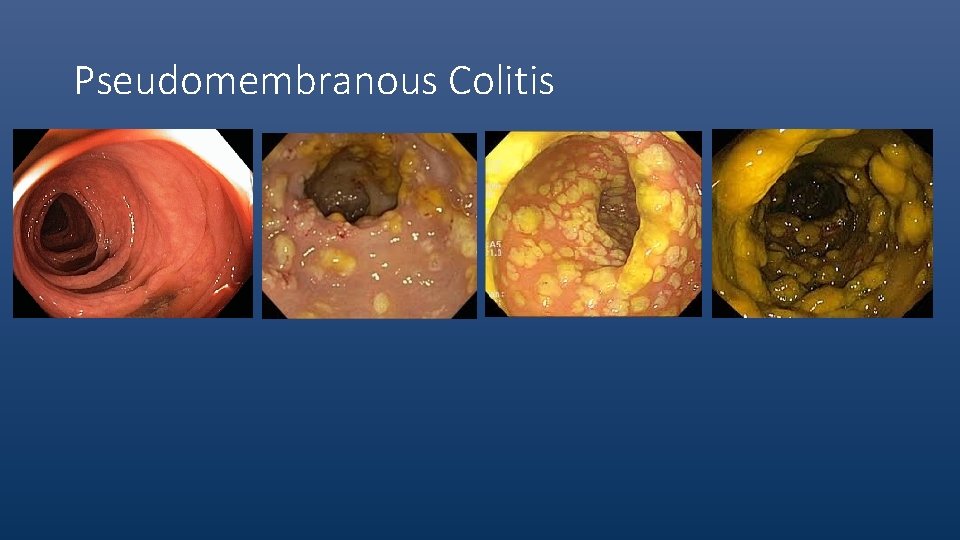
Pseudomembranous Colitis
History of Fecal Transplantation • FMT used for CDI (C. Difficile Infection) • 1 st documented: 1983 • 65 yo patient with diarrhea and CDI • Treatment with human fecal enemas • normalization of bowel fxn in pt with Schwan A, Sjolin S, Trottestam U, Aronsson B. Lancet 1983, Oct 8; 2(8354): 845.
History of Fecal Transplantation • Early methods • • Retention enema only thru 1989 Nasoduodenal tube 1991 Rectal tube 1994 Colonoscopy 1998 • Widespread success reported
Human Gut Microbiota • Extremely complex • 1000 -1200 bacterial species known in human GI tract • Every person is different • Estimate: 1014 (=100 trillion) bacteria in human GI tract • (10 x more than total # cells in human body) • 7 main bacterial divisions • • Firmicutes 70% Bacteriodes Proteobacteria Fusobacteria Verrucomicrobiotia Cyanobacteria Actinobacteria Sekirov I, Russell SL, Antunes CM, et al. Gut Microbiota in health and disease. Physiol Rev 2010; 90(3): 859 -904.
Human Gut Microbiota • Difficult to study • Until recently, most constituents could not be grown in lab • Individual microorganisms • highly specialized • Part of tightly structured networks • Disruption of support structure prevents growth in culture media • What we know: microbiome (DNA) • Microbiota = bacterial organisms inhabiting the GI tract • Microbiome = the “collective genomes of the intestinal microbiota” Borody, TJ. Campbell J. Fecal Microbiota Transplantation: Techniques, Applications, and Issues. GI Clin NA 41 (2012) 781803.
Microbiota Function • Dramatically underestimated • Historically, thought to be • Digestive waste • Poop • Stool • Kaka • Crap • Sh**
Microbiota Function: Current Understanding (still evolving) • Acts like an “organ” • Microbial organ • Important Roles • Immunity • Energy Metabolism • Control of epithelial cell proliferation and differentiation • New fields of study are emerging • Metagenomics • Metabolomics • pretomics 1. "Host-bacterial mutualism in the human intestine. " Backhed F. , et. al. , Science. 2005 Mar 25; 307 (5717): 1915 -20.
Microbiota Function: Immunity • Constantly in contact with the external environment • 1 st line of defense • Passive Defense: 1. Competition for nutrients 2. Competition for adhesion sites • Active Defense 1. Production of bacteriocins 2. Production of bacterial-derived immunomodulatory molecules
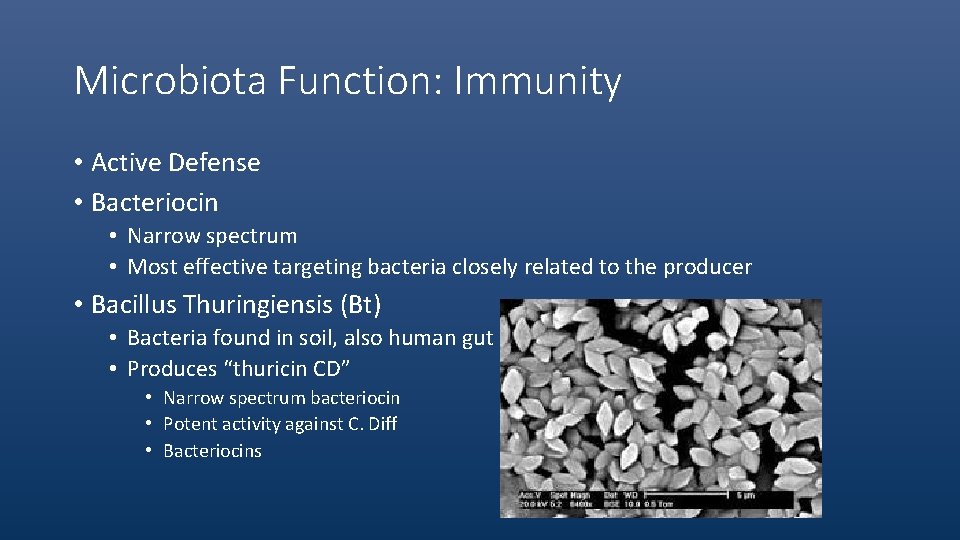
Microbiota Function: Immunity • Active Defense • Bacteriocin • Narrow spectrum • Most effective targeting bacteria closely related to the producer • Bacillus Thuringiensis (Bt) • Bacteria found in soil, also human gut • Produces “thuricin CD” • Narrow spectrum bacteriocin • Potent activity against C. Diff • Bacteriocins
Microbiotia Function: Energy Metabolism • Synthesis of vitamins • Fermentation of dietary carbohydrates • FODMAPS anyone? • Bile metabolism • Hormone metabolism Robinson CJ, Bohannan BJ, Young VB. Microbiol Mol Biol Rev. 2010 Sep; 74(3): 453 -76.
Rationale for FMT • Dysbiosis • Microbial imbalance inside the body • Dominant species become underrepresented • Contained or outcompeted species increase to fill the void • Caused by • Antibiotics • Diet • Illness, especially GI illness • Leads to • Alteration in microbiota function
Rationale for FMT • Correct dysbiosis • Goal is to repair, or replace, a stable balanced bacterial community into a disrupted human GI tract • Evidence suggests it works 1. Chang JY, et. al. , Journ Infect Dis 2008; 197(3): 435.
FMT • Evidence suggests it is durable • Report (Khoruts) • FMT from a healthy individual into a person with recurrent CDI • Recipient fecal composition • Dominated by Bacteroides / butyrate-producing bacterium • This closely matched the healthy donor • Symptoms resolved • Report (Grehan) • Implantation of donor bacterial population demonstrated at 24 weeks 1. Khoruts A. , Dicksved J. , Jansson JK. , et. al. , "Changes in the conmplistion of the human fecal microbiome after bacteriotherapy for recurrent C. Diff-asst'd diarrhea". J Clin Gastroenterol 2010; 44: 354 -60 2. Grehan MJ, Leis SM, Campbell J, etal. , “Durable alteration of the colonic microbiota by the administration of donor fecal flora. ” J Clin Gastroenterol 2010; 44: 551 -61.
FMT vs. Probiotics • FMT • Complex and complete microbiota with structures support network • Durable • Long term implantation • Probiotics • Usually only a single, or at best, a few strains of cultured bacteria • May lack adequate bacterial complexity and support network critical for implanation / survival
FMT - Uses • Recurrent CDI • IBD • Obesity / Metabolic Syndrome • Functional GI disorders / IBS
Sonata Facile
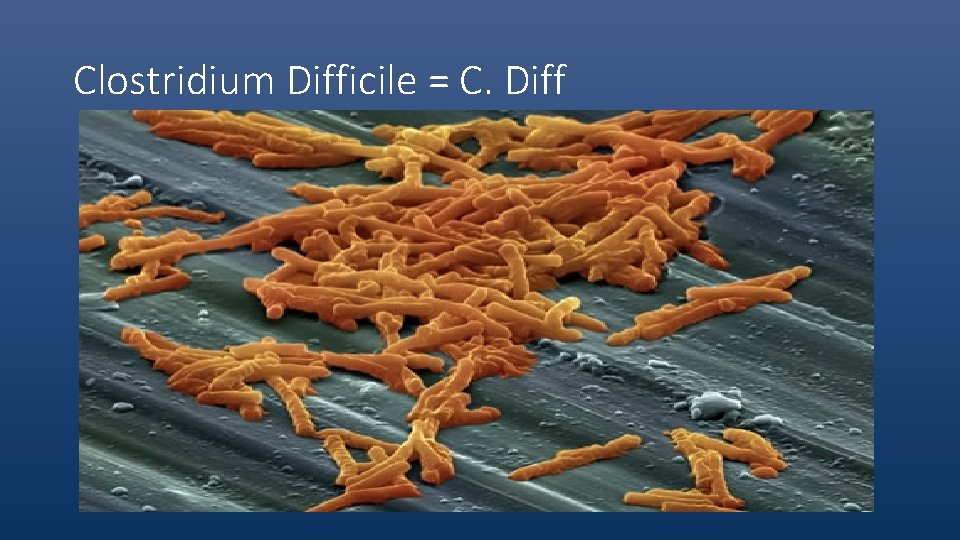
Clostridium Difficile = C. Diff
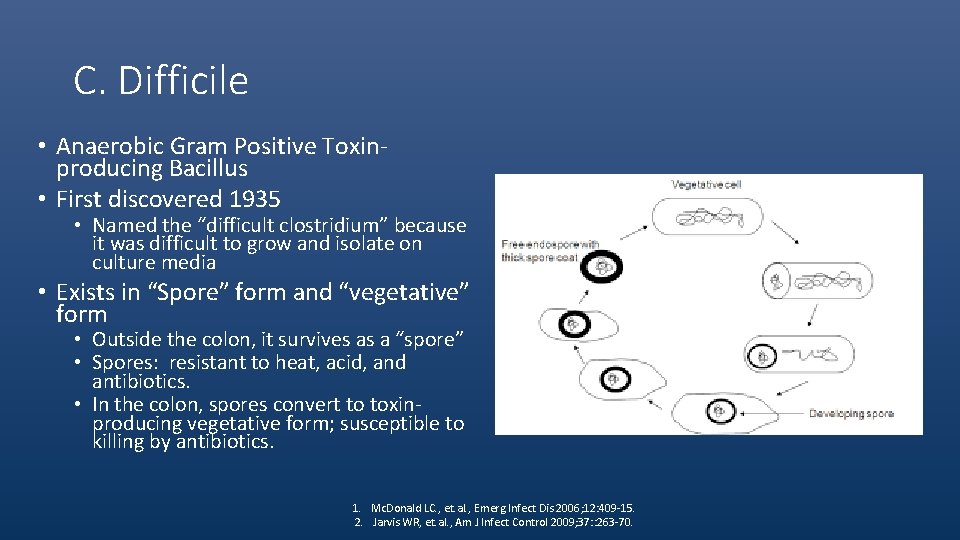
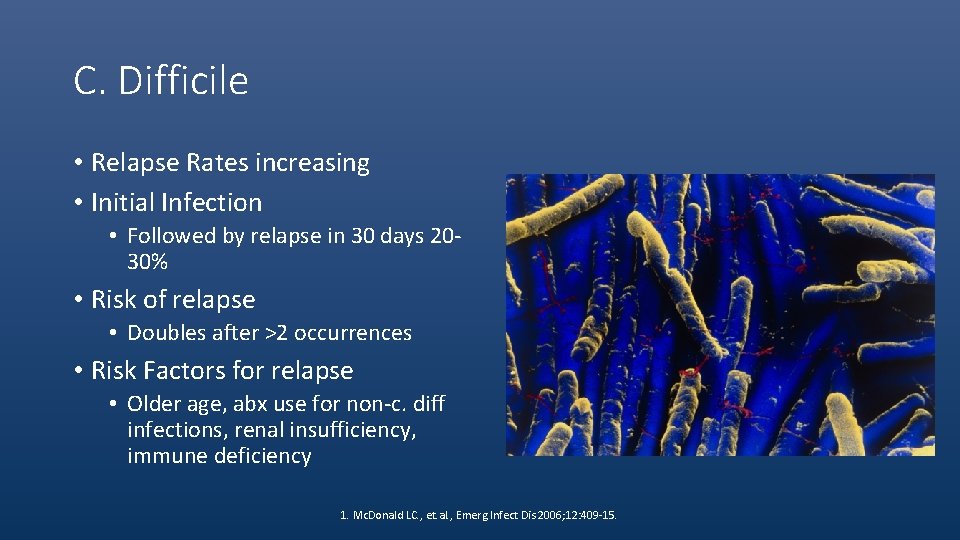
C. Difficile • Anaerobic Gram Positive Toxinproducing Bacillus • First discovered 1935 • Named the “difficult clostridium” because it was difficult to grow and isolate on culture media • Exists in “Spore” form and “vegetative” form • Outside the colon, it survives as a “spore” • Spores: resistant to heat, acid, and antibiotics. • In the colon, spores convert to toxinproducing vegetative form; susceptible to killing by antibiotics. 1. Mc. Donald LC. , et. al. , Emerg Infect Dis 2006; 12: 409 -15. 2. Jarvis WR, et. al. , Am J Infect Control 2009; 37: : 263 -70.
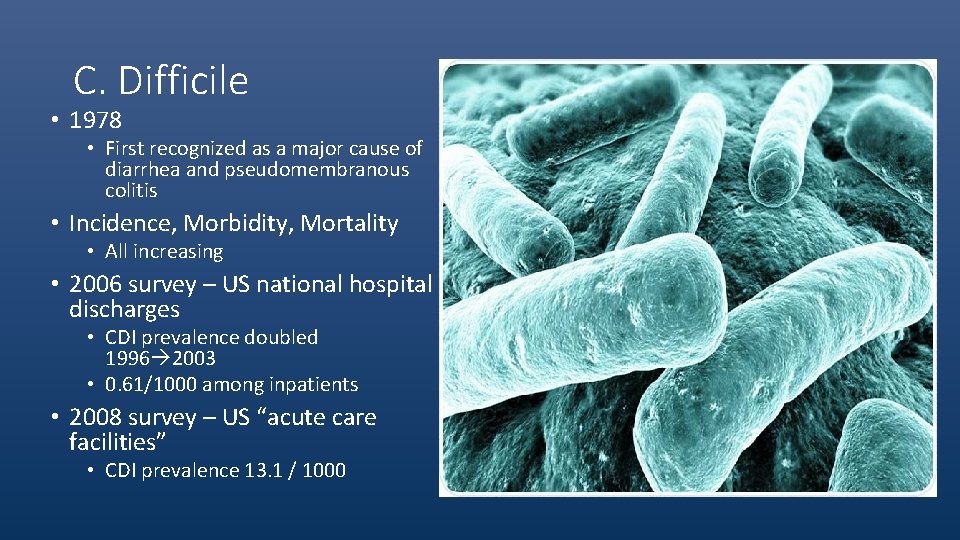
C. Difficile • 1978 • First recognized as a major cause of diarrhea and pseudomembranous colitis • Incidence, Morbidity, Mortality • All increasing • 2006 survey – US national hospital discharges • CDI prevalence doubled 1996 2003 • 0. 61/1000 among inpatients • 2008 survey – US “acute care facilities” • CDI prevalence 13. 1 / 1000
C. Difficile • Toxin A • Causes inflammation leading to mucosal injury, intestinal fluid secretion • Toxin B • More potent, damages colonic mucosa • Some produce only A or B • Most produce both A and B • Some (10 -30%) produce neither; these strains are non-pathogenic • Stool Toxin levels correlate with disease severity 1. Akerlund T. , et. al. , J Clin Microbiol. 2006; 44(2): 353 2. Lyras D. , et. al. , Nature. 2009; 458(7242): 1176
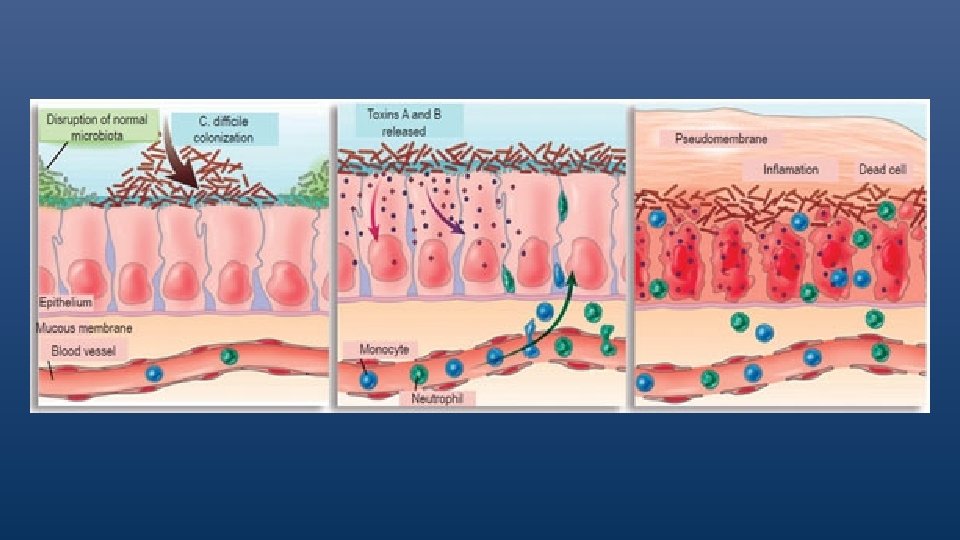
C. Difficile • Transmission • Fecal-oral • Easily cultures from the home or healthcare environment • Furniture, door handles, remotes, clothing, stethoscopes, etc. • Risk Factors • • • Antibiotic Use Hospitalization Age > 65 Severe illness Gastric acid suppression (2 x inc risk) 1. Gerding DN, et. al. , Infection Control Hosp. Epidemiology; 1995; 16(8): 459. 2. Linsky A, et. al. , Arch Internal Medicine 2010; 170(9); 772.
C. Difficile • Relapse Rates increasing • Initial Infection • Followed by relapse in 30 days 2030% • Risk of relapse • Doubles after >2 occurrences • Risk Factors for relapse • Older age, abx use for non-c. diff infections, renal insufficiency, immune deficiency 1. Mc. Donald LC. , et. al. , Emerg Infect Dis 2006; 12: 409 -15.
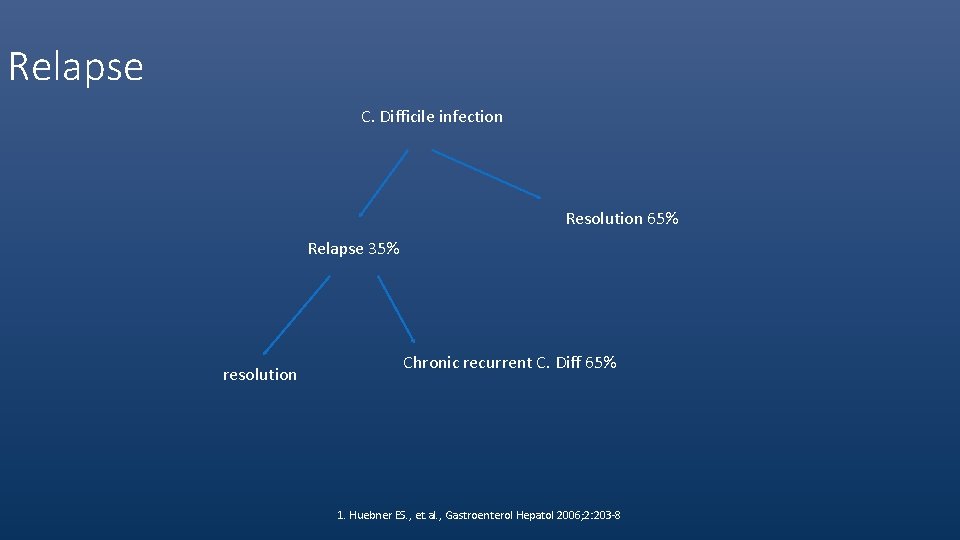
Relapse C. Difficile infection Resolution 65% Relapse 35% resolution Chronic recurrent C. Diff 65% 1. Huebner ES. , et. al. , Gastroenterol Hepatol 2006; 2: 203 -8
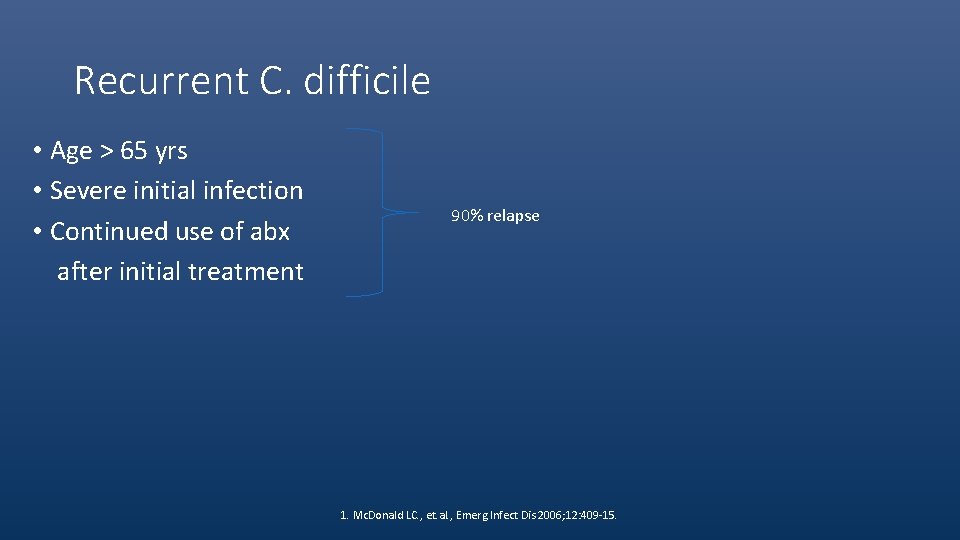
Recurrent C. difficile • Age > 65 yrs • Severe initial infection • Continued use of abx after initial treatment 90% relapse 1. Mc. Donald LC. , et. al. , Emerg Infect Dis 2006; 12: 409 -15.
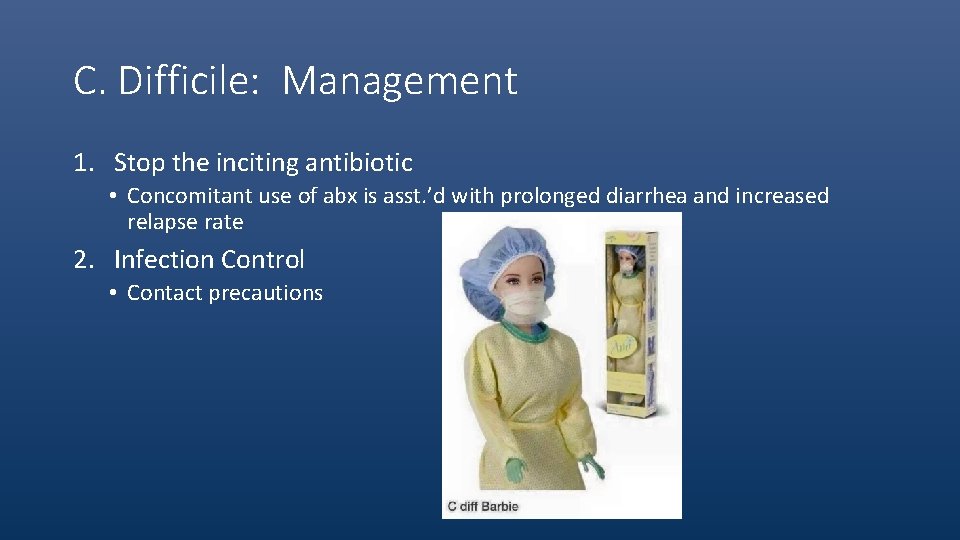
C. Difficile: Management 1. Stop the inciting antibiotic • Concomitant use of abx is asst. ’d with prolonged diarrhea and increased relapse rate 2. Infection Control • Contact precautions
C. Difficile Management • Infection Control • Handwashing • Soap & water more effective than alcohol-based solution (C. diff spores resistant to alcohol) • Home environment: clean with a bleach-containing product (Clorox) • Door knobs, light switches, kitchen cabinets, phones, remotes, etc.
C. Difficile: Management 3. Indication(s) for Treatment • Symptoms (diarrhea, abd pain, n/v) AND + C. Diff toxin • Empiric treatment reasonable while waiting for toxin result in high risk pt • Do NOT treat if + toxin, but no symptoms. 4. Non-Severe Disease • Oral metronidazole 500 mg po tid x 10 -14 days • Oral vancomycin 125 mg po qid x 10 days *, ** • IV metronidazole 500 mg IV q 8 hrs if oral dosing is not possible *preferred ** 125 mg po qid = 500 mg po qid
C. Difficile: Management 5. Severe Disease • Serum Albumin < 3 gm/dl, WBC > 15 k, abdominal tenderness, and / or creatinine increased > 1. 5 x the pre-morbid level • Vancomycin 125 mg po qid • More effective than oral metronidazole • RCT: 69 pts with severe CDI • Vancomycin 97% response, metronidazole 76 % response • If not-responding, increase vancomycin 500 mg po qid, add IV Flagyl 500 mg q 8 hrs, consider alternatives • Fidaxomycin 200 mg po bid • FMT Zar FA, et. al. , Clin Infectious Dis 2007; 45(3): 302.
FMT: Indications • Chronic Recurrent C. Difficile • Acute Fulminant C. Difficile • Not FDA-approved
FMT: Patient Selection • C. Difficile infection (#1) • Treated with appropriate antibiotics • Vancomycin or metronidazole x 10 -14 days • Documented Recurrence of CDI (#2) • Treated with appropriate antibiotics • Includes 6 week tapering course • Documented 2 nd Recurrence of CDI (#3)
FMT: Where does the material come from? • Patient directed • Universal Donor
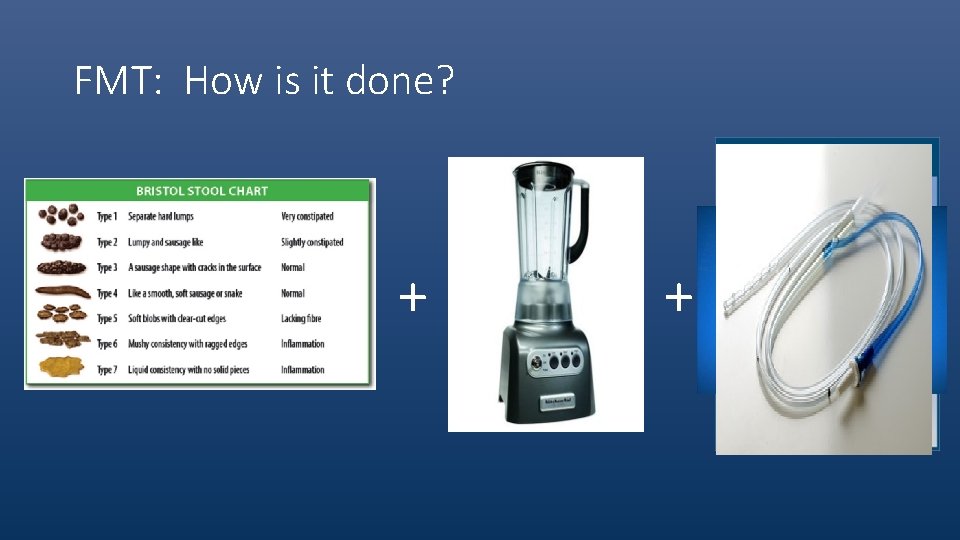
FMT: How is it done? + +
Donor Exclusion Criteria Absolute Relative • Known HIV, HBV, HCV • H/o major GI surgery: Gastric • High risk sexual behavior / Use of bypass illicit drugs • Tattoo or body piercing w/in 6 m • Metabolic syndrome • H/o incarceration • Systemic autoimmunity (MS, • Risk factors for Creutzfeldt-Jacob Dx • Travel w/in last 6 m to location where Connective Tissue Dx) diarrheal illness is common • Atopic Disease (asthma, eczema, • GI Dx: IBD; idiopathic chronic constipation or chronic diarrhea; h/o Eo. E) GI malignancy or polyposis • Abx within prior 3 m • Chronic Pain Syndrome (chronic • Immunomodulator use: fatigue, fibromyalgia) (glucocorticoids, biologic agents, calcineurin inhibitors (cyclosporine, MMF, etc. ) Bakken JS, et. al. , "Treating Clostridium difficile infection with FMT". Clin Gastroenterol Hepatol 2011; 9: 1044 -9.
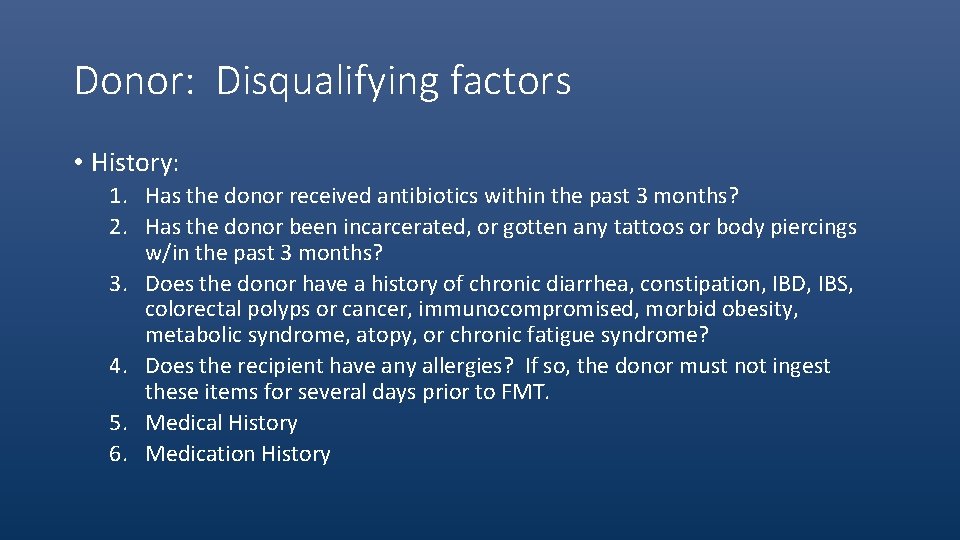
Donor: Disqualifying factors • History: 1. Has the donor received antibiotics within the past 3 months? 2. Has the donor been incarcerated, or gotten any tattoos or body piercings w/in the past 3 months? 3. Does the donor have a history of chronic diarrhea, constipation, IBD, IBS, colorectal polyps or cancer, immunocompromised, morbid obesity, metabolic syndrome, atopy, or chronic fatigue syndrome? 4. Does the recipient have any allergies? If so, the donor must not ingest these items for several days prior to FMT. 5. Medical History 6. Medication History
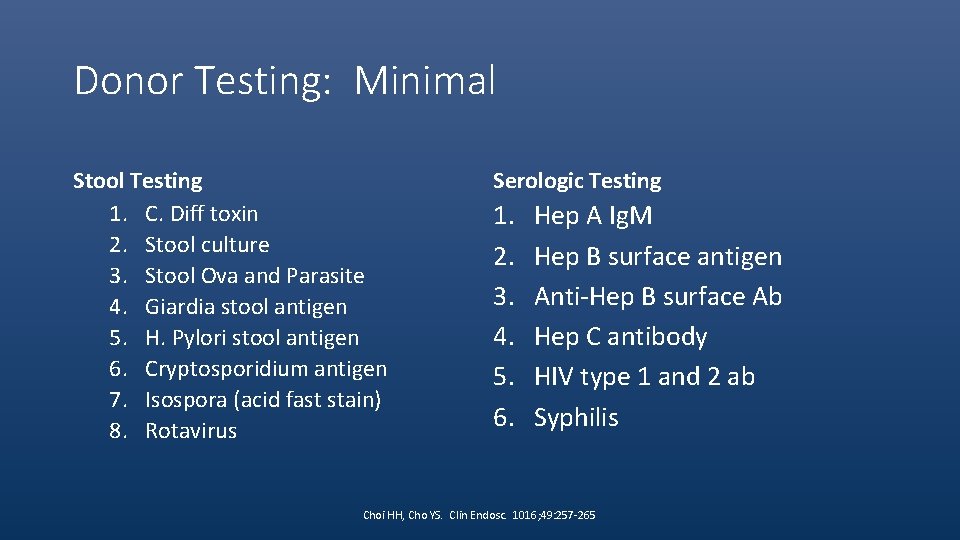
Donor Testing: Minimal Stool Testing 1. C. Diff toxin 2. Stool culture 3. Stool Ova and Parasite 4. Giardia stool antigen 5. H. Pylori stool antigen 6. Cryptosporidium antigen 7. Isospora (acid fast stain) 8. Rotavirus Serologic Testing 1. 2. 3. 4. 5. 6. Hep A Ig. M Hep B surface antigen Anti-Hep B surface Ab Hep C antibody HIV type 1 and 2 ab Syphilis Choi HH, Cho YS. Clin Endosc. 1016; 49: 257 -265
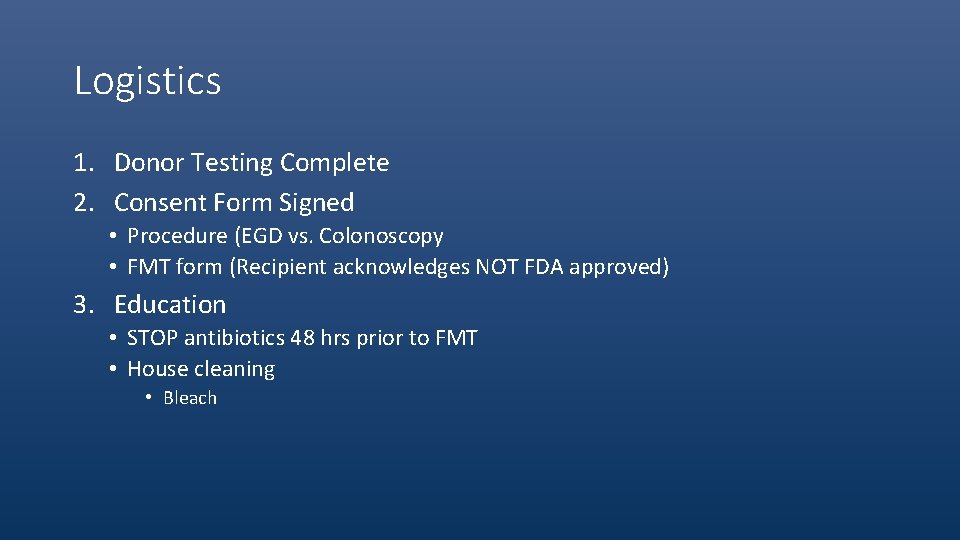
Logistics 1. Donor Testing Complete 2. Consent Form Signed • Procedure (EGD vs. Colonoscopy • FMT form (Recipient acknowledges NOT FDA approved) 3. Education • STOP antibiotics 48 hrs prior to FMT • House cleaning • Bleach
Logistics • Donor Factors (if using patient-directed donor) • Performance Anxiety • Gender • Timing
Post-FMT Issues • Success Rate 85% • Even if “successful” • BM’s pattern may be different • IBS / Lactose Intolerance • Anti-diarrhea diet • Diarrhea ≠ C. Diff • Indication for Post-FMT stool testing
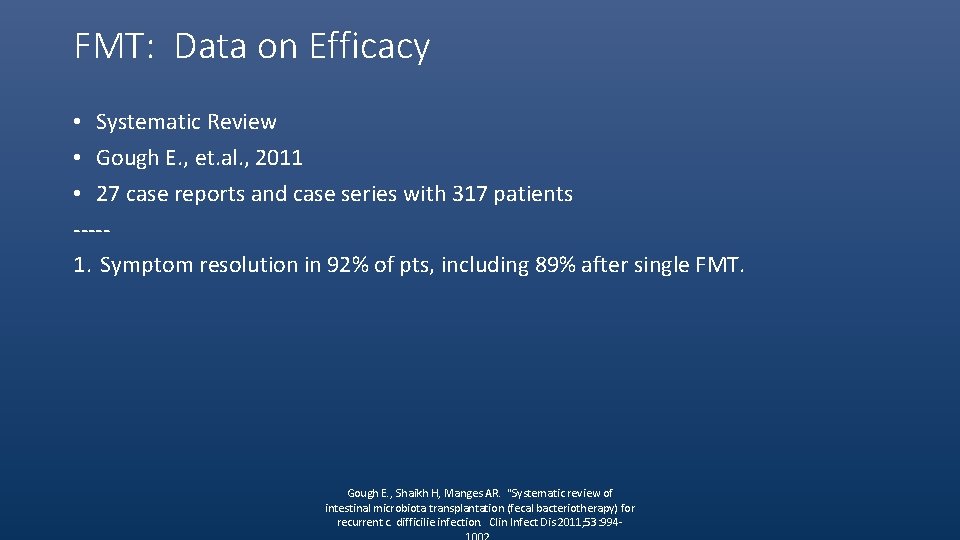
FMT: Data on Efficacy • Systematic Review • Gough E. , et. al. , 2011 • 27 case reports and case series with 317 patients ----1. Symptom resolution in 92% of pts, including 89% after single FMT. Gough E. , Shaikh H, Manges AR. "Systematic review of intestinal microbiota transplantation (fecal bacteriotherapy) for recurrent c. difficilie infection. Clin Infect Dis 2011; 53: 994 -
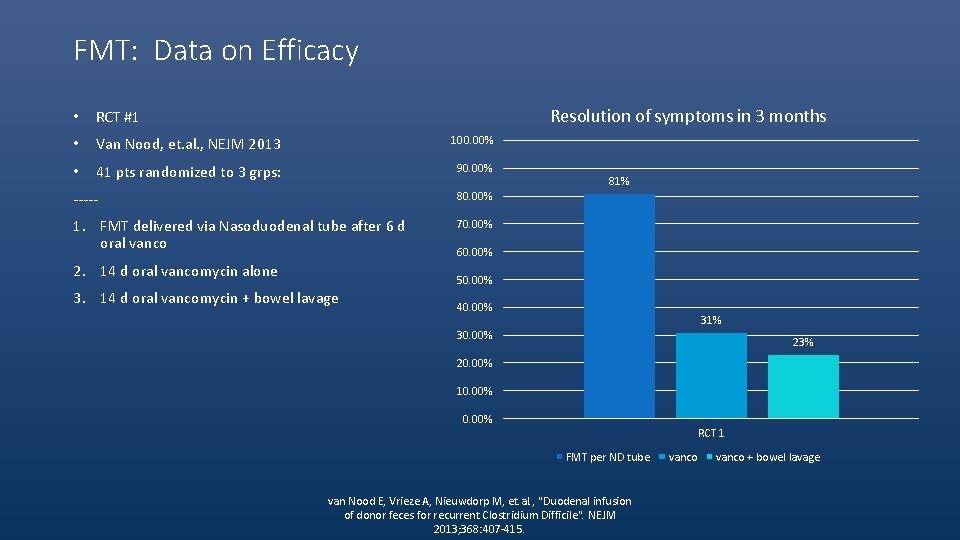
FMT: Data on Efficacy Resolution of symptoms in 3 months • RCT #1 • Van Nood, et. al. , NEJM 2013 100. 00% • 41 pts randomized to 3 grps: 90. 00% ----- 80. 00% 1. FMT delivered via Nasoduodenal tube after 6 d oral vanco 70. 00% 2. 14 d oral vancomycin alone 81% 60. 00% 50. 00% 3. 14 d oral vancomycin + bowel lavage 40. 00% 31% 30. 00% 23% 20. 00% 10. 00% RCT 1 FMT per ND tube van Nood E, Vrieze A, Nieuwdorp M, et. al. , "Duodenal infusion of donor feces for recurrent Clostridium Difficile". NEJM 2013; 368: 407 -415. vanco + bowel lavage
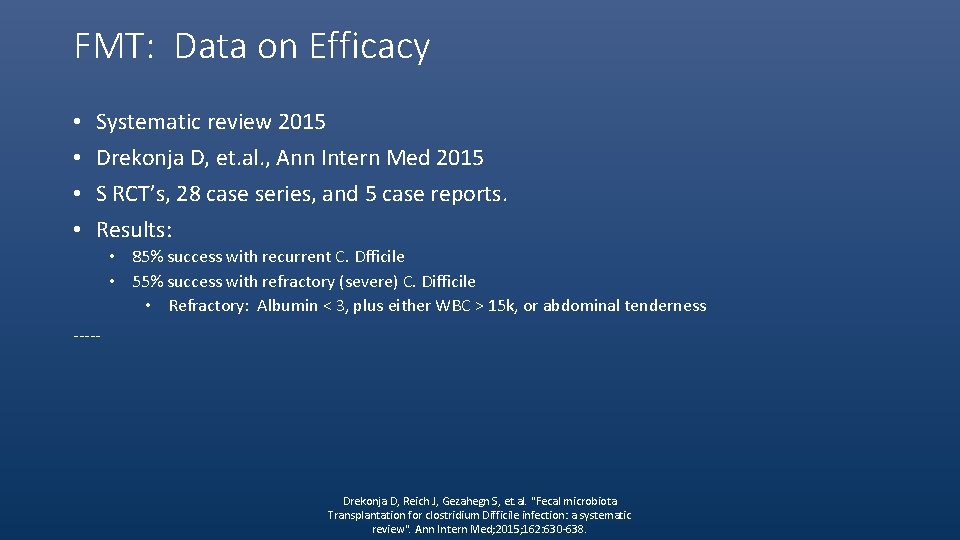
FMT: Data on Efficacy • • Systematic review 2015 Drekonja D, et. al. , Ann Intern Med 2015 S RCT’s, 28 case series, and 5 case reports. Results: • 85% success with recurrent C. Dfficile • 55% success with refractory (severe) C. Difficile • Refractory: Albumin < 3, plus either WBC > 15 k, or abdominal tenderness ----- Drekonja D, Reich J, Gezahegn S, et. al. "Fecal microbiota Transplantation for clostridium Difficile infection: a systematic review". Ann Intern Med; 2015; 162: 630 -638.
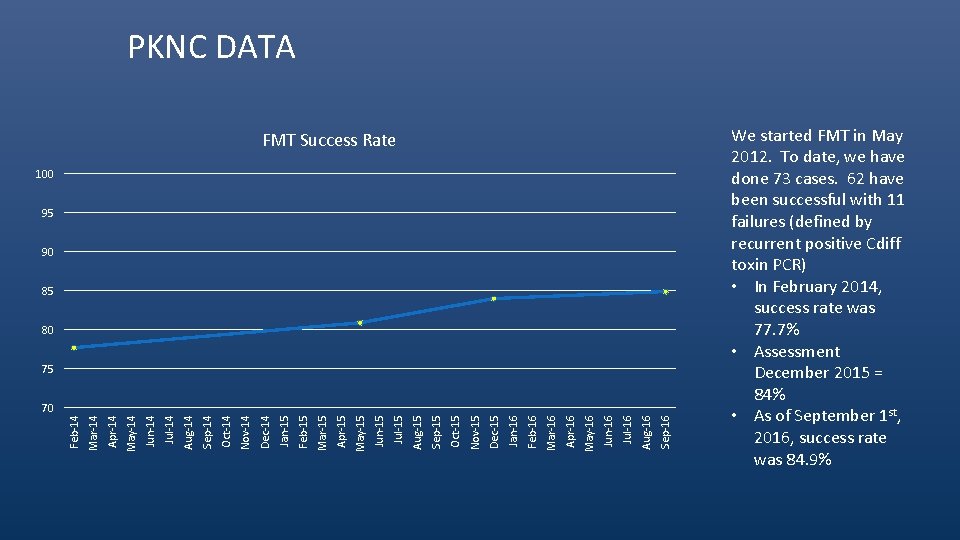
PKNC DATA FMT Success Rate 100 95 90 85 80 75 Sep-16 Aug-16 Jul-16 Jun-16 May-16 Apr-16 Mar-16 Feb-16 Jan-16 Dec-15 Nov-15 Oct-15 Sep-15 Aug-15 Jul-15 Jun-15 May-15 Apr-15 Mar-15 Feb-15 Jan-15 Dec-14 Nov-14 Oct-14 Sep-14 Aug-14 Jul-14 Jun-14 May-14 Apr-14 Mar-14 Feb-14 70 We started FMT in May 2012. To date, we have done 73 cases. 62 have been successful with 11 failures (defined by recurrent positive Cdiff toxin PCR) • In February 2014, success rate was 77. 7% • Assessment December 2015 = 84% • As of September 1 st, 2016, success rate was 84. 9%
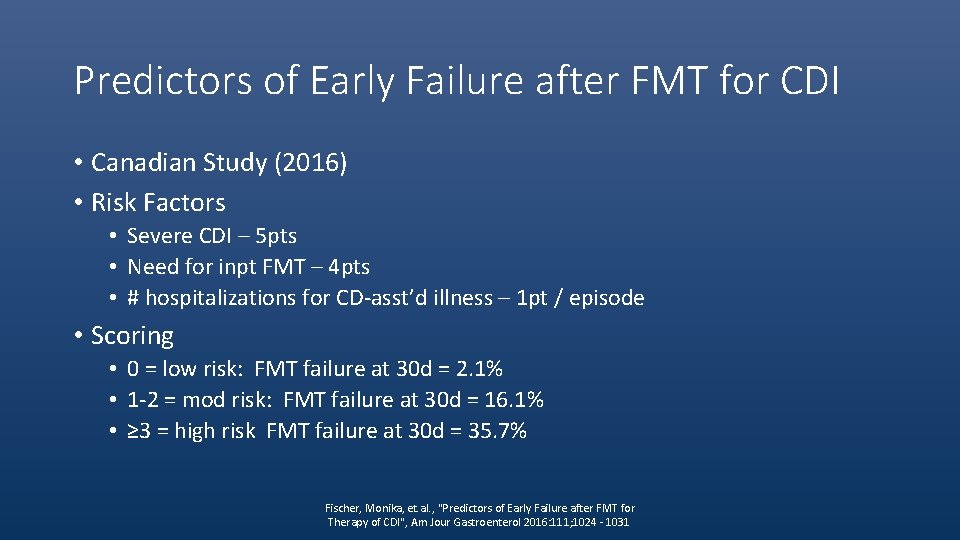
Predictors of Early Failure after FMT for CDI • Canadian Study (2016) • Risk Factors • Severe CDI – 5 pts • Need for inpt FMT – 4 pts • # hospitalizations for CD-asst’d illness – 1 pt / episode • Scoring • 0 = low risk: FMT failure at 30 d = 2. 1% • 1 -2 = mod risk: FMT failure at 30 d = 16. 1% • ≥ 3 = high risk FMT failure at 30 d = 35. 7% Fischer, Monika, et. al. , "Predictors of Early Failure after FMT for Therapy of CDI", Am Jour Gastroenterol 2016: 111; 1024 - 1031
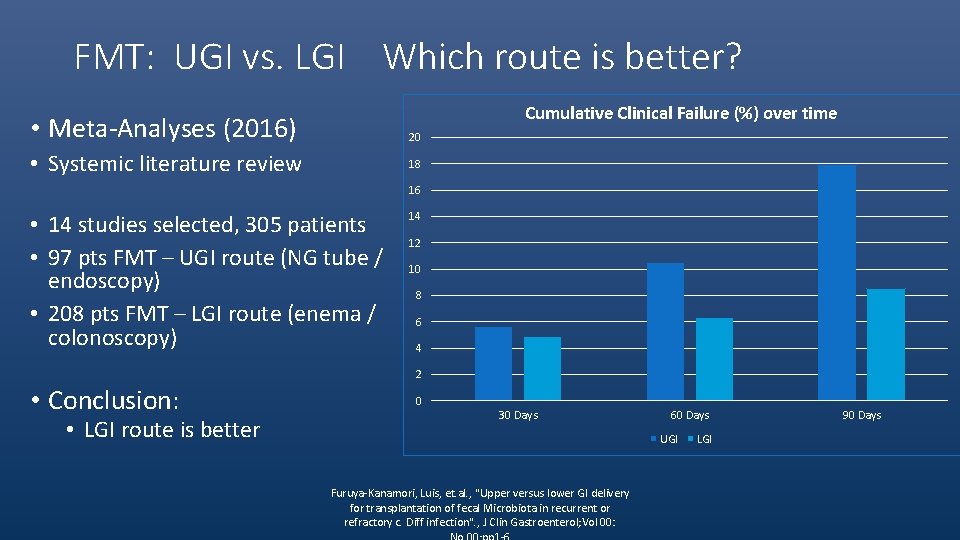
FMT: UGI vs. LGI Which route is better? Cumulative Clinical Failure (%) over time • Meta-Analyses (2016) 20 • Systemic literature review 18 16 • 14 studies selected, 305 patients • 97 pts FMT – UGI route (NG tube / endoscopy) • 208 pts FMT – LGI route (enema / colonoscopy) 14 12 10 8 6 4 2 • Conclusion: • LGI route is better 0 30 Days 60 Days UGI Furuya-Kanamori, Luis, et. al. , "Upper versus lower GI delivery for transplantation of fecal Microbiota in recurrent or refractory c. Diff infection". , J Clin Gastroenterol; Vol 00: LGI 90 Days
Frozen vs. Fresh? • Randomized DB Trial 2016 • Objective: • Is Frozen (and thawed) FMT non-inferior to fresh FMT? • Design: • 236 pts at 6 Canadian academic med ctrs with RCDI • End point: clinical resolution of diarrhea without relapse at 13 w • Non-inferiority margin set at 15% Lee Christine, et. al. , JAMA 2016; 315(2): 142 -149
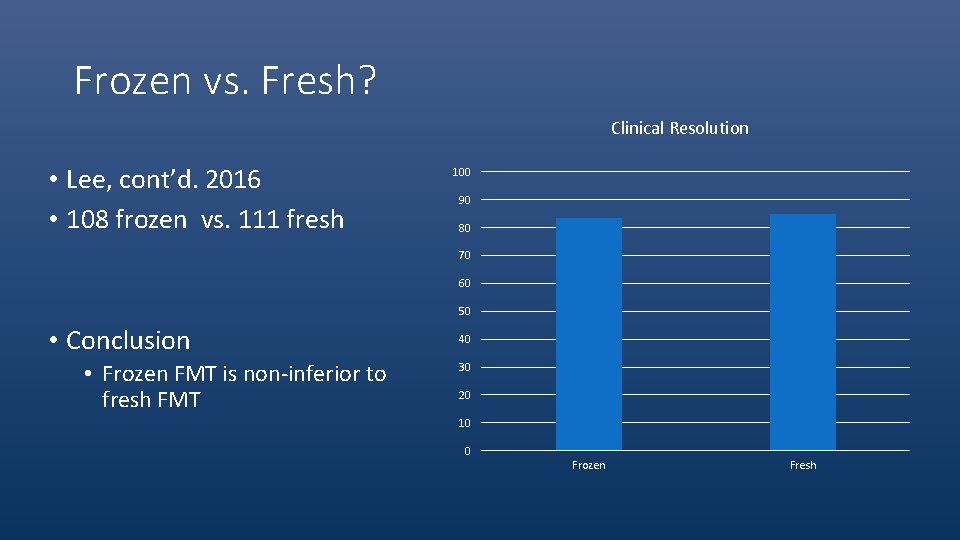
Frozen vs. Fresh? Clinical Resolution • Lee, cont’d. 2016 • 108 frozen vs. 111 fresh 100 90 80 70 60 50 • Conclusion • Frozen FMT is non-inferior to fresh FMT 40 30 20 10 0 Frozen Fresh
Current Guidelines • European Society of Clinical Microbiology and infectious Disease 2014 • “FMT is strongly recommended after a second recurrence of C. Difficile Infection” • American College of Gastroenterology 2013 • Consider FMT “if there is a third recurrence after a pulsed vancomycin regimen” 1. Debast SB, Bauer MP, Kuilper EJ, Clin Microbiol Infect 2014; 20 Suppl 2: 1 -26. 2. Surawicz CM, Brandt LJ, Binion DG, et. al. , Am J Gastroenterol 2013; 108: 478 -498.
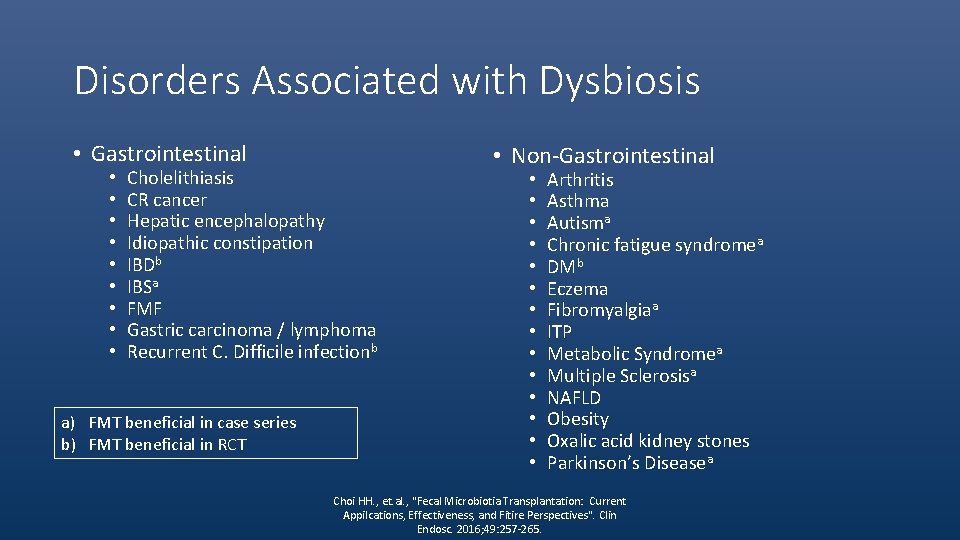
Disorders Associated with Dysbiosis • Gastrointestinal • • • Cholelithiasis CR cancer Hepatic encephalopathy Idiopathic constipation IBDb IBSa FMF Gastric carcinoma / lymphoma Recurrent C. Difficile infectionb a) FMT beneficial in case series b) FMT beneficial in RCT • Non-Gastrointestinal • • • • Arthritis Asthma Autisma Chronic fatigue syndromea DMb Eczema Fibromyalgiaa ITP Metabolic Syndromea Multiple Sclerosisa NAFLD Obesity Oxalic acid kidney stones Parkinson’s Diseasea Choi HH. , et. al. , "Fecal Microbiotia Transplantation: Current Appilcations, Effectiveness, and Fitire Perspectives". Clin Endosc. 2016; 49: 257 -265.
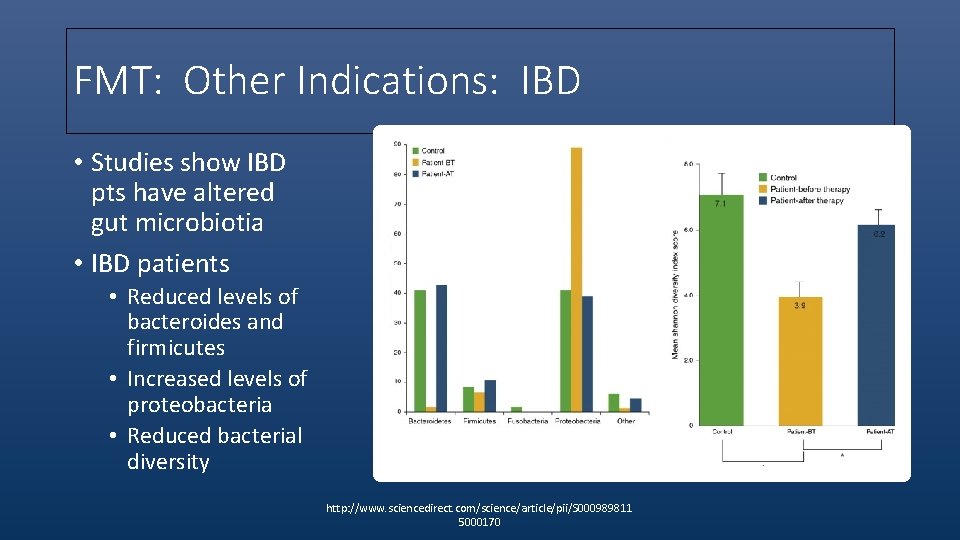
FMT: Other Indications: IBD • Studies show IBD pts have altered gut microbiotia • IBD patients • Reduced levels of bacteroides and firmicutes • Increased levels of proteobacteria • Reduced bacterial diversity http: //www. sciencedirect. com/science/article/pii/S 000989811 5000170
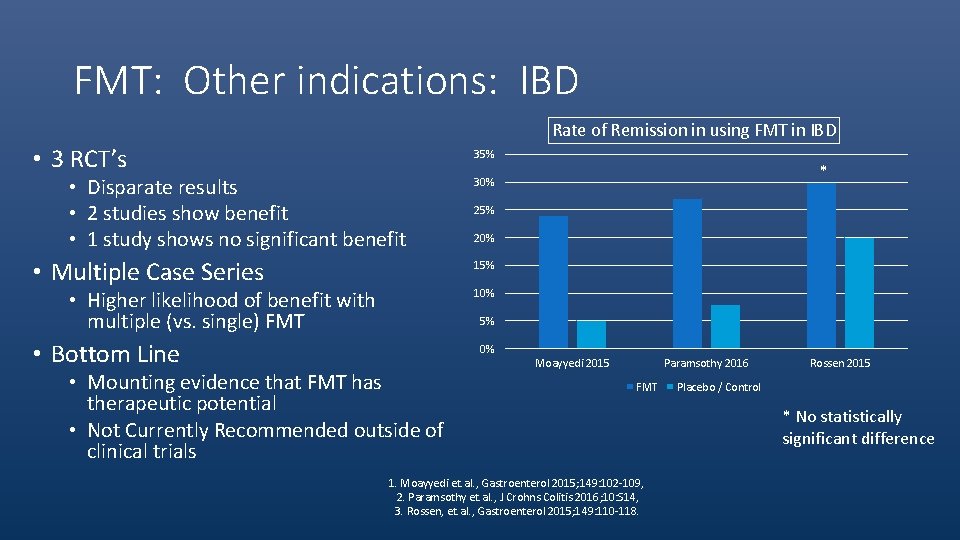
FMT: Other indications: IBD Rate of Remission in using FMT in IBD • 3 RCT’s 35% • Disparate results • 2 studies show benefit • 1 study shows no significant benefit • Multiple Case Series 25% 20% 15% 10% • Higher likelihood of benefit with multiple (vs. single) FMT • Bottom Line * 30% 5% 0% • Mounting evidence that FMT has therapeutic potential • Not Currently Recommended outside of clinical trials Moayyedi 2015 Paramsothy 2016 FMT 1. Moayyedi et. al. , Gastroenterol 2015; 149: 102 -109, 2. Paramsothy et. al. , J Crohns Colitis 2016; 10: S 14, 3. Rossen, et. al. , Gastroenterol 2015; 149: 110 -118. Rossen 2015 Placebo / Control * No statistically significant difference
FMT: Other Indications: Obesity • Background • Mice studies: 2004 -2014 • Transplanting intestinal flora from an obese mice model into lean mice lead to increased body fat in the lean mice • Theory: • Certain bacteria degrade dietary fiber into SCFA • Calorie-rich SCFA are absorbed by the host • Downstream effects on insulin resistance, increased triglyceride storage, increased hepatic lipogenesis • Insufficient data to recommend FMT for Rx of obesity in humans 1. Backhed F. , et. al. , Proc. Natl. Acad. Sci. USA 101, 1571815723 2. Turnbaugh P. , et. al. , Cell Host Microbe 3, 213 -223, 3. Hartsra A. , et. al. , Diabetes Care 38, 159 -165.
FMT: Other Indications: IBS • Irritable Bowel Syndrome • Common: > 10 -15% of adults • • Chronic abdominal pain Alteration in bowel habit (Diarrhea vs. constipation) Absence of demonstrable pathology Other symptoms: Bloating / Gas / Urgency • Etiology • Incompletely understood • Stress and diet related • Increasing evidence suggests Gut Microbiotia plays a role Distrust E. , et. al. , Gut Microbiotia Modulation in IBS. World J Gastroenterol 2016 Feb 21; 22(7): 2219 -2241.
FMT: Other Indications: IBS • Microbiotia – Gut – Brain Axis • Deep interrelationship between these 3 functional organs • Significant portion of circulating metabolites are derived from intestinal microbiotia • Circulating metabolites act as signaling molecules; • Leads to production of neurotransmitters: Dopamine, Acetylcholine, NEpi, GABA • Intestinal Gas production: Hydrogen Sulfide is a gaseous neurotransmitter • Evidence: • Direct contact of probiotics (L. Acidophilus) with gut epithelium • Leads to upregulation of gut opioid / cannabinoid pain receptors • Modulation of pain perception Distrust E. , et. al. , Gut Microbiotia Modulation in IBS. World J Gastroenterol 2016 Feb 21; 22(7): 2219 -2241.
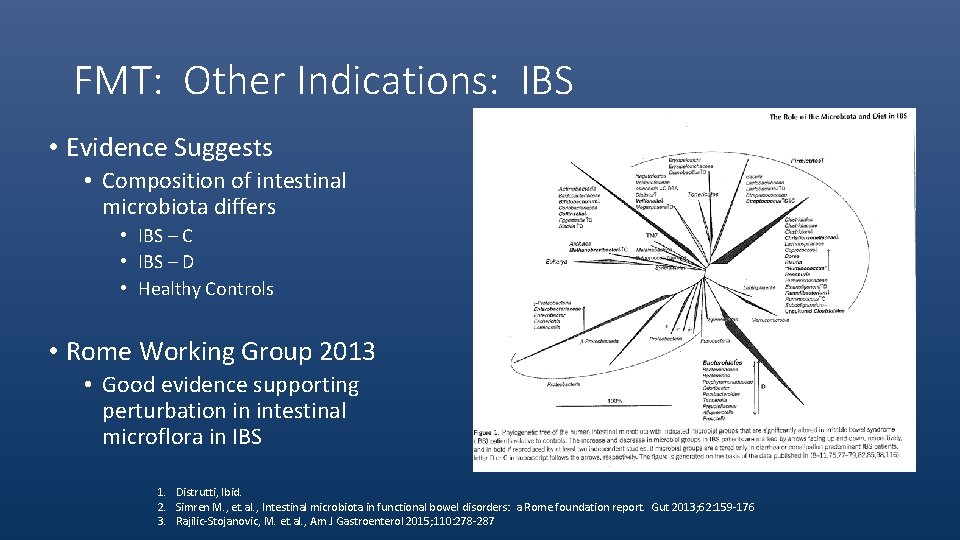
FMT: Other Indications: IBS • Evidence Suggests • Composition of intestinal microbiota differs • IBS – C • IBS – D • Healthy Controls • Rome Working Group 2013 • Good evidence supporting perturbation in intestinal microflora in IBS 1. Distrutti, Ibid. 2. Simren M. , et. al. , Intestinal microbiota in functional bowel disorders: a Rome foundation report. Gut 2013; 62: 159 -176 3. Rajilic-Stojanovic, M. et. al. , Am J Gastroenterol 2015; 110: 278 -287
Possible Adverse Effects of FMT • Short Term • Minor • • Bloating Flatulence Diarrhea Constipation • Serious • Complication of endoscopy (bleeding, perforation, etc. ) • Adverse effect related to sedation (aspiration, etc. ) • Transmission of enteric pathogens • IBD flare • Pneumonia • Potential Long Term • Transmission of unrecognized infectious agent(s) that causes illness years later (Hep C, HIV, etc. ) • Induction of chronic diseases based on alteration of gut microbiota • • Obesity Diabetes Atherosclerosis IBD Colon cancer NAFLD IBS asthma
Summary • Intestinal Microbiome functions as an “organ” functioning in immunity and digestion • Perturbation of the microbiome (“dysbiosis”) predisposes to disease • FMT is the best available Rx for chronic recurrent C. Difficile • FMT will likely play an increasing role in mgmt. of other diseases including IBD, IBS, obesity, and many others
- Slides: 68