
FMCSA Entry Level Training 2020 Overview June 2018




































- Slides: 94
FMCSA Entry Level Training 2020 Overview June 2018
Intent of this Training • • Break it down in detail Show Summary of Theory Show Summary of Behind the Wheel Answer Questions
VERY IMPORTANT THINGS TO REMEMBER!! YOU MUST TEACH THIS TRAINING “AS IS”! THIS IS NOT YOUR DISTRICT TRAINING!!!!
Purpose and Scope 380. 601
Purpose and Scope 380. 601 This subpart establishes training requirements for entry-level drivers, as defined in this subpart, and minimum content for theory and Behind-the -Wheel (BTW) training curricula. Entry-level driver training, as defined in this subpart, applies only to those individuals who apply for a commercial driver's license (CDL) or a CDL upgrade or endorsement and does not otherwise amend substantive CDL requirements in part 383 of this chapter.
Applicability 380. 603
Applicability 380. 603 Apply to all entry-level drivers who intend to drive CMVs in interstate and/or intrastate commerce, except: 383. 3(c) (1) Drivers excepted from the CDL requirements under § 383. 3(c), (d), and (h) of this chapter;
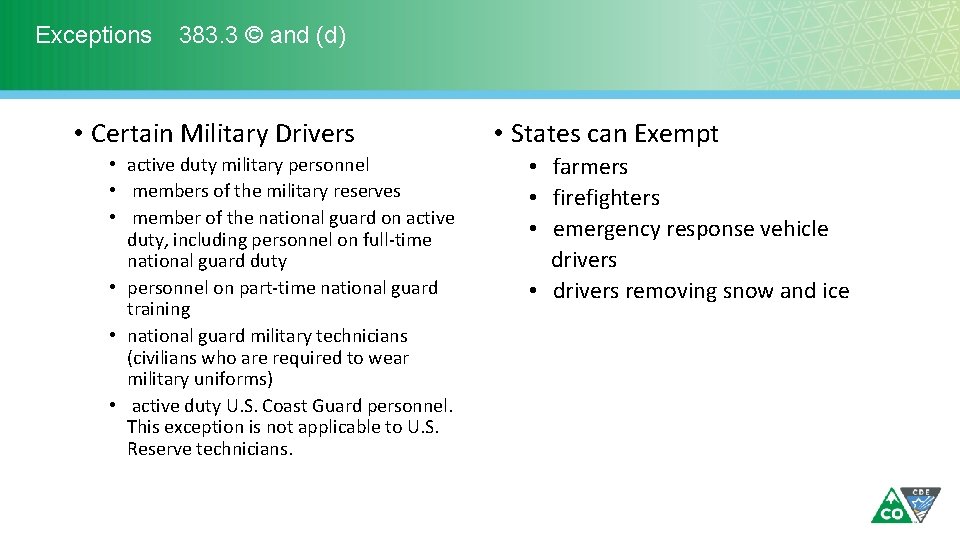
Exceptions 383. 3 © and (d) • Certain Military Drivers • active duty military personnel • members of the military reserves • member of the national guard on active duty, including personnel on full-time national guard duty • personnel on part-time national guard training • national guard military technicians (civilians who are required to wear military uniforms) • active duty U. S. Coast Guard personnel. This exception is not applicable to U. S. Reserve technicians. • States can Exempt • farmers • firefighters • emergency response vehicle drivers • drivers removing snow and ice
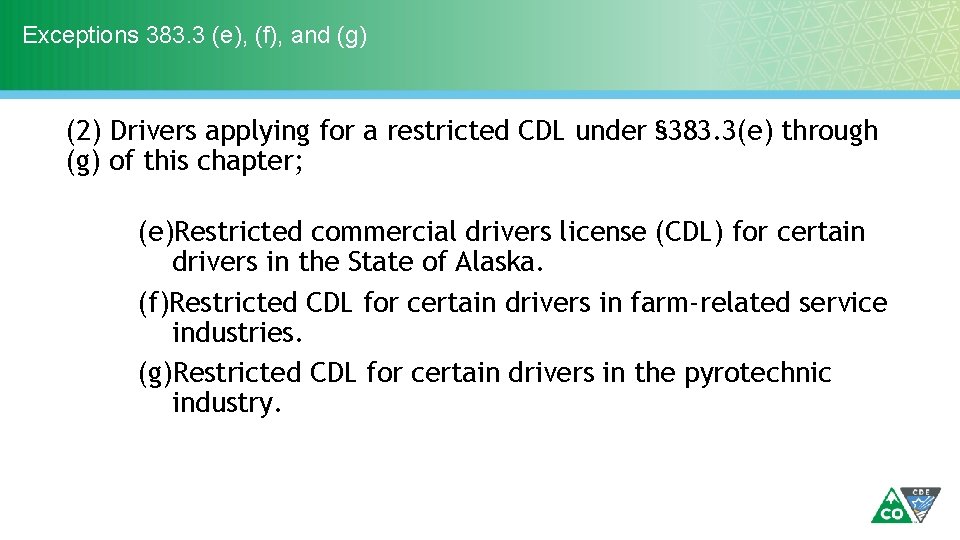
Exceptions 383. 3 (e), (f), and (g) (2) Drivers applying for a restricted CDL under § 383. 3(e) through (g) of this chapter; (e)Restricted commercial drivers license (CDL) for certain drivers in the State of Alaska. (f)Restricted CDL for certain drivers in farm-related service industries. (g)Restricted CDL for certain drivers in the pyrotechnic industry.
Exception 383. 77 (3) Veterans with military CMV experience who meet all the requirements and conditions of § 383. 77 of this chapter “Grandfathering” • The pool of applicants eligible for grandfathering is limited to drivers with current Commercial Motor Vehicle (CMV) operating experience under a CDL waiver (e. g. , farm, Farm-Related Service Industries (FRSI), firefighting, emergency and military vehicles). • ‘‘Grandfathering’’ of CDL basic or endorsement knowledge testing is not permitted by part 383.
Exception 383. 135(b)(7) (4) Drivers applying for a removal of a restriction in accordance with § 383. 135(b)(7) If a driver applicant wants to remove any of the restrictions in paragraphs (b)(3) through (5) of this section, the applicant does not have to retake the complete skills test. The State may administer a modified skills test that demonstrates that the applicant can safely and effectively operate the vehicle's full air brakes, air over hydraulic brakes, and/or manual transmission. In addition, to remove the air brake or full air brake restriction, the applicant must successfully perform the air brake pre-trip inspection and pass the air brake knowledge test.
Applicability Drivers who hold a valid Class A or Class B CDL, or a passenger (P), school bus (S), or hazardous materials (H) endorsement, issued before February 7, 2020, are not required to comply with this subpart pertaining to that CDL or endorsement. Individuals who obtain a CLP before February 7, 2020, are not required to comply with this subpart if they obtain a CDL before the CLP or renewed CLP expires. Individuals who obtain a CLP on or after February 7, 2020, are required to comply with this subpart.
Applicability Except for individuals seeking the H endorsement, individuals must complete theory and BTW (range and public road) portions of entry-level driver training within one year of completing the first portion.
Definitions 380. 605
Definitions Behind the Wheel Instructor Behind-the-wheel (BTW) instructor means an individual who provides BTW training involving the actual operation of a CMV by an entry-level driver on a range or a public road and meets one of these qualifications
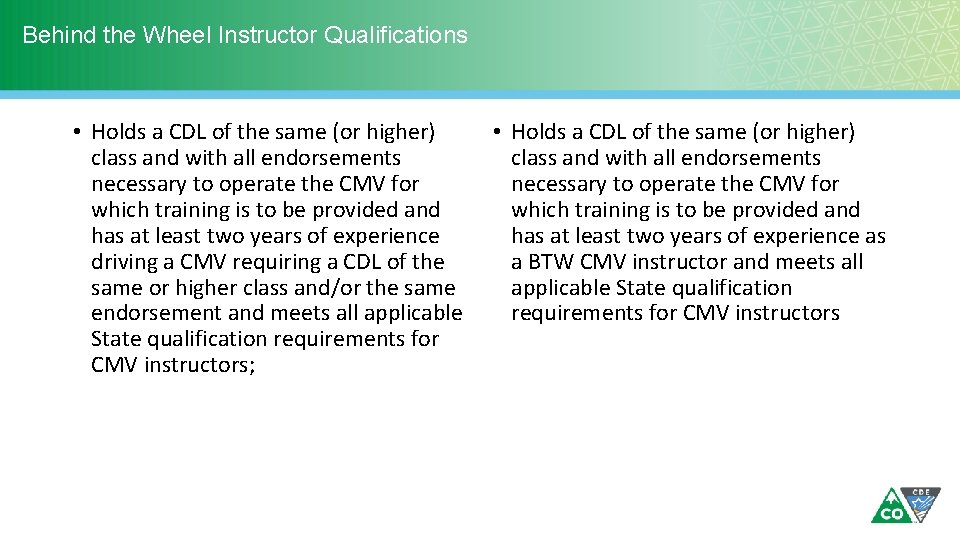
Behind the Wheel Instructor Qualifications • Holds a CDL of the same (or higher) class and with all endorsements necessary to operate the CMV for which training is to be provided and has at least two years of experience driving a CMV requiring a CDL of the same or higher class and/or the same endorsement and meets all applicable State qualification requirements for CMV instructors; • Holds a CDL of the same (or higher) class and with all endorsements necessary to operate the CMV for which training is to be provided and has at least two years of experience as a BTW CMV instructor and meets all applicable State qualification requirements for CMV instructors
Behind the Wheel Instructor Qualifications • If an instructor's CDL has been cancelled, suspended, or revoked due to any of the disqualifying offenses identified in § 383. 51, the instructor is prohibited from engaging in BTW instruction for two years following the date his or her CDL is reinstated. • EXCEPTION - A BTW instructor who provides training solely on a range which is not a public road is not required to hold a CDL of the same (or higher) class and with all endorsements necessary to operate the CMV for which training is to be provided, as long as the instructor previously held a CDL of the same (or higher) class and with all endorsements necessary to operate the CMV for which training is to be provided, and complies with the other requirements set forth in paragraphs (1), (2), or (3) of this definition.
Definitions - Continued Range means an area that must be free of obstructions, enables the driver to maneuver safely and free from interference from other vehicles and hazards, and has adequate sight lines.
383. 51 Disqualification for major offenses • • • Drug and Alcohol Offenses Leaving the Scene of an Accident Using the vehicle to commit a felony Driving a CMV revoked, suspended or cancelled Causing a fatality through the negligent operation of a CMV Using the vehicle in the commission of a felony involving, manufacturing, distribution or dispensing of a controlled substance
383. 51 - Continued Disqualification for serious traffic violations. • • Speeding excessively, involving any speed of 24. 1 kmph (15 mph) or more above the posted speed limit. Driving recklessly, as defined by State or local law or regulation, including but not limited to, offenses of driving a motor vehicle in willful or wanton disregard for the safety of persons or property Making improper or erratic traffic lane changes Following the vehicle ahead too closely. Violating State or local law relating to motor vehicle traffic control (other than a parking violation) arising in connection with a fatal accident. Driving a CMV without obtaining a CDL or without one in possession Driving a CMV without the proper class of CDL and/or endorsements for the specific vehicle group being operated or for the passengers or type of cargo being transported.
383. 51 - Continued Disqualification for railroad-highway grade crossing offenses. • • • The driver is not required to always stop, but fails to slow down and check that tracks are clear of an approaching train The driver is not required to always stop, but fails to stop before reaching the crossing, if the tracks are not clear The driver is always required to stop, but fails to stop before driving onto the crossing. The driver fails to have sufficient space to drive completely through the crossing without stopping. The driver fails to obey a traffic control device or the directions of an enforcement official at the crossing The driver fails to negotiate a crossing because of insufficient undercarriage clearance.
383. 51 - Continued Disqualification for violating out-of-service orders. • • Violating a driver or vehicle out-of-service order while transporting nonhazardous materials Violating a driver or vehicle out-of-service order while transporting hazardous materials required to be placarded under part 172, subpart F of this title, or while operating a vehicle designed to transport 16 or more passengers, including the driver.
Definitions - Continued Behind-the-wheel (BTW) range training means training provided by a BTW instructor when an entry-level driver has actual control of the power unit during a driving lesson conducted on a range. BTW range training does not include time an entry-level driver spends observing the operation of a CMV when he or she is not in control of the vehicle
Definitions - Continued Behind-the-wheel (BTW) public road training means training provided by a BTW instructor when an entry-level driver has actual control of the power unit during a driving lesson conducted on a public road. BTW public road training does not include the time that an entry-level driver spends observing the operation of a CMV when he or she is not in control of the vehicle
Definitions - Continued Entry-level driver means an individual who must complete the CDL skills test requirements under § 383. 71 prior to receiving a CDL for the first time, upgrading to a Class A or Class B CDL, or obtaining a hazardous materials, passenger, or school bus endorsement for the first time. This definition does not include individuals for whom States waive the CDL skills test under § 383. 77 or individuals seeking to remove a restriction in accordance with § 383. 135(b)(7).
Definitions - Continued Entry-level driver training means training an entry-level driver receives from an entity listed on FMCSA's Training Provider Registry prior • Taking the CDL skills test required to receive the Class A or Class B CDL for the first time; • Taking the CDL skills test required to upgrade to a Class A or Class B CDL; or • Taking the CDL skills test required to obtain a passenger and/or school bus endorsement for the first time or the CDL knowledge test required to obtain a hazardous materials endorsement for the first time.
Definitions - Continued Theory instruction means knowledge instruction on the operation of a CMV and related matters provided by a theory instructor through lectures, demonstrations, audio-visual presentations, computer-based instruction, driving simulation devices, online training, or similar means.
Definitions - Continued Theory instructor means an individual who provides knowledge instruction on the operation of a CMV and meets one of these qualifications:
Theory Instructor Qualifications • Holds a CDL of the same (or higher) class and with all endorsements necessary to operate the CMV for which training is to be provided and has at least two years of experience driving a CMV requiring a CDL of the same (or higher) class and/or the same endorsement and meets all applicable State qualification requirements for CMV instructors • Holds a CDL of the same (or higher) class and with all endorsements necessary to operate the CMV for which training is to be provided and has at least two years of experience as a BTW CMV instructor and meets all applicable State qualification requirements for CMV instructors
Theory Instructor Qualifications • Exception - An instructor is not required to hold a CDL of the same (or higher) class and with all endorsements necessary to operate the CMV for which training is to be provided, if the instructor previously held a CDL of the same (or higher) class and complies with the other requirements set forth in paragraphs (1), (2), and (3) of this definition. • Exception - Training providers offering online content exclusively are not required to meet State qualification requirements for theory instructors.
Definitions - Continued Training provider means an entity that is listed on the FMCSA Training Provider Registry, as required by subpart G of this part. Training providers include, but are not limited to, training schools, educational institutions, rural electric cooperatives, motor carriers, State/local governments, school districts, joint labor management programs, owner-operators, and individuals.
Registry for Entry-level Driver Training Providers 380. 70
Scope 380. 70 The rules in this subpart establish the eligibility requirements for listing on FMCSA's Training Provider Registry (TPR). In order to provide entry-level driver training in compliance with this part, training providers must be listed on the TPR.
Requirements for Listing on the Training Providers Registry (TPR) 380. 703 To be eligible for listing on the TPR, an entity must: (1) Follow a curriculum that meets the applicable criteria set forth in appendices A through E of part 380, (2) Utilize facilities that meet the criteria set forth in § 380. 709; (3) Utilize vehicles that meet the criteria set forth in § 380. 711;
Requirements for Listing on the Training Providers Registry (TPR) (4) Utilize driver training instructors that meet the criteria set forth in § 380. 713; (5)(i) Be licensed, certified, registered, or authorized to provide training in accordance with the applicable laws and regulations of any State where in-person training is conducted (ii)Exception: State qualification requirements otherwise applicable to theory instruction do not apply to providers offering such instruction only online.
Requirements for Listing on the Training Providers Registry (TPR) (6) Allow FMCSA or its authorized representative to audit or investigate the training provider's operations to ensure that the provider meets the criteria set forth in this section (7) Electronically transmit an Entry-Level Driver Training Provider Registration Form through the TPR Web site maintained by FMCSA, which attests that the training provider meets all the applicable requirements of this section, to obtain a unique TPR number. If a training provider has more than one campus or training location, the training provider must electronically transmit an Entry-Level Driver Training Provider Registration Form for each campus or training location in order to obtain a unique TPR number for each location
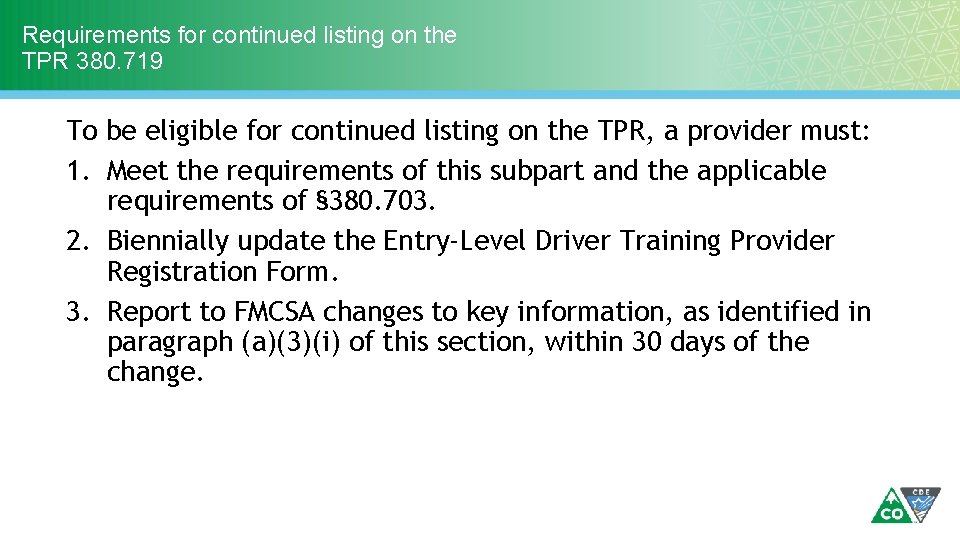
Requirements for continued listing on the TPR 380. 719 To be eligible for continued listing on the TPR, a provider must: 1. Meet the requirements of this subpart and the applicable requirements of § 380. 703. 2. Biennially update the Entry-Level Driver Training Provider Registration Form. 3. Report to FMCSA changes to key information, as identified in paragraph (a)(3)(i) of this section, within 30 days of the change.
Requirements for continued listing on the TPR 380. 719 i. Key information is defined as training provider name, address, phone number, type(s) of training offered, training provider status, and, if applicable, any change in State licensure, certification, or accreditation status. ii. Changes must be reported by electronically transmitting an updated Entry-Level Driver Training Provider Registration Form.
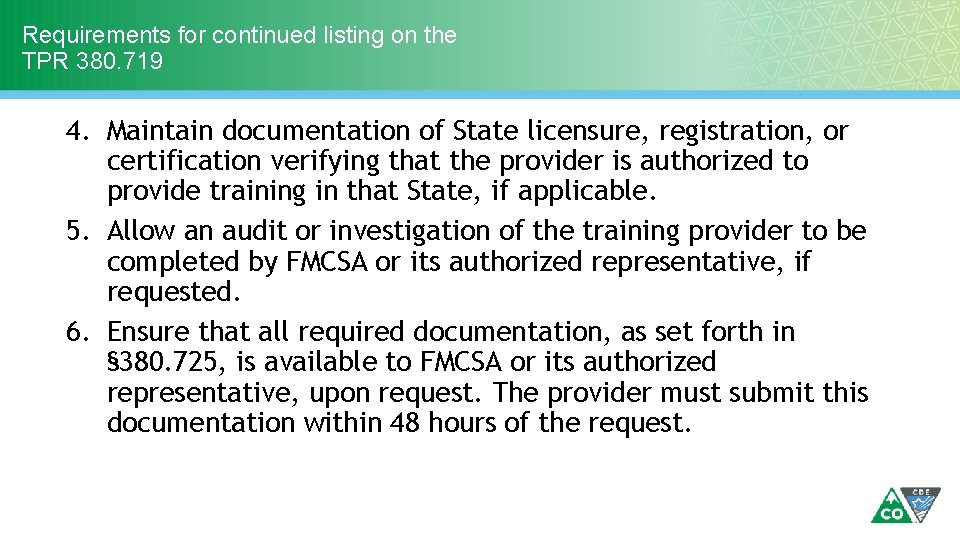
Requirements for continued listing on the TPR 380. 719 4. Maintain documentation of State licensure, registration, or certification verifying that the provider is authorized to provide training in that State, if applicable. 5. Allow an audit or investigation of the training provider to be completed by FMCSA or its authorized representative, if requested. 6. Ensure that all required documentation, as set forth in § 380. 725, is available to FMCSA or its authorized representative, upon request. The provider must submit this documentation within 48 hours of the request.
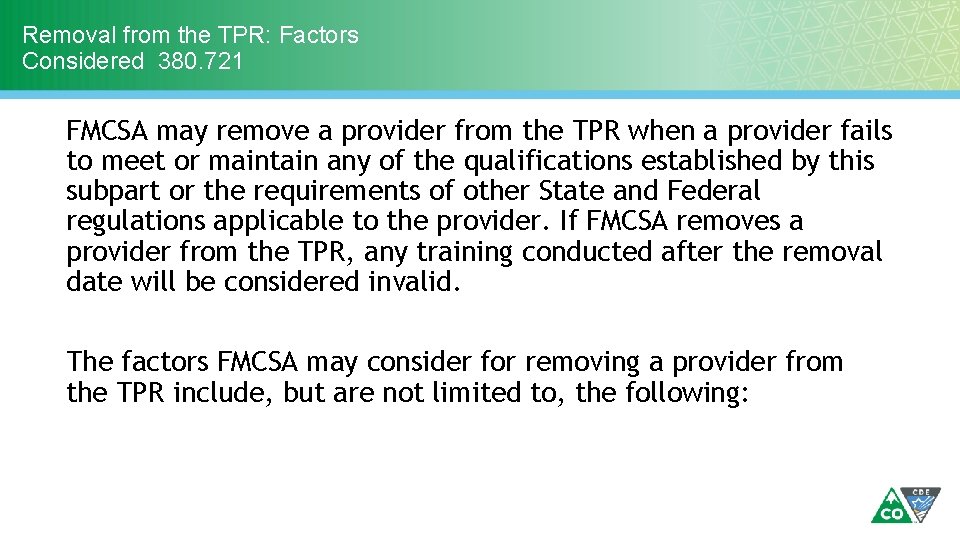
Removal from the TPR: Factors Considered 380. 721 FMCSA may remove a provider from the TPR when a provider fails to meet or maintain any of the qualifications established by this subpart or the requirements of other State and Federal regulations applicable to the provider. If FMCSA removes a provider from the TPR, any training conducted after the removal date will be considered invalid. The factors FMCSA may consider for removing a provider from the TPR include, but are not limited to, the following:
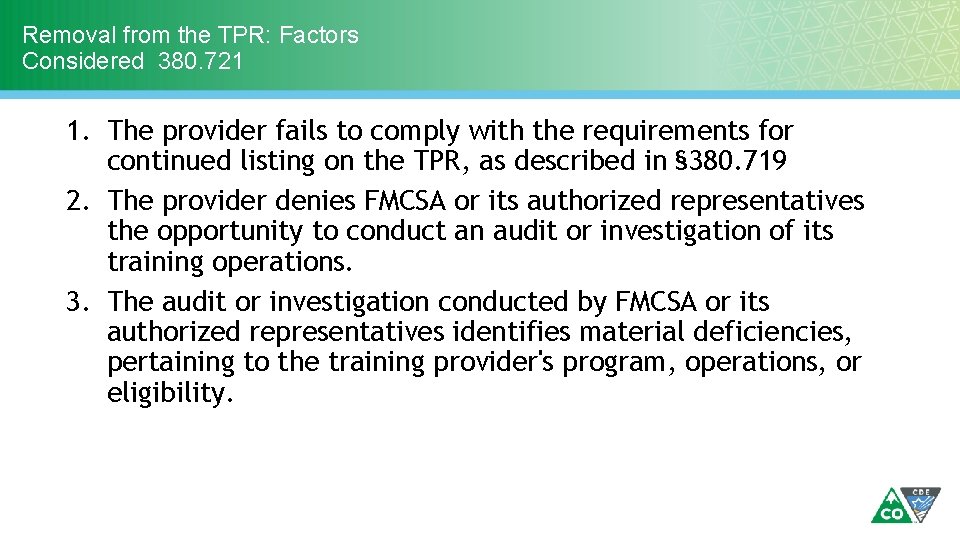
Removal from the TPR: Factors Considered 380. 721 1. The provider fails to comply with the requirements for continued listing on the TPR, as described in § 380. 719 2. The provider denies FMCSA or its authorized representatives the opportunity to conduct an audit or investigation of its training operations. 3. The audit or investigation conducted by FMCSA or its authorized representatives identifies material deficiencies, pertaining to the training provider's program, operations, or eligibility.
Removal from the TPR: Factors Considered 380. 721 4. The provider falsely claims to be licensed, certified, registered, or authorized to provide training in accordance with the applicable laws and regulations in any State where in -person training is provided. 5. The State-administered CDL skills examination passage rate for applicants for the Class A CDL, Class B CDL, passenger endorsement, and/or school bus endorsement who complete the provider's training and the CDL knowledge test passage rate for applicants for the hazardous materials endorsement who complete the provider's training.
Removal from the TPR: Factors Considered 380. 721 In instances of fraud or other criminal behavior by a training provider in which driver-trainees have knowingly participated, FMCSA reserves the right, on a case-by-case basis, to retroactively invalidate training conducted under this subpart.
Removal from the TPR: Procedure Voluntary removal. To be voluntarily removed from the Training Provider Registry (TPR), a provider must submit written notice to FMCSA's Director, Office of Carrier, Driver, and Vehicle Safety Standards (Director). Upon receiving the written notice, FMCSA will remove the training provider from the TPR. On and after the date of issuance of a notice of proposed removal from the TPR issued in accordance with paragraph (b) of this section, such a voluntary removal notice will not be effective.
Removal from the TPR: Procedure Involuntary removal; Notice of proposed removal. Except as provided by paragraphs (a) and (e) of this section, FMCSA initiates the process for involuntary removal of a provider from the TPR by issuing a written notice to the provider, stating the reasons for the proposed removal and setting forth any corrective actions necessary for the provider to remain listed on the TPR. If a notice of proposed removal is issued, the provider must notify current driver-trainees and driver-trainees scheduled for future training of the proposed removal. If a notice of proposed removal is issued to a training provider listed on the TPR Web site, FMCSA will note on the TPR Web site that such notice has been issued. FMCSA will remove the notation if the notice is withdrawn.
Removal from the TPR: Procedure Response to notice of proposed removal and corrective action. A training provider that has received a notice of proposed removal and wishes to remain on the TPR must submit a written response to the Director no later than 30 days after the date of issuance of the notice explaining why it believes that decision is not proper, as described in paragraph (c)(1) of this section. Alternatively, the provider will set forth corrective actions taken in response to FMCSA's notice of proposed removal, as described in paragraph (c)(2) of this section.
Removal from the TPR: Procedure Opposing a notice of proposed removal. If the provider believes FMCSA has relied on erroneous information in proposing removal from the TPR, the provider must explain the basis for that belief and provide supporting documentation. The Director will review the explanation. i. If the Director finds that FMCSA has relied on erroneous information to propose removal of a training provider from the TPR, the Director will withdraw the notice of proposed removal and notify the provider of the withdrawal in writing.
Removal from the TPR: Procedure If the Director finds that FMCSA has not relied on erroneous information in proposing removal, the Director will affirm the notice of proposed removal and notify the provider in writing of the determination. No later than 60 days after the date the Director affirms the notice of proposed removal, or as otherwise agreed to by the provider and the Director, the provider must comply with this subpart and correct the deficiencies identified in the notice of proposed removal as described in paragraph (c)(2) of this section.
Removal from the TPR: Procedure If the provider does not respond in writing within 30 days of the date of issuance of a notice of proposed removal, the removal becomes effective immediately and the provider will be removed from the TPR. Any training conducted after the removal date is invalid.
Removal from the TPR: Procedure Corrective action. (i) The provider must comply with this subpart and complete the corrective actions specified in the notice of proposed removal no later than 60 days after either the date of issuance of the notice of proposed removal or the date the Director subsequently affirms or modifies the notice of proposed removal. The provider must provide documentation of completion of the corrective action(s) to the Director. The Director may conduct an investigation and request any documentation necessary to verify that the provider has complied with this subpart and completed the required corrective action(s). The Director will notify the provider in writing whether it has met the requirements for continued listing on the TPR. (ii)If the provider fails to complete the proposed corrective action(s) within the 60 -day period, the provider will be removed from the TPR. The Director will notify the provider in writing of the removal.
Removal from the TPR: Procedure Request for administrative review. If a provider has been removed from the TPR under paragraph (c)(1)(iii), (c)(2)(ii), or (e) of this section, the provider may request an administrative review. The request must be submitted in writing to the FMCSA Associate Administrator for Policy (Associate Administrator) no later than 30 days after the effective date of the removal. The request must explain the alleged error(s) committed in removing the provider from the TPR, and include all factual, legal, and procedural issues in dispute, as well as any supporting documentation.
Removal from the TPR: Procedure Additional procedures for administrative review. The Associate Administrator may ask the provider to submit additional information or attend a conference to discuss the removal. If the provider does not provide the information requested, or does not attend the scheduled conference, the Associate Administrator may dismiss the request for administrative review. Decision on administrative review. The Associate Administrator will complete the administrative review and notify the provider in writing of the decision. The decision constitutes final Agency action. If the Associate Administrator deems the removal to be invalid, FMCSA will reinstate the provider's listing on the TPR.
Removal from the TPR: Procedure Emergency removal. In cases of fraud, criminal behavior, or willful disregard of the regulations in this subpart or in which public health, interest, or safety requires, the provisions of paragraph (b) of this section are not applicable. In these cases, the Director may immediately remove a provider from the TPR. In instances of fraud or other criminal behavior by a training provider in which driver-trainees have knowingly participated, FMCSA reserves the right to retroactively invalidate training conducted under this subpart. A provider who has been removed under the provisions of this paragraph may request an administrative review of that decision as described under paragraph (d) of this section. Reinstatement to the Training Provider Registry. (1) Any time after a training provider's voluntary removal from the TPR, the provider may apply to the Director to be reinstated.
Removal from the TPR: Procedure No sooner than 30 days after the date of a provider's involuntary removal from the TPR, the provider may apply to the Director to be reinstated. The provider must submit documentation showing completion of any corrective action(s) identified in the notice of proposed removal or final notice of removal, as applicable.
Entry Level Training Provider
Entry Level Training Provider 380. 707 Training providers must require all accepted applicants for behind-the-wheel (BTW) training to certify that they will comply U. S. Department of Transportation regulations in parts 40, 382, 383, and 391, as well as State and/or local laws, related to controlled substances testing, age, medical certification, licensing, and driving record. Training providers must verify that all accepted BTW applicants hold a valid commercial learner's permit or commercial driver's license, as applicable.
Entry Level Training Provider Training providers offering online training must ensure that the content is prepared and/or delivered by a theory instructor, as defined in § 380. 605. Separate training providers may deliver theory and BTW portions of the training, but both portions (range and public road) of the BTW training must be delivered by the same training provider.
When a provider meets the requirements of §§ 380. 703 and 380. 707, FMCSA will issue the provider a unique TPR number and, as applicable, add the provider's name and/or contact information to the TPR Web site.
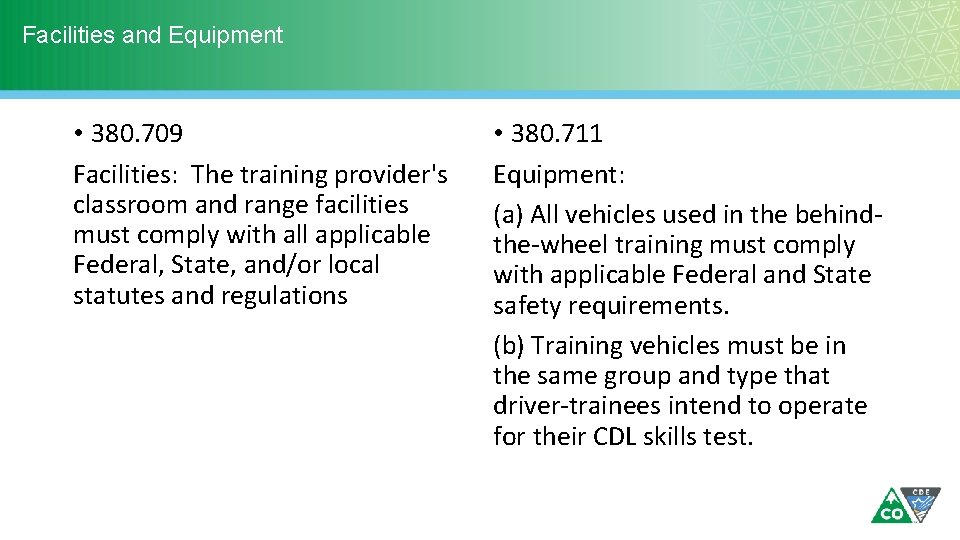
Facilities and Equipment • 380. 709 Facilities: The training provider's classroom and range facilities must comply with all applicable Federal, State, and/or local statutes and regulations • 380. 711 Equipment: (a) All vehicles used in the behindthe-wheel training must comply with applicable Federal and State safety requirements. (b) Training vehicles must be in the same group and type that driver-trainees intend to operate for their CDL skills test.
Instructor Requirements Assessments and Training Certification
Instructor Requirements Theory training providers must utilize instructors who are a theory instructor as defined in § 380. 605. BTW training providers must utilize instructors who are a BTW instructors as defined in § 380. 605.
Assessments • Training providers must use assessments (in written or electronic format) to determine driver-trainees' proficiency in the knowledge objectives in theory portion of each unit of instruction in appendices A through E of part 380, as applicable. The driver-trainee must receive an overall minimum score of 80 percent on theory assessment. • Training instructors must evaluate and document a driver-trainee's proficiency in BTW skills in accordance with the curricula in appendices A through D of part 380, as applicable.
Training Certification After an individual completes training administered by a provider listed on the TPR, that provider must, by midnight of the second business day after the driver-trainee completes the training, electronically transmit training certification information through the TPR Web site including the following:
Training Certification 1. Driver-trainee name, number of driver's license/commercial learner's permit/commercial driver's license, as applicable, and State of licensure; 2. Commercial driver's license class and/or endorsement and type of training (theory and/or BTW) the driver-trainee completed; 3. Total number of clock hours the driver-trainee spent to complete BTW training, as applicable; 4. Name of the training provider and its unique TPR identification number; and 5. Date(s) of successful training completion.
Starting to feel a bit overwhelmed?
Documentation and Record Retention
Document Retention All training providers on the TPR must retain the following: 1. Self-certifications by all accepted applicants for behind-thewheel (BTW) training attesting that they will comply with U. S. Department of Transportation regulations in parts 40, 382, 383 and 391, as well as State and/or local laws, related to alcohol and controlled substances testing, age, medical certification, licensing, and driver records, as required in 380. 707(a). 2. A copy of the driver-trainee's commercial learner's permit(s) or commercial driver's license, as applicable, as required in 380. 707(a).
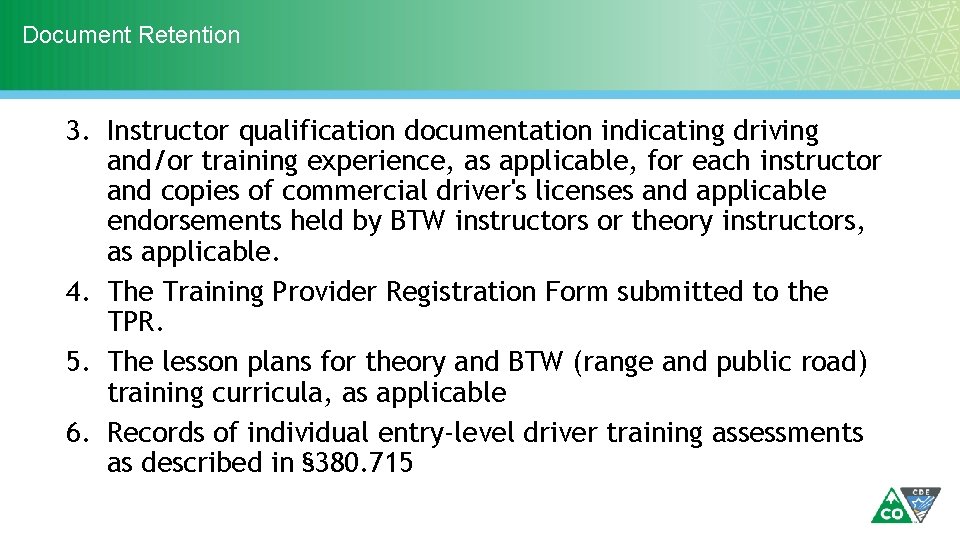
Document Retention 3. Instructor qualification documentation indicating driving and/or training experience, as applicable, for each instructor and copies of commercial driver's licenses and applicable endorsements held by BTW instructors or theory instructors, as applicable. 4. The Training Provider Registration Form submitted to the TPR. 5. The lesson plans for theory and BTW (range and public road) training curricula, as applicable 6. Records of individual entry-level driver training assessments as described in § 380. 715
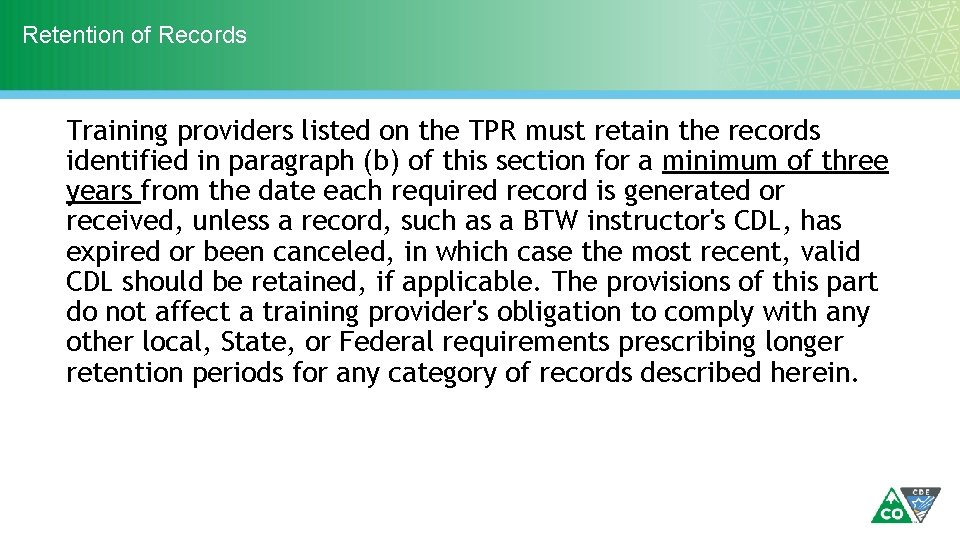
Retention of Records Training providers listed on the TPR must retain the records identified in paragraph (b) of this section for a minimum of three years from the date each required record is generated or received, unless a record, such as a BTW instructor's CDL, has expired or been canceled, in which case the most recent, valid CDL should be retained, if applicable. The provisions of this part do not affect a training provider's obligation to comply with any other local, State, or Federal requirements prescribing longer retention periods for any category of records described herein.
Class B – CDL Training Curriculum,
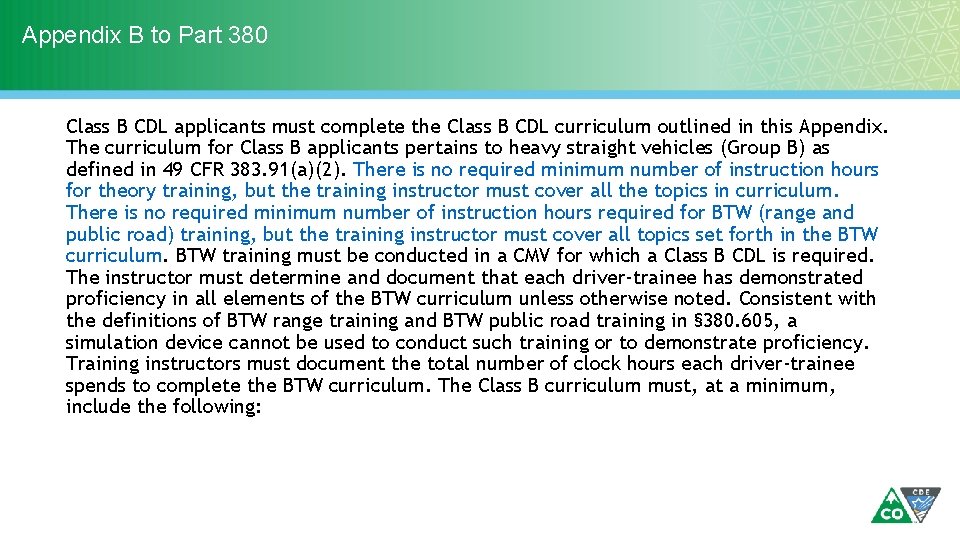
Appendix B to Part 380 Class B CDL applicants must complete the Class B CDL curriculum outlined in this Appendix. The curriculum for Class B applicants pertains to heavy straight vehicles (Group B) as defined in 49 CFR 383. 91(a)(2). There is no required minimum number of instruction hours for theory training, but the training instructor must cover all the topics in curriculum. There is no required minimum number of instruction hours required for BTW (range and public road) training, but the training instructor must cover all topics set forth in the BTW curriculum. BTW training must be conducted in a CMV for which a Class B CDL is required. The instructor must determine and document that each driver-trainee has demonstrated proficiency in all elements of the BTW curriculum unless otherwise noted. Consistent with the definitions of BTW range training and BTW public road training in § 380. 605, a simulation device cannot be used to conduct such training or to demonstrate proficiency. Training instructors must document the total number of clock hours each driver-trainee spends to complete the BTW curriculum. The Class B curriculum must, at a minimum, include the following:
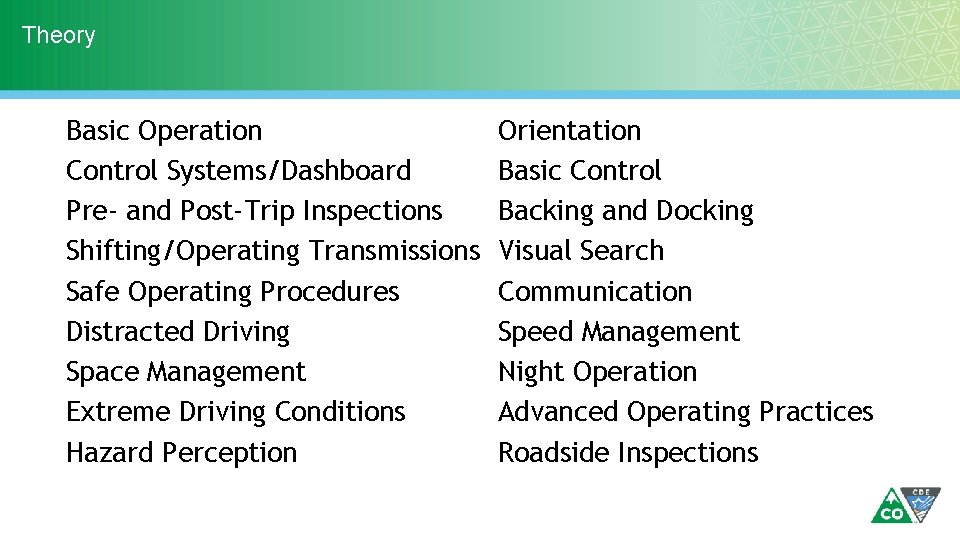
Theory Basic Operation Control Systems/Dashboard Pre- and Post-Trip Inspections Shifting/Operating Transmissions Safe Operating Procedures Distracted Driving Space Management Extreme Driving Conditions Hazard Perception Orientation Basic Control Backing and Docking Visual Search Communication Speed Management Night Operation Advanced Operating Practices Roadside Inspections
Theory Skid Control/Recovery, Jackknifing, and Other Emergencies Railroad-Highway Grade Crossings Vehicle Systems and Reporting Malfunctions Identification and Diagnosis of Malfunctions Handling and Documenting Cargo Environmental Compliance Issues Hours of Service Requirements Fatigue and Wellness Awareness Post-Crash Procedures
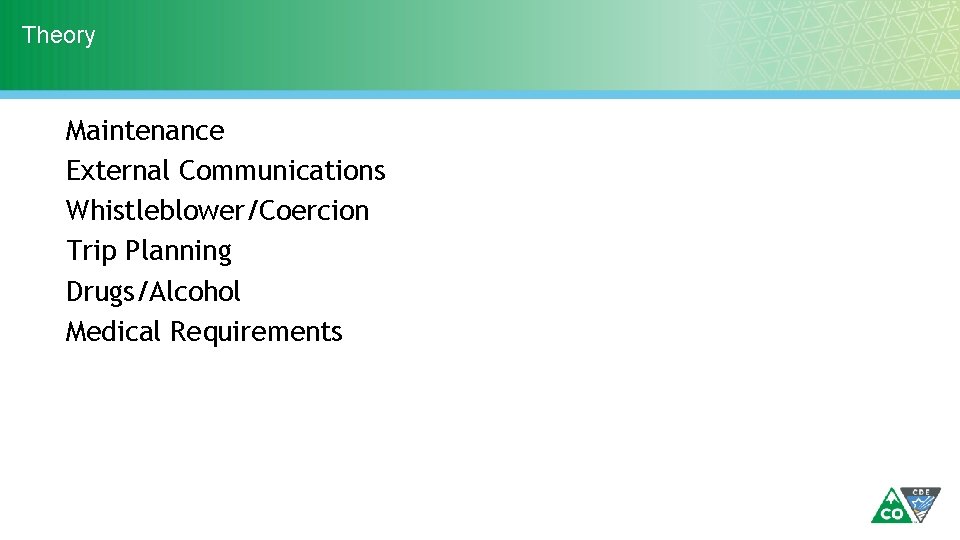
Theory Maintenance External Communications Whistleblower/Coercion Trip Planning Drugs/Alcohol Medical Requirements
That’s not so much to cover!
Let me break down just one of these Units.
Let’s take Trip Planning This unit must address the importance of and requirements for planning routes and trips. This instruction must address planning the safest route, planning for rest stops, heavy traffic areas, railroad-highway grade crossing safe clearance and ground clearance (i. e. , “high center”), the importance of Federal and State requirements on the need for permits, and vehicle size and weight limitations. The training providers must teach drivertrainees the correct identification of restricted routes, the pros and cons of Global Positioning System (GPS)/trip routing software, and the importance of selecting fuel-efficient routes.
Behind-the-Wheel Training
Behind-The-Wheel Range Vehicle Inspection Pre-Trip/Enroute/Post-Trip Straight Line Backing Alley Dock Backing (45/90 Degree) Off-Set Backing Parallel Parking Blind Side Parallel Parking Sight Side
Behind-The-Wheel Public Road Vehicle Controls Including: Left Turns, Right Turns, Lane Changes, Curves at Highway Speeds, and Entry and Exit on the Interstate or Controlled Access Highway Shifting/Transmission Communications/Signaling Visual Search Speed and Space Management Safe Driver Behavior Hours of Service (HOS) Requirements
Behind-The-Wheel Public Road Hazard Perception Railroad (RR)-Highway Grade Crossing Night Operation Extreme Driving Conditions Skid Control/Recovery, Jackknifing, and Other Emergencies
Passenger and School Bus Endorsements
Passenger Endorsement Training Post-Crash Procedures Other Emergency Procedures Vehicle Orientation Fueling and Idling Pre-Trip, Enroute, and Post-Trip Inspection Baggage and/or Cargo Management Passenger Safety Awareness Briefing Passenger Management Americans With Disabilities Act (ADA) Compliance Hours of Service (HOS) Requirements
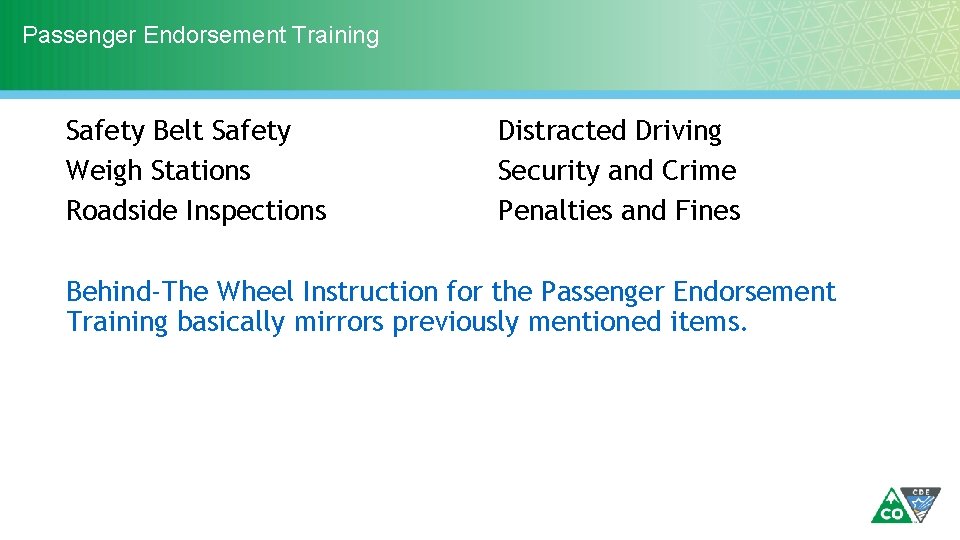
Passenger Endorsement Training Safety Belt Safety Weigh Stations Roadside Inspections Distracted Driving Security and Crime Penalties and Fines Behind-The Wheel Instruction for the Passenger Endorsement Training basically mirrors previously mentioned items.
Let’s break one down. . This is what is required under Vehicle Orientation: Drivertrainees must demonstrate their familiarity with basic passengercarrying CMV physical and operational characteristics including overall height, length, width, ground clearances, rear overhang, gross vehicle weight and gross vehicle weight rating, axle weights, wheels and rims, tire ratings, mirrors, steer wheels, lighting, windshield wipers, engine compartments, basic electric system, and spare tire storage. Additionally, driver-trainees must demonstrate techniques for proper driver's seat and mirror adjustments.
Nope………Not Yet!
School Bus Endorsement Curriculum Danger Zones and Use of Mirrors Loading and Unloading Vehicle Orientation Post-Crash Procedures Emergency Exit and Evacuation Student Management Special Safety Considerations Pre- and Post-Trip Inspections School Bus Security Route and Stop Reviews Railroad-Highway Grade Crossings Emergency Exit and Evacuation Behind-The Wheel Range and Public Road for the School Bus Endorsement basically mirrors previously mentioned items
Remember – Teach it “As Is” District Training is presented after the trainee passes the Skills Test!
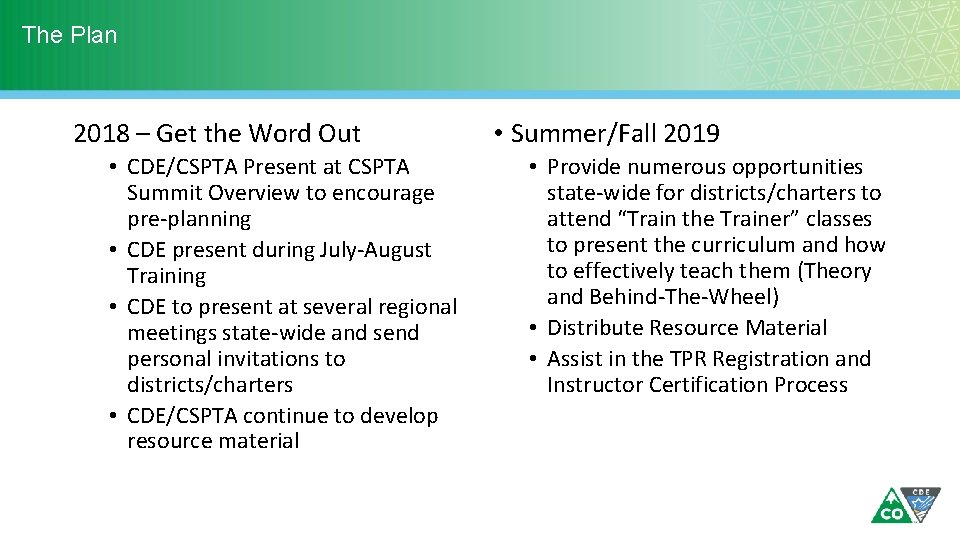
The Plan 2018 – Get the Word Out • CDE/CSPTA Present at CSPTA Summit Overview to encourage pre-planning • CDE present during July-August Training • CDE to present at several regional meetings state-wide and send personal invitations to districts/charters • CDE/CSPTA continue to develop resource material • Summer/Fall 2019 • Provide numerous opportunities state-wide for districts/charters to attend “Train the Trainer” classes to present the curriculum and how to effectively teach them (Theory and Behind-The-Wheel) • Distribute Resource Material • Assist in the TPR Registration and Instructor Certification Process
Questions?
Contact Information Susan M Miller Lead Transportation Consultant Colorado Department of Education 201 East Colfax Ave, Room 209 Denver, CO 80203 Miller_s@cde. state. co. us