
FMCG GURUS The War on Sugar the evolution
- Slides: 14
FMCG GURUS: The War on Sugar - the evolution of consumers May 2019
AGENDA Introduction and methodology Consumer attitudes towards sugar and artificial sweetener reduction Consumer behavior towards sugar reduction Natural sweeteners – opportunities and challenges Conclusions
Introduction This report examines the topic of sugar reduction What is it? Trend evolution? This report examines the extent that consumers are reducing their intake of sugar and what their attitudes are to alternative and substitute products. Sugar reduction is not a new trend. Indeed, a focus on weight reduction is something that has existed amongst society for decades. However in recent years, sugar has overtaken fat as the number one dietary evil in the eyes of many consumers. The report examines consumer attitudes towards sugar intake, artificial and natural sweeteners and sugar substitutes. The report also examines the attitude/behavior gap that exists when it comes to consumers saying they are making conscious attempts to reduce sugar intake and that ultimately this is not always the case. At a time when consumers claim to be paying more attention than ever before to ingredients and want to improve their health, negative media coverage around excessive sugar intake is influencing their perceptions of what constitutes a healthy diet. Why is it important? Barriers to the trend The importance of health maintenance is important to consumers for two key reasons. Firstly, society is ageing which increases the risk of illness. Secondly, younger adults are recognizing that current lifestyle and dietary habits are something that can increase the risk of illness later in life. One of the key barriers that exists when it comes to sugar reduction is the attitude/behavior gap. That is, whilst consumers may say they are reducing sugar intake the reality is they are not. This is resulting in consumers placing greater emphasis on leading a healthier lifestyle so that they can stay fit and active until as late in life as possible. A healthy and balanced diet that is free from “dietary evils” is seen as a key way of achieving this. For instance, many consumers do not monitor their intake of sugar on a daily basis and also admit that attempts to reduce sugar intake are something that tend to be short-term only. This is because consumers can find monitoring nutritional intake timeconsuming, whilst the importance of indulgence also overrides the desire to monitor and limit sugar intake.
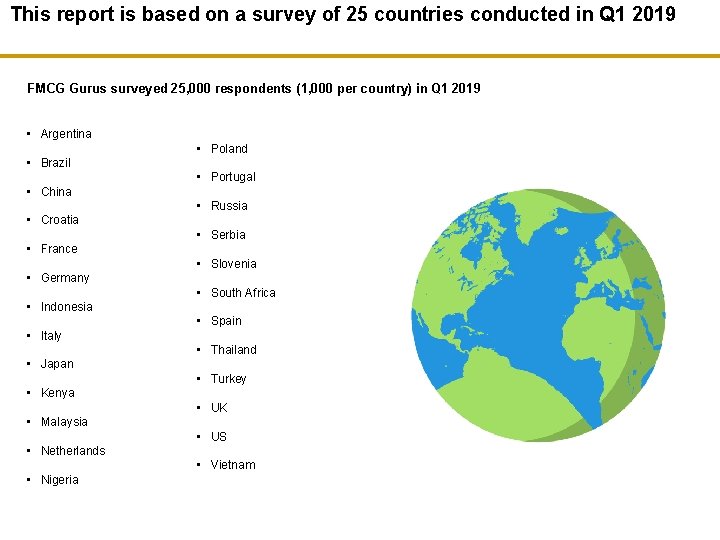
This report is based on a survey of 25 countries conducted in Q 1 2019 FMCG Gurus surveyed 25, 000 respondents (1, 000 per country) in Q 1 2019 • Argentina • Poland • Brazil • Portugal • China • Russia • Croatia • Serbia • France • Slovenia • Germany • South Africa • Indonesia • Spain • Italy • Thailand • Japan • Turkey • Kenya • UK • Malaysia • US • Netherlands • Vietnam • Nigeria
AGENDA Introduction and methodology Consumer attitudes towards sugar and artificial sweetener reduction Consumer behavior towards sugar reduction Natural sweeteners – opportunities and challenges Conclusions
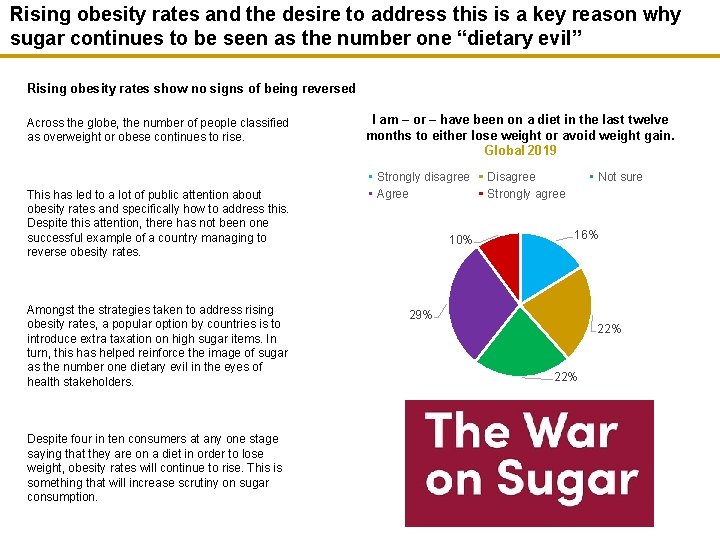
Rising obesity rates and the desire to address this is a key reason why sugar continues to be seen as the number one “dietary evil” Rising obesity rates show no signs of being reversed Across the globe, the number of people classified as overweight or obese continues to rise. This has led to a lot of public attention about obesity rates and specifically how to address this. Despite this attention, there has not been one successful example of a country managing to reverse obesity rates. Amongst the strategies taken to address rising obesity rates, a popular option by countries is to introduce extra taxation on high sugar items. In turn, this has helped reinforce the image of sugar as the number one dietary evil in the eyes of health stakeholders. Despite four in ten consumers at any one stage saying that they are on a diet in order to lose weight, obesity rates will continue to rise. This is something that will increase scrutiny on sugar consumption. I am – or – have been on a diet in the last twelve months to either lose weight or avoid weight gain. Global 2019 Strongly disagree Agree 10% Disagree Strongly agree Not sure 16% 29% 22%
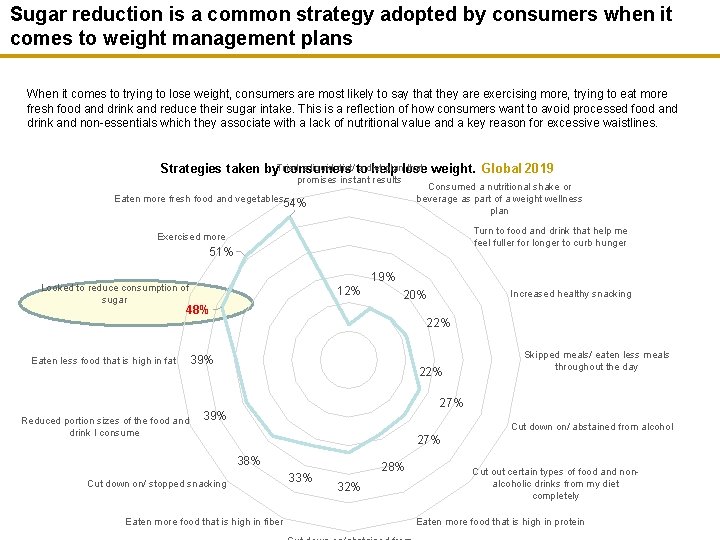
Sugar reduction is a common strategy adopted by consumers when it comes to weight management plans When it comes to trying to lose weight, consumers are most likely to say that they are exercising more, trying to eat more fresh food and drink and reduce their sugar intake. This is a reflection of how consumers want to avoid processed food and drink and non-essentials which they associate with a lack of nutritional value and a key reason for excessive waistlines. a liquid diet/ to a diet planlose that weight. Global 2019 Strategies taken by. Tried consumers help promises instant results Consumed a nutritional shake or beverage as part of a weight wellness plan Eaten more fresh food and vegetables 54% Turn to food and drink that help me feel fuller for longer to curb hunger Exercised more 51% 19% Looked to reduce consumption of sugar 12% Increased healthy snacking 20% 48% 22% Eaten less food that is high in fat Reduced portion sizes of the food and drink I consume 39% 22% Skipped meals/ eaten less meals throughout the day 27% 39% Cut down on/ abstained from alcohol 27% 38% Cut down on/ stopped snacking Eaten more food that is high in fiber 33% 28% 32% Cut out certain types of food and nonalcoholic drinks from my diet completely Eaten more food that is high in protein
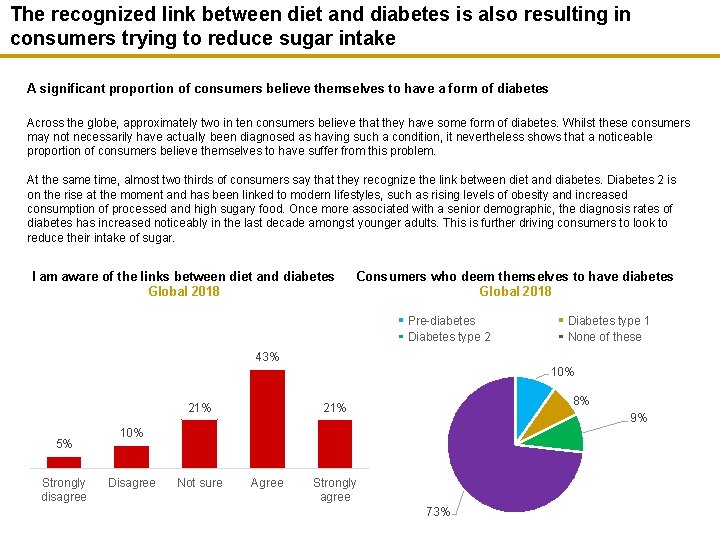
The recognized link between diet and diabetes is also resulting in consumers trying to reduce sugar intake A significant proportion of consumers believe themselves to have a form of diabetes Across the globe, approximately two in ten consumers believe that they have some form of diabetes. Whilst these consumers may not necessarily have actually been diagnosed as having such a condition, it nevertheless shows that a noticeable proportion of consumers believe themselves to have suffer from this problem. At the same time, almost two thirds of consumers say that they recognize the link between diet and diabetes. Diabetes 2 is on the rise at the moment and has been linked to modern lifestyles, such as rising levels of obesity and increased consumption of processed and high sugary food. Once more associated with a senior demographic, the diagnosis rates of diabetes has increased noticeably in the last decade amongst younger adults. This is further driving consumers to look to reduce their intake of sugar. I am aware of the links between diet and diabetes Global 2018 Consumers who deem themselves to have diabetes Global 2018 Pre-diabetes Diabetes type 2 Diabetes type 1 None of these 43% 10% 21% 5% Strongly disagree 8% 21% 9% 10% Disagree Not sure Agree Strongly agree 73%
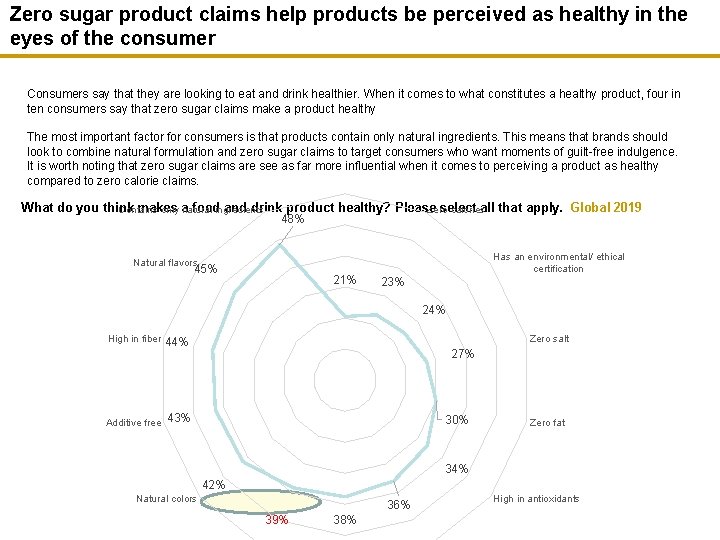
Zero sugar product claims help products be perceived as healthy in the eyes of the consumer Consumers say that they are looking to eat and drink healthier. When it comes to what constitutes a healthy product, four in ten consumers say that zero sugar claims make a product healthy The most important factor for consumers is that products contain only natural ingredients. This means that brands should look to combine natural formulation and zero sugar claims to target consumers who want moments of guilt-free indulgence. It is worth noting that zero sugar claims are see as far more influential when it comes to perceiving a product as healthy compared to zero calorie claims. Small portion size What do you think makes foodingredients and drink product healthy? Please select Contains only a natural Zero caloriesall that apply. Global 2019 48% Has an environmental/ ethical certification Natural flavors 45% 21% 23% 24% High in fiber 44% Zero salt 27% Additive free 43% 30% Zero fat 34% 42% Natural colors 36% 39% 38% High in antioxidants
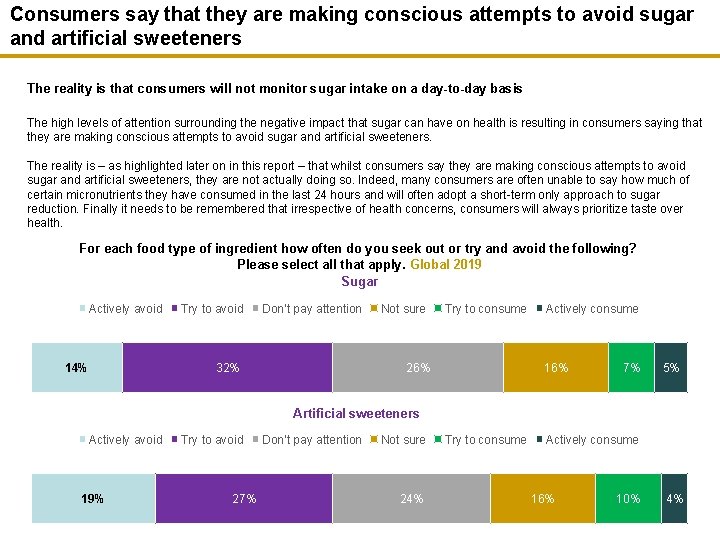
Consumers say that they are making conscious attempts to avoid sugar and artificial sweeteners The reality is that consumers will not monitor sugar intake on a day-to-day basis The high levels of attention surrounding the negative impact that sugar can have on health is resulting in consumers saying that they are making conscious attempts to avoid sugar and artificial sweeteners. The reality is – as highlighted later on in this report – that whilst consumers say they are making conscious attempts to avoid sugar and artificial sweeteners, they are not actually doing so. Indeed, many consumers are often unable to say how much of certain micronutrients they have consumed in the last 24 hours and will often adopt a short-term only approach to sugar reduction. Finally it needs to be remembered that irrespective of health concerns, consumers will always prioritize taste over health. For each food type of ingredient how often do you seek out or try and avoid the following? Please select all that apply. Global 2019 Sugar Actively avoid 14% Try to avoid Don’t pay attention 32% Not sure Try to consume 26% Actively consume 16% 7% 5% Artificial sweeteners Actively avoid 19% Try to avoid 27% Don’t pay attention Not sure 24% Try to consume Actively consume 16% 10% 4%
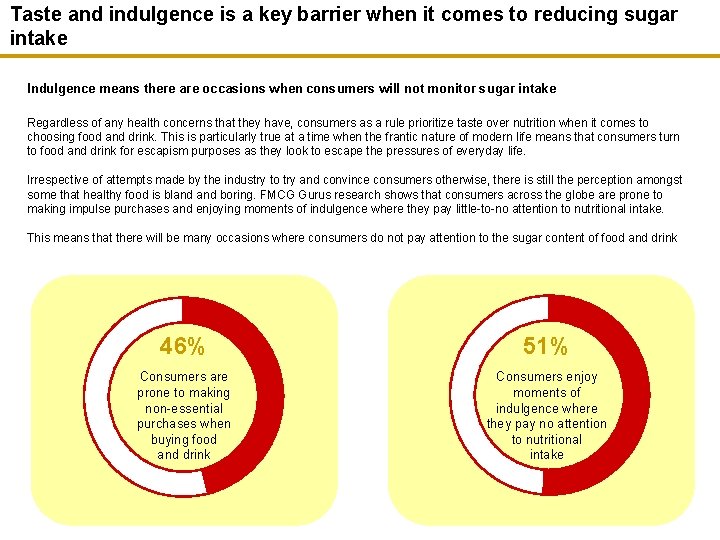
Taste and indulgence is a key barrier when it comes to reducing sugar intake Indulgence means there are occasions when consumers will not monitor sugar intake Regardless of any health concerns that they have, consumers as a rule prioritize taste over nutrition when it comes to choosing food and drink. This is particularly true at a time when the frantic nature of modern life means that consumers turn to food and drink for escapism purposes as they look to escape the pressures of everyday life. Irrespective of attempts made by the industry to try and convince consumers otherwise, there is still the perception amongst some that healthy food is bland boring. FMCG Gurus research shows that consumers across the globe are prone to making impulse purchases and enjoying moments of indulgence where they pay little-to-no attention to nutritional intake. This means that there will be many occasions where consumers do not pay attention to the sugar content of food and drink 46% 51% Consumers are prone to making non-essential purchases when buying food and drink Consumers enjoy moments of indulgence where they pay no attention to nutritional intake
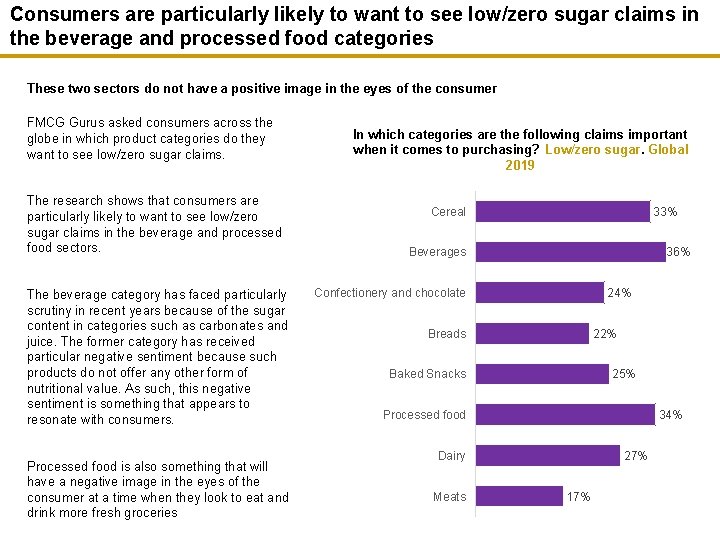
Consumers are particularly likely to want to see low/zero sugar claims in the beverage and processed food categories These two sectors do not have a positive image in the eyes of the consumer FMCG Gurus asked consumers across the globe in which product categories do they want to see low/zero sugar claims. The research shows that consumers are particularly likely to want to see low/zero sugar claims in the beverage and processed food sectors. The beverage category has faced particularly scrutiny in recent years because of the sugar content in categories such as carbonates and juice. The former category has received particular negative sentiment because such products do not offer any other form of nutritional value. As such, this negative sentiment is something that appears to resonate with consumers. Processed food is also something that will have a negative image in the eyes of the consumer at a time when they look to eat and drink more fresh groceries In which categories are the following claims important when it comes to purchasing? Low/zero sugar. Global 2019 Cereal 33% Beverages 36% Confectionery and chocolate 24% Breads 22% Baked Snacks 25% Processed food 34% Dairy Meats 27% 17%
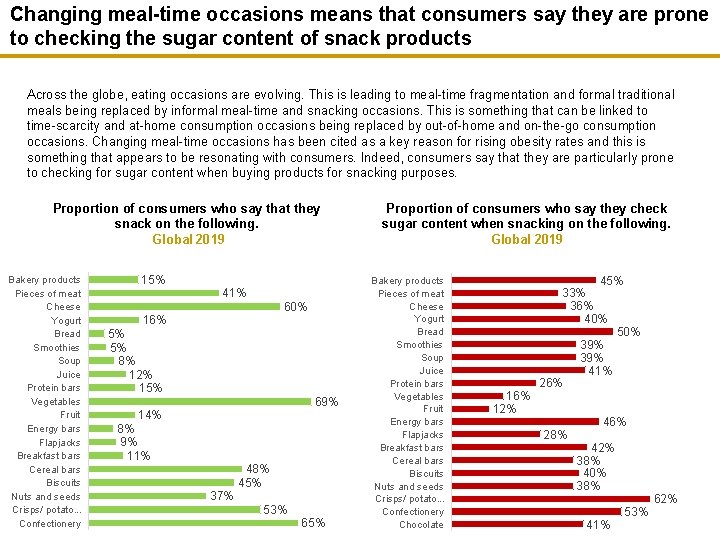
Changing meal-time occasions means that consumers say they are prone to checking the sugar content of snack products Across the globe, eating occasions are evolving. This is leading to meal-time fragmentation and formal traditional meals being replaced by informal meal-time and snacking occasions. This is something that can be linked to time-scarcity and at-home consumption occasions being replaced by out-of-home and on-the-go consumption occasions. Changing meal-time occasions has been cited as a key reason for rising obesity rates and this is something that appears to be resonating with consumers. Indeed, consumers say that they are particularly prone to checking for sugar content when buying products for snacking purposes. Proportion of consumers who say that they snack on the following. Global 2019 Bakery products Pieces of meat Cheese Yogurt Bread Smoothies Soup Juice Protein bars Vegetables Fruit Energy bars Flapjacks Breakfast bars Cereal bars Biscuits Nuts and seeds Crisps/ potato. . . Confectionery 15% 41% 60% 16% 5% 5% 8% 12% 15% 69% 14% 8% 9% 11% 48% 45% 37% 53% 65% Proportion of consumers who say they check sugar content when snacking on the following. Global 2019 Bakery products Pieces of meat Cheese Yogurt Bread Smoothies Soup Juice Protein bars Vegetables Fruit Energy bars Flapjacks Breakfast bars Cereal bars Biscuits Nuts and seeds Crisps/ potato. . . Confectionery Chocolate 16% 12% 45% 33% 36% 40% 50% 39% 41% 26% 28% 46% 42% 38% 40% 38% 41% 53% 62%
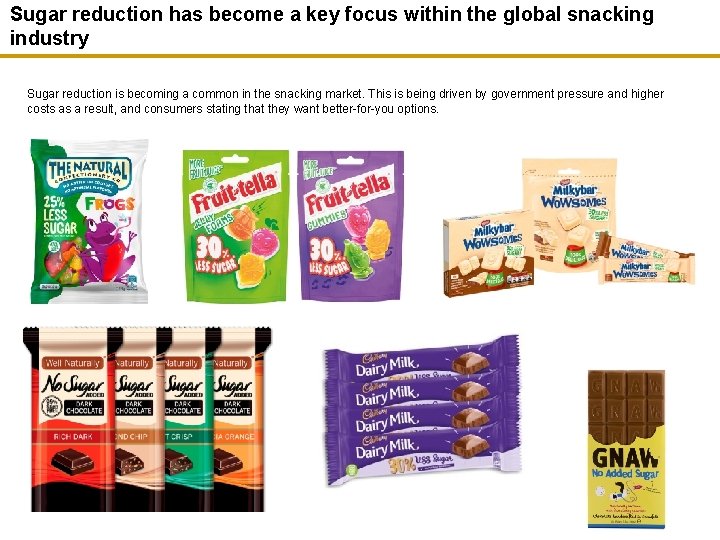
Sugar reduction has become a key focus within the global snacking industry Sugar reduction is becoming a common in the snacking market. This is being driven by government pressure and higher costs as a result, and consumers stating that they want better-for-you options.