
FMAG Overview Purpose of Fire Management Assistance Grant
- Slides: 8
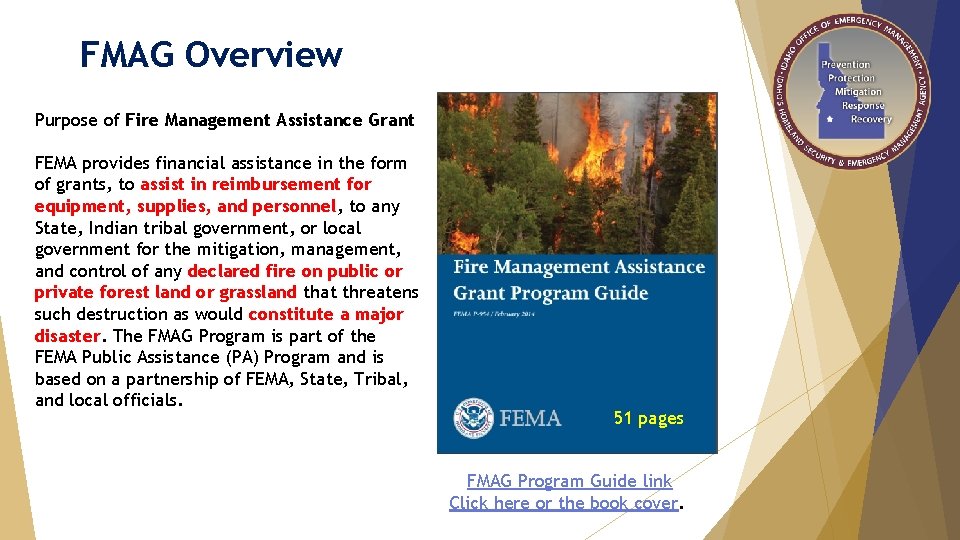
FMAG Overview Purpose of Fire Management Assistance Grant FEMA provides financial assistance in the form of grants, to assist in reimbursement for equipment, supplies, and personnel, to any State, Indian tribal government, or local government for the mitigation, management, and control of any declared fire on public or private forest land or grassland that threatens such destruction as would constitute a major disaster. The FMAG Program is part of the FEMA Public Assistance (PA) Program and is based on a partnership of FEMA, State, Tribal, and local officials. 51 pages FMAG Program Guide link Click here or the book cover.
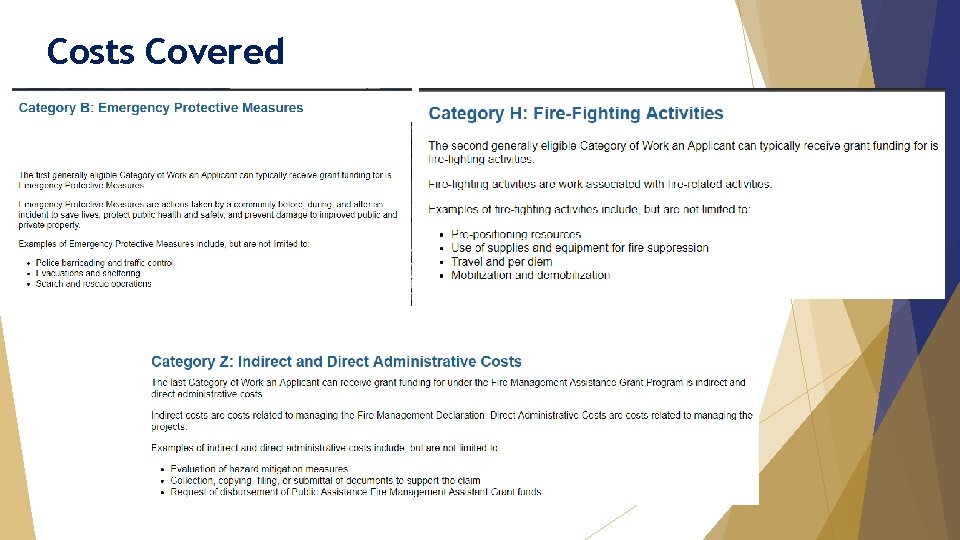
FMAG Cheat Sheet 1. When an FMAG could be applicable. - Request while uncontrolled fire is threatening; BEFORE it burns the community. - Threatening improved property, CI/KR, or critical watershed. - Fire-fighting resources unavailable. - High fire danger conditions. - Major Economic impact. - Constitutes a “major declaration” means certain threshholds need to be met. - $117, 579 locally for single fire or $500, 000 cumulative 2. The application process. - Information gathering: Population, Cost of property/infrastructure threatened, Economic Impact - Staff involved: EM, Fire, Sheriff, Clerk, GIS, Public Works, Utilities, Dispatch - Call your Idaho OEM Area Field Officer! - Verbal approval options are available. - Include a local Declaration and RFA to provide IOEM opportunity to assist. 3. Layers of Government Contacts. - County/Tribe provides information and completes application. AFO assists. - IOEM applies. - Principal Advisor provides input. - FEMA Region X Regional Administrator approves/denies. 4. Track available costs. FMAG cost-share is normally 75% federal, 15% state, 10% local - Category B: Emergency Protective Measures – evacuation, roadblocks, etc - Fire-fighting: resources fighting the fire - Indirect and Direct Admin
When is FMAG Applicable ** slide information from IS-1027 https: //training. fema. gov/is/courseoverview. aspx? code=IS-1027 When an uncontrolled fire or fire complex on non-Federal public or private forest or grassland is such a threat that, in the opinion of the on-scene commanders or other government officials, the fire threatens such destruction as would constitute a major disaster, the State or Territory’s governor may request assistance from FEMA as prescribed in the Fire Management Assistance Grant Program. To evaluate a fire's threat of destruction, the Governor should answer the following questions when requesting a declaration: • Is there an imminent threat to lives and improved property, including threats to critical facilities/infrastructure, and critical watershed areas? • What is the availability of State and local firefighting resources? • Are there high fire danger conditions, as indicated by nationally accepted indices such as the National Fire Danger Ratings System? • What is the potential major economic impact? Scenarios: 1. Wildfire threatening a rural community (town or sub-division). 2. Wildfire threatening critical community resource (CI/KR) – water purification, school, etc Threshholds: 1. Local single fire will reach $117, 000. 2. Statewide costs to exceed $500, 000.
FMAG Process 1. Fire determined to be FMAG applicable. 2. Initial discussion with AHJ and AFO/IOEM to confirm applicability. 3. Initiate application process: - AHJ submits required/add’l information - AFO coordinates state and federal contacts and provides situation update. - Principal Advisor: input and review - IOEM: input and review. - FEMA Region X: approval/denial. 4. AHJ submits FMAG application to IOEM. - AHJ include Declaration and RFA that provides IOEM ability to provide support. 5. IOEM submits application to FEMA Region X. 6. FEMA Region X approves or denies. Required Information. For FEMA to apply the evaluation criteria in 44 CFR 204. 21, the following information, if available, should be included in both the verbal and written requests: �Size of fire(s) in acres or square miles; �Name, location, and population of community(ies) threatened; �Number of primary and secondary residences and businesses threatened; �Distance of fire to nearest communities; �Number of persons evacuated to date, if applicable; �Current and predicted (24 -hour) weather conditions; and �Degree to which State and local resources are committed to this fire and other fires in Federal, State, or local jurisdictions. To further support a declaration request, the State may append additional documentation to the FF 078 -0 -1, including: �Fire severity maps; �Geographic, topographical, or land assessment maps; or �Incident status summary report (ICS-209).
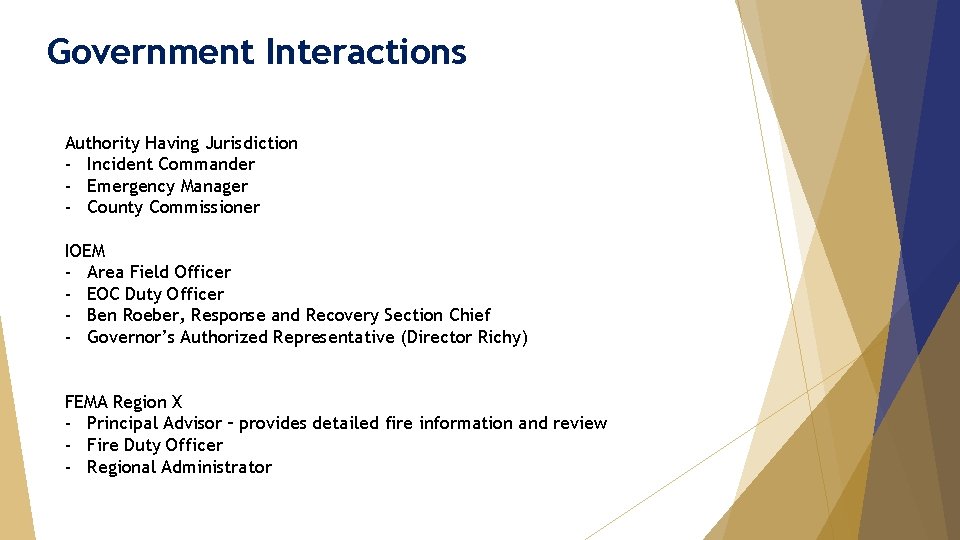
Government Interactions Authority Having Jurisdiction - Incident Commander - Emergency Manager - County Commissioner IOEM - Area Field Officer - EOC Duty Officer - Ben Roeber, Response and Recovery Section Chief - Governor’s Authorized Representative (Director Richy) FEMA Region X - Principal Advisor – provides detailed fire information and review - Fire Duty Officer - Regional Administrator
Costs Covered
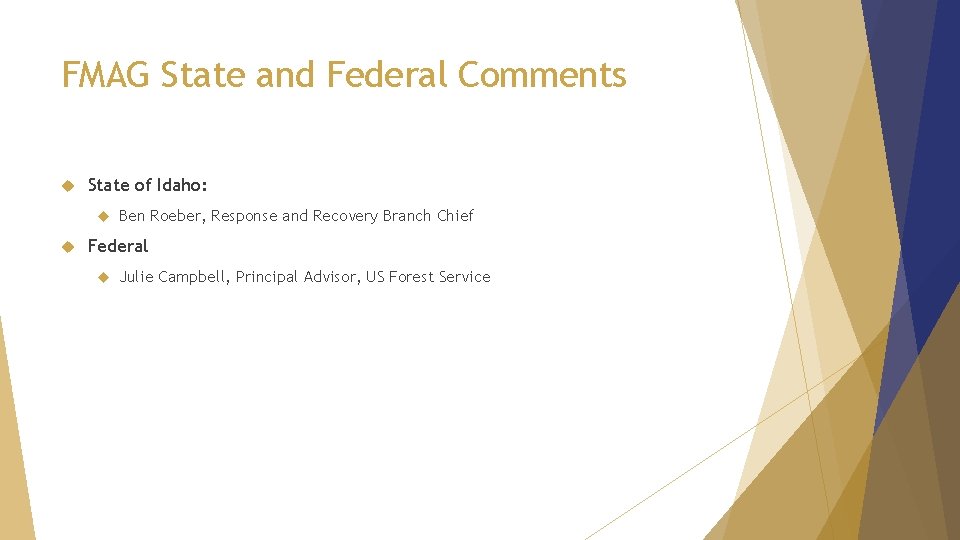
FMAG State and Federal Comments State of Idaho: Ben Roeber, Response and Recovery Branch Chief Federal Julie Campbell, Principal Advisor, US Forest Service
More Information FMAG Program Guide FAQ from Congressional Research Service - February 2019 https: //www. fema. gov/media-library-data/158101723221674156 de 976 d 581852 e 91 b 9826 c 2968 c 2/FMAG_Guide_Feb_2014_508. pdf https: //fas. org/sgp/crs/homesec/R 43738. pdf Online FEMA Training: IS-1027 https: //training. fema. gov/is/courseoverview. aspx? code=IS-1027