
FlyByWire Control Augmentation SEA Control Guidance Systems Committee
Fly-By-Wire Control Augmentation SEA Control & Guidance Systems Committee Lake Tahoe March 1 -3, 2006 Anthony A. Lambregts FAA Chief Scientific and Technical Adviser for Flight Guidance and Control Tony. Lambregts@FAA. gov Tel 425 -917 -6581 1
Overview n n Motivation for Fly-By-Wire Design Top Level FBW Design Requirements n n FBW design issues/choices n n n Algorithm types, design issues Observations Proposed systematic Design Process n n Time domain based Handling Qualities Static Inversion of Short Period dynamics Stability Augmentation; Command Response Shaping, Hold Examples: PRC/PAH and FPARC/FPAH; relationships Primary Flight Display & Controller requirements Conclusions 2
Motivation for Fly-By-Wire Design § Costs Reduction § common flight deck/ Handling Qualities / Type Rating § pilot training § maintenance and spare parts § weight reduction § aerodynamic performance optimization (aft CG) § § Flight safety improvements – Envelope Protection Customer Appeal 3
Top Level FBW Design Objectives § Suitable handling qualities - all control tasks § § § simplify pilot's control task reduce workload consistent throughout the flight envelope avoid PIO Flight envelope protection: § prevent stall, overspeed, excessive bank angles and nz § not get in pilot’s way, or compromise airplane performance 4
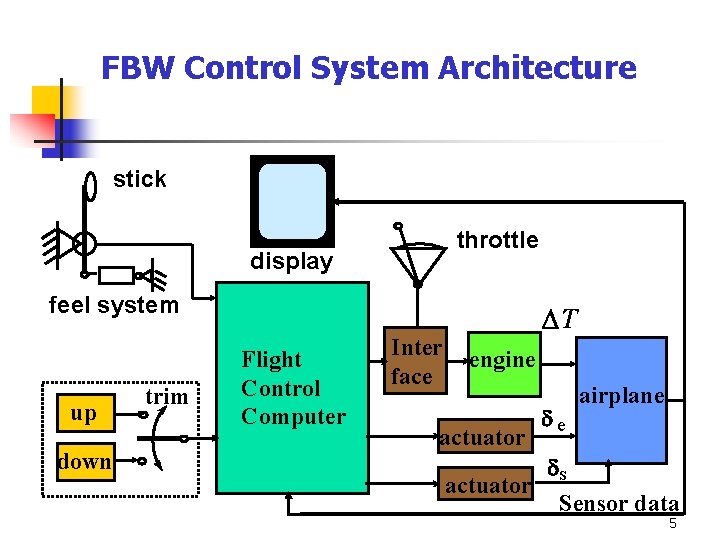
FBW Control System Architecture stick throttle display feel system up down trim Flight Control Computer Inter face DT engine actuator e airplane S actuator Sensor data 5
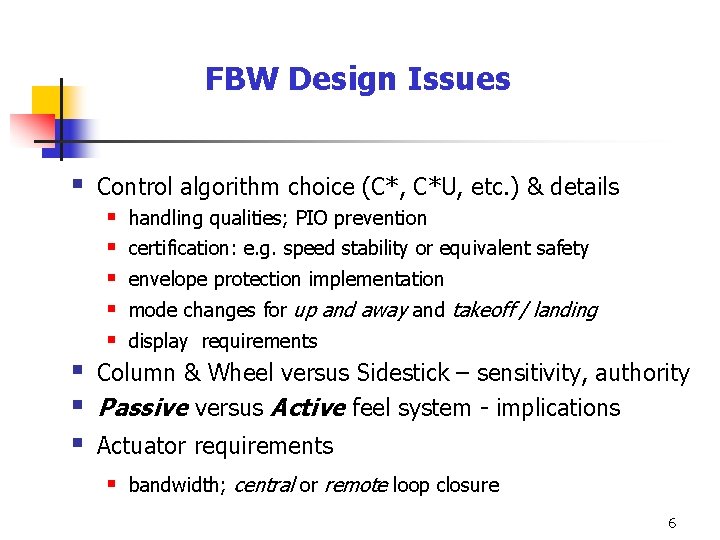
FBW Design Issues § Control algorithm choice (C*, C*U, etc. ) & details § § § handling qualities; PIO prevention certification: e. g. speed stability or equivalent safety envelope protection implementation mode changes for up and away and takeoff / landing display requirements § Column & Wheel versus Sidestick – sensitivity, authority § Passive versus Active feel system - implications § Actuator requirements § bandwidth; central or remote loop closure 6
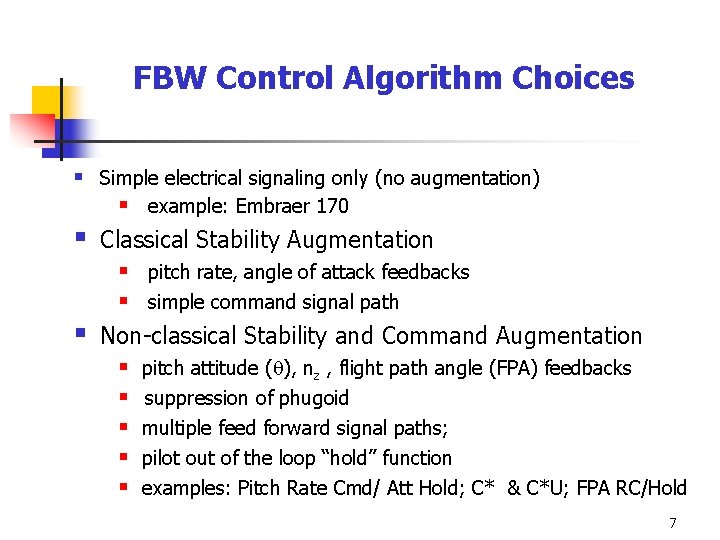
FBW Control Algorithm Choices § Simple electrical signaling only (no augmentation) § example: Embraer 170 § Classical Stability Augmentation § § § pitch rate, angle of attack feedbacks simple command signal path Non-classical Stability and Command Augmentation § § § pitch attitude ( ), nz , flight path angle (FPA) feedbacks suppression of phugoid multiple feed forward signal paths; pilot out of the loop “hold” function examples: Pitch Rate Cmd/ Att Hold; C* & C*U; FPA RC/Hold 7
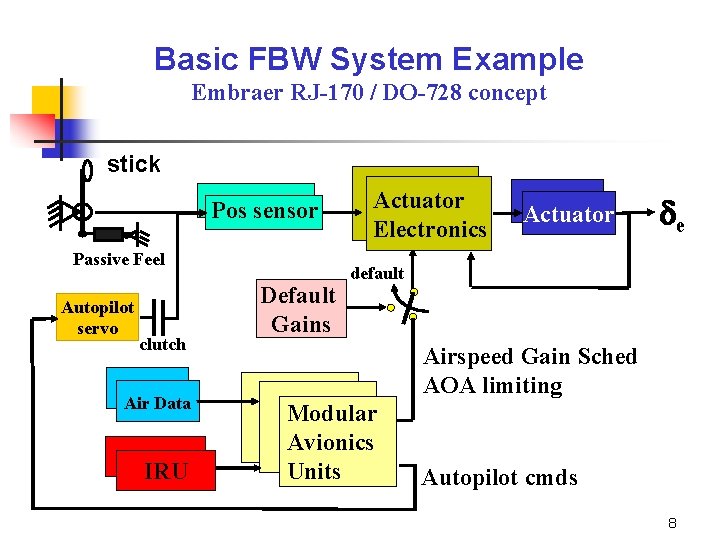
Basic FBW System Example Embraer RJ-170 / DO-728 concept stick Pos sensor Passive Feel Autopilot servo clutch Air Data IRU Default Gains Actuator Electronics Actuator e default Airspeed Gain Sched AOA limiting Modular Avionics Units Autopilot cmds 8
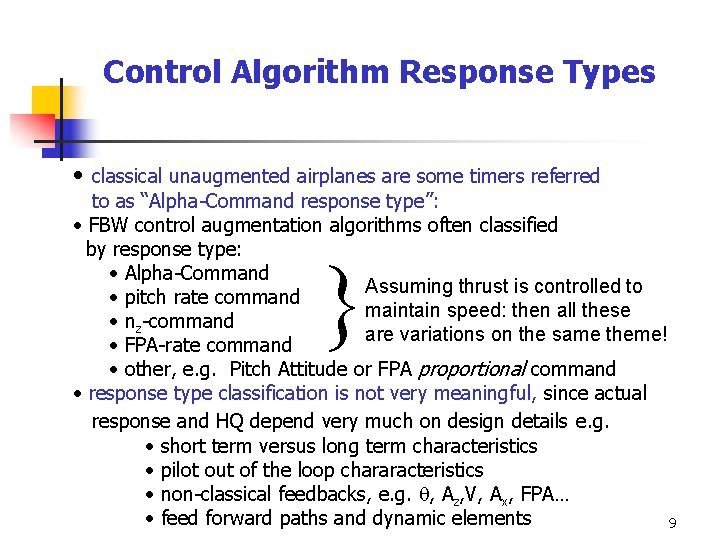
Control Algorithm Response Types • classical unaugmented airplanes are some timers referred to as “Alpha-Command response type”: • FBW control augmentation algorithms often classified by response type: • Alpha-Command Assuming thrust is controlled to • pitch rate command maintain speed: then all these • nz-command are variations on the same theme! • FPA-rate command • other, e. g. Pitch Attitude or FPA proportional command • response type classification is not very meaningful, since actual response and HQ depend very much on design details e. g. • short term versus long term characteristics • pilot out of the loop chararacteristics • non-classical feedbacks, e. g. , Az, V, Ax, FPA… • feed forward paths and dynamic elements 9
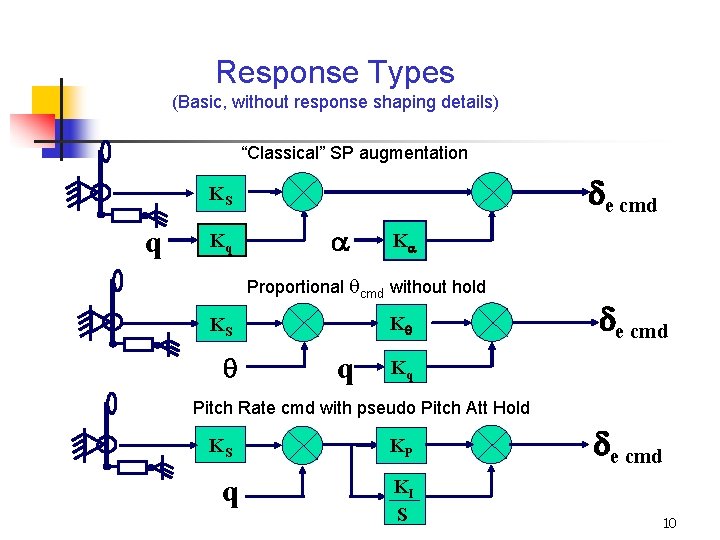
Response Types (Basic, without response shaping details) “Classical” SP augmentation e cmd KS q Kq K Proportional cmd without hold K KS q e cmd Kq Pitch Rate cmd with pseudo Pitch Att Hold KS q KP KI S e cmd 10
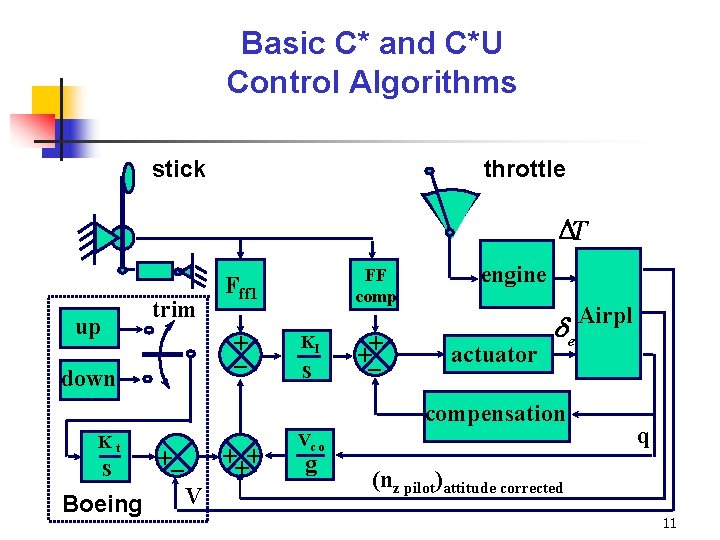
Basic C* and C*U Control Algorithms stick throttle DT trim up + _ down FF comp Fff 1 KI S + +_ engine actuator de compensation Kt S Boeing +++ +_ V Vc o g Airpl q (nz pilot)attitude corrected 11
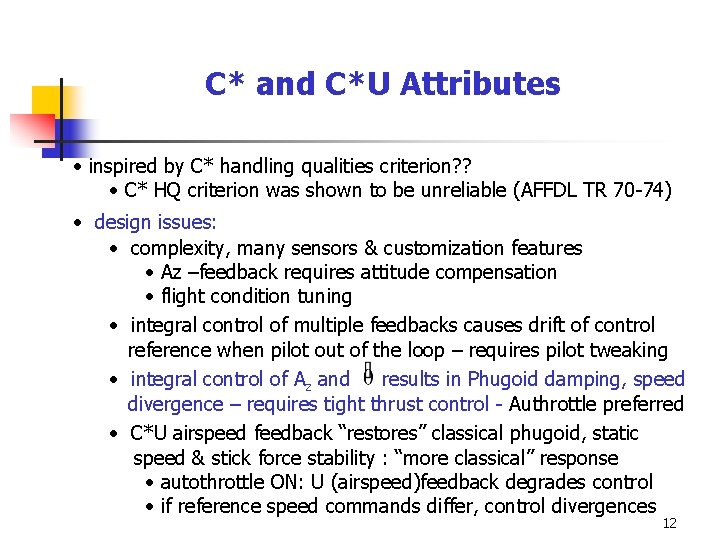
C* and C*U Attributes • inspired by C* handling qualities criterion? ? • C* HQ criterion was shown to be unreliable (AFFDL TR 70 -74) • design issues: • complexity, many sensors & customization features • Az –feedback requires attitude compensation • flight condition tuning • integral control of multiple feedbacks causes drift of control reference when pilot out of the loop – requires pilot tweaking • integral control of Az and results in Phugoid damping, speed divergence – requires tight thrust control - Authrottle preferred • C*U airspeed feedback “restores” classical phugoid, static speed & stick force stability : “more classical” response • autothrottle ON: U (airspeed)feedback degrades control • if reference speed commands differ, control divergences 12
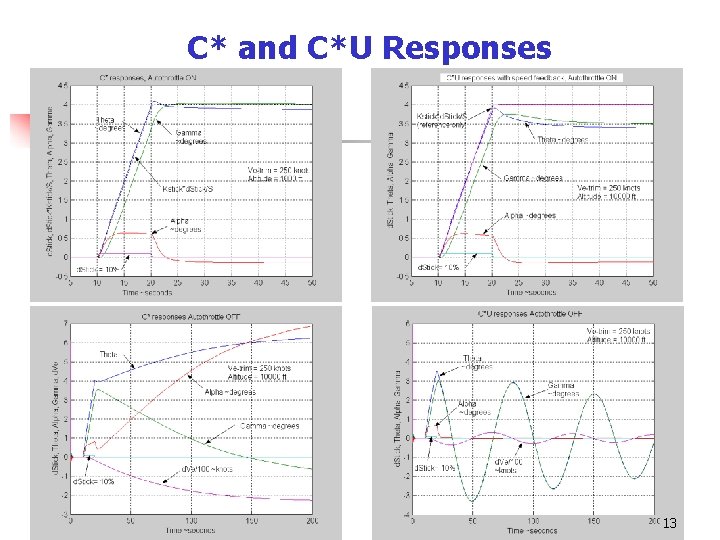
C* and C*U Responses 13
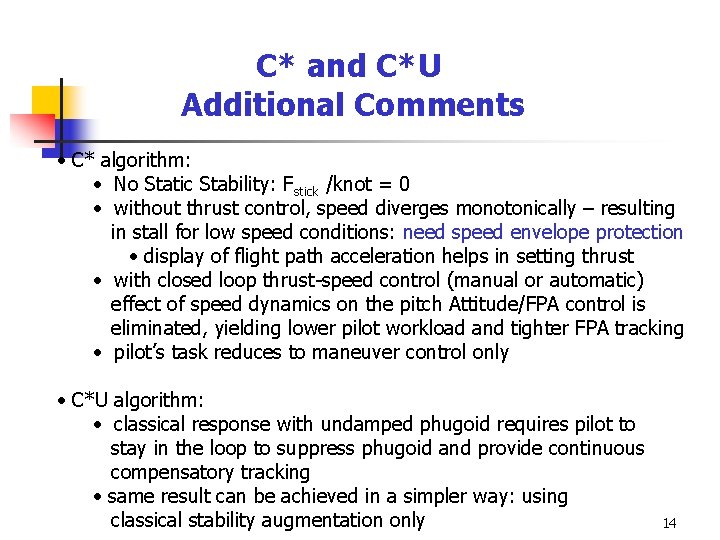
C* and C*U Additional Comments • C* algorithm: • No Static Stability: Fstick /knot = 0 • without thrust control, speed diverges monotonically – resulting in stall for low speed conditions: need speed envelope protection • display of flight path acceleration helps in setting thrust • with closed loop thrust-speed control (manual or automatic) effect of speed dynamics on the pitch Attitude/FPA control is eliminated, yielding lower pilot workload and tighter FPA tracking • pilot’s task reduces to maneuver control only • C*U algorithm: • classical response with undamped phugoid requires pilot to stay in the loop to suppress phugoid and provide continuous compensatory tracking • same result can be achieved in a simpler way: using classical stability augmentation only 14
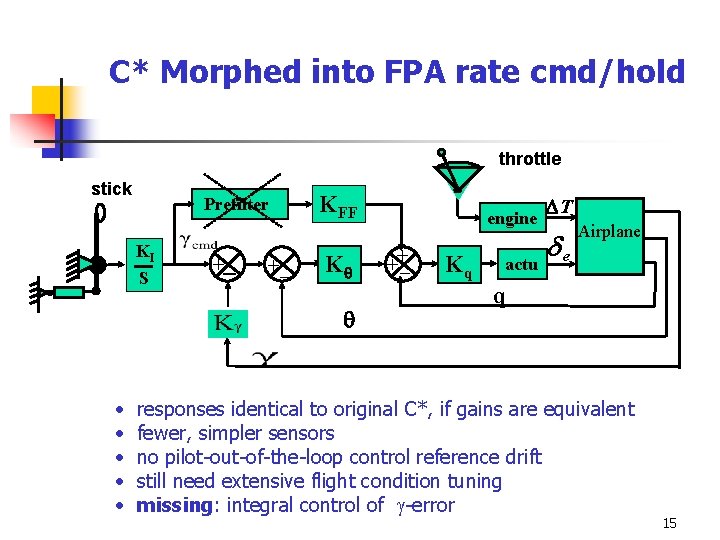
C* Morphed into FPA rate cmd/hold throttle stick Prefilter KI S +_ +_ KFF K • • • engine ++_ Kq DT d actu e Airplane q responses identical to original C*, if gains are equivalent fewer, simpler sensors no pilot-out-of-the-loop control reference drift still need extensive flight condition tuning missing: integral control of -error 15
Control Algorithm Design Considerations § What response characteristics are desirable? § § Classical Short Period augmentation only? § If yes, achievable HQ improvements limited! SP + Phugoid augmentation? Other? Which one, why? Sensor requirements? Algorithm complexity, § § § Analyzability of “Higher order” design Applicability of classical Handling Qualities criteria use of “Equivalent Lower Order Systems”: problematic Achieving good Handling Qualities still very difficult ! 16
Handling Qualities Definition: The conglomerate of characteristics and features that facilitate the execution of a specific flight control task; includes display and feel system! • good HQ requires design attributes appropriate to control task (e. g. pitch attitude, FPA, or altitude control) • each task has a finite time allotment or expectation for its completion (bandwidth requirement) • direct control of “slow variables” requires special design attributes (e. g. FPA response augmentation & display) • desired HQ and control harmony achieved when the pilot can execute the task without undue stress and high concentration effort, e. g. using interim innerloop(s) & control targets 17
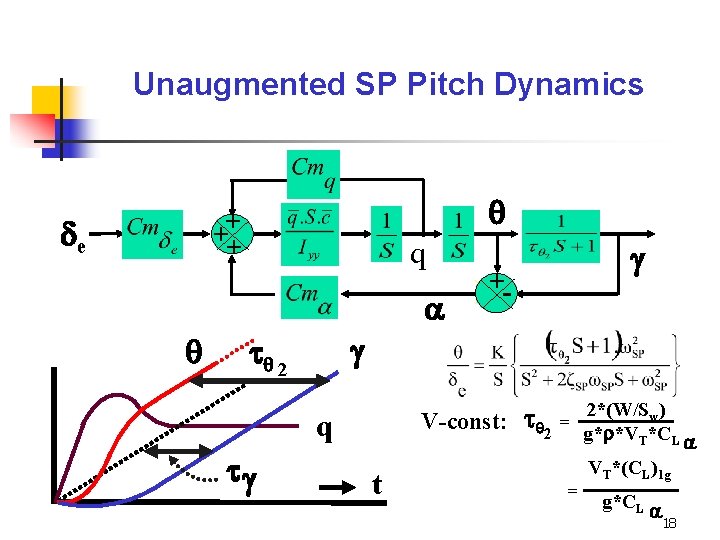
Unaugmented SP Pitch Dynamics + + + e q + - 2 V-const: 2 = q t = 2*(W/Sw) g* *VT*CL VT*(CL)1 g g*CL 18
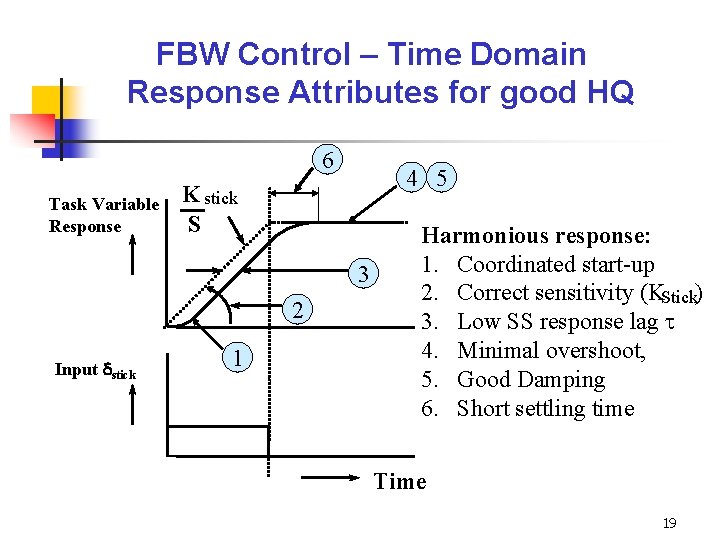
FBW Control – Time Domain Response Attributes for good HQ 6 Task Variable Response 4 5 K stick S 3 2 Input stick 1 Harmonious response: 1. Coordinated start-up 2. Correct sensitivity (KStick) 3. Low SS response lag 4. Minimal overshoot, 5. Good Damping 6. Short settling time Time 19
Design Methodology - An Update Desired: • systematic/reliable process, producing desired results: • generalized/reusable design – minimal application & Flt Condition adaptation Approach: Step 1: Stability Augmentation using Static Inversion § § eliminates flight condition dependencies, gain schedules defines basic SP innerloop characteristics: , Step 2: Add Integral Feedback loop § “retrims” airplane - eliminates SS command response droop Step 3: Add Command Augmentation Feed Forward Paths § § shapes response to pilot control inputs, as desired provides “Hold” function for pilot established command 20
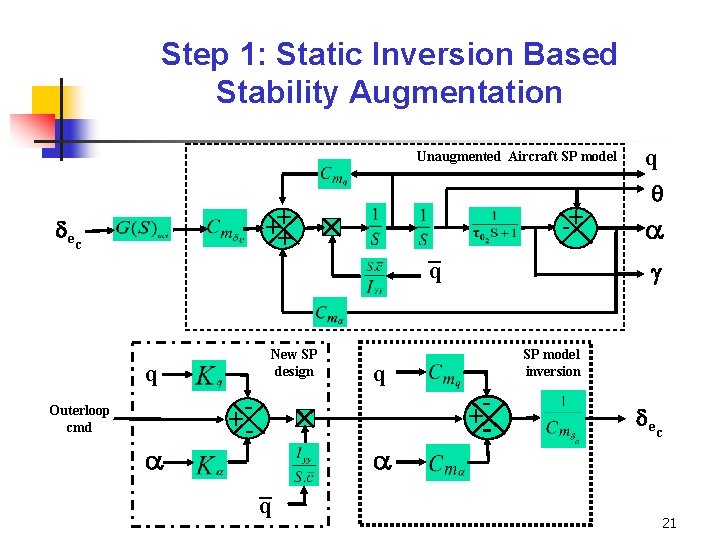
Step 1: Static Inversion Based Stability Augmentation Unaugmented Aircraft SP model ++ + e c New SP design q Outerloop cmd +- -+ _ q q _ q SP model inversion - + q - e c 21
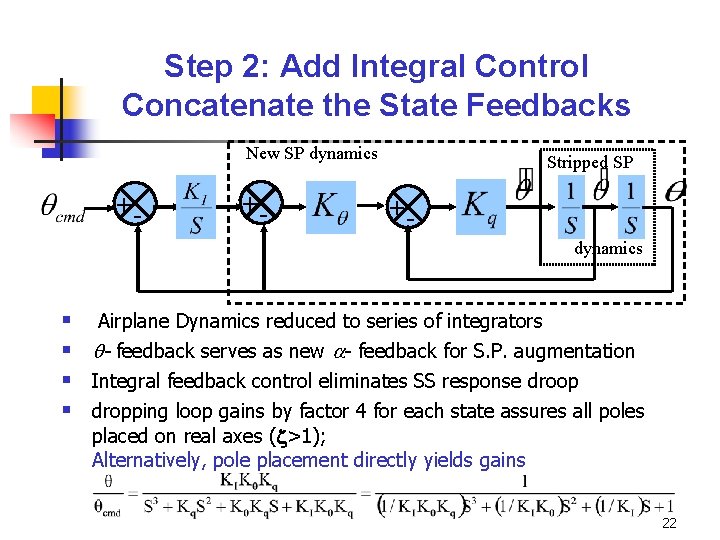
Step 2: Add Integral Control Concatenate the State Feedbacks New SP dynamics + - +- Stripped SP +dynamics § Airplane Dynamics reduced to series of integrators § - feedback serves as new - feedback for S. P. augmentation § Integral feedback control eliminates SS response droop § dropping loop gains by factor 4 for each state assures all poles placed on real axes ( >1); Alternatively, pole placement directly yields gains 22
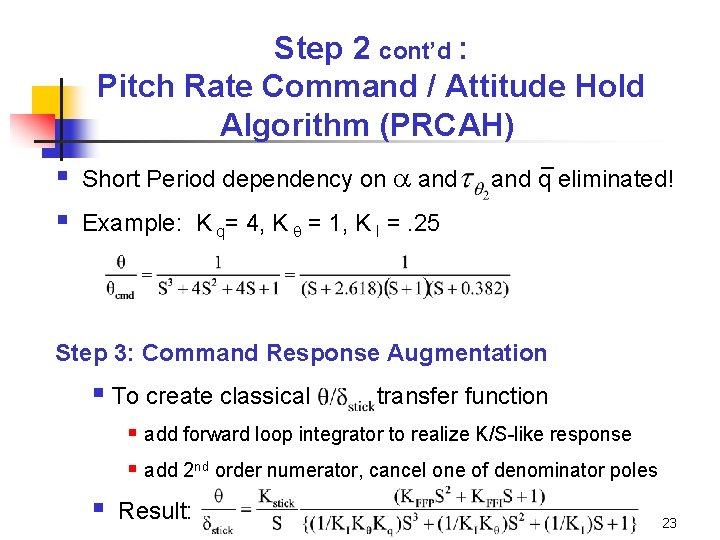
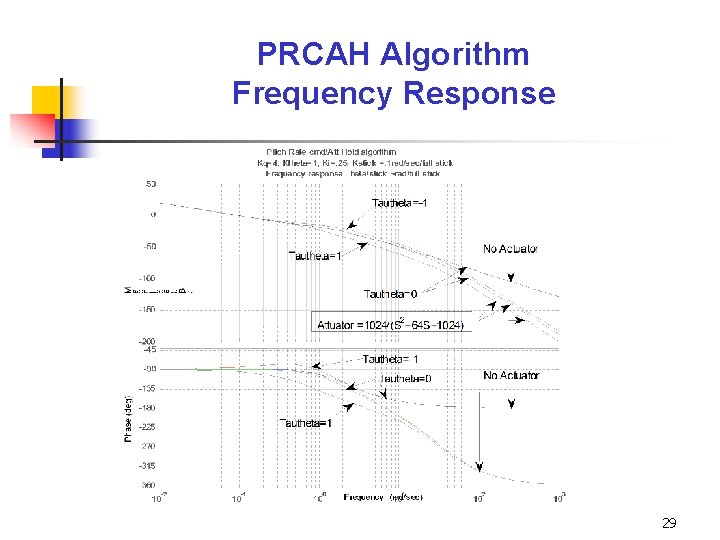
Step 2 cont’d : Pitch Rate Command / Attitude Hold Algorithm (PRCAH) § § Short Period dependency on and _ and q eliminated! Example: K q= 4, K = 1, K I =. 25 Step 3: Command Response Augmentation § To create classical transfer function § add forward loop integrator to realize K/S-like response § add 2 nd order numerator, cancel one of denominator poles § Result: 23
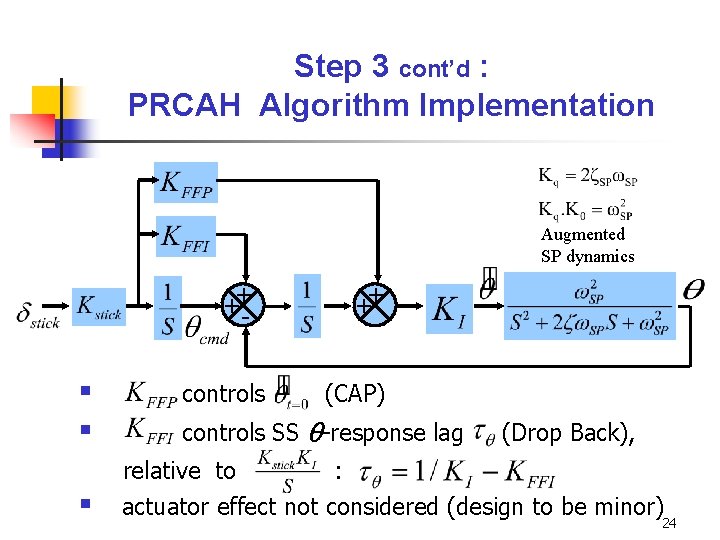
Step 3 cont’d : PRCAH Algorithm Implementation Augmented SP dynamics ++ - § § § controls ++ (CAP) controls SS -response lag (Drop Back), relative to : actuator effect not considered (design to be minor) 24
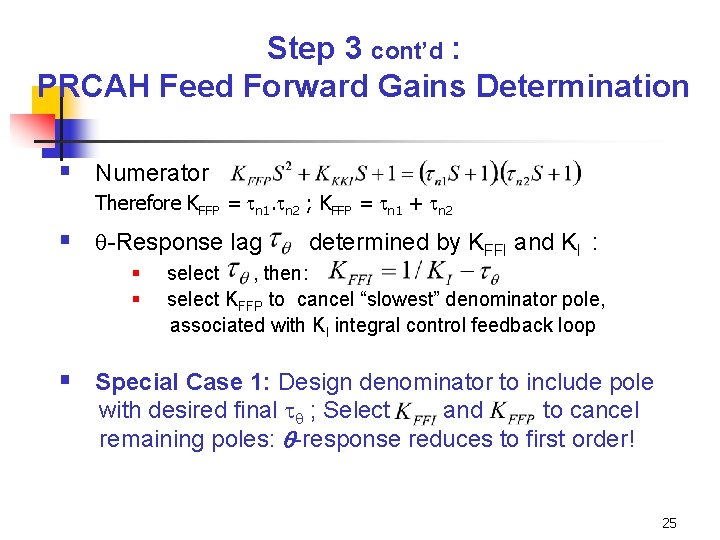
Step 3 cont’d : PRCAH Feed Forward Gains Determination § Numerator Therefore KFFP = n 1. n 2 ; KFFP = n 1 + n 2 § -Response lag § § determined by KFFI and KI : select , then: select KFFP to cancel “slowest” denominator pole, associated with KI integral control feedback loop § Special Case 1: Design denominator to include pole with desired final ; Select and to cancel remaining poles: -response reduces to first order! 25
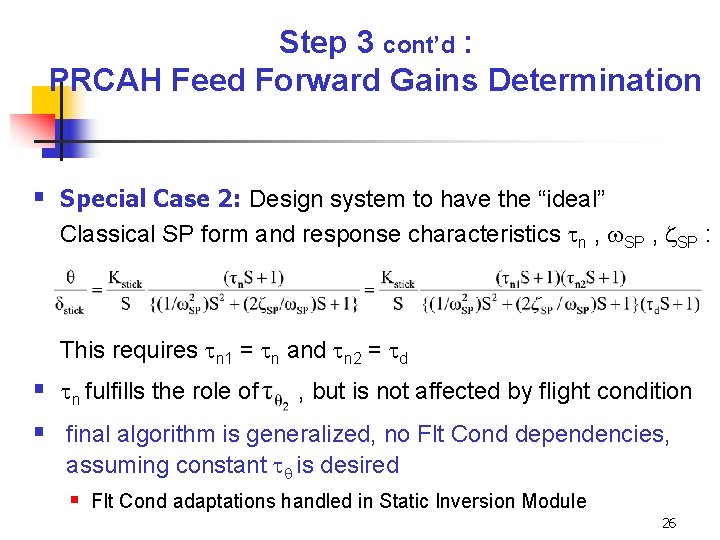
Step 3 cont’d : PRCAH Feed Forward Gains Determination § Special Case 2: Design system to have the “ideal” Classical SP form and response characteristics n , SP : This requires n 1 = n and n 2 = d § n fulfills the role of , but is not affected by flight condition § final algorithm is generalized, no Flt Cond dependencies, assuming constant is desired § Flt Cond adaptations handled in Static Inversion Module 26
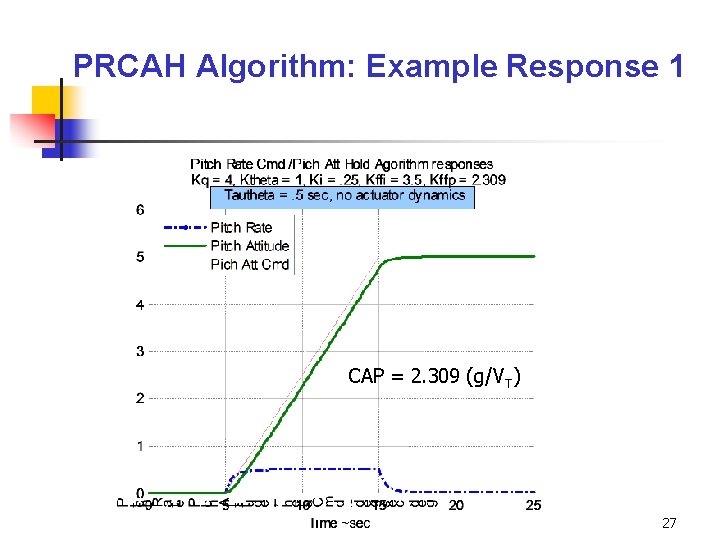
PRCAH Algorithm: Example Response 1 CAP = 2. 309 (g/VT) 27
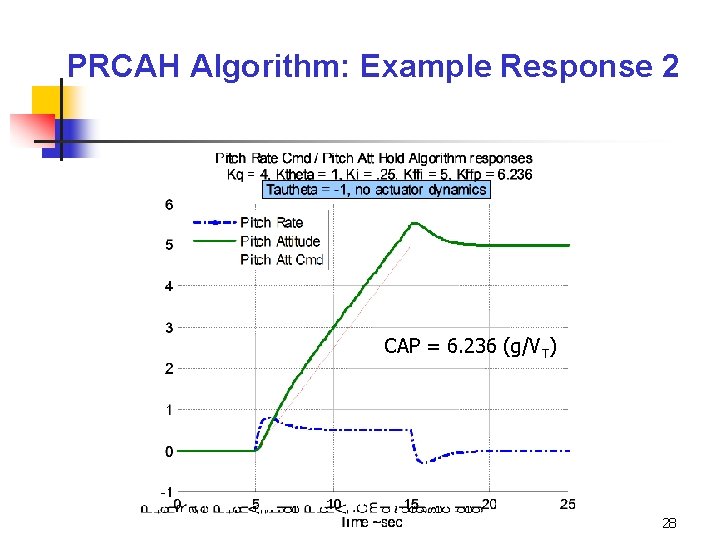
PRCAH Algorithm: Example Response 2 CAP = 6. 236 (g/VT) 28
PRCAH Algorithm Frequency Response 29
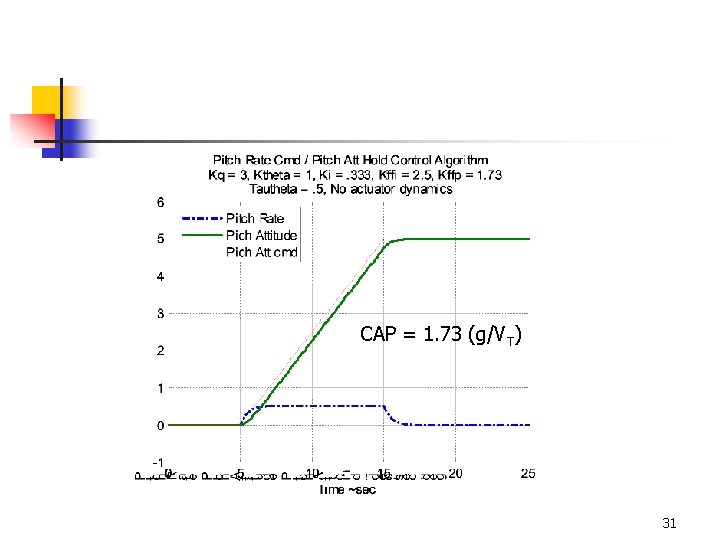
PRCAH Algorithm Comments • may be selected for the specific task, e. g. • for -control 0; for FPA control < 0 • Algorithm Feedback gains may be selected to support Autopilot outerloop modes • Feed Forward gains can compensate to a large extend to provide desired augmented manual responses • Not clear how to interpret CAP criteria, since ~ the same response characteristics can be achieved with different sets of feedback & feedforward gains, yielding different values for CAP, compare slide 27: CAP =2. 309 (g/VT) and slide 31: CAP =1. 73(g/VT) • here CAP = (g/VT). KFFP. KI. K. Kq 30
CAP = 1. 73 (g/VT) 31
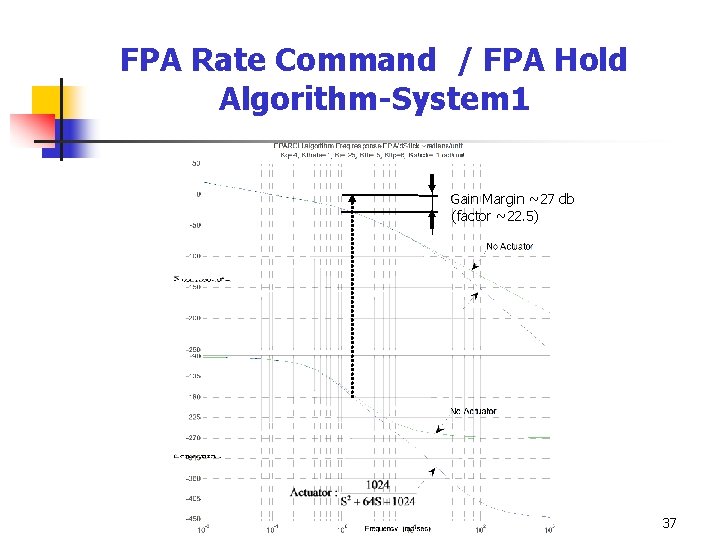
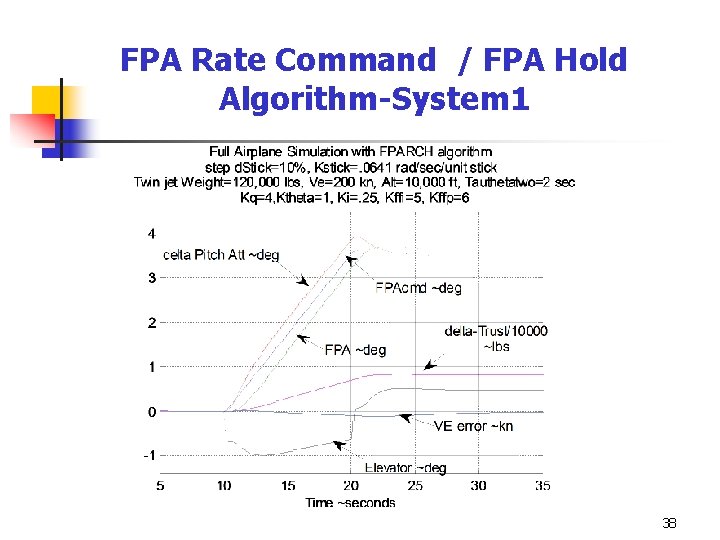
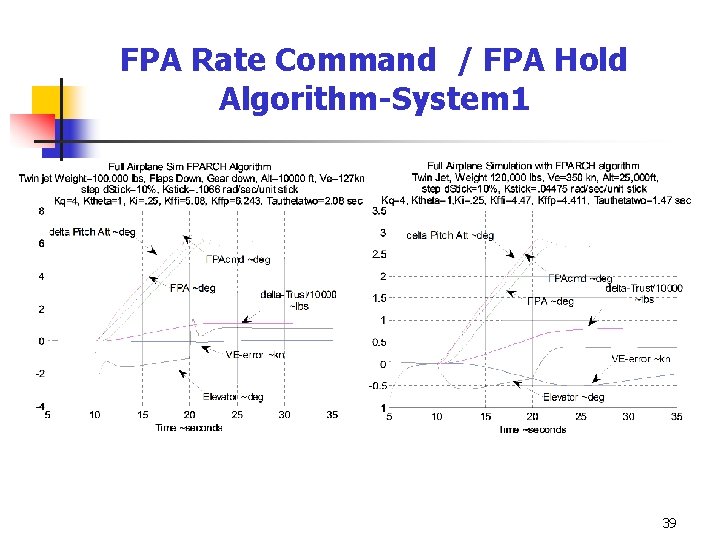
Flight Path Angle Rate Command / Hold (FPARCH) Algorithm § Direct FPA rate command Hold control strategy is very attractive: § eliminates need for using iterative -control to satisfy higher order objective: reduces work pilot workload § FPA will be maintained without pilot tweaking, regardless of speed & configuration changes, turbulence and windshear § facilitates altitude crossing at designated waypoints, continuous descent procedures, final approach tracking § § HUD compatible needs suitable display 32
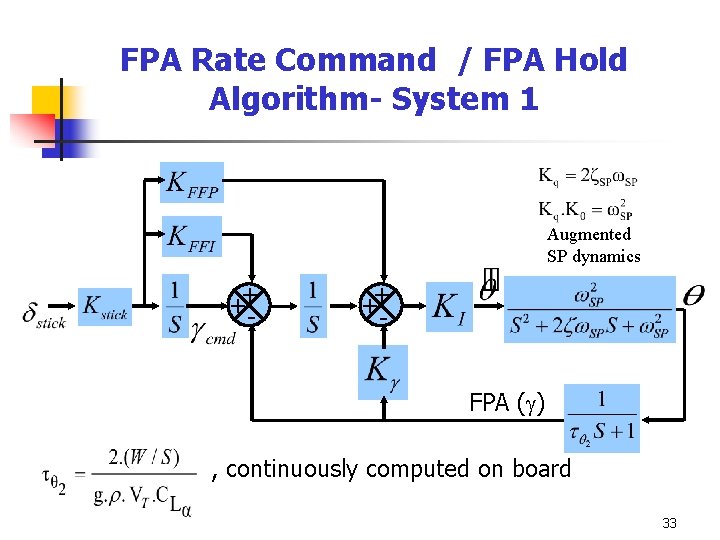
FPA Rate Command / FPA Hold Algorithm- System 1 Augmented SP dynamics ++ - ++ FPA ( ) , continuously computed on board 33
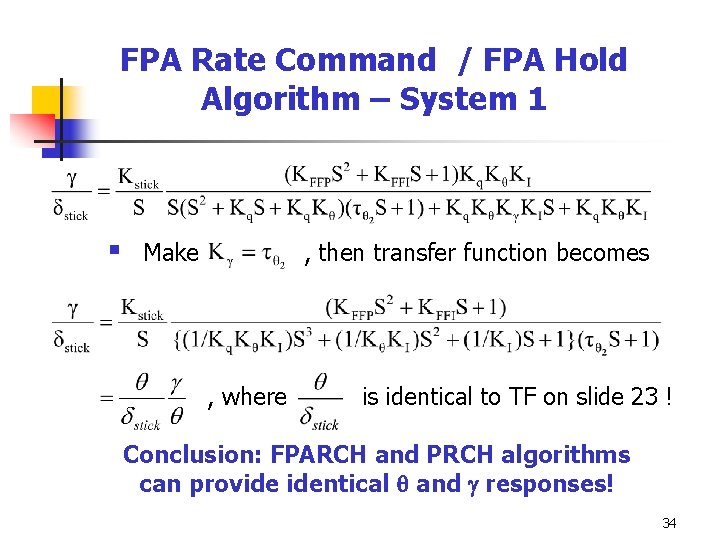
FPA Rate Command / FPA Hold Algorithm – System 1 § Make , then transfer function becomes , where is identical to TF on slide 23 ! Conclusion: FPARCH and PRCH algorithms can provide identical and responses! 34
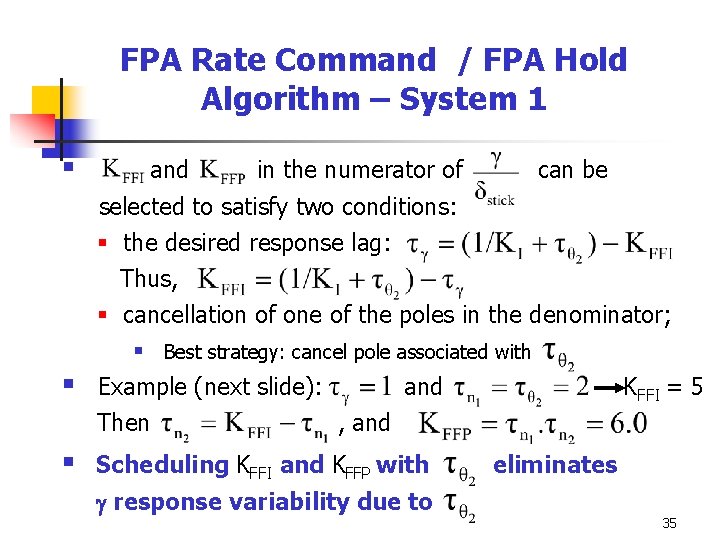
FPA Rate Command / FPA Hold Algorithm – System 1 § and in the numerator of can be selected to satisfy two conditions: § the desired response lag: Thus, § cancellation of one of the poles in the denominator; § Best strategy: cancel pole associated with § Example (next slide): and Then , and § Scheduling KFFI and KFFP with response variability due to K FFI = 5 eliminates 35
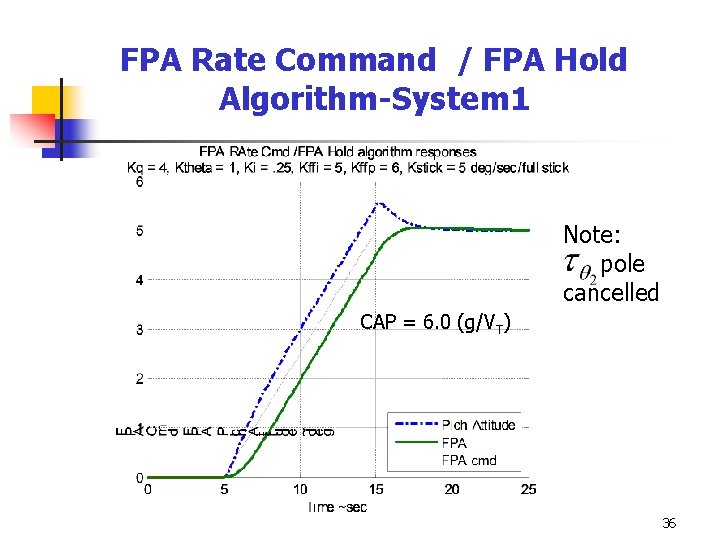
FPA Rate Command / FPA Hold Algorithm-System 1 Note: pole cancelled CAP = 6. 0 (g/VT) 36
FPA Rate Command / FPA Hold Algorithm-System 1 Gain Margin ~27 db (factor ~22. 5) 37
FPA Rate Command / FPA Hold Algorithm-System 1 38
FPA Rate Command / FPA Hold Algorithm-System 1 39
FPA Rate Command/FPA Hold Algorithm-system 2 Augmented SP dynamics ++- Selecting ++ FPA ( ) results in Conclusion: response no longer a function of 40
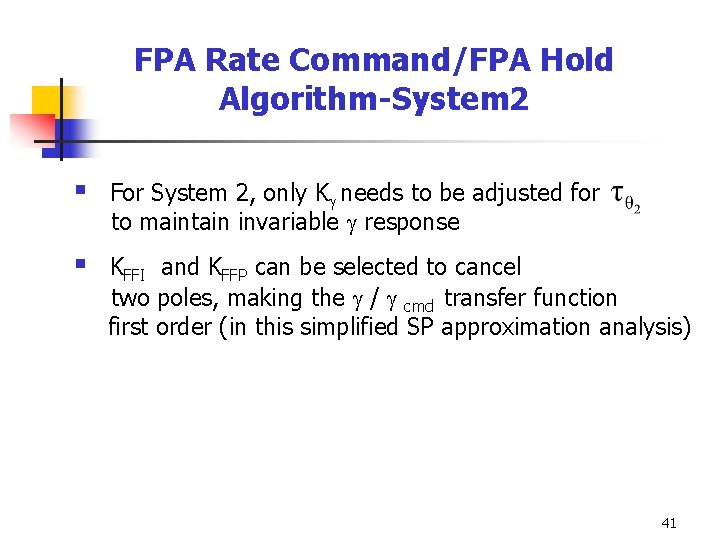
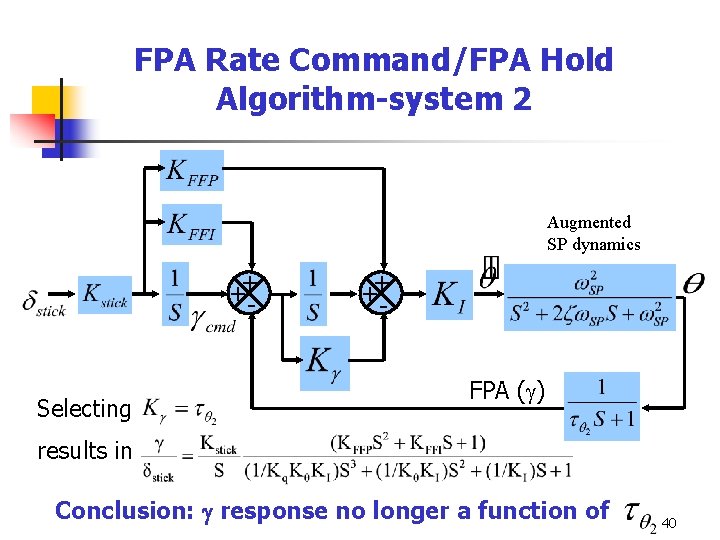
FPA Rate Command/FPA Hold Algorithm-System 2 § For System 2, only K needs to be adjusted for to maintain invariable response § KFFI and KFFP can be selected to cancel two poles, making the / cmd transfer function first order (in this simplified SP approximation analysis) 41
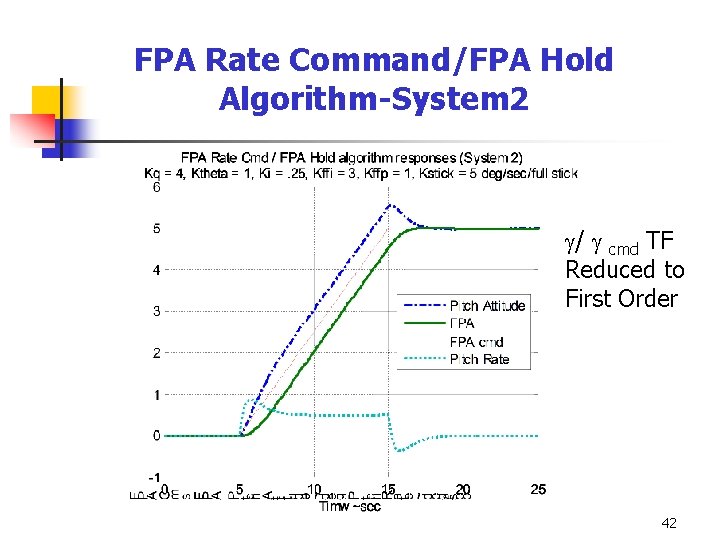
FPA Rate Command/FPA Hold Algorithm-System 2 / cmd TF Reduced to First Order 42
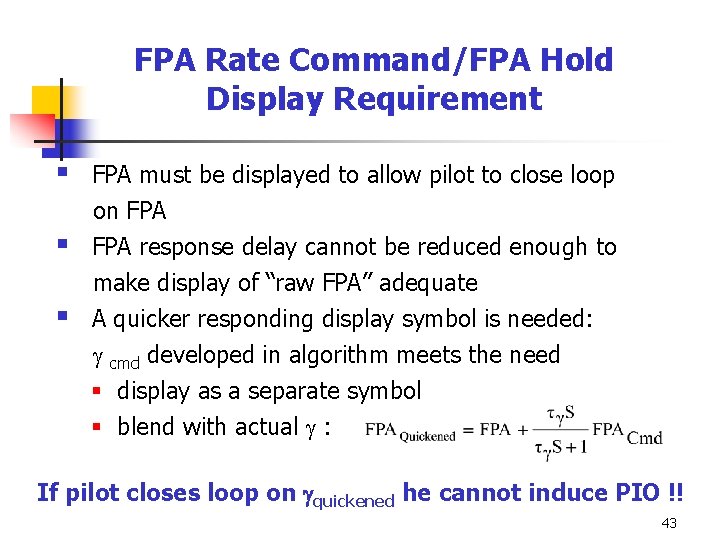
FPA Rate Command/FPA Hold Display Requirement § § § FPA must be displayed to allow pilot to close loop on FPA response delay cannot be reduced enough to make display of “raw FPA” adequate A quicker responding display symbol is needed: cmd developed in algorithm meets the need § display as a separate symbol § blend with actual : If pilot closes loop on quickened he cannot induce PIO !! 43
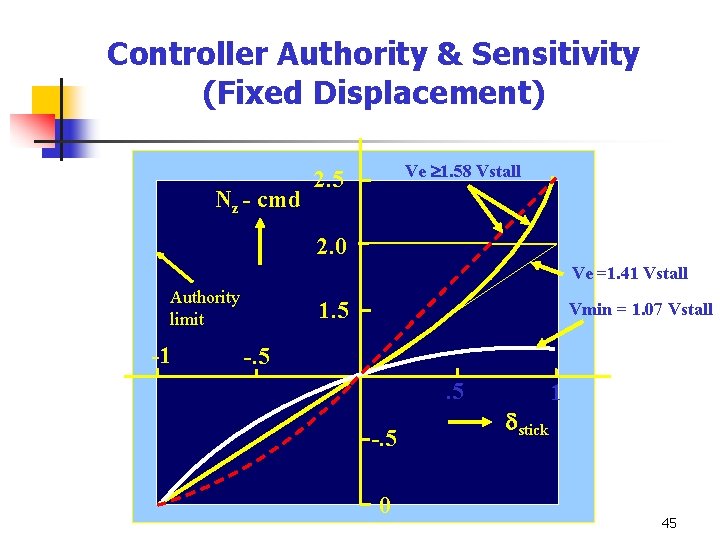
Controller Authority & Sensitivity Scheduling § Airplane manuever authority (nz) is proportional to § Controller dead zones and command discontinuities § must be avoided; maneuver command limit must § § occur at controller displacement limit § be matched to airplane maneuver authority Controller sensitivity around neutral must be suitable and sensitivity variation must be minimal These requirements are difficult to reconcile with passive feel system, but its advantage is simplicity 44
Controller Authority & Sensitivity (Fixed Displacement) Nz - cmd Ve 1. 58 Vstall 2. 5 2. 0 Ve =1. 41 Vstall Authority limit -1 1. 5 Vmin = 1. 07 Vstall -. 5. 5 -. 5 0 stick 1 45
Final Algorithm & control System Implementation Details • “Front-end” sensitivity scheduling: • need to assure pilot cannot command more than the airplane maneuver limits, to prevent stall and excessive nz • “Tail-end” control surface command processing: • need to include software cmd rate and position limits, that correspond to actuator performance capability • prevent command wind-up • minimize delay on control command reversal • Assuming control surfaces are dimensioned correctly, then pilot + control algorithm should always operate within airplane performance capability and limits: • Minimizes PIO susceptibility 46
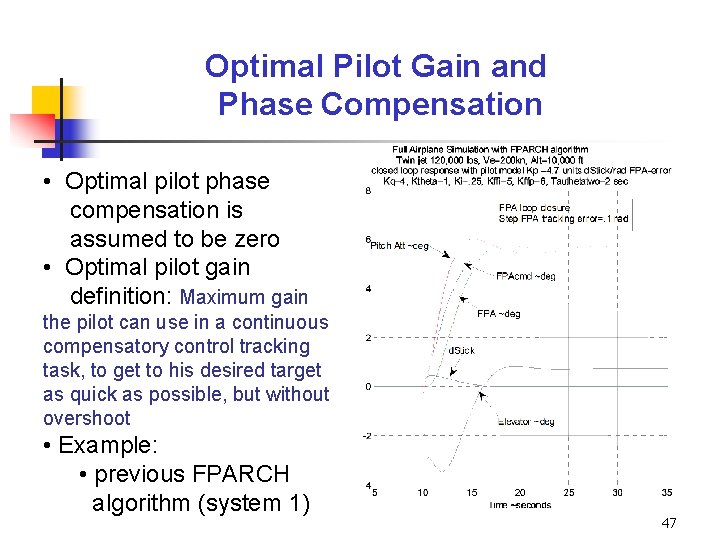
Optimal Pilot Gain and Phase Compensation • Optimal pilot phase compensation is assumed to be zero • Optimal pilot gain definition: Maximum gain the pilot can use in a continuous compensatory control tracking task, to get to his desired target as quick as possible, but without overshoot • Example: • previous FPARCH algorithm (system 1) 47
Loop Closure Options and Effects 48
PIO Susceptibility Graceful stability Degradation (No cliffs, No actuator rate & position limiting) 49
Conclusions § Existing FBW control algorithms and design methodologies are complex, difficult to understand & analyze § A new, simpler, more systematic methodology was discussed, consisting of three major design phases § static SP Airplane model inversion § synthesis if new SP innerloop dynamics § command response augmentation to satisfy HQ Result: a generalized, flight condition independent design § PRCAH and FPARCH algorithms can be designed to produce identical responses and HQ § FPARCH algorithm requires display of quickened FPA 50
- Slides: 50