
FLY HIGH FRIDAY Launchpad Publishing Ltd 2018 illustrations
FLY HIGH FRIDAY © Launchpad Publishing Ltd 2018, illustrations © Clive Goodyer
Challenge Who can make paper fly the farthest? Let’s learn how to fly…
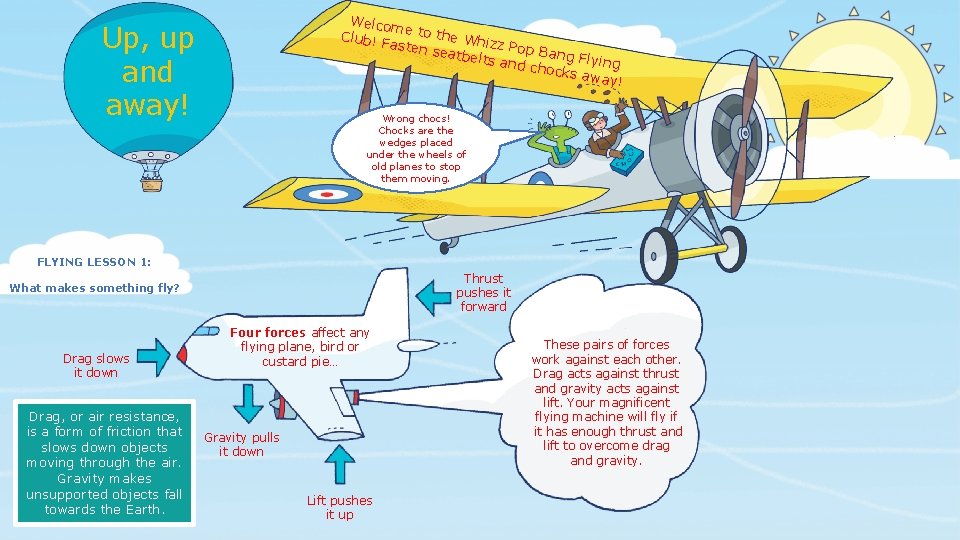
Welcom Club! F e to the Whi zz Pop asten s Ba eatbelt s and c ng Flying hocks away! Up, up and away! Wrong chocs! Chocks are the wedges placed under the wheels of old planes to stop them moving. FLYING LESSON 1: Thrust pushes it forward What makes something fly? Drag slows it down Drag, or air resistance, is a form of friction that slows down objects moving through the air. Gravity makes unsupported objects fall towards the Earth. Four forces affect any flying plane, bird or custard pie… Gravity pulls it down Lift pushes it up These pairs of forces work against each other. Drag acts against thrust and gravity acts against lift. Your magnificent flying machine will fly if it has enough thrust and lift to overcome drag and gravity.
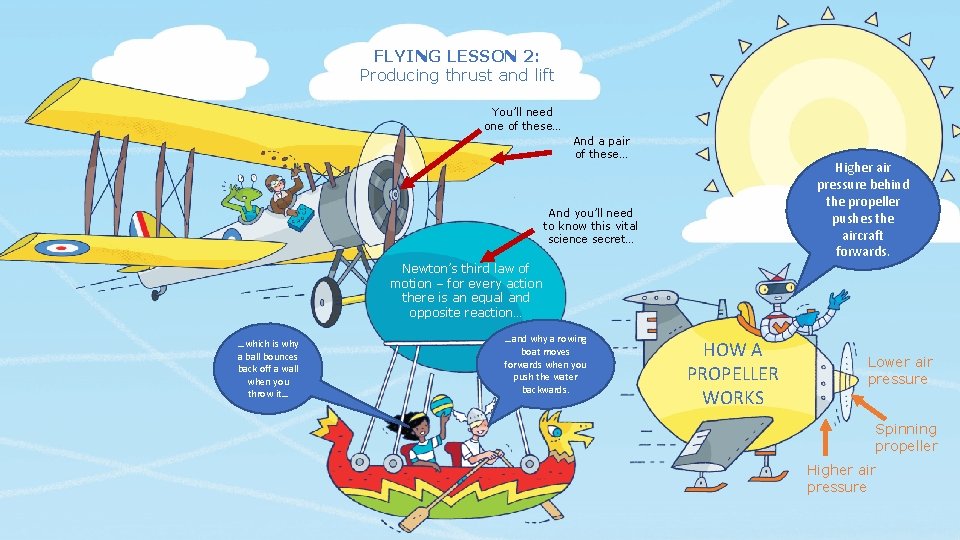
FLYING LESSON 2: Producing thrust and lift You’ll need one of these… And a pair of these… Higher air pressure behind the propeller pushes the aircraft forwards. And you’ll need to know this vital science secret… Newton’s third law of motion – for every action there is an equal and opposite reaction… …which is why a ball bounces back off a wall when you throw it… …and why a rowing boat moves forwards when you push the water backwards. HOW A PROPELLER WORKS Lower air pressure Spinning propeller Higher air pressure

HOW WINGS CREATE LIFT As a plane speeds along the runway, air flows around the wings. The curved shape of the wings (called an aerofoil) creates a pressure difference between the top and bottom of the wing: the air forced below the wing has a higher pressure than the air forced above it, which pushes the wing upwards, creating lift. Another way of thinking about it is that the shape and angle of the wing makes the air coming off the wing flow downwards. This produces an upward force on the wing and creates lift. It’s Newton’s third law of motion in action! More thrust means faster air over the wings… …which causes more lift. Lower air pressure Plane wings, propellers and birds’ wings are aerofoil-shaped to produce lift. Air rushes downwards Higher air pressure LIFT
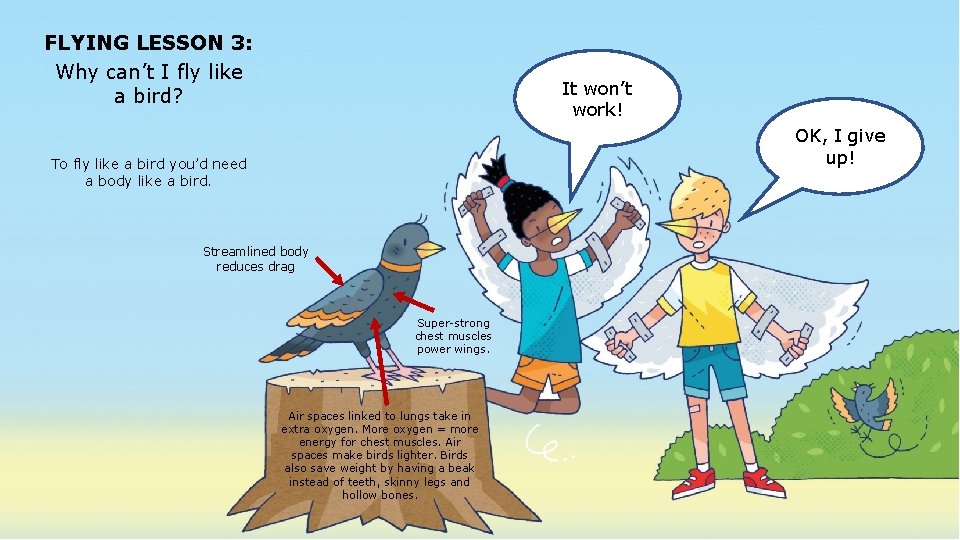
FLYING LESSON 3: Why can’t I fly like a bird? It won’t work! OK, I give up! To fly like a bird you’d need a body like a bird. Streamlined body reduces drag Super-strong chest muscles power wings. Air spaces linked to lungs take in extra oxygen. More oxygen = more energy for chest muscles. Air spaces make birds lighter. Birds also save weight by having a beak instead of teeth, skinny legs and hollow bones.
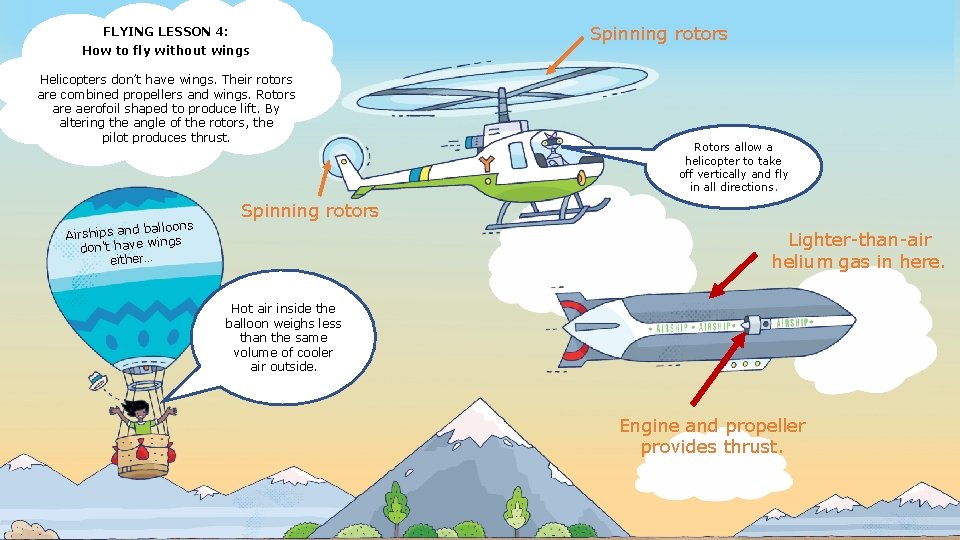
Spinning rotors FLYING LESSON 4: How to fly without wings Helicopters don’t have wings. Their rotors are combined propellers and wings. Rotors are aerofoil shaped to produce lift. By altering the angle of the rotors, the pilot produces thrust. balloons Airships and ings don’t have w either… Rotors allow a helicopter to take off vertically and fly in all directions. Spinning rotors Lighter-than-air helium gas in here. Hot air inside the balloon weighs less than the same volume of cooler air outside. Engine and propeller provides thrust.
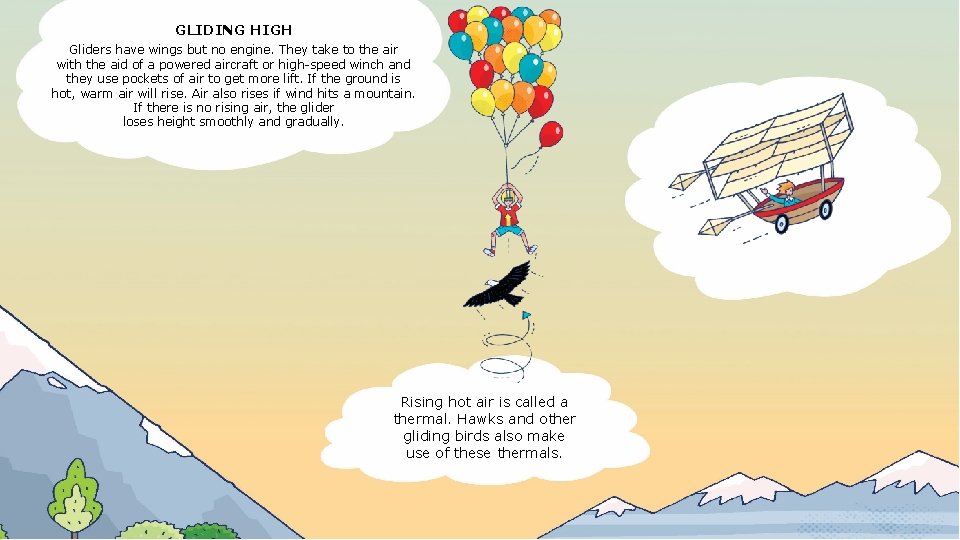
GLIDING HIGH Gliders have wings but no engine. They take to the air with the aid of a powered aircraft or high-speed winch and they use pockets of air to get more lift. If the ground is hot, warm air will rise. Air also rises if wind hits a mountain. If there is no rising air, the glider loses height smoothly and gradually. Rising hot air is called a thermal. Hawks and other gliding birds also make use of these thermals.
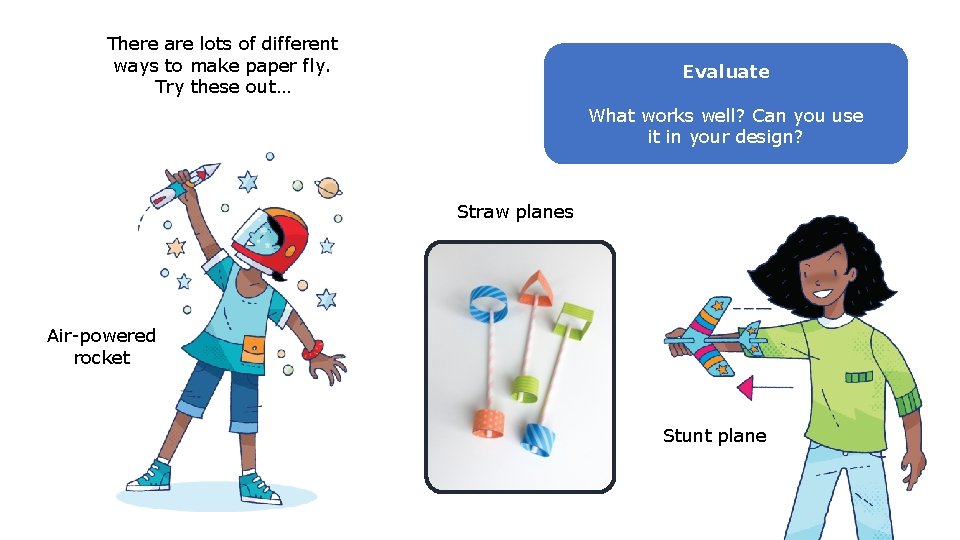
There are lots of different ways to make paper fly. Try these out… Evaluate What works well? Can you use it in your design? Straw planes Air-powered rocket Stunt plane
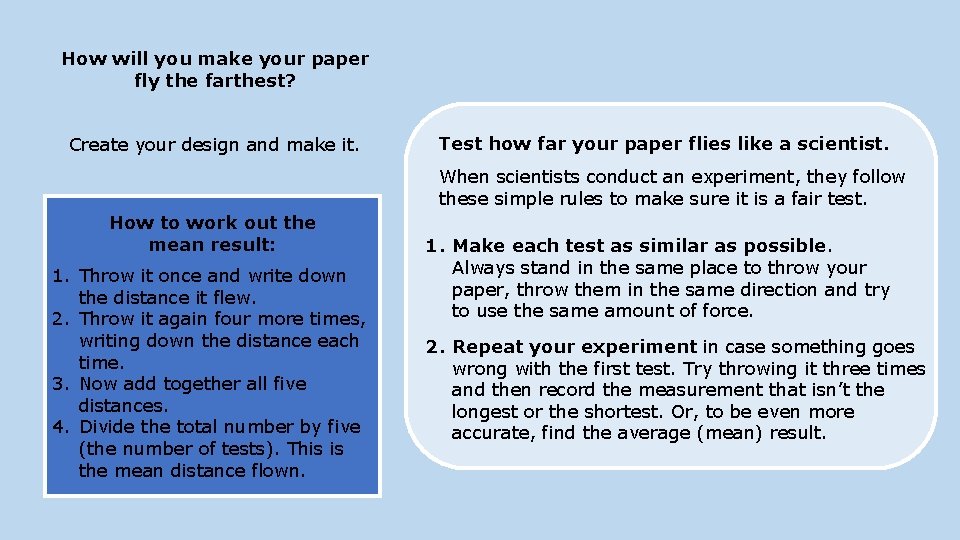
How will you make your paper fly the farthest? Create your design and make it. Test how far your paper flies like a scientist. When scientists conduct an experiment, they follow these simple rules to make sure it is a fair test. How to work out the mean result: 1. Throw it once and write down the distance it flew. 2. Throw it again four more times, writing down the distance each time. 3. Now add together all five distances. 4. Divide the total number by five (the number of tests). This is the mean distance flown. 1. Make each test as similar as possible. Always stand in the same place to throw your paper, throw them in the same direction and try to use the same amount of force. 2. Repeat your experiment in case something goes wrong with the first test. Try throwing it three times and then record the measurement that isn’t the longest or the shortest. Or, to be even more accurate, find the average (mean) result.
Don’t forget to share your results with the rest of the school. Good luck!
- Slides: 11