
Flux pinning mechanism and RF properties of ingot





- Slides: 36
Flux pinning mechanism and RF properties of ingot Niobium used in SRF cavity fabrication Pashupati Dhakal 09/26/2011
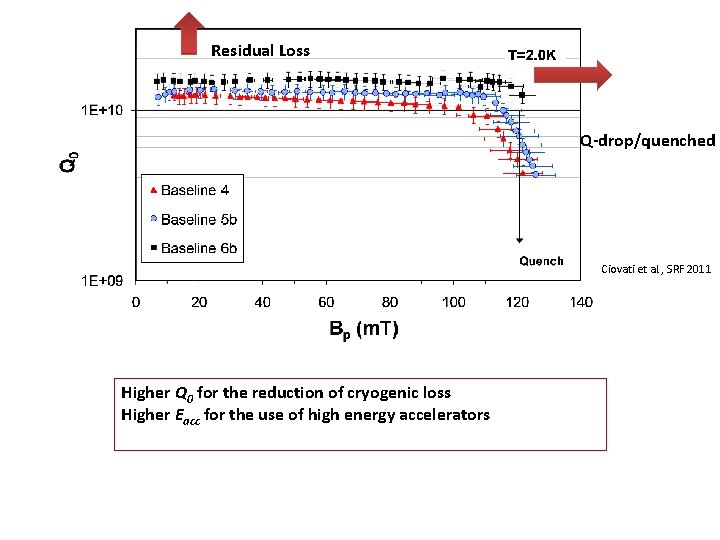
Residual Loss Q-drop/quenched Ciovati et al. , SRF 2011 Higher Q 0 for the reduction of cryogenic loss Higher Eacc for the use of high energy accelerators
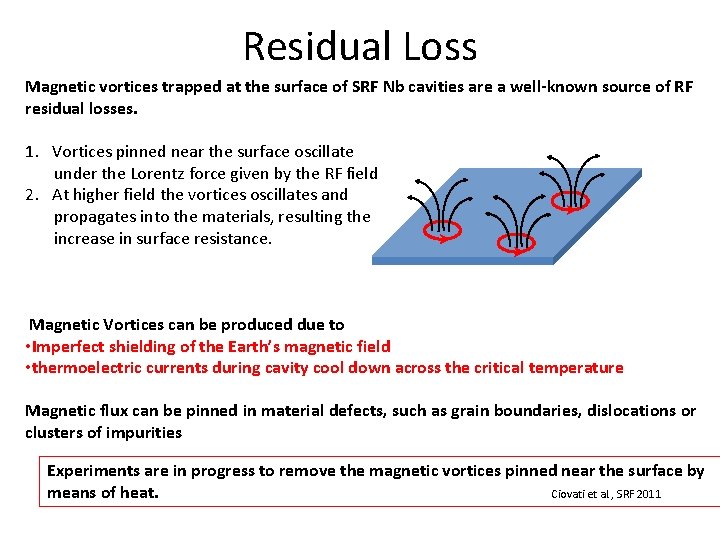
Residual Loss Magnetic vortices trapped at the surface of SRF Nb cavities are a well-known source of RF residual losses. 1. Vortices pinned near the surface oscillate under the Lorentz force given by the RF field 2. At higher field the vortices oscillates and propagates into the materials, resulting the increase in surface resistance. Magnetic Vortices can be produced due to • Imperfect shielding of the Earth’s magnetic field • thermoelectric currents during cavity cool down across the critical temperature Magnetic flux can be pinned in material defects, such as grain boundaries, dislocations or clusters of impurities Experiments are in progress to remove the magnetic vortices pinned near the surface by means of heat. Ciovati et al. , SRF 2011
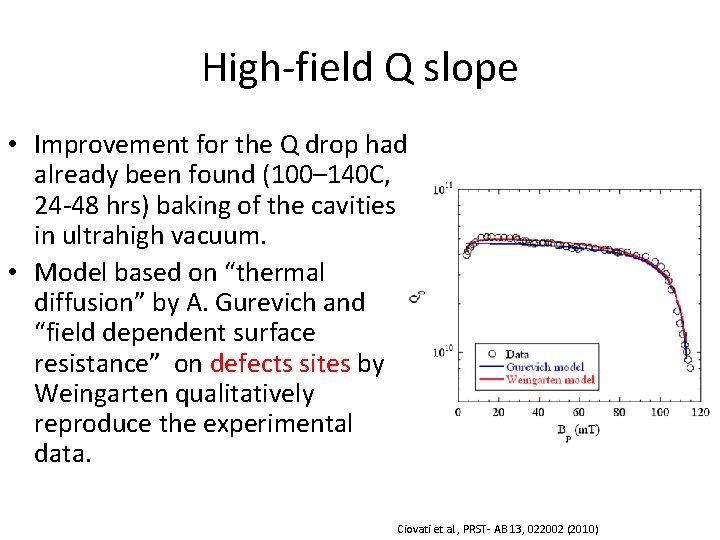
High-field Q slope • Improvement for the Q drop had already been found (100– 140 C, 24 -48 hrs) baking of the cavities in ultrahigh vacuum. • Model based on “thermal diffusion” by A. Gurevich and “field dependent surface resistance” on defects sites by Weingarten qualitatively reproduce the experimental data. Ciovati et al. , PRST- AB 13, 022002 (2010)
Motivations Understanding the flux-pinning mechanisms and trapping efficiency in Nb material of different grain size and purity is important for the fabrication of SRF cavities with high quality factor. Effect of surface and heat treatments on RF properties on sample rods.
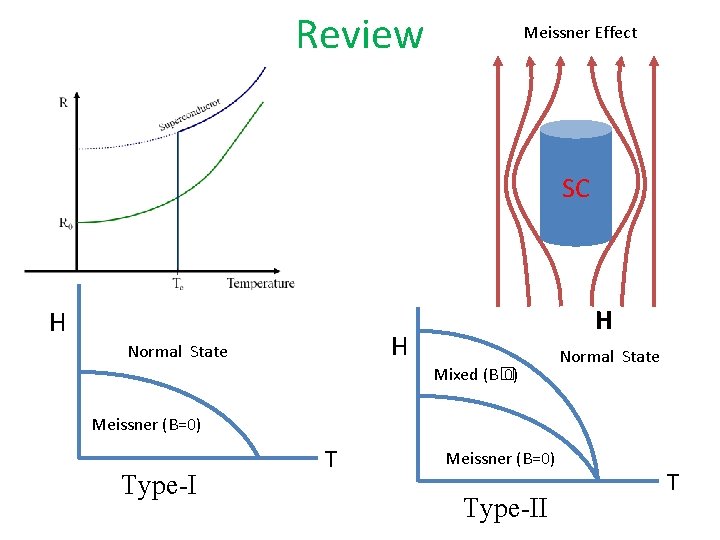
Review Meissner Effect SC H H H Normal State Mixed (B� 0) Normal State Meissner (B=0) Type-I T Meissner (B=0) Type-II T
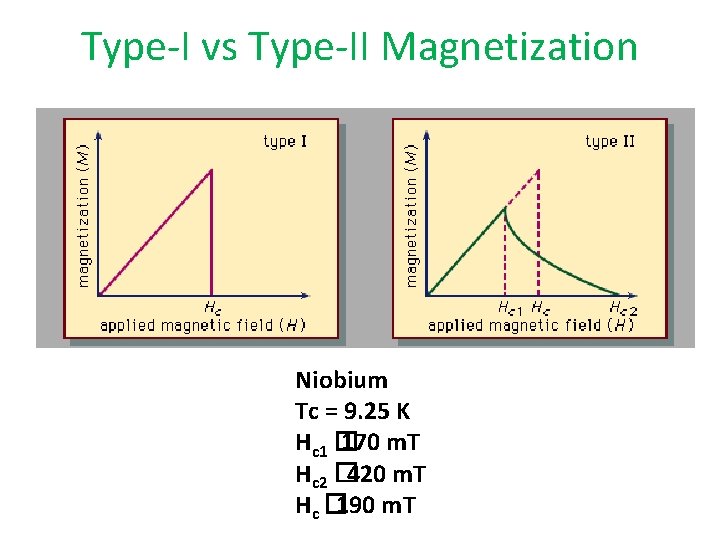
Type-I vs Type-II Magnetization Niobium Tc = 9. 25 K Hc 1 � 170 m. T Hc 2 � 420 m. T Hc � 190 m. T
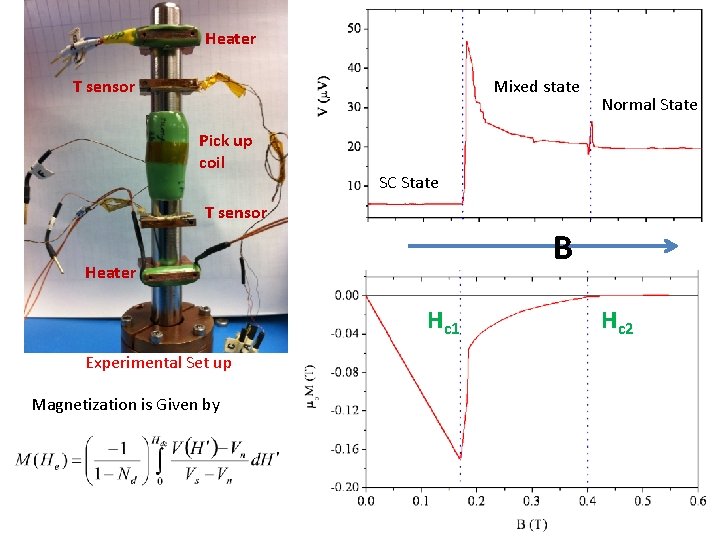
Heater T sensor Mixed state Pick up coil Normal State SC State T sensor B Heater Hc 1 Experimental Set up Magnetization is Given by Hc 2
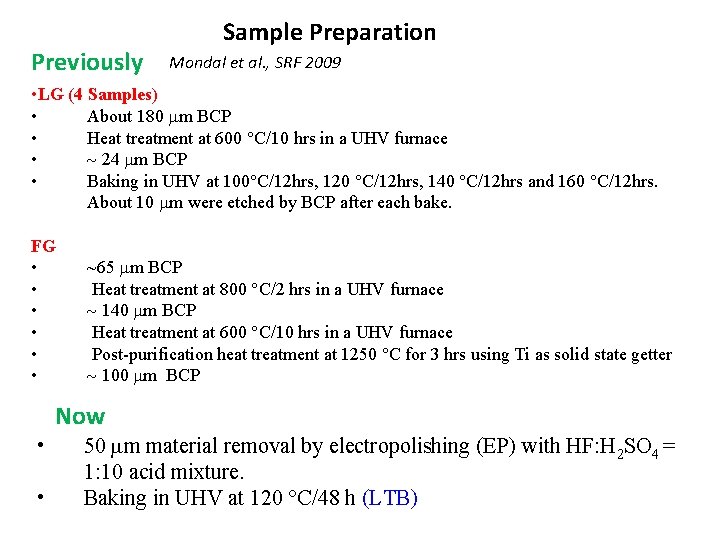
Previously Sample Preparation Mondal et al. , SRF 2009 • LG (4 Samples) • About 180 mm BCP • Heat treatment at 600 °C/10 hrs in a UHV furnace • 24 mm BCP • Baking in UHV at 100°C/12 hrs, 120 °C/12 hrs, 140 °C/12 hrs and 160 °C/12 hrs. About 10 mm were etched by BCP after each bake. FG • • • ~65 mm BCP Heat treatment at 800 °C/2 hrs in a UHV furnace 140 mm BCP Heat treatment at 600 °C/10 hrs in a UHV furnace Post-purification heat treatment at 1250 °C for 3 hrs using Ti as solid state getter 100 mm BCP Now • • 50 mm material removal by electropolishing (EP) with HF: H 2 SO 4 = 1: 10 acid mixture. Baking in UHV at 120 °C/48 h (LTB)
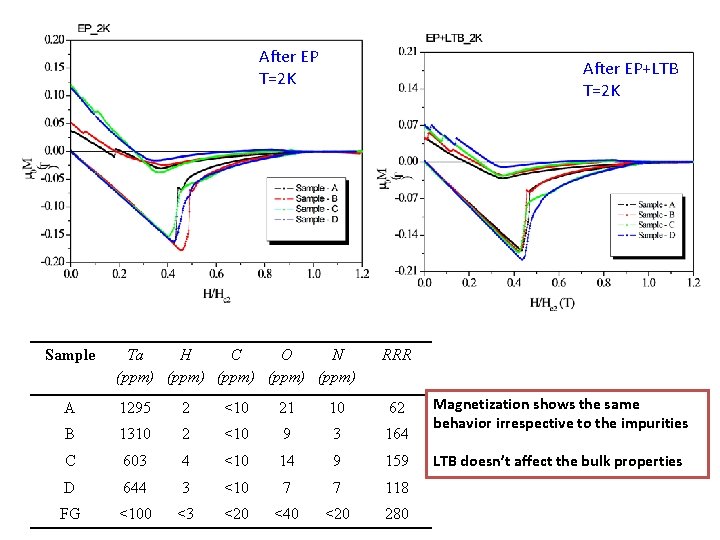
After EP T=2 K Sample After EP+LTB T=2 K Ta H C O N (ppm) (ppm) RRR A 1295 2 <10 21 10 62 B 1310 2 <10 9 3 164 C 603 4 <10 14 9 159 D 644 3 <10 7 7 118 FG <100 <3 <20 <40 <20 280 Magnetization shows the same behavior irrespective to the impurities LTB doesn’t affect the bulk properties
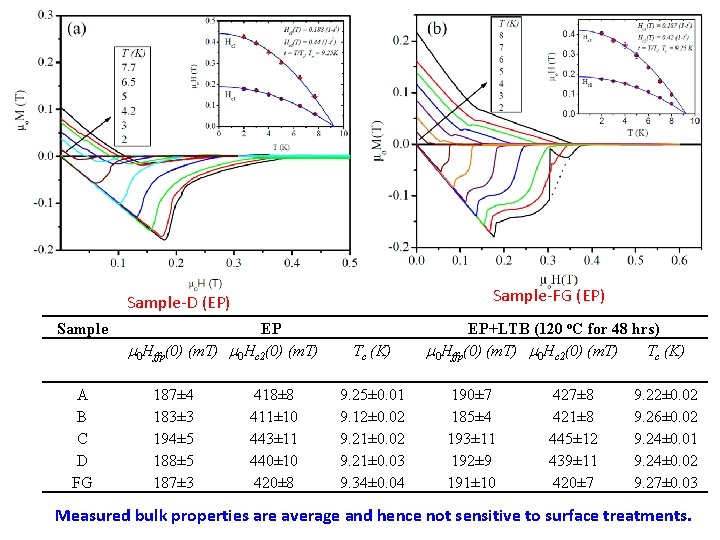
Sample-FG (EP) Sample-D (EP) Sample A B C D FG EP m 0 Hffp(0) (m. T) m 0 Hc 2(0) (m. T) 187± 4 183± 3 194± 5 188± 5 187± 3 418± 8 411± 10 443± 11 440± 10 420± 8 Tc (K) 9. 25± 0. 01 9. 12± 0. 02 9. 21± 0. 03 9. 34± 0. 04 EP+LTB (120 o. C for 48 hrs) m 0 Hffp(0) (m. T) m 0 Hc 2(0) (m. T) Tc (K) 190± 7 185± 4 193± 11 192± 9 191± 10 427± 8 421± 8 445± 12 439± 11 420± 7 9. 22± 0. 02 9. 26± 0. 02 9. 24± 0. 01 9. 24± 0. 02 9. 27± 0. 03 Measured bulk properties are average and hence not sensitive to surface treatments.
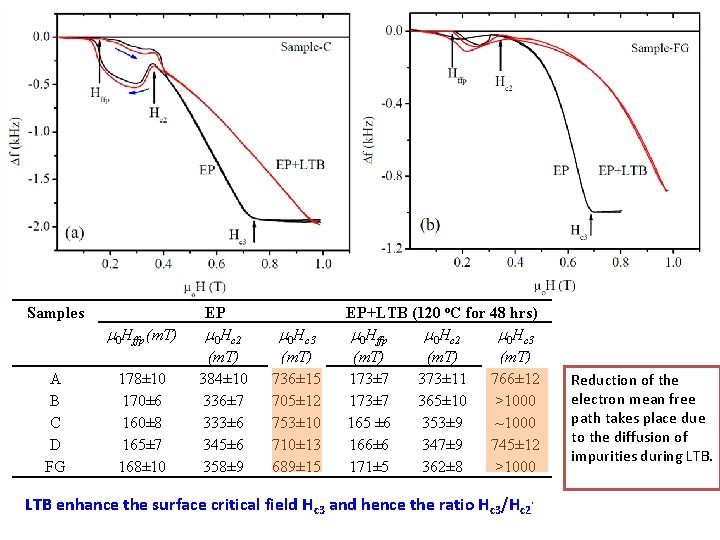
Samples m 0 Hffp (m. T) A B C D FG 178± 10 170± 6 160± 8 165± 7 168± 10 EP m 0 Hc 2 (m. T) 384± 10 336± 7 333± 6 345± 6 358± 9 m 0 Hc 3 (m. T) 736± 15 705± 12 753± 10 710± 13 689± 15 EP+LTB (120 o. C for 48 hrs) m 0 Hffp m 0 Hc 2 m 0 Hc 3 (m. T) 173± 7 373± 11 766± 12 173± 7 365± 10 >1000 165 ± 6 353± 9 ~1000 166± 6 347± 9 745± 12 171± 5 362± 8 >1000 LTB enhance the surface critical field Hc 3 and hence the ratio Hc 3/Hc 2. Reduction of the electron mean free path takes place due to the diffusion of impurities during LTB.
Critical State Once flux penetrates static magnetic flux distribution is determined by the balance between the Lorentz force and pinning force F p = Jc x B Critical State Models Many More In all these models, the magnetic field and the current density are coupled through the Maxwell relations � ×B = m 0 J These models don’t really explains the nature of superconductivity but provide the convenient means of describing some experimentally observed phenomena.
Static magnetic flux distribution is determined by the balance between the Lorentz force and pinning force F p = Jc x B Experimentally, Critical current can be calculated from magnetization measurements as (widely used Bean model) Even though the Bean model successfully explained the critical state of high k type-II superconductor, it deviates for the low k and weakly pinned superconductors where the diamagnetic contribution to critical state is significant.
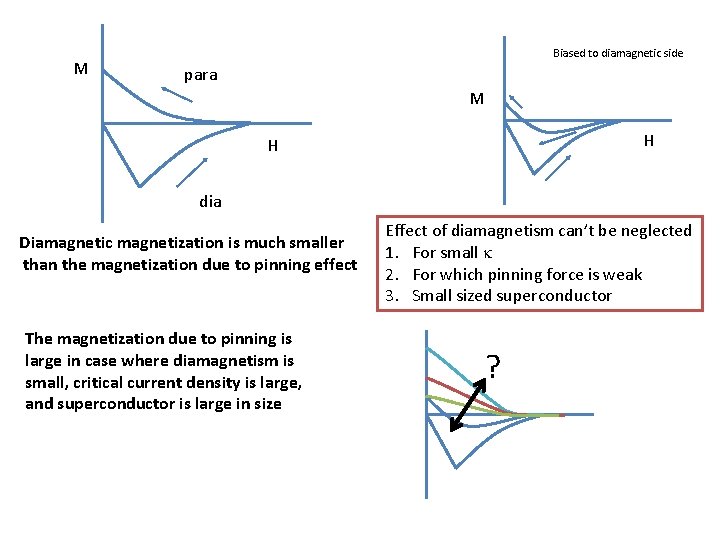
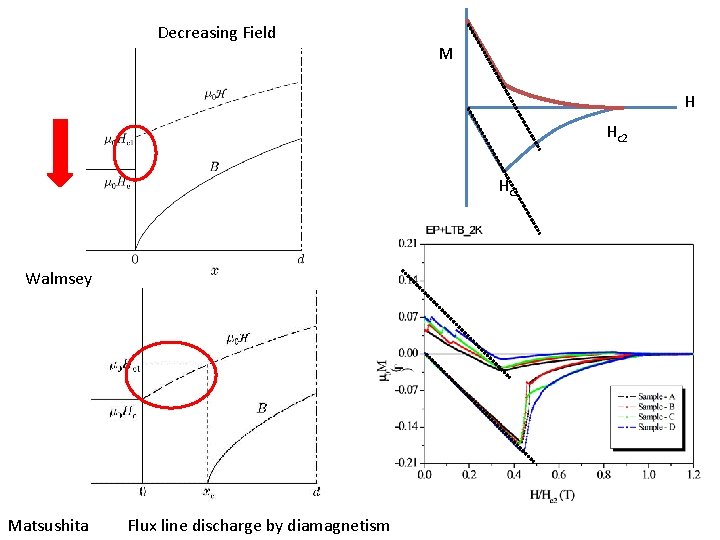
M Biased to diamagnetic side para M H H dia Diamagnetic magnetization is much smaller than the magnetization due to pinning effect The magnetization due to pinning is large in case where diamagnetism is small, critical current density is large, and superconductor is large in size Effect of diamagnetism can’t be neglected 1. For small k 2. For which pinning force is weak 3. Small sized superconductor ?
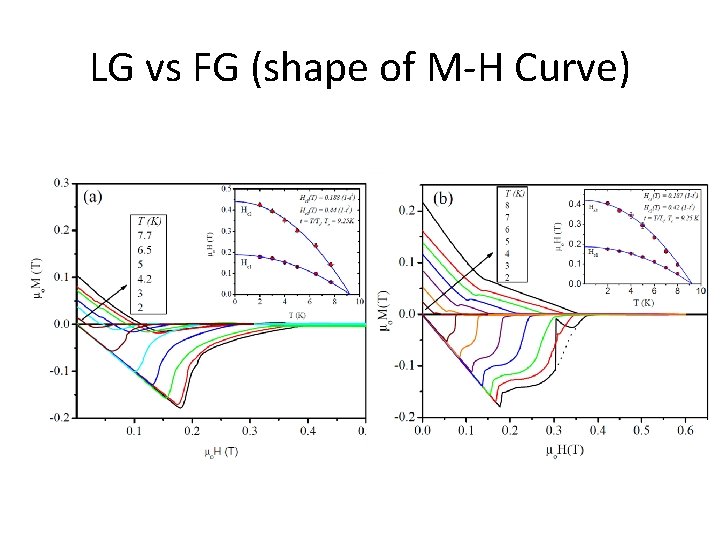
LG vs FG (shape of M-H Curve)
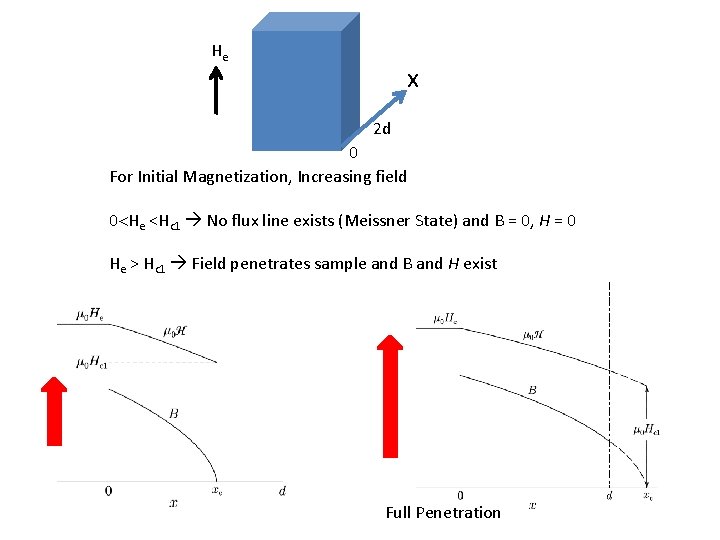
He x 2 d 0 For Initial Magnetization, Increasing field 0<He <Hc 1 No flux line exists (Meissner State) and B = 0, H = 0 He > Hc 1 Field penetrates sample and B and H exist Full Penetration
Decreasing Field M H Hc 2 Hc 1 Walmsey Matsushita Flux line discharge by diamagnetism
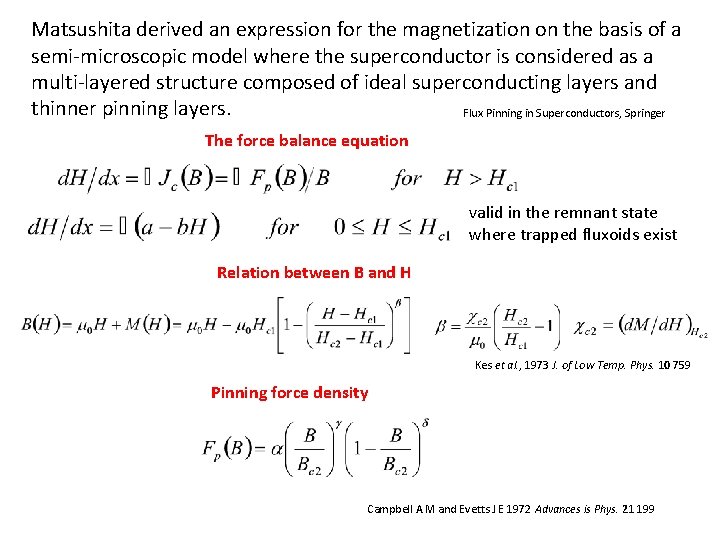
Matsushita derived an expression for the magnetization on the basis of a semi-microscopic model where the superconductor is considered as a multi-layered structure composed of ideal superconducting layers and thinner pinning layers. Flux Pinning in Superconductors, Springer The force balance equation valid in the remnant state where trapped fluxoids exist Relation between B and H Kes et al. , 1973 J. of Low Temp. Phys. 10 759 Pinning force density Campbell A M and Evetts J E 1972 Advances is Phys. 21 199
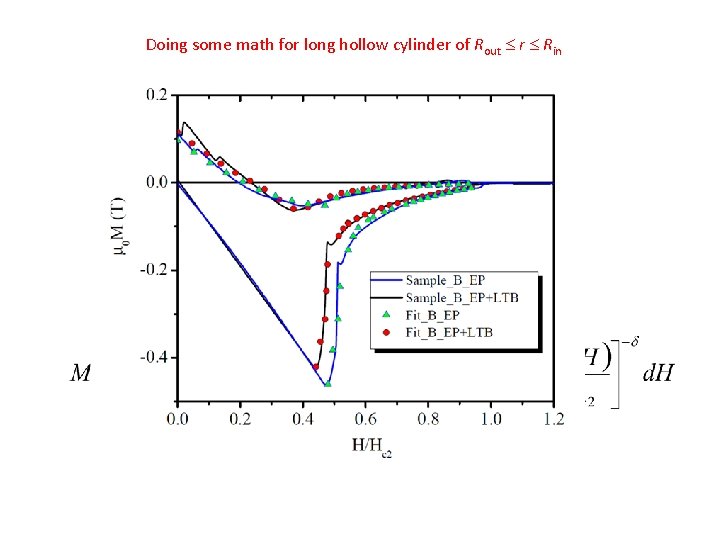
Doing some math for long hollow cylinder of Rout r Rin H > Hc 1 0 �H �Hc 1 Once the curves H(R), B(R) are calculated, the magnetization is obtained as:
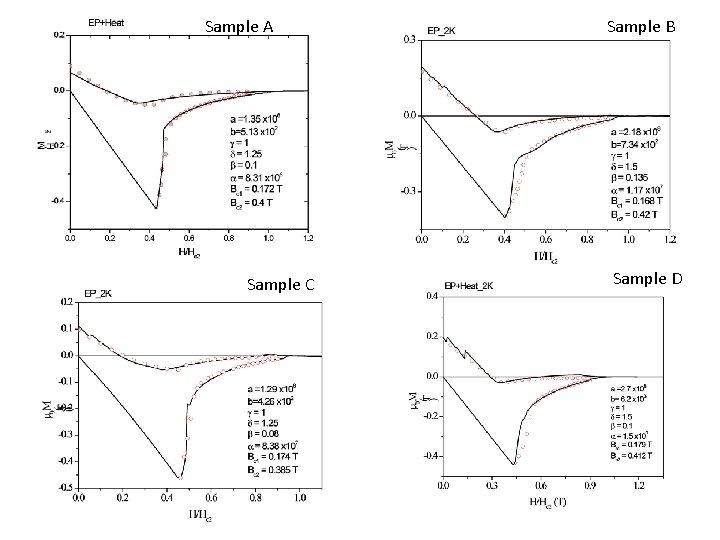
Sample A Sample C Sample B Sample D
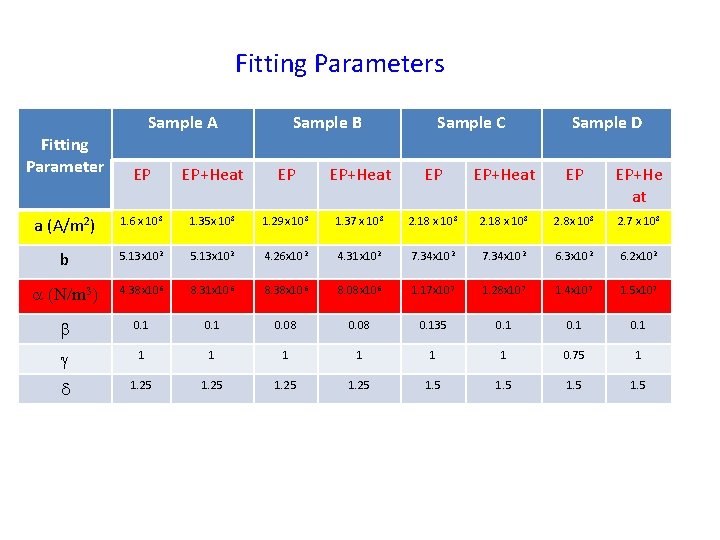
Fitting Parameters Fitting Parameter Sample A Sample B Sample C Sample D EP EP+Heat EP EP+He at a (A/m 2) 1. 6 x 10⁸ 1. 35 x 108 1. 29 x 108 1. 37 x 10 8 2. 18 x 10 8 2. 8 x 10⁸ 2. 7 x 10⁸ b 5. 13 x 102 4. 26 x 102 4. 31 x 102 7. 34 x 102 6. 3 x 10² 6. 2 x 10² a (N/m 3) 4. 38 x 106 8. 31 x 106 8. 38 x 106 8. 08 x 106 1. 17 x 107 1. 28 x 107 1. 4 x 10⁷ 1. 5 x 10⁷ b 0. 1 0. 08 0. 135 0. 1 g 1 1 1 0. 75 1 d 1. 25 1. 5
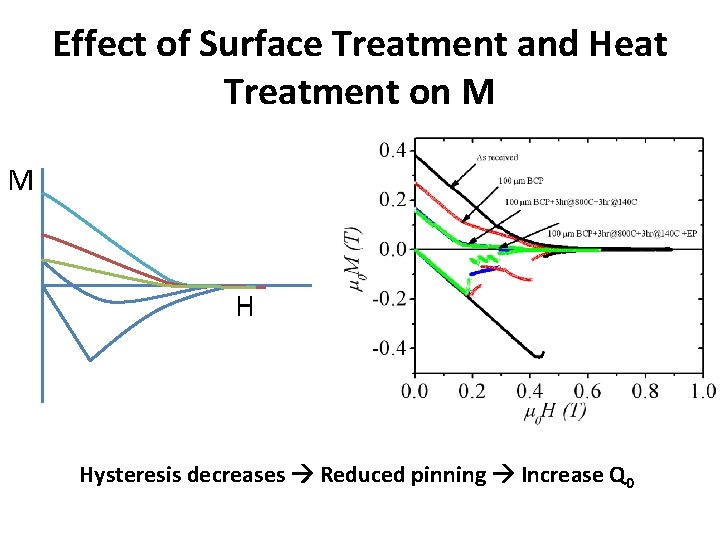
Effect of Surface Treatment and Heat Treatment on M M H Hysteresis decreases Reduced pinning Increase Q 0
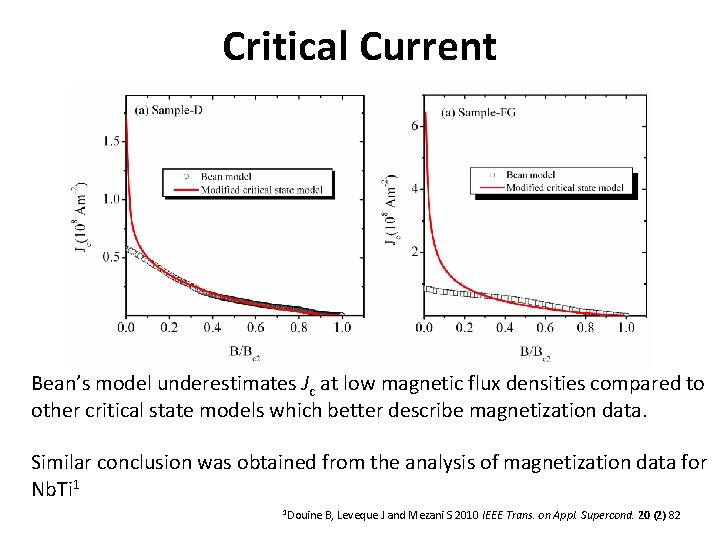
Critical Current Bean’s model underestimates Jc at low magnetic flux densities compared to other critical state models which better describe magnetization data. Similar conclusion was obtained from the analysis of magnetization data for Nb. Ti 1 1 Douine B, Leveque J and Mezani S 2010 IEEE Trans. on Appl. Supercond. 20 (2) 82
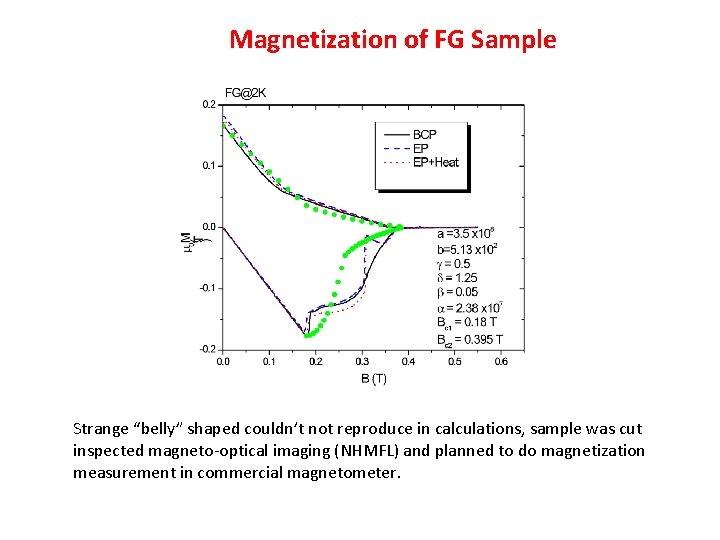
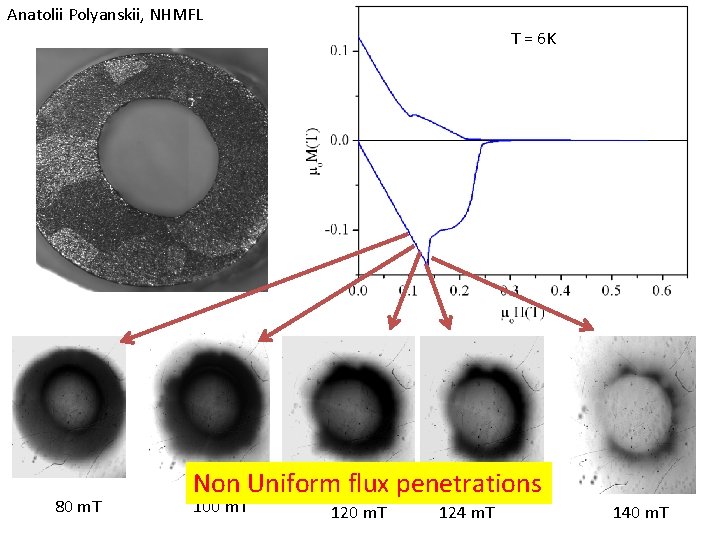
Magnetization of FG Sample Strange “belly” shaped couldn’t not reproduce in calculations, sample was cut inspected magneto-optical imaging (NHMFL) and planned to do magnetization measurement in commercial magnetometer.
Anatolii Polyanskii, NHMFL T = 6 K 80 m. T Non Uniform flux penetrations 100 m. T 124 m. T 140 m. T
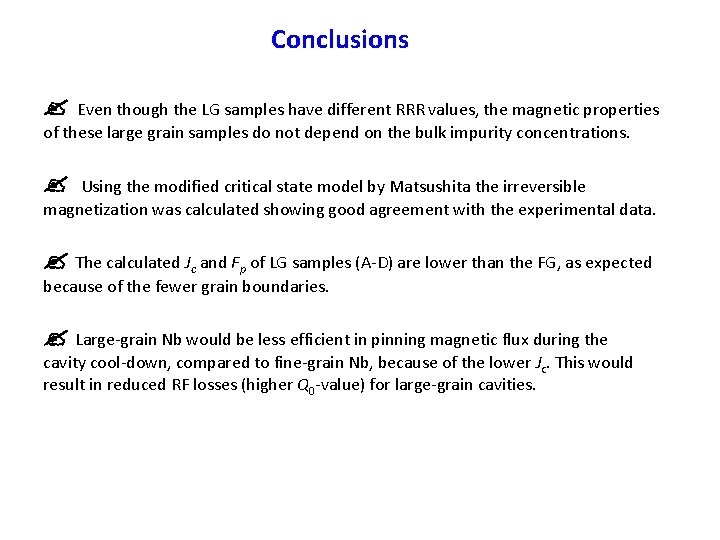
Conclusions Even though the LG samples have different RRR values, the magnetic properties of these large grain samples do not depend on the bulk impurity concentrations. Using the modified critical state model by Matsushita the irreversible magnetization was calculated showing good agreement with the experimental data. The calculated Jc and Fp of LG samples (A-D) are lower than the FG, as expected because of the fewer grain boundaries. Large-grain Nb would be less efficient in pinning magnetic flux during the cavity cool-down, compared to fine-grain Nb, because of the lower Jc. This would result in reduced RF losses (higher Q 0 -value) for large-grain cavities.
RF Measurements
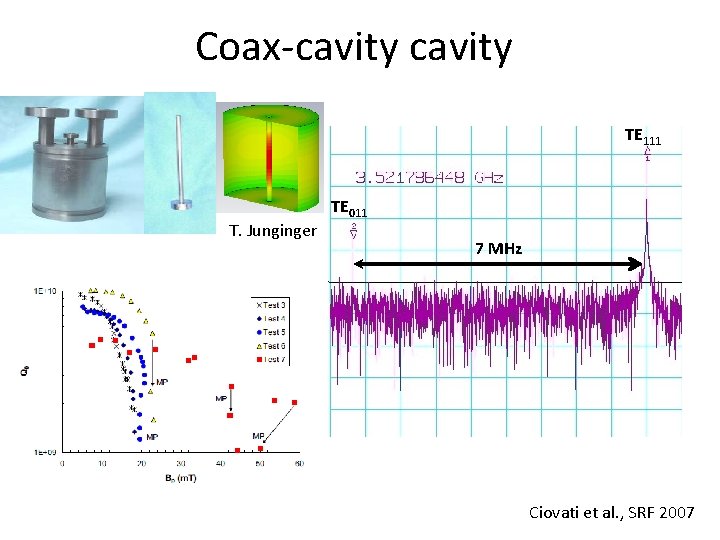
Coax-cavity TE 111 T. Junginger TE 011 7 MHz Ciovati et al. , SRF 2007
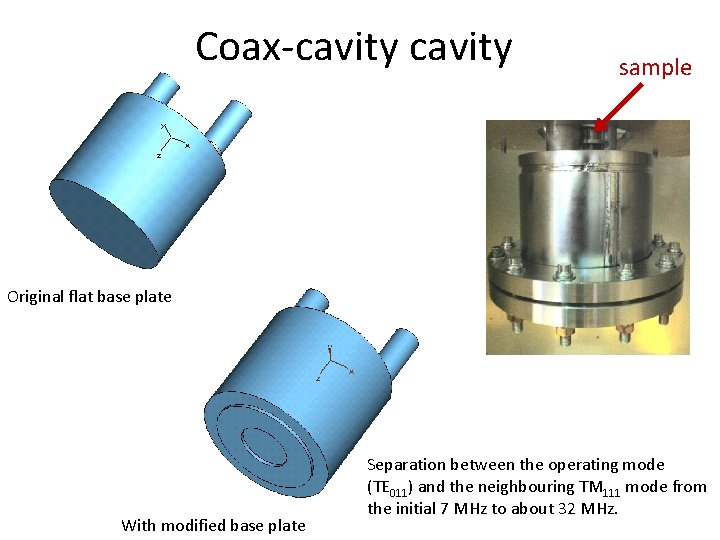
Coax-cavity sample Original flat base plate With modified base plate Separation between the operating mode (TE 011) and the neighbouring TM 111 mode from the initial 7 MHz to about 32 MHz.
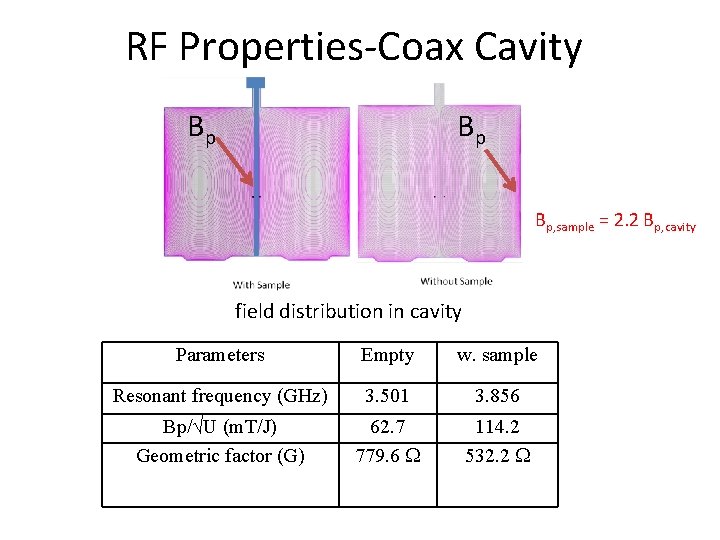
RF Properties-Coax Cavity Bp Bp Bp, sample = 2. 2 Bp, cavity field distribution in cavity Parameters Empty w. sample Resonant frequency (GHz) 3. 501 3. 856 Bp/√U (m. T/J) Geometric factor (G) 62. 7 779. 6 W 114. 2 532. 2 W
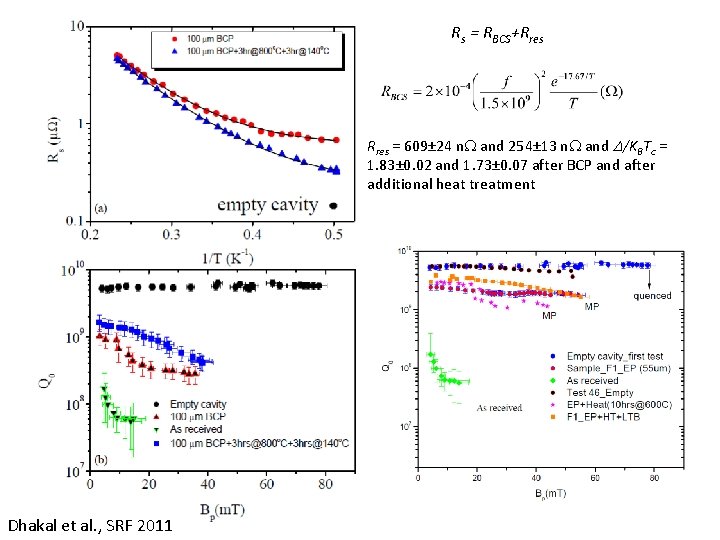
Rs = RBCS+Rres = 609± 24 n. W and 254± 13 n. W and D/KBTc = 1. 83± 0. 02 and 1. 73± 0. 07 after BCP and after additional heat treatment Dhakal et al. , SRF 2011
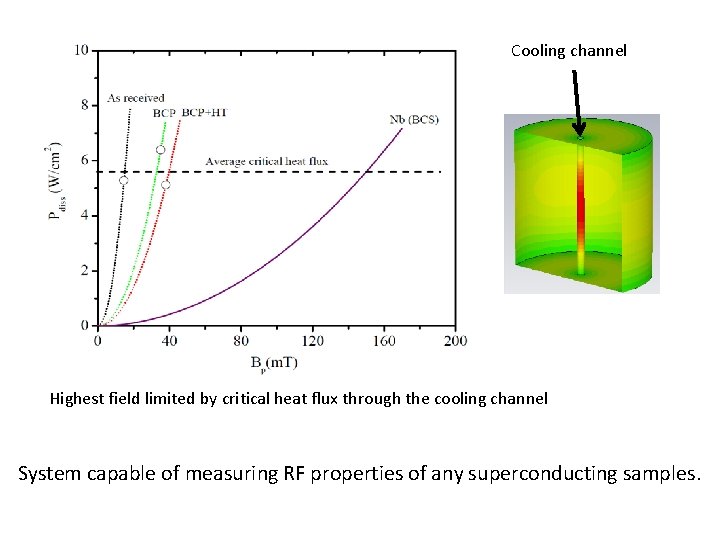
Cooling channel Highest field limited by critical heat flux through the cooling channel System capable of measuring RF properties of any superconducting samples.
Conclusions Even though the LG samples have different RRR values, the magnetic properties of these large grain samples do not depend on the bulk impurity concentrations. Using the modified critical state model by Matsushita the irreversible magnetization was calculated showing good agreement with the experimental data. ? The calculated Jc and Fp of LG samples (A-D) are lower than the FG, as expected because of the fewer grain boundaries. Large-grain Nb would be less efficient in pinning magnetic flux during the cavity cool-down, compared to fine-grain Nb, because of the lower Jc. This would result in reduced RF losses (higher Q 0 -value) for large-grain cavities. RF measurement on TE 011 cavity shows the reduction of surface resistance and hence the increase in quality factor due to the chemical and heat treatment, however maximum peak magnetic field is limited due to the critical heat flux of the niobium rods.
Acknowledgement G. Ciovati A. Dhavele M. Marrone P. Kushnick
Thank You