
Flux Mapping of the Beam Down Solar Thermal

Flux Mapping of the Beam Down Solar Thermal Concentrator at Masdar City Steven Meyers, Marwan Mokhtar, Peter Armstrong, Matteo Chiesa Laboratory of Energy and Nano-Science (LENS) Solar Energy Group © November 2009 Masdar Institute of Science and Technology. All rights reserved.

Outline Flux Mapping Basics Beam Down Solar Thermal Concentrator Initial Results Forward Optical Model Bidirectional Reflectivity Distribution Function Convolution Model Results Discussion Page 2

Flux Mapping Basics • Flux Mapping – A method to determine the distribution and quantity of concentrated solar radiation generated by a CSP facility • Three Basic Tools • CCD Camera • Diffuse Reflector (Lambertian) • Heat Flux Sensor (HFS) • CCD Camera –Luminance Map (cd/m 2) • 300 -750 nm • HFS – Discrete flux measurement (k. W/m 2) • 300 -3000 nm • Conversion ratio (k. W/cd) • Yields a continuous flux map of (k. W/m 2) Solar. PACES 2011 Page 3 Kaluza and Neumann, 1998

Diffuse Surface • Lambert’s Cosine Law (Lambertian surface) • The measured radiation intensity by an ideal diffusing surface is directly proportional to the cosine of the angle between the observer’s line of sight and the surface normal (Photometria, 1760). • If the surface obeys Lambert’s Cosine Law, the radiation angle of incidence (AOI) and azimuth are inconsequential • However, if the surface does not perfectly follow the Law, the reflected radiation to a stationary observer will change based on the radiation AOI and azimuth Source: www. odforce. net Solar. PACES 2011 Page 4
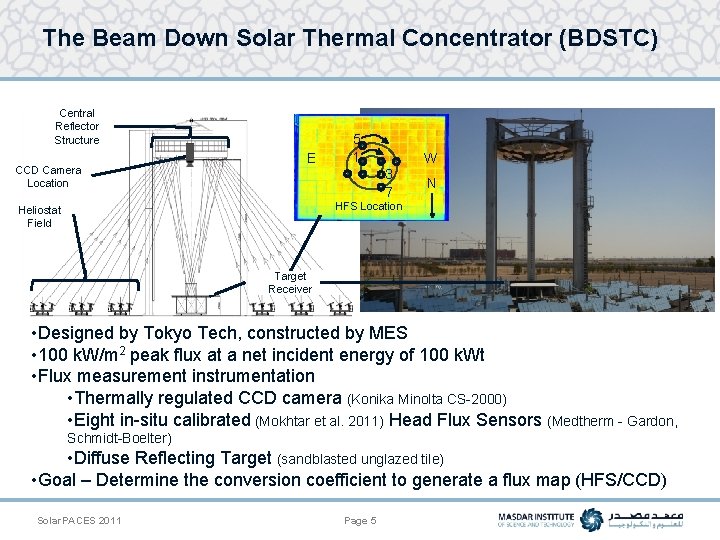
The Beam Down Solar Thermal Concentrator (BDSTC) Central Reflector Structure CCD Camera Location E 5 1 W 3 7 N HFS Location Heliostat Field Target Receiver • Designed by Tokyo Tech, constructed by MES • 100 k. W/m 2 peak flux at a net incident energy of 100 k. Wt • Flux measurement instrumentation • Thermally regulated CCD camera (Konika Minolta CS-2000) • Eight in-situ calibrated (Mokhtar et al. 2011) Head Flux Sensors (Medtherm - Gardon, Schmidt-Boelter) • Diffuse Reflecting Target (sandblasted unglazed tile) • Goal – Determine the conversion coefficient to generate a flux map (HFS/CCD) Solar. PACES 2011 Page 5
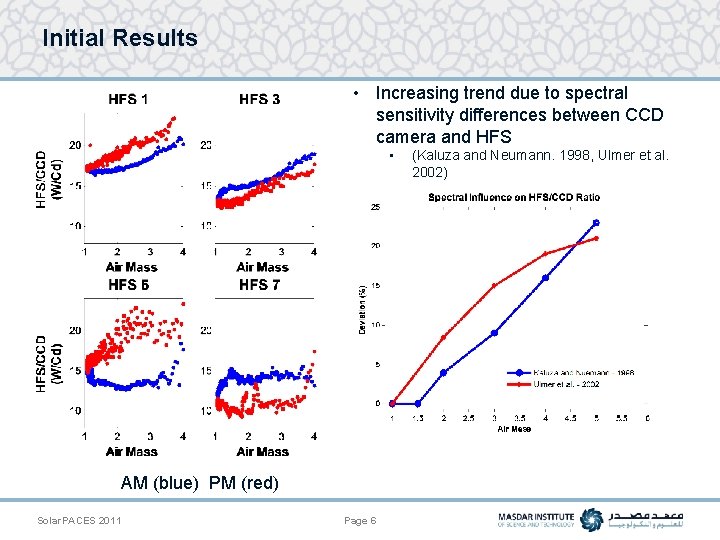
Initial Results • Increasing trend due to spectral sensitivity differences between CCD camera and HFS • AM (blue) PM (red) Solar. PACES 2011 Page 6 (Kaluza and Neumann. 1998, Ulmer et al. 2002)
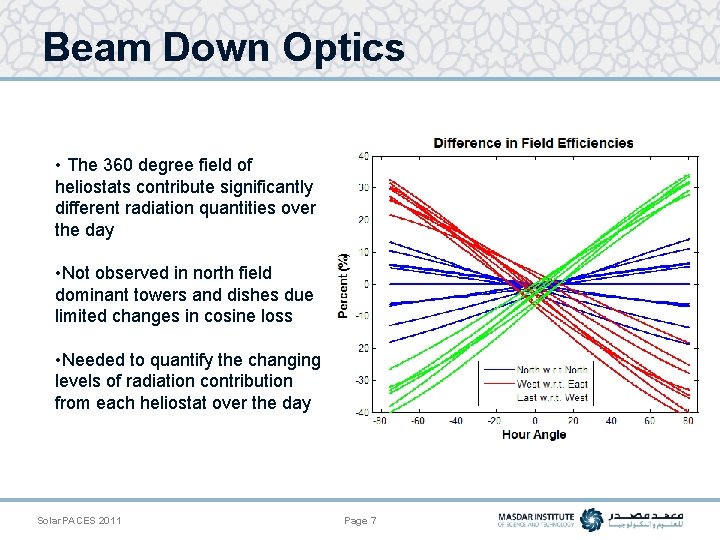
Beam Down Optics • The 360 degree field of heliostats contribute significantly different radiation quantities over the day • Not observed in north field dominant towers and dishes due limited changes in cosine loss • Needed to quantify the changing levels of radiation contribution from each heliostat over the day Solar. PACES 2011 Page 7
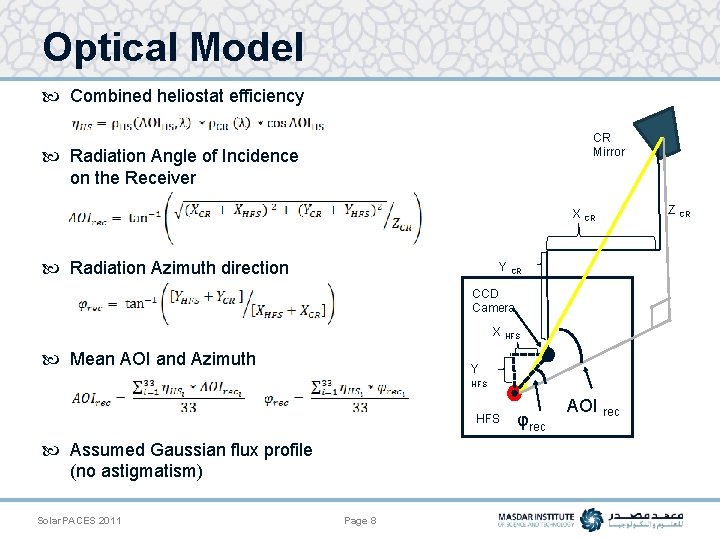
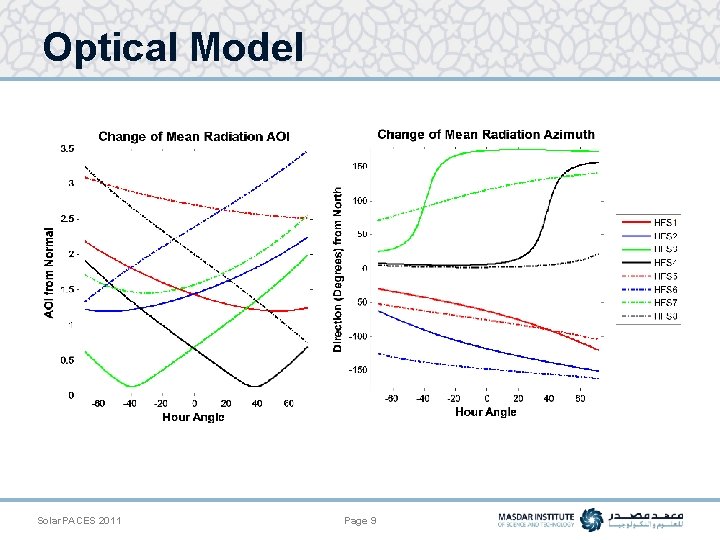
Optical Model Combined heliostat efficiency CR Mirror Radiation Angle of Incidence on the Receiver X CR Radiation Azimuth direction Y CR CCD Camera X HFS Mean AOI and Azimuth Y HFS Assumed Gaussian flux profile (no astigmatism) Solar. PACES 2011 Page 8 φrec AOI rec Z CR
Optical Model Solar. PACES 2011 Page 9

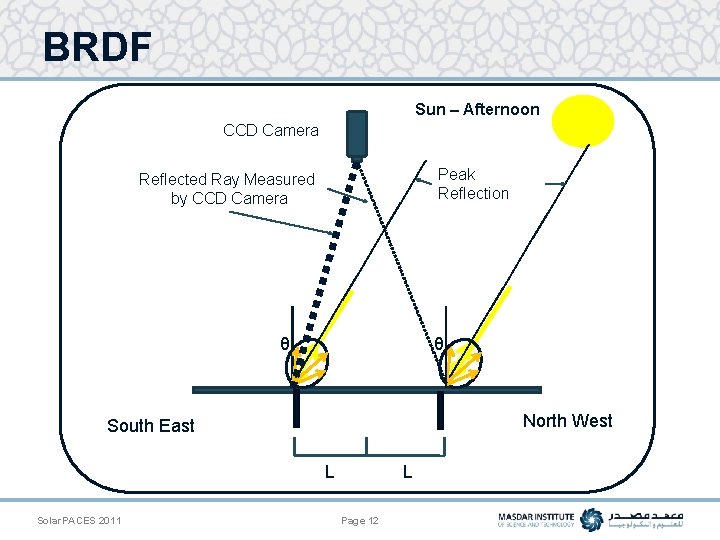
BRDF • Lambertian assumption? • A Bidirectional Reflectance Distribution Function (BRDF) was constructed Source: NIST Solar. PACES 2011 Page 10

BRDF Results indicated a significant backscatter reflectance, consistent with a rough diffuse surface § (Oren-Nayar model) Solar. PACES 2011 Page 11
BRDF Sun – Afternoon CCD Camera Peak Reflection Reflected Ray Measured by CCD Camera θ θ North West South East L Solar. PACES 2011 L Page 12

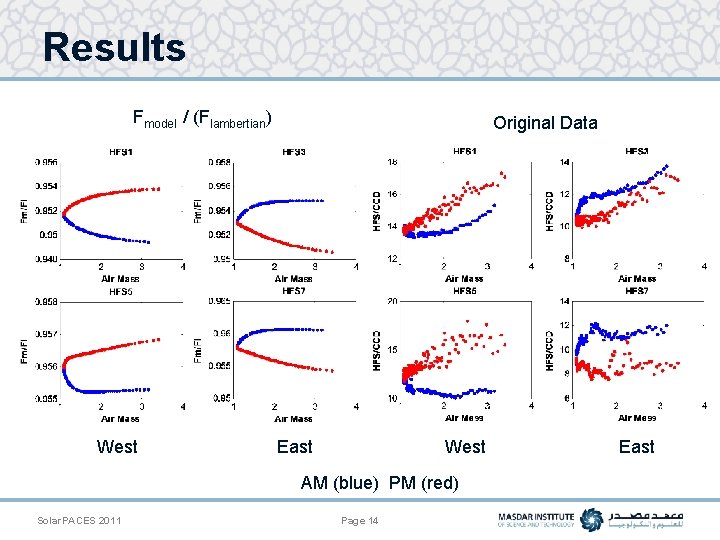
Convolution By convoluting the optical forward model with the BRDF, we can estimate the quantity of light which is measured by the CCD camera (Fmodel )and compare that to predicted light assuming a true Lambertian surface (Flambertian) Solar. PACES 2011 Page 13
Results Fmodel / (Flambertian) West Original Data East West AM (blue) PM (red) Solar. PACES 2011 Page 14 East
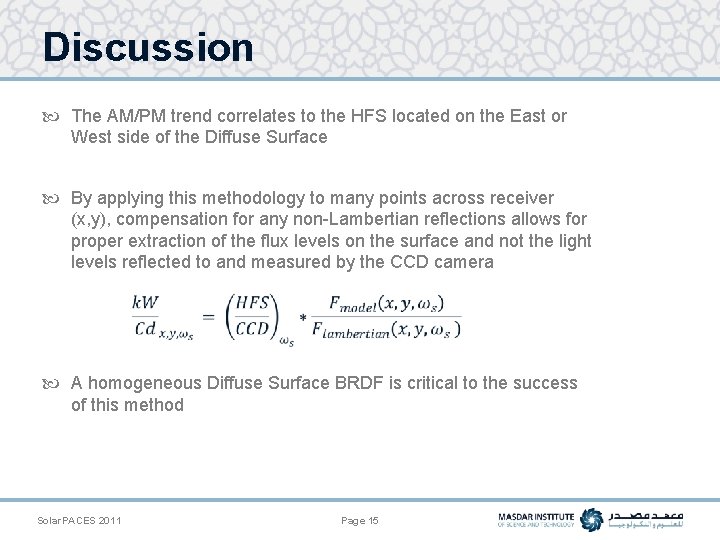
Discussion The AM/PM trend correlates to the HFS located on the East or West side of the Diffuse Surface By applying this methodology to many points across receiver (x, y), compensation for any non-Lambertian reflections allows for proper extraction of the flux levels on the surface and not the light levels reflected to and measured by the CCD camera A homogeneous Diffuse Surface BRDF is critical to the success of this method Solar. PACES 2011 Page 15
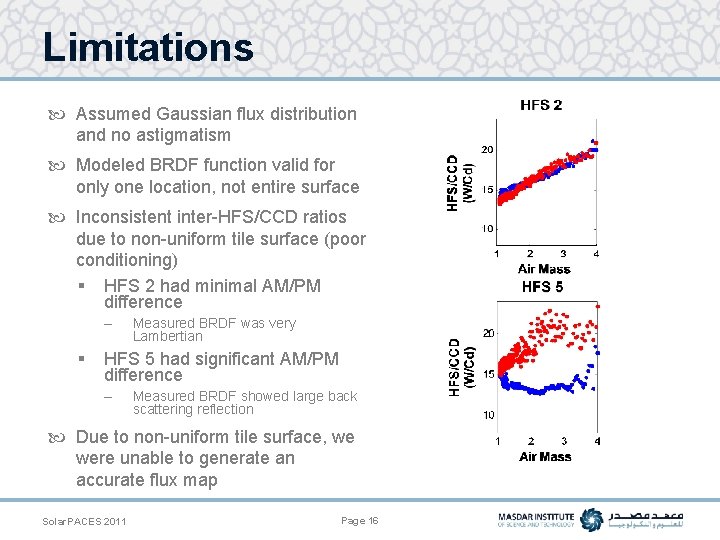
Limitations Assumed Gaussian flux distribution and no astigmatism Modeled BRDF function valid for only one location, not entire surface Inconsistent inter-HFS/CCD ratios due to non-uniform tile surface (poor conditioning) § HFS 2 had minimal AM/PM difference – § Measured BRDF was very Lambertian HFS 5 had significant AM/PM difference – Measured BRDF showed large back scattering reflection Due to non-uniform tile surface, we were unable to generate an accurate flux map Solar. PACES 2011 Page 16
Conclusion Method can be used to minimize errors caused by non -ideal Lambertian surfaces Simple forward optical model and BRDF can provide significant insight into the changing radiation measured by the CCD camera Allows for less precise (cheaper, more rugged) surfaces to be used for flux analysis, as long as they are homogeneous Solar. PACES 2011 Page 17

Thank you Questions? Page 18
- Slides: 18