
Flux Concentrator Opera Model H Bajas D Tommasini
Flux Concentrator Opera Model H. Bajas, D. Tommasini
Outline • • Background Goals of the simulation Description of the Opera models Axial field profile for different cases of study Current density distribution and field boost origin Comparison with experimental result Parametric study for FC design optimisation 2/26/2021 Linear Collider Workshop 3
Background • • • [1] R. H. Helm, “Adiabatic approximation for dynamics of a particle in the field of a tapered solenoid, ” Stanford Linear Accelerator center SLAC, Report No. 4, August 1962. [2] M. N. Wilson and K. D. Srivastava, “Design of Efficient Flux Concentrators for Pulsed High Magnetic Fields, ” Rutherford High Energy Laboratory, May 1965. [3] A. V. Kulikov, S. D. Ecklund, and E. M. Reute, “SLC Positron Source Pulsed Flux Concentrator, ” Stanford Linear Accelerator Center, Stanford University, Stanford, CA 94309, SLAC-PUB-5473, June 1991. [4] J. De Lamare, A. V. Kulikov, R. Cassel, V. Nesterov, “SLC Positron Source Flux Concentrator Modulator, ” Stanford Linear Accelerator Center, Stanford University, Stanford, CA 94309, SLAC-PUB-5472, May 1991. [5] H. Wang, W. Liu, W. Gai, T. Wong, “Modeling and Prototyping of a Flux Concentrator for Positron Capture, ” Argonne National Laboratory and Illinois Institute of Technology, IEEE Transaction On Magnetics, Vol. 44, NO. 10, Oct. 2008. [6] “Design of a Pulsed Flux Concentrator for the ILC Positron Source, ” J. Gronberg, R. Abbort, C. Brown et. al. , Lawrence Livermore National Lab. , Livermore, CA, 1018008, May 2010. [7] L. Zang, T. Kamitani, S. Fukuda and Y. Ogawa, “Design Optimization of Flux Concentrator for Super. KEKB, ” Proceedings of the IPAC’ 12, New Orleans, USA, May 2012. [8] L. Zang, M. Akemoto, S. Fukuda, et. al. , “Prototyping of the Flux Concentrator for Super. KEKB Positron Capture, ” The 9 th Annual Meeting of Particle Accelerator Society of Japan, 2012. [9] J. Zhang on the behalf of CEPC team, “Overall Design of the CEPC Injector Linac, ” ee. FACT 2018, HKUST, Hong Kong, China, 2018. [10] CERN, “The Compact Linear Collider (CLIC) 2018 Summary 6 Report, ” Geneva, 2018. 2/26/2021 Linear Collider Workshop 4
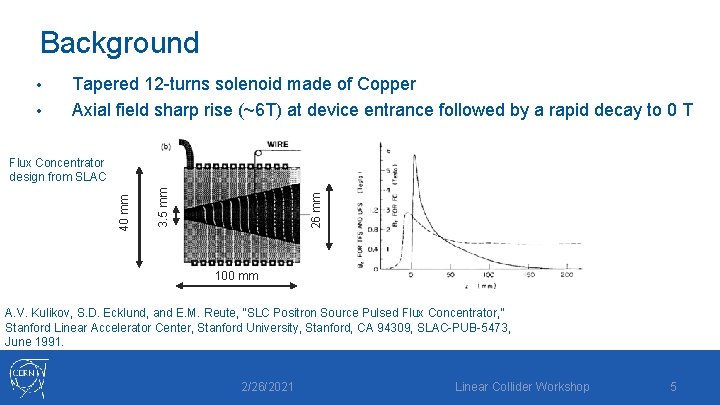
Background • • Tapered 12 -turns solenoid made of Copper Axial field sharp rise (~6 T) at device entrance followed by a rapid decay to 0 T 26 mm 3. 5 mm 40 mm Flux Concentrator design from SLAC 100 mm A. V. Kulikov, S. D. Ecklund, and E. M. Reute, “SLC Positron Source Pulsed Flux Concentrator, ” Stanford Linear Accelerator Center, Stanford University, Stanford, CA 94309, SLAC-PUB-5473, June 1991. 2/26/2021 Linear Collider Workshop 5
Goals of the simulation • To understand the working principle of an Adiabatic Matching Device Flux Concentrator (AMD FC) by the mean of electromagnetic models using Opera® software • To give the phenomenology of the axial field boost from 2 to 6 T • To reproduce the design and result of the SLAC AMD FC • To run parametric study in order to optimize future AMD FC design 2/26/2021 Linear Collider Workshop 6
Description of the Opera models • • • 2 D model Axi-symmetric system Straight and tapered, SLAC design Geometry of solenoid: Constant conductivity of Copper Material properties: Tangential field for symmetry and far field Boundary conditions: AC or DC current supply and winding Powering circuit: quadrilateral FE and Bias method Regular mesh and mesh refinement: Eddy Current and Skin effect Static and dynamic simulation: decoupling the various effects Cases of study: 2/26/2021 Linear Collider Workshop 7
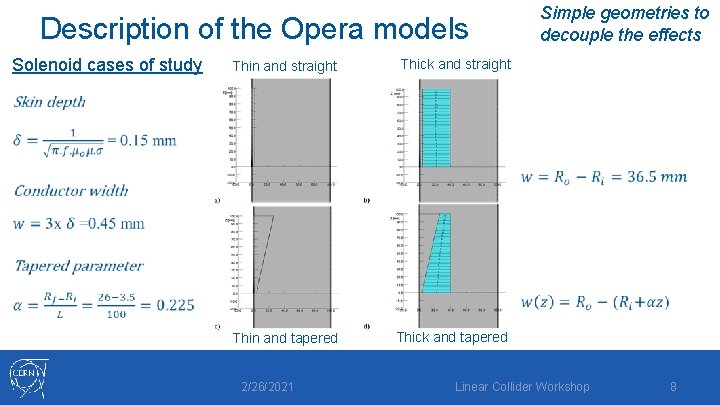
Description of the Opera models Solenoid cases of study Thin and straight Simple geometries to decouple the effects Thick and straight Thin and tapered 2/26/2021 Thick and tapered Linear Collider Workshop 8
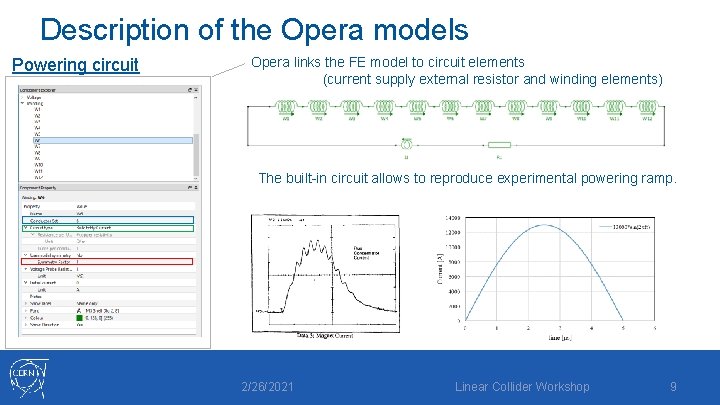
Description of the Opera models Powering circuit Opera links the FE model to circuit elements (current supply external resistor and winding elements) The built-in circuit allows to reproduce experimental powering ramp. 2/26/2021 Linear Collider Workshop 9
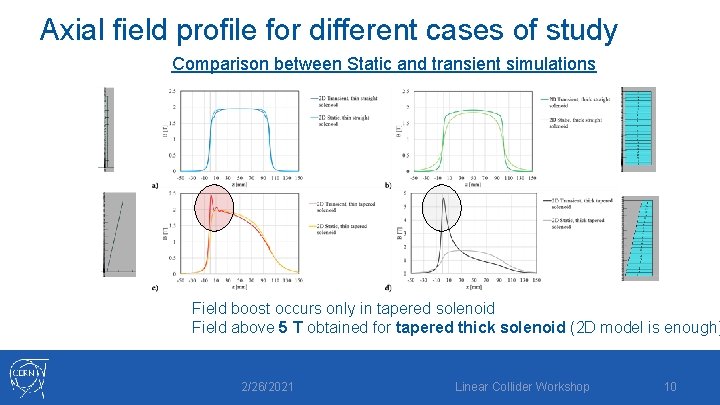
Axial field profile for different cases of study Comparison between Static and transient simulations Field boost occurs only in tapered solenoid Field above 5 T obtained for tapered thick solenoid (2 D model is enough) 2/26/2021 Linear Collider Workshop 10
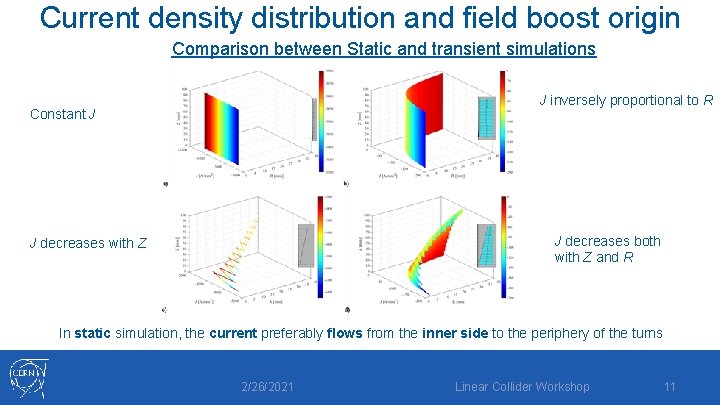
Current density distribution and field boost origin Comparison between Static and transient simulations J inversely proportional to R Constant J J decreases both with Z and R J decreases with Z In static simulation, the current preferably flows from the inner side to the periphery of the turns 2/26/2021 Linear Collider Workshop 11
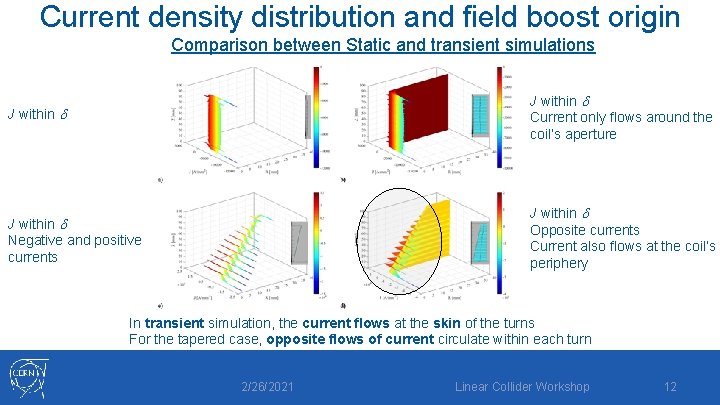
Current density distribution and field boost origin Comparison between Static and transient simulations J within d Current only flows around the coil’s aperture J within d Negative and positive currents J within d Opposite currents Current also flows at the coil’s periphery In transient simulation, the current flows at the skin of the turns For the tapered case, opposite flows of current circulate within each turn 2/26/2021 Linear Collider Workshop 12
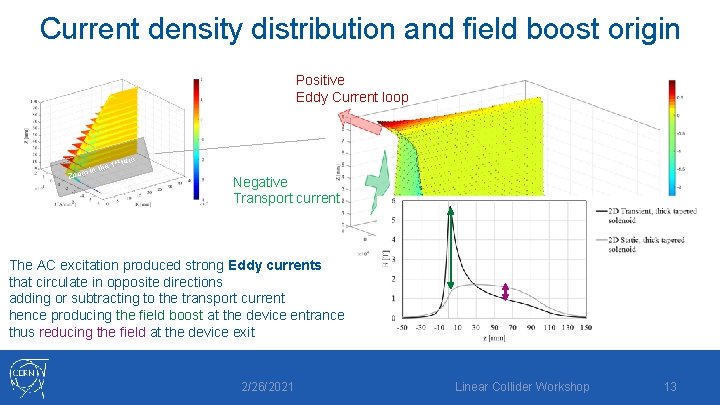
Current density distribution and field boost origin Positive Eddy Current loop rn 1 s tu the in Zoom t Negative Transport current The AC excitation produced strong Eddy currents that circulate in opposite directions adding or subtracting to the transport current hence producing the field boost at the device entrance thus reducing the field at the device exit 2/26/2021 Negative Eddy Current loop Linear Collider Workshop 13
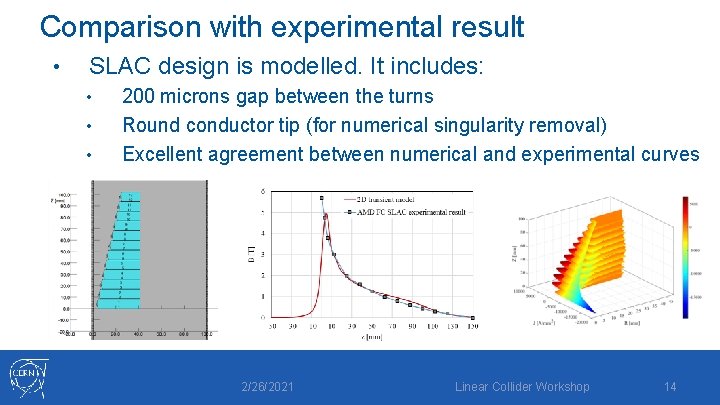
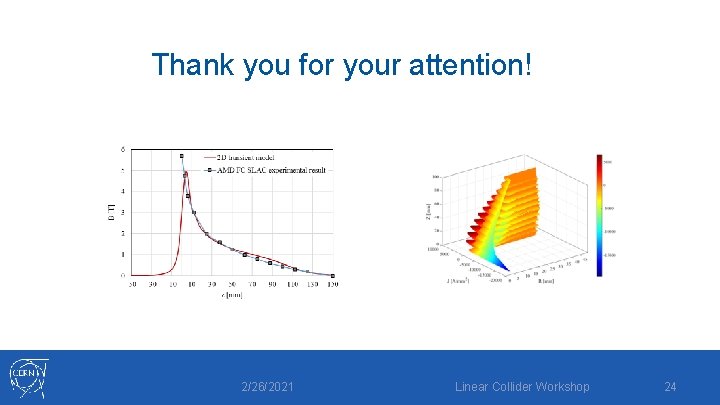
Comparison with experimental result • SLAC design is modelled. It includes: • • • 200 microns gap between the turns Round conductor tip (for numerical singularity removal) Excellent agreement between numerical and experimental curves 2/26/2021 Linear Collider Workshop 14
Parametric study for FC design optimisation • Sensitivity analysis of the model to the design parameters is carried out on: • Current’s Amplitude and Frequency • Material conductivity • Coil geometry: • gap size, solenoid outer radius, number of turns 2/26/2021 Linear Collider Workshop 15
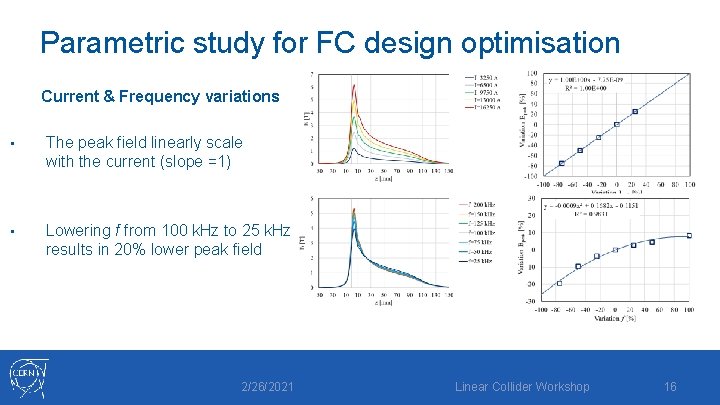
Parametric study for FC design optimisation Current & Frequency variations • The peak field linearly scale with the current (slope =1) • Lowering f from 100 k. Hz to 25 k. Hz results in 20% lower peak field 2/26/2021 Linear Collider Workshop 16
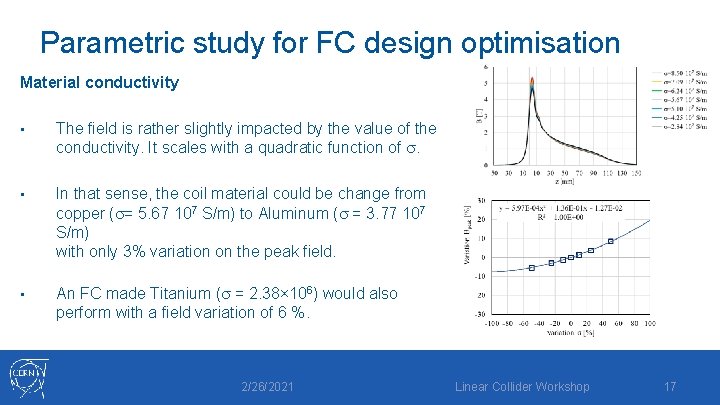
Parametric study for FC design optimisation Material conductivity • The field is rather slightly impacted by the value of the conductivity. It scales with a quadratic function of s. • In that sense, the coil material could be change from copper (s= 5. 67 107 S/m) to Aluminum (s = 3. 77 107 S/m) with only 3% variation on the peak field. • An FC made Titanium (s = 2. 38× 106) would also perform with a field variation of 6 %. 2/26/2021 Linear Collider Workshop 17
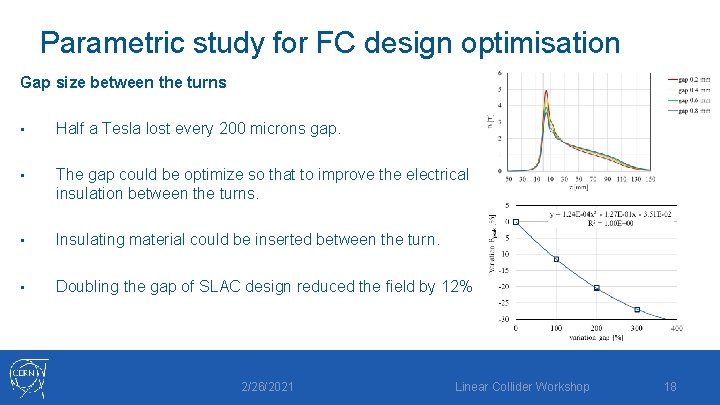
Parametric study for FC design optimisation Gap size between the turns • Half a Tesla lost every 200 microns gap. • The gap could be optimize so that to improve the electrical insulation between the turns. • Insulating material could be inserted between the turn. • Doubling the gap of SLAC design reduced the field by 12% 2/26/2021 Linear Collider Workshop 18
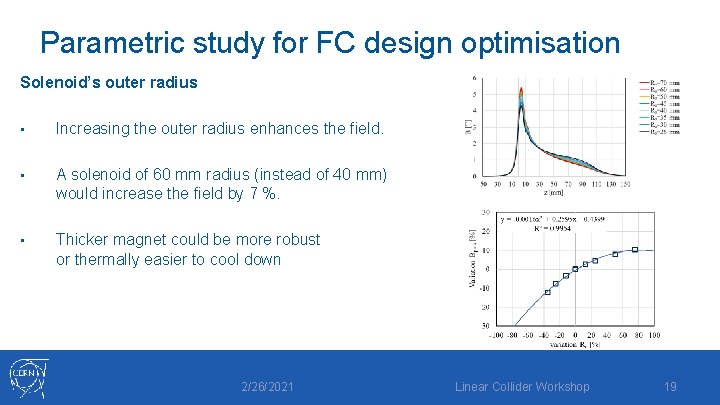
Parametric study for FC design optimisation Solenoid’s outer radius • Increasing the outer radius enhances the field. • A solenoid of 60 mm radius (instead of 40 mm) would increase the field by 7 %. • Thicker magnet could be more robust or thermally easier to cool down 2/26/2021 Linear Collider Workshop 19
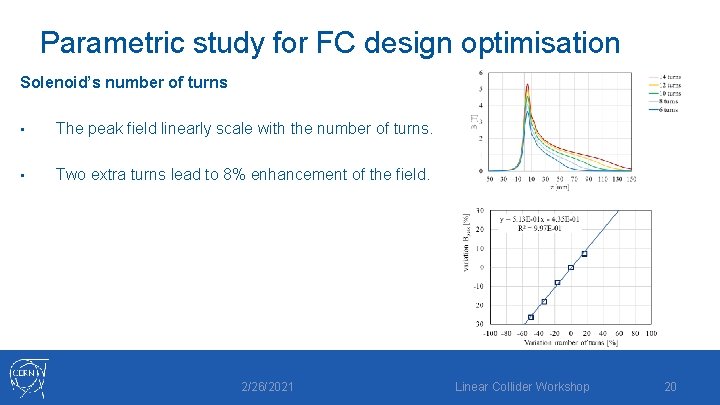
Parametric study for FC design optimisation Solenoid’s number of turns • The peak field linearly scale with the number of turns. • Two extra turns lead to 8% enhancement of the field. 2/26/2021 Linear Collider Workshop 20
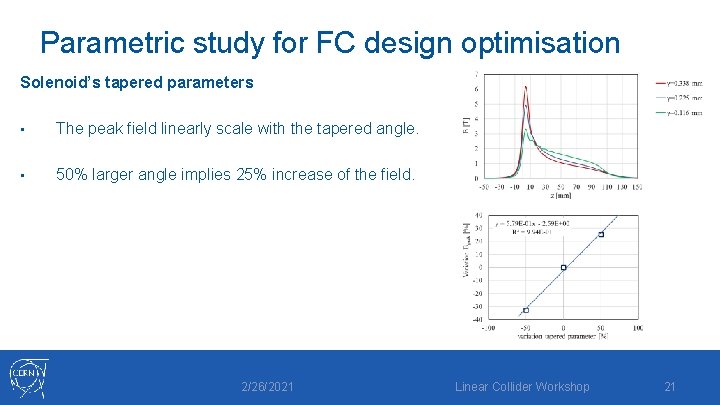
Parametric study for FC design optimisation Solenoid’s tapered parameters • The peak field linearly scale with the tapered angle. • 50% larger angle implies 25% increase of the field. 2/26/2021 Linear Collider Workshop 21
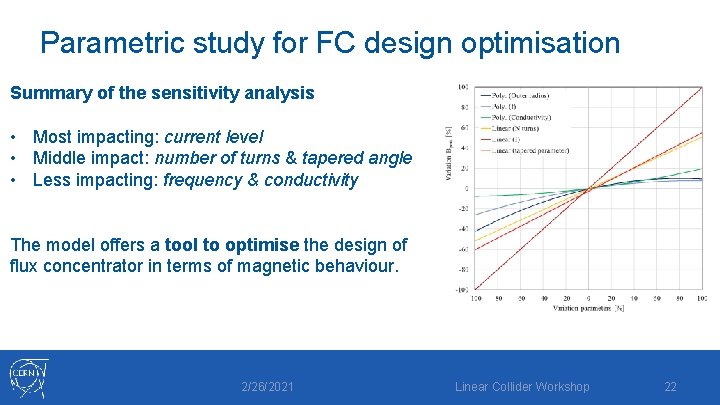
Parametric study for FC design optimisation Summary of the sensitivity analysis • Most impacting: current level • Middle impact: number of turns & tapered angle • Less impacting: frequency & conductivity The model offers a tool to optimise the design of flux concentrator in terms of magnetic behaviour. 2/26/2021 Linear Collider Workshop 22
Conclusion • Development of a parametric numerical model of Flux Concentrator using Opera software. • Understanding of the field boost as the creation of Eddy current loops circulating in opposite directions in each turn. Phenomenon that only occurs in the case of tapered solenoid in transient mode. The current flows only within the skin depth of the conductor. • Validation of the model and measurement by direct comparison of the field profile. • Possible optimisation of the design thanks to sensitivity analysis for future FC. 2/26/2021 Linear Collider Workshop 23
Thank you for your attention! 2/26/2021 Linear Collider Workshop 24
Linear Collider Workshop
- Slides: 25