
Fluvial systems 8 b Controls over river channel
Fluvial systems 8 b: Controls over river channel pattern

Fluvial Systems 8 b: Controls over river channel pattern • • • Basic classification of channel pattern Discriminating pattern types Revised classifications of channel pattern Theoretical approaches References
Summary River channel patterns have caused considerable debate during the past 40 years. Meandering was initially recognised as the 'natural' form for a river channel and it was then realised that the degree of meandering varied between channels. Braided channels were identified with mountain and fluvioglacial environments, leading to suggestions that braiding was associated with steep slopes, high sediment supply rates, varying water discharge or a combination thereof. Leopold and Wolman (1957) were the first to suggest a relationship between meandering and braided channels, suggesting that there was a threshold between the two channel types defined in terms of bed slope. This idea of a meandering-braided river threshold became common in the literature and many attempts were made to define it more precisely in terms of stream power, and with bed material size and bank erodibility being introduced as secondary variables. The idea of a distinct threshold somewhat ignores the reality of actual channel patterns - the classical types are not often seen in nature and there is a wide range of transitional forms. Recognition that these are not oddities, but are manifestations of a continuum of channel patterns has led to changed thinking on this topic in the past decade. There is still acknowledged to be a broad association of braiding with higher energy and coarse bed material streams, but more emphasis is now given to the relative erodibility of bank and bed sediments. Studies in other channel types have shown how different patterns can co-exist as a result of different processes operating under different conditions. Theoretical studies of channel pattern have supported ideas of an association between meandering and braiding. The onset of braiding and its intensity can be predicted with reasonable accuracy once allowance is made for local conditions. Re-definition of descriptive indices of channel pattern has enabled the gradual nature of the transition to be expressed quantitatively.

Basic classification Straight (P<1. 1) Braided (multiple channels) Meandering (1. 1<P)
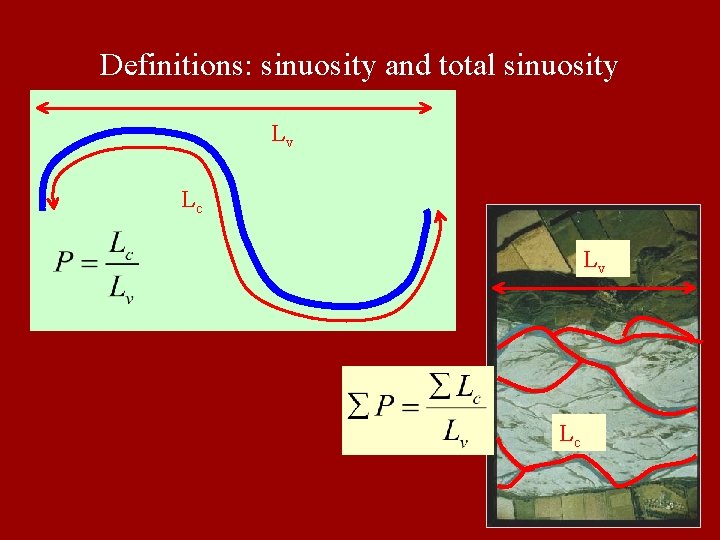
Definitions: sinuosity and total sinuosity Lv Lc
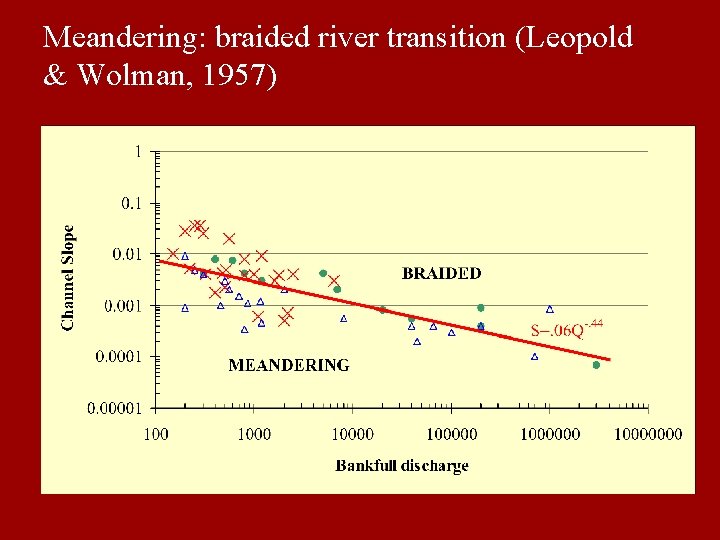
Meandering: braided river transition (Leopold & Wolman, 1957)
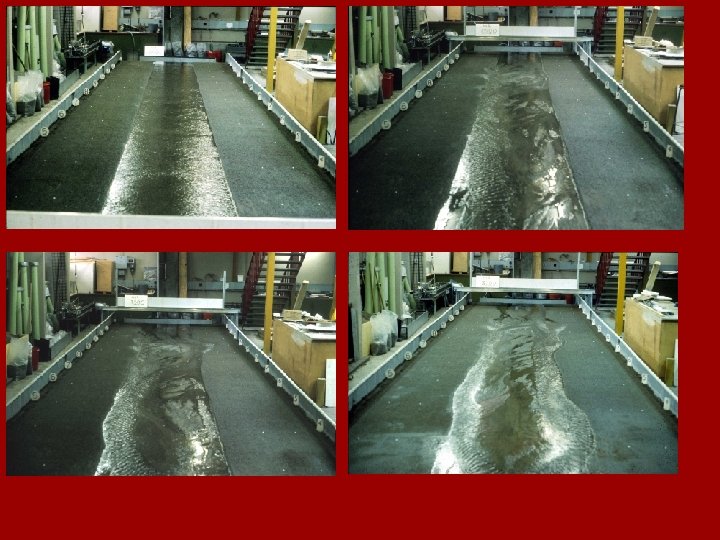
Limitations to traditional approach • different studies gave quantitatively different results i. e. no general laws for the variables used • relative importance of hydraulic and sedimentary factors unclear • Why thresholds? What is their physical basis? • definition of braiding (alternative with total sinuosity) • other, non quantified, variables often suggested (eg sediment supply, and discharge variability) • analysis often based on lab. experiments
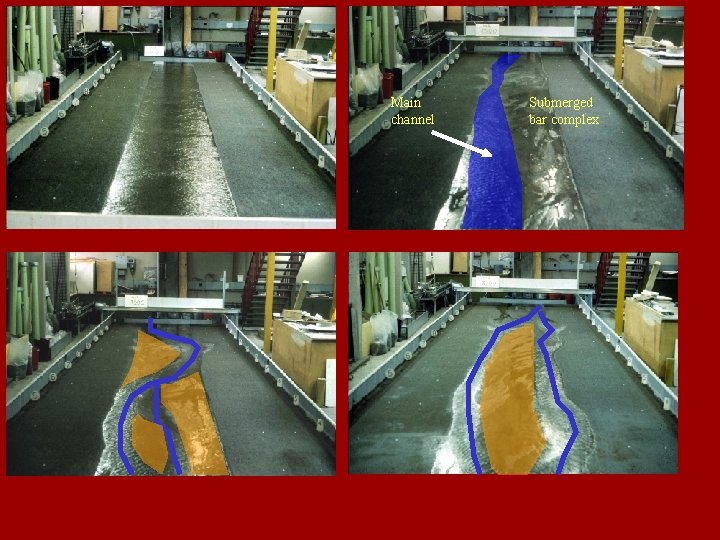
Main channel Submerged bar complex
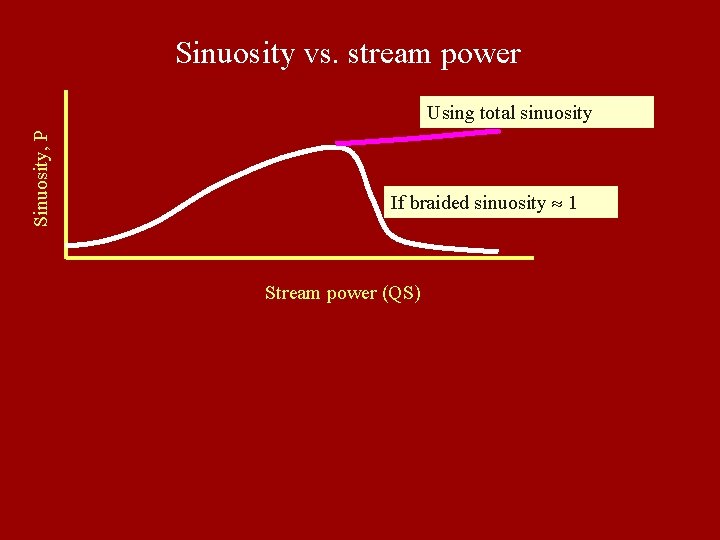
Sinuosity vs. stream power Sinuosity, P Using total sinuosity If braided sinuosity 1 Stream power (QS)
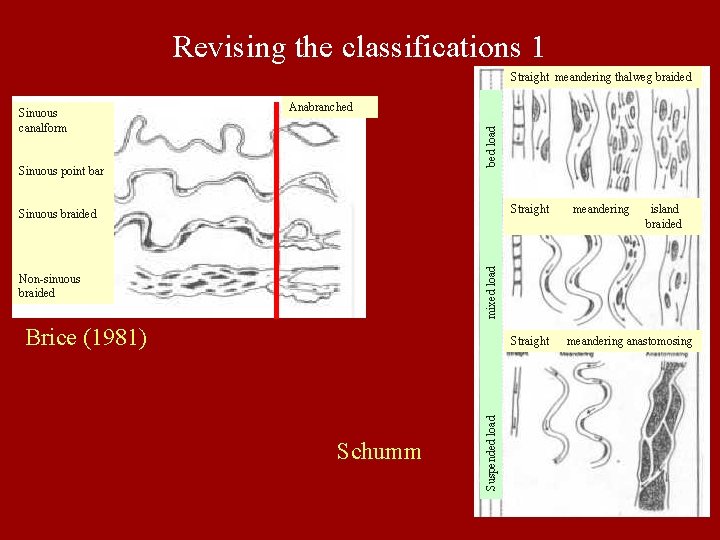
Revising the classifications 1 Straight meandering thalweg braided Anabranched Sinuous point bar Sinuous braided Non-sinuous braided Brice (1981) Schumm Suspended load mixed load bed load Sinuous canalform Straight meandering island braided Straight meandering anastomosing
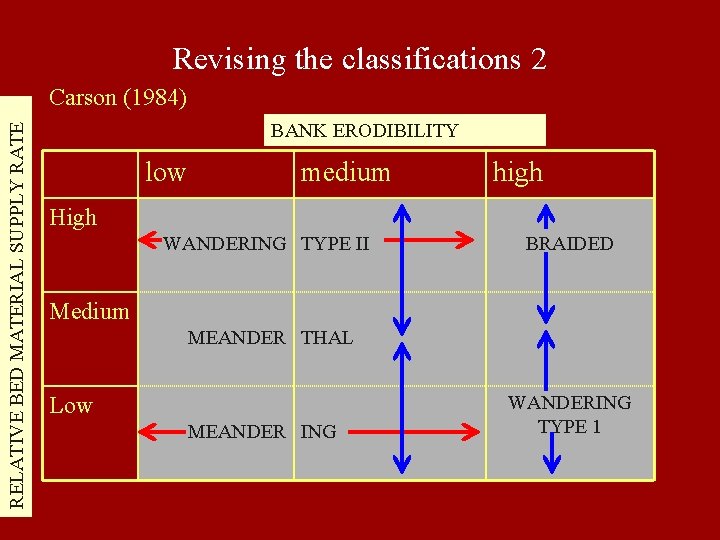
Revising the classifications 2 RELATIVE BED MATERIAL SUPPLY RATE Carson (1984) BANK ERODIBILITY low medium high High WANDERING TYPE II BRAIDED Medium MEANDER THAL Low MEANDER ING WANDERING TYPE 1
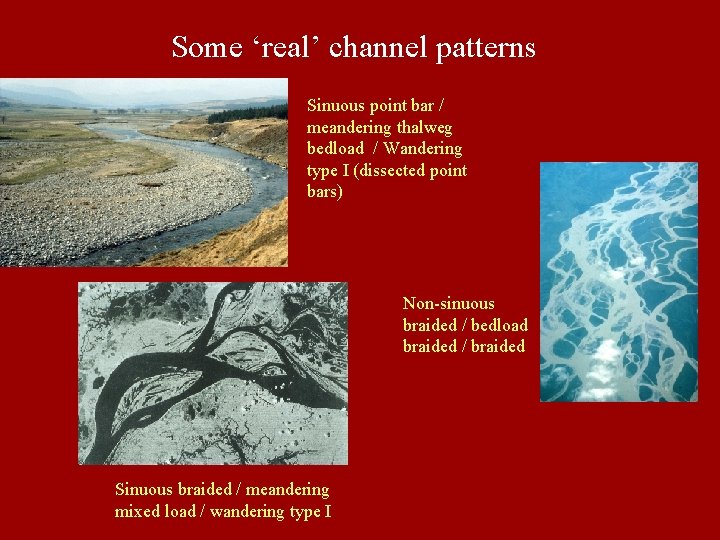
Some ‘real’ channel patterns Sinuous point bar / meandering thalweg bedload / Wandering type I (dissected point bars) Non-sinuous braided / bedload braided / braided Sinuous braided / meandering mixed load / wandering type I
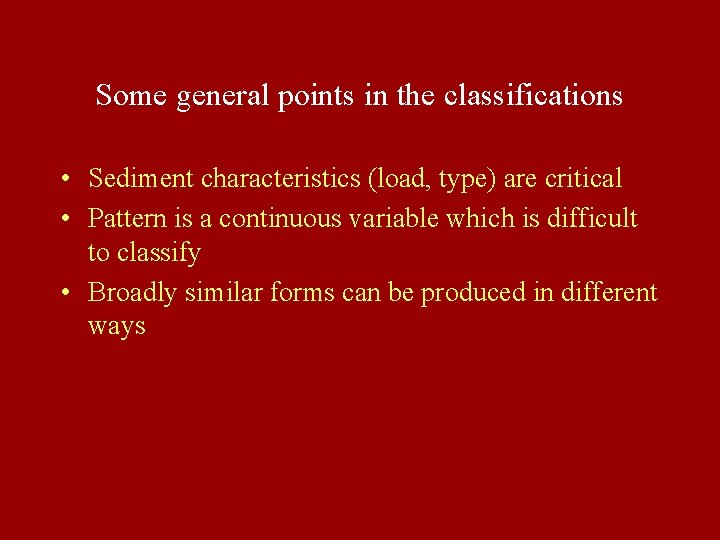
Some general points in the classifications • Sediment characteristics (load, type) are critical • Pattern is a continuous variable which is difficult to classify • Broadly similar forms can be produced in different ways
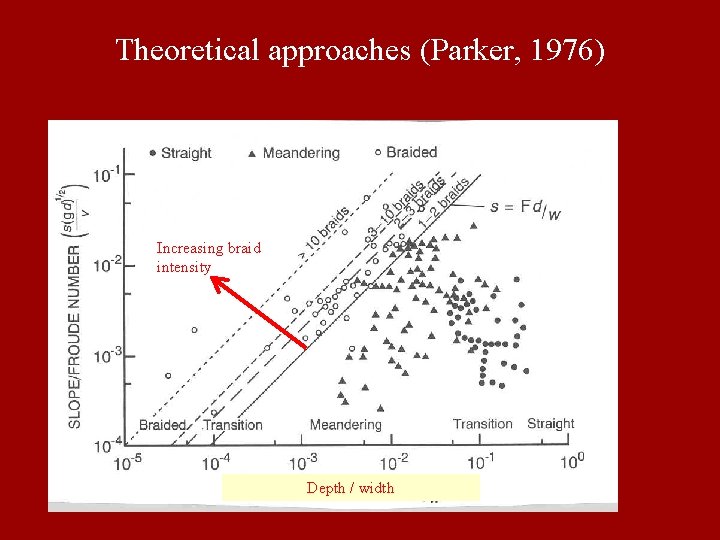
Theoretical approaches (Parker, 1976) Increasing braid intensity Depth / width
References Ashmore, PE, 1991, How do gravel-bed rivers braid? , Canadian Journal of Earth Science, 28, 326 -341 Brotherton, DI, 1979, On the origin and characteristics of river channel patterns, J. Hydrology, 44, 211 -230 Callander, RA, 1969, Instability and river channels, Journal of Fluid Mechanics, 36, 465 -480 Carson, MA, 1984, Observations on the meandering-braided river transition, the Canterbury Plains, New Zealand, New Zealand Geographer, 40, 12 -19, 89 -99 Carson, MA, 1984, The meandering-braided river threshold: a reappraisal, J. of Hydrology, 73, 315 -334 Church, M, Jones, D, 1982, Channel bars in gravel-bed rivers, In Hey, RD et al. (eds): Gravel Bed Rivers, 291 -324 Dade, WB, 2000 Grain size, sediment transport and alluvial channel pattern, Geomorphology 35, 119 -126 Ferguson, RI, 1987, Hydraulic and sedimentary controls of channel pattern, In Richards, KS (ed): River Channels: environment and process, IBG Special Publication 18, 129 -158 Ferguson, RI, 1993, Understanding braiding processes in gravel-bed rivers: progress and unsolved problems, In Best, JL; Bristow, CS (eds): Braided Rivers, Geol. Soc. Spec. Pub. , 75, 73 -87 Hong, L B, Davies, TRH, 1979, A study of stream braiding: summary, Geol. Soc. Am. Bull. , 90, 1094 -1095 Leopold, LB, Wolman, MG, 1957, River channel patterns: braided, meandering and straight, Professional Paper, United States Geological Survey, 282 B, 39 -85 Lewin J, Brewer, PA, 2001 Predicting channel patterns, Geomorphology 40, 329 -339. Osterkamp, WR, 1978, Gradient, discharge, and particle-size relations of alluvial channels in Kansas, with observations on braiding, American Journal of Science, 278, 1253 -1268
- Slides: 16