
Fluorescence get beautiful pictures www invitrogen com Lab
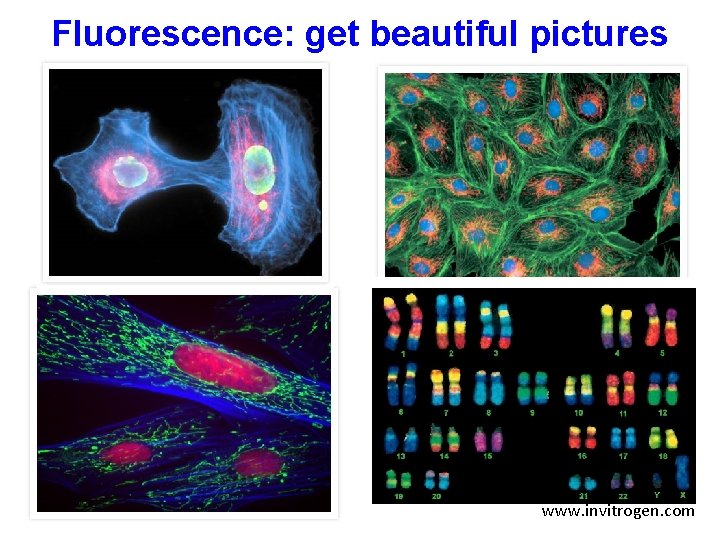
Fluorescence: get beautiful pictures www. invitrogen. com

Lab 1: Bright Field and Fluorescence Optical Microscopy and Sectioning Ensemble Fluorescence (Location - Loomis Selvin Lab; Instructor(s) Marco Tjioe and/or another Selvin student) Part 1: Dye absorption, emission, lifetime, anisotropy Part 2: Bulk FRET, donor-acceptance donor Bright Field & Fluorescence Microscopy (Location – IGB; Instructor Jaya Yodh) Part 1: Brightfield, Kohler illumination DIC, Phase Contrast, Color, ✔ Fluorescence Microscopy Part 2: Widefield fluorescence 3 D stack and deconvolution
Physics 598 BP Today: Fluorescence What is it? Why is it good? Basic Set-up, Anisotropy (Polarization), FRET We spent about an hour on signal-to-noise in a dark-field experiment (for example, fluorescence), vs. a light field experiment. The bottom line is when you have a large background, you can. NOT simply subtract it off to see a small signal. Just like you cannot see the stars during the day (where there is a lot of sunlight). That is because, with photons (and many other source), the noise of the background is proportional to the square root of the brightness. So, if you have N bg photons of background, you will have Nbg 1/2 of noise. As long as this is greater than Nsignal you can’t see the signal. Hence, with the stars, the amount of noise in the background is very large because sun is shining during the day, but is absent from the night. This becomes very clear with fluorescence. Fluorescenceis a dark field experiment, so with background so low, you can see very little signal, which means very low fluorescence. With a high numerical aperture objective (so you can collect all the light), you can even see single molecules! By absorption, which is a light-background experiment (i. e. with no sample you have a bright light, and then you are trying to measure the particles because they cause a decrease in the signal), it is very difficult to see a little amount. So we saw that by diluting a concentrated solution, 10, 000 fold, we could still see it by fluorescence although the absorption was so small that we couldn’t see it by absorption.
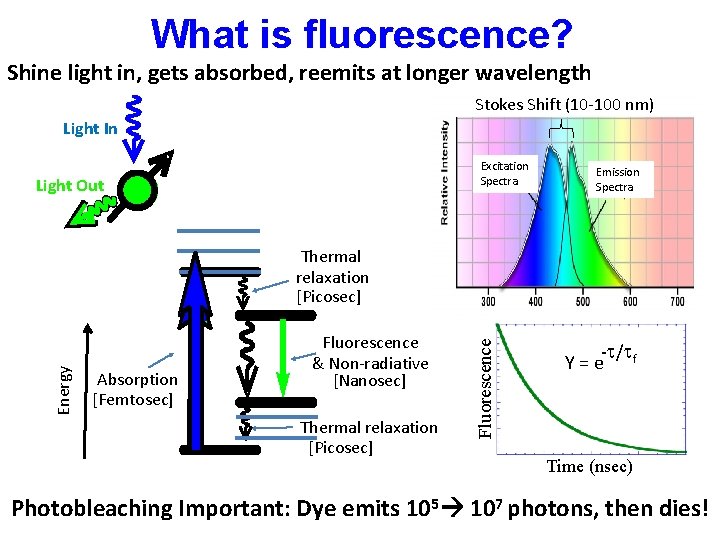
What is fluorescence? Shine light in, gets absorbed, reemits at longer wavelength Stokes Shift (10 -100 nm) Light In Excitation Spectra Light Out Emission Spectra Absorption [Femtosec] Fluorescence & Non-radiative [Nanosec] Thermal relaxation [Picosec] Fluorescence Energy Thermal relaxation [Picosec] -t/t Y=e f Time (nsec) Photobleaching Important: Dye emits 105 107 photons, then dies!
Why fluorescence? Why so good? 1. Super-sensitive: see single fluorescent dye! Why? Answer: It’s a dark-field technique– shine light and w/o fluorophore being there, (ideally) see nothing. [Recall, that the noise associate with taking a measurement is proportional to how much there is: want to weigh something—it’s hard to do really precisely if object weighs a lot; easier to do if you’re weighing a light object. A bright-field technique has a lot of noise. 2. Lots of different labels for different objects. Get specificity and see many different objects on same sample. 3. Problem w fluorescence: must label with a fluorophore – sometimes, this is difficult/impossible.

Fluorescence Microscopy What is it? How does it compare in sensitivity to brightfield? Stokes Shift (10 -100 nm) Excitation Spectra Emission Spectra Use dyes which absorb at one wavelength and emit at their own wavelength. It’s MUCH more sensitive --in fact, can see down to a single molecule! Background is potentially ZERO! (It’s a dark-field technique) But signal is reasonably strong (ideally, get out one photon for every photon that you put in) With little background, can see very little, i. e. tremendously sensitive
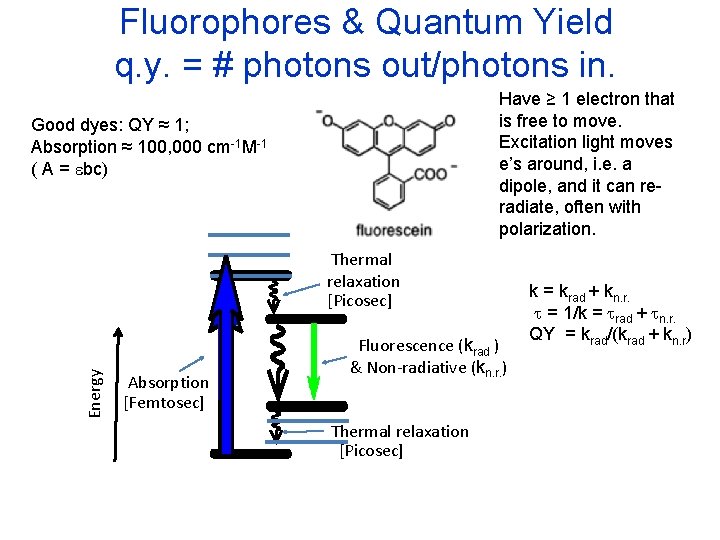
Fluorophores & Quantum Yield q. y. = # photons out/photons in. Have ≥ 1 electron that is free to move. Excitation light moves e’s around, i. e. a dipole, and it can reradiate, often with polarization. Good dyes: QY ≈ 1; Absorption ≈ 100, 000 cm-1 M-1 ( A = ebc) Energy Thermal relaxation [Picosec] Absorption [Femtosec] Fluorescence (krad ) & Non-radiative (kn. r. ) Thermal relaxation [Picosec] k = krad + kn. r. t = 1/k = trad + tn. r. QY = krad/(krad + kn. r)
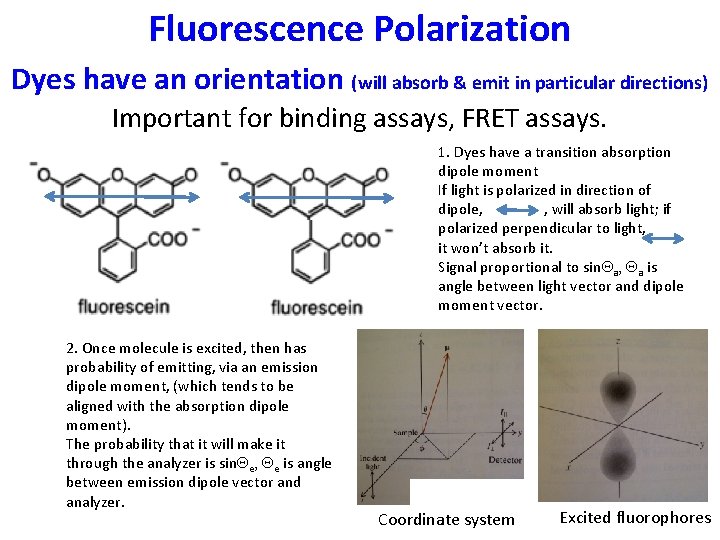
Fluorescence Polarization Dyes have an orientation (will absorb & emit in particular directions) Important for binding assays, FRET assays. 1. Dyes have a transition absorption dipole moment If light is polarized in direction of dipole, , will absorb light; if polarized perpendicular to light, it won’t absorb it. Signal proportional to sin. Qa, Qa is angle between light vector and dipole moment vector. 2. Once molecule is excited, then has probability of emitting, via an emission dipole moment, (which tends to be aligned with the absorption dipole moment). The probability that it will make it through the analyzer is sin. Qe, Qe is angle between emission dipole vector and analyzer. Coordinate system Excited fluorophores
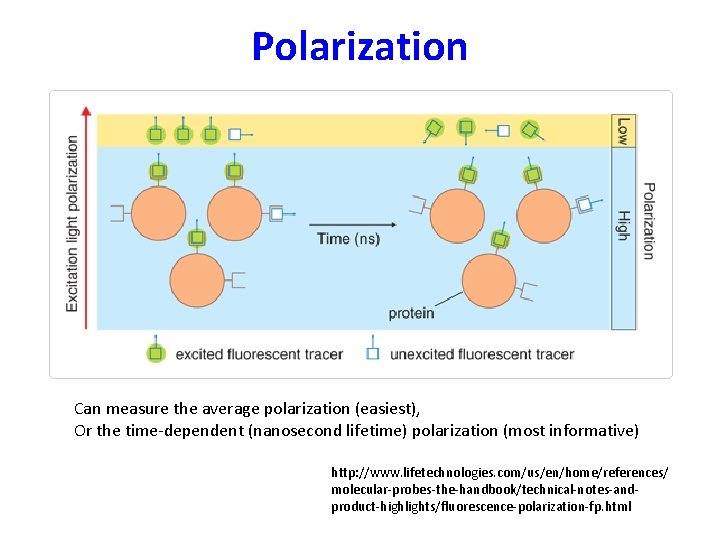
Polarization Can measure the average polarization (easiest), Or the time-dependent (nanosecond lifetime) polarization (most informative) http: //www. lifetechnologies. com/us/en/home/references/ molecular-probes-the-handbook/technical-notes-andproduct-highlights/fluorescence-polarization-fp. html
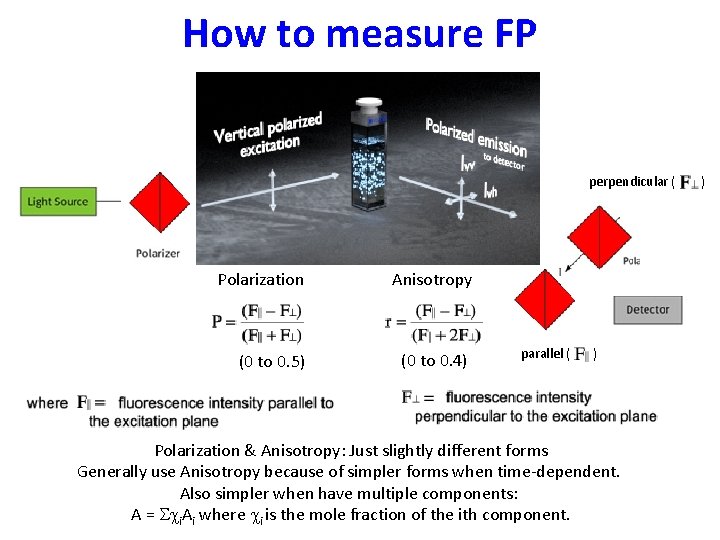
How to measure FP perpendicular ( Polarization Anisotropy (0 to 0. 5) (0 to 0. 4) parallel ( ) Polarization & Anisotropy: Just slightly different forms Generally use Anisotropy because of simpler forms when time-dependent. Also simpler when have multiple components: A = Sci. Ai where ci is the mole fraction of the ith component. )
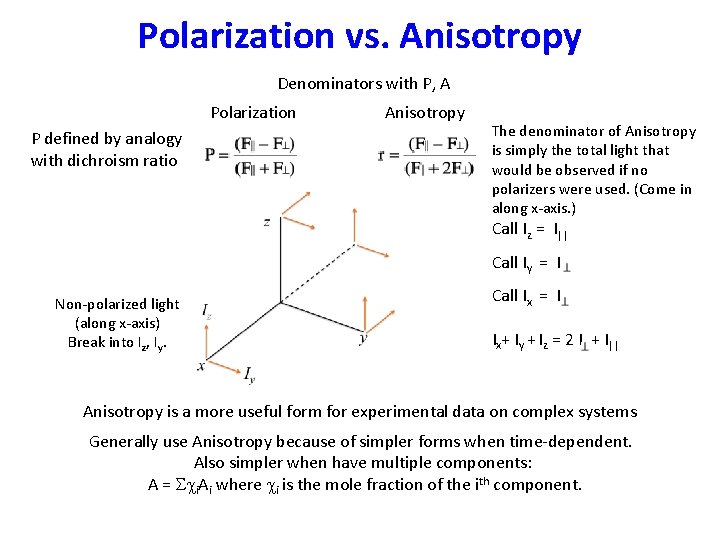
Polarization vs. Anisotropy Denominators with P, A Polarization P defined by analogy with dichroism ratio Anisotropy The denominator of Anisotropy is simply the total light that would be observed if no polarizers were used. (Come in along x-axis. ) Call Iz = I|| Call Iy = I Non-polarized light (along x-axis) Break into Iz, Iy. Call Ix = I Ix+ Iy + Iz = 2 I + I|| Anisotropy is a more useful form for experimental data on complex systems Generally use Anisotropy because of simpler forms when time-dependent. Also simpler when have multiple components: A = Sci. Ai where ci is the mole fraction of the ith component.
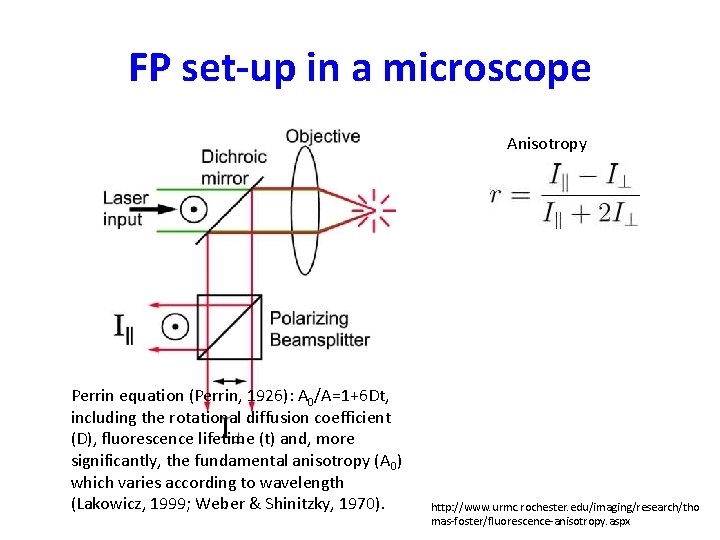
FP set-up in a microscope Anisotropy Perrin equation (Perrin, 1926): A 0/A=1+6 Dt, including the rotational diffusion coefficient (D), fluorescence lifetime (t) and, more significantly, the fundamental anisotropy (A 0) which varies according to wavelength (Lakowicz, 1999; Weber & Shinitzky, 1970). http: //www. urmc. rochester. edu/imaging/research/tho mas-foster/fluorescence-anisotropy. aspx
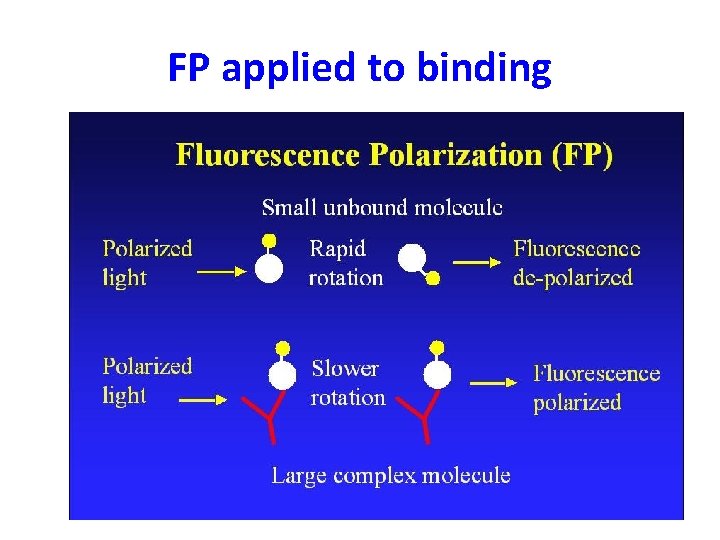
FP applied to binding
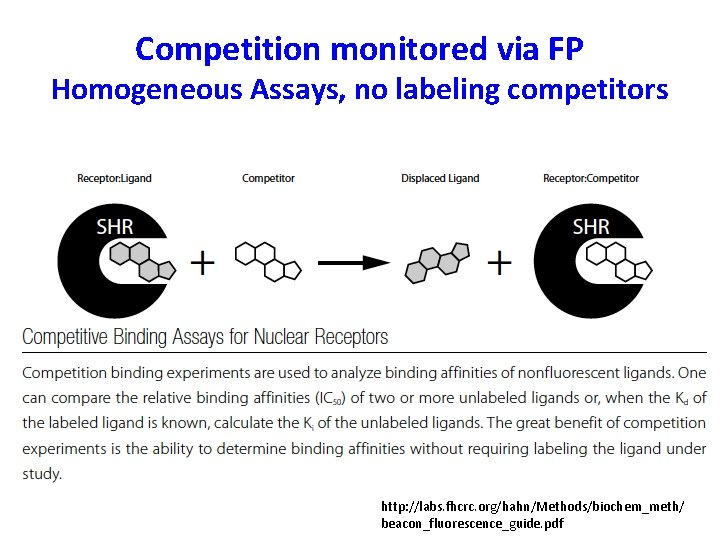
Competition monitored via FP Homogeneous Assays, no labeling competitors http: //labs. fhcrc. org/hahn/Methods/biochem_meth/ beacon_fluorescence_guide. pdf
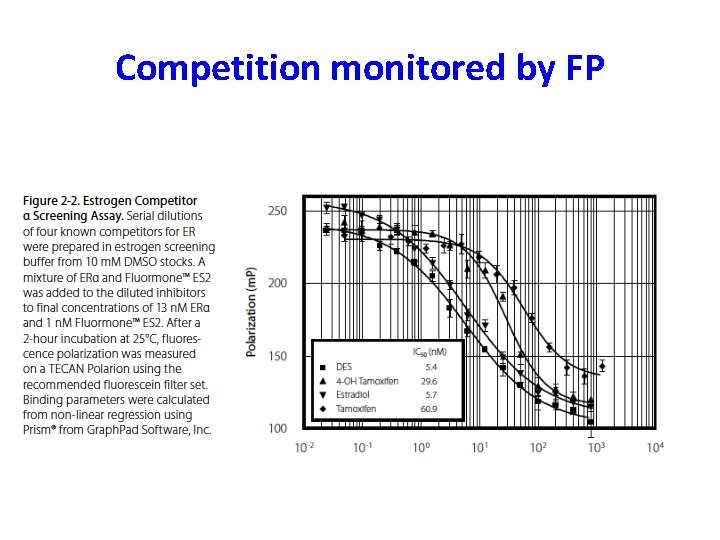
Competition monitored by FP
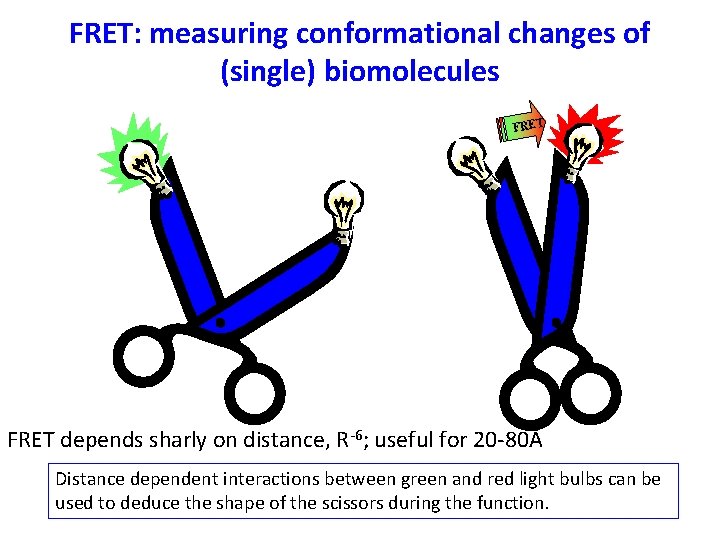
FRET: measuring conformational changes of (single) biomolecules FRET depends sharly on distance, R-6; useful for 20 -80Å Distance dependent interactions between green and red light bulbs can be used to deduce the shape of the scissors during the function.
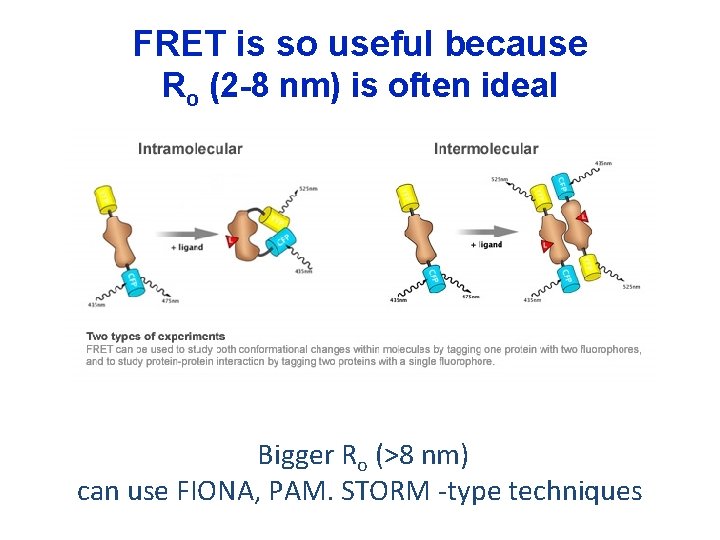
FRET is so useful because Ro (2 -8 nm) is often ideal Bigger Ro (>8 nm) can use FIONA, PAM. STORM -type techniques
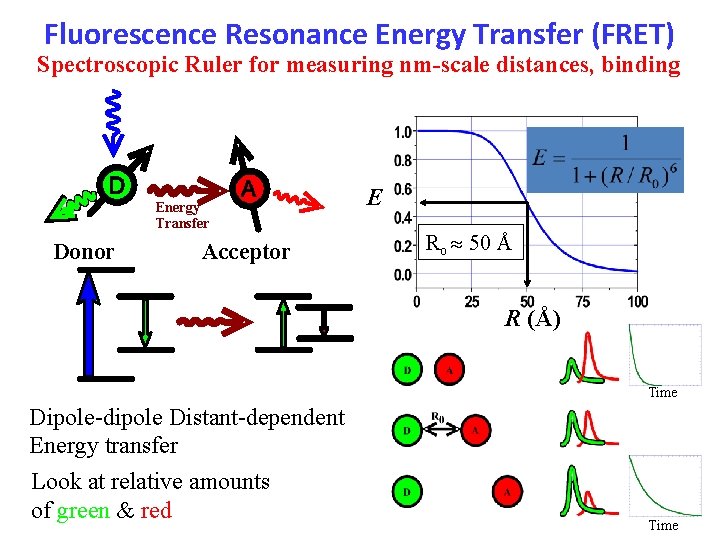
Fluorescence Resonance Energy Transfer (FRET) Spectroscopic Ruler for measuring nm-scale distances, binding Energy Transfer Donor Acceptor E Ro 50 Å R (Å) Time Dipole-dipole Distant-dependent Energy transfer Look at relative amounts of green & red Time
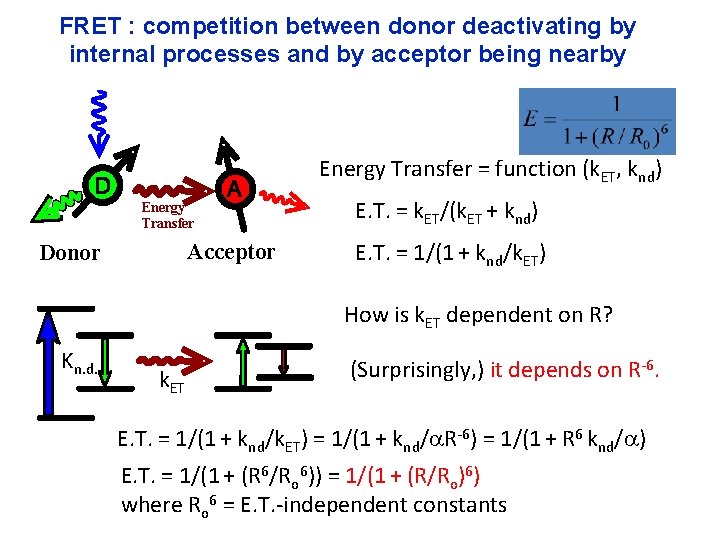
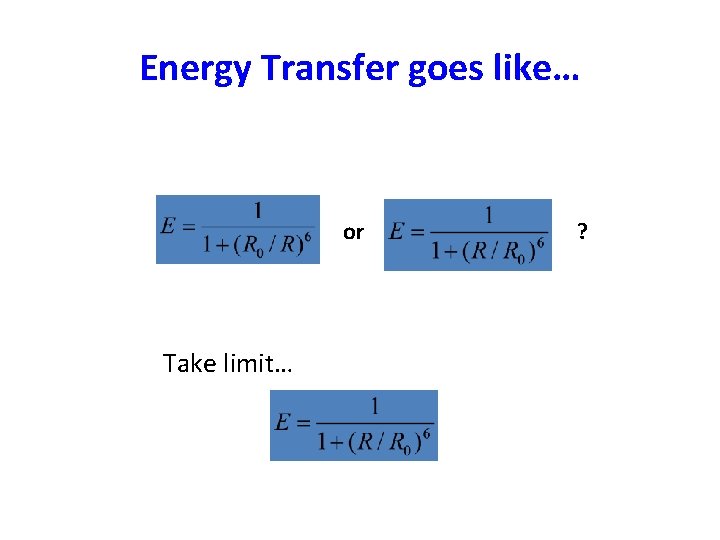
FRET : competition between donor deactivating by internal processes and by acceptor being nearby Energy Transfer = function (k. ET, knd) Energy Transfer Acceptor Donor E. T. = k. ET/(k. ET + knd) E. T. = 1/(1 + knd/k. ET) How is k. ET dependent on R? Kn. d. k. ET (Surprisingly, ) it depends on R-6. E. T. = 1/(1 + knd/k. ET) = 1/(1 + knd/a. R-6) = 1/(1 + R 6 knd/a) E. T. = 1/(1 + (R 6/Ro 6)) = 1/(1 + (R/Ro)6) where Ro 6 = E. T. -independent constants
Energy Transfer goes like… or Take limit… ?
The End
- Slides: 21