
Fluke 820 2 LED Stroboscope How to use
Fluke 820 -2 LED Stroboscope How to use a stroboscope to measure speed and make visual inspections of moving components
Agenda Fluke Family of Products • Multiple tools to cover complete drive train: Input Power to Output • Applications - Measuring machine speed Product Overview - technology • What is stroboscopic effect? What is a stroboscope? • Rotational speed / Operation Deflection Shape analysis • Inspections / Industries / Applications • LED light source / Phase shifting / Pulse Width (Duty Cycle) • How to use the strobe as a tachometer • Key Features & Benefits • Fluke 820 -2 Stroboscope – hardware / display 2
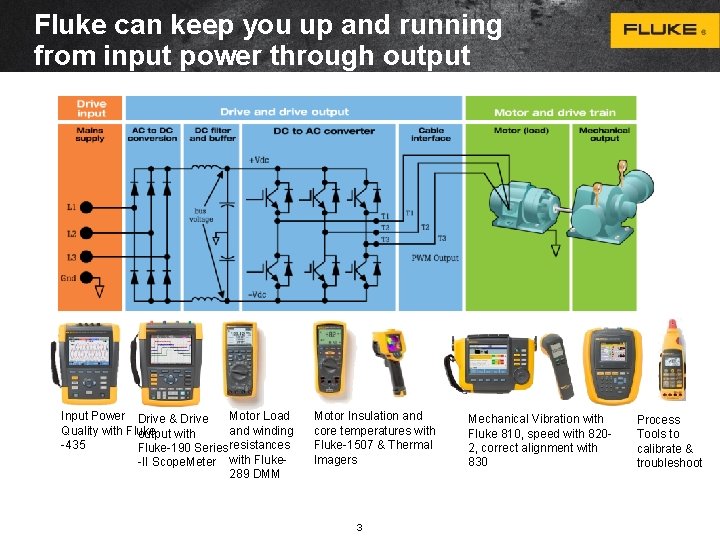
Fluke can keep you up and running from input power through output Input Power Drive & Drive Motor Load Quality with Fluke and winding output with -435 Fluke-190 Series resistances -II Scope. Meter with Fluke 289 DMM Motor Insulation and core temperatures with Fluke-1507 & Thermal Imagers 3 Mechanical Vibration with Fluke 810, speed with 8202, correct alignment with 830 Process Tools to calibrate & troubleshoot
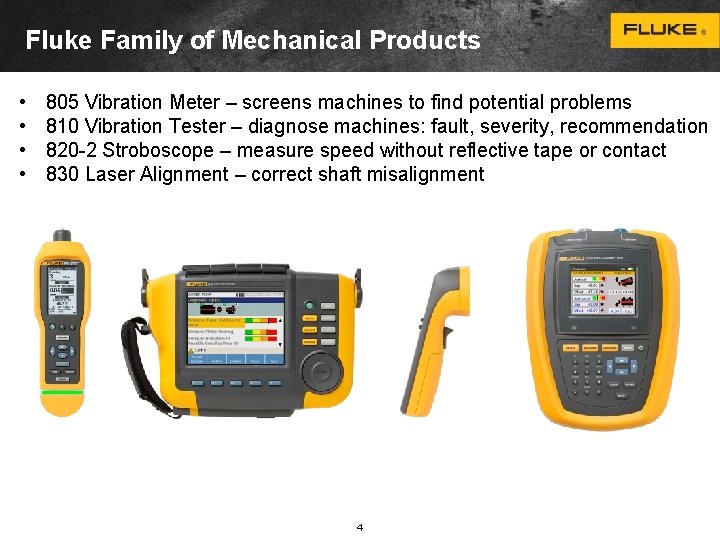
Fluke Family of Mechanical Products • • 805 Vibration Meter – screens machines to find potential problems 810 Vibration Tester – diagnose machines: fault, severity, recommendation 820 -2 Stroboscope – measure speed without reflective tape or contact 830 Laser Alignment – correct shaft misalignment 4

Fluke tools help keep your plant running 5
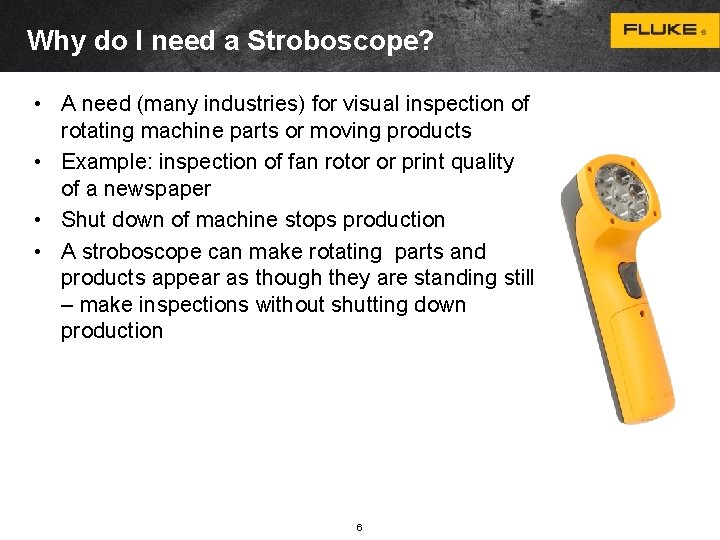
Why do I need a Stroboscope? • A need (many industries) for visual inspection of rotating machine parts or moving products • Example: inspection of fan rotor or print quality of a newspaper • Shut down of machine stops production • A stroboscope can make rotating parts and products appear as though they are standing still – make inspections without shutting down production 6
What is Stroboscopic effect? Stroboscopic effect: (Wikipedia) • A visual phenomenon caused by aliasing that occurs when continuous motion is represented by a series of short or instantaneous samples. • It occurs when the view of a moving object is represented by a series of short samples as distinct from a continuous view, and the moving object is in rotational or other cyclic motion at a rate close to the sampling rate. Example: a stream of water droplets falling at regular intervals Ø when viewed under normal light, this is a normal water fountain. Ø when viewed under a strobe light with its frequency tuned to the rate at which the droplets fall, the droplets appear to be suspended in midair. Ø Adjusting the strobe frequency can make the droplets seemingly move slowly up or down Content from this page copied from Wikipedia 7
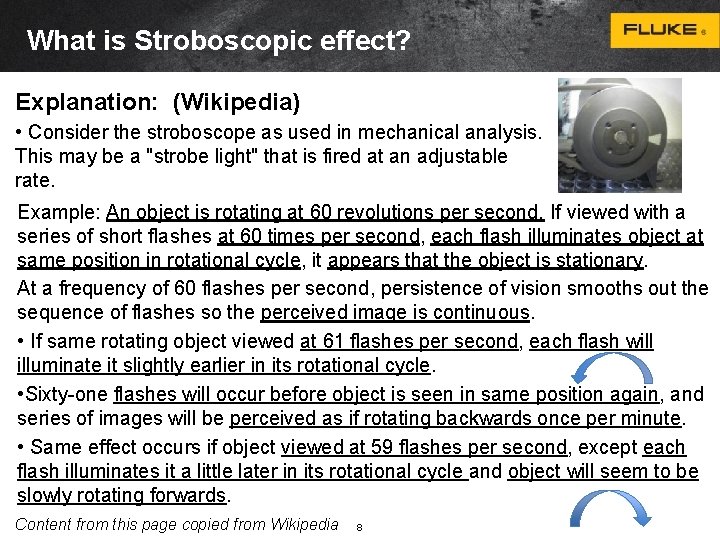
What is Stroboscopic effect? Explanation: (Wikipedia) • Consider the stroboscope as used in mechanical analysis. This may be a "strobe light" that is fired at an adjustable rate. Example: An object is rotating at 60 revolutions per second. If viewed with a series of short flashes at 60 times per second, each flash illuminates object at same position in rotational cycle, it appears that the object is stationary. At a frequency of 60 flashes per second, persistence of vision smooths out the sequence of flashes so the perceived image is continuous. • If same rotating object viewed at 61 flashes per second, each flash will illuminate it slightly earlier in its rotational cycle. • Sixty-one flashes will occur before object is seen in same position again, and series of images will be perceived as if rotating backwards once per minute. • Same effect occurs if object viewed at 59 flashes per second, except each flash illuminates it a little later in its rotational cycle and object will seem to be slowly rotating forwards. Content from this page copied from Wikipedia 8
What is a Stroboscope? • A stroboscope is a device consisting of a light source that can be switched on and/ off continuously by an electronic pulse train, that triggers the on/off switch. • The period of the pulses, and hence the flash frequency can be adjusted manually by the user. • The device has a display that shows the flash frequency expressed in Flashes per minute (FPM) or Rotations per second (Hz). Rotational speed • Most common application to determine rotational speed of a machine • Flash frequency adjusted until looks like motion of rotating part stopped • Display gives flash frequency in Hz or in FPM (Flashes per Minute) • Parameter relates one to rotational speed of machine part • Determination of rotational speed at high degree of accuracy, without making contact with machine, is big advantage 9
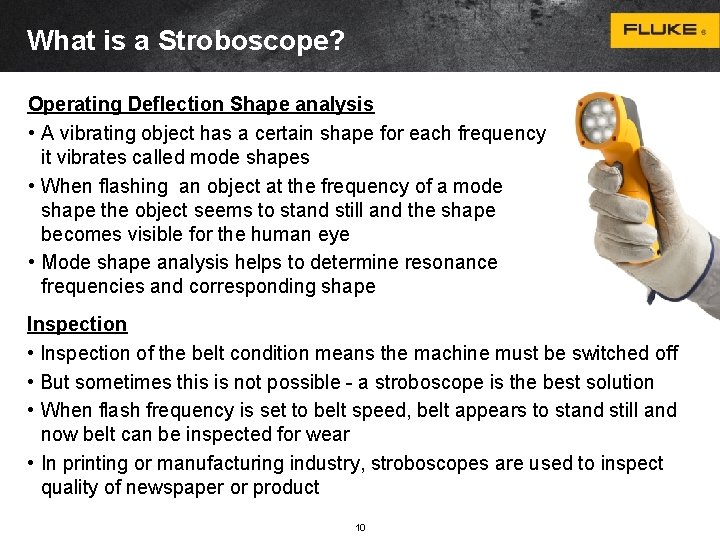
What is a Stroboscope? Operating Deflection Shape analysis • A vibrating object has a certain shape for each frequency it vibrates called mode shapes • When flashing an object at the frequency of a mode shape the object seems to stand still and the shape becomes visible for the human eye • Mode shape analysis helps to determine resonance frequencies and corresponding shape Inspection • Inspection of the belt condition means the machine must be switched off • But sometimes this is not possible - a stroboscope is the best solution • When flash frequency is set to belt speed, belt appears to stand still and now belt can be inspected for wear • In printing or manufacturing industry, stroboscopes are used to inspect quality of newspaper or product 10
When to use a Stroboscope? A stroboscope is used to stop motion for diagnostic purposes: • Parasitic oscillations, flaws, slippage or unwanted distortions • Measure speed of rotation or frequency of rotating shaft, speaker, or mechanical part • Identify part numbers or other markings without stopping machine Industries/Facilities – maintenance, production and quality control: • • • Repair facilities and maintenance departments Field work and test benches Laboratories, universities and pharmaceutical Textile, food and manufacturing Facilities, automotive, aerospace Mining, metals, petrochemical 11
When to use a Stroboscope? Applications: • Belt driven machines – HVAC fans, pumps • Roller bearings, shafts, gear teeth or other machine components • Clutches and cogwheels • Foundations – resonance vibrations • Cable or piping wear or damage • Mixing and dosage processes 12
Common uses for the Stroboscope • Use as a strobe tachometer to measure speed instead of a laser tachometer • Need access to visibly see object to measure and need some marking on object to use as a reference point. • No need to stick a piece of reflective tape like with a laser tachometer or make contact with a moving shaft like with a contact tachometer. • Use stroboscope to “freeze” a shaft, but only down to 300 RPM (FPM) • Read RPM on display and manually enter speed into 810 Vibration Tester Common uses for the stroboscope: • Turbines vary in speed and change speed frequently • Variable Frequency Drive motors vary in speed, but do not change frequently • Find belt rotation speed and look for belt slippage • Find machine element components – fan blades, pump vanes, compressor screws, gear teeth. 13
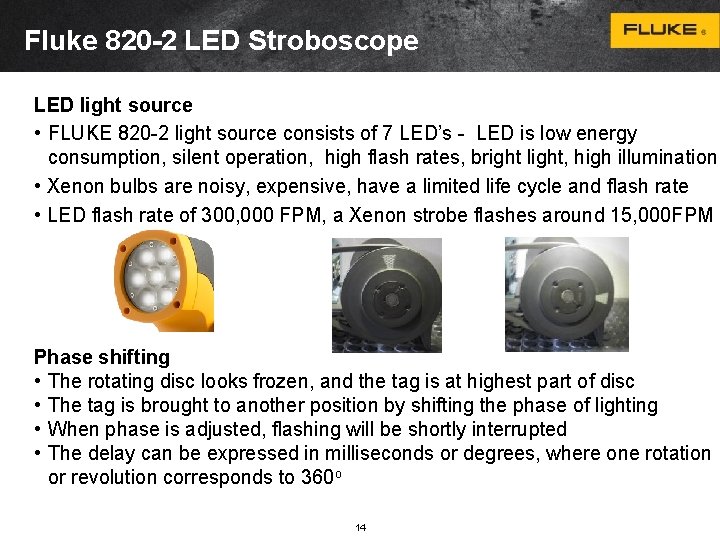
Fluke 820 -2 LED Stroboscope LED light source • FLUKE 820 -2 light source consists of 7 LED’s - LED is low energy consumption, silent operation, high flash rates, bright light, high illumination. • Xenon bulbs are noisy, expensive, have a limited life cycle and flash rate • LED flash rate of 300, 000 FPM, a Xenon strobe flashes around 15, 000 FPM Phase shifting • The rotating disc looks frozen, and the tag is at highest part of disc • The tag is brought to another position by shifting the phase of lighting • When phase is adjusted, flashing will be shortly interrupted • The delay can be expressed in milliseconds or degrees, where one rotation or revolution corresponds to 360 o 14
Fluke 820 -2 LED Stroboscope External Triggering • For inspection of rotating parts, or to detect belt slip, flash frequency is set to machine RPM • Most convenient way - trigger light source with tachometer signal from machine under test • Fluke 820 -2 comes with an external trigger input connector and a mini jack • Apply tachometer signal to stroboscope and get correct flash frequency in a split second! • Sometimes given tachometer signal is not the same as rotational speed of machine, but is multiplied. • The signal can be divided by the stroboscope - flash frequency is the same as rotational speed. • Strobe can also trigger on the negative edge of the external trigger 15
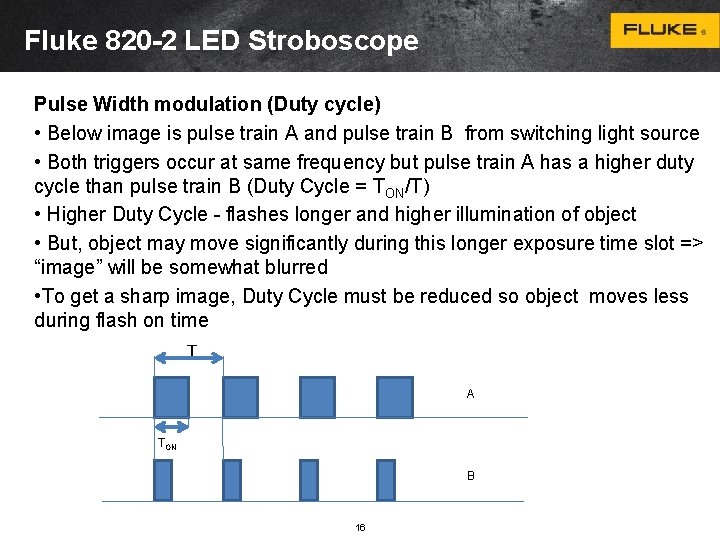
Fluke 820 -2 LED Stroboscope Pulse Width modulation (Duty cycle) • Below image is pulse train A and pulse train B from switching light source • Both triggers occur at same frequency but pulse train A has a higher duty cycle than pulse train B (Duty Cycle = TON/T) • Higher Duty Cycle - flashes longer and higher illumination of object • But, object may move significantly during this longer exposure time slot => “image” will be somewhat blurred • To get a sharp image, Duty Cycle must be reduced so object moves less during flash on time T A B TON 16
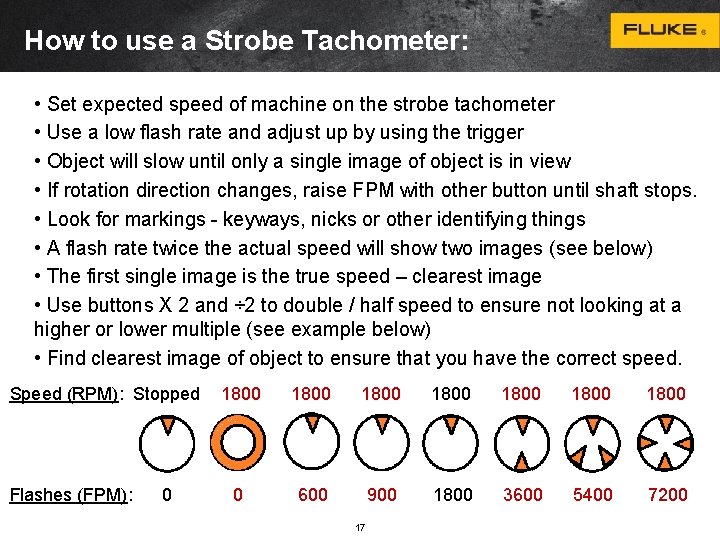
How to use a Strobe Tachometer: • Set expected speed of machine on the strobe tachometer • Use a low flash rate and adjust up by using the trigger • Object will slow until only a single image of object is in view • If rotation direction changes, raise FPM with other button until shaft stops. • Look for markings - keyways, nicks or other identifying things • A flash rate twice the actual speed will show two images (see below) • The first single image is the true speed – clearest image • Use buttons X 2 and ÷ 2 to double / half speed to ensure not looking at a higher or lower multiple (see example below) • Find clearest image of object to ensure that you have the correct speed. Speed (RPM): Stopped 1800 1800 Flashes (FPM): 0 0 600 900 1800 3600 5400 7200 17
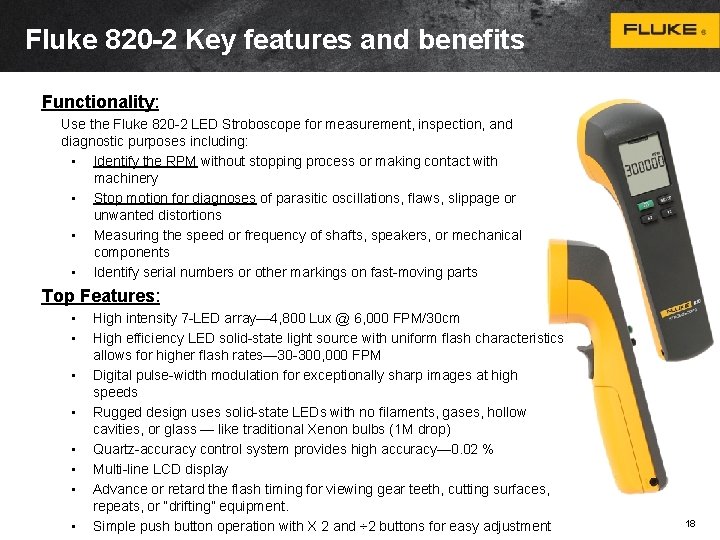
Fluke 820 -2 Key features and benefits Functionality: Use the Fluke 820 -2 LED Stroboscope for measurement, inspection, and diagnostic purposes including: • Identify the RPM without stopping process or making contact with machinery • Stop motion for diagnoses of parasitic oscillations, flaws, slippage or unwanted distortions • Measuring the speed or frequency of shafts, speakers, or mechanical components • Identify serial numbers or other markings on fast-moving parts Top Features: • • High intensity 7 -LED array— 4, 800 Lux @ 6, 000 FPM/30 cm High efficiency LED solid-state light source with uniform flash characteristics allows for higher flash rates— 30 -300, 000 FPM Digital pulse-width modulation for exceptionally sharp images at high speeds Rugged design uses solid-state LEDs with no filaments, gases, hollow cavities, or glass — like traditional Xenon bulbs (1 M drop) Quartz-accuracy control system provides high accuracy— 0. 02 % Multi-line LCD display Advance or retard the flash timing for viewing gear teeth, cutting surfaces, repeats, or “drifting” equipment. Simple push button operation with X 2 and ÷ 2 buttons for easy adjustment 18
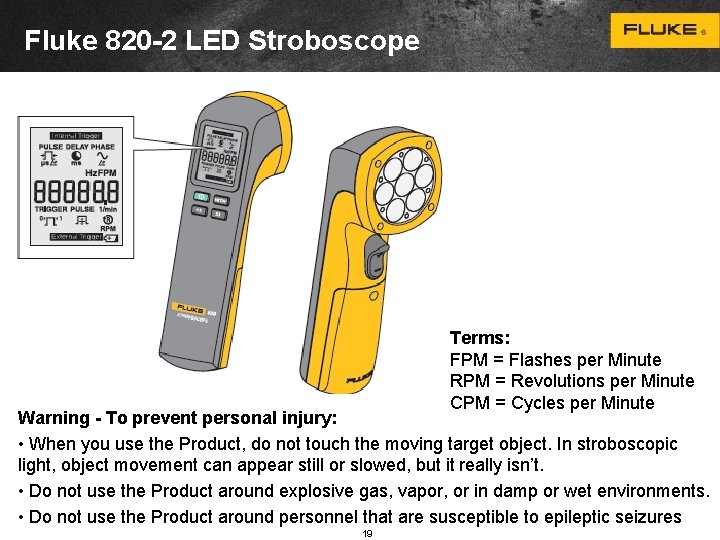
Fluke 820 -2 LED Stroboscope Terms: FPM = Flashes per Minute RPM = Revolutions per Minute CPM = Cycles per Minute Warning - To prevent personal injury: • When you use the Product, do not touch the moving target object. In stroboscopic light, object movement can appear still or slowed, but it really isn’t. • Do not use the Product around explosive gas, vapor, or in damp or wet environments. • Do not use the Product around personnel that are susceptible to epileptic seizures 19
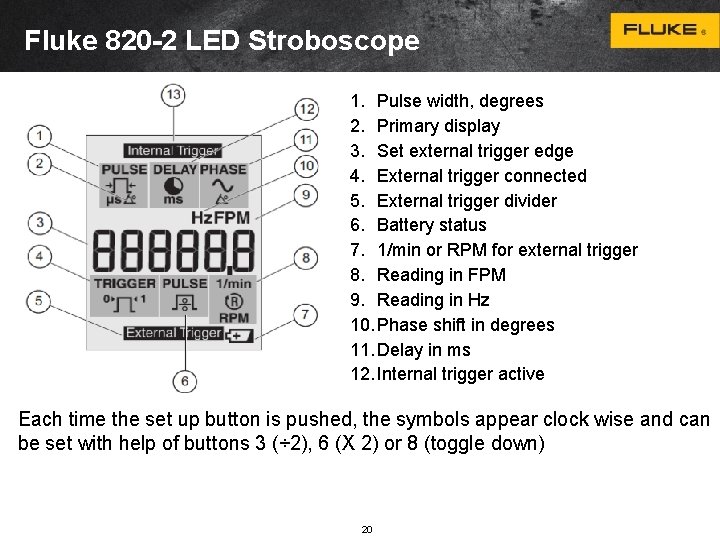
Fluke 820 -2 LED Stroboscope 1. Pulse width, degrees 2. Primary display 3. Set external trigger edge 4. External trigger connected 5. External trigger divider 6. Battery status 7. 1/min or RPM for external trigger 8. Reading in FPM 9. Reading in Hz 10. Phase shift in degrees 11. Delay in ms 12. Internal trigger active Each time the set up button is pushed, the symbols appear clock wise and can be set with help of buttons 3 (÷ 2), 6 (X 2) or 8 (toggle down) 20

Fluke 820 -2 LED Stroboscope 21
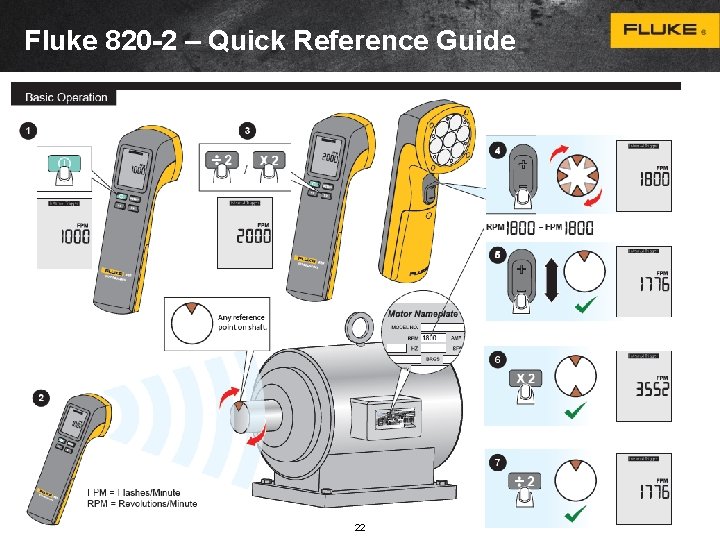
Fluke 820 -2 – Quick Reference Guide 2222
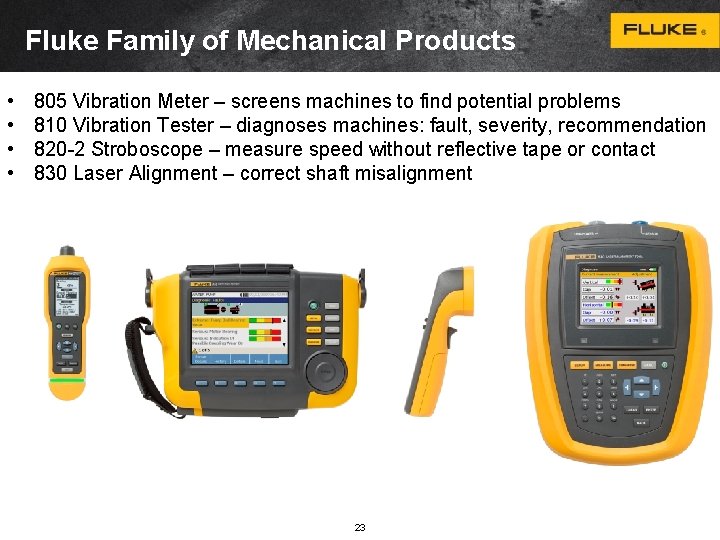
Fluke Family of Mechanical Products • • 805 Vibration Meter – screens machines to find potential problems 810 Vibration Tester – diagnoses machines: fault, severity, recommendation 820 -2 Stroboscope – measure speed without reflective tape or contact 830 Laser Alignment – correct shaft misalignment 23
- Slides: 23