
Fluke 438 II Motor Analyzer Technical Training June




- Slides: 21
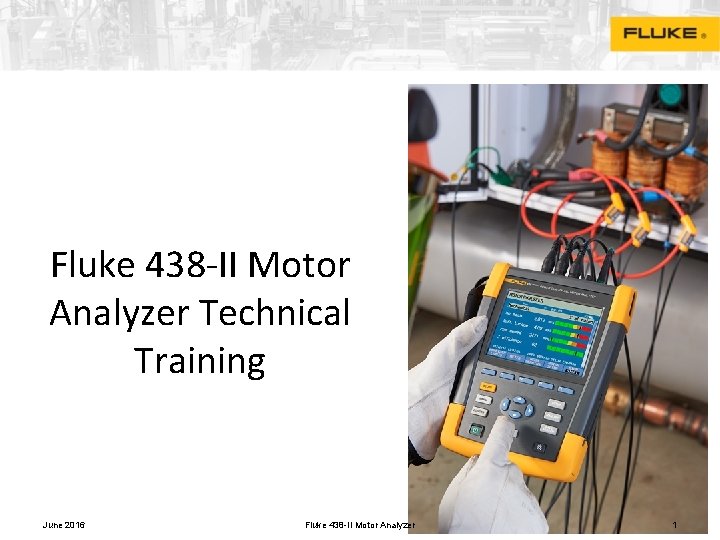
Fluke 438 -II Motor Analyzer Technical Training June 2016 Fluke 438 -II Motor Analyzer 1
Objectives • The primary objective of this training presentation is to provide the background information regarding the measurement capability of the Fluke 438 Motor Analyzer. • The presentation explains how the Fluke 438 -II measures a motor’s electrical parameters and derives values that are normally only to be available by making mechanical measurements. • This conversion from electrical parameters to mechanical data is made possible by the physics of the motor operation and uses proprietary algorithms which have been developed over a number years by a specialist company who have partnered Fluke in this development. The algorithms combine a mixture of physics-based and data-driven models of an induction motor. • The subjects covered relate only to the motor analysis, for a full presentation of the capabilities of the power quality and energy of the Fluke 430 -II refer to those presentations. June 2016 Fluke 438 -II Motor Analyzer 2
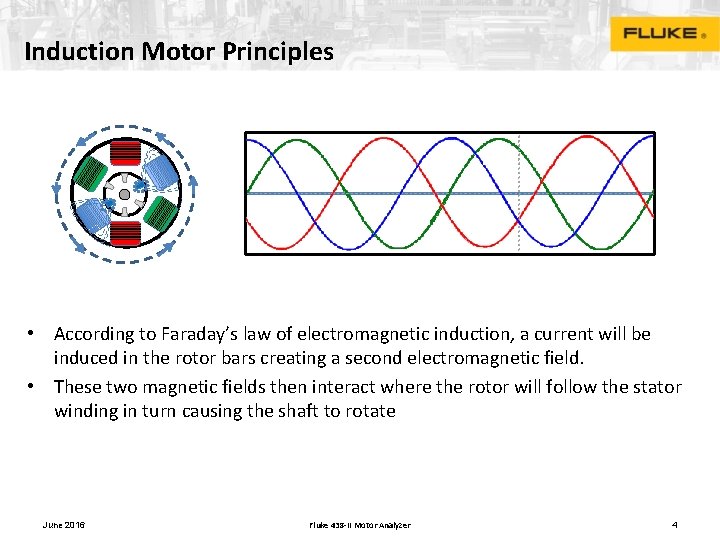
Induction Motor Principles • An alternating current produces a magnetic field in the stator winding • Each phase creates a rotating magnetic field June 2016 Fluke 438 -II Motor Analyzer 3
Induction Motor Principles • According to Faraday’s law of electromagnetic induction, a current will be induced in the rotor bars creating a second electromagnetic field. • These two magnetic fields then interact where the rotor will follow the stator winding in turn causing the shaft to rotate June 2016 Fluke 438 -II Motor Analyzer 4
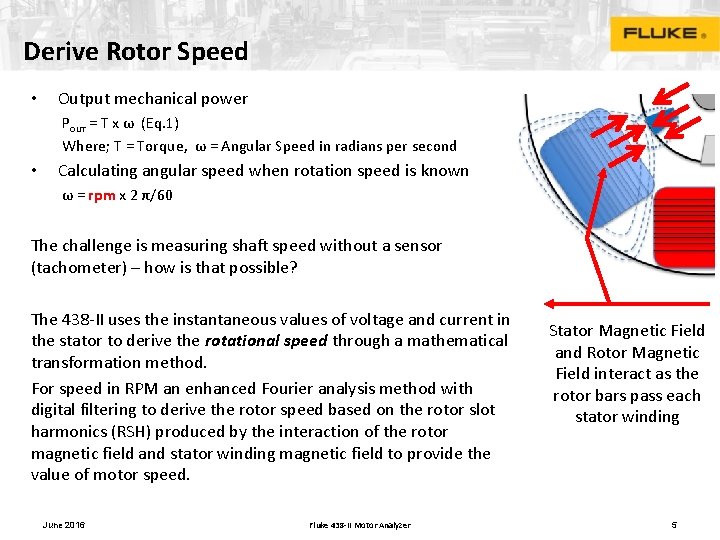
Derive Rotor Speed • Output mechanical power POUT = T x ω (Eq. 1) Where; T = Torque, ω = Angular Speed in radians per second • Calculating angular speed when rotation speed is known ω = rpm x 2 π/60 The challenge is measuring shaft speed without a sensor (tachometer) – how is that possible? The 438 -II uses the instantaneous values of voltage and current in the stator to derive the rotational speed through a mathematical transformation method. For speed in RPM an enhanced Fourier analysis method with digital filtering to derive the rotor speed based on the rotor slot harmonics (RSH) produced by the interaction of the rotor magnetic field and stator winding magnetic field to provide the value of motor speed. June 2016 Fluke 438 -II Motor Analyzer Stator Magnetic Field and Rotor Magnetic Field interact as the rotor bars pass each stator winding 5
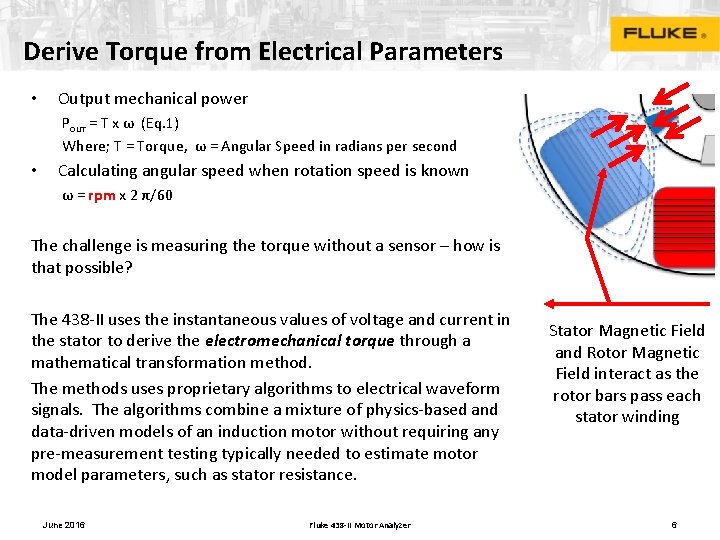
Derive Torque from Electrical Parameters • Output mechanical power POUT = T x ω (Eq. 1) Where; T = Torque, ω = Angular Speed in radians per second • Calculating angular speed when rotation speed is known ω = rpm x 2 π/60 The challenge is measuring the torque without a sensor – how is that possible? The 438 -II uses the instantaneous values of voltage and current in the stator to derive the electromechanical torque through a mathematical transformation method. The methods uses proprietary algorithms to electrical waveform signals. The algorithms combine a mixture of physics-based and data-driven models of an induction motor without requiring any pre-measurement testing typically needed to estimate motor model parameters, such as stator resistance. June 2016 Fluke 438 -II Motor Analyzer Stator Magnetic Field and Rotor Magnetic Field interact as the rotor bars pass each stator winding 6
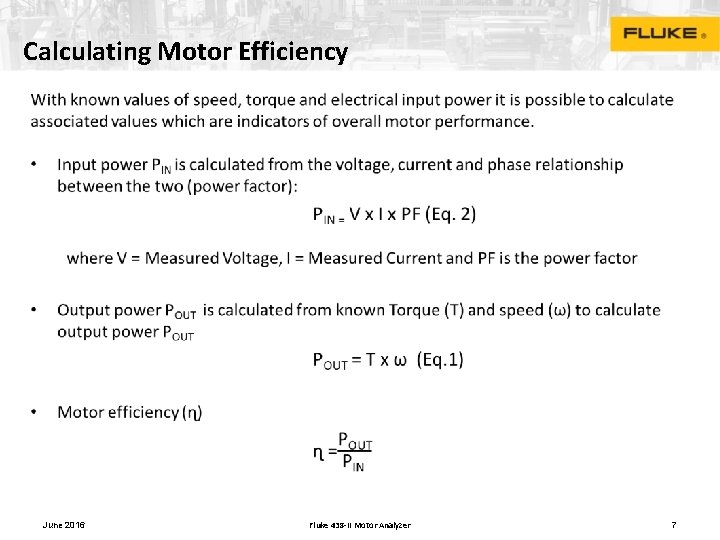
Calculating Motor Efficiency • June 2016 Fluke 438 -II Motor Analyzer 7
Alternatives for measuring mechanical power • Measurement of mechanical power usually requires a torque sensing system which requires a sensor, conditioning electronics and acquisition hardware. • Installing the torque sensors in to existing motors is difficult and time consuming. • The complexity and cost of these systems is high. • Systems that also measure electrical power are even more complex. • Field testing systems are difficult to install, understand costly. The Fluke 438 -II provides a very affordable alternative delivering easy to understand measurement data on systems that are operating in their typical environment. June 2016 Fluke 438 -II Motor Analyzer 8
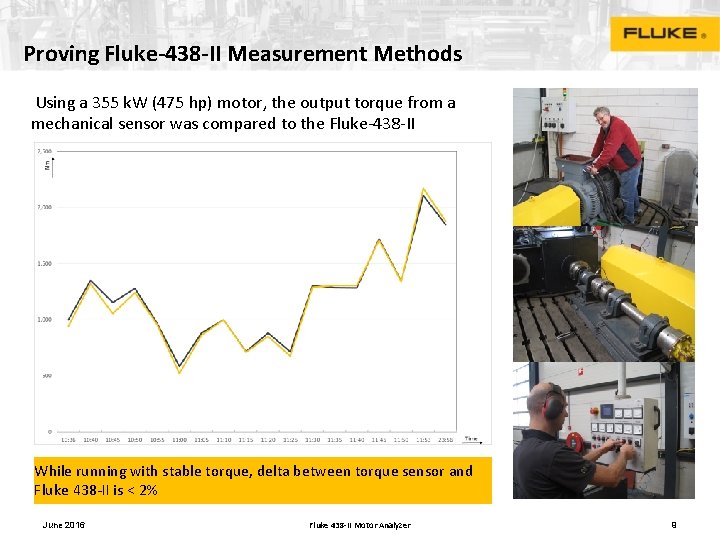
Proving Fluke-438 -II Measurement Methods Using a 355 k. W (475 hp) motor, the output torque from a mechanical sensor was compared to the Fluke-438 -II While running with stable torque, delta between torque sensor and Fluke 438 -II is < 2% June 2016 Fluke 438 -II Motor Analyzer 9
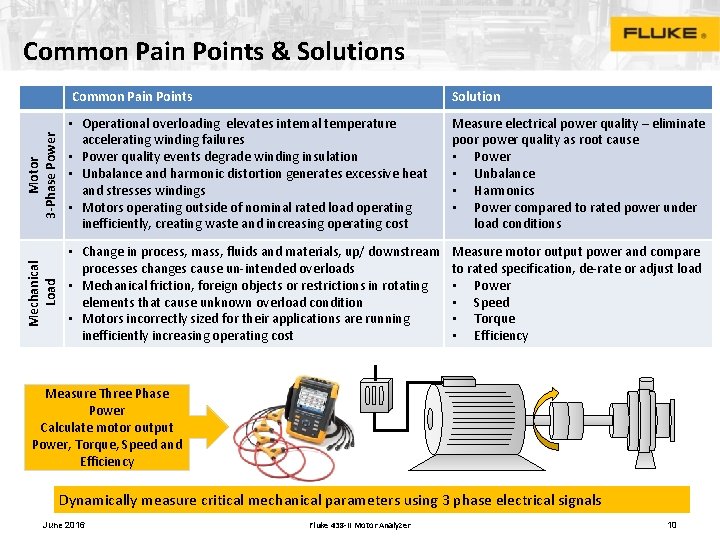
Common Pain Points Solution Motor 3 -Phase Power • Operational overloading elevates internal temperature accelerating winding failures • Power quality events degrade winding insulation • Unbalance and harmonic distortion generates excessive heat and stresses windings • Motors operating outside of nominal rated load operating inefficiently, creating waste and increasing operating cost Measure electrical power quality – eliminate poor power quality as root cause • Power • Unbalance • Harmonics • Power compared to rated power under load conditions Mechanical Load Common Pain Points & Solutions • Change in process, mass, fluids and materials, up/ downstream processes changes cause un-intended overloads • Mechanical friction, foreign objects or restrictions in rotating elements that cause unknown overload condition • Motors incorrectly sized for their applications are running inefficiently increasing operating cost Measure motor output power and compare to rated specification, de-rate or adjust load • Power • Speed • Torque • Efficiency Measure Three Phase Power Calculate motor output Power, Torque, Speed and Efficiency Dynamically measure critical mechanical parameters using 3 phase electrical signals June 2016 Fluke 438 -II Motor Analyzer 10
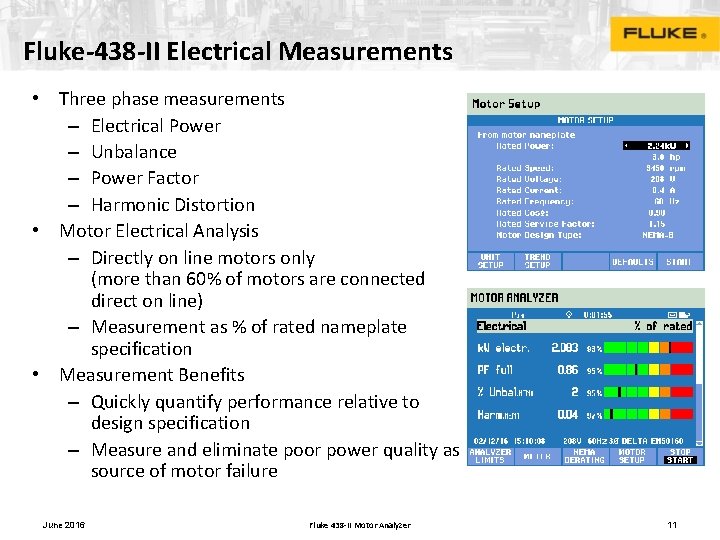
Fluke-438 -II Electrical Measurements • Three phase measurements – Electrical Power – Unbalance – Power Factor – Harmonic Distortion • Motor Electrical Analysis – Directly on line motors only (more than 60% of motors are connected direct on line) – Measurement as % of rated nameplate specification • Measurement Benefits – Quickly quantify performance relative to design specification – Measure and eliminate poor power quality as source of motor failure June 2016 Fluke 438 -II Motor Analyzer 11
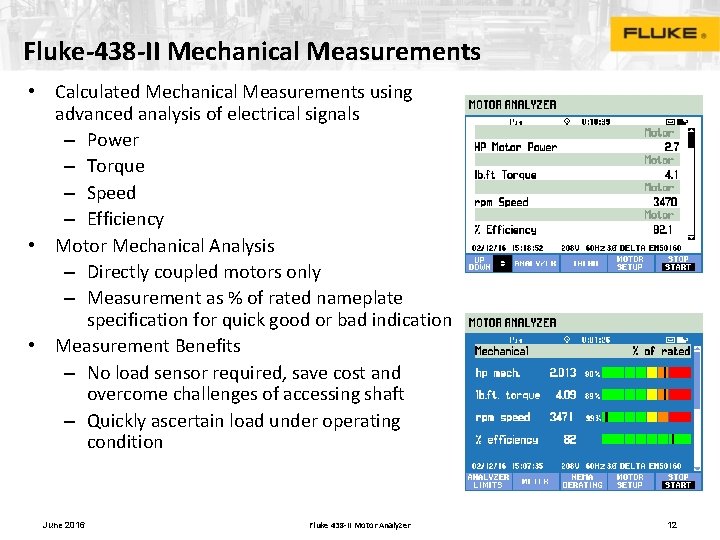
Fluke-438 -II Mechanical Measurements • Calculated Mechanical Measurements using advanced analysis of electrical signals – Power – Torque – Speed – Efficiency • Motor Mechanical Analysis – Directly coupled motors only – Measurement as % of rated nameplate specification for quick good or bad indication • Measurement Benefits – No load sensor required, save cost and overcome challenges of accessing shaft – Quickly ascertain load under operating condition June 2016 Fluke 438 -II Motor Analyzer 12
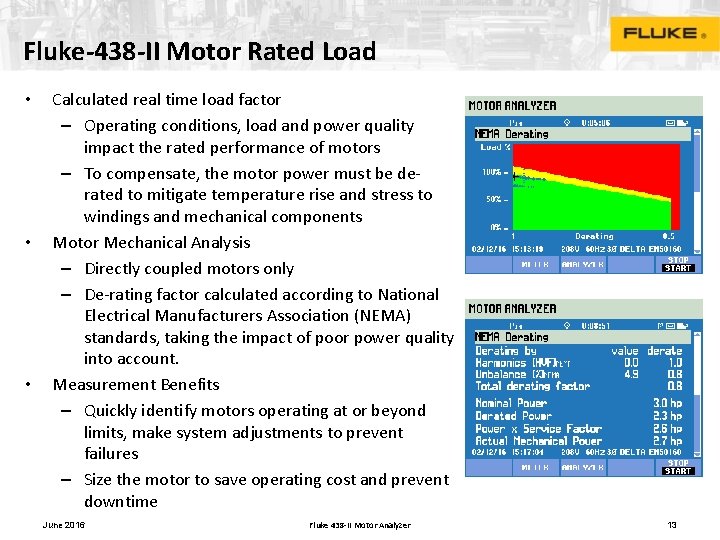
Fluke-438 -II Motor Rated Load • • • Calculated real time load factor – Operating conditions, load and power quality impact the rated performance of motors – To compensate, the motor power must be derated to mitigate temperature rise and stress to windings and mechanical components Motor Mechanical Analysis – Directly coupled motors only – De-rating factor calculated according to National Electrical Manufacturers Association (NEMA) standards, taking the impact of poor power quality into account. Measurement Benefits – Quickly identify motors operating at or beyond limits, make system adjustments to prevent failures – Size the motor to save operating cost and prevent downtime June 2016 Fluke 438 -II Motor Analyzer 13
Diagnostic benefits The difference between running a motor within the manufacturer’s specification or outside is significant. • Running motors in mechanically overloaded conditions places stress on all components including bearings, insulation, the shaft and more. • Running in this mode will shorten the motors life and lower reliability. • In addition to running according to the specification it’s equally important to consider the effects of poor power quality. June 2016 Fluke 438 -II Motor Analyzer 14
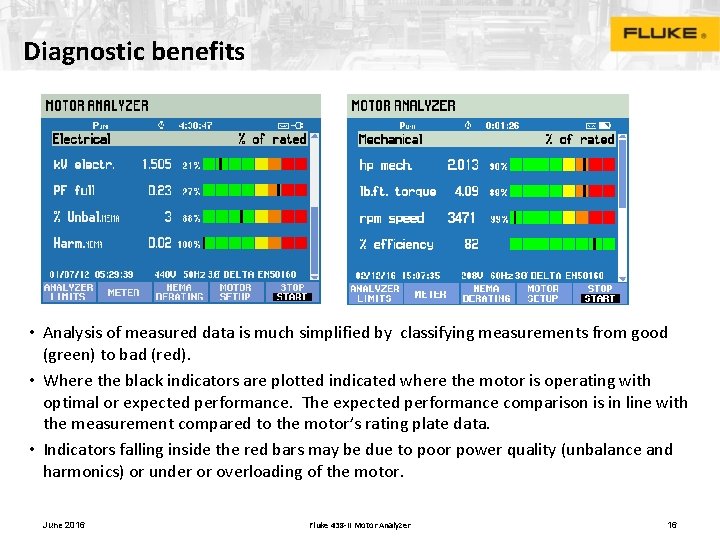
Diagnostic benefits • The 438 -II has two important summary screens that show key electrical and mechanical parameters in terms of ‘state of health’ to provide a quick insight on the status of the motors as it operates. • Measuring torque can give a direct insight into the state of health of the motor, the load and process. • Reliable operation over time is ensured while minimizing maintenance costs. June 2016 Fluke 438 -II Motor Analyzer 15
Diagnostic benefits • Analysis of measured data is much simplified by classifying measurements from good (green) to bad (red). • Where the black indicators are plotted indicated where the motor is operating with optimal or expected performance. The expected performance comparison is in line with the measurement compared to the motor’s rating plate data. • Indicators falling inside the red bars may be due to poor power quality (unbalance and harmonics) or under or overloading of the motor. June 2016 Fluke 438 -II Motor Analyzer 16
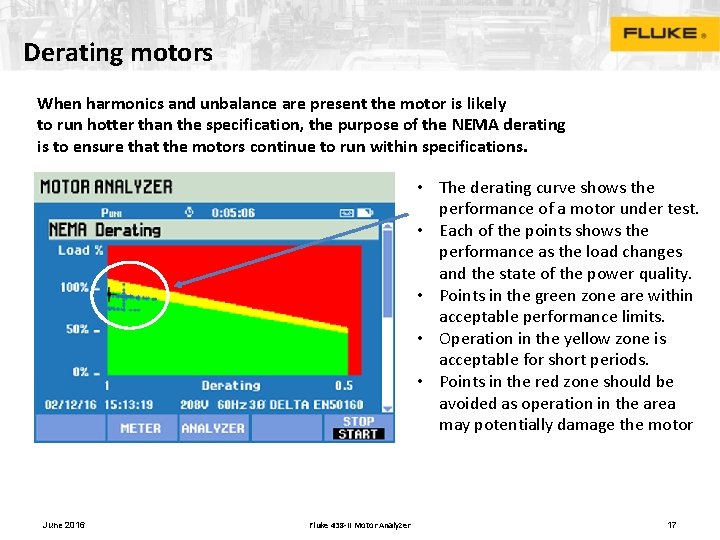
Derating motors When harmonics and unbalance are present the motor is likely to run hotter than the specification, the purpose of the NEMA derating is to ensure that the motors continue to run within specifications. • The derating curve shows the performance of a motor under test. • Each of the points shows the performance as the load changes and the state of the power quality. • Points in the green zone are within acceptable performance limits. • Operation in the yellow zone is acceptable for short periods. • Points in the red zone should be avoided as operation in the area may potentially damage the motor June 2016 Fluke 438 -II Motor Analyzer 17
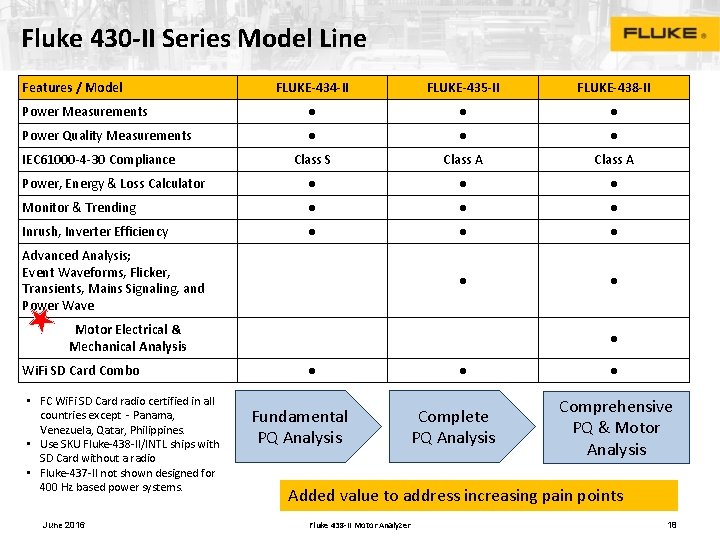
Fluke 430 -II Series Model Line Features / Model FLUKE-434 -II FLUKE-435 -II FLUKE-438 -II Power Measurements ● ● ● Power Quality Measurements ● ● ● Class S Class A Power, Energy & Loss Calculator ● ● ● Monitor & Trending ● ● ● Inrush, Inverter Efficiency ● ● ● Advanced Analysis; Event Waveforms, Flicker, Transients, Mains Signaling, and Power Wave ● ● ● ● IEC 61000 -4 -30 Compliance Motor Electrical & Mechanical Analysis Wi. Fi SD Card Combo • FC Wi. Fi SD Card radio certified in all countries except - Panama, Venezuela, Qatar, Philippines. • Use SKU Fluke-438 -II/INTL ships with SD Card without a radio • Fluke-437 -II not shown designed for 400 Hz based power systems. June 2016 Fundamental PQ Analysis Complete PQ Analysis Comprehensive PQ & Motor Analysis Added value to address increasing pain points Fluke 438 -II Motor Analyzer 18
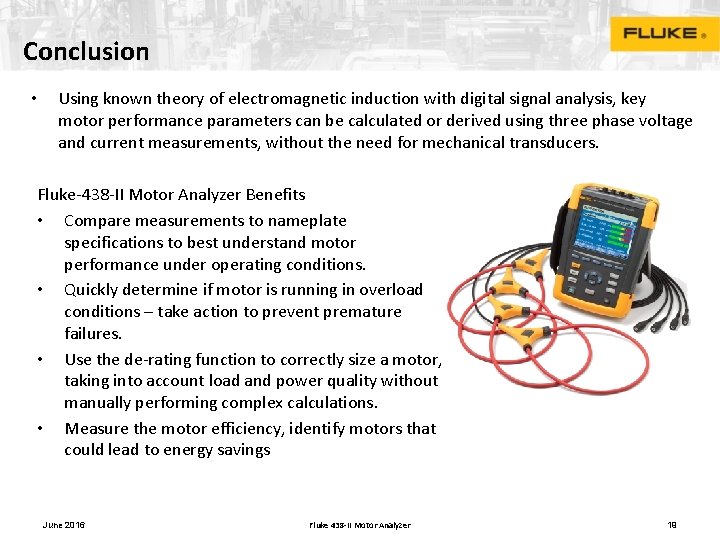
Conclusion • Using known theory of electromagnetic induction with digital signal analysis, key motor performance parameters can be calculated or derived using three phase voltage and current measurements, without the need for mechanical transducers. Fluke-438 -II Motor Analyzer Benefits • Compare measurements to nameplate specifications to best understand motor performance under operating conditions. • Quickly determine if motor is running in overload conditions – take action to prevent premature failures. • Use the de-rating function to correctly size a motor, taking into account load and power quality without manually performing complex calculations. • Measure the motor efficiency, identify motors that could lead to energy savings June 2016 Fluke 438 -II Motor Analyzer 19
Notes June 2016 Fluke 438 -II Motor Analyzer 20
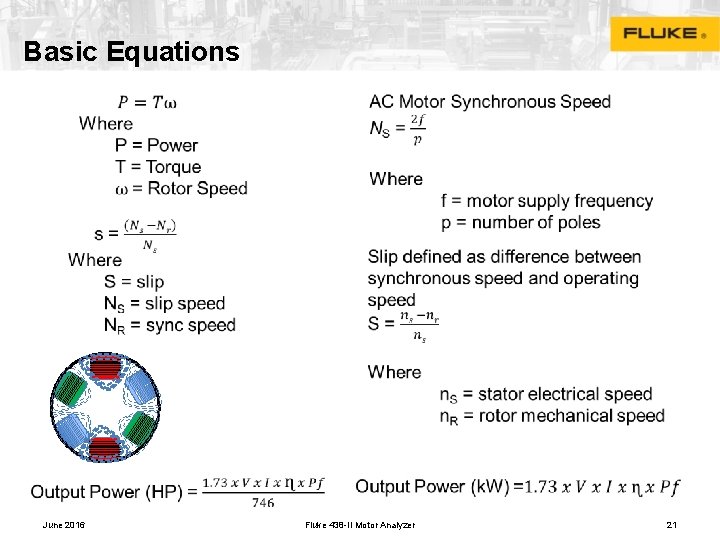
Basic Equations June 2016 Fluke 438 -II Motor Analyzer 21