
fluids which follow Newtons law CHE 315 Shear



- Slides: 19
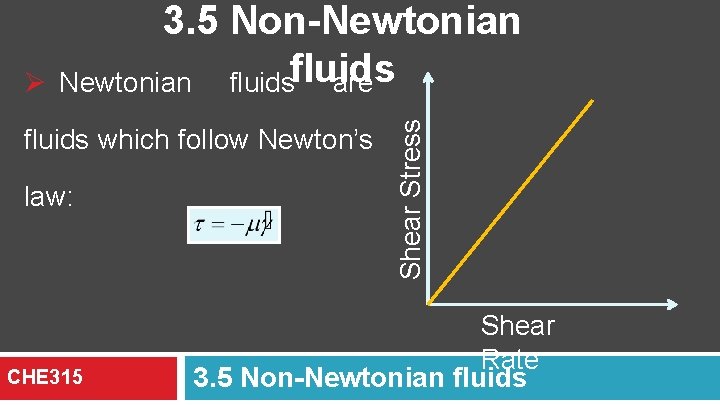
fluids which follow Newton’s law: CHE 315 Shear Stress Ø 3. 5 Non-Newtonian fluids are Shear Rate 3. 5 Non-Newtonian fluids
follow Newtonian law. Ø Therefore, For non-Newtonian fluids, the plot of the shear stress vs. shear rate is not linear through the origin. CHE 315 Shear Stress Ø Non-Newtonian fluids do not Shear Rate 3. 5 Non-Newtonian fluids
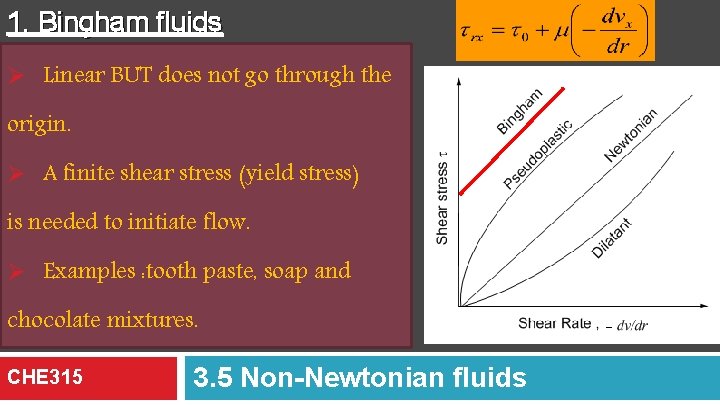
1. Bingham fluids Ø Linear BUT does not go through the origin. Ø A finite shear stress (yield stress) is needed to initiate flow. Ø Examples : tooth paste, soap and chocolate mixtures. CHE 315 3. 5 Non-Newtonian fluids
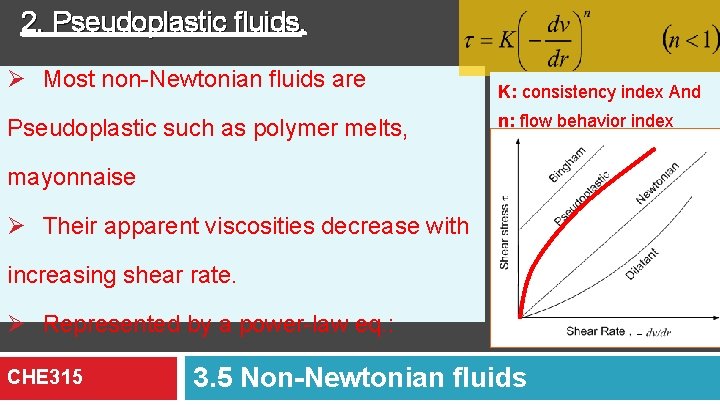
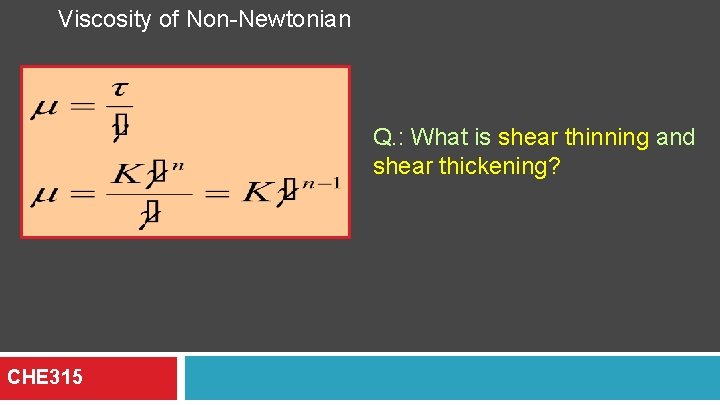
2. Pseudoplastic fluids. Ø Most non-Newtonian fluids are Pseudoplastic such as polymer melts, K: consistency index And n: flow behavior index mayonnaise Ø Their apparent viscosities decrease with increasing shear rate. Ø Represented by a power-law eq. : CHE 315 3. 5 Non-Newtonian fluids
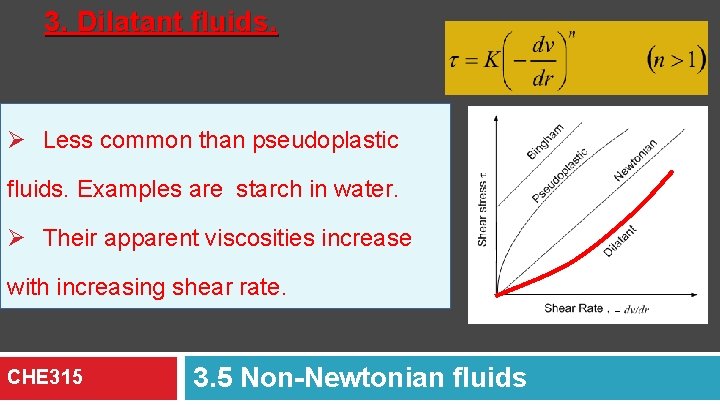
3. Dilatant fluids. Ø Less common than pseudoplastic fluids. Examples are starch in water. Ø Their apparent viscosities increase with increasing shear rate. CHE 315 3. 5 Non-Newtonian fluids
Group Study CHE 31 5 3. 5 Non-Newtonian fluids Task: Study with your group the following: • Bingham Fluids • Pseudoplastic Fluids • Dilatant Fluids Hint Questions: 1. Which mathematical model can represent each type of fluids 2. What is the relation between shear rate and viscosity for each type? Compare with Newtonian fluids. 3. Can you write one general model for all types of fluids ? Try!! 4. What is the value of n for each
Viscosity of Non-Newtonian Q. : What is shear thinning and shear thickening? CHE 315
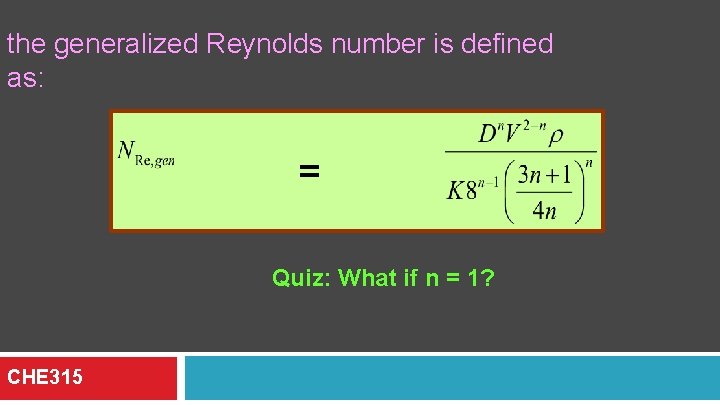
the generalized Reynolds number is defined as: = Quiz: What if n = 1? CHE 315
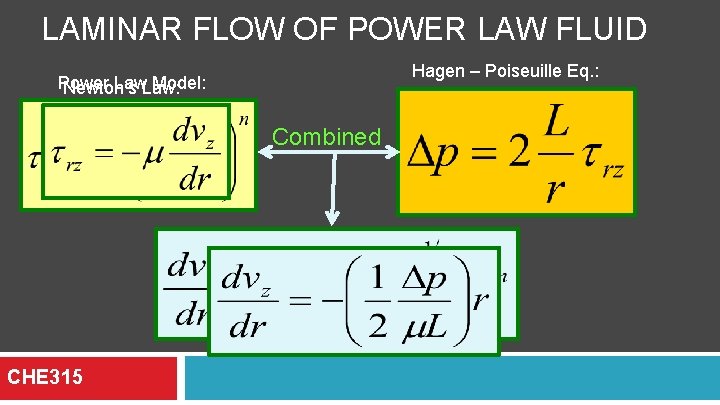
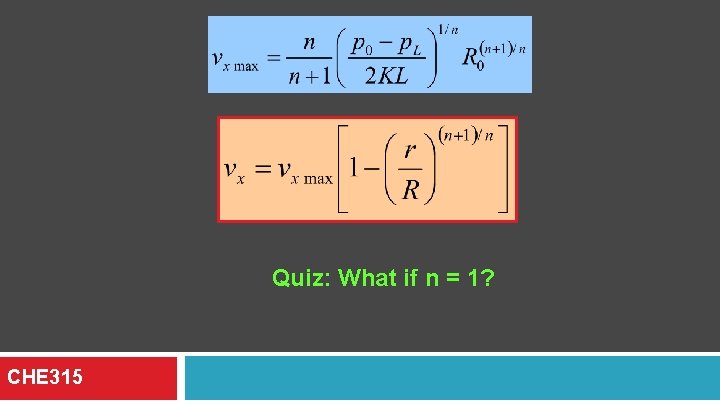
LAMINAR FLOW OF POWER LAW FLUID Hagen – Poiseuille Eq. : Power Law: Model: Newton’s Combined CHE 315
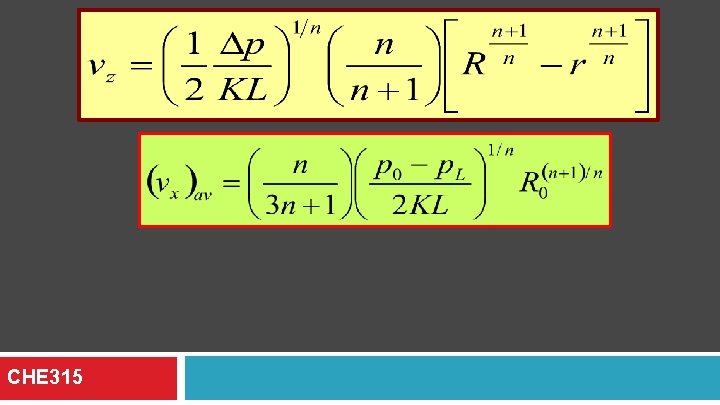
CHE 315
Quiz: What if n = 1? CHE 315
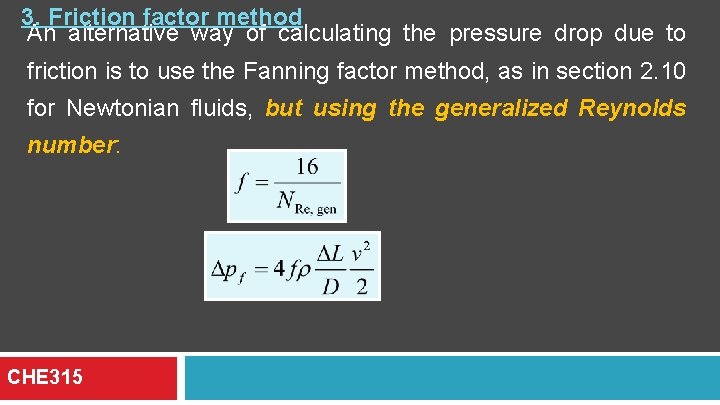
3. Friction factor method An alternative way of calculating the pressure drop due to friction is to use the Fanning factor method, as in section 2. 10 for Newtonian fluids, but using the generalized Reynolds number: CHE 315
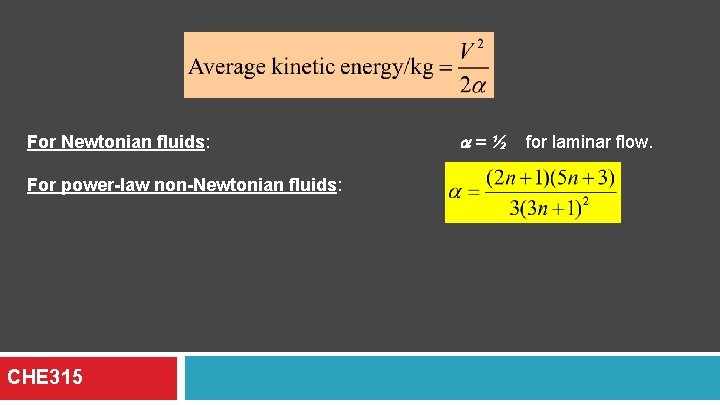
For Newtonian fluids: For power-law non-Newtonian fluids: CHE 315 a=½ for laminar flow.
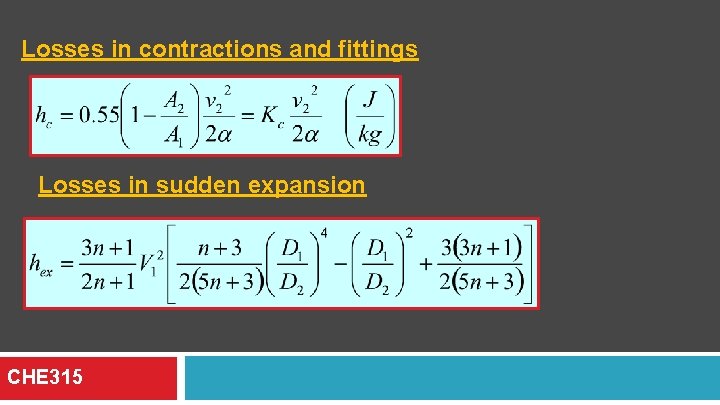
Losses in contractions and fittings Losses in sudden expansion CHE 315
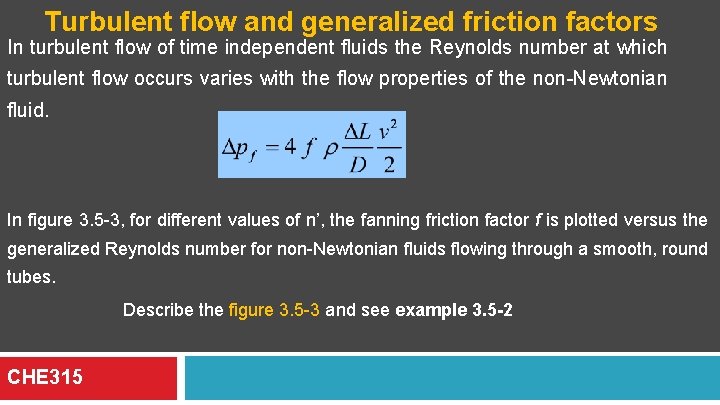
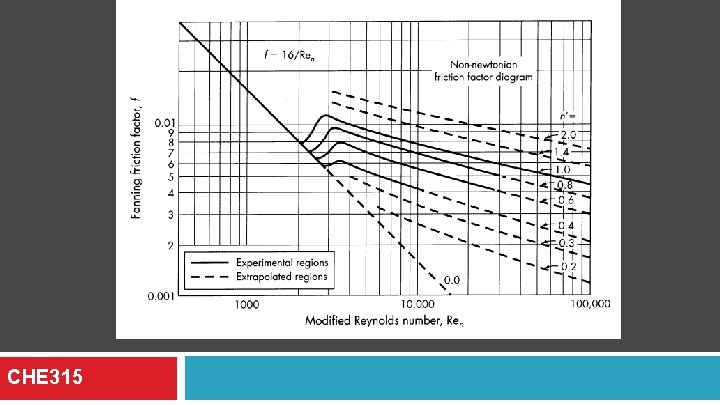
Turbulent flow and generalized friction factors In turbulent flow of time independent fluids the Reynolds number at which turbulent flow occurs varies with the flow properties of the non-Newtonian fluid. In figure 3. 5 -3, for different values of n’, the fanning friction factor f is plotted versus the generalized Reynolds number for non-Newtonian fluids flowing through a smooth, round tubes. Describe the figure 3. 5 -3 and see example 3. 5 -2 CHE 315
CHE 315
Example: A chemical solution (density =960 kg/m 3) is being pumped at the rate of 5 e-3 m 3/s. pump efficiency is 65%. The pipes are schedule 40. The solution is a power law fluid with power law index being 0. 8 and consistency index being 0. 5 pa. sn. Calculate the power needed for the pump. (Hint: See example 2. 11. 7) CHE 315
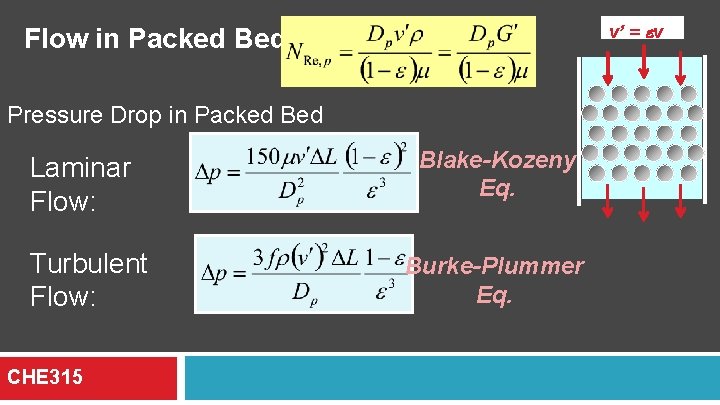
v’ = ev Flow in Packed Beds Pressure Drop in Packed Bed Laminar Flow: Turbulent Flow: CHE 315 Blake-Kozeny Eq. Burke-Plummer Eq.
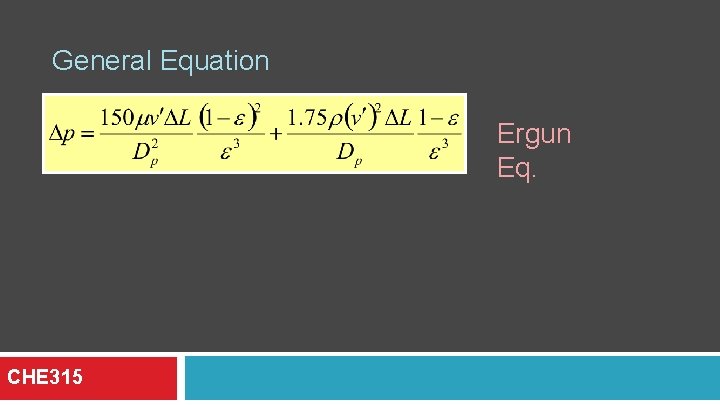
General Equation Ergun Eq. CHE 315