
Fluids Under Pressure How do fluid systems work
- Slides: 13
Fluids Under Pressure How do fluid systems work?
Compressibility Imagine filling a balloon with air and another balloon with water. Will these two balloons act the same way if you compress or squeeze them? Let’s try it.
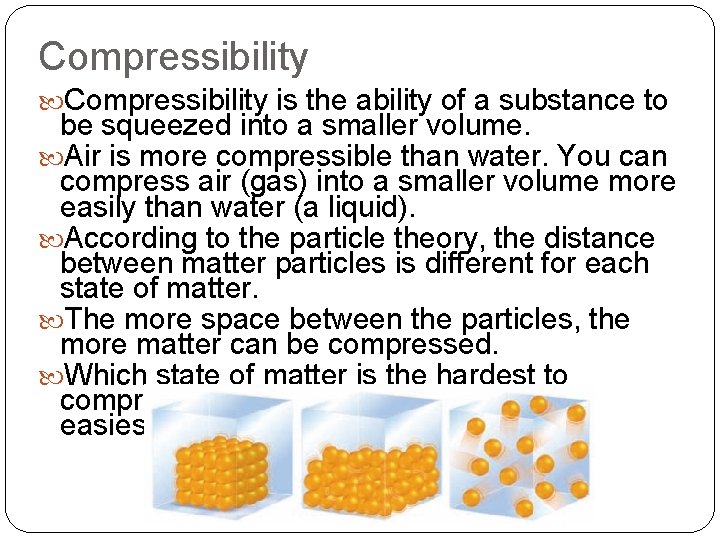
Compressibility is the ability of a substance to be squeezed into a smaller volume. Air is more compressible than water. You can compress air (gas) into a smaller volume more easily than water (a liquid). According to the particle theory, the distance between matter particles is different for each state of matter. The more space between the particles, the more matter can be compressed. Which state of matter is the hardest to compress? Which state of matter is the easiest?
Types Of Fluid Systems There are two types of fluid systems that use compressed fluids. Pneumatic systems use pressurized air or other gases to do work. Hydraulic systems use pressurized liquids to do work. Many fluid systems must keep the fluids contained in order to work. These systems are called closed systems. In a closed system, no matter enters or leaves the system.
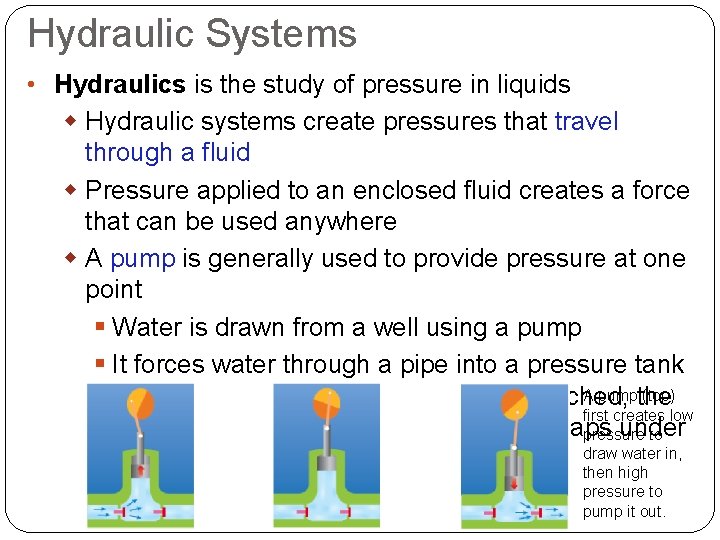
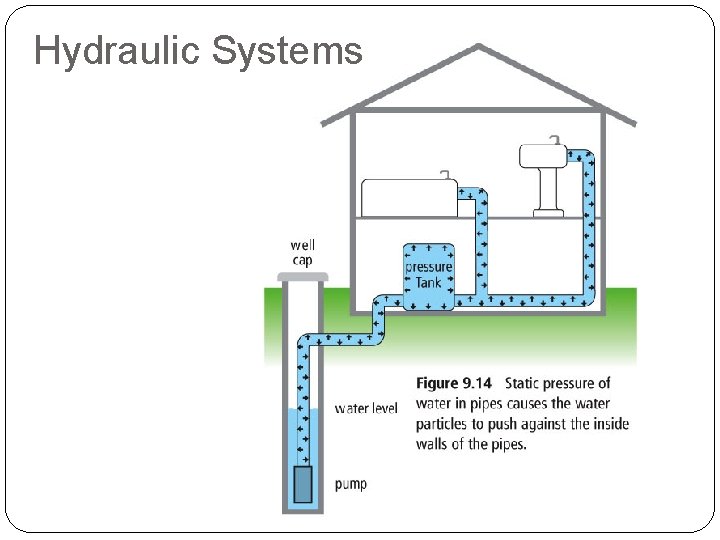
Hydraulic Systems • Hydraulics is the study of pressure in liquids w Hydraulic systems create pressures that travel through a fluid w Pressure applied to an enclosed fluid creates a force that can be used anywhere w A pump is generally used to provide pressure at one point § Water is drawn from a well using a pump § It forces water through a pipe into a pressure tank A pumpthe (top) – when the right level of pressure is reached, first creates low pump turns off and water is sent to our taps under pressure to draw water in, pressure then high pressure to pump it out.
Hydraulic Systems
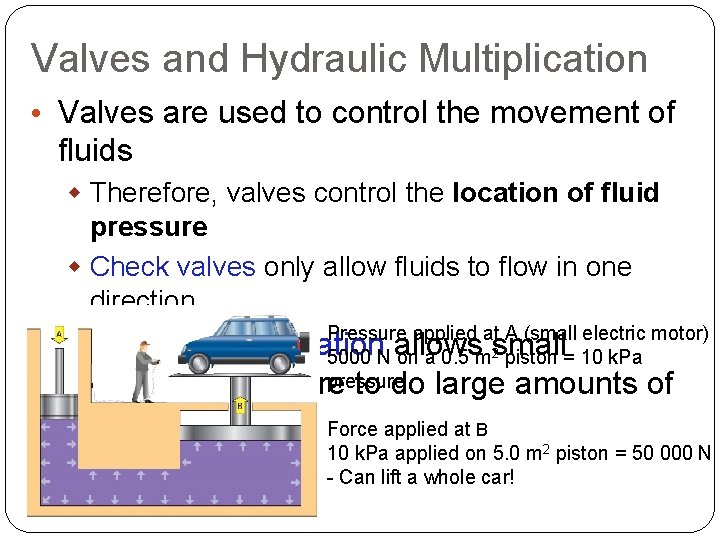
Valves and Hydraulic Multiplication • Valves are used to control the movement of fluids w Therefore, valves control the location of fluid pressure w Check valves only allow fluids to flow in one direction Pressure applied at A (small electric motor) 5000 N on a 0. 5 m 2 piston = 10 k. Pa pressure • Hydraulic multiplication allows small changes in pressure to do large amounts of work. Force applied at B 10 k. Pa applied on 5. 0 m 2 piston = 50 000 N - Can lift a whole car!
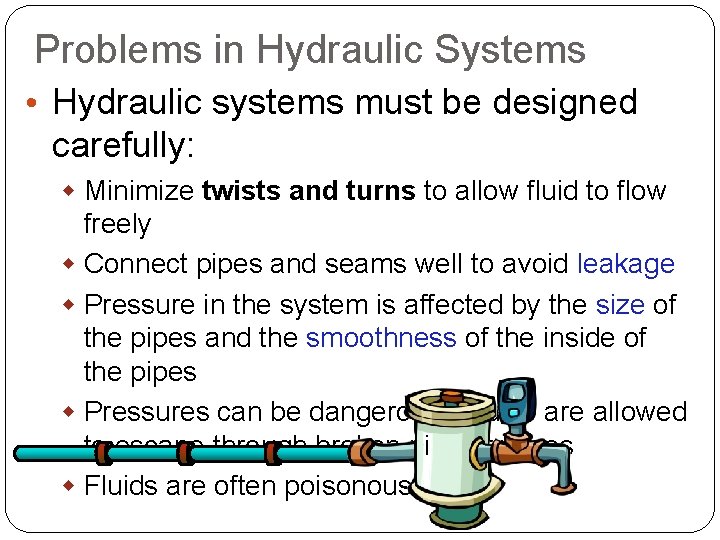
Problems in Hydraulic Systems • Hydraulic systems must be designed carefully: w Minimize twists and turns to allow fluid to flow freely w Connect pipes and seams well to avoid leakage w Pressure in the system is affected by the size of the pipes and the smoothness of the inside of the pipes w Pressures can be dangerous if fluids are allowed to escape through broken pipes or lines w Fluids are often poisonous
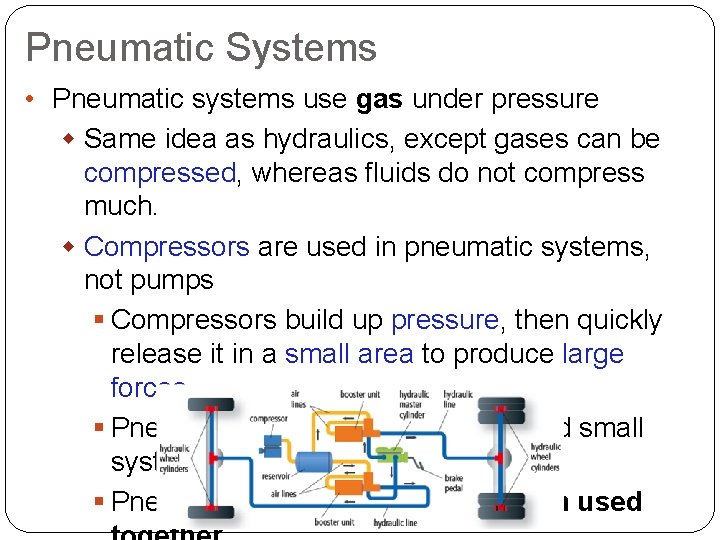
Pneumatic Systems • Pneumatic systems use gas under pressure w Same idea as hydraulics, except gases can be compressed, whereas fluids do not compress much. w Compressors are used in pneumatic systems, not pumps § Compressors build up pressure, then quickly release it in a small area to produce large forces § Pneumatics can be used in large and small systems § Pneumatics and hydraulics are often used
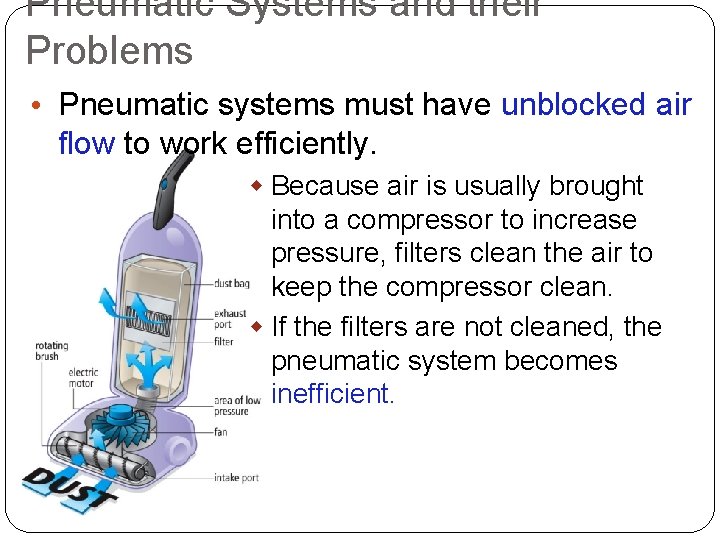
Pneumatic Systems and their Problems • Pneumatic systems must have unblocked air flow to work efficiently. w Because air is usually brought into a compressor to increase pressure, filters clean the air to keep the compressor clean. w If the filters are not cleaned, the pneumatic system becomes inefficient.
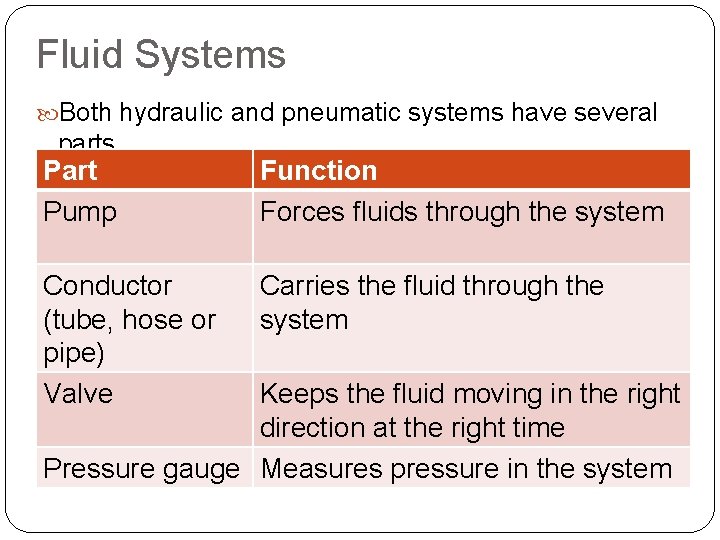
Fluid Systems Both hydraulic and pneumatic systems have several parts. Part Pump Function Forces fluids through the system Conductor (tube, hose or pipe) Valve Carries the fluid through the system Keeps the fluid moving in the right direction at the right time Pressure gauge Measures pressure in the system
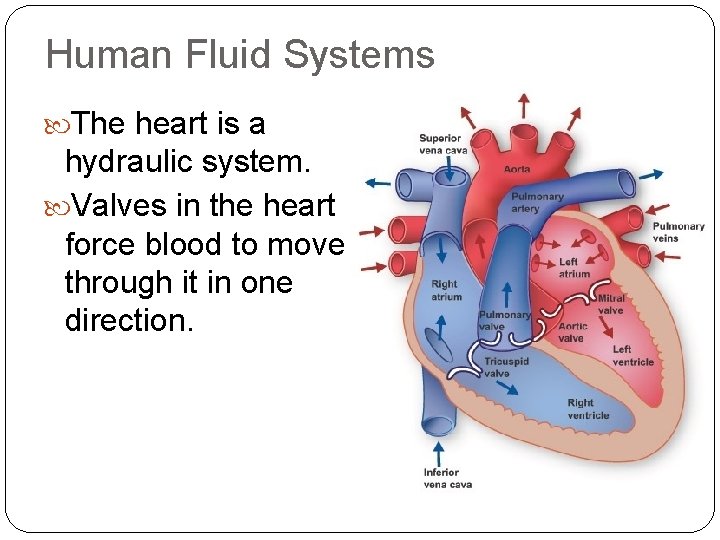
Human Fluid Systems The heart is a hydraulic system. Valves in the heart force blood to move through it in one direction.
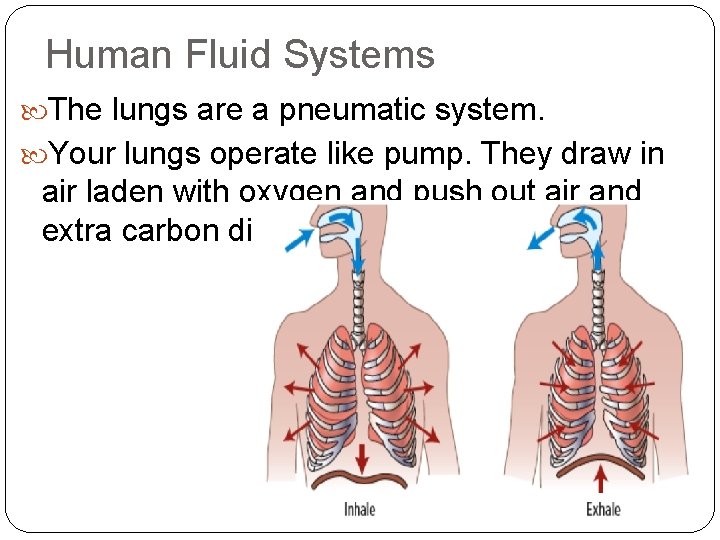
Human Fluid Systems The lungs are a pneumatic system. Your lungs operate like pump. They draw in air laden with oxygen and push out air and extra carbon dioxide.