
Fluid substitution effects on seismic anisotropy Long Huang
Fluid substitution effects on seismic anisotropy Long Huang, Robert Stewart, Samik Sil, and Nikolay Dyaur Houston April 2 nd, 2014 1
Outline Ø Motivation Natural fractures and anisotropy, fluid effects Ø Theory and methods Anisotropic Gassmann’s equations, parameterize, recast Gassmann’s equations Ø Discussions P- & S-wave moduli and velocities, Thomsen’s parameters, azimuthal amplitude variation Ø Conclusions 2

Fractures The deformation in carbonates rocks Beautiful fractured Atoka Sandstone at Natural Dam. (http: //www. rechproject. com/related-project. html) (Liner, 2013) Orthorhombic HTI X X Y Y Z Z (Huang et al. , 2013) How to characterize these fractured rocks? How would fluid influence their physical properties? How about seismic anisotropy with different fluids? 3

Theory X Y Z Dry term Fluid term (Gassmann, 1951) (Schoenberg, 1980; Schoenberg and Sayers, 1995; Bukulin et al. , 2000) 4
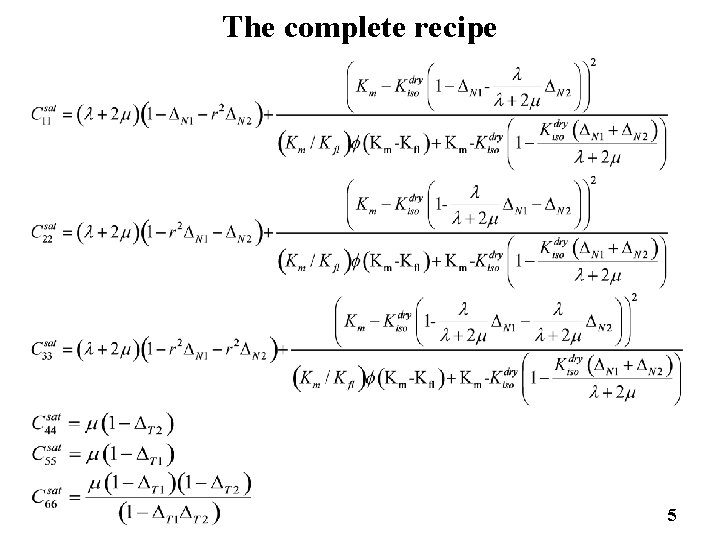
The complete recipe 5
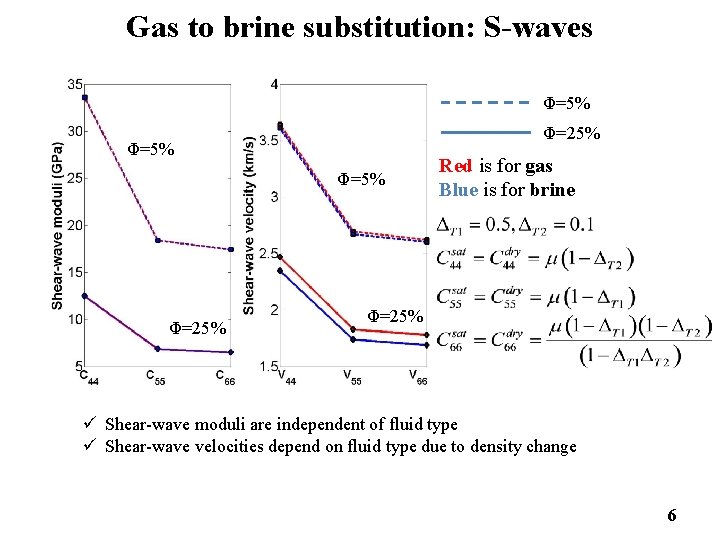
Gas to brine substitution: S-waves Φ=5% Φ=25% Red is for gas Blue is for brine Φ=25% ü Shear-wave moduli are independent of fluid type ü Shear-wave velocities depend on fluid type due to density change 6
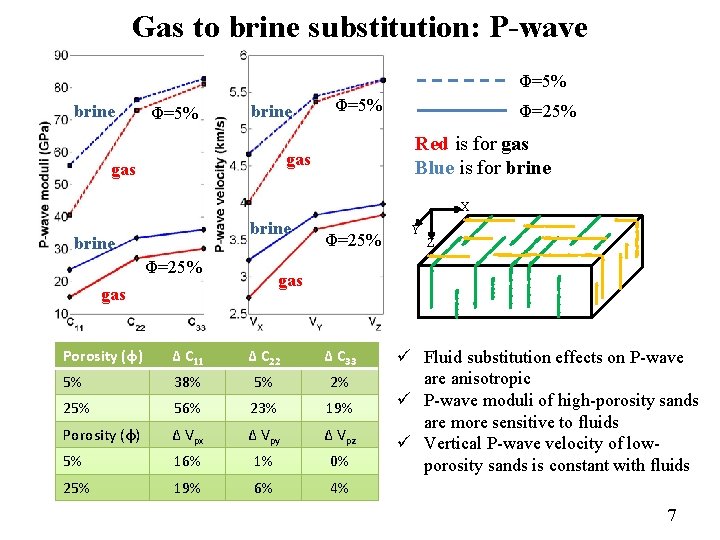
Gas to brine substitution: P-wave Φ=5% brine gas Φ=5% brine X brine Φ=25% gas Φ=25% Red is for gas Blue is for brine gas Φ=5 % brine Φ=5% Φ=25% Y Z gas Φ=25% Porosity (φ) Δ C 11 Δ C 22 Δ C 33 5% 38% 5% 2% 25% 56% 23% 19% Porosity (φ) Δ Vpx Δ Vpy Δ Vpz 5% 16% 1% 0% 25% 19% 6% 4% ü Fluid substitution effects on P-wave are anisotropic ü P-wave moduli of high-porosity sands are more sensitive to fluids ü Vertical P-wave velocity of lowporosity sands is constant with fluids 7
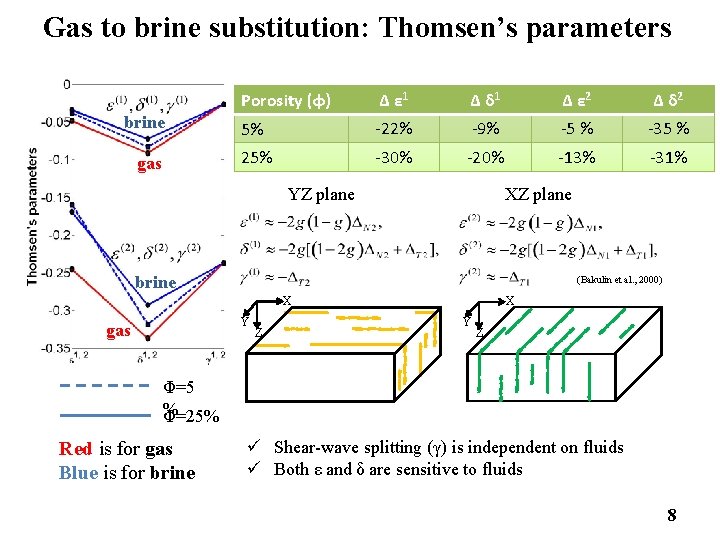
Gas to brine substitution: Thomsen’s parameters (1) brine gas Porosity (φ) Δ ε 1 Δ δ 1 Δ ε 2 Δ δ 2 5% -22% -9% -5 % -35 % 25% -30% -20% -13% -31% YZ plane brine (2) gas XZ plane (Bakulin et al. , 2000) X Y Z Φ=5 % Φ=25% Red is for gas Blue is for brine ü Shear-wave splitting (γ) is independent on fluids ü Both ε and δ are sensitive to fluids 8
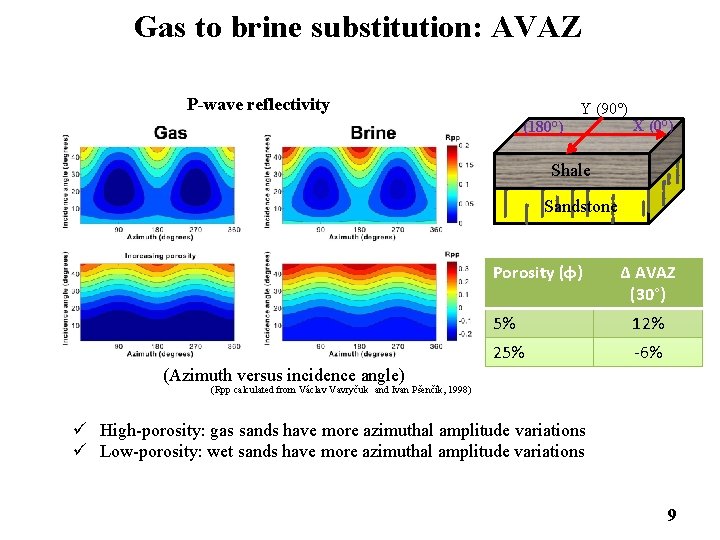
Gas to brine substitution: AVAZ P-wave reflectivity Y (90°) (180°) X (0°) Shale Sandstone Porosity (φ) Δ AVAZ (30°) 5% 12% 25% -6% (Azimuth versus incidence angle) (Rpp calculated from Václav Vavryčuk and Ivan Pšenčík, 1998) ü High-porosity: gas sands have more azimuthal amplitude variations ü Low-porosity: wet sands have more azimuthal amplitude variations 9
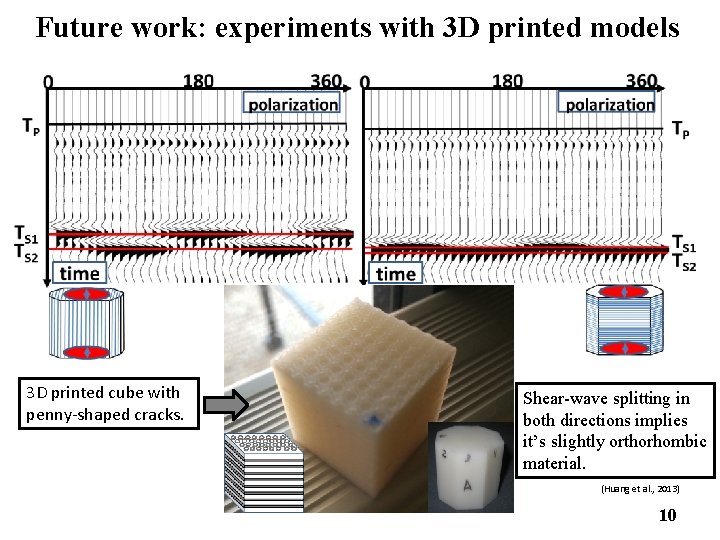
Future work: experiments with 3 D printed models 3 D printed cube with penny-shaped cracks. Shear-wave splitting in both directions implies it’s slightly orthorhombic material. (Huang et al. , 2013) 10
Conclusions v Extended Gassmann’s equations for an orthorhombic medium v Shear rigidity and splitting are independent on fluid type, but not shearwave velocity v Fluid substitution effects are anisotropic v Vertical P-wave velocity of low-porosity sands is constant with fluids v High-porosity gas sands or low-porosity wet sands, have more azimuthal amplitude variations 11
Acknowledgement • Allied Geophysical Laboratories, UH • Dr. Robert Sheriff and SEG Foundation • UH adjunct and research professors: Dr. Leon Thomsen and Dr. Colin Sayers 12
Thank you! Questions? 13
- Slides: 13