
Fluid Processes in Subduction Zones Hydrous Minerals and
Fluid Processes in Subduction Zones Hydrous Minerals and Dehydration Reactions Simon M. Peacock Dept. of Earth and Ocean Sciences University of British Columbia
Effects of H 2 O on Subduction Zones • H 2 O and hydrous minerals weaken plate interface permitting subduction and plate tectonics to occur • H 2 O lowers melting temperature of mantle, generates explosive arc magmas • Fluids released by slab dehydration promote brittle behavior and may trigger earthquakes • Hydration structure, rheological structure, and thermal structure of subduction zones are strongly coupled
Selected Characteristics of Volcanic Arcs • Depth to underlying Benioff zone is ~100 – 200 km • Depth to underlying Benioff zone beneath volcanic front is 124± 38 km (Gill, 1981) – suggestive of P-dependent melting or slab dehydration rxn – or may be necessary depth for slab in order to be overlain by hot asthenosphere such that addition of H 2 O triggers melting • Several places where active arc is missing (or feeble) – Peru, central Chile, SW Japan • T eruptions – 1050 -1100°C • T mantle equil – commonly 1300°C+ for basalts
Geochemistry of Arc Magmas Compared to MORBs, arc magmas are: • Fractionated • basalts andesites dacites rhyolites • Wet • Enriched in many trace elements, such as Rb, that appear to be derived from the subducting slab
H 2 O Content of Arc Magmas • Significantly more H 2 O than MORBs, OIBs • Explosive eruptions (more H 2 O degassing, higher Si. O 2 content) • Hornblende (amphibole) is common phenocryst • H 2 O dramatically lowers melting T of rocks, mantle by 100 s of degrees. key to arc magma genesis
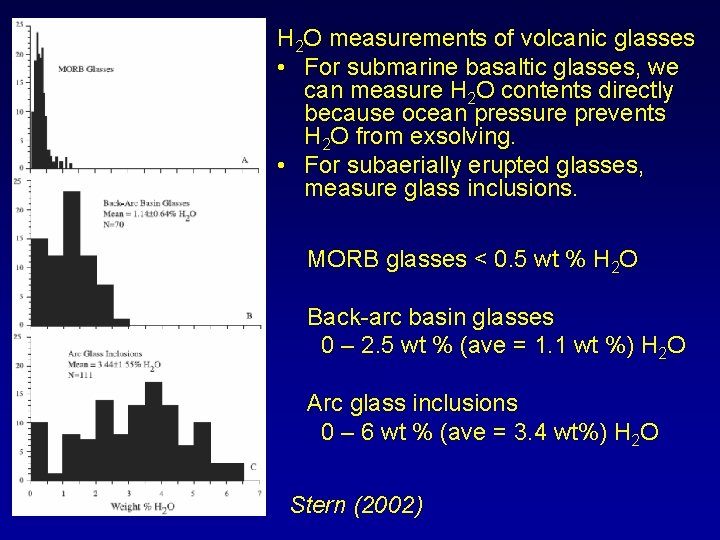
H 2 O measurements of volcanic glasses • For submarine basaltic glasses, we can measure H 2 O contents directly because ocean pressure prevents H 2 O from exsolving. • For subaerially erupted glasses, measure glass inclusions. MORB glasses < 0. 5 wt % H 2 O Back-arc basin glasses 0 – 2. 5 wt % (ave = 1. 1 wt %) H 2 O Arc glass inclusions 0 – 6 wt % (ave = 3. 4 wt%) H 2 O Stern (2002)
Arc Magmas Distinctive Trace Element Characteristics • Arc basalts, as compared to MORBs, are – Enriched in large-ion lithophile elements (LILE) K, Rb, Cs, Sr, Ba, and Pb, U, B, Be – Depleted in high field strength elements (HFSE) Y, Zr, Hf, HREE, Nb, Ta (controversial niobium anomaly: Ti-phase in source? , prev. melting event? ) • H 2 O-rich fluids will preferentially contain more mobile LILE – derived from slab • Be and Th are relatively enriched in arc basalts, but believed to be relatively insoluble in H 2 O-rich fluids suggests sediment melting
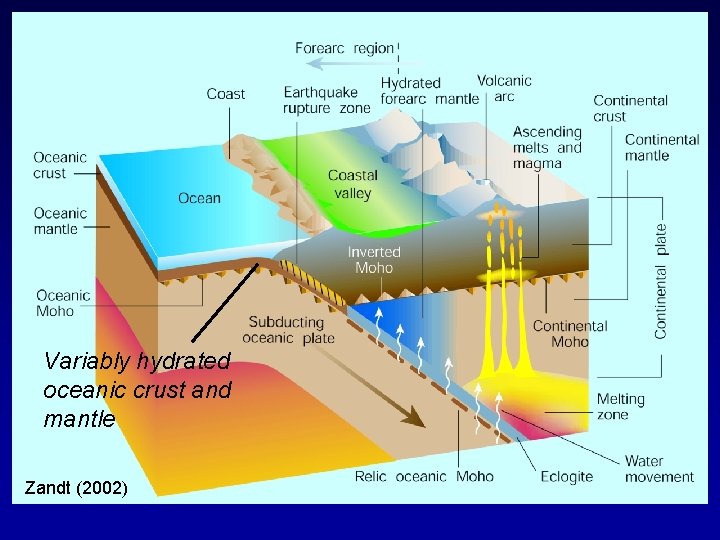
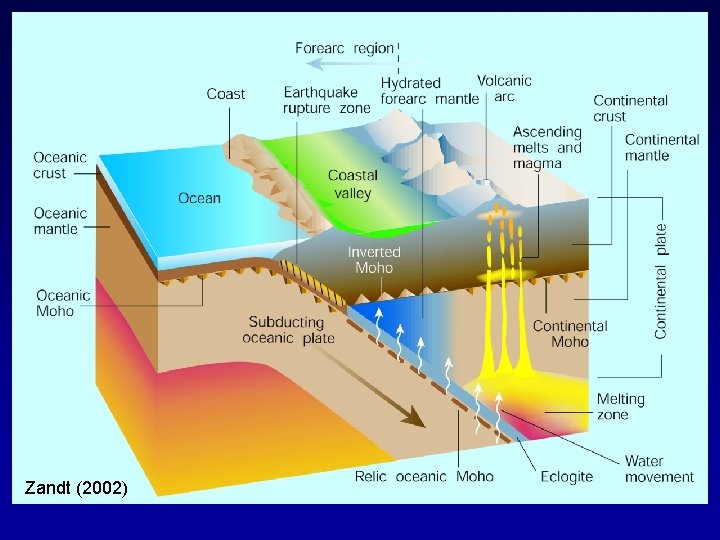
Variably hydrated oceanic crust and mantle Zandt (2002)
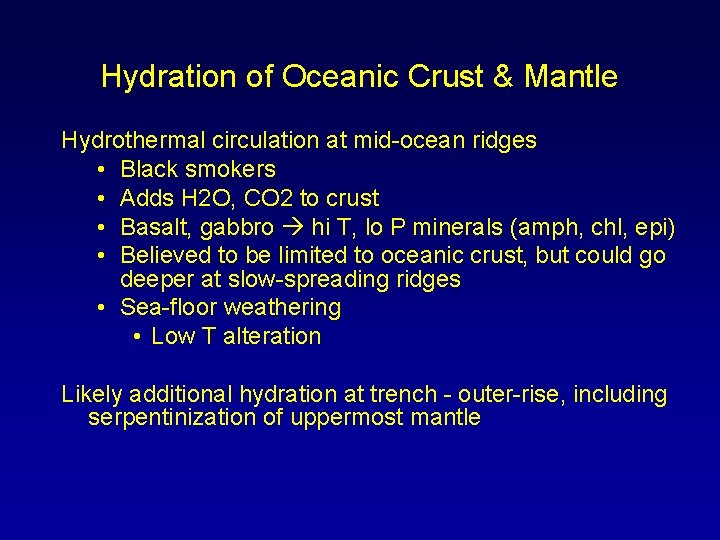
Hydration of Oceanic Crust & Mantle Hydrothermal circulation at mid-ocean ridges • Black smokers • Adds H 2 O, CO 2 to crust • Basalt, gabbro hi T, lo P minerals (amph, chl, epi) • Believed to be limited to oceanic crust, but could go deeper at slow-spreading ridges • Sea-floor weathering • Low T alteration Likely additional hydration at trench - outer-rise, including serpentinization of uppermost mantle
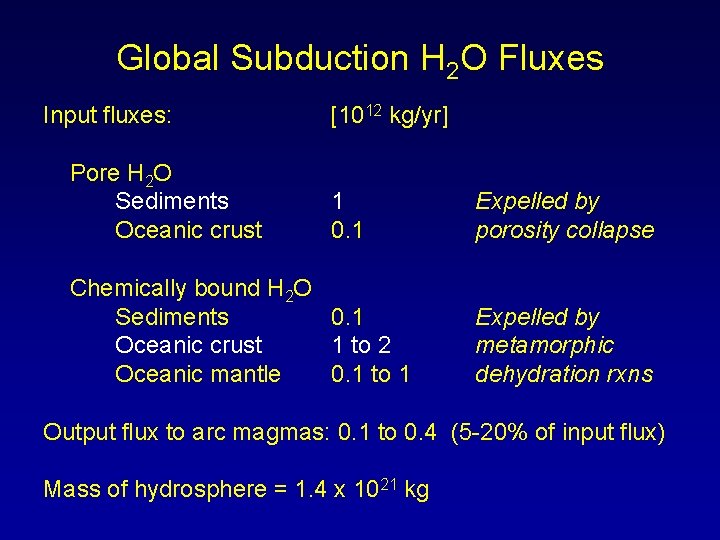
Global Subduction H 2 O Fluxes Input fluxes: Pore H 2 O Sediments Oceanic crust [1012 kg/yr] 1 0. 1 Chemically bound H 2 O Sediments 0. 1 Oceanic crust 1 to 2 Oceanic mantle 0. 1 to 1 Expelled by porosity collapse Expelled by metamorphic dehydration rxns Output flux to arc magmas: 0. 1 to 0. 4 (5 -20% of input flux) Mass of hydrosphere = 1. 4 x 10²¹ kg
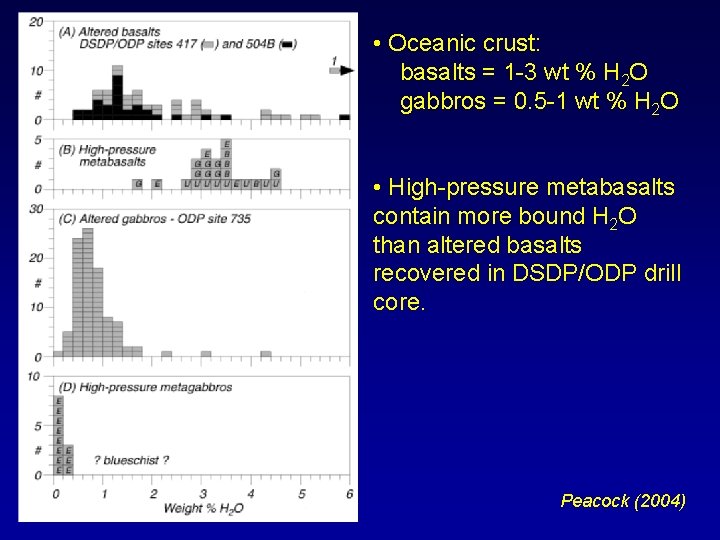
• Oceanic crust: basalts = 1 -3 wt % H 2 O gabbros = 0. 5 -1 wt % H 2 O • High-pressure metabasalts contain more bound H 2 O than altered basalts recovered in DSDP/ODP drill core. Peacock (2004)
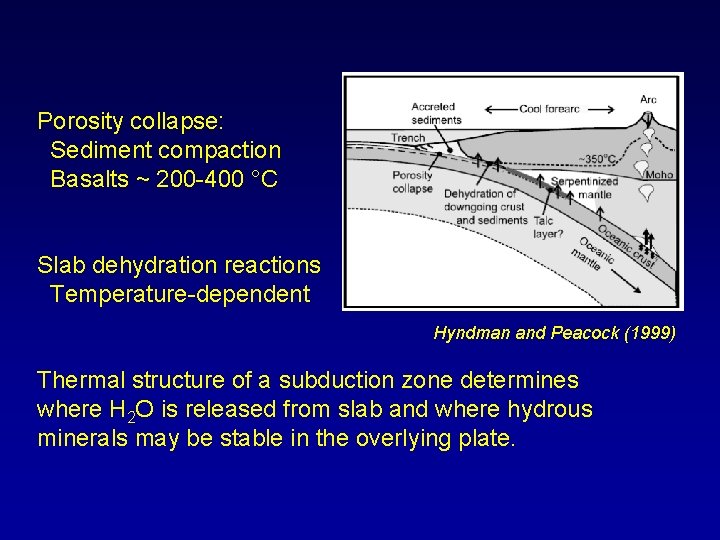
Porosity collapse: Sediment compaction Basalts ~ 200 -400 °C Slab dehydration reactions Temperature-dependent Hyndman and Peacock (1999) Thermal structure of a subduction zone determines where H 2 O is released from slab and where hydrous minerals may be stable in the overlying plate.
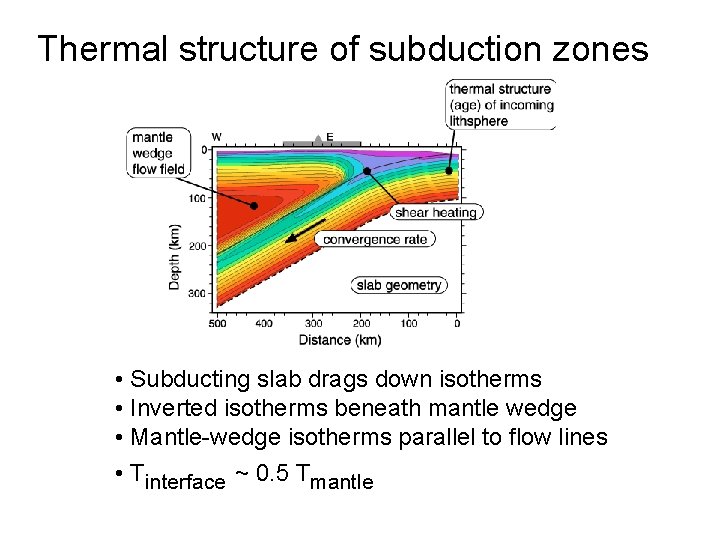
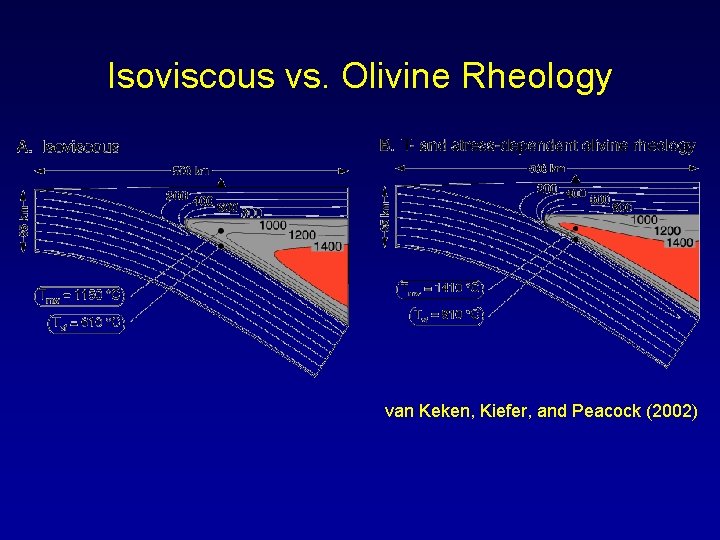
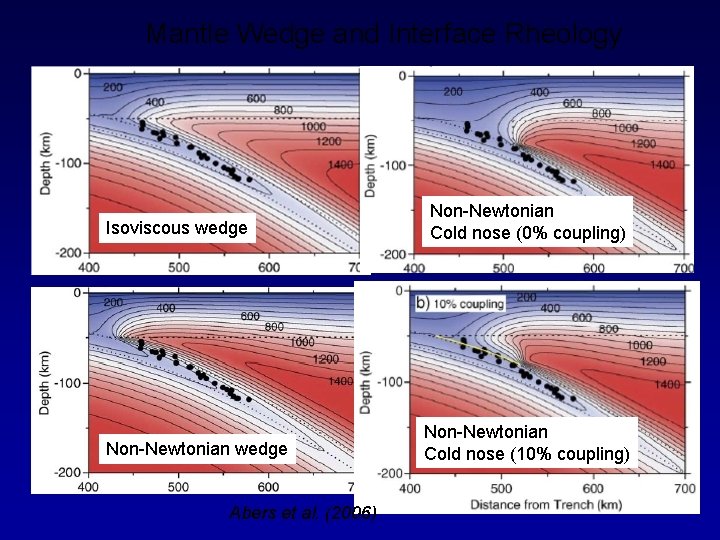
Thermal structure of subduction zones • Subducting slab drags down isotherms • Inverted isotherms beneath mantle wedge • Mantle-wedge isotherms parallel to flow lines • Tinterface ~ 0. 5 Tmantle
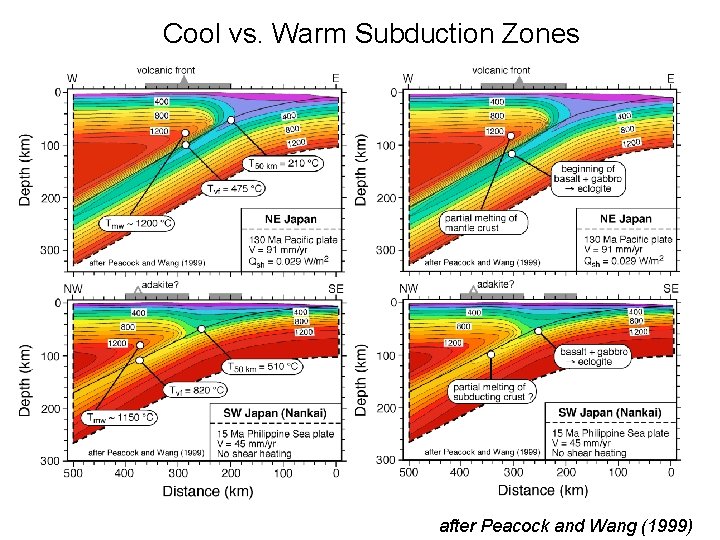
Cool vs. Warm Subduction Zones after Peacock and Wang (1999)
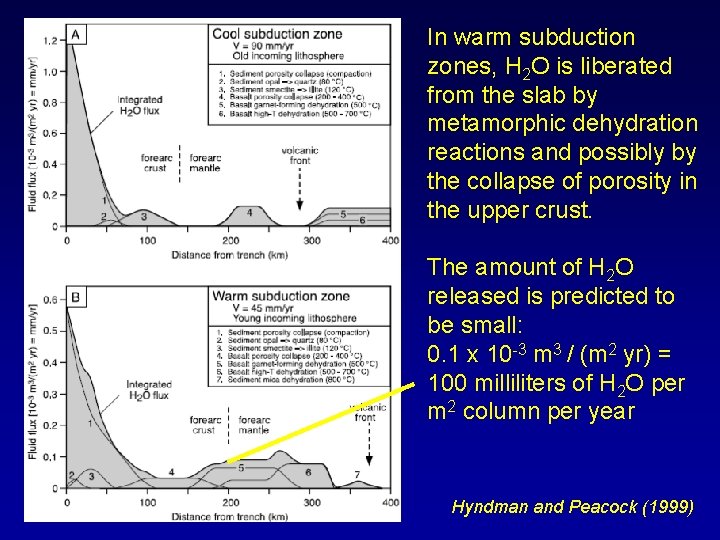
In warm subduction zones, H 2 O is liberated from the slab by metamorphic dehydration reactions and possibly by the collapse of porosity in the upper crust. The amount of H 2 O released is predicted to be small: 0. 1 x 10 -3 m 3 / (m 2 yr) = 100 milliliters of H 2 O per m 2 column per year Hyndman and Peacock (1999)
Metamorphic facies – diagnostic mineral assemblage indicative of region in P-T space (particularly used in mafic systems) Facies boundaries – complex reactions
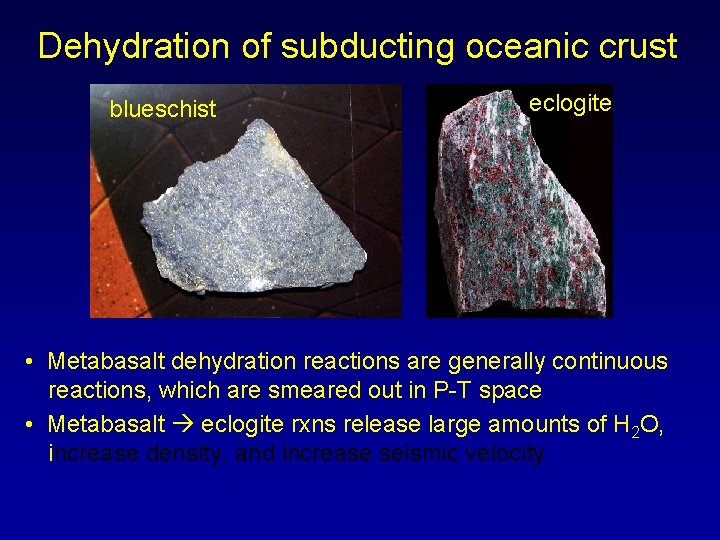
Dehydration of subducting oceanic crust blueschist eclogite • Metabasalt dehydration reactions are generally continuous reactions, which are smeared out in P-T space • Metabasalt eclogite rxns release large amounts of H 2 O, increase density, and increase seismic velocity
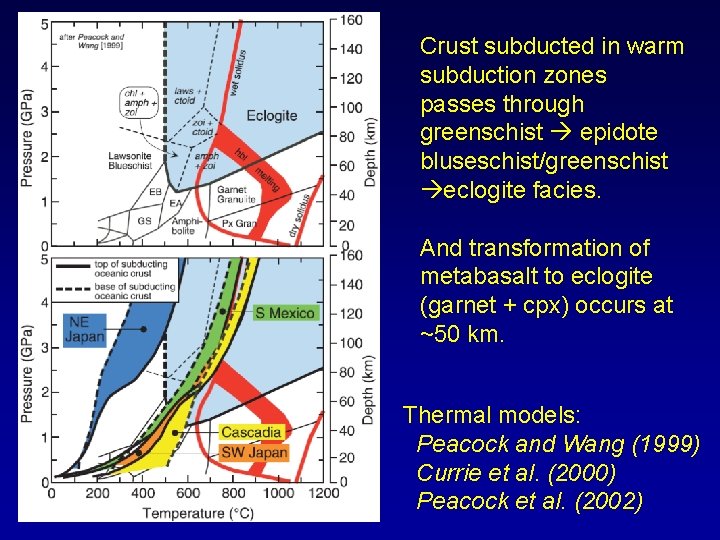
Crust subducted in warm subduction zones passes through greenschist epidote bluseschist/greenschist eclogite facies. And transformation of metabasalt to eclogite (garnet + cpx) occurs at ~50 km. Thermal models: Peacock and Wang (1999) Currie et al. (2000) Peacock et al. (2002)
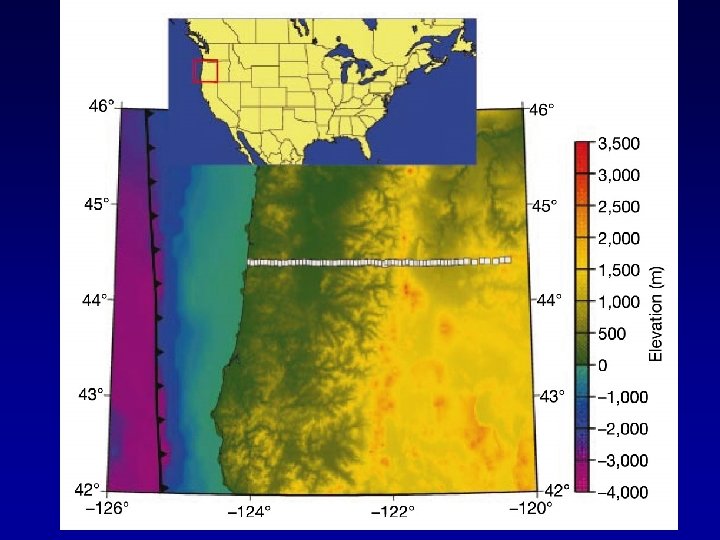
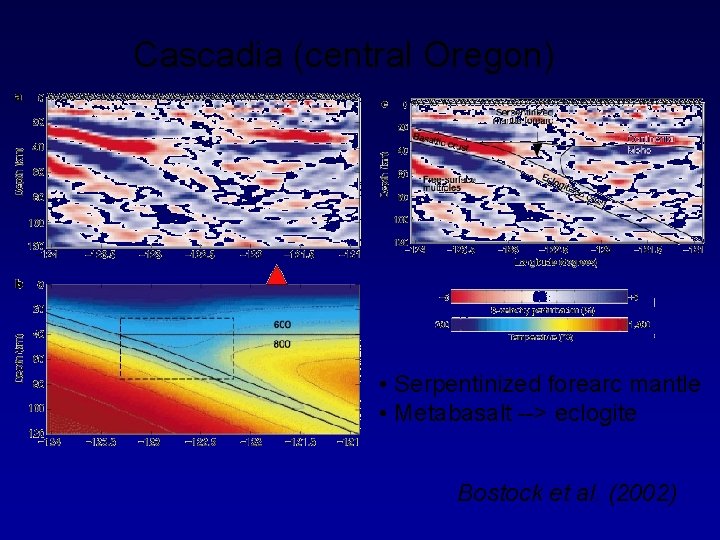
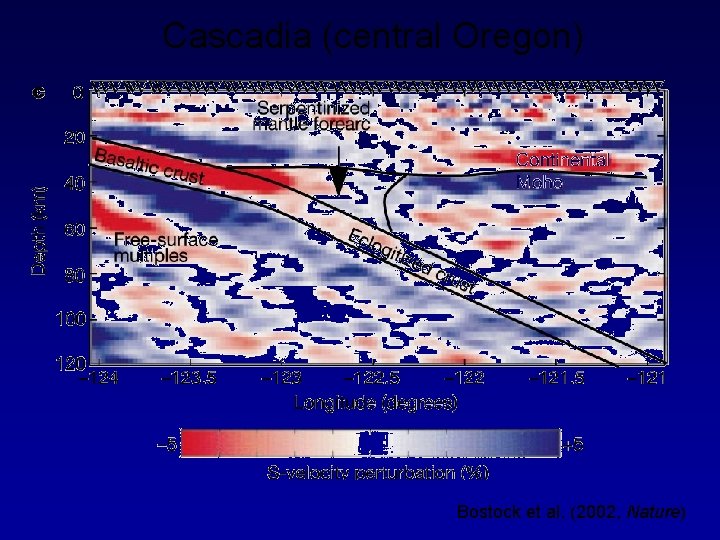
Cascadia (central Oregon) • Serpentinized forearc mantle • Metabasalt --> eclogite Bostock et al. (2002)
For a given P, T, and composition (X), what is the mineralogy of the rock? • P=rgz • T = thermal models • X = bulk composition, including H 2 O content - fully hydrated or anhydrous?
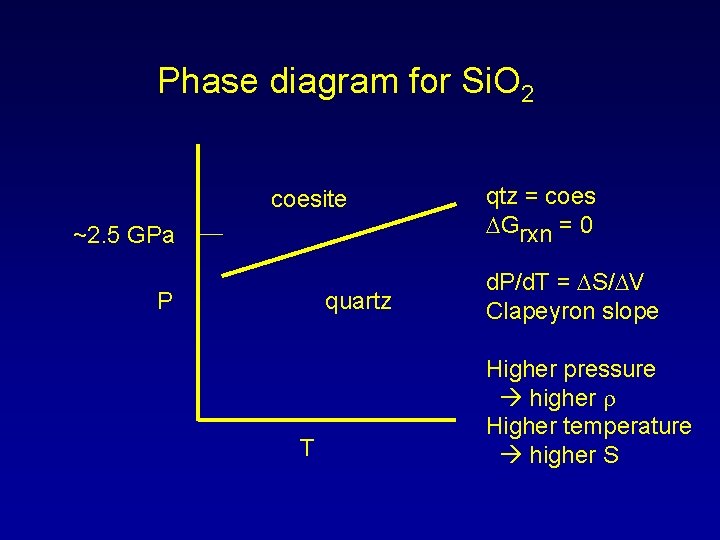
Phase diagram for Si. O 2 coesite ~2. 5 GPa P quartz T qtz = coes DGrxn = 0 d. P/d. T = DS/DV Clapeyron slope Higher pressure higher r Higher temperature higher S
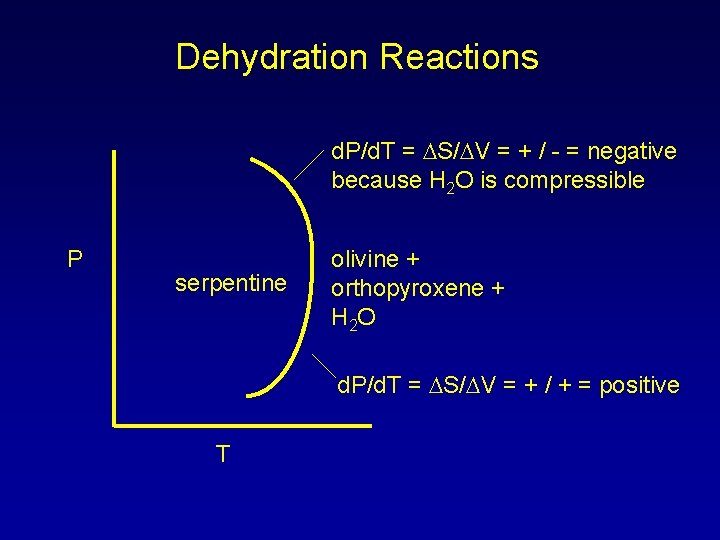
Dehydration Reactions d. P/d. T = DS/DV = + / - = negative because H 2 O is compressible P serpentine olivine + orthopyroxene + H 2 O d. P/d. T = DS/DV = + / + = positive T
Dehydration rxns: In nature, many reactions are “smeared out” in P-T space because of: • Solid solutions – particularly in mafic rocks (e. g. , Fe-Mg) • Variable fluid compositions • Kinetics
Dehydration rxns (cont. ): Phase diagrams can be based on : • Experiments (sluggish at T < 600°C) • Thermodynamic calculations (must know all phases, solid solutions) • Field-based petrologic studies (observations + P-T-ometry) • Combinations of all 3
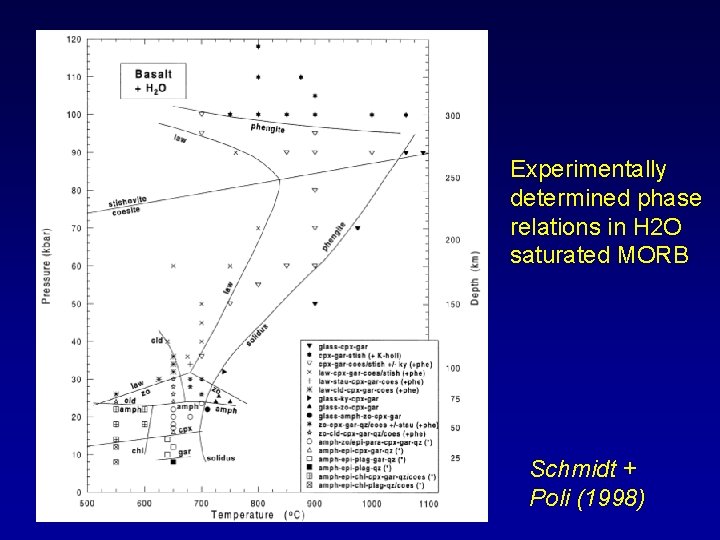
Experimentally determined phase relations in H 2 O saturated MORB Schmidt + Poli (1998)
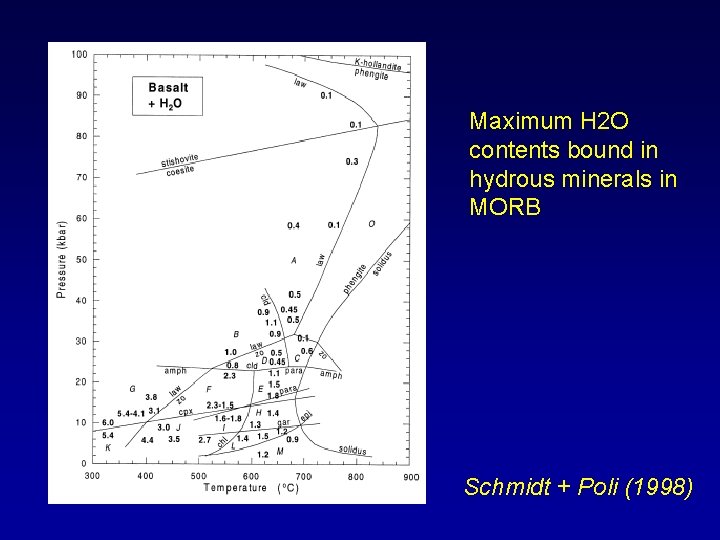
Maximum H 2 O contents bound in hydrous minerals in MORB Schmidt + Poli (1998)
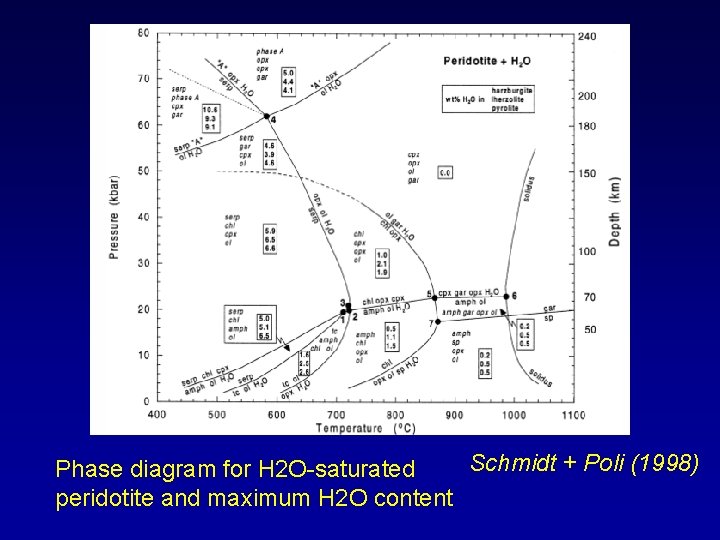
Schmidt + Poli (1998) Phase diagram for H 2 O-saturated peridotite and maximum H 2 O content
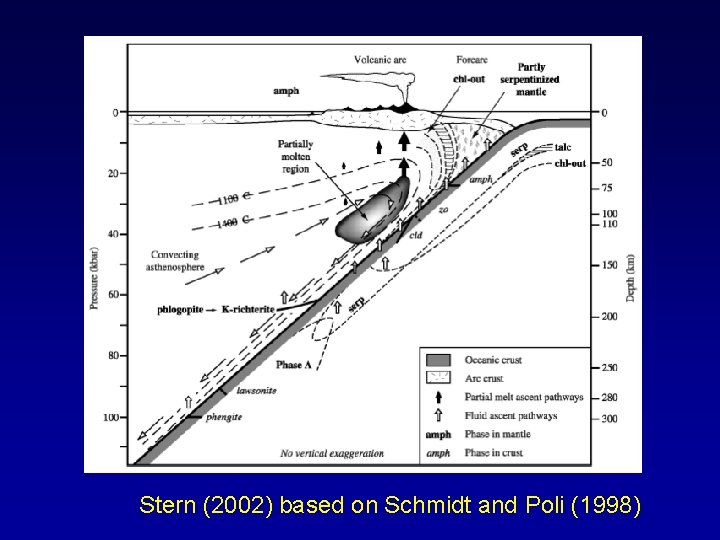
Stern (2002) based on Schmidt and Poli (1998)
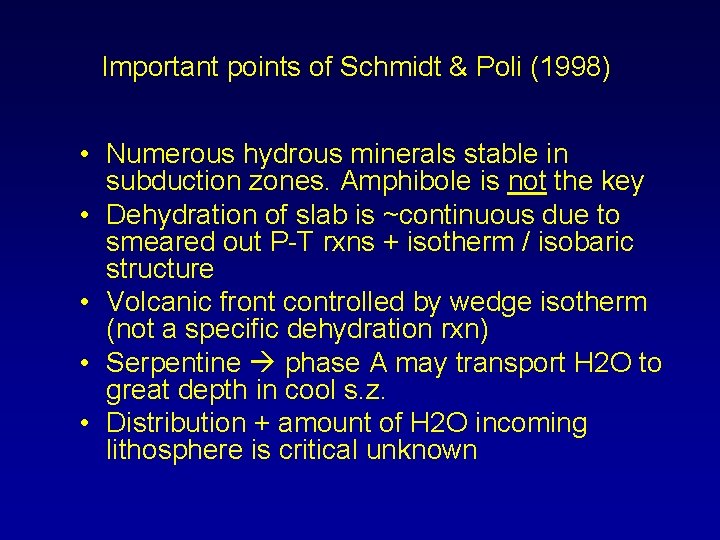
Important points of Schmidt & Poli (1998) • Numerous hydrous minerals stable in subduction zones. Amphibole is not the key • Dehydration of slab is ~continuous due to smeared out P-T rxns + isotherm / isobaric structure • Volcanic front controlled by wedge isotherm (not a specific dehydration rxn) • Serpentine phase A may transport H 2 O to great depth in cool s. z. • Distribution + amount of H 2 O incoming lithosphere is critical unknown
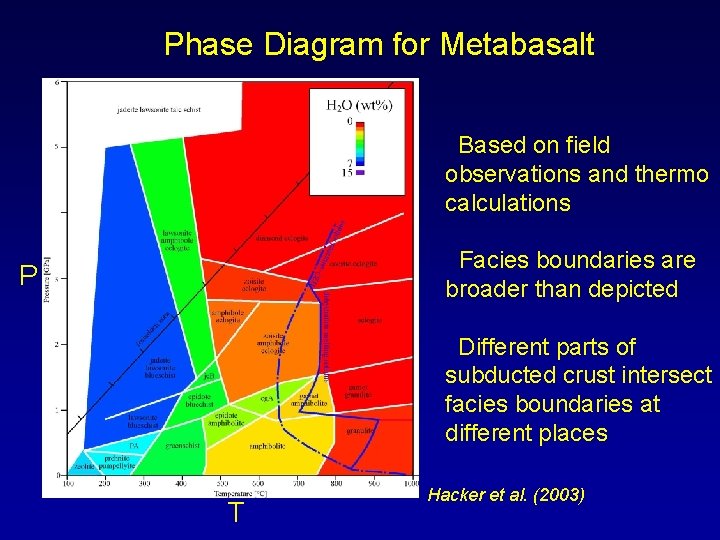
Phase Diagram for Metabasalt Based on field observations and thermo calculations Facies boundaries are broader than depicted P Different parts of subducted crust intersect facies boundaries at different places T Hacker et al. (2003)
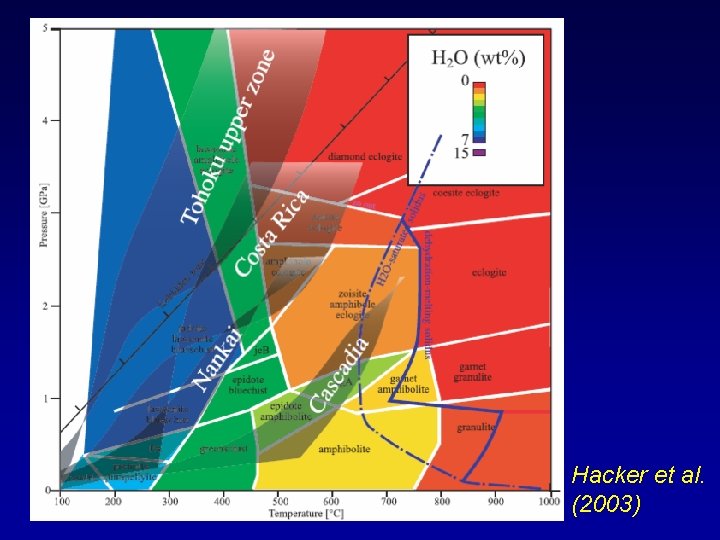
Hacker et al. (2003)
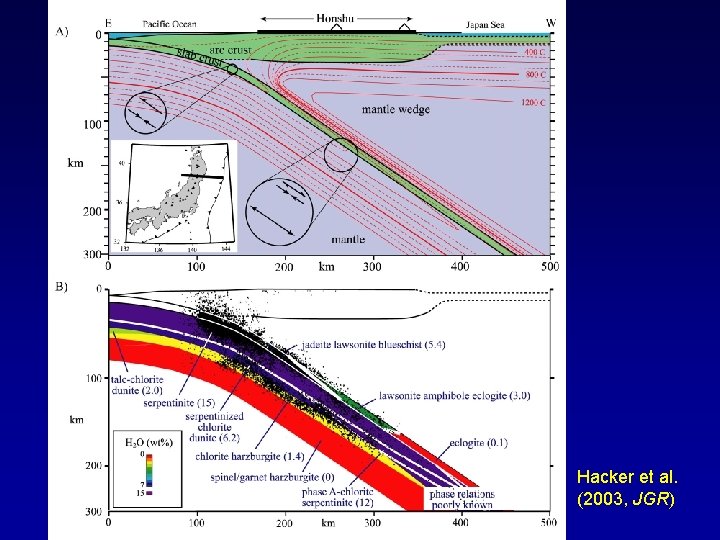
Hacker et al. (2003, JGR)
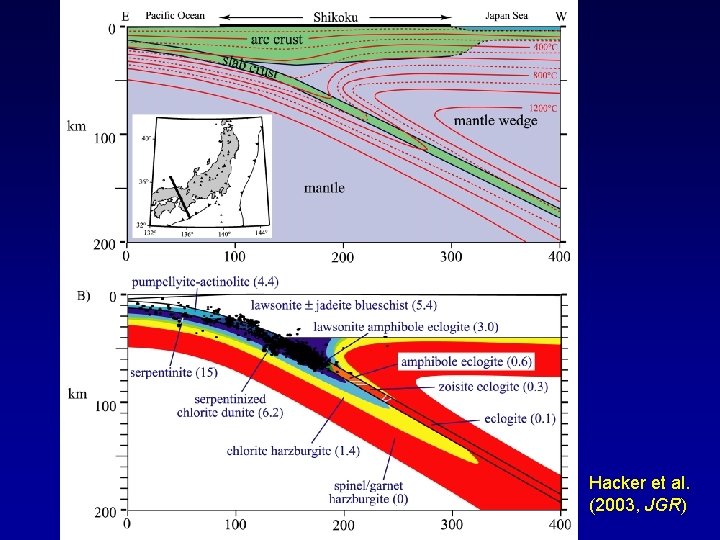
Hacker et al. (2003, JGR)
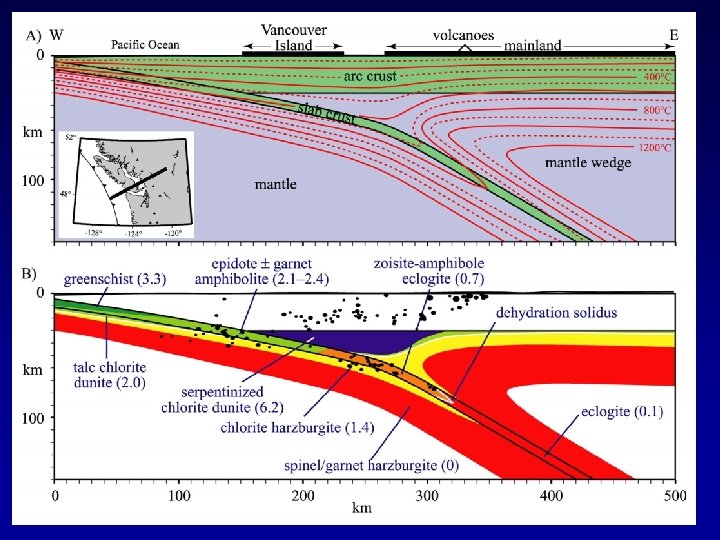
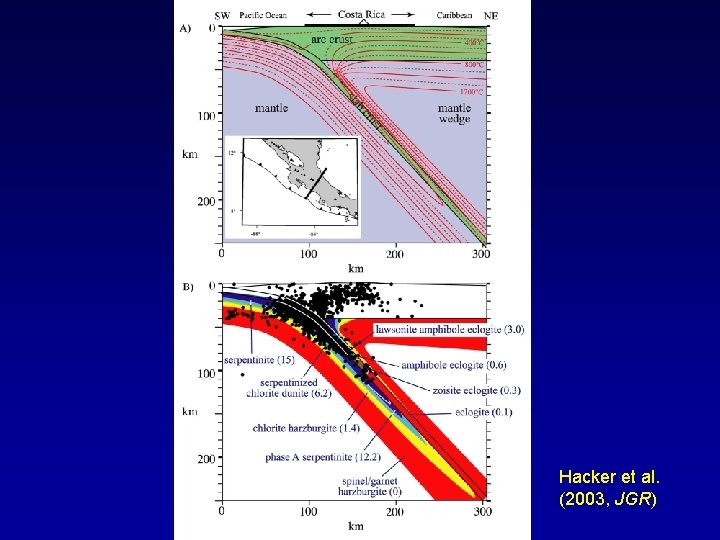
Hacker et al. (2003, JGR)
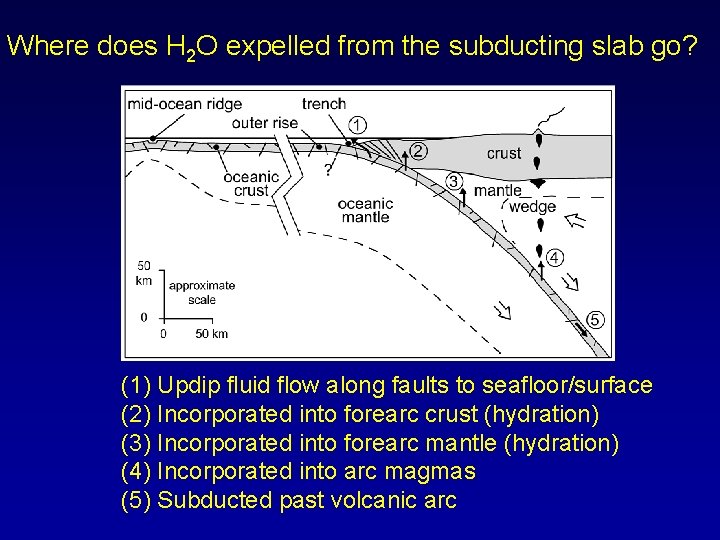
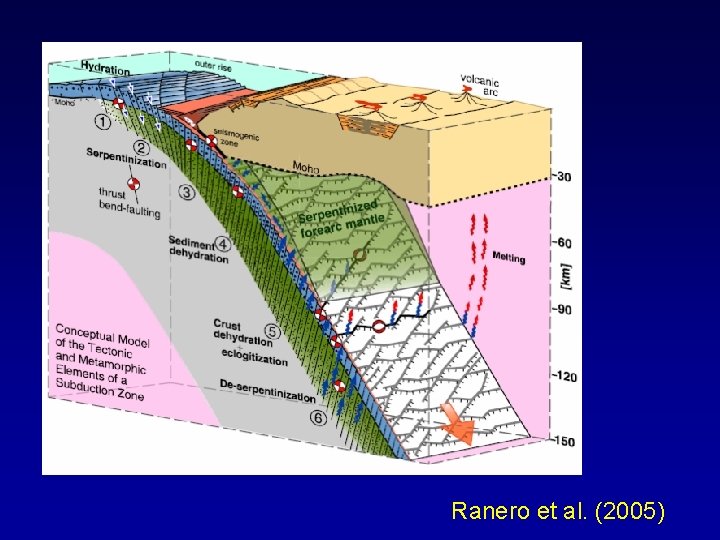
Where does H 2 O expelled from the subducting slab go? (1) Updip fluid flow along faults to seafloor/surface (2) Incorporated into forearc crust (hydration) (3) Incorporated into forearc mantle (hydration) (4) Incorporated into arc magmas (5) Subducted past volcanic arc
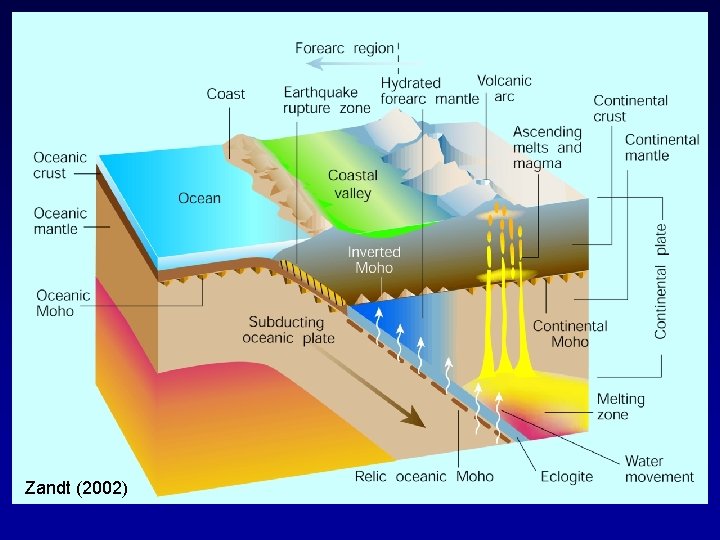
Zandt (2002)
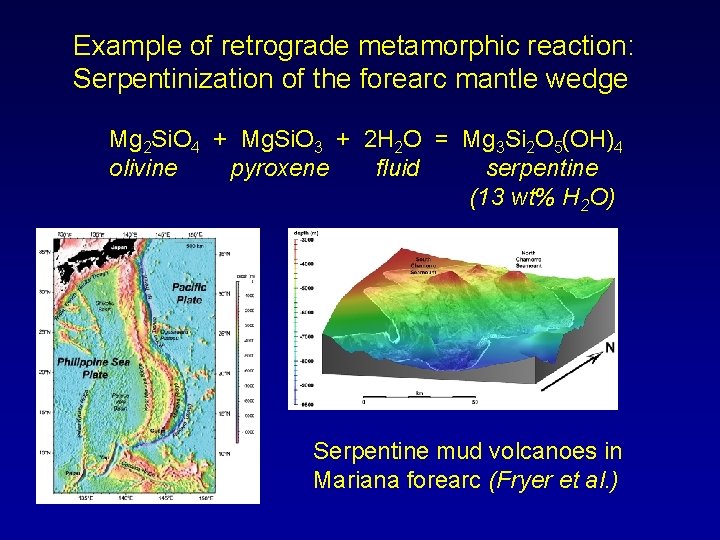
Example of retrograde metamorphic reaction: Serpentinization of the forearc mantle wedge Mg 2 Si. O 4 + Mg. Si. O 3 + 2 H 2 O = Mg 3 Si 2 O 5(OH)4 olivine pyroxene fluid serpentine (13 wt% H 2 O) Serpentine mud volcanoes in Mariana forearc (Fryer et al. )
Evidence for Serpentinized Forearc Mantle • Active serpentine mud volcanoes (Mariana forearc) • Hydrated ultramafic hanging walls of paleosubduction zones • Low seismic velocities, high Poisson’s ratios observed in forearc mantle (Alaska, Aleutians, Andes, Cascadia, Costa Rica, Izu. Bonin, Japan, Mariana)
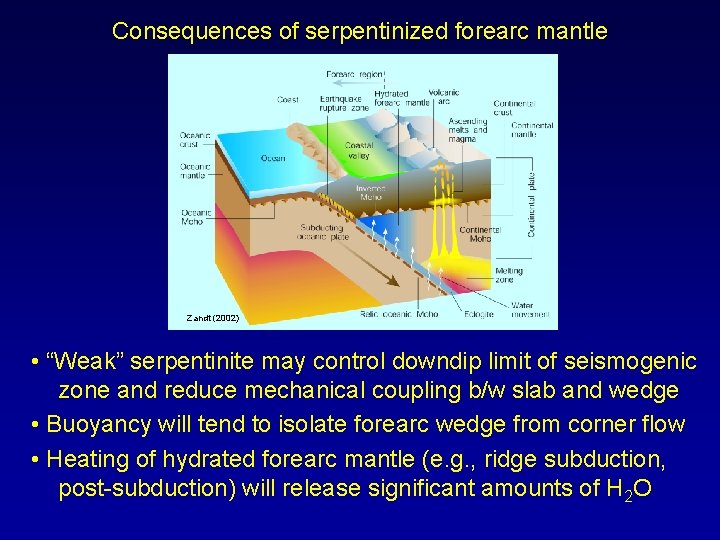
Consequences of serpentinized forearc mantle Zandt (2002) • “Weak” serpentinite may control downdip limit of seismogenic zone and reduce mechanical coupling b/w slab and wedge • Buoyancy will tend to isolate forearc wedge from corner flow • Heating of hydrated forearc mantle (e. g. , ridge subduction, post-subduction) will release significant amounts of H 2 O
Cascadia (central Oregon) Bostock et al. (2002, Nature)
Isoviscous vs. Olivine Rheology van Keken, Kiefer, and Peacock (2002)
Mantle Wedge and Interface Rheology Isoviscous wedge Non-Newtonian wedge Abers et al. (2006) Non-Newtonian Cold nose (0% coupling) Non-Newtonian Cold nose (10% coupling)
Ranero et al. (2005)
Zandt (2002)

The End
- Slides: 47