
Fluid Overload Prior To Continuous Hemofiltration and Survival


- Slides: 25
Fluid Overload Prior To Continuous Hemofiltration and Survival in Critically Ill Children J Foland, J Fortenberry, B Warshaw, R Pettignano, R Merritt, M Heard, K Rogers, C Reid, A Tanner, K Easley Children’s Healthcare of Atlanta at Egleston Emory University School of Medicine Atlanta, Georgia Accepted for publication in Critical Care Medicine, August 2004
Background o Renal replacement therapy is used for primary and secondary renal failure o Continuous venous hemofiltration (CVVH) is the preferred modality in our ICUs
Background o Goldstein et al. (Pediatrics, 2000) o 21 ICU children on CVVH(D) o Survival associated with ICU fluid overload prior to CVVH o GFR had no association with survival o Lane et al. (Bone Marrow Transplant, 1994) o 30 pediatric BMT recipients o Survival associated with < 10% weight gain from baseline
Hypotheses o CVVH survivors have less fluid overload than non-survivors prior to CVVH o Increasing fluid overload prior to CVVH is associated with decreasing survival
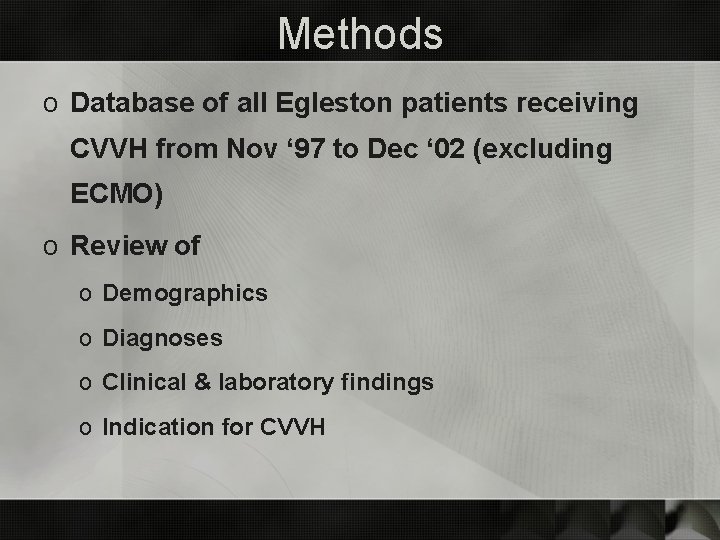
Methods o Database of all Egleston patients receiving CVVH from Nov ‘ 97 to Dec ‘ 02 (excluding ECMO) o Review of o Demographics o Diagnoses o Clinical & laboratory findings o Indication for CVVH
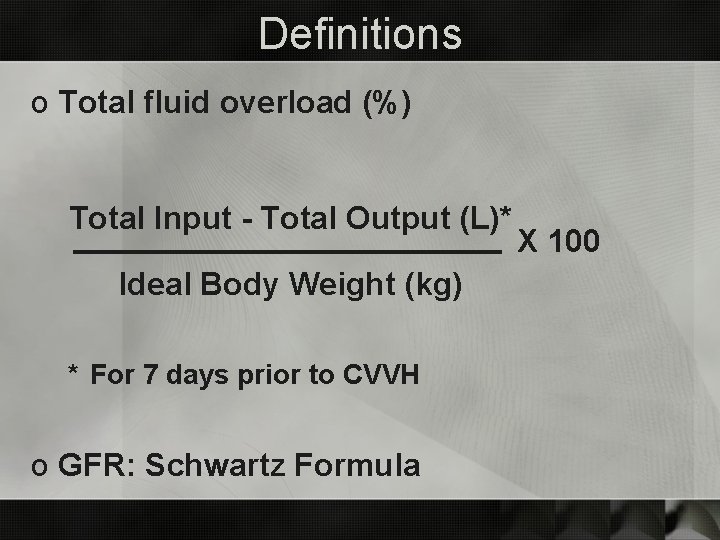
Definitions o Total fluid overload (%) Total Input - Total Output (L)* Ideal Body Weight (kg) * For 7 days prior to CVVH o GFR: Schwartz Formula X 100
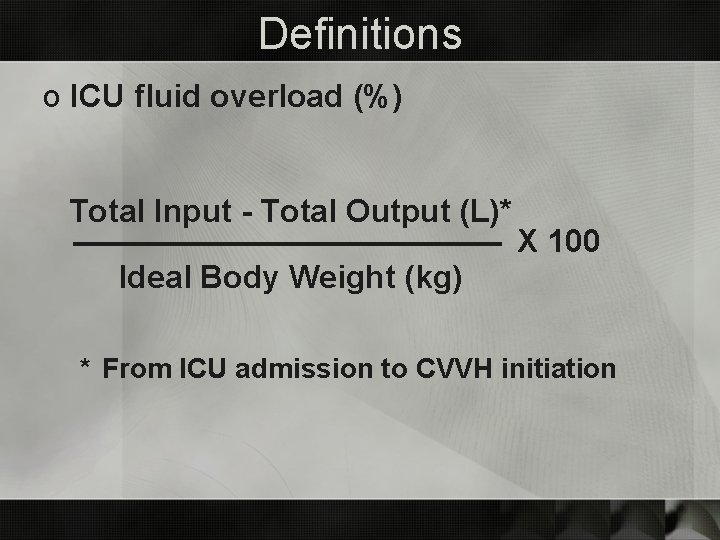
Definitions o ICU fluid overload (%) Total Input - Total Output (L)* X 100 Ideal Body Weight (kg) * From ICU admission to CVVH initiation
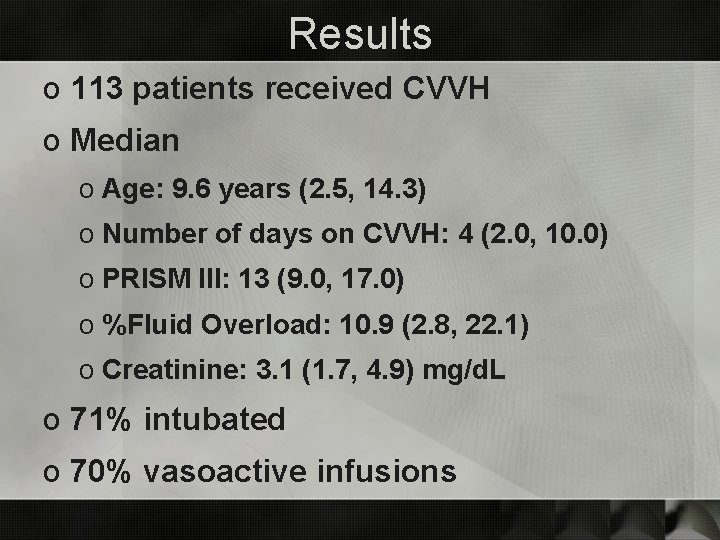
Results o 113 patients received CVVH o Median o Age: 9. 6 years (2. 5, 14. 3) o Number of days on CVVH: 4 (2. 0, 10. 0) o PRISM III: 13 (9. 0, 17. 0) o %Fluid Overload: 10. 9 (2. 8, 22. 1) o Creatinine: 3. 1 (1. 7, 4. 9) mg/d. L o 71% intubated o 70% vasoactive infusions
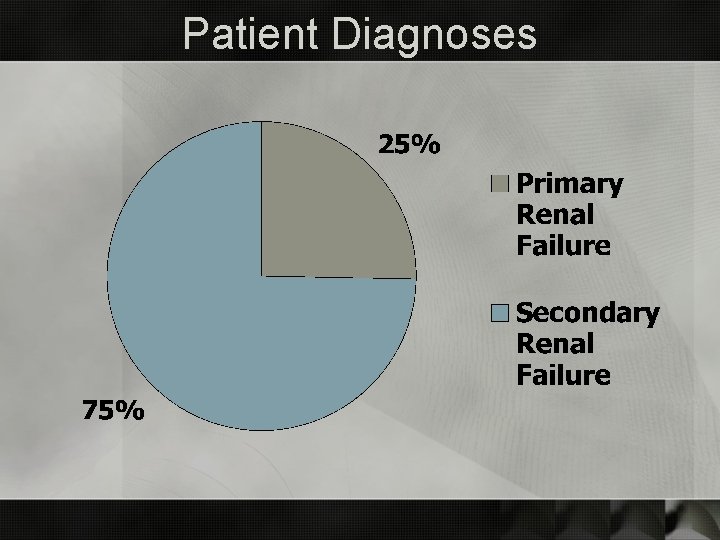
Patient Diagnoses
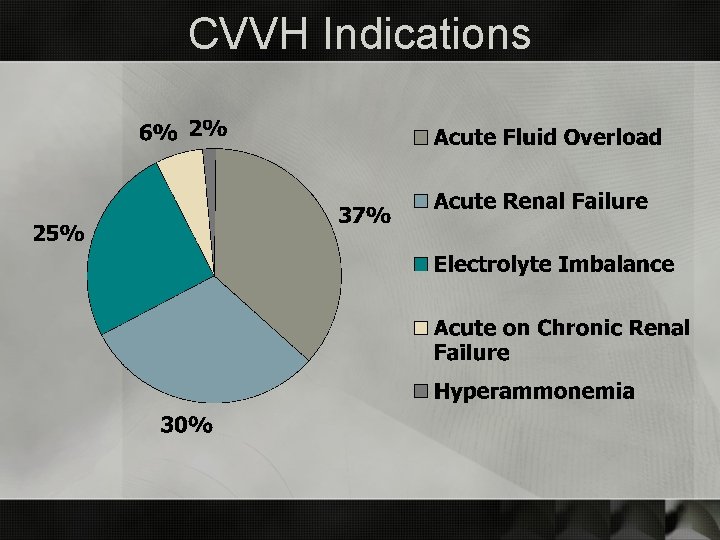
CVVH Indications
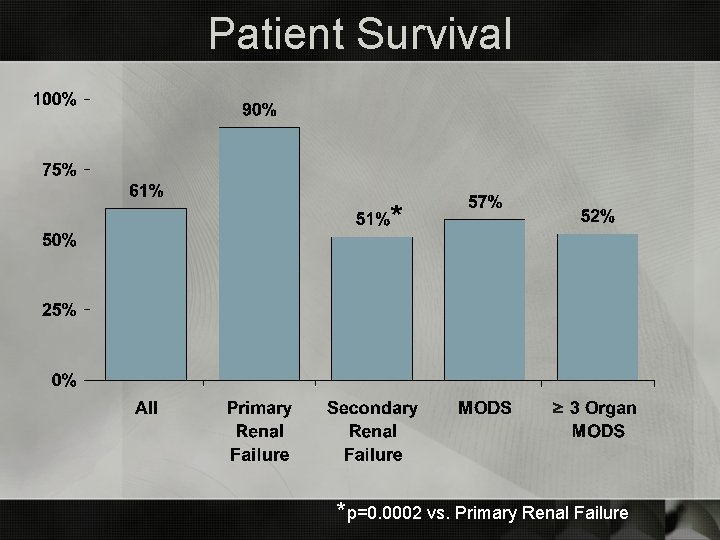
Patient Survival * *p=0. 0002 vs. Primary Renal Failure
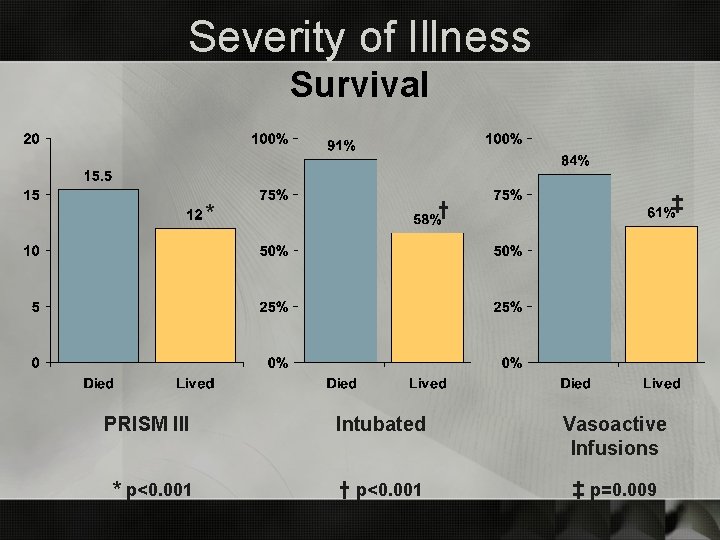
Severity of Illness Survival ‡ † * PRISM III Intubated Vasoactive Infusions * p<0. 001 † p<0. 001 ‡ p=0. 009
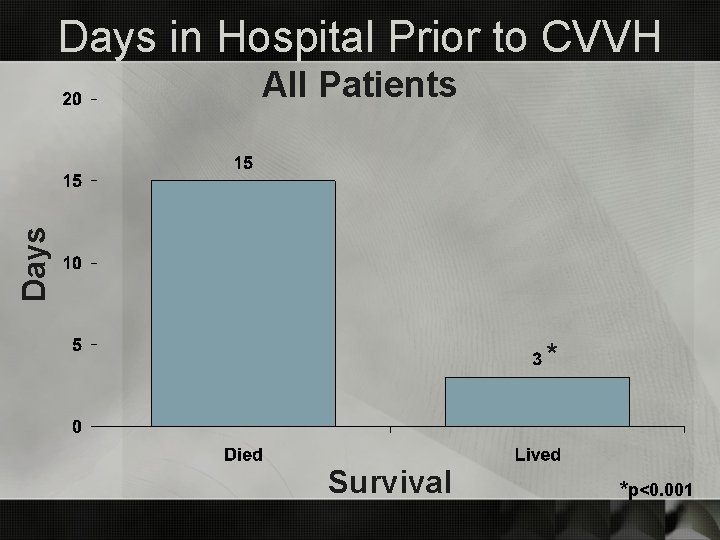
Days in Hospital Prior to CVVH Days All Patients * Survival *p<0. 001
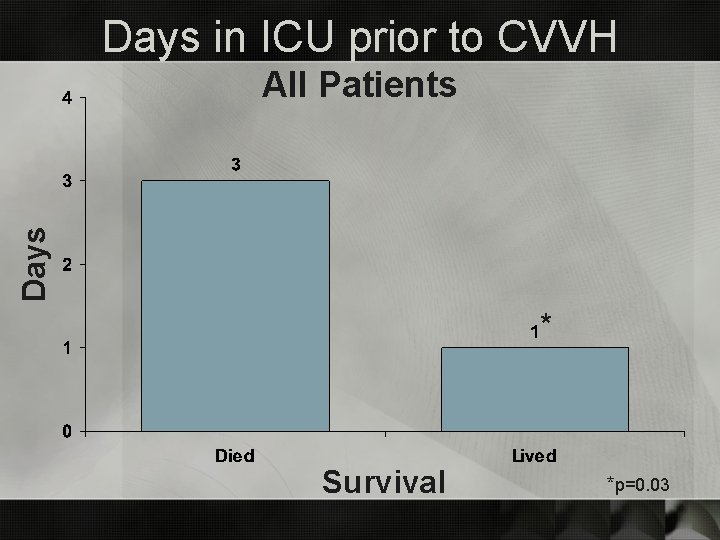
Days in ICU prior to CVVH Days All Patients * Survival *p=0. 03
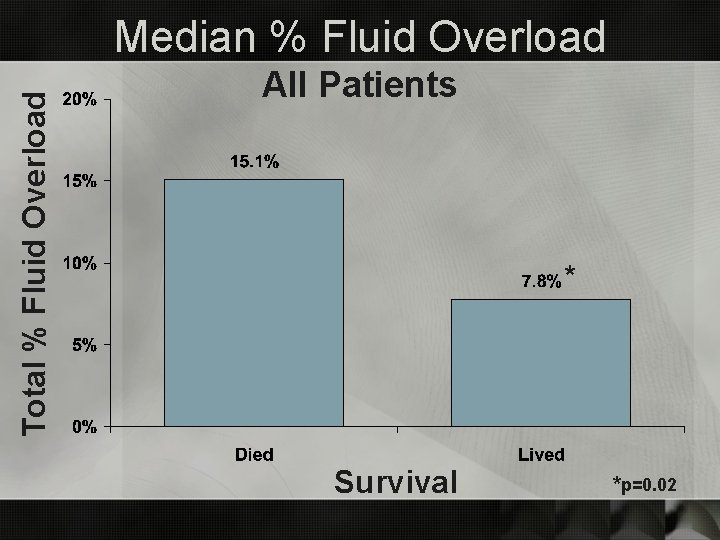
Total % Fluid Overload Median % Fluid Overload All Patients * Survival *p=0. 02
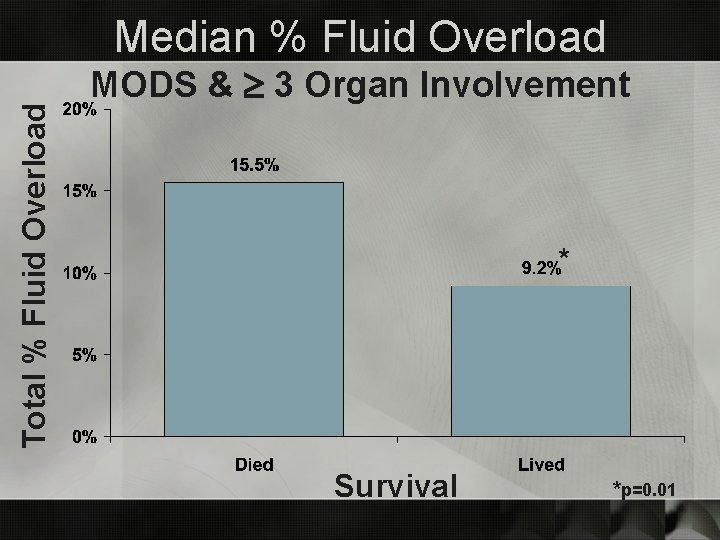
Total % Fluid Overload Median % Fluid Overload MODS & 3 Organ Involvement * Survival *p=0. 01
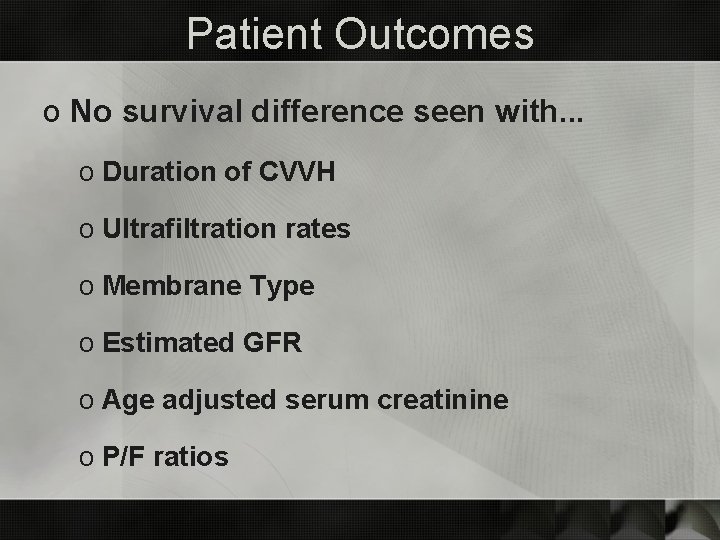
Patient Outcomes o No survival difference seen with. . . o Duration of CVVH o Ultrafiltration rates o Membrane Type o Estimated GFR o Age adjusted serum creatinine o P/F ratios
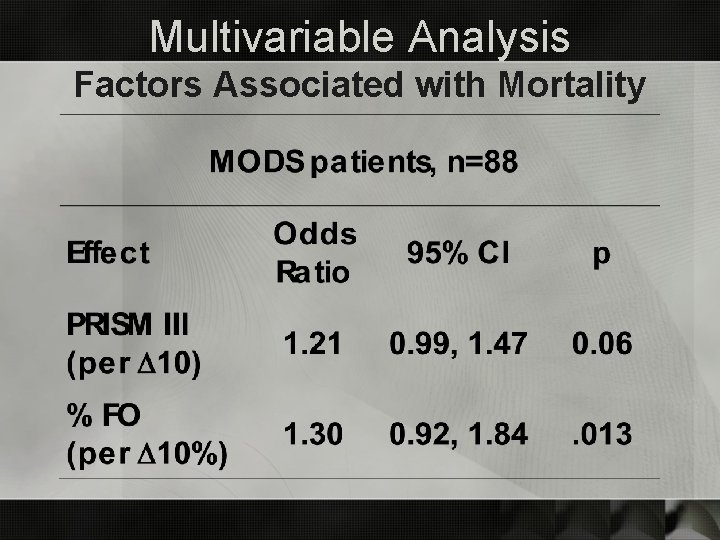
Multivariable Analysis Factors Associated with Mortality
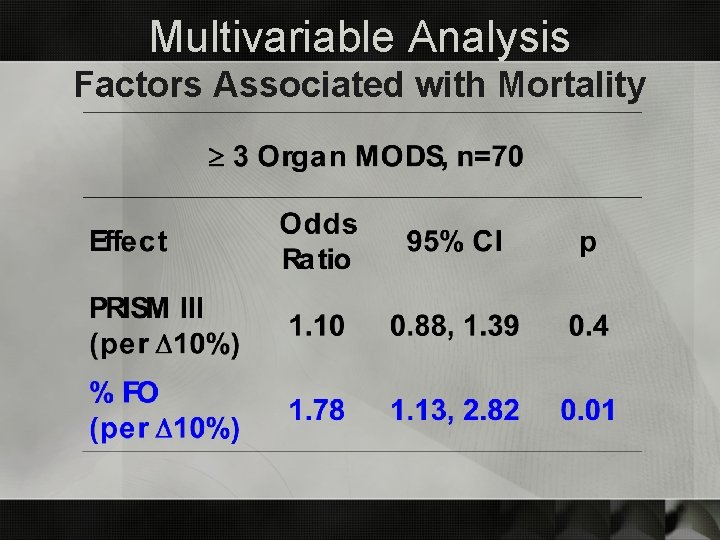
Multivariable Analysis Factors Associated with Mortality
Multivariable Analysis Factors Associated with Mortality
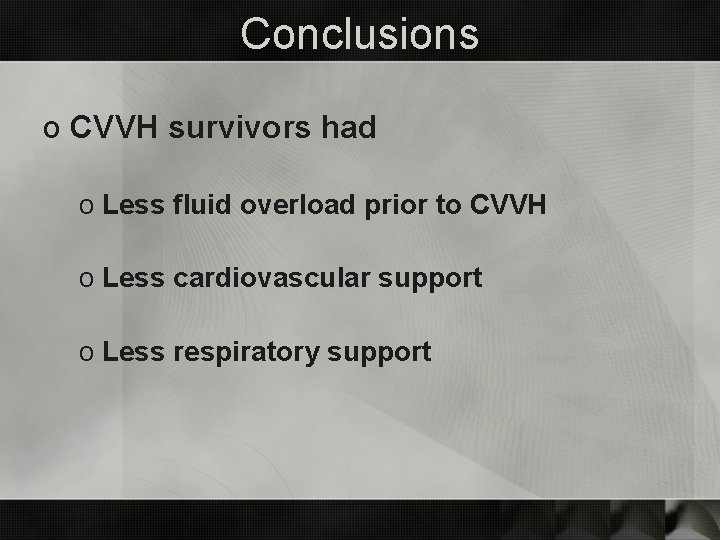
Conclusions o CVVH survivors had o Less fluid overload prior to CVVH o Less cardiovascular support o Less respiratory support
Conclusion: Fluid Overload Our review suggests that increasing fluid overload is associated with decreased survival in pediatric patients receiving CVVH, particularly those with 3 organ MODS
Speculation Total percent fluid overload prior to CVVH may be a better predictor of survival than other indicators of severity of illness in select patients
Speculation Earlier use of CVVH, prior to excessive fluid overload, overload in critically ill children may be associated with increased survival
Questions?