
Fluid Mechanics Preview Section 1 Fluids and Buoyant
Fluid Mechanics Preview Section 1 Fluids and Buoyant Force Section 2 Fluid Pressure Section 3 Fluids in Motion © Houghton Mifflin Harcourt Publishing Company Section 1
Fluid Mechanics Section 1 What do you think? • Imagine yourself relaxing in the deep end of a swimming pool. You don’t move at all to stay afloat. Will you float anyway, or will you gently sink to the bottom of the pool? • Explain why you will or will not float. • Do you believe your classmates will answer similarly? • Why? © Houghton Mifflin Harcourt Publishing Company

Fluid Mechanics Section 1 Fluids • A fluid is anything that flows. – Liquids or gases • Liquids have a definite volume. – Changing containers does not change the volume • Gases do not have definite volume. – They fill any container. • What property of gas molecules allows them to fill any container? © Houghton Mifflin Harcourt Publishing Company
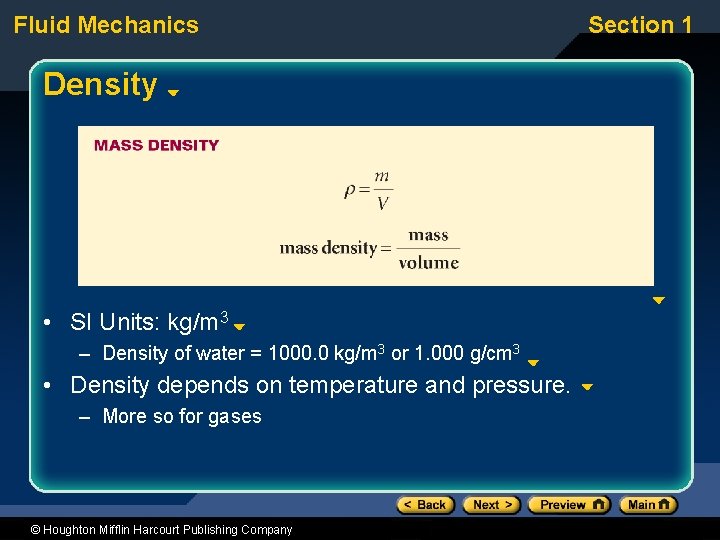
Fluid Mechanics Density • SI Units: kg/m 3 – Density of water = 1000. 0 kg/m 3 or 1. 000 g/cm 3 • Density depends on temperature and pressure. – More so for gases © Houghton Mifflin Harcourt Publishing Company Section 1
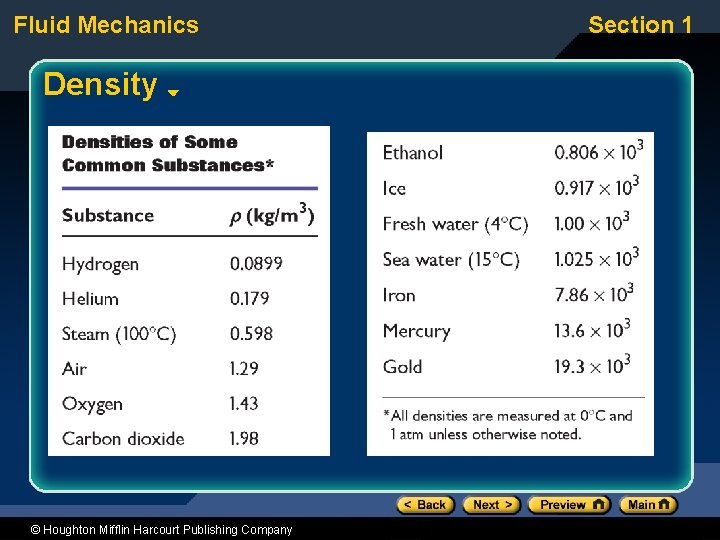
Fluid Mechanics Density © Houghton Mifflin Harcourt Publishing Company Section 1
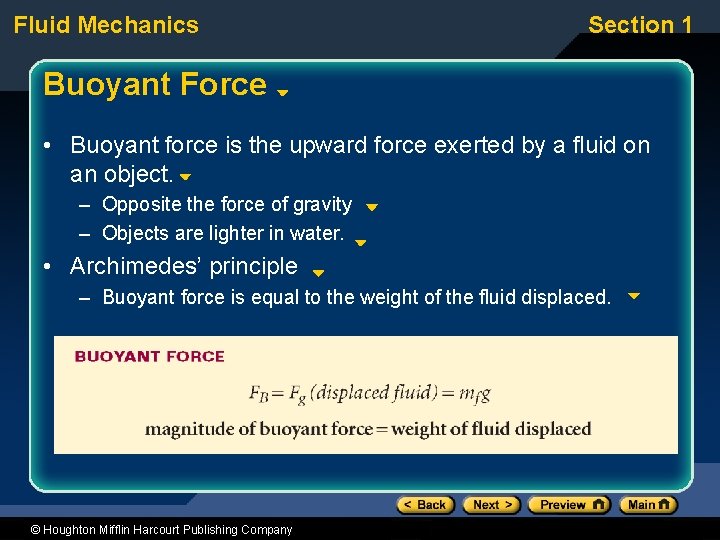
Fluid Mechanics Section 1 Buoyant Force • Buoyant force is the upward force exerted by a fluid on an object. – Opposite the force of gravity – Objects are lighter in water. • Archimedes’ principle – Buoyant force is equal to the weight of the fluid displaced. © Houghton Mifflin Harcourt Publishing Company
Fluid Mechanics Section 1 Buoyant Force Click below to watch the Visual Concept © Houghton Mifflin Harcourt Publishing Company
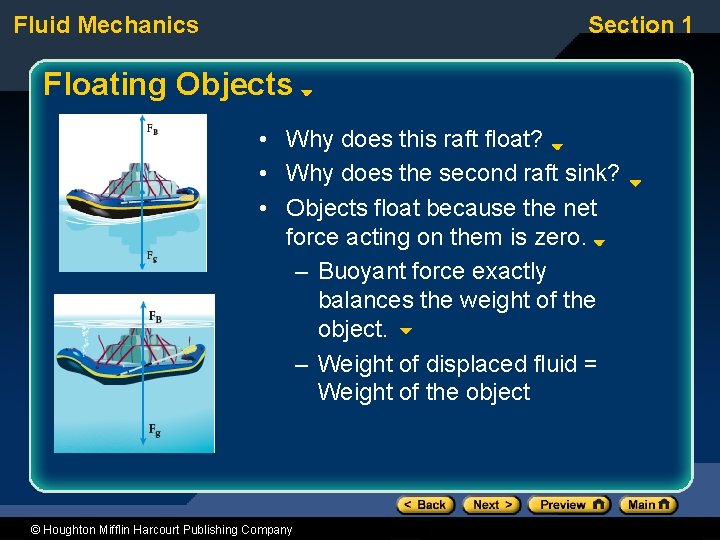
Fluid Mechanics Section 1 Floating Objects • Why does this raft float? • Why does the second raft sink? • Objects float because the net force acting on them is zero. – Buoyant force exactly balances the weight of the object. – Weight of displaced fluid = Weight of the object © Houghton Mifflin Harcourt Publishing Company
Fluid Mechanics Section 1 Buoyant Force on Floating Objects Click below to watch the Visual Concept © Houghton Mifflin Harcourt Publishing Company
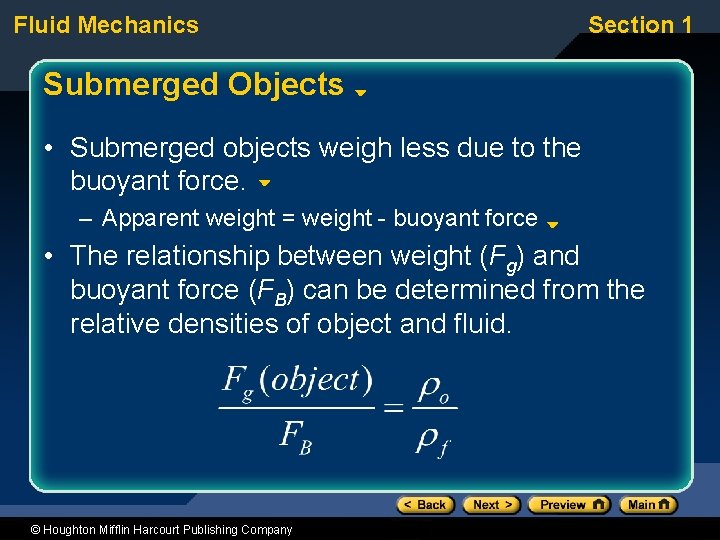
Fluid Mechanics Section 1 Submerged Objects • Submerged objects weigh less due to the buoyant force. – Apparent weight = weight - buoyant force • The relationship between weight (Fg) and buoyant force (FB) can be determined from the relative densities of object and fluid. © Houghton Mifflin Harcourt Publishing Company
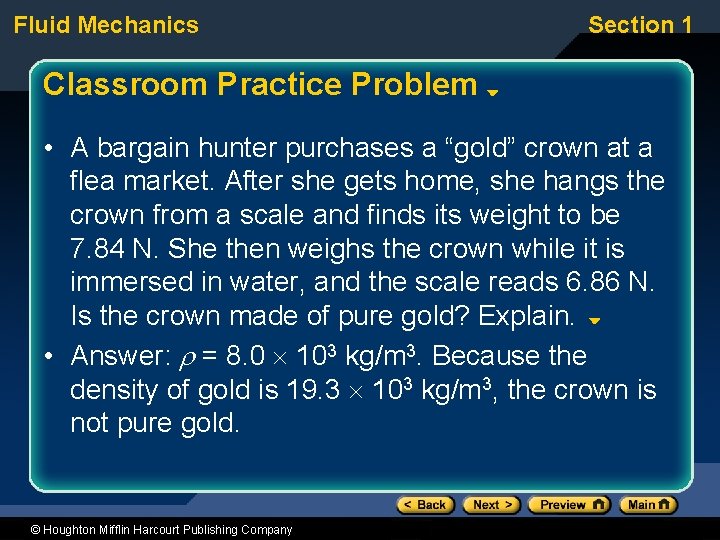
Fluid Mechanics Section 1 Classroom Practice Problem • A bargain hunter purchases a “gold” crown at a flea market. After she gets home, she hangs the crown from a scale and finds its weight to be 7. 84 N. She then weighs the crown while it is immersed in water, and the scale reads 6. 86 N. Is the crown made of pure gold? Explain. • Answer: r = 8. 0 103 kg/m 3. Because the density of gold is 19. 3 103 kg/m 3, the crown is not pure gold. © Houghton Mifflin Harcourt Publishing Company
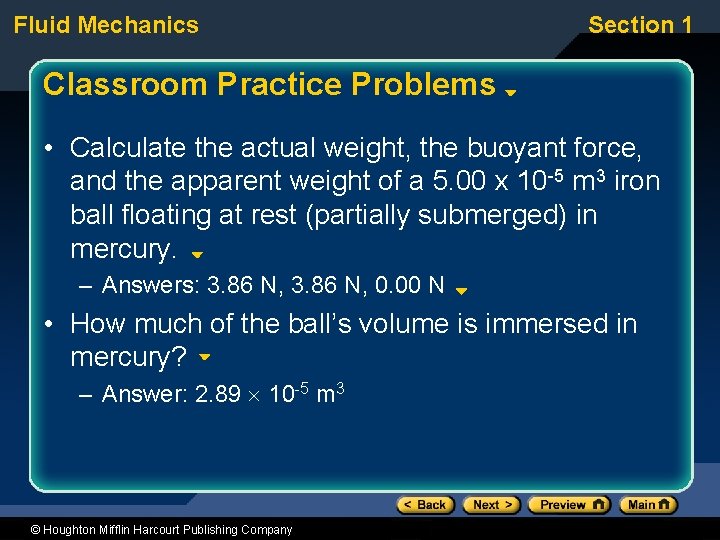
Fluid Mechanics Section 1 Classroom Practice Problems • Calculate the actual weight, the buoyant force, and the apparent weight of a 5. 00 x 10 -5 m 3 iron ball floating at rest (partially submerged) in mercury. – Answers: 3. 86 N, 0. 00 N • How much of the ball’s volume is immersed in mercury? – Answer: 2. 89 10 -5 m 3 © Houghton Mifflin Harcourt Publishing Company
Fluid Mechanics Section 1 Now what do you think? • Imagine yourself relaxing in the deep end of a swimming pool. You don’t move at all to stay afloat. Will you float anyway, or will you gently sink to the bottom of the pool? • Explain why you will or will not float. • Use density to explain why objects float. • Use Archimedes’ principle to explain why objects float. © Houghton Mifflin Harcourt Publishing Company
Fluid Mechanics Section 2 What do you think? • What causes air pressure? • Why does air pressure vary in the same location on different days? • How does air pressure vary with altitude? Why? • When climatologists talk about “high pressure systems” or “low pressure systems, ” what do they mean? © Houghton Mifflin Harcourt Publishing Company
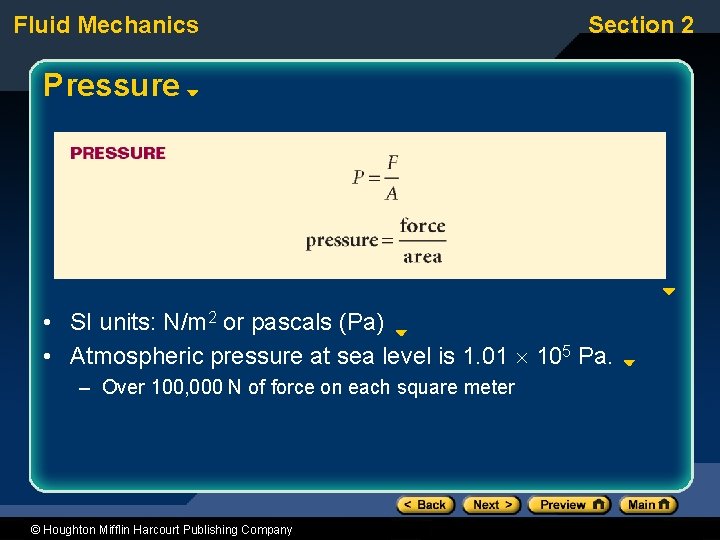
Fluid Mechanics Section 2 Pressure • SI units: N/m 2 or pascals (Pa) • Atmospheric pressure at sea level is 1. 01 105 Pa. – Over 100, 000 N of force on each square meter © Houghton Mifflin Harcourt Publishing Company
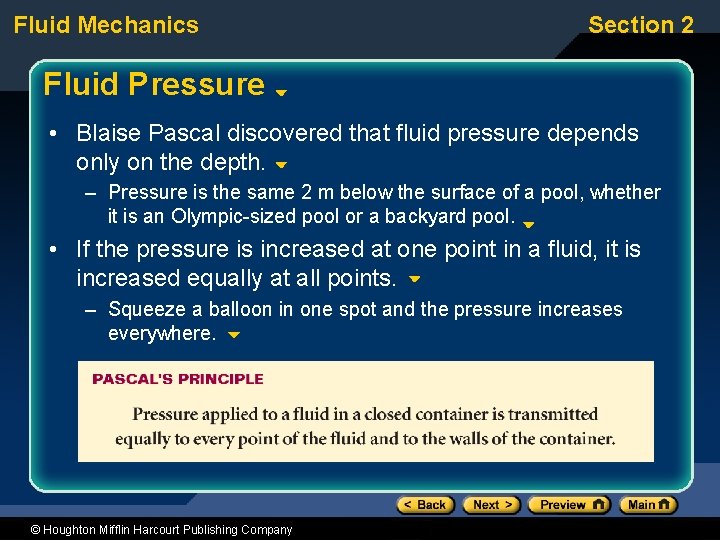
Fluid Mechanics Section 2 Fluid Pressure • Blaise Pascal discovered that fluid pressure depends only on the depth. – Pressure is the same 2 m below the surface of a pool, whether it is an Olympic-sized pool or a backyard pool. • If the pressure is increased at one point in a fluid, it is increased equally at all points. – Squeeze a balloon in one spot and the pressure increases everywhere. © Houghton Mifflin Harcourt Publishing Company
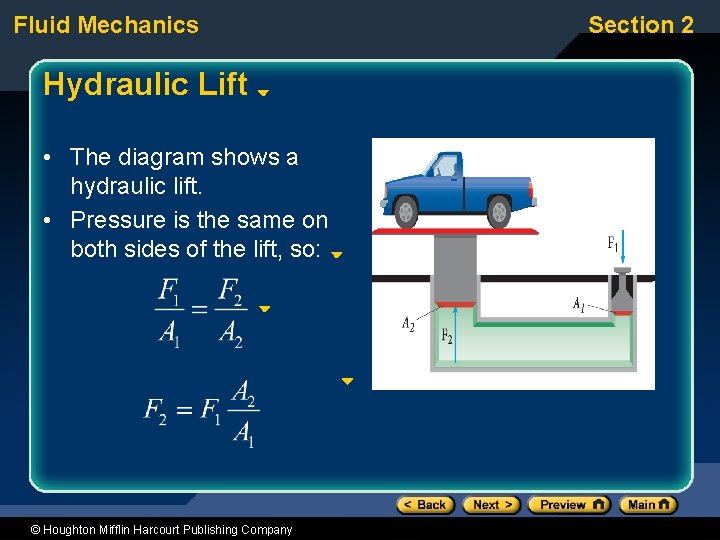
Fluid Mechanics Hydraulic Lift • The diagram shows a hydraulic lift. • Pressure is the same on both sides of the lift, so: © Houghton Mifflin Harcourt Publishing Company Section 2
Fluid Mechanics Section 2 Pascal's Principle Click below to watch the Visual Concept © Houghton Mifflin Harcourt Publishing Company
Fluid Mechanics Section 2 Pressure Varies with Depth • Pressure from fluids is caused by the weight of the fluid pushing down. – For example, atmospheric pressure is caused by the weight of the air above us. • How would you calculate the weight and the pressure from a column of water with a base area of 1. 00 m 2 and a height of 2. 00 m? – Answers: 19, 600 N, 19, 600 Pa © Houghton Mifflin Harcourt Publishing Company
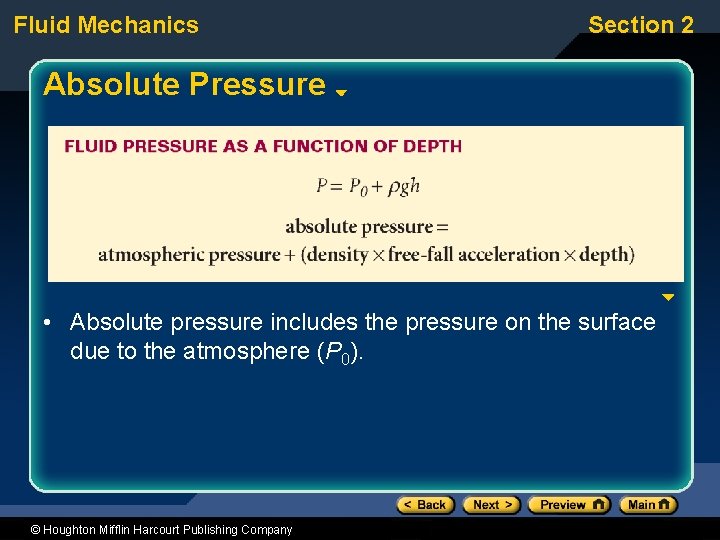
Fluid Mechanics Section 2 Absolute Pressure • Absolute pressure includes the pressure on the surface due to the atmosphere (P 0). © Houghton Mifflin Harcourt Publishing Company
Fluid Mechanics Section 2 Classroom Practice Problems • In a hydraulic lift, a 620 N force is exerted on a 0. 20 m 2 piston in order to support a weight that is placed on a 2. 0 m 2 piston. How much pressure is exerted on the narrow piston? How much weight can the wide piston hold? – Answers: 3. 1 x 10³ Pa, 6. 2 x 10³ N • At what depth, in water, does the pressure double from normal atmospheric pressure (1. 01 105 Pa)? – Answer: 10. 3 m © Houghton Mifflin Harcourt Publishing Company
Fluid Mechanics Section 2 Now what do you think? • What causes air pressure? – Why does air pressure vary in the same location on different days? – How does air pressure vary with altitude? Why? • When climatologists talk about “high pressure systems” or “low pressure systems, ” what do they mean? © Houghton Mifflin Harcourt Publishing Company
Fluid Mechanics Section 3 What do you think? • In order for an airplane to lift off from the ground, there must be an upward force greater than the weight of the plane. • What is the source of that force? • How can it be increased or decreased? • How does the design of the plane produce this net upward force? © Houghton Mifflin Harcourt Publishing Company
Fluid Mechanics Section 3 Fluid Flow • There are two basic types of flow. – Laminar flow - smooth paths that all particles follow – Turbulent flow - irregular motions of the particles • For now, we’ll study only the flow of ideal fluids. – incompressible – no viscosity or internal friction – non-turbulent flow © Houghton Mifflin Harcourt Publishing Company
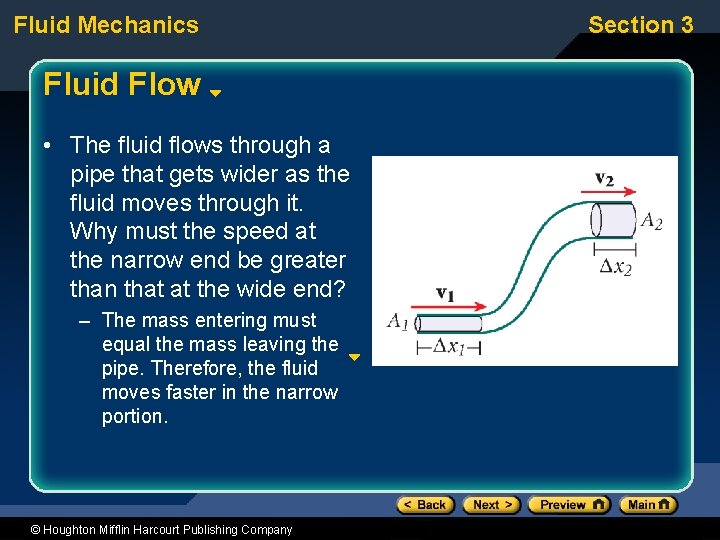
Fluid Mechanics Fluid Flow • The fluid flows through a pipe that gets wider as the fluid moves through it. Why must the speed at the narrow end be greater than that at the wide end? – The mass entering must equal the mass leaving the pipe. Therefore, the fluid moves faster in the narrow portion. © Houghton Mifflin Harcourt Publishing Company Section 3
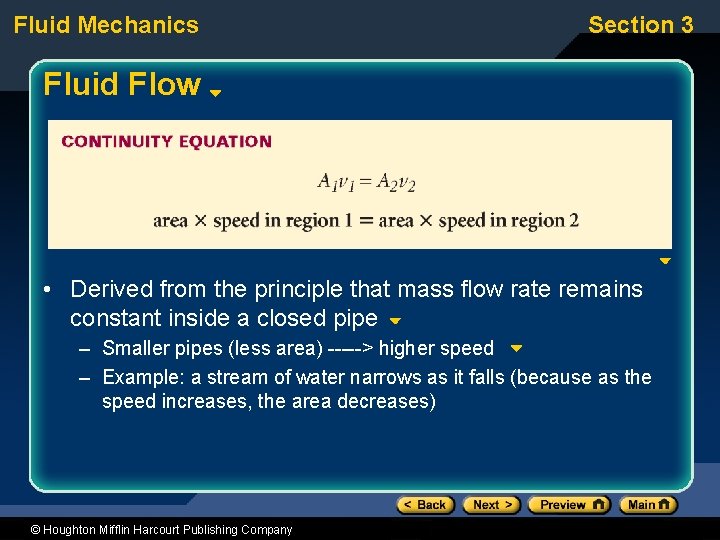
Fluid Mechanics Section 3 Fluid Flow • Derived from the principle that mass flow rate remains constant inside a closed pipe – Smaller pipes (less area) -----> higher speed – Example: a stream of water narrows as it falls (because as the speed increases, the area decreases) © Houghton Mifflin Harcourt Publishing Company
Fluid Mechanics Section 3 Classroom Practice Problem • Water falling from a faucet has a cross-sectional area of 1. 25 cm 2 near the top when the speed is 0. 500 m/s. After it has fallen to a point near the bottom of the sink, the speed is 2. 50 m/s. What is the cross-sectional area of the stream at that point? • Answer: 0. 250 cm 2 © Houghton Mifflin Harcourt Publishing Company
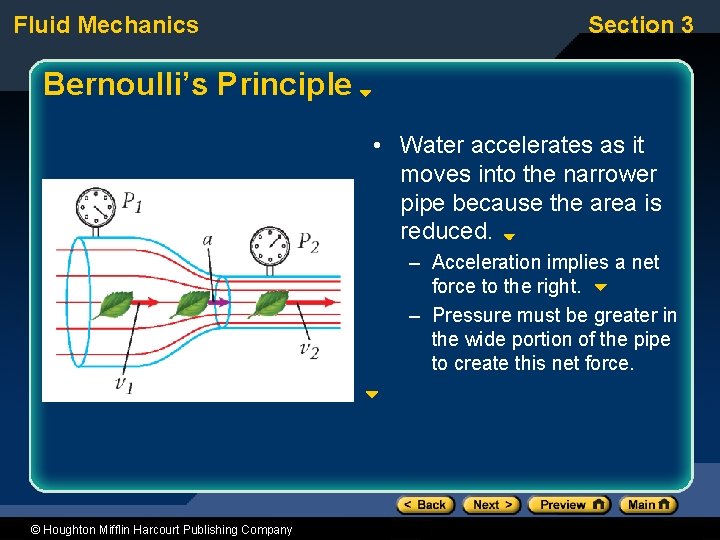
Fluid Mechanics Section 3 Bernoulli’s Principle • Water accelerates as it moves into the narrower pipe because the area is reduced. – Acceleration implies a net force to the right. – Pressure must be greater in the wide portion of the pipe to create this net force. © Houghton Mifflin Harcourt Publishing Company
Fluid Mechanics Section 3 Bernoulli's Principle Click below to watch the Visual Concept © Houghton Mifflin Harcourt Publishing Company
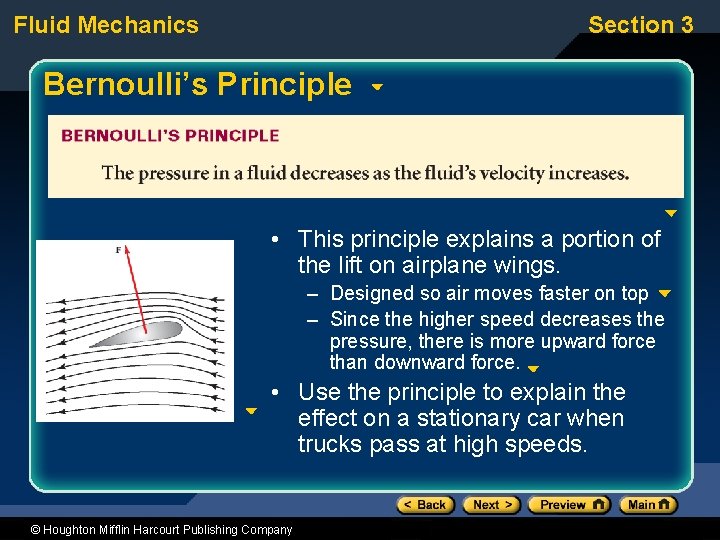
Fluid Mechanics Section 3 Bernoulli’s Principle • This principle explains a portion of the lift on airplane wings. – Designed so air moves faster on top – Since the higher speed decreases the pressure, there is more upward force than downward force. • Use the principle to explain the effect on a stationary car when trucks pass at high speeds. © Houghton Mifflin Harcourt Publishing Company
Fluid Mechanics Section 3 Now what do you think? • In order for an airplane to lift off the ground, there must be an upward force greater than the weight of the plane. • What is the source of that force? • How can it be increased or decreased? • How does the design of the plane produce this net upward force? © Houghton Mifflin Harcourt Publishing Company
- Slides: 31