
FLUID KINEMATICS LAGRANGIAN AND EULERIAN DESCRIPTIONS Kinematics The

- Slides: 25
FLUID KINEMATICS
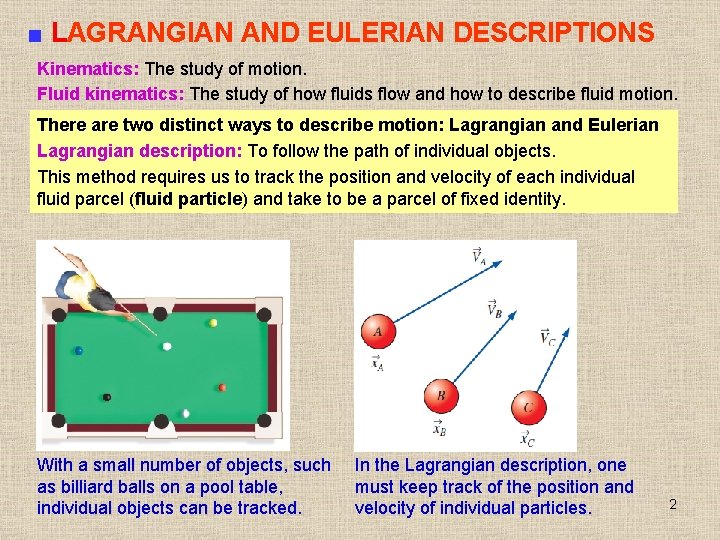
■ LAGRANGIAN AND EULERIAN DESCRIPTIONS Kinematics: The study of motion. Fluid kinematics: The study of how fluids flow and how to describe fluid motion. There are two distinct ways to describe motion: Lagrangian and Eulerian Lagrangian description: To follow the path of individual objects. This method requires us to track the position and velocity of each individual fluid parcel (fluid particle) and take to be a parcel of fixed identity. With a small number of objects, such as billiard balls on a pool table, individual objects can be tracked. In the Lagrangian description, one must keep track of the position and velocity of individual particles. 2
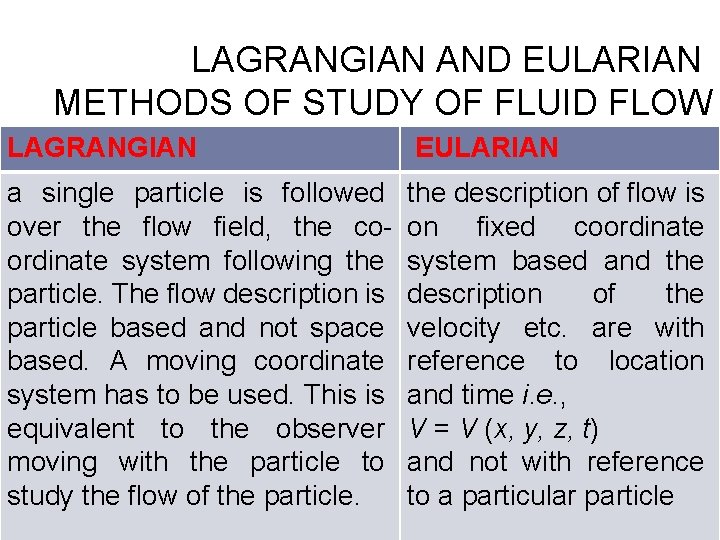
LAGRANGIAN AND EULARIAN METHODS OF STUDY OF FLUID FLOW LAGRANGIAN EULARIAN a single particle is followed over the flow field, the coordinate system following the particle. The flow description is particle based and not space based. A moving coordinate system has to be used. This is equivalent to the observer moving with the particle to study the flow of the particle. the description of flow is on fixed coordinate system based and the description of the velocity etc. are with reference to location and time i. e. , V = V (x, y, z, t) and not with reference to a particular particle
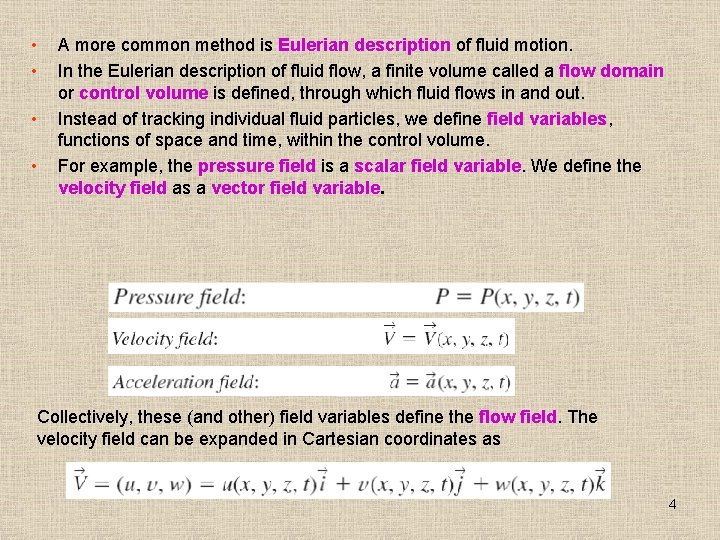
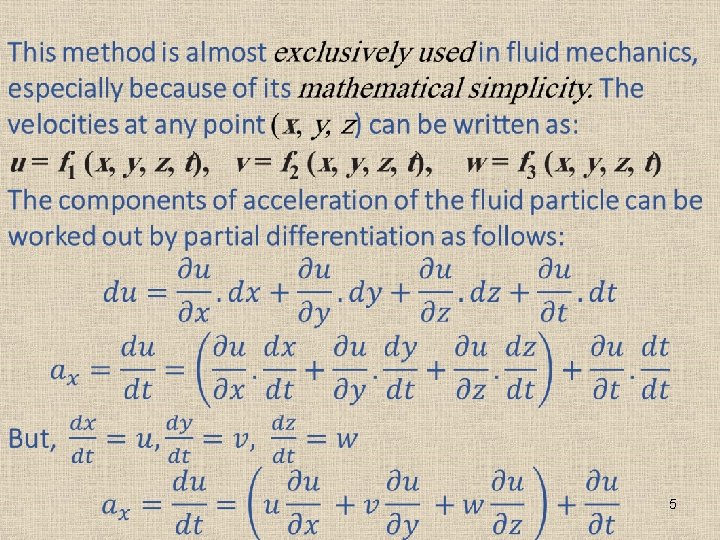
• • A more common method is Eulerian description of fluid motion. In the Eulerian description of fluid flow, a finite volume called a flow domain or control volume is defined, through which fluid flows in and out. Instead of tracking individual fluid particles, we define field variables, functions of space and time, within the control volume. For example, the pressure field is a scalar field variable. We define the velocity field as a vector field variable. Collectively, these (and other) field variables define the flow field. The velocity field can be expanded in Cartesian coordinates as 4
5
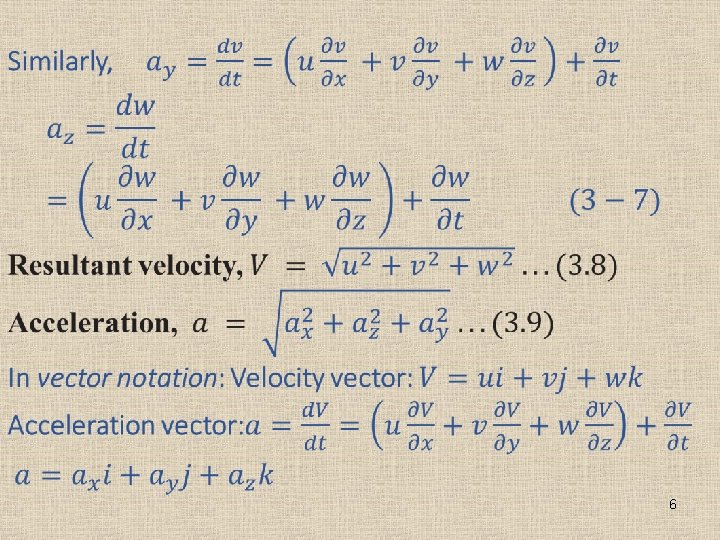
6
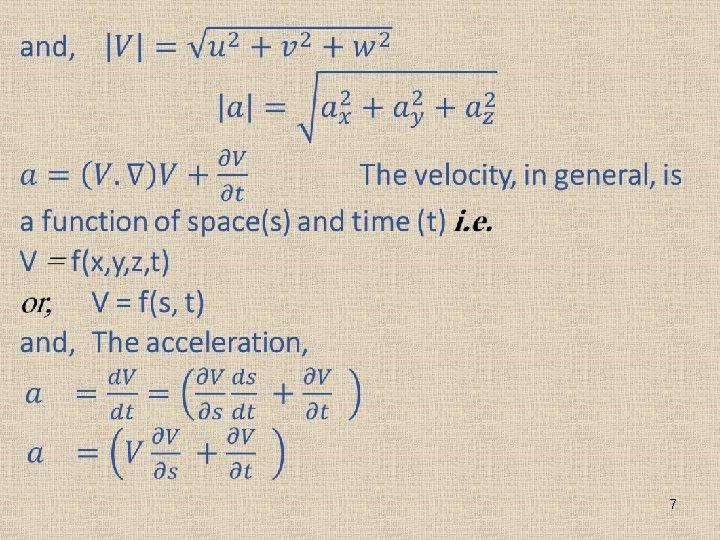
7
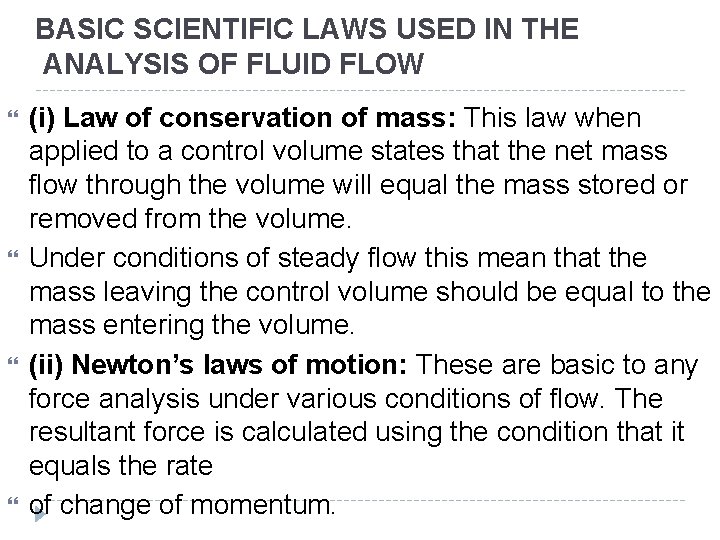
BASIC SCIENTIFIC LAWS USED IN THE ANALYSIS OF FLUID FLOW (i) Law of conservation of mass: This law when applied to a control volume states that the net mass flow through the volume will equal the mass stored or removed from the volume. Under conditions of steady flow this mean that the mass leaving the control volume should be equal to the mass entering the volume. (ii) Newton’s laws of motion: These are basic to any force analysis under various conditions of flow. The resultant force is calculated using the condition that it equals the rate of change of momentum.
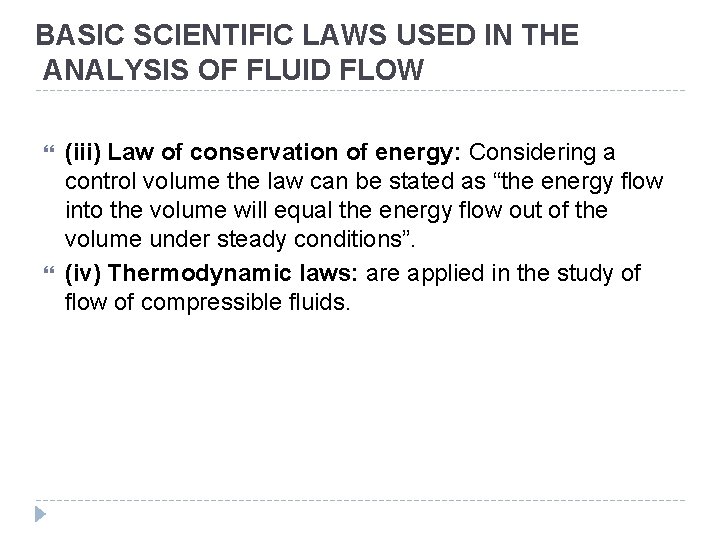
BASIC SCIENTIFIC LAWS USED IN THE ANALYSIS OF FLUID FLOW (iii) Law of conservation of energy: Considering a control volume the law can be stated as “the energy flow into the volume will equal the energy flow out of the volume under steady conditions”. (iv) Thermodynamic laws: are applied in the study of flow of compressible fluids.
10
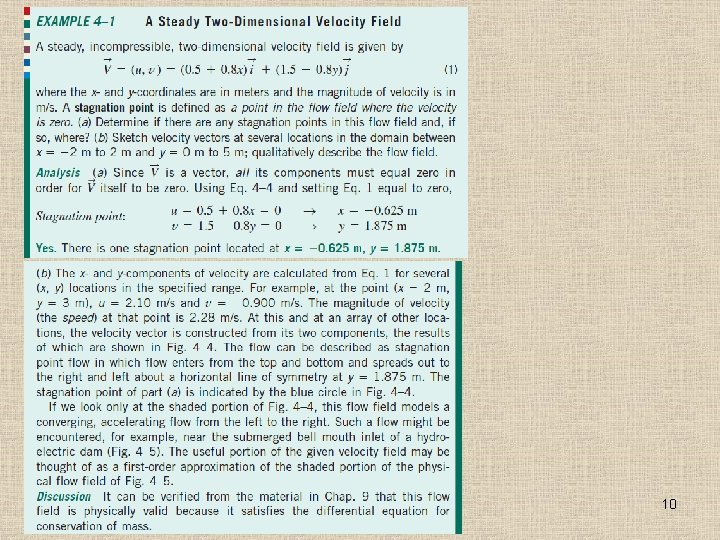
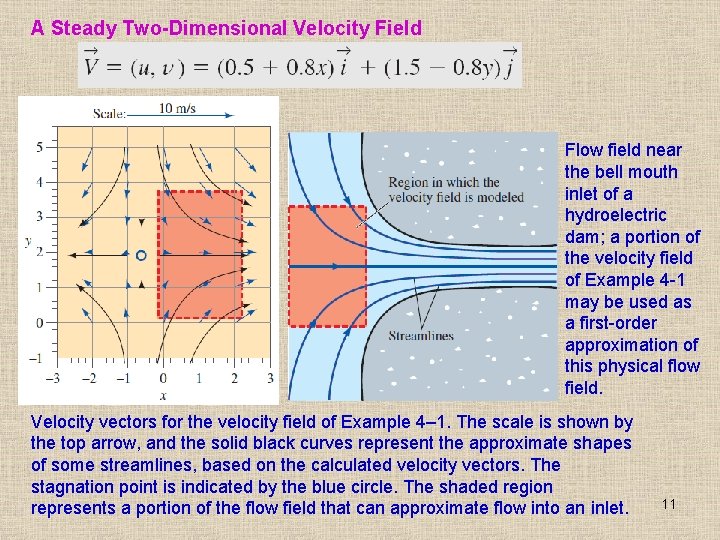
A Steady Two-Dimensional Velocity Field Flow field near the bell mouth inlet of a hydroelectric dam; a portion of the velocity field of Example 4 -1 may be used as a first-order approximation of this physical flow field. Velocity vectors for the velocity field of Example 4– 1. The scale is shown by the top arrow, and the solid black curves represent the approximate shapes of some streamlines, based on the calculated velocity vectors. The stagnation point is indicated by the blue circle. The shaded region represents a portion of the flow field that can approximate flow into an inlet. 11
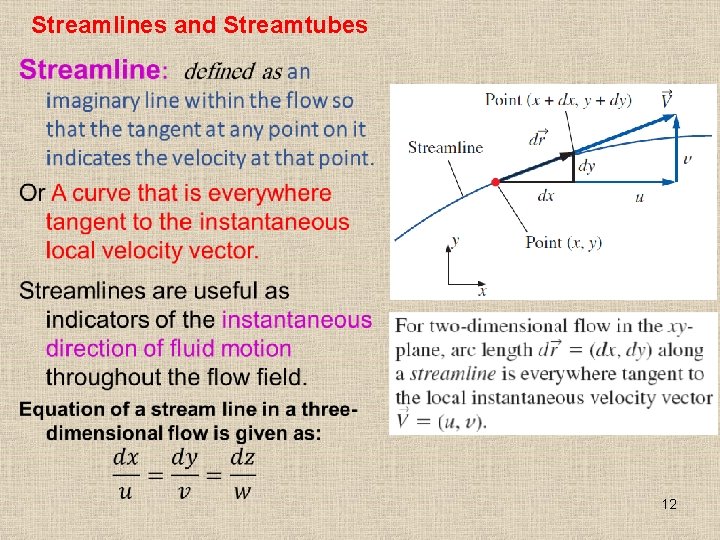
Streamlines and Streamtubes 12
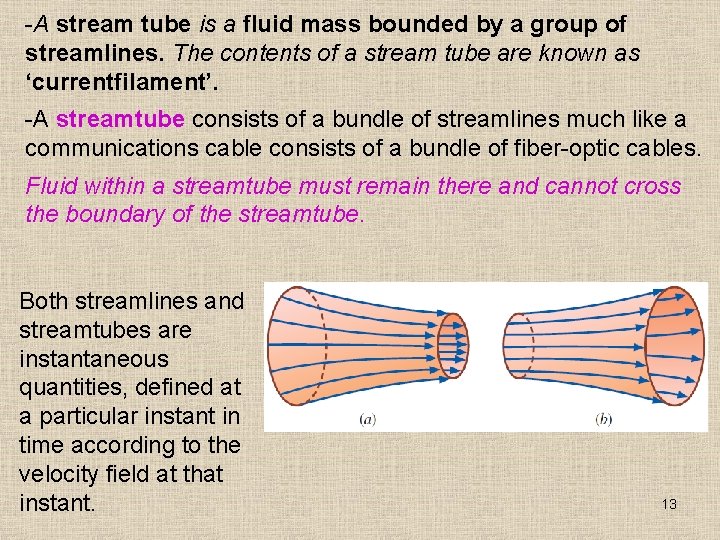
-A stream tube is a fluid mass bounded by a group of streamlines. The contents of a stream tube are known as ‘currentfilament’. -A streamtube consists of a bundle of streamlines much like a communications cable consists of a bundle of fiber-optic cables. Fluid within a streamtube must remain there and cannot cross the boundary of the streamtube. Both streamlines and streamtubes are instantaneous quantities, defined at a particular instant in time according to the velocity field at that instant. 13
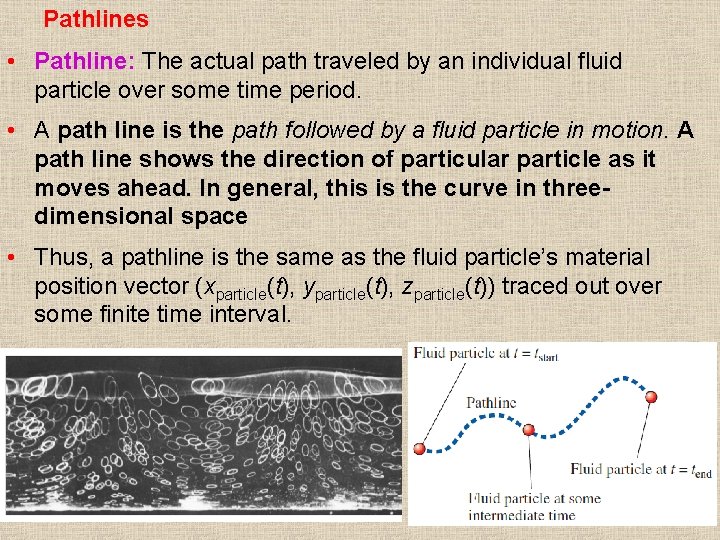
Pathlines • Pathline: The actual path traveled by an individual fluid particle over some time period. • A path line is the path followed by a fluid particle in motion. A path line shows the direction of particular particle as it moves ahead. In general, this is the curve in threedimensional space • Thus, a pathline is the same as the fluid particle’s material position vector (xparticle(t), yparticle(t), zparticle(t)) traced out over some finite time interval. 14
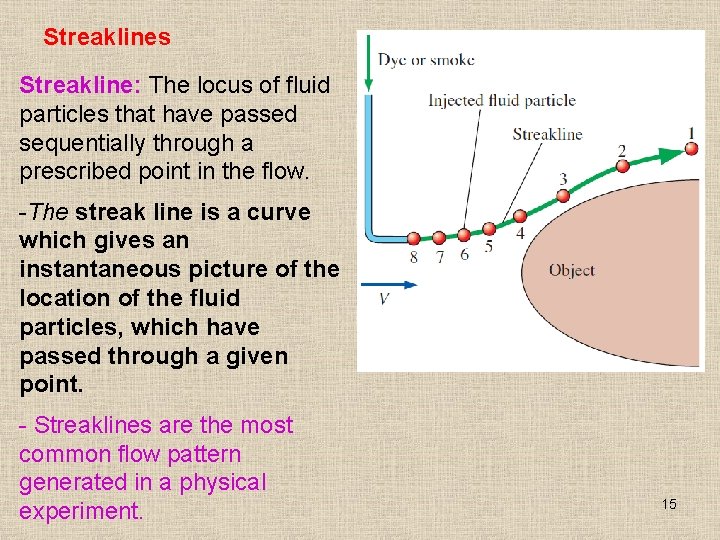
Streaklines Streakline: The locus of fluid particles that have passed sequentially through a prescribed point in the flow. -The streak line is a curve which gives an instantaneous picture of the location of the fluid particles, which have passed through a given point. - Streaklines are the most common flow pattern generated in a physical experiment. 15
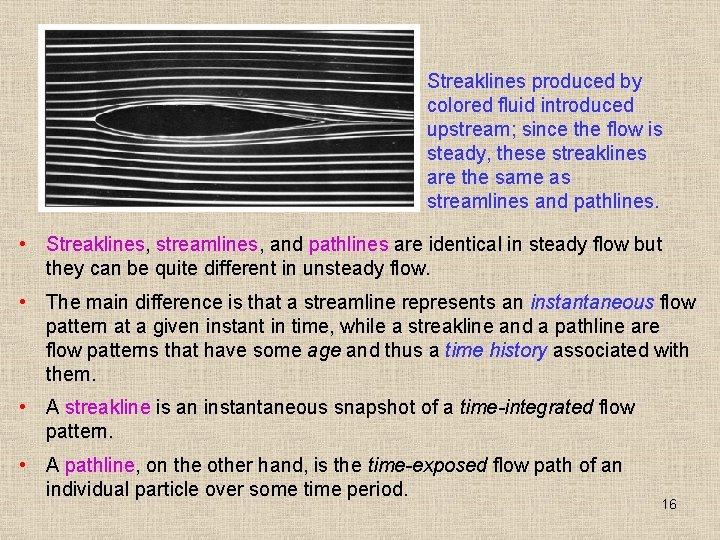
Streaklines produced by colored fluid introduced upstream; since the flow is steady, these streaklines are the same as streamlines and pathlines. • Streaklines, streamlines, and pathlines are identical in steady flow but they can be quite different in unsteady flow. • The main difference is that a streamline represents an instantaneous flow pattern at a given instant in time, while a streakline and a pathline are flow patterns that have some age and thus a time history associated with them. • A streakline is an instantaneous snapshot of a time-integrated flow pattern. • A pathline, on the other hand, is the time-exposed flow path of an individual particle over some time period. 16
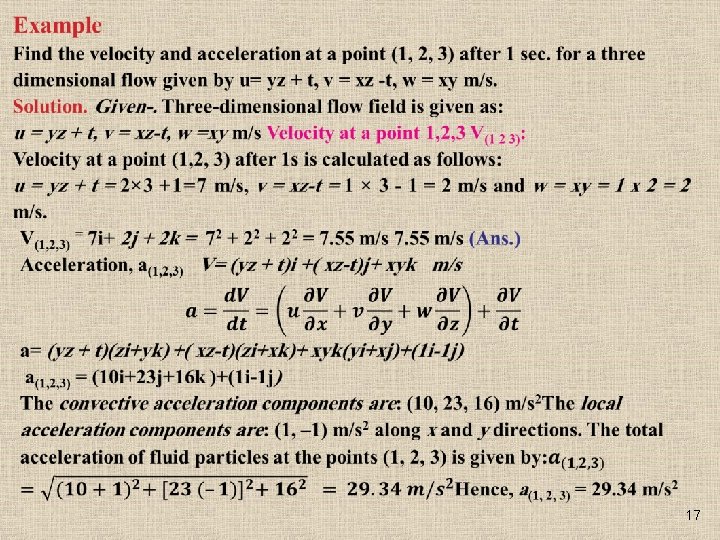
17
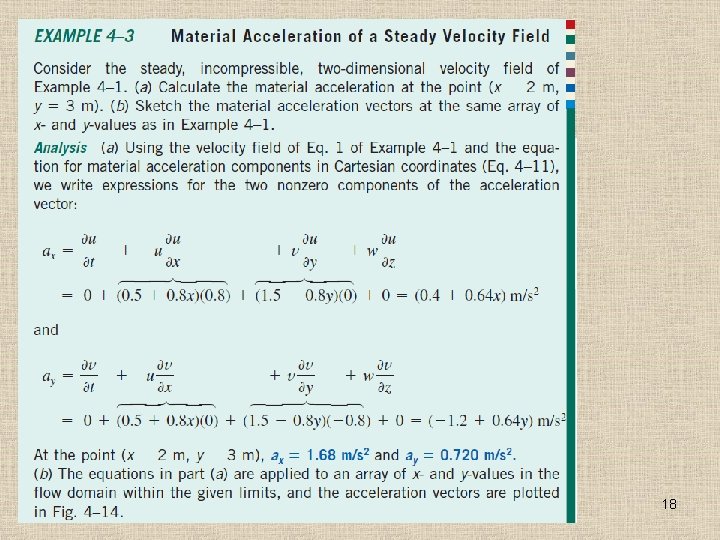
18
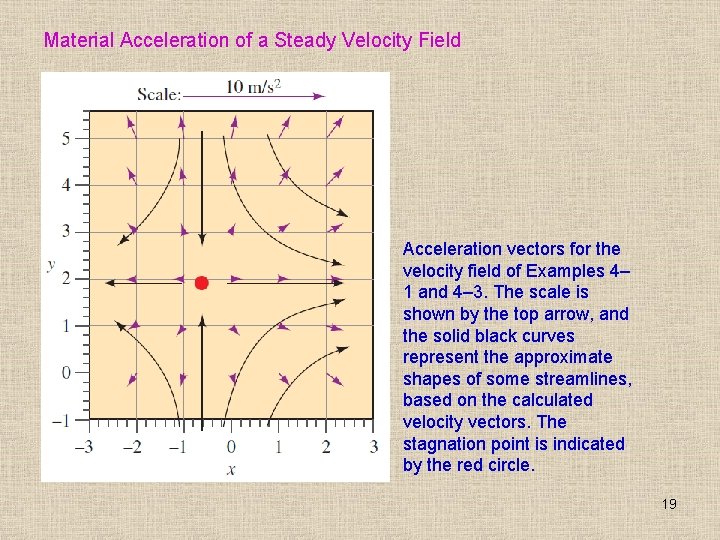
Material Acceleration of a Steady Velocity Field Acceleration vectors for the velocity field of Examples 4– 1 and 4– 3. The scale is shown by the top arrow, and the solid black curves represent the approximate shapes of some streamlines, based on the calculated velocity vectors. The stagnation point is indicated by the red circle. 19
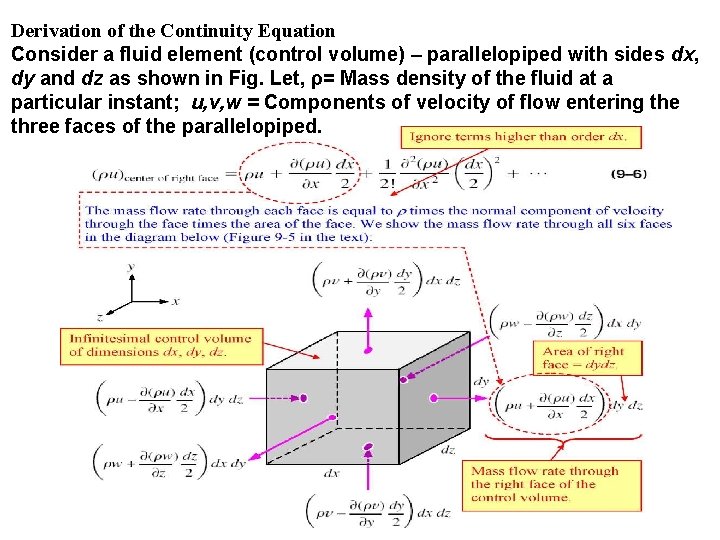
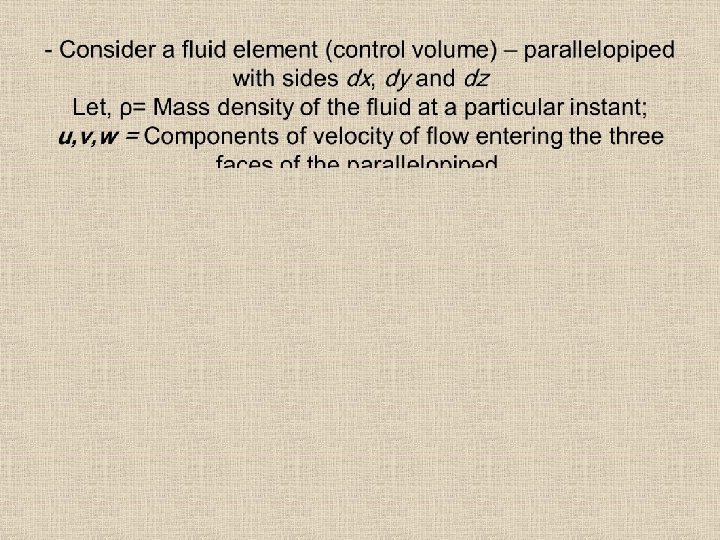
Derivation of the Continuity Equation Consider a fluid element (control volume) – parallelopiped with sides dx, dy and dz as shown in Fig. Let, ρ= Mass density of the fluid at a particular instant; u, v, w = Components of velocity of flow entering the three faces of the parallelopiped.
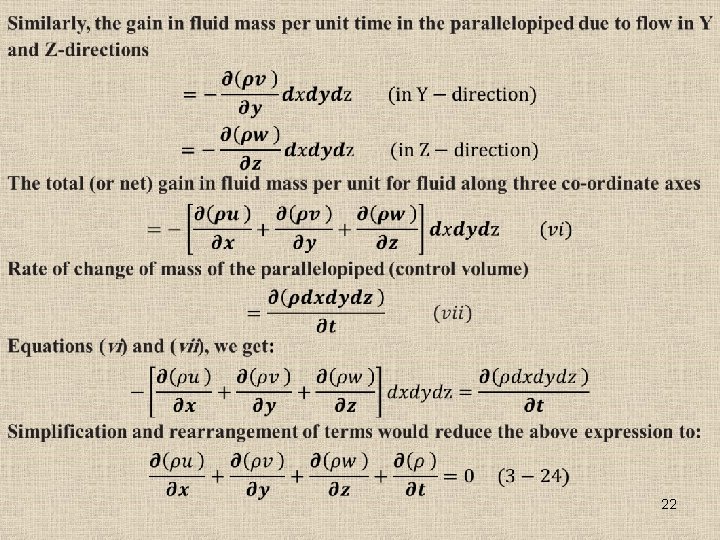
22
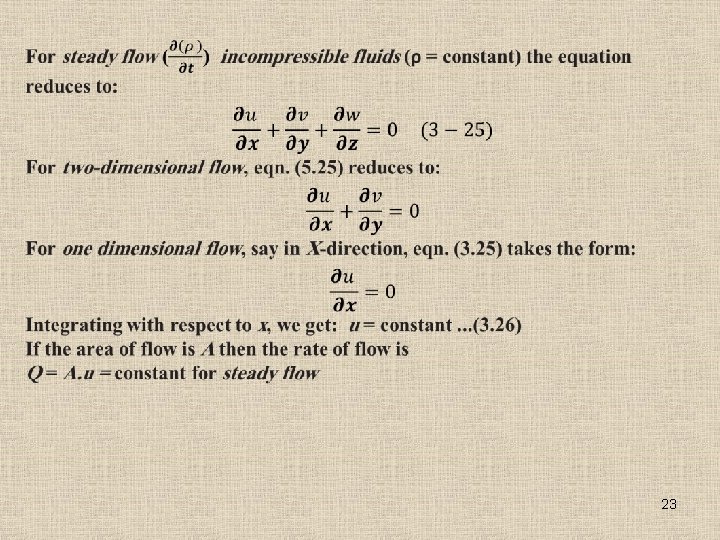
23
Describe the EQUATION OF CONTINUITY IN POLAR COORDINATES? 24
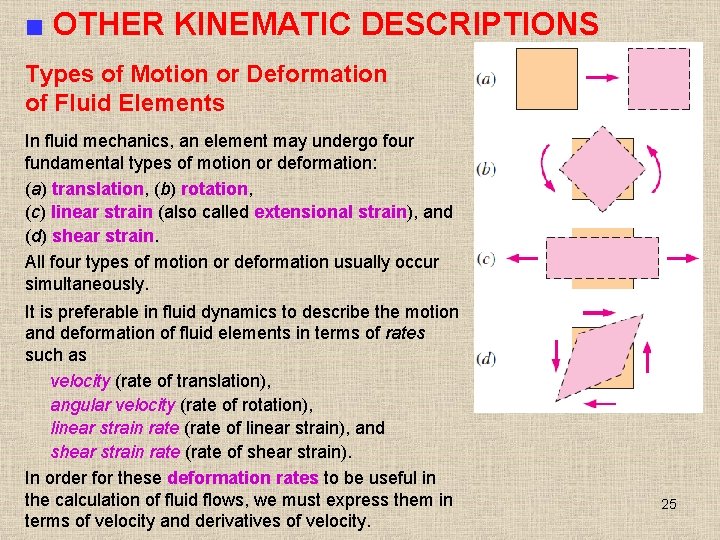
■ OTHER KINEMATIC DESCRIPTIONS Types of Motion or Deformation of Fluid Elements In fluid mechanics, an element may undergo four fundamental types of motion or deformation: (a) translation, (b) rotation, (c) linear strain (also called extensional strain), and (d) shear strain. All four types of motion or deformation usually occur simultaneously. It is preferable in fluid dynamics to describe the motion and deformation of fluid elements in terms of rates such as velocity (rate of translation), angular velocity (rate of rotation), linear strain rate (rate of linear strain), and shear strain rate (rate of shear strain). In order for these deformation rates to be useful in the calculation of fluid flows, we must express them in terms of velocity and derivatives of velocity. 25