
Fluid Kinematics By Me Edited from Mr Basirul
Fluid Kinematics By : Me Edited from Mr. Basirul notes
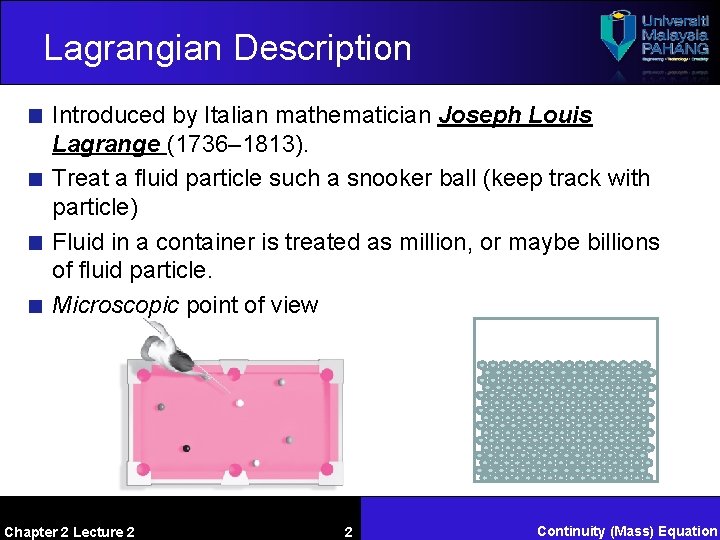
Lagrangian Description Introduced by Italian mathematician Joseph Louis Lagrange (1736– 1813). Treat a fluid particle such a snooker ball (keep track with particle) Fluid in a container is treated as million, or maybe billions of fluid particle. Microscopic point of view Chapter 2 Lecture 2 2 Continuity (Mass) Equation
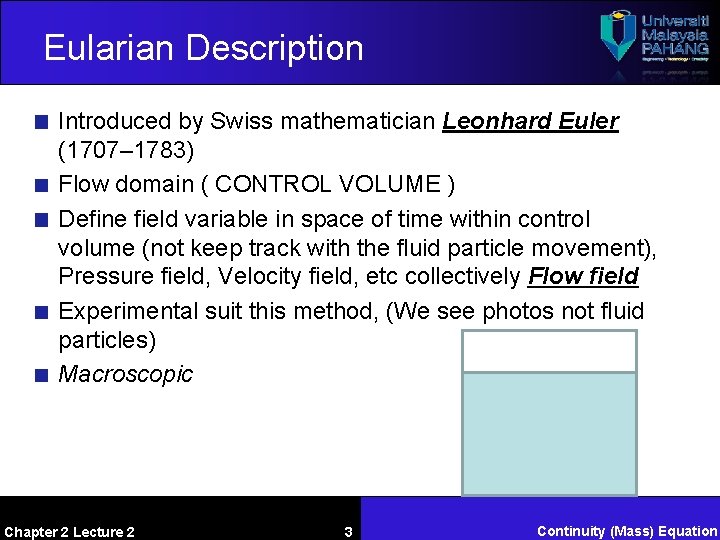
Eularian Description Introduced by Swiss mathematician Leonhard Euler (1707– 1783) Flow domain ( CONTROL VOLUME ) Define field variable in space of time within control volume (not keep track with the fluid particle movement), Pressure field, Velocity field, etc collectively Flow field Experimental suit this method, (We see photos not fluid particles) Macroscopic Chapter 2 Lecture 2 3 Continuity (Mass) Equation

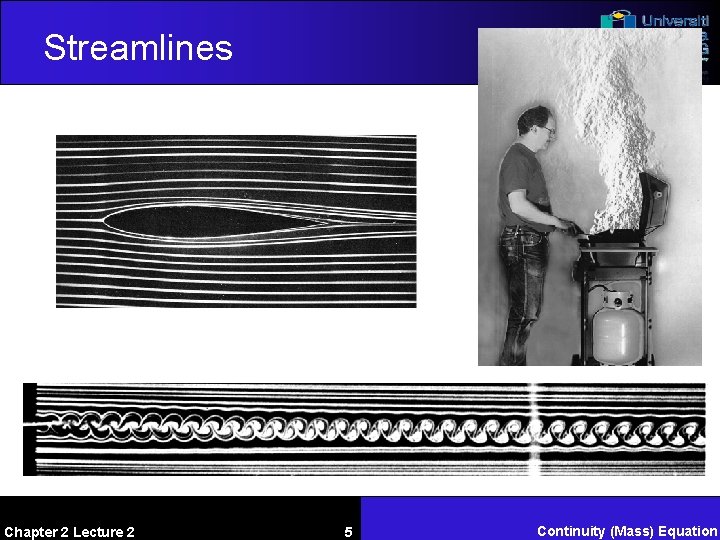
Related terms in fluid motion A streamline is a curve that is everywhere tangent to the instantaneous local Velocity vector. A Pathline is the actual path traveled by an individual fluid particle over some time period. Chapter 2 Lecture 2 4 Continuity (Mass) Equation
Streamlines Chapter 2 Lecture 2 5 Continuity (Mass) Equation
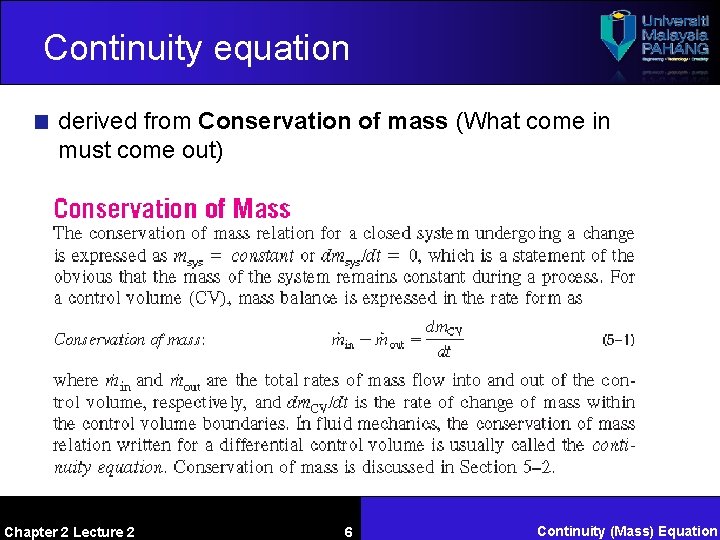
Continuity equation derived from Conservation of mass (What come in must come out) Chapter 2 Lecture 2 6 Continuity (Mass) Equation

Continuity (Mass) Equation
Definition of Mass Equation Expression of mass conservation in the system Learning motivation? Apply mass equation to balance flow rates of flow system Chapter 2 Lecture 2 8 Continuity (Mass) Equation
Mass Conservation - Closed system = Mass remains unchanged - Basic science; 16 kgs 02 + 2 kgs H 2 18 kgs H 20 - Mass conserved but can be converted to energy as E = mc 2 - Means that mass changes when energy change - Open System = Must keep track the entering and leaving masses Chapter 2 Lecture 2 9 Continuity (Mass) Equation
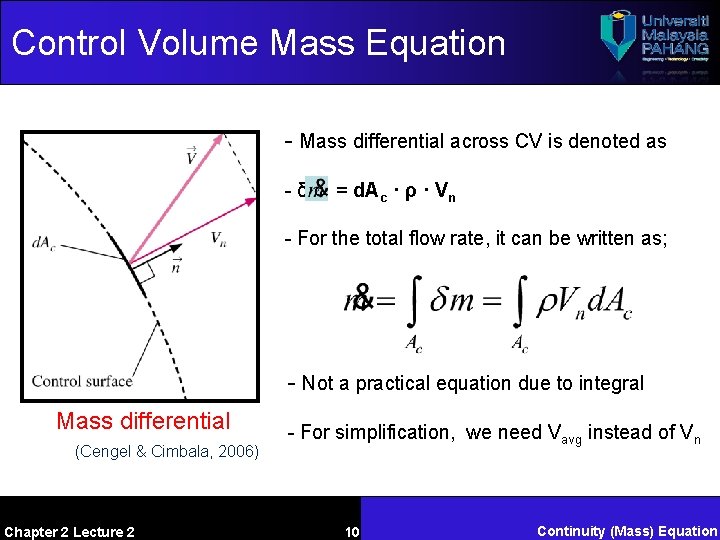
Control Volume Mass Equation - Mass differential across CV is denoted as -δ = d. Ac · ρ · Vn - For the total flow rate, it can be written as; - Not a practical equation due to integral Mass differential (Cengel & Cimbala, 2006) Chapter 2 Lecture 2 - For simplification, we need Vavg instead of Vn 10 Continuity (Mass) Equation
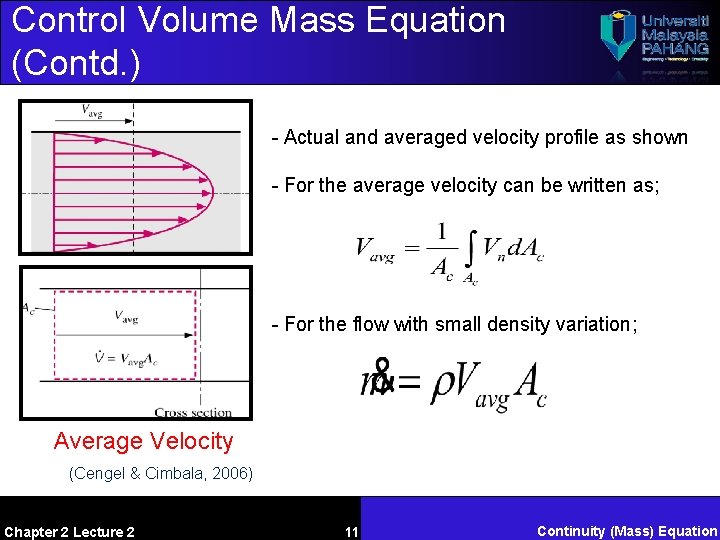
Control Volume Mass Equation (Contd. ) - Actual and averaged velocity profile as shown - For the average velocity can be written as; - For the flow with small density variation; Average Velocity (Cengel & Cimbala, 2006) Chapter 2 Lecture 2 11 Continuity (Mass) Equation
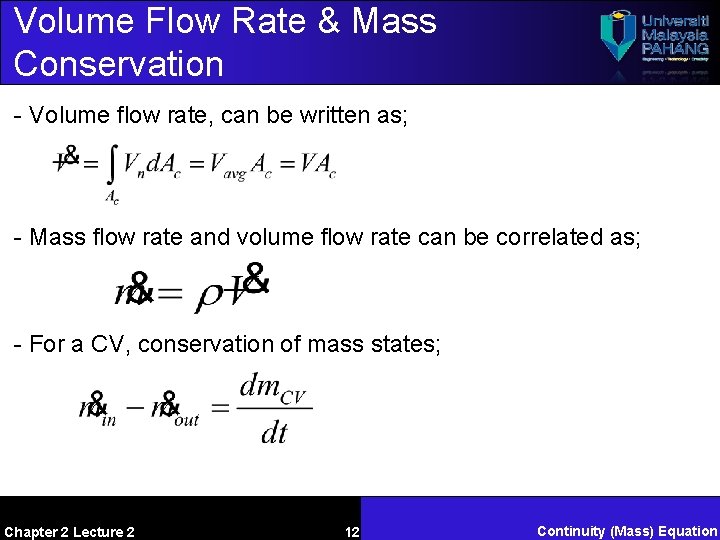
Volume Flow Rate & Mass Conservation - Volume flow rate, can be written as; - Mass flow rate and volume flow rate can be correlated as; - For a CV, conservation of mass states; Chapter 2 Lecture 2 12 Continuity (Mass) Equation
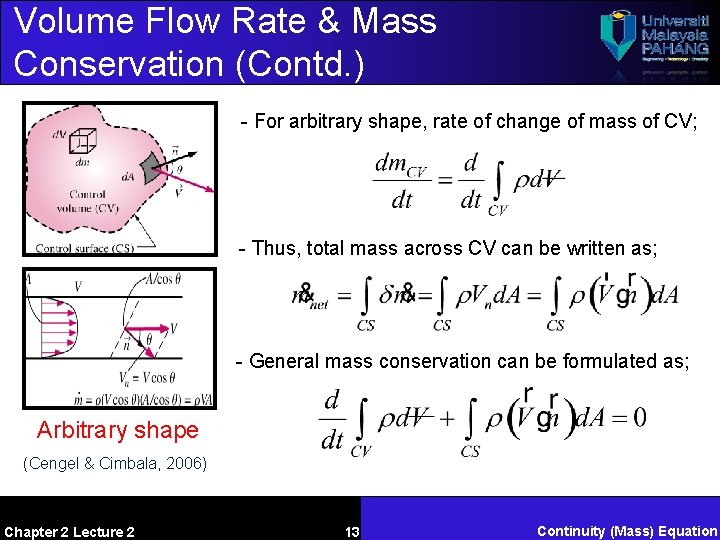
Volume Flow Rate & Mass Conservation (Contd. ) - For arbitrary shape, rate of change of mass of CV; - Thus, total mass across CV can be written as; - General mass conservation can be formulated as; Arbitrary shape (Cengel & Cimbala, 2006) Chapter 2 Lecture 2 13 Continuity (Mass) Equation
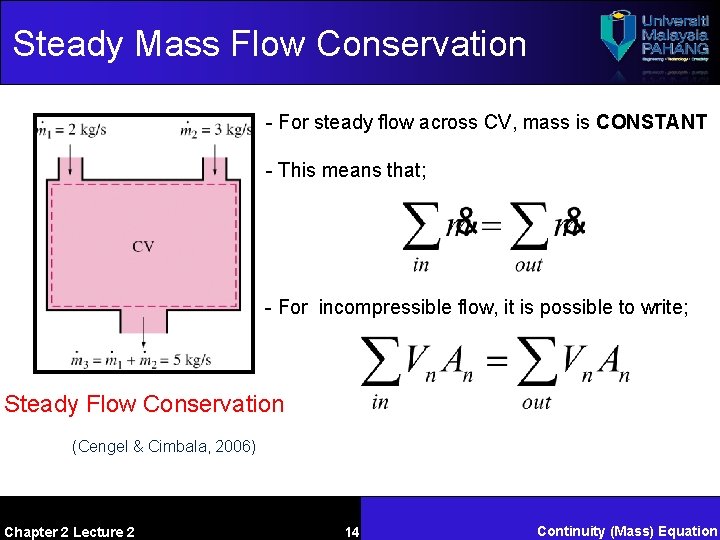
Steady Mass Flow Conservation - For steady flow across CV, mass is CONSTANT - This means that; - For incompressible flow, it is possible to write; Steady Flow Conservation (Cengel & Cimbala, 2006) Chapter 2 Lecture 2 14 Continuity (Mass) Equation
Examples & Tutorials A garden hose attached with a nozzle is used to fill a 75 L bucket. The inner diameter of the hose is 2. 5 cm and it reduces to 1. 25 cm at the nozzle exit. If the average velocity in the hose is 2. 5 m/s. Determine the following properties; (a) Volume and mass flow rates throughout the nozzle (b) How long it takes to fill in the bucket with water (c) Average velocity of water at the nozzle exit Chapter 2 Lecture 2 15 Continuity (Mass) Equation
Examples & Tutorials (Contd. ) Air enters a nozzle steadily at 2. 21 kg/m 3 and 30 m/s and leaves at 0. 762 kg/m 3 and 180 m/s. If the inlet area of the nozzle is 80 cm 2, determine; (a) Mass flow rate through the nozzle (b) Exit area of the nozzle Chapter 2 Lecture 2 16 Continuity (Mass) Equation
Examples & Tutorials (Contd. ) A hair dryer is basically a duct of constant diameter in which a few layers of electric resistors are placed. A small fan pulls the air in and forces it through the resistors where it is heated. If the density of air is 1. 20 kg/m 3 at the inlet and 1. 05 kg/m 3 at the exit, determine the percent increase in the velocity of air as it flows through the dryer; Chapter 2 Lecture 2 17 Continuity (Mass) Equation
Examples & Tutorials (Contd. ) A desktop computer is to be cooled by a fan whose flow rate is 0. 34 m 3/min. Determine the mass flow rate of air through the fan at an elevation of 3400 m where the air density is 0. 7 kg/m 3. Also, if the average velocity of air is not to exceed 110 m/min, determine the diameter of the casing of the fan Chapter 2 Lecture 2 18 Continuity (Mass) Equation
Examples & Tutorials (Contd. ) A smoking lounge is to accommodate 15 heavy smokers. The minimum fresh air for smoking lounges is specified to be 30 L/s person (ASHRAE, Standard 62, 1989). Determine the minimum required flow rate of fresh air that needs to be supplied to the lounge, and the diameter of the duct if the air velocity is not to exceed 8 m/s Chapter 2 Lecture 2 19 Continuity (Mass) Equation
Examples & Tutorials (Contd. ) The minimum fresh air requirement of a residential building is specified to be 0. 35 air change per hour (ASHRAE, Standard 62, 1989). That is, 35 percent of the entire air contained in a residence should be replaced by fresh outdoor air every hour. If the ventilation requirement of a 2. 7 m-high, 200 m 2 residence is to be met entirely by a fan, determine the flow velocity in L/min of the fan that needs to be installed. Also determine the diameter of the duct if the air velocity is not to exceed 6 m/s Chapter 2 Lecture 2 20 Continuity (Mass) Equation
Next Lecture? Energy Equation Chapter 2 Lecture 2 21 Continuity (Mass) Equation
- Slides: 21