
Fluid Electrolyte Acid Base Balance EQ How does
Fluid, Electrolyte & Acid. Base Balance EQ: How does our body maintain a balance of water and electrolytes?
Body Fluids l l l Your body is 66% water Not evenly distributed – separated into compartments Able to move back and forth through the cell membranes to maintain an equilibrium
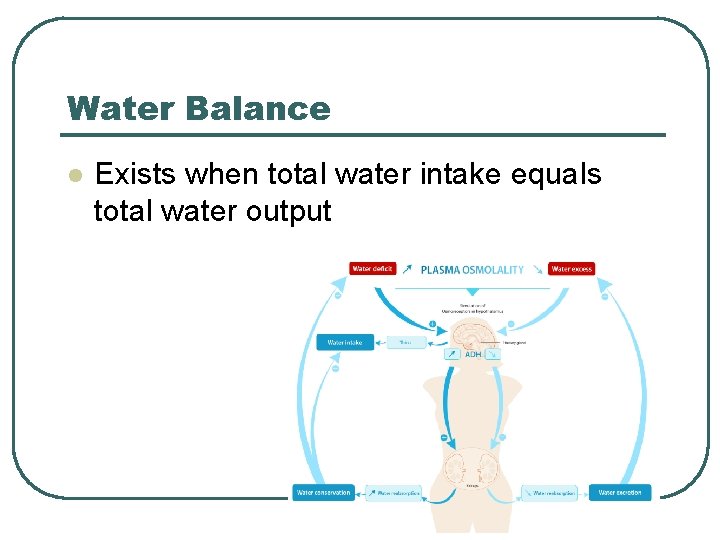
Water Balance l Exists when total water intake equals total water output
![Fluid Compartments l l l Intracellular fluid – fluid inside cells [ICF] Extracellular fluid](http://slidetodoc.com/presentation_image/00e867f2d502b63f20e806735ab828fa/image-4.jpg "Fluid Compartments l l l Intracellular fluid – fluid inside cells [ICF] Extracellular fluid")
Fluid Compartments l l l Intracellular fluid – fluid inside cells [ICF] Extracellular fluid – fluid outside cells and all other body fluids Interstitial fluid- Solution that surrounds cells of eukaryotes
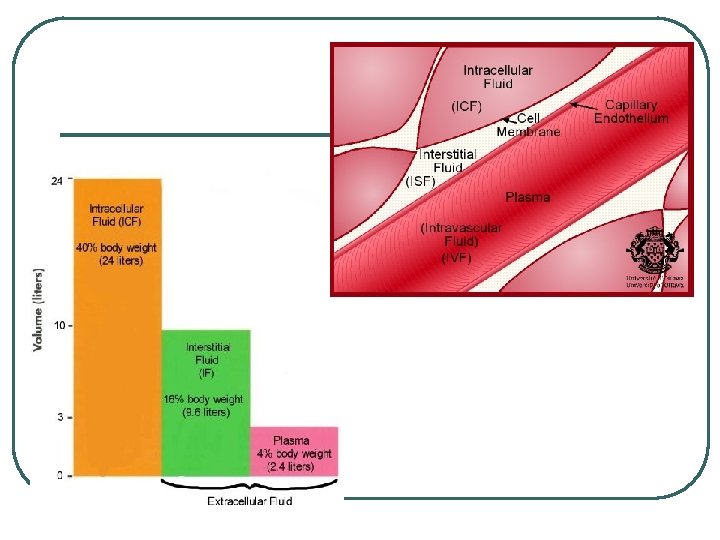
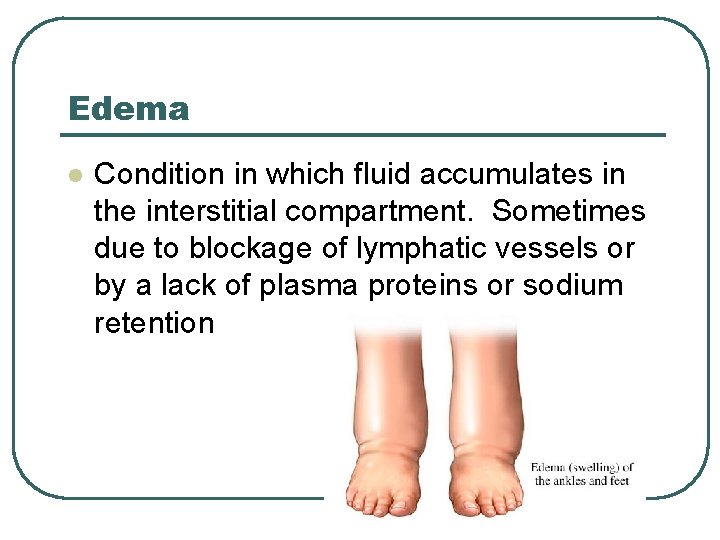
Edema l Condition in which fluid accumulates in the interstitial compartment. Sometimes due to blockage of lymphatic vessels or by a lack of plasma proteins or sodium retention
Fluid Balance l l Average daily intake is 2500 ml [ fluids, food and metabolic water] Average daily output is 2500 ml [ urine, feces, perspiration, insensible perspiration]
Electrolytes l l Molecules that release ions in water. Can affect amount of water, p. H balance, and muscle function
Electrolyte Balance l l Concentration of individual electrolytes in the body fluid compartments is normal and remains relatively constant. Electrolytes are dissolved in body fluids
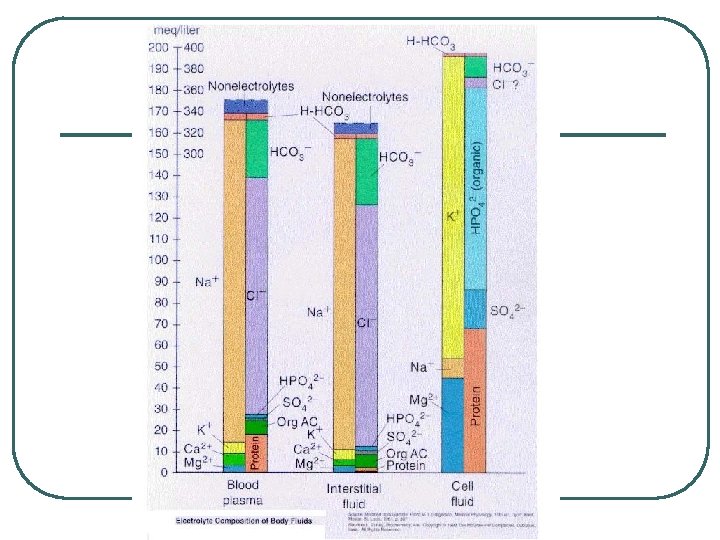
Electrolyte Balance l l Because of sodium and potassium influence, water will move between compartments Example: if high [sodium], then water will move from intracellular space to extracellular space due to osmotic pressure
Acid - Base Balance l l • Blood - normal p. H of 7. 2 – 7. 45 3 buffer systems to maintain normal blood p. H Copy Table 18. 1 on page 500
Maintenance of Acid-Base Balance l Respiratory System: removal of CO 2 by lungs – stabilizes the ECF, has direct effect on Carbonic Acid – Bicarbonate Buffer System l Urinary System: removal of H+ ions by kidneys
LEFT SIDE ACTIVITY l Draw a diagram to explain water balance
- Slides: 14