
Fluid and Electrolytes 2017 Rhonda Keen Terms Insensible
Fluid and Electrolytes 2017 Rhonda Keen
Terms • Insensible fluid loss- loss that cannot be measured ie lungs and skin • Sensible loss- loss that can be measured ie urination wounds etc… • Intracellular inside the cell • Extracellular outside the cell • Two additional compartments intravascular fluid (plasma ) liquid portion of blood and interstitial (surrounds the cells) • Albumin is a large protein molecule acts like a magnet to attract water and hole it in the blood vessel
How fluid shifts • Capillary “ fluid pushing “ aka Hydrostatic pressure when pressure builds inside the capillary it forces fluids and solutes out through the capillary walls into interstitial fluid • Kidneys- use the antidiuretic hormone ADH and the Renin and angiotensin systems to retain or release fluid • Adrenal gland – Angiotensin II • Atrial natriuretic peptide- cardiac hormone • Thirst- hypothalamus
Antidiuretic hormone Low blood volume; increase • Sensed by the Hypothalamus salt content of blood Pituitary gland secretes ADH • ADH causes the kidneys to retain water Water retention boost blood volume • Decrease salt( AKA osmolality) content
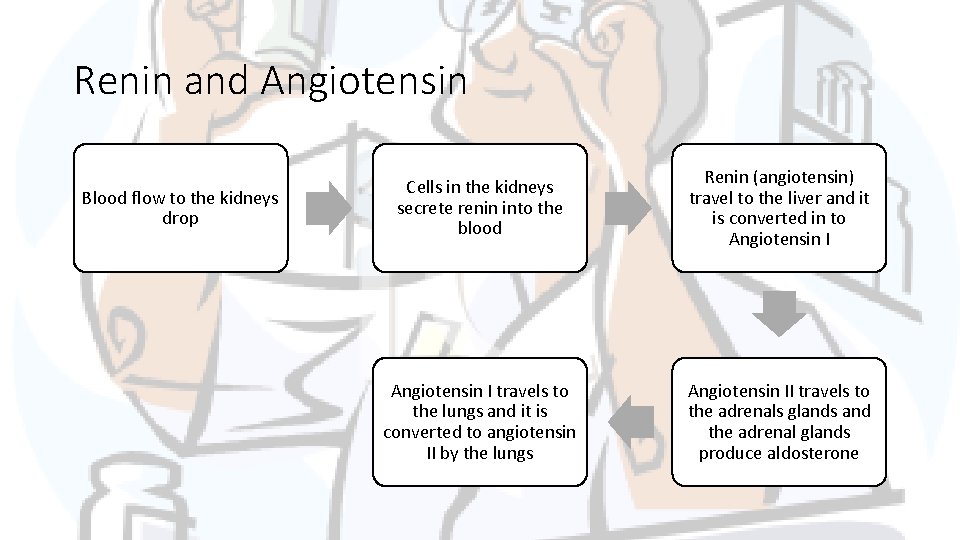
Renin and Angiotensin Blood flow to the kidneys drop Cells in the kidneys secrete renin into the blood Renin (angiotensin) travel to the liver and it is converted in to Angiotensin I travels to the lungs and it is converted to angiotensin II by the lungs Angiotensin II travels to the adrenals glands and the adrenal glands produce aldosterone
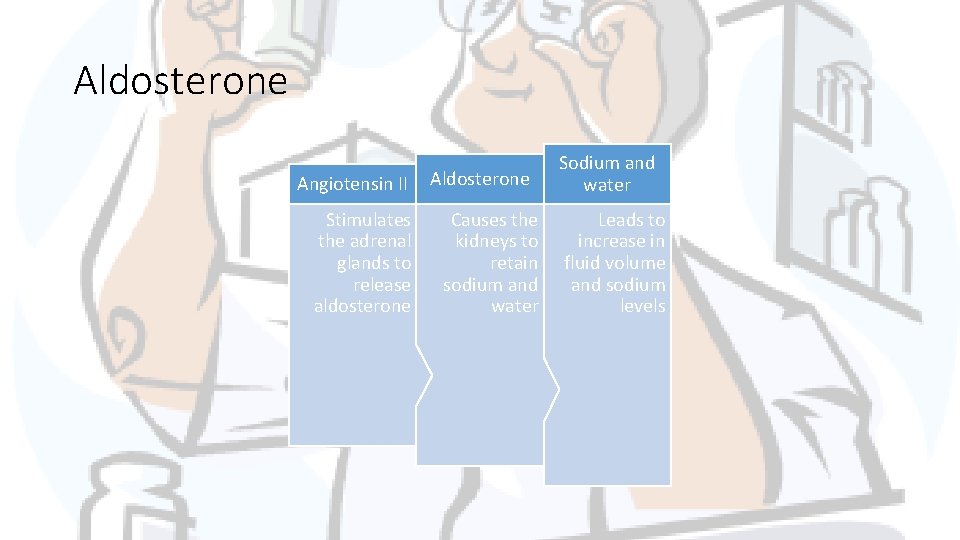
Aldosterone Angiotensin II Stimulates the adrenal glands to release aldosterone Aldosterone Causes the kidneys to retain sodium and water Sodium and water Leads to increase in fluid volume and sodium levels
Solutions ………………. only bolus with LR and Normal saline • Isotonic Solutions • Has nearly the same concentration of blood so isotonic solutions stay in the blood stream LR and NS are two examples of Isotonic solutions • NS. 9 is for maintenance and fluid resuscitation • LR is usually used in surgery and when rapid fluid resuscitation is necessary • LR has several electrolyte additives that NS does not contain and can cause rapid shifts if given for long periods of time. • D%5 W is isotonic solution but because of the Glucose content it very quickly becomes hypotonic so it is never used to bolus or for IV maintenance
Hypotonic solutions • They have a lower solute concentration than the blood ( vascular beds) so the fluid will shift from the vascular bed to the into cells • This treats cellular dehydration and hypernatremia . 45%Normal saline • This can worsen hypotension • D 5 W can fit this category if given for an extended period • Any fluid that is less than. 9 % is in this category. ½ Normal saline
Hypertonic solutions • They have a higher concentration than the blood there for fluid shifts from the cells into the vascular beds • D 5 LR • D 5 WNS • D%1/2 NS (. 45)

Electrolytes Sodium Na+ • Sodium Na+ - main extracellular fluid cation(positive charge) • 135 -145 m. Eq/L- Hypo >>common cause is syndrome of inappropriate antidiuretic hormone secretion Hyper>>>> Diabetic Insipidus-(water gain or loss) • Governs ECF , acid base balance , nerve cells and water distribution • Food sources-cheese, salt, seafood, canned foods processed snacks • Signs: Hypo: neurologic, headache, nausea severe drop can cause seizures; muscle twitching; hypertension • Signs: HYPer>SALT –skin flushed, agitation, low grade fever, thirst
Potassium K+ • 3. 5 -5 m. Eq/L; K+ • Main intracellular fluid cation; regulates cell excitability so it can contract • flows opposite of Na+; may show EKG changes Common causes : Hypo>>> diarrhea; meds, suctioning Hyper>>>>burns • Food sources: vegs, fruits, nuts, chocolate • Signs Hypo>SUCTION>Skeletal muscle weakness, U-wave (ekg ), Constipation, Toxicity of Digoxin, Irregular pulse, Orthostatic hypotension, Numbness; HYPO often occurs with hypomagnesemia: Treat HYPO with K+ • HYPEr: irritability, paresthesia, muscle weakness Treat: calcium chloride/gluconate; shift potassium>10 units Insulin with 100 ml 50% Dextrose>High dose Albuterol 15 -25 mg of NEB TX: removal K+ with Lasix and fluid
Calcium –Ca+ 8. 9 -10. 1 mg/dl (SERUM) • Major cation in teeth and bones; muscles must have Ca+ to bring in potassium so the muscle can contract ; maintains cell shape; coagulation and cell permeability. • Common causes>>>Hypo>>>>acute pancreatitis , neuromuscular excitability; Hyperreflexia and Trousseau’s sign : Treat with 1 -2 ampules calcium gluconate mixed with D 5 W over 10 -20 min Hyper>>> Hyperparathyroidism, neuromuscular depression constipation, Bradycardia, hypotension: Treatment find cause NS, Glucocorticoids, calcitionin; Cancer • Inverse relationship to Phosphorus and often times Potassium and Hydrogen so when Calcium is low the others are high vice versa • Trousseau’s sign and Chvostek’s with HYPO
Phosphorous P- 1. 8 to 2. 6 m. Eq/L • Common causes Hypo>>> diabetic ketoacidosis; Treatment: diet, IV sodium phosphate; Hyper>>> renal insufficiency; tx limit diuretics and fluid loss • The main ICF anion(negative charge) • Promotes energy storage and metabolism and Hydrogen buffer • In an inverse relationship to calcium • HYPO: IMBIBING: irritability, malaise, bleeding, inflammation, bone muscle pain, infection, numbness, generalized weakness • Hyper: CHEMO: Cardiac irregularities, hyperreflexia, eating poorly, muscle weakness, oliguria
Magnesium 1. 5 to 2. 5 m. Eq/L Mg++ • Common causes Hypo>>>malnutrition, neuromuscular excitability, cramping and Chvostek’s sign and Trousseau’s sign Hyper>>>> Renal failure • Leading ICF cation; Metabolic processes , nerve impulses and muscle contraction opens up the cell for potassium • Chvostek sign when facial nerve is tapped facial or eye muscle will be elicited • Trousseau’s sign when blood pressure cuff is inflated to 20 mm. HG above systolic blood pressure for 3 minutes carpal spasms will be induced • Tremors, twitching and tetany is frequent signs • Hypo- STARVED- seizures, tetany, anorexia, rapid pulse, vomiting, emotional lability , deep tendon reflexes increase • Hyper- RENAL-Reflexes decreases, ecg changes, Nausea, appearance flushed, lethargy
Chloride Cl- 96 -106 m. Eq/L • Common cause Hypo>>>prolonged vomiting; Hyper>>>>Hypernatremia • Follows NA+ and water Signs hypo; agitation, hyperactive reflexes, shallow resp, seizure, coma Hyper signs; metabolic acidosis, weakness, kussmaul’s resp, edema, tachycardia
Bicarbonate ( HCO 3 -) 22 -26 m. Eq/L • Functions mainly to regulate acid base balance • Bicarbonate and p. H of the blood increase and decrease together • p. H and Paco 2 move in opposite directions • Pa. Co 2= the effectiveness of ventilation they reflect the concentration of the Carbon dioxide in the blood as concentration of gas increases so does the partial pressure • Pa. O 2=reflects the body’s ability to pick up oxygen from the lungs
Orthostatic hypotension • Have patient lie flat take base line BP and HR • Have client sit up dangle feet one minute while sitting up then check BP and HR again • Have them stand one minute watch for dizziness check bp and HR • If the heart rate increases >20 beats or BP systolic drops more than 20 they are considered orthostatic hypotensive
Hypovolemic • • • Mental status change late sign Thirst Tachycardia Delayed capillary refill Low urinary output Cool pale skin Hypotension late sign Elevated Na+, BUN and specific gravity Normal fluid bolus 20 ml/kg in sepsis it is increased to 30 ml/hr Treatment: correct with fluid/isotonic
Hypervolemia • Tachypnea • Dyspnea • Crackles • Rapid bounding pulse • Hypertension • Distended neck veins • Weight gain • S 3 gallop
Reference (not in APA format) Fluid and Electrolytes Made Incredibly Easy ISBN 0 -87434 -886 -2 Springhouse Corporation PA Nurse’s Quick Check Fluid and Electrolytes , 2006 ISBN 1 -58255 -414 -5 Lippincott Williams & Wilkins A Wolters Kluwer company, PA Solheim, Jeff, 2017, Solheim’s Certified Emergency Nurse Exam Prepartion Course Manual Solheim Enterprises WWW. solheimenterprises. com/shop
- Slides: 20