
Fluid and Blood Therapy Kelly Shinkaruk MD FRCPC
Fluid and Blood Therapy Kelly Shinkaruk, MD FRCPC HLT 123 October 17, 2009 1
Fluid Therapy Objectives Body Fluid Compartments Fluid Requirements Maintenance and Insensible Losses Fluid Deficit Third Space Blood Loss Types of Fluid and Resuscitation Crystalloids Colloids 2
Fluid Therapy Objectives Intravenous Access Sites for Line Insertion Advantages and Disadvantages Complication Risks Insertion Techniques 3
Fluid Therapy Objectives Body Fluid Compartments Fluid Requirements Maintenance and Insensible Losses Fluid Deficit Third Space Blood Loss Types of Fluid and Resuscitation Crystalloids Colloids 4
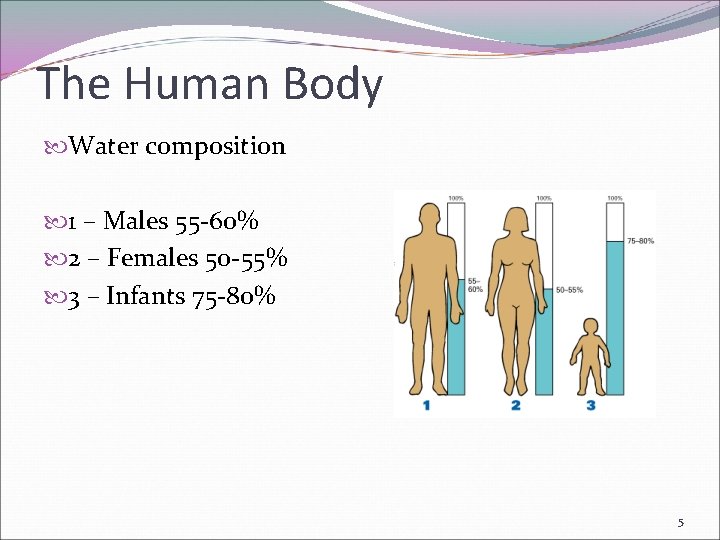
The Human Body Water composition 1 – Males 55 -60% 2 – Females 50 -55% 3 – Infants 75 -80% 5
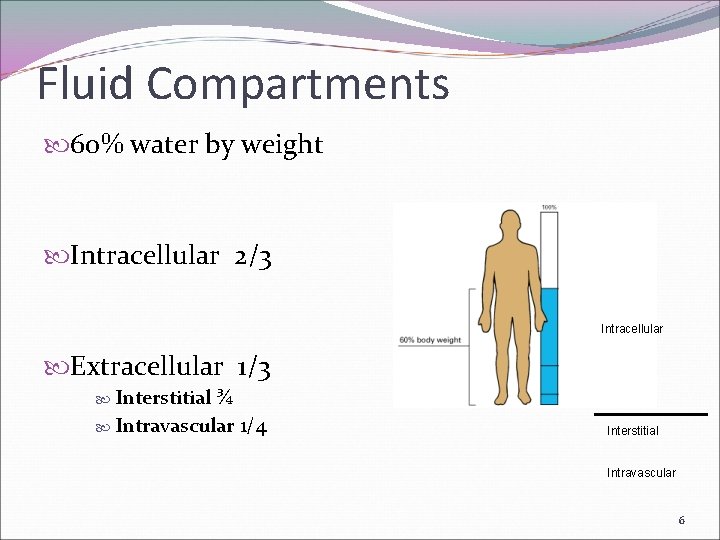
Fluid Compartments 60% water by weight Intracellular 2/3 Intracellular Extracellular 1/3 Interstitial ¾ Intravascular 1/4 Interstitial Intravascular 6
Differences in Body Fluids Age and Gender: Prems – 90 m. L/kg Children – 80 m. L/kg Adult Male – 70 75 m. L/kg Adult Female – 60 65 m. L/kg Obesity: Water volume based on ideal body weight (IBW) IBW = 50 kg + 2. 3 kg per inch over 5 ft 7
Fluid Therapy Objectives Body Fluid Compartments Fluid Requirements Maintenance and Insensible Losses Fluid Deficit Third Space Blood Loss Types of Fluid and Resuscitation Crystalloids Colloids 8
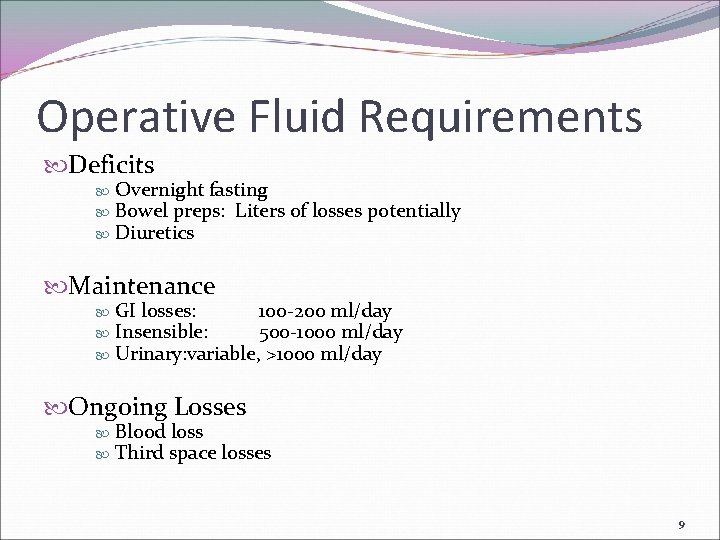
Operative Fluid Requirements Deficits Overnight fasting Bowel preps: Liters of losses potentially Diuretics Maintenance GI losses: 100 -200 ml/day Insensible: 500 -1000 ml/day Urinary: variable, >1000 ml/day Ongoing Losses Blood loss Third space losses 9
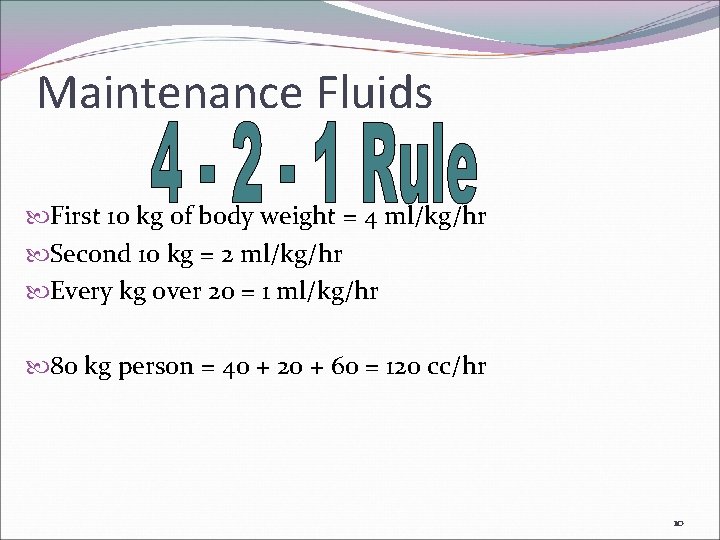
Maintenance Fluids First 10 kg of body weight = 4 ml/kg/hr Second 10 kg = 2 ml/kg/hr Every kg over 20 = 1 ml/kg/hr 80 kg person = 40 + 20 + 60 = 120 cc/hr 10

Fluid Requirements for Surgery Calculated per hour during OR: Fluid deficit (NPO for 6+ hours): 4/2/1 Ongoing fluid requirements: 4/2/1 Replacement of blood loss Crystalloid 3: 1, Colloid 1: 1 “Third-space” loss 4/6/8 rule: 4 ml/kg/h for minor surgery (hernias, wrist ORIF, breast) 6 for moderate surgery (gyne, ortho, thoracics) 8 for major procedures (major bowel, vascular, trauma) 11
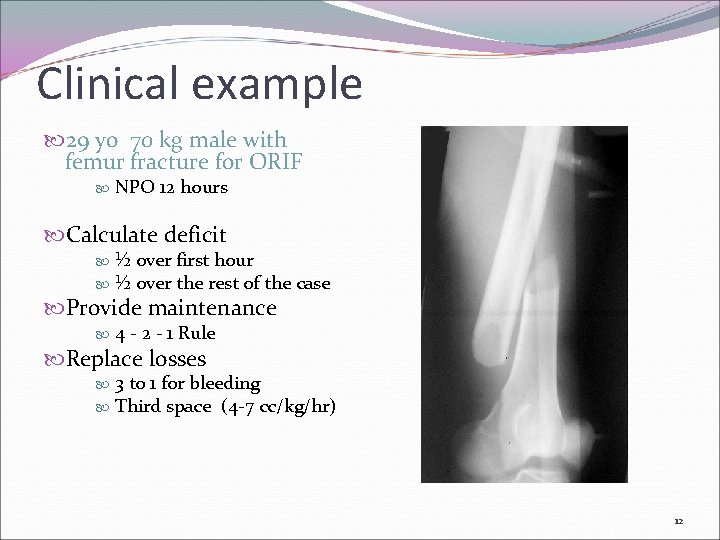
Clinical example 29 yo 70 kg male with femur fracture for ORIF NPO 12 hours Calculate deficit ½ over first hour ½ over the rest of the case Provide maintenance 4 - 2 - 1 Rule Replace losses 3 to 1 for bleeding Third space (4 -7 cc/kg/hr) 12
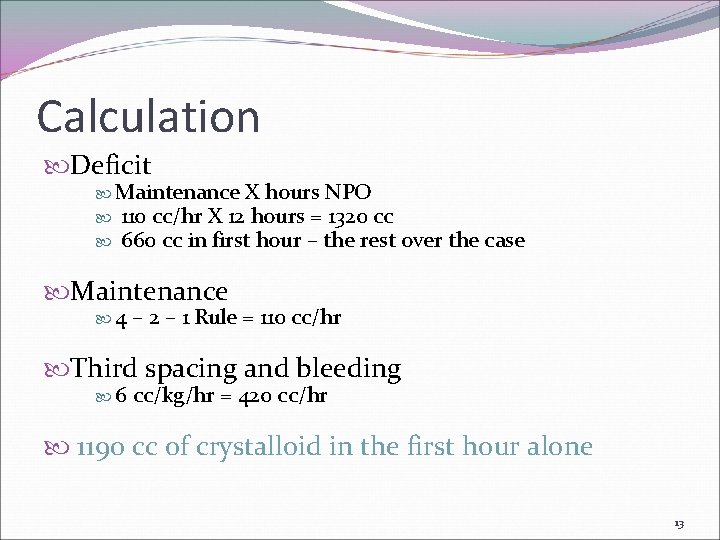
Calculation Deficit Maintenance X hours NPO 110 cc/hr X 12 hours = 1320 cc 660 cc in first hour – the rest over the case Maintenance 4 – 2 – 1 Rule = 110 cc/hr Third spacing and bleeding 6 cc/kg/hr = 420 cc/hr 1190 cc of crystalloid in the first hour alone 13
Fluid Therapy Objectives Body Fluid Compartments Fluid Requirements Maintenance and Insensible Losses Fluid Deficit Third Space Blood Loss Types of Fluid and Resuscitation Crystalloids Colloids 14
What is osmolarity? 15
What is osmolarity? Osmolarity: a measure of how many dissolved particles are in the blood Equilibrium: dissolved particles “pull” water across membranes so that total concentration of dissolved particles (osmolarity) is equal on each side (give or take, with some electrochemistry involved) 16
What is normal serum osmolarity? 17
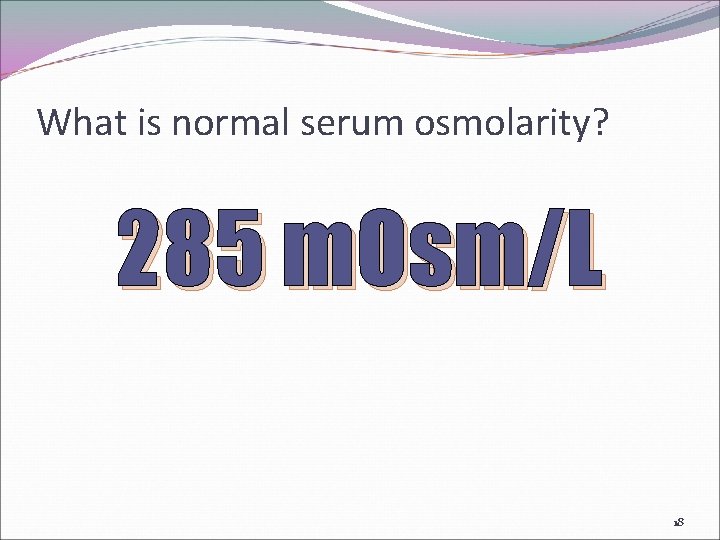
What is normal serum osmolarity? 285 m. Osm/L 18
Osmolarity Hypertonic: more concentrated than plasma Hypotonic: less concentrated than plasma Isotonic: the same concentration as plasma 19
Osmolarity If you give too much hypotonic fluid, cells can swell and burst If you give too much hypertonic fluid, cells can shrink Fast correction of electrolyte imbalances is BAD Where is this most important? The brain! WHY? 20
Types of Fluids Classification: based on their behaviour once given Mostly go to ICF: free water Stay in ECF: crystalloid Stay in plasma: colloid 21
Free Water Dextrose 5% or D 5 W 10 % or D 10 W 50% or D 50 W (low volume packages) IMPORTANT NOTE: Pure water is NEVER given IV! It is very hypotonic and will burst RBCs and cause electrolyte imbalances! 22
Free Water D 5 W: most commonly used D 10 W and D 50 W usually used for low blood glucose levels, not free water deficit Stats: Dextrose 5 gm/d. L p. H 5. 0 Osmolarity 253 IV infusion: little stays intravascular Dextrose is actively transported into cells and water follows it (equilibrium) 23
D 5 W Pros: Treats hypoglycemia Often used preop for diabetic patients who are NPO Body needs sugar for long-term NPO Cons: No good for resuscitation Can cause hypoosmolarity and water intoxication May worsen brain trauma 24
Crystalloids Used for fluid deficit, third space losses, maintenance Equilibrates in ECF (plasma/interstitial) When infused: about 1/3 stays in intravascular space, and after ~ 10 minutes, the other 2/3 has diffused out of the plasma When administering for blood loss, must use 3 -5 L for every 1 L of blood Ex: 3 L blood loss = 9 -15 L of RL!! So we use other fluids for LARGE replacement! 25
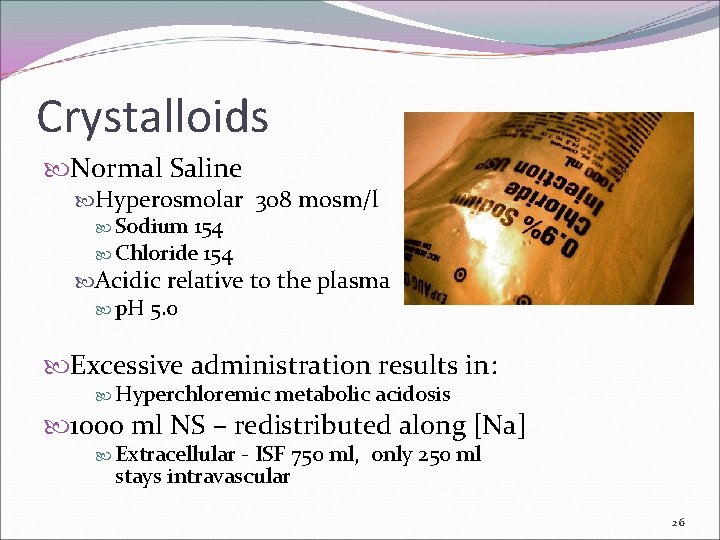
Crystalloids Normal Saline Hyperosmolar 308 mosm/l Sodium 154 Chloride 154 Acidic relative to the plasma p. H 5. 0 Excessive administration results in: Hyperchloremic metabolic acidosis 1000 ml NS – redistributed along [Na] Extracellular - ISF 750 ml, only 250 ml stays intravascular 26
Crystalloids Normal Saline Pros: Good for initial resuscitation Cheap Readily available, multiple sizes Widely used for OR maintenance fluid Compatible with all drugs and blood products Cons: Hyperchloremic, hypernatremic metabolic acidosis (Use 3 L or less) Large sodium load Use care with heart failure, renal failure, brain injury, old age 27
Crystalloids Ringer’s Lactate Osmolality 279 m. Osm/L Na+ 130 mmol/L Cl 110 mmol/L Lactate 27 mmol/L K+ 4 mmol/L Ca++ 3 mmol/L p. H 6. 5 Closer to physiologic p. H and Osmo 28
Crystalloids Ringer’s Lactate Pros: Good for resuscitation More “physiologic” Contains K Less hyperosmolar than saline No hyperchloremia Cons: More expensive Not compatible with some drugs or blood May worsen brain swelling (not as bad as NS) Use caution with elevated K, renal failure 29
Colloids NS based fluids Contain osmotically active particles Large molecules unable to cross endothelium Provide colloid oncotic pressure Theoretically replenish intravascular volume and stay in this compartment much longer than crystalloids 30
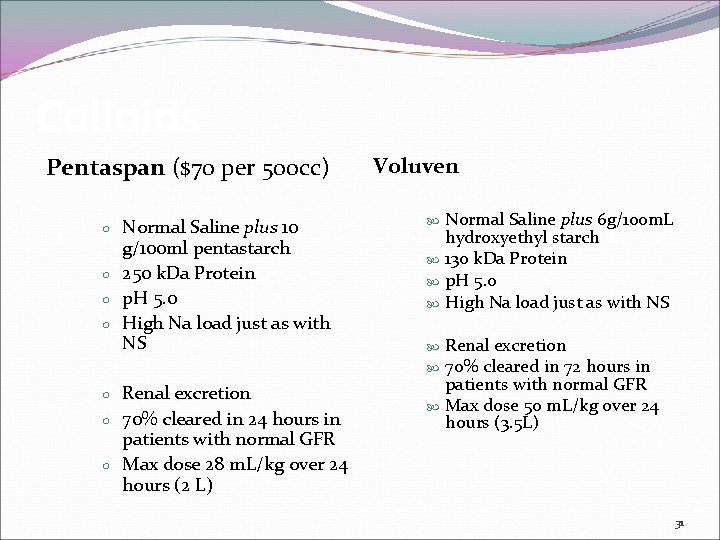
Colloids Pentaspan ($70 per 500 cc) ○ ○ Normal Saline plus 10 g/100 ml pentastarch 250 k. Da Protein p. H 5. 0 High Na load just as with NS Voluven ○ ○ ○ Renal excretion 70% cleared in 24 hours in patients with normal GFR Max dose 28 m. L/kg over 24 hours (2 L) Normal Saline plus 6 g/100 m. L hydroxyethyl starch 130 k. Da Protein p. H 5. 0 High Na load just as with NS Renal excretion 70% cleared in 72 hours in patients with normal GFR Max dose 50 m. L/kg over 24 hours (3. 5 L) 31
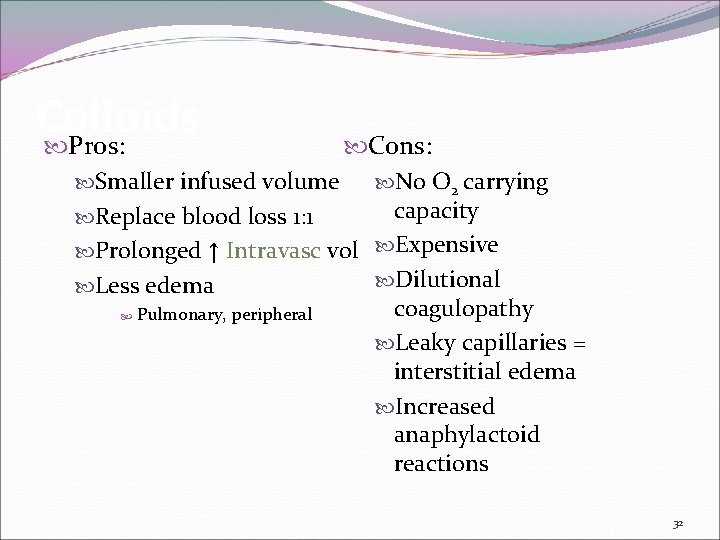
Colloids Pros: Cons: Smaller infused volume No O 2 carrying capacity Replace blood loss 1: 1 Prolonged ↑ Intravasc vol Expensive Dilutional Less edema coagulopathy Pulmonary, peripheral Leaky capillaries = interstitial edema Increased anaphylactoid reactions 32
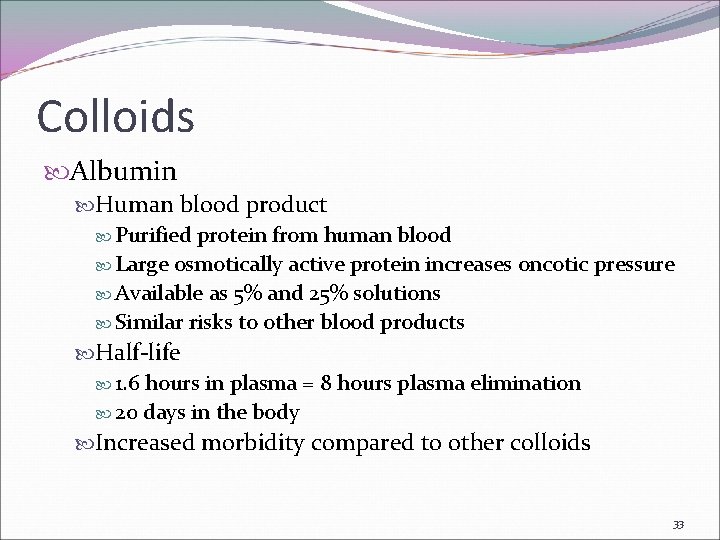
Colloids Albumin Human blood product Purified protein from human blood Large osmotically active protein increases oncotic pressure Available as 5% and 25% solutions Similar risks to other blood products Half-life 1. 6 hours in plasma = 8 hours plasma elimination 20 days in the body Increased morbidity compared to other colloids 33
Hypertonic solutions Hypertonic Saline Available as 1. 8%, 3%, 7. 5%, 10% solutions Increases extracellular osmolality Promotes fluid shift from ICF to ECF Rare indications: Trauma Symptomatic acute hyponatremia (TURP syndrome) Unclear benefits – risk acute hypernatremia 34
Fluid Therapy Objectives Intravenous Access Sites for Line Insertion Advantages and Disadvantages Complication Risks Insertion Techniques 35
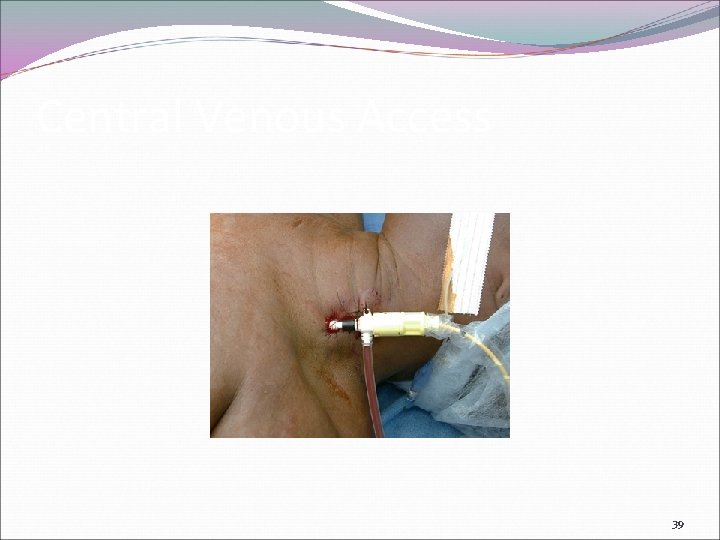
Sites for Line Insertion Peripheral Intravenous Access Central Intravenous Access Internal Jugular (IJ) Subclavian Femoral Intraosseous Access 36
Peripheral IV Access 37
Peripheral IV Access Advantages Easy to place Many points of access If unsuccessful, compressible site Fewer complications than central access Large bore access allows rapid infusion of large volumes Disadvantages Vein may be difficult to access Not used for prolonged administration of vasoactive drugs Cannot be placed distal to site of surgery or injury 38
Central Venous Access 39
Central Venous Access Advantages Reliable IV access when peripheral sites not available Long term IV and vasopressor therapy Large volume resuscitation Disadvantages Special equipment required Longer time to place Higher complication rate Need for special skill 40
Complications Mechanical Arterial puncture (femoral > IJ > subclavian) Hematoma (femoral > SC > IJ) Hemothorax (only seen in SC) Pneumothorax (SC >> IJ) Cardiac Tamponade (SC = IJ) Infectious Embolic Wire/catheter embolism 41
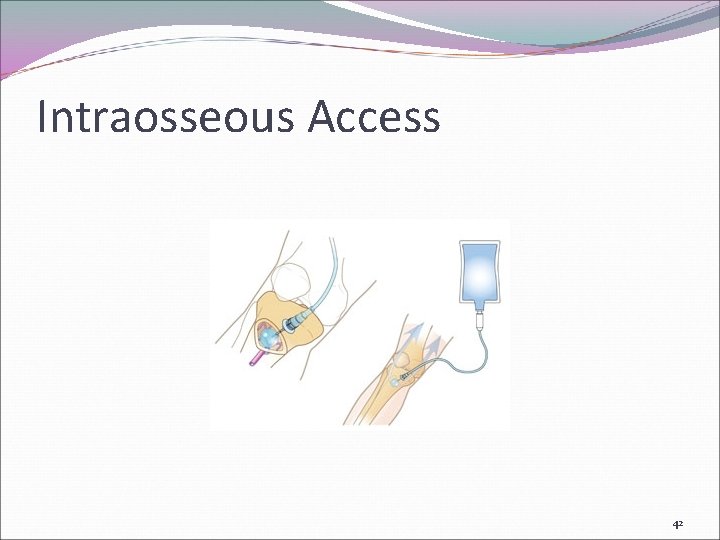
Intraosseous Access 42
Intraosseous Access Advantages Disadvantages Venous access when Need for special equipment and skill no other sites can be found Requires pressure Useful if difficult, delayed, bag to provide or impossible IV access reasonable flow of Used in burns or other injuries fluids preventing alternate access Osteomyelitis if long term 43
Whaddya do now? ? ? 44
Blood Therapy Kelly Shinkaruk, MD FRCPC HLT 123 October 17, 2009 45
Blood Therapy Objectives Blood Components Blood Transfusion Pros and Cons of Blood Products Indications for Transfusion Acceptable Blood Loss Factors Related to Blood Administration Complications Related to Transfusion Lab and Point of Care Testing Administration Techniques 46
Blood Therapy Objectives Blood Components Blood Transfusion Pros and Cons of Blood Products Indications for Transfusion Acceptable Blood Loss Factors Related to Blood Administration Complications Related to Transfusion Lab and Point of Care Testing Administration Techniques 47
Blood Components Cells: Red blood cells: carry oxygen Platelets: imperative for clotting White blood cells: removed Fluid: Plasma: Fluid with proteins (albumin), clotting factors Proteins: Clotting factors II-XII 48
Blood Transfusion Autologous blood Recovered blood Pooled blood products No “whole blood” anymore RBCs platelets Plasma Cryoprecipitate, factor VII 49
Autologous Blood Pros: Person’s own bloodlow risk of transfusion reactions Can donate up to 4 units Whole blood: coagulation factors, etc. Cons: Anemic, heart disease, transmissible diseases not eligible Whole blood only Anemia from donation Expensive 50
Recovered Blood (Cell Saver) Pros: Person’s own RBCs, washed No transfusion reaction Can be used for some Jehovah’s Witnesses Cons: Expensive Surgical contamination Bone Infection Cancer? Not 100% recovery 51
Cell Saver When? Major vascular procedures Major ortho procedures Major trauma Sometimes used in neurosurgery/backs Scoliosis surgery 52
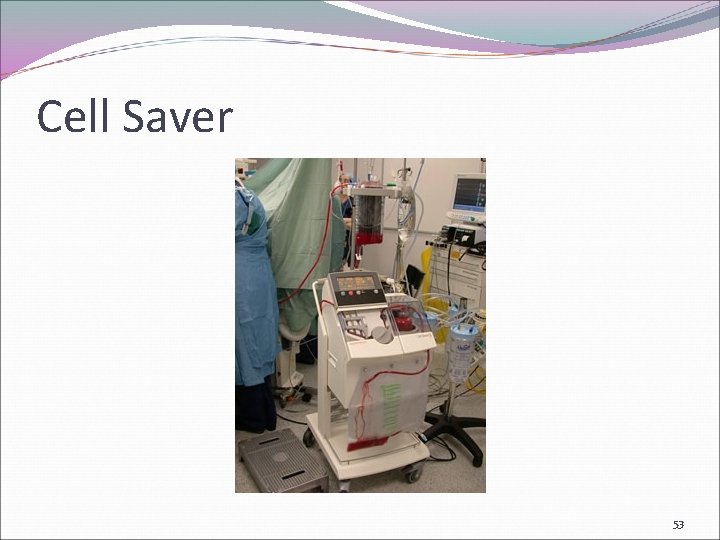
Cell Saver 53
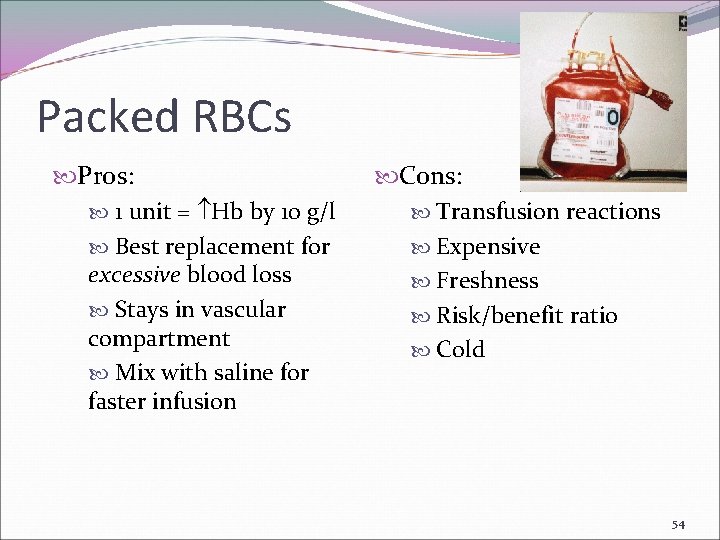
Packed RBCs Pros: 1 unit = Hb by 10 g/l Best replacement for excessive blood loss Stays in vascular compartment Mix with saline for faster infusion Cons: Transfusion reactions Expensive Freshness Risk/benefit ratio Cold 54
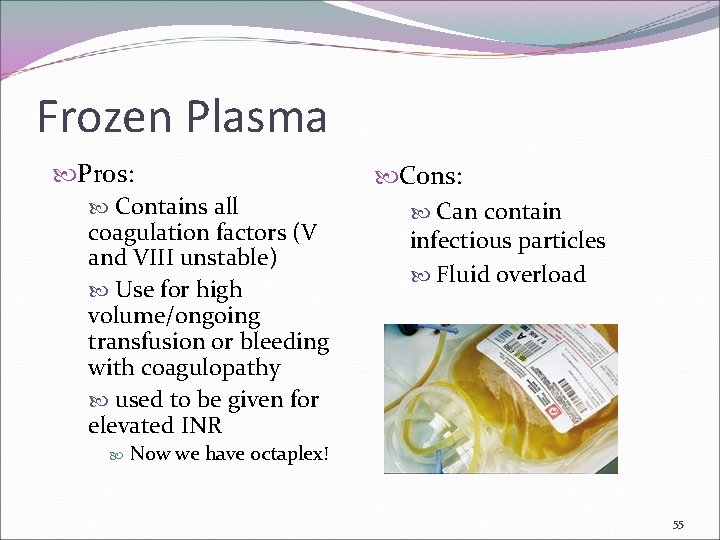
Frozen Plasma Pros: Contains all coagulation factors (V and VIII unstable) Use for high volume/ongoing transfusion or bleeding with coagulopathy used to be given for elevated INR Cons: Can contain infectious particles Fluid overload Now we have octaplex! 55
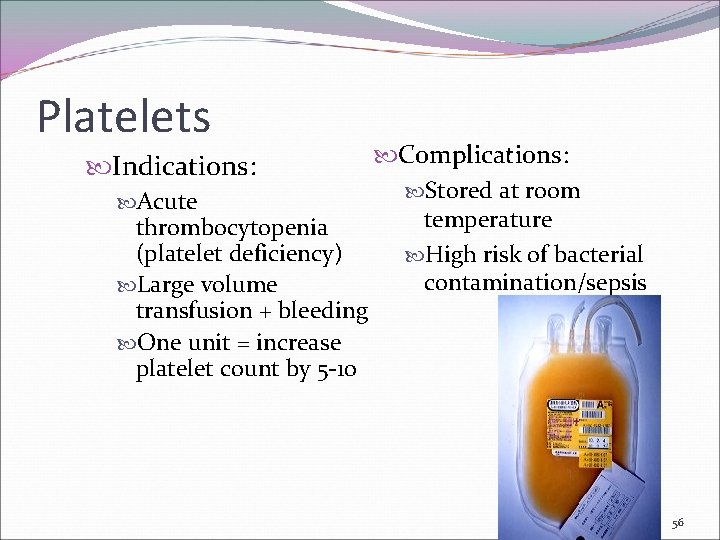
Platelets Indications: Acute thrombocytopenia (platelet deficiency) Large volume transfusion + bleeding One unit = increase platelet count by 5 -10 Complications: Stored at room temperature High risk of bacterial contamination/sepsis 56
Cryoprecipitate Contains Factor VIII Factor XIII Von Willebrand’s Factor Fibrinogen (Factor II) Indications Coagulopathy in massive bleeding and transfusion Actively bleeding patients with Fibrinogen < 0. 8 -1. 0 g/L VWD or Hemophilia A (Factor 8 deficiency) Only in the absence of specific factor concentrates DDAVP is not available or ineffective 57
Blood Therapy Objectives Blood Components Blood Transfusion Pros and Cons of Blood Products Indications for Transfusion Acceptable Blood Loss Factors Related to Blood Administration Complications Related to Transfusion Lab and Point of Care Testing Administration Techniques 58
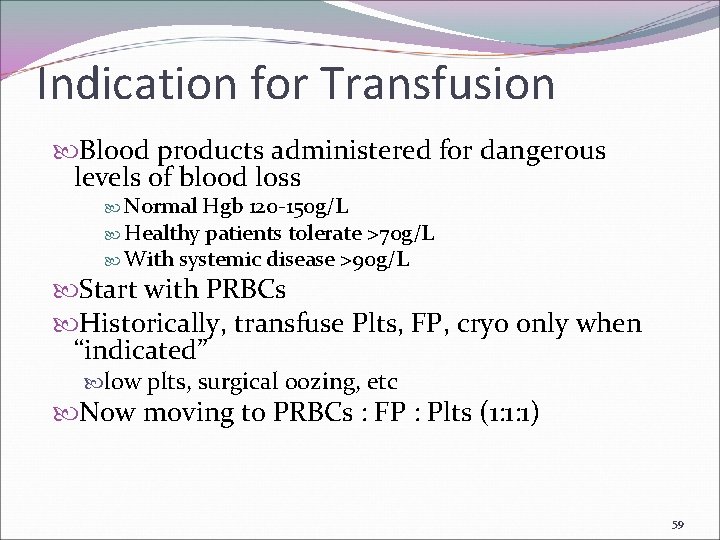
Indication for Transfusion Blood products administered for dangerous levels of blood loss Normal Hgb 120 -150 g/L Healthy patients tolerate >70 g/L With systemic disease >90 g/L Start with PRBCs Historically, transfuse Plts, FP, cryo only when “indicated” low plts, surgical oozing, etc Now moving to PRBCs : FP : Plts (1: 1: 1) 59
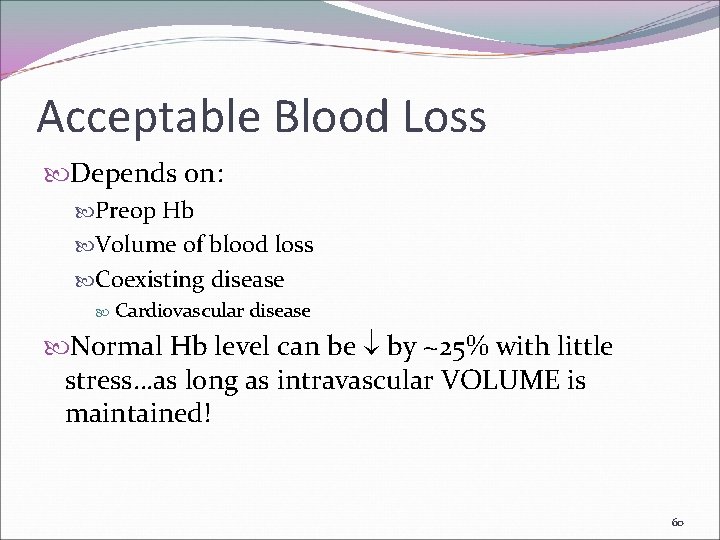
Acceptable Blood Loss Depends on: Preop Hb Volume of blood loss Coexisting disease Cardiovascular disease Normal Hb level can be by ~25% with little stress…as long as intravascular VOLUME is maintained! 60
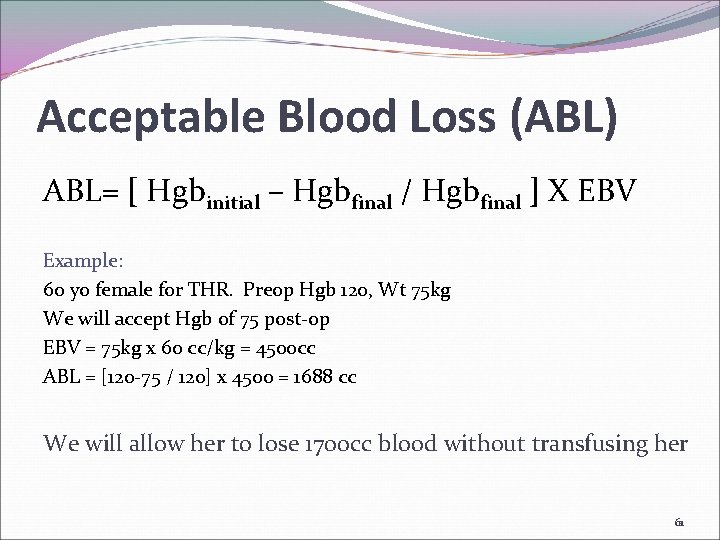
Acceptable Blood Loss (ABL) ABL= [ Hgbinitial – Hgbfinal / Hgbfinal ] X EBV Example: 60 yo female for THR. Preop Hgb 120, Wt 75 kg We will accept Hgb of 75 post-op EBV = 75 kg x 60 cc/kg = 4500 cc ABL = [120 -75 / 120] x 4500 = 1688 cc We will allow her to lose 1700 cc blood without transfusing her 61
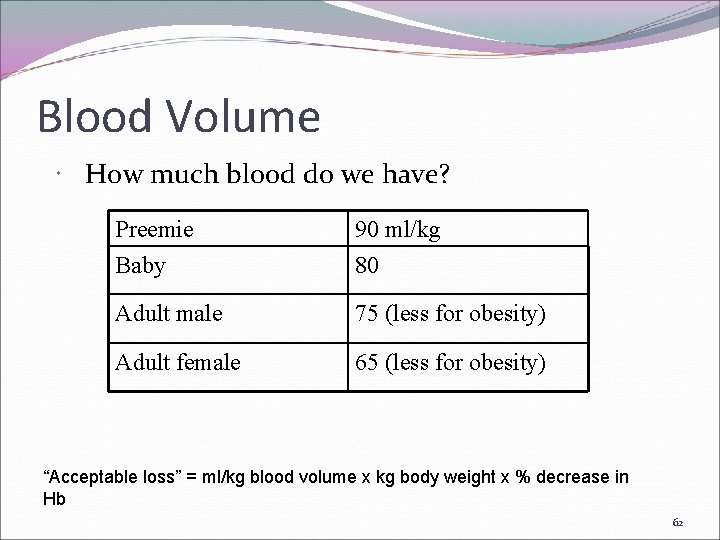
Blood Volume How much blood do we have? Preemie Baby 90 ml/kg 80 Adult male 75 (less for obesity) Adult female 65 (less for obesity) “Acceptable loss” = ml/kg blood volume x kg body weight x % decrease in Hb 62
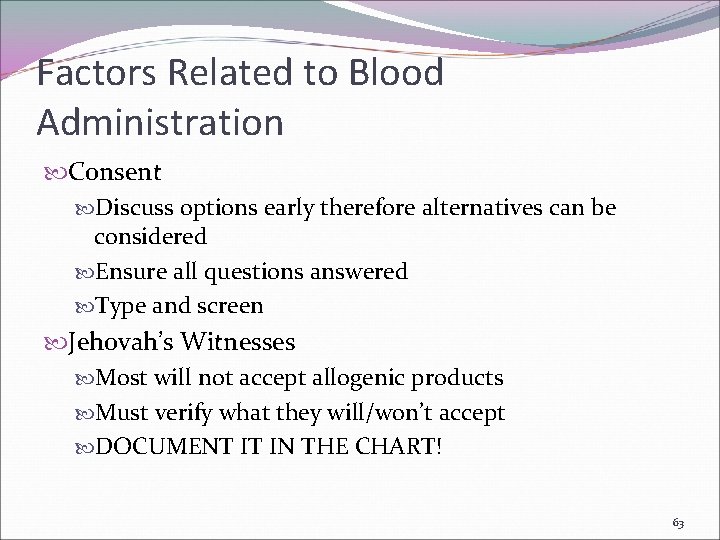
Factors Related to Blood Administration Consent Discuss options early therefore alternatives can be considered Ensure all questions answered Type and screen Jehovah’s Witnesses Most will not accept allogenic products Must verify what they will/won’t accept DOCUMENT IT IN THE CHART! 63
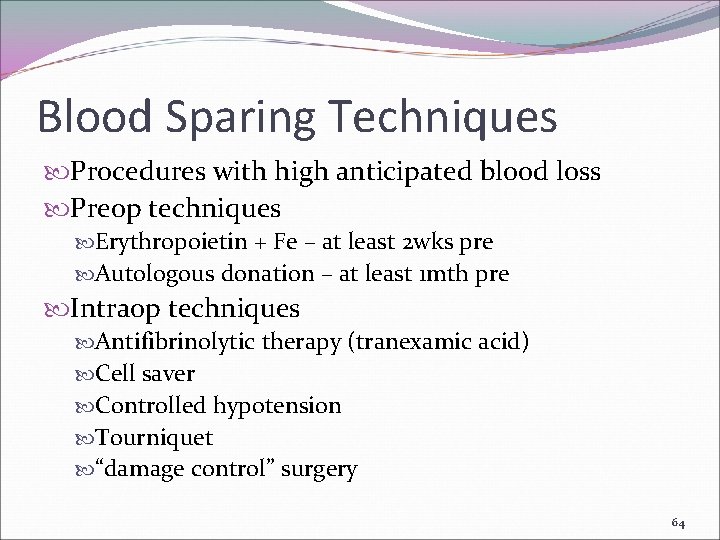
Blood Sparing Techniques Procedures with high anticipated blood loss Preop techniques Erythropoietin + Fe – at least 2 wks pre Autologous donation – at least 1 mth pre Intraop techniques Antifibrinolytic therapy (tranexamic acid) Cell saver Controlled hypotension Tourniquet “damage control” surgery 64
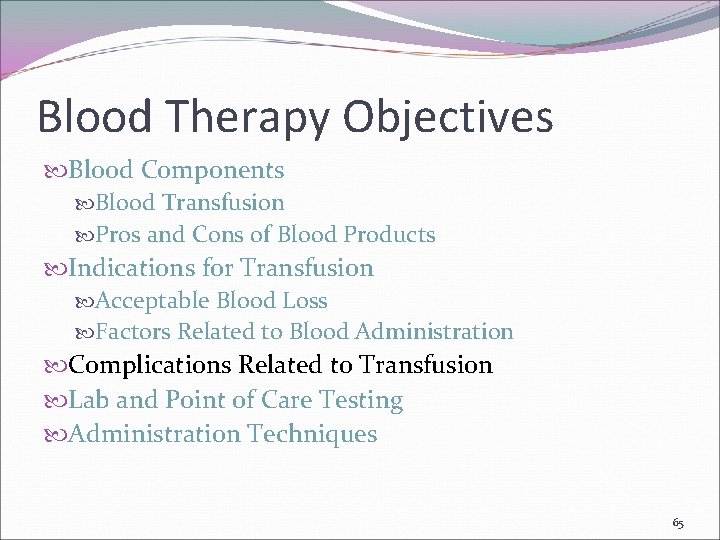
Blood Therapy Objectives Blood Components Blood Transfusion Pros and Cons of Blood Products Indications for Transfusion Acceptable Blood Loss Factors Related to Blood Administration Complications Related to Transfusion Lab and Point of Care Testing Administration Techniques 65
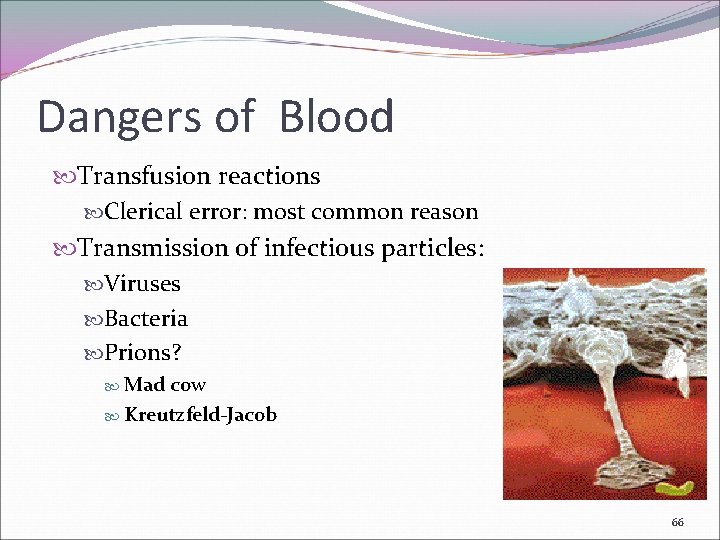
Dangers of Blood Transfusion reactions Clerical error: most common reason Transmission of infectious particles: Viruses Bacteria Prions? Mad cow Kreutzfeld-Jacob 66
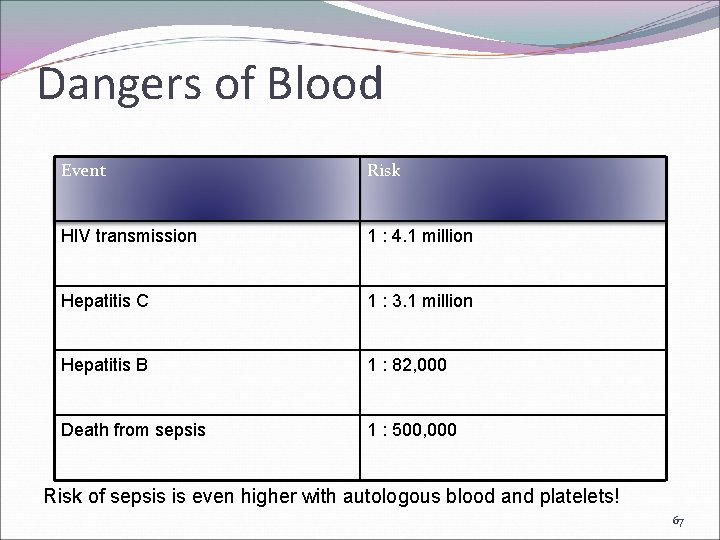
Dangers of Blood Event Risk HIV transmission 1 : 4. 1 million Hepatitis C 1 : 3. 1 million Hepatitis B 1 : 82, 000 Death from sepsis 1 : 500, 000 Risk of sepsis is even higher with autologous blood and platelets! 67
Complications of Blood Transfusion Volume overload heart failure, pulmonary edema Temperature hypothermia from large amounts of cold blood/fluid Air if given under pressure, risk of air entering circulation (air trapping in lung, heart, brain) Immune suppression non-specific suppression with blood product administration 68
Complications of Blood Transfusion Incompatibility red blood cell, white blood cell, plasma antibody reactions Most common reason: clerical error Dilutional coagulopathy Infection blood screened for HIV, Hep C/B, syphilis, others Not screened for all viruses! 69
Complications of Blood Transfusion Biochemical abnormalities Citrate: anticoagulant in p. RBCs, binds calcium, may necessitate calcium replacement Potassium: high concentrations in p. RBCs, with low p. H. Interreaction of p. H and K may mean high or low K after transfusion Microaggregates tiny clots in p. RBCs may lodge in lungs (TRALI) 70
Symptoms of Blood Reactions Pain, rash, hives, edema Fever, chills, nausea, vomiting, SOB BP, HR, O 2 sat, mental status changes Pink or brown urine Circulatory collapse TAKE-HOME MESSAGE Any change in clinical condition after blood transfusion is suspect!! Stop transfusion and treat aggressively!! 71
Complications: What to Do STOP blood product IMMEDIATELY! Notify other OR staff, blood bank. Send blood and samples from patient to lab. O 2, drugs as necessary to support vital signs. Fluids, drugs to flush kidneys. Monitor for coagulation problems, treat as necessary. 72
Transfusing Blood Does patient want blood? How much of this anemia is acute? Is blood loss more than “acceptable”? Will there be more blood loss? Is there a coagulopathy causing this? Is the patient at risk from heart or vascular disease? Have I tried to use other fluids without success? 73
Blood Therapy Objectives Blood Components Blood Transfusion Pros and Cons of Blood Products Indications for Transfusion Acceptable Blood Loss Factors Related to Blood Administration Complications Related to Transfusion Lab and Point of Care Testing Administration Techniques 74
Lab and Point of Care Testing Used for intra-op diagnosis Rapid assessment of blood measurements Helps guide ongoing therapy Different equipment Hemocue for Hgb Hemochron for PTT/INR i. Stat for ABGs, lytes, Hgb Traditional lab work also available – but takes far longer! 75
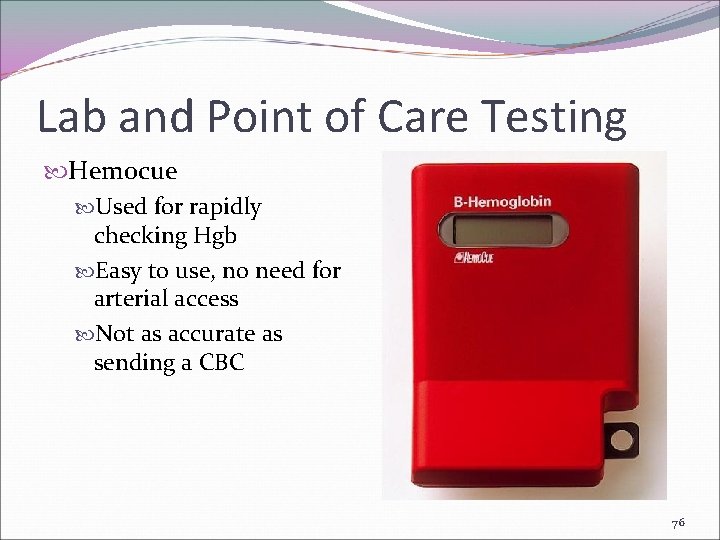
Lab and Point of Care Testing Hemocue Used for rapidly checking Hgb Easy to use, no need for arterial access Not as accurate as sending a CBC 76
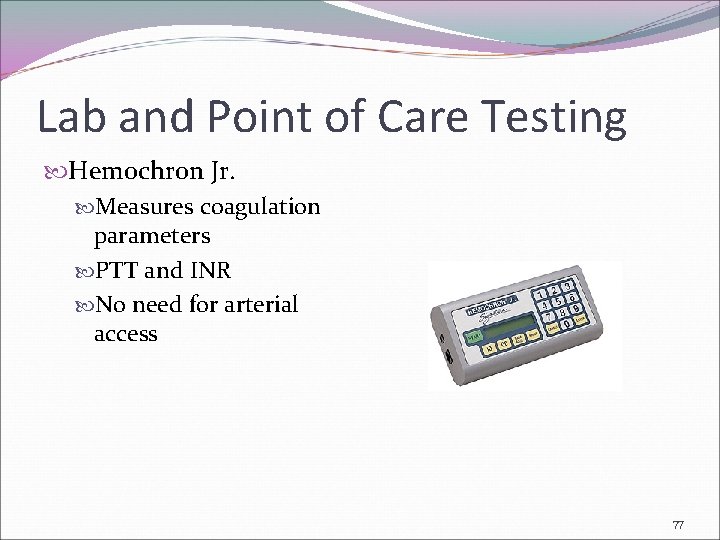
Lab and Point of Care Testing Hemochron Jr. Measures coagulation parameters PTT and INR No need for arterial access 77
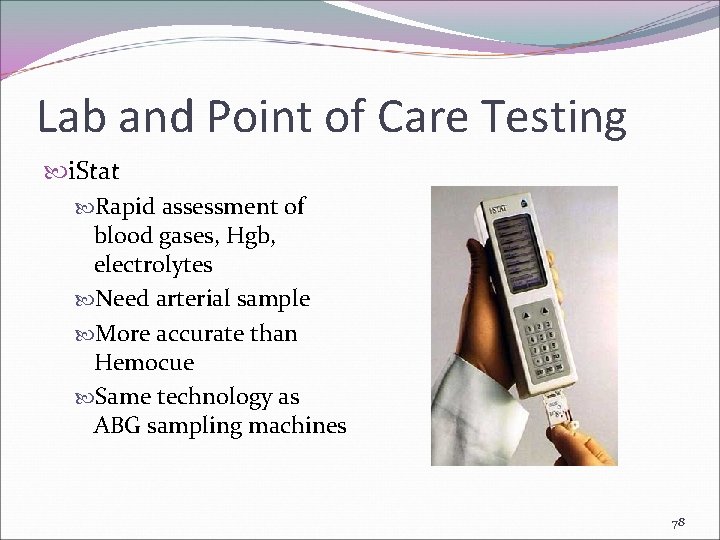
Lab and Point of Care Testing i. Stat Rapid assessment of blood gases, Hgb, electrolytes Need arterial sample More accurate than Hemocue Same technology as ABG sampling machines 78
Lab and Point of Care Testing ACT (activated clotting time) Used during vascular procedures Monitors effectiveness of high dose heparin therapy Sample from undiluted site not contaminated by heparin infusion Helps guide further dosing of heparin or reversal of heparin with protamine 79
Blood Therapy Objectives Blood Components Blood Transfusion Pros and Cons of Blood Products Indications for Transfusion Acceptable Blood Loss Factors Related to Blood Administration Complications Related to Transfusion Lab and Point of Care Testing Administration Techniques 80
Administering Fluids and Blood Products Ensure at least one functional IV Normal Procedure IV infusion set up Fluid warmer - not necessary, often if >2 hr procedure or possibility of blood transfusion Procedure with anticipated transfusion IV Blood set Fluid warmer essential 81
Administering Fluids and Blood Products Some physicians now use infusion pumps Occasionally administer meds by infusion pump Vancomycin Insulin 82
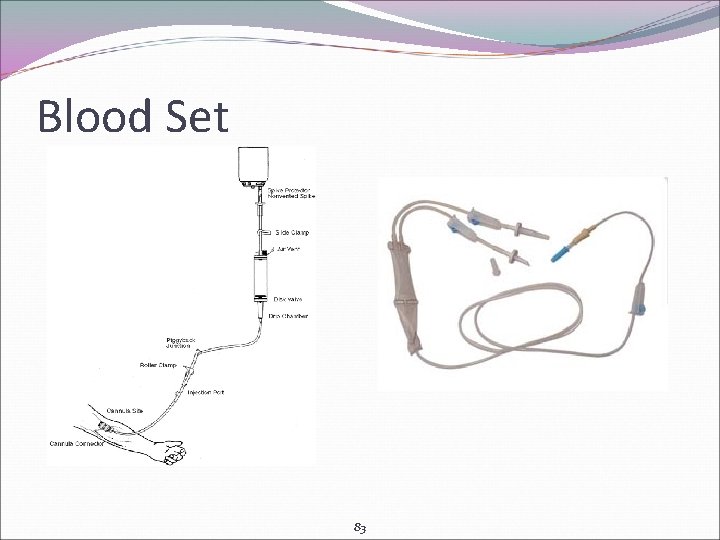
Blood Set 83
Massive Transfusion Definition the replacement of TBV in less than 24 hours or… more than half the EBV per hour. TOH has a massive transfusion protocol In the binder Includes studies/point of care, order of blood products, factor VIIa, etc. Rapid infusion – Pressure bags, Level 1 84
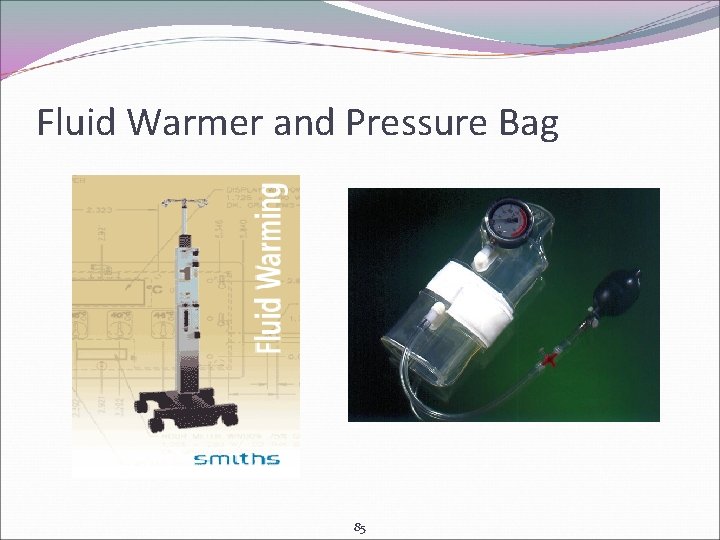
Fluid Warmer and Pressure Bag 85
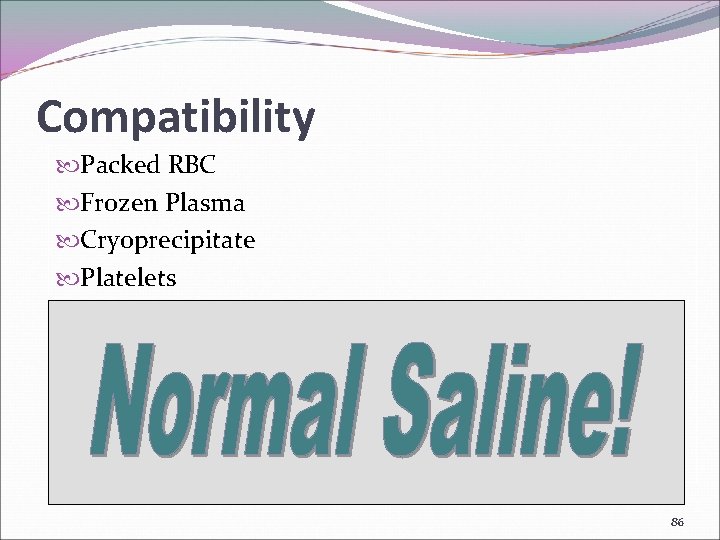
Compatibility Packed RBC Frozen Plasma Cryoprecipitate Platelets 86
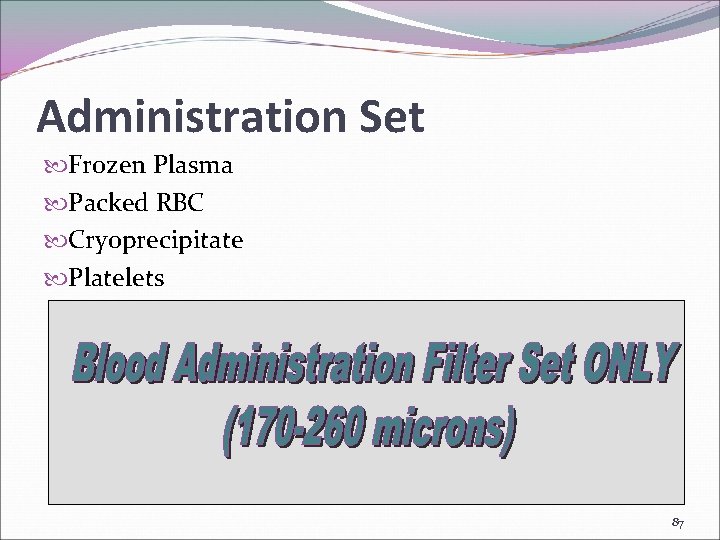
Administration Set Frozen Plasma Packed RBC Cryoprecipitate Platelets 87

Questions? ? ? 88
- Slides: 88