
Fluency Instruction TLED 432532 Fluency Building the Bridge
Fluency Instruction TLED 432/532

Fluency: Building the Bridge… Fluency Identifying Words Constructing Meaning Fluency: The bridge between the ability to identify words and the ability to construct meaning.
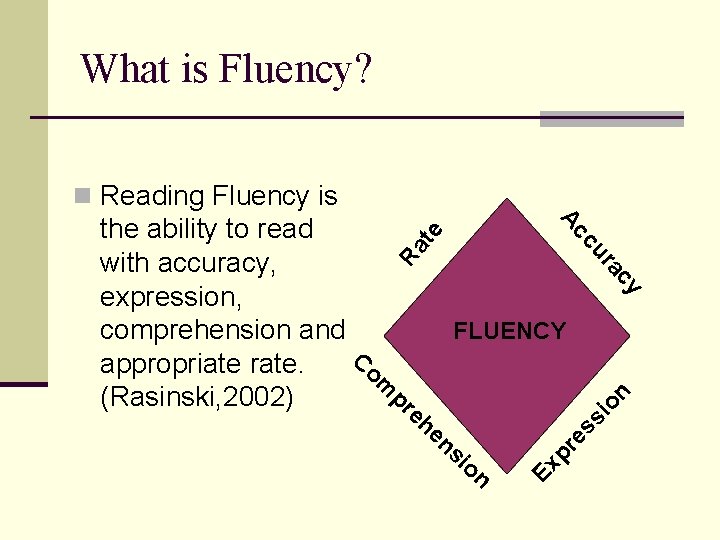
What is Fluency? n Reading Fluency is cy ra Ra te cu Ac si es ns io n pr he on FLUENCY Ex the ability to read with accuracy, expression, comprehension and C appropriate rate. om pr (Rasinski, 2002) e
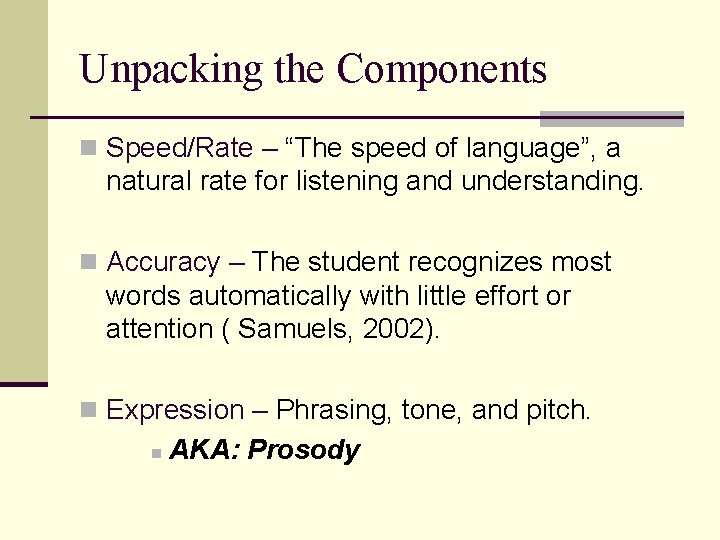
Unpacking the Components n Speed/Rate – “The speed of language”, a natural rate for listening and understanding. n Accuracy – The student recognizes most words automatically with little effort or attention ( Samuels, 2002). n Expression – Phrasing, tone, and pitch. n AKA: Prosody
Unpacking the Components Comprehension n Constructing meaning with the text. n The GOAL of fluency instruction
Why is Fluency Important? n Students who are fluent readers are better able to devote their attention to constructing meaning. n Extensive time/memory devoted to decoding = less attention to comprehension (La. Berge & Samuels, 1974). n Fluency does not guarantee comprehension, but comprehension is difficult without it.

How Does Fluency Develop? n Fluency develops over time with modeling and instruction, guided and independent practice, and reading a variety of texts. n Fluency develops as children read interesting and manageable texts (at least 95% accuracy rate) every day.
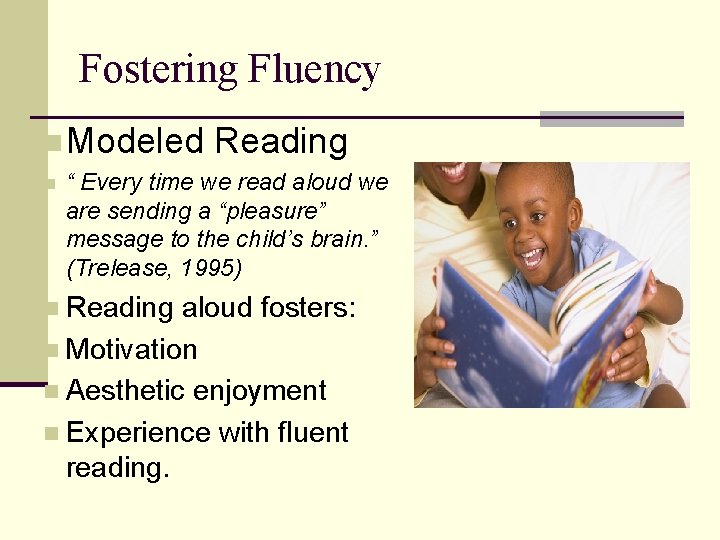
Fostering Fluency n Modeled n Reading “ Every time we read aloud we are sending a “pleasure” message to the child’s brain. ” (Trelease, 1995) n Reading aloud fosters: n Motivation n Aesthetic enjoyment n Experience with fluent reading.
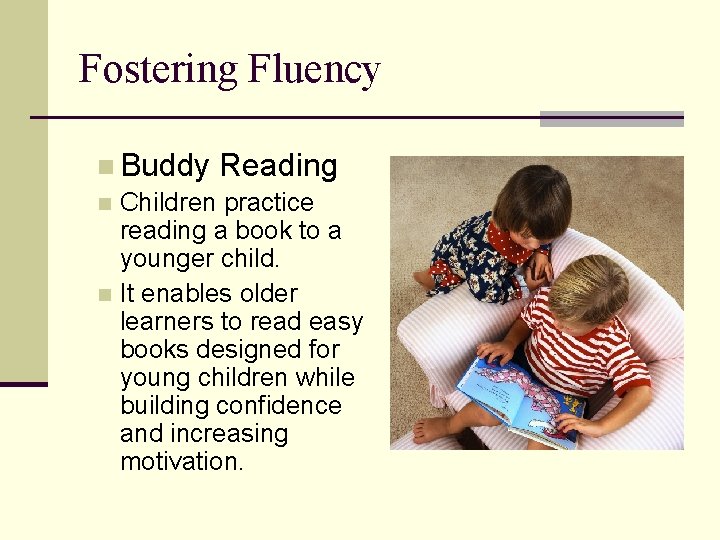
Fostering Fluency n Buddy Reading Children practice reading a book to a younger child. n It enables older learners to read easy books designed for young children while building confidence and increasing motivation. n
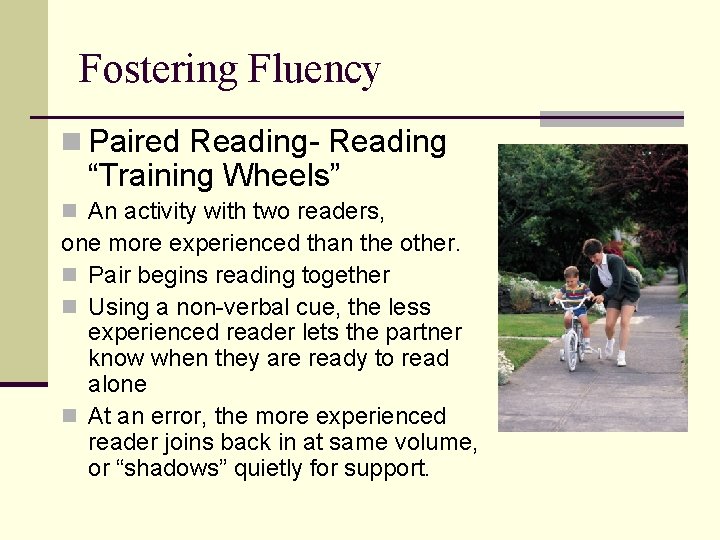
Fostering Fluency n Paired Reading- Reading “Training Wheels” n An activity with two readers, one more experienced than the other. n Pair begins reading together n Using a non-verbal cue, the less experienced reader lets the partner know when they are ready to read alone n At an error, the more experienced reader joins back in at same volume, or “shadows” quietly for support.
Fostering Fluency n Readers Theater Is an authentic oral reading activity in which readers perform a play using just their voices ( no props, sets, etc. ) n A story is adapted in script format (or prepared plays may be used) n The goal is to read a script effectively so that the audience can visualize the action. n
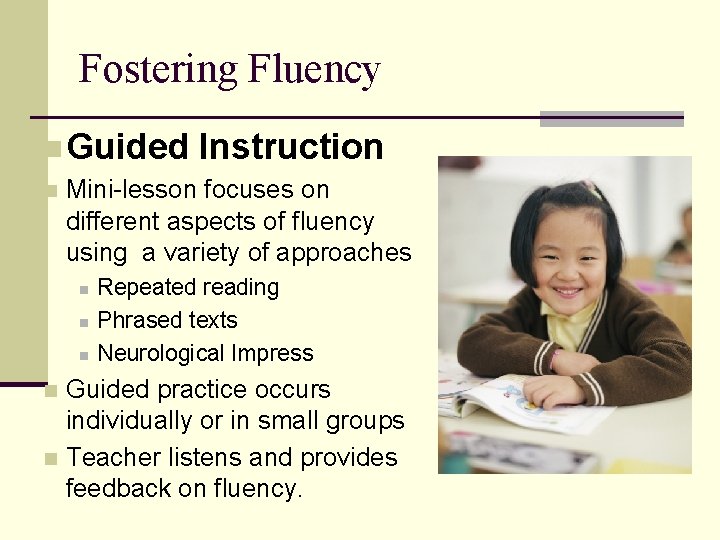
Fostering Fluency n Guided n Instruction Mini-lesson focuses on different aspects of fluency using a variety of approaches n n n Repeated reading Phrased texts Neurological Impress Guided practice occurs individually or in small groups n Teacher listens and provides feedback on fluency. n
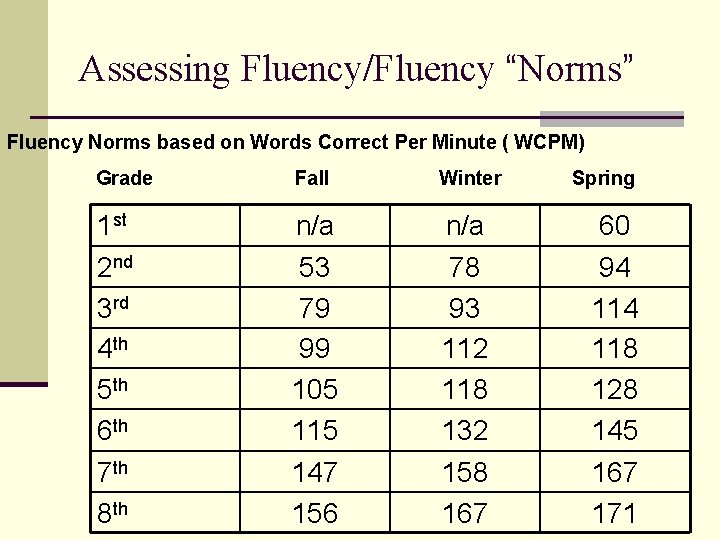
Assessing Fluency/Fluency “Norms” Fluency Norms based on Words Correct Per Minute ( WCPM) Grade Fall Winter Spring 1 st 2 nd 3 rd 4 th 5 th 6 th n/a 53 79 99 105 115 n/a 78 93 112 118 132 60 94 118 128 145 7 th 8 th 147 156 158 167 171
Cautions for Fluency Instruction n Q: How fast should a child read? A: Fast enough to understand a text. ( J. Samuels, IRA-May, 2006) n Fluency instruction should be in the service of meaning… not an end unto itself. n “Fluency n is not a DIBELS race. ” (T. Shanahan, March, 12, 2007)
- Slides: 14