
Fluency in Oral Interaction Workshop FLOW Zoe Handley



- Slides: 19
Fluency in Oral Interaction Workshop (FLOW) Zoe Handley, Department of Education, University of York zoe. handley@york. ac. uk
Programme Time Location 10: 00 – 12: 00 B/R/012 Exploring oral fluency using PRAAT (Zoe Handley, Stewart Cooper, Ann-Marie Hunter) 12: 30 – 2: 00 Various Lunch 2: 00 – 3: 00 D/L/104 Challenges in measuring and assessing second language oral frequency (Parvaneh Tavakoli) 3: 00 – 3: 30 D/L/104 Broadening the context for analysing fluency - time and task effects on Mandarin in fluency development during Study Abroad (Clare Wright) 3: 30 – 4: 45 Norman Rea Gallery Coffee and posters 4: 45 – 5: 15 D/L/104 Investigating fluency across multiple languages and tasks (Amanda Huensch) 5: 15 – 5: 45 D/L/104 What is oral fluency? (Zoe Handley) 5: 45 – 6: 00 D/L/104 Summing up
Exploring Oral Fluency Using PRAAT Zoe Handley, Department of Education, University of York Stewart Cooper, Department of Education, University of York Ann-Marie Hunter, St Mary’s University, London
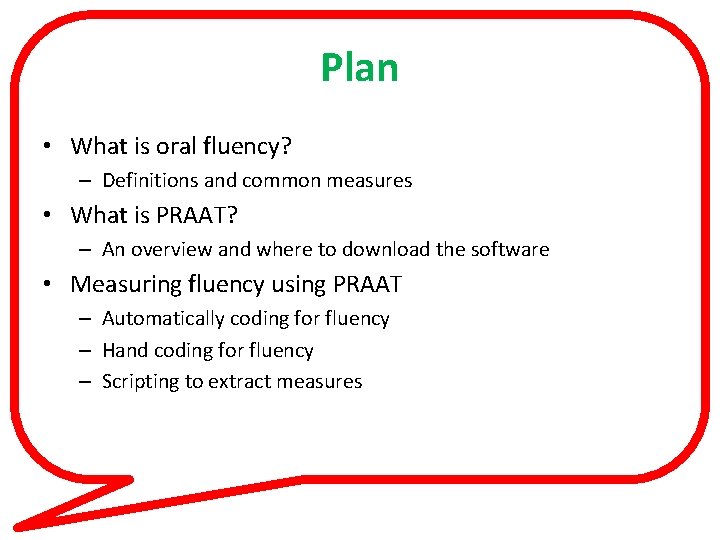
Plan • What is oral fluency? – Definitions and common measures • What is PRAAT? – An overview and where to download the software • Measuring fluency using PRAAT – Automatically coding for fluency – Hand coding for fluency – Scripting to extract measures
What is oral fluency? • Broad sense: – – • “the highest point on a scale that measures spoken command of a foreign language” “oral proficiency” Narrow sense: – – “speak[s] correctly by not very fluently” “native-like rapidity”, “flowingly” (Lennon, 1990, p. 389 - 390) • Fluency in the narrow sense – Perceived fluency: “the inferences listeners make about … cognitive fluency based on their perceptions of utterance fluency” – Utterance fluency: “the features of utterances that reflect cognitive fluency” – Cognitive fluency: “efficiency of the operation of the underlying processes” (Segalowitz, 2010, p. 165)
Common measures of oral fluency Type Holistic Speed fluency Breakdown fluency Repair fluency Measure Pruned speech rate Speech rate Articulation rate Pauses per minute Mean length of pauses Mean length of run Phonation-time-ratio Dysfluencies per minute Corrections per minute Repetitions per minute (Kormos & Dènes, 2004; Segalowitz, 2010) Measure duration of - Speech - Pauses AND Count - Syllables - Pauses
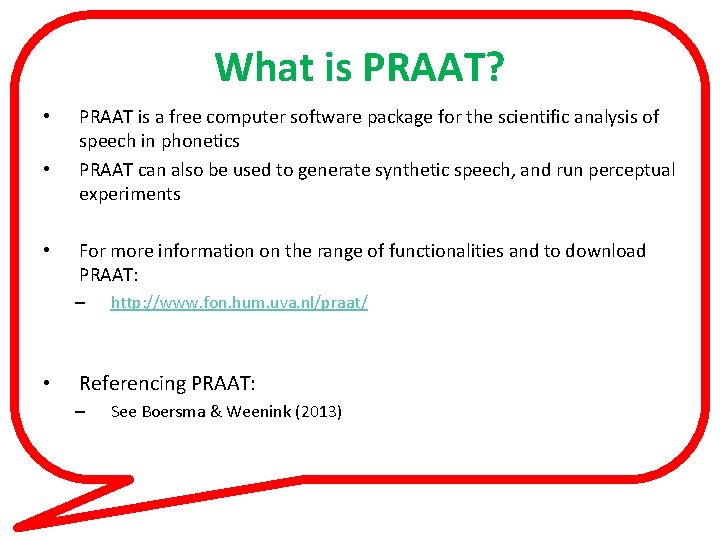
What is PRAAT? • • • PRAAT is a free computer software package for the scientific analysis of speech in phonetics PRAAT can also be used to generate synthetic speech, and run perceptual experiments For more information on the range of functionalities and to download PRAAT: – • http: //www. fon. hum. uva. nl/praat/ Referencing PRAAT: – See Boersma & Weenink (2013)
Measuring fluency using PRAAT 1. Overview 2. Automatically coding for fluency 3. Hand coding for fluency 4. Extracting fluency measures
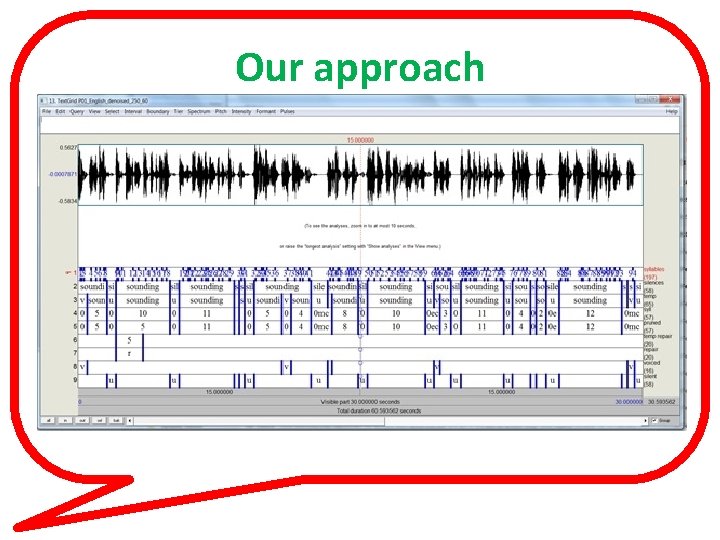
Our approach
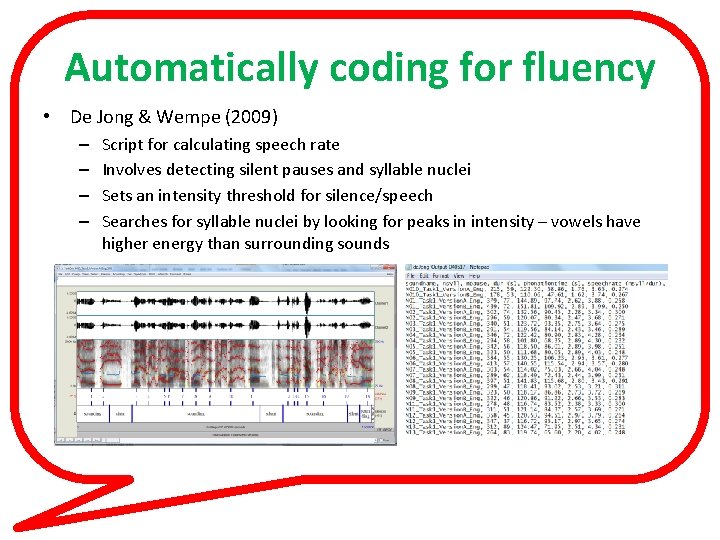
Automatically coding for fluency • De Jong & Wempe (2009) – – Script for calculating speech rate Involves detecting silent pauses and syllable nuclei Sets an intensity threshold for silence/speech Searches for syllable nuclei by looking for peaks in intensity – vowels have higher energy than surrounding sounds
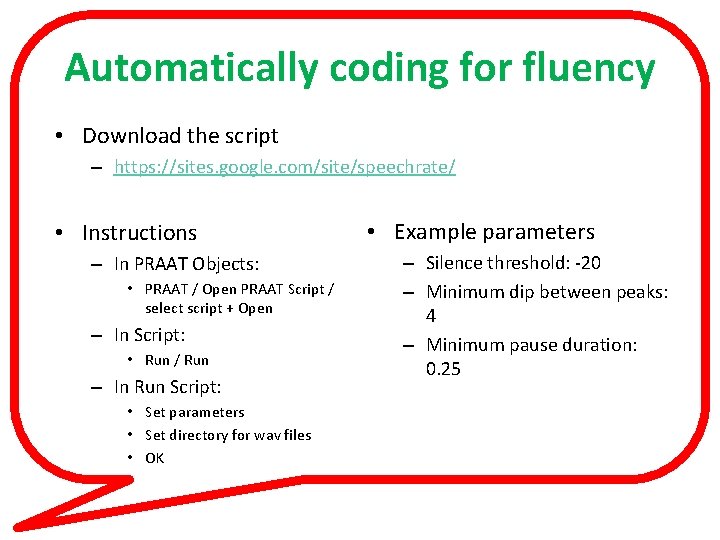
Automatically coding for fluency • Download the script – https: //sites. google. com/site/speechrate/ • Instructions – In PRAAT Objects: • PRAAT / Open PRAAT Script / select script + Open – In Script: • Run / Run – In Run Script: • Set parameters • Set directory for wav files • OK • Example parameters – Silence threshold: -20 – Minimum dip between peaks: 4 – Minimum pause duration: 0. 25
Discussion What are the strengths and limitations of automatic coding?
Hand coding for fluency
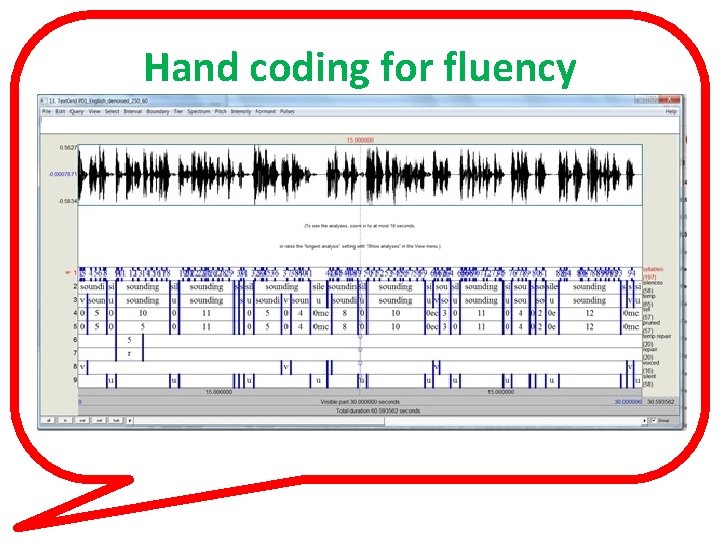
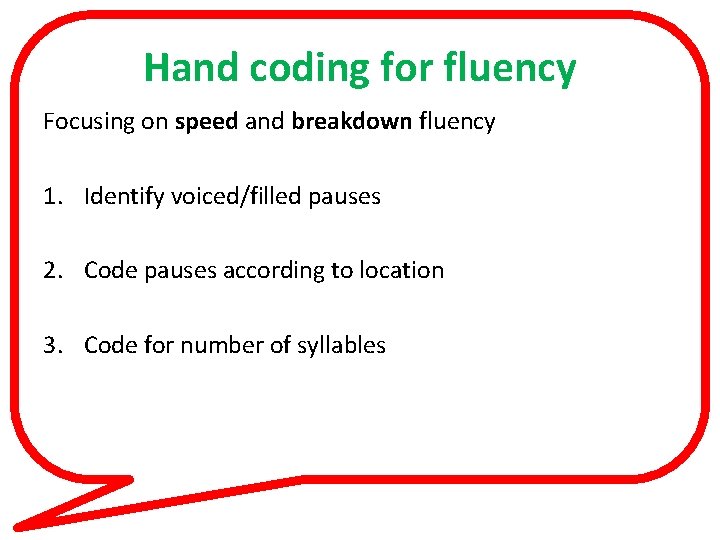
Hand coding for fluency Focusing on speed and breakdown fluency 1. Identify voiced/filled pauses 2. Code pauses according to location 3. Code for number of syllables
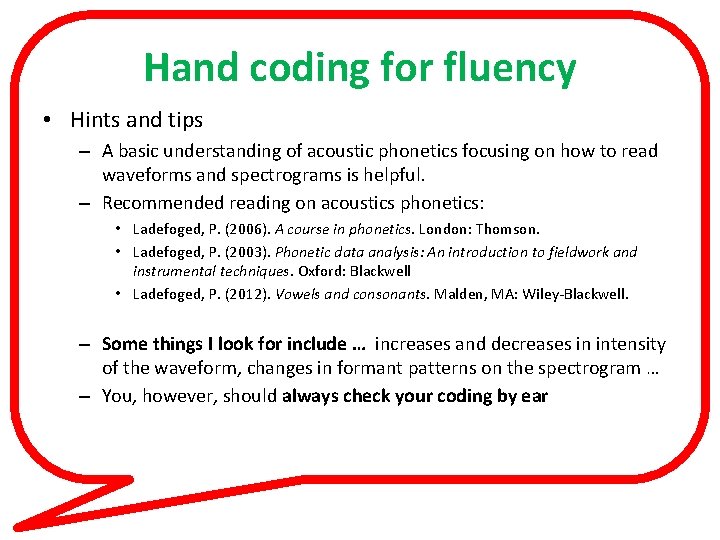
Hand coding for fluency • Hints and tips – A basic understanding of acoustic phonetics focusing on how to read waveforms and spectrograms is helpful. – Recommended reading on acoustics phonetics: • Ladefoged, P. (2006). A course in phonetics. London: Thomson. • Ladefoged, P. (2003). Phonetic data analysis: An introduction to fieldwork and instrumental techniques. Oxford: Blackwell • Ladefoged, P. (2012). Vowels and consonants. Malden, MA: Wiley-Blackwell. – Some things I look for include … increases and decreases in intensity of the waveform, changes in formant patterns on the spectrogram … – You, however, should always check your coding by ear
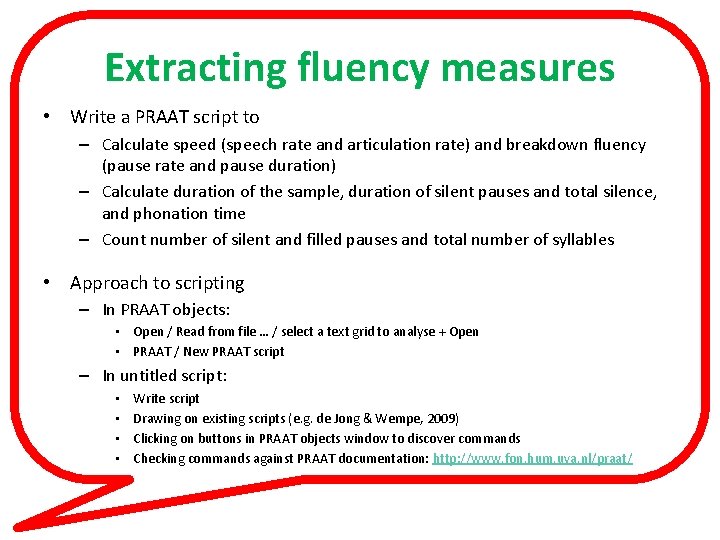
Extracting fluency measures • Write a PRAAT script to – Calculate speed (speech rate and articulation rate) and breakdown fluency (pause rate and pause duration) – Calculate duration of the sample, duration of silent pauses and total silence, and phonation time – Count number of silent and filled pauses and total number of syllables • Approach to scripting – In PRAAT objects: • Open / Read from file … / select a text grid to analyse + Open • PRAAT / New PRAAT script – In untitled script: • • Write script Drawing on existing scripts (e. g. de Jong & Wempe, 2009) Clicking on buttons in PRAAT objects window to discover commands Checking commands against PRAAT documentation: http: //www. fon. hum. uva. nl/praat/
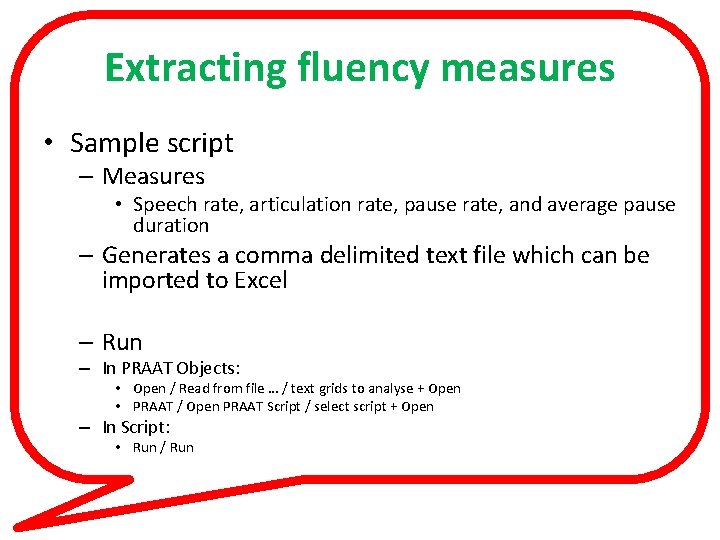
Extracting fluency measures • Sample script – Measures • Speech rate, articulation rate, pause rate, and average pause duration – Generates a comma delimited text file which can be imported to Excel – Run – In PRAAT Objects: • Open / Read from file … / text grids to analyse + Open • PRAAT / Open PRAAT Script / select script + Open – In Script: • Run / Run
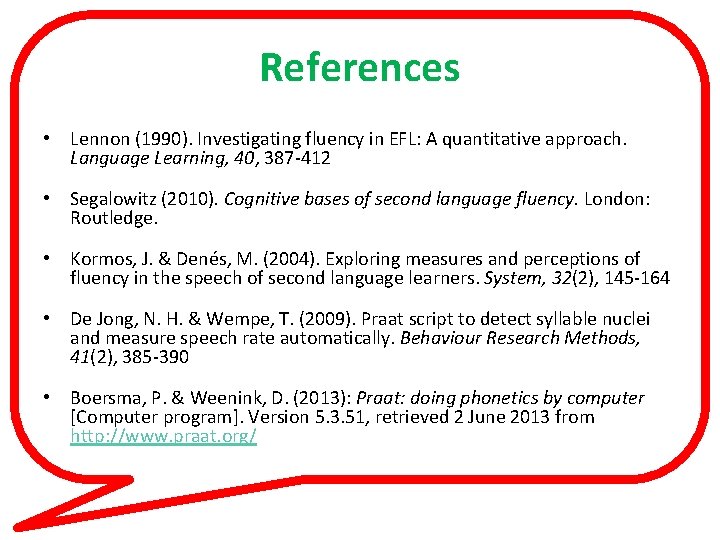
References • Lennon (1990). Investigating fluency in EFL: A quantitative approach. Language Learning, 40, 387 -412 • Segalowitz (2010). Cognitive bases of second language fluency. London: Routledge. • Kormos, J. & Denés, M. (2004). Exploring measures and perceptions of fluency in the speech of second language learners. System, 32(2), 145 -164 • De Jong, N. H. & Wempe, T. (2009). Praat script to detect syllable nuclei and measure speech rate automatically. Behaviour Research Methods, 41(2), 385 -390 • Boersma, P. & Weenink, D. (2013): Praat: doing phonetics by computer [Computer program]. Version 5. 3. 51, retrieved 2 June 2013 from http: //www. praat. org/
Thank you!