
FLUENCY A Bridge to Comprehension Anne Riggs OBJECTIVES
FLUENCY A Bridge to Comprehension Anne Riggs
OBJECTIVES n Define and describe fluency n Recognize how fluency helps students become proficient readers. n Learn how to measure fluency n Review classroom practices that support fluency n Participate in activities that help students become fluent readers.
Think-Ink-Pair-Share What Do I Already Know About Fluency?
WHAT THE RESEARCH SAYS: n“Fluency is important because it provides a bridge between word recognition and comprehension” (National Institute for Literacy (NIFL) 2001, p. 22).
WHAT THE RESEARCH SAYS: n. Students who do not develop reading fluency, regardless of how bright they are, are likely to remain poor readers throughout their lives (National Reading Panel, 2000)
What’s Wrong with Round Robin? n Poor use of instructional time n Comprehension is low n Students not really listening n High levels of anxiety among poor readers n High levels of boredom among competent readers n Not real reading n Needy students exposed to poor models of oral reading, etc.
Oral Reading … n Real Reading n Connects Written and Spoken Confidence Language n Creates n Strengthens Community Decoding Skills n Fosters Fluency n Builds The Fluent Reader, T. Rasinski (Scholastic)
What is Fluency? n. Fluency is reading quickly, accurately, and with expression” (National Reading Panel, 2000).
Components of Fluency: n. ACCURACY n. RATE n. PROSODY
ACCURACY n. Accurate reading of the text
RATE n. The speed at which a reader reads
PROSODY n. Phrasing, intonation and stress
FLUENCY All three components must be present if the result is to be fluent reading. The majority of readers who have reading difficulties lack one or more components of fluency (Wolf, Miller, & Donnelly, 2000).
Think-Ink-Pair-Share n Fluent readers vs. non-fluent readers n What are they like? Make a T chart
Non-Fluent Readers n Read word-by-word n Think fast reading is good reading n Have a poor bank of sight words n Lack word analysis skills n Lack knowledge of language skills
Non-Fluent Readers…more n Lack expression n Ignore punctuation n Lack prior knowledge of story structure and expository text structure n Lack the ability to phrase text appropriately
Fluent Readers n Use knowledge of language to keep reading. n Use appropriate reading rate. n Slow down to solve problems. n Have automatic word recognition. n Have automatic word analysis skills.
Fluent Readers…more n Use intonation to convey meaning. n Adhere to punctuation cues. n Use knowledge of story structure and expository text to keep reading. n Reproduce the natural phrasing of the text.
Why Fluency Matters? n. Fluency matters because for fluent readers their thinking and their energy are freed up to deal solely with comprehension. They are not held back by trying to figure out the text.
More Reasons Why Fluency Matters n A fluent reader is more likely to view reading as a pleasurable activity, rather than an activity filled with failure and frustration. n A non-fluent reader is very likely to have very little confidence in his or her ability to read, either aloud or silently. n Fluency in itself is not the goal of reading, our concern is its integral connection with comprehension (and all aspects of the processing system. ” Fountas and Pinnell, 2006
MEASURING FLUENCY n Brief unfamiliar passage, at least 200 words, grade level text n Time student reading for 1 minute n Calculate the total number of words read, minus the number of words read incorrectly n Repeat with two more passages, take middle score n Rate prosody using a rubric n Repeat assessment three times annually, more often for struggling readers
Scoring a Fluency Assessment Count as Error: n Omission n Insertion n Substitution n Word told Not an Error: n Repetition n Self-correction After 2 -3 seconds, provide the word if the student is struggling.
Prosody Rubric n. Phrasing: (word-by-word, phrases, etc) n. Expression/Intonation n. Preserves Author’s Syntax n. Ease/Smoothness
Building Fluency Vygotsky: Zone of Proximal Development n Begin the level of instruction at the students’ current level of success
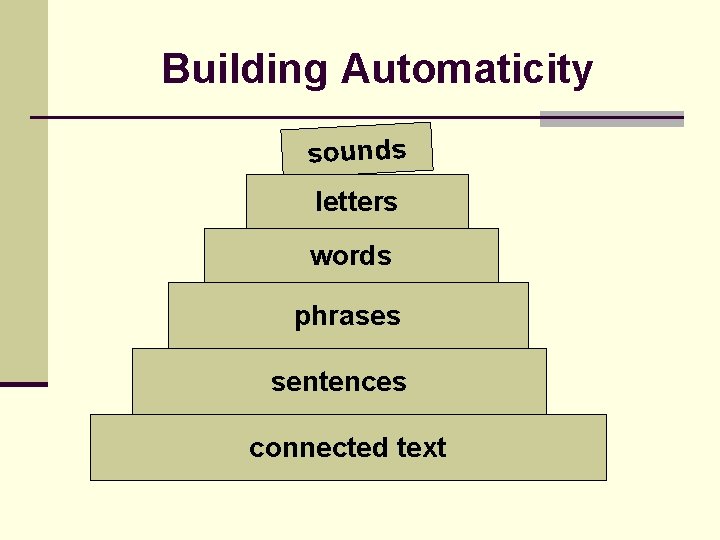
Building Automaticity sounds letters words phrases sentences connected text
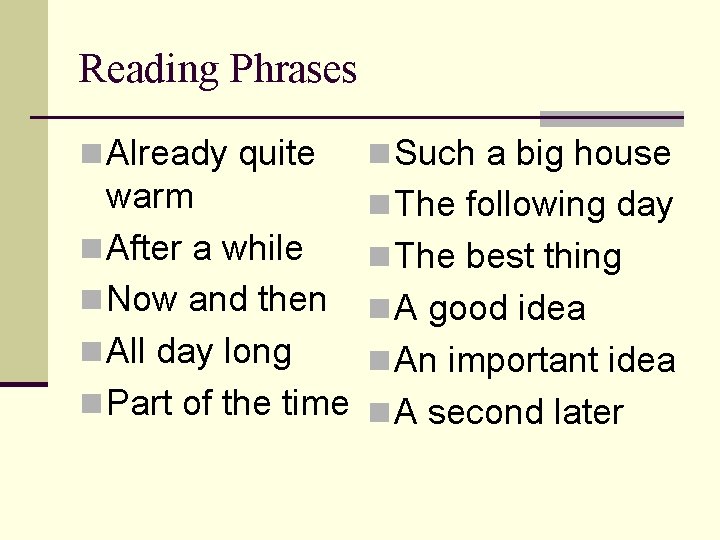
Reading Phrases n Already quite n Such a big house warm n After a while n Now and then n All day long n Part of the time n The following day n The best thing n A good idea n An important idea n A second later
Fluency Activities for Everyone? n. All students benefit from involvement in whole class, small group, partner and individual fluency activities. n. A few need the one-on-one level of teacher intervention.
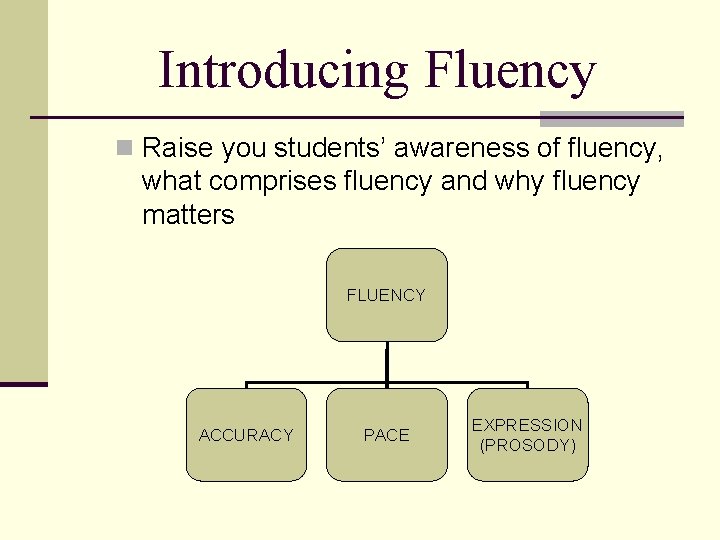
Introducing Fluency n Raise you students’ awareness of fluency, what comprises fluency and why fluency matters FLUENCY ACCURACY PACE EXPRESSION (PROSODY)
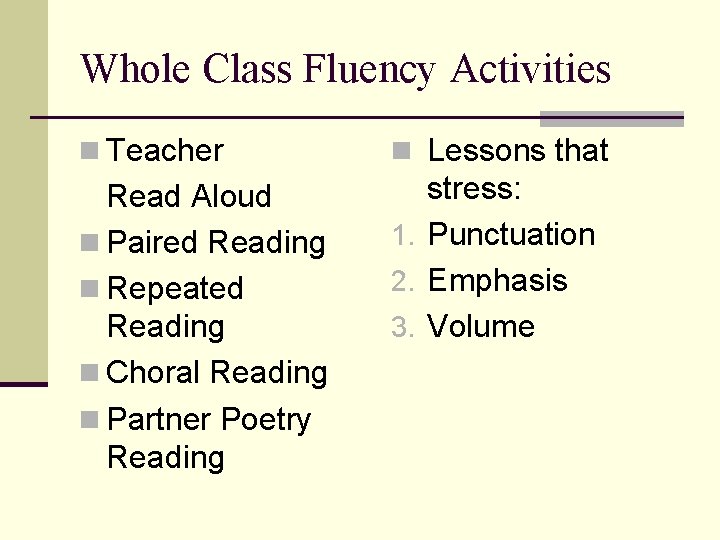
Whole Class Fluency Activities n Teacher n Lessons that Read Aloud n Paired Reading n Repeated Reading n Choral Reading n Partner Poetry Reading stress: 1. Punctuation 2. Emphasis 3. Volume
Improving Fluency… Teacher Read Aloud n Model appropriate rate and prosody n Point out text features: bold, italics, etc n Share thinking aloud for oral reading choices:
Improving Fluency… Choral Reading The whole class or group reads a poem or text of a song together, sometimes with solos or small groups within the choral reading.
Choral Reading n. Refrain n. Dialogue n. Call and Response n. Cumulative
Improving Fluency… Repeated Reading Students read a selected text aloud several times, discussing the “tricky parts. ” n Read for accuracy n Read with attention to punctuation n Read again with attention to phrasing n Read as if talking to a friend
Improving Fluency… Paired Reading Partners read a selected text, taking turns reading. They can support each other by providing help with difficult words.
Improving Fluency… Partner Poetry Reading After modeling, discussion and guided practice, pairs of students select poems, arrange them into parts, some parts together, some parts solo, and then practice and perform for the rest of the class. …Paul Fleischmann’s Joyful Noise
Improving Fluency…performances n. Radio Readings n. Reader’s Theatre n. Poetry Readings
Let’s try one… n Poems by Billy Collins: n Another Reason Why I Don’t Keep a Gun in the House n The Lanyard
Recording Student Practice n Critical part of improving fluency. n Students listen to recording and read print version to check for accuracy.
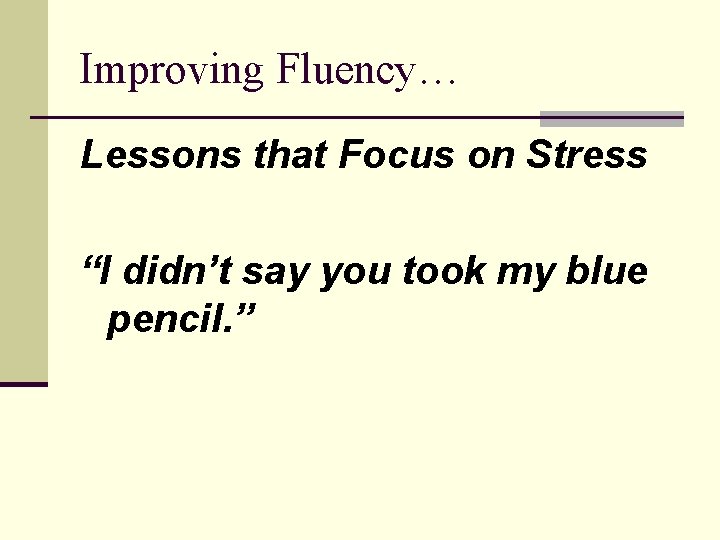
Improving Fluency… Lessons that Focus on Stress “I didn’t say you took my blue pencil. ”
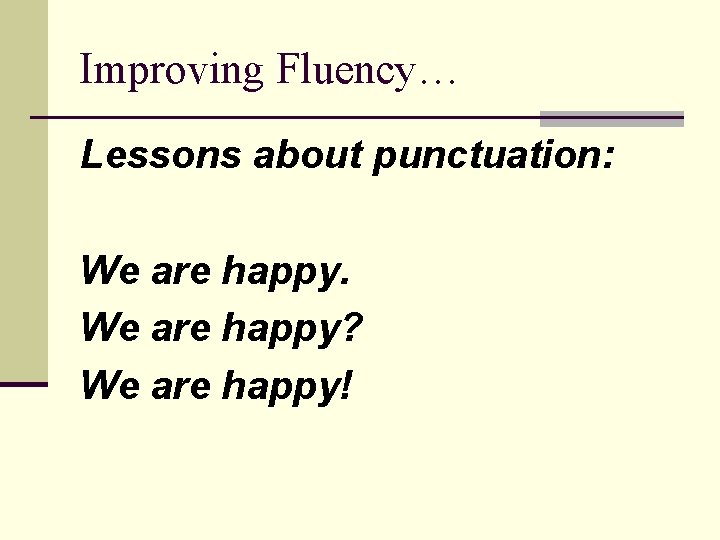
Improving Fluency… Lessons about punctuation: We are happy? We are happy!
Eats, Shoots, and Leaves
Improving Fluency… Lessons about volume and pacing: Include readings that benefit from louder and softer parts, parts that need to be sped up and slowed down.
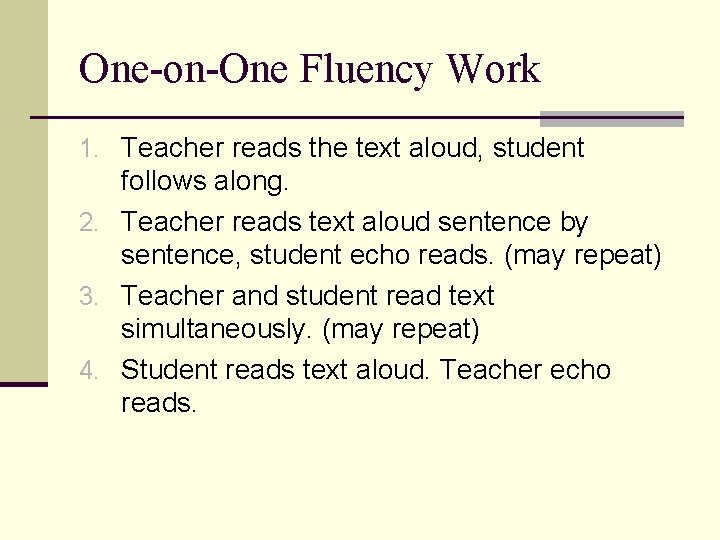
One-on-One Fluency Work 1. Teacher reads the text aloud, student follows along. 2. Teacher reads text aloud sentence by sentence, student echo reads. (may repeat) 3. Teacher and student read text simultaneously. (may repeat) 4. Student reads text aloud. Teacher echo reads.
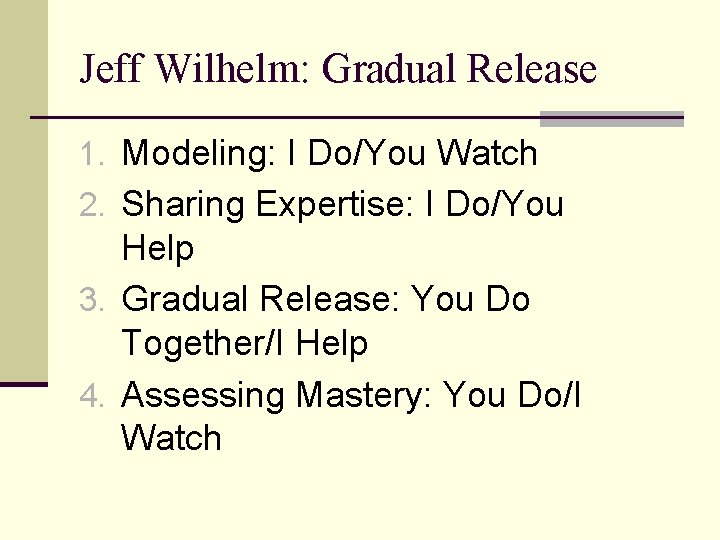
Jeff Wilhelm: Gradual Release 1. Modeling: I Do/You Watch 2. Sharing Expertise: I Do/You Help 3. Gradual Release: You Do Together/I Help 4. Assessing Mastery: You Do/I Watch
Gradual Release Model 1. Modeling Teacher models and demonstrates reading fluently, sharing thinking aloud about the reading process.
Gradual Release Model 2. Shared Expertise: Student practices reading the piece with feedback and support from the teacher.
Gradual Release Model 3. Gradual Release Student practices independently until he/she is satisfied with the reading. This should include the student recording, listening to and evaluating his or her own reading.
Gradual Release Model 4. Assessment The teacher listens to the student read, evaluates the student and provides feedback.
Effective Fluency Instruction n. Explicit Explanation n. Demonstration/Modeling n. Guided Practice n. Supported and/or Recorded Practice n. Performance
What is your Fluency Plan? n Regular assessment n Regular whole group fluency lessons n Intervention strategies for your neediest students
OBJECTIVES n Define and describe fluency n Recognize how fluency helps students become proficient readers. n Learn how to measure fluency n Review classroom practices that support fluency n Participate in activities that help students become fluent readers.

Thank You! n Contact info: Anne Riggs 21 Main Street Windham, Maine, USA 04062 1 -207 -831 -6184 anneriggs@yahoo. com
- Slides: 52