
Flowers Fruits and Seeds Outline Dicots versus Monocots



- Slides: 26
Flowers, Fruits, and Seeds
Outline • • • Dicots versus Monocots Structure of Flowers Fruits v Fleshy v Dry Fruit and Seed Dispersal Seeds v Germination v Longevity
Dicots versus Monocots • • Dicots Two cotyledons Flower parts in fours or fives Leaves with distinct vein network Vascular cambium present Vascular bundles in ring Pollen grain with three apertures • • Monocots One cotyledon Flower parts in threes Leaves with parallel primary veins. Vascular cambium absent Vascular bundles scattered Pollen grain with one aperture
Structure of Flowers • Each flower, which begins as an embryonic primordium that develops into a bud, occurs as a specialized branch at the tip of a peduncle which may have branchlets of pedicles. v A peduncle or pedicle swells at its tip into a small pad (receptacle). - Other parts of the flower are attached to the receptacle.
Structure of Flowers • • Outermost whorl typically consists of three to five sepals (usually green). v Sepals (calyx) may be fused together. The calyx protects the flower while it is in the bud. Next whorl consists of three to many petals (corolla). Colorful Corolla attract pollinators. v Calyx and corolla form the perianth.
Structure of Flowers • Several to many stamens are attached to the receptacle around the base of the pistil. v Each stamen (male organ of the flower) consists of a filament with an anther at the top. - Pollen grains are developed and disseminated in anthers.
Structure of Flowers • • Pistil (female organ of flower) consists of Stigma, Style, and Ovary. Ovaries carry ovules (eggs also known as carpels) and some ovaries fuse to form a compound ovary. After fertilization with male nuclei from the pollen grain, an ovule develops to a seed and the ovary develops and becomes the fruit bearing the seed. v Superior Ovary - Calyx and corolla are attached to the receptacle at the base of the ovary. v Inferior Ovary - Receptacle grows up and around the ovary. - Calyx and corolla appear to be attached at the top. Inflorescences - Group of several to hundreds of flowers.
Generalized Flower
Fruits • Fruit is an ovary and its accessory parts that have developed and matured. v Usually contains seeds. v All fruits develop from flower ovaries and accordingly are found exclusively in flowering plants.
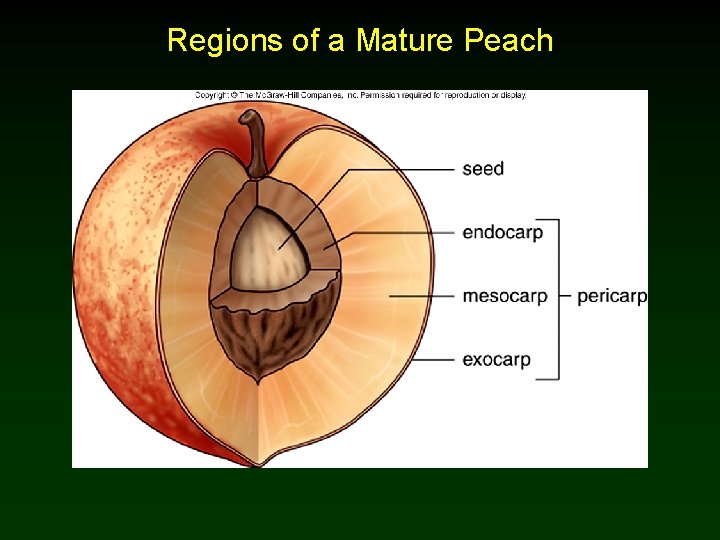
Fruits • Fruit Regions v Exocarp - Skin v Endocarp - Inner boundary around seed(s). v Mesocarp - Fleshy tissue between exocarp and endocarp. - Three regions are collectively called the pericarp.
Regions of a Mature Peach
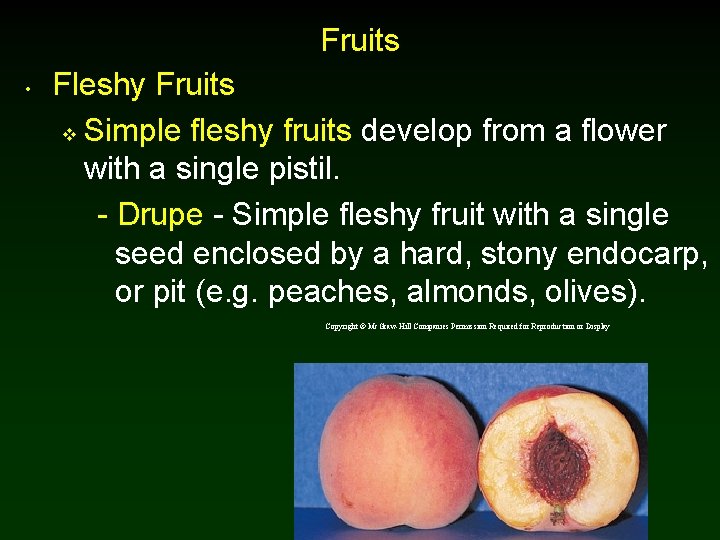
Fruits • Fleshy Fruits v Simple fleshy fruits develop from a flower with a single pistil. - Drupe - Simple fleshy fruit with a single seed enclosed by a hard, stony endocarp, or pit (e. g. peaches, almonds, olives). Copyright © Mc. Graw-Hill Companies Permission Required for Reproduction or Display
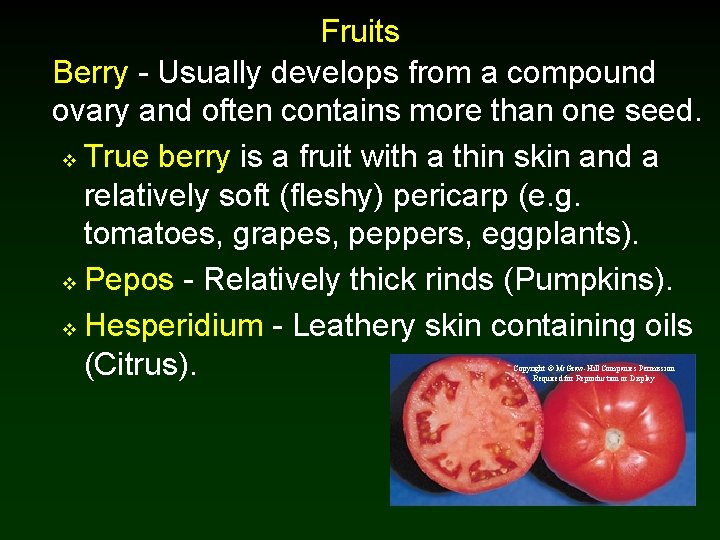
Fruits Berry - Usually develops from a compound ovary and often contains more than one seed. v True berry is a fruit with a thin skin and a relatively soft (fleshy) pericarp (e. g. tomatoes, grapes, peppers, eggplants). v Pepos - Relatively thick rinds (Pumpkins). v Hesperidium - Leathery skin containing oils (Citrus). Copyright © Mc. Graw-Hill Companies Permission Required for Reproduction or Display
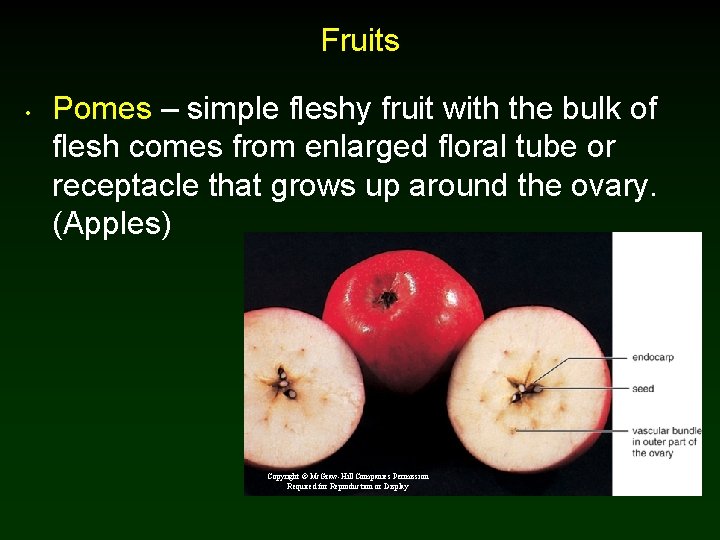
Fruits • Pomes – simple fleshy fruit with the bulk of flesh comes from enlarged floral tube or receptacle that grows up around the ovary. (Apples) Copyright © Mc. Graw-Hill Companies Permission Required for Reproduction or Display
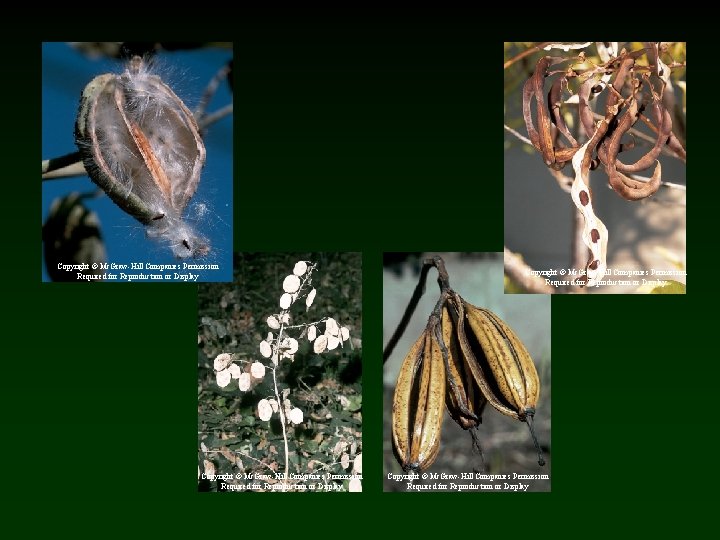
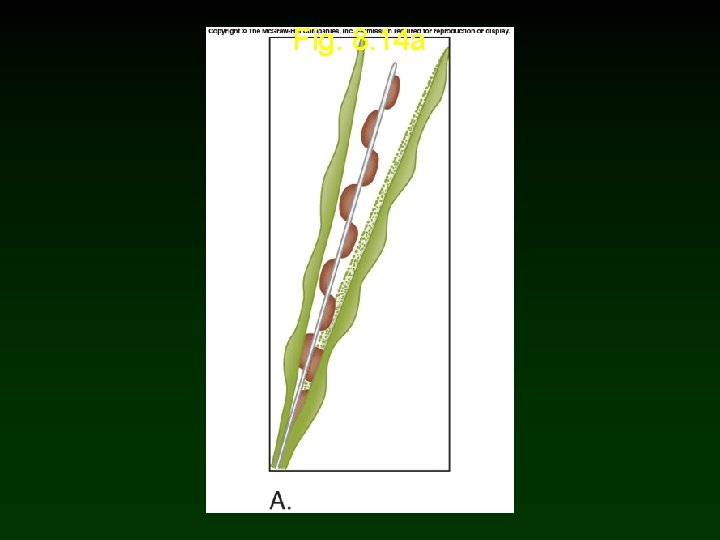
Fruits • Dry Fruits That Split at Maturity (Dehiscent) v Follicle - Splits along one side or seam (e. g. milkkweed). v Legume - Splits along two sides or seams. v Silique - Splits along two sides or seams, but seeds are borne on central partition exposed when the two halves separate. v Capsules - Consist of at least two carpels, and split in a variety of ways.
Copyright © Mc. Graw-Hill Companies Permission Required for Reproduction or Display
Fig. 8. 14 a
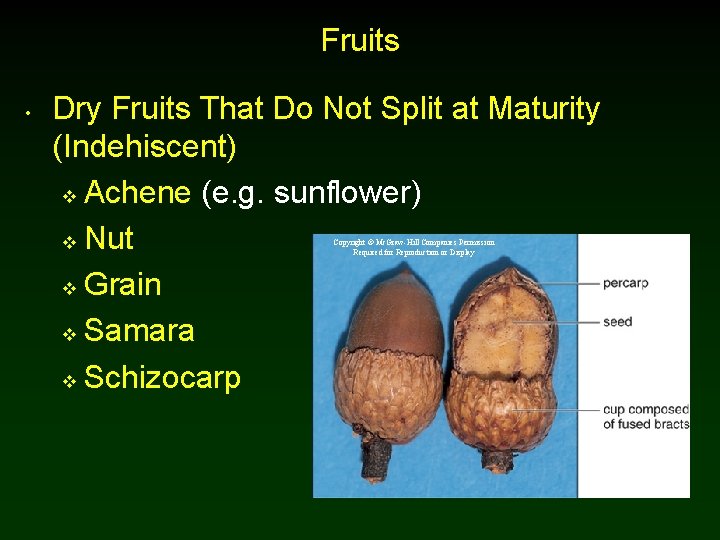
Fruits • Dry Fruits That Do Not Split at Maturity (Indehiscent) v Achene (e. g. sunflower) v Nut v Grain v Samara v Schizocarp Copyright © Mc. Graw-Hill Companies Permission Required for Reproduction or Display
Fruits • • Aggregate Fruits v Derived from a single flower with several to many pistils. - Individual pistils mature as a clustered unit on a single receptacle Ø Raspberries, Strawberries. Multiple Fruits v Derived from several to many individual flowers in a single inflorescence. - Pineapples, Figs
Fruit and Seed Dispersal • • Wind Dispersal v Small and Lightweight seeds. Animal Dispersal v Seeds pass through digestive tract. v Fruits and seeds catch in fur or feathers. v Oils attract ants. Water Dispersal v Some fruits contain trapped air. Mechanical Ejection of Seeds
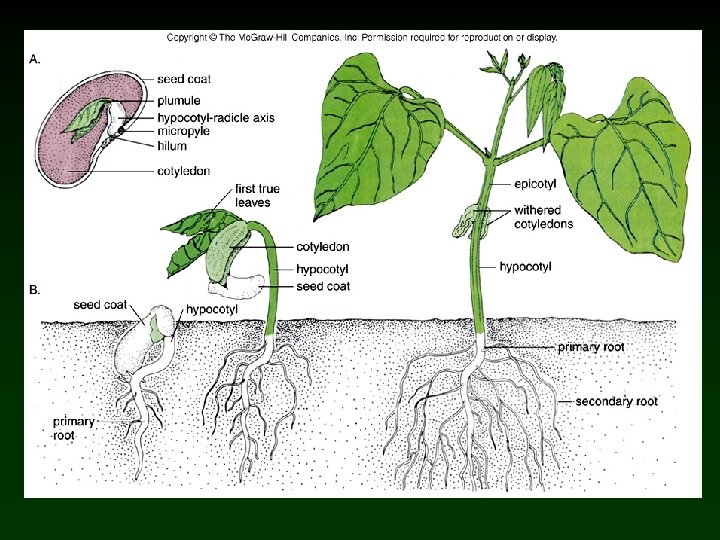
Seeds • Structure v Cotyledons - Food storage organs that function as first seed leaves. v Plumule - Embryo shoot. v Epicotyl - Stem above cotyledon. v Hypocotyl - Stem below attachment point. v Radicle - Stem tip developing into a root.
Germination • Germination is the beginning or resumption of seed growth. v Seed must be viable. - Some require period of dormancy. Ø Scarification - After Ripening v Favorable Environmental Factors - Imbibe water
Longevity • Viability of most seeds is significantly extended when the seeds are stored under conditions of low temperatures and kept dry. v A few species produce seeds with no period of dormancy. This is known as vivipary
Review • • • Dicots versus Monocots Structure of Flowers Fruits v Fleshy v Dry Fruit and Seed Dispersal Seeds v Germination v Longevity
Copyright © Mc. Graw-Hill Companies Permission Required for Reproduction or Display