
Flowering Plant Functions Roots Roots anchor and support
- Slides: 23
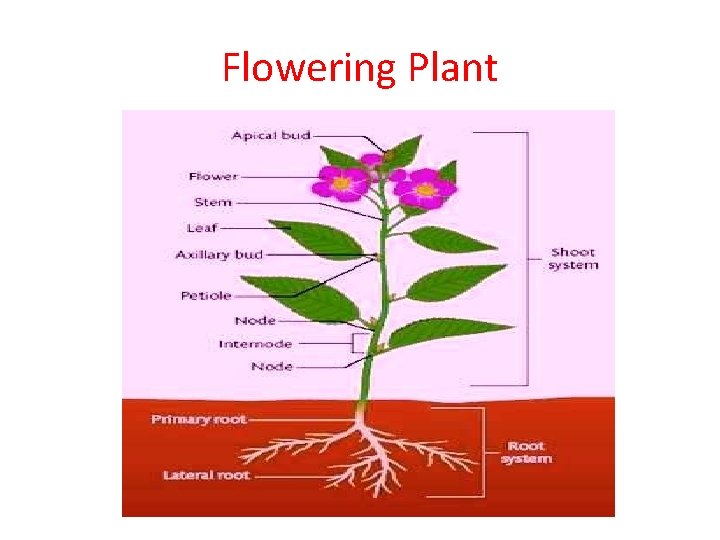
Flowering Plant
Functions • Roots: Roots anchor and support the plant in the soil. • Absorb water and minerals from the soil. The water and minerals pass up through the stem to the leaves where they are used by the plant. • Some plants store food in their roots. • http: //www. youtube. com/watch? v=A 39 ATK A 7 Pfw
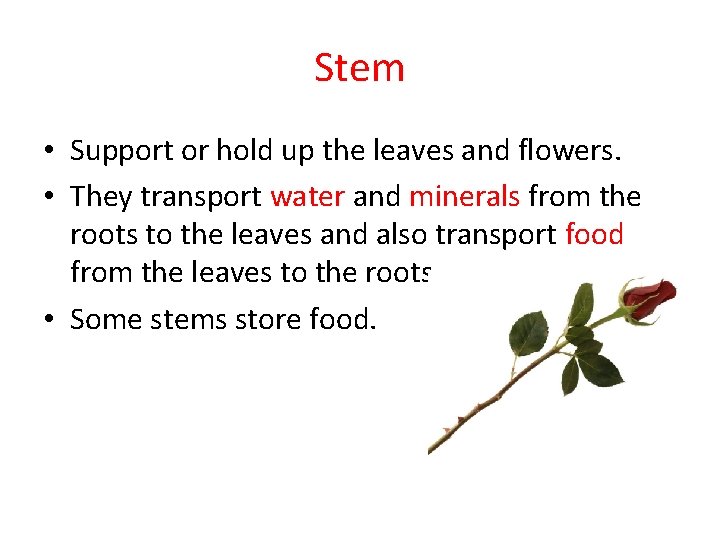
Stem • Support or hold up the leaves and flowers. • They transport water and minerals from the roots to the leaves and also transport food from the leaves to the roots. • Some stems store food.
Leaf • Leaves make food in a process called Photosynthesis • They allow gases to pass in and out. • They allow water vapour to pass out of the plant (Transpiration) • Some leaves store food (lettuce and cabbage) • The leaf contains a substance called chlorophyll which traps the suns energy to make food through photosynthesis.
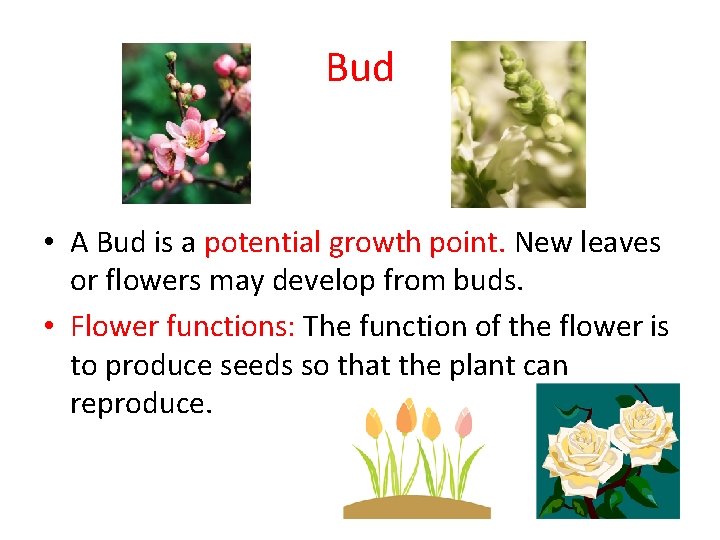
Bud • A Bud is a potential growth point. New leaves or flowers may develop from buds. • Flower functions: The function of the flower is to produce seeds so that the plant can reproduce.
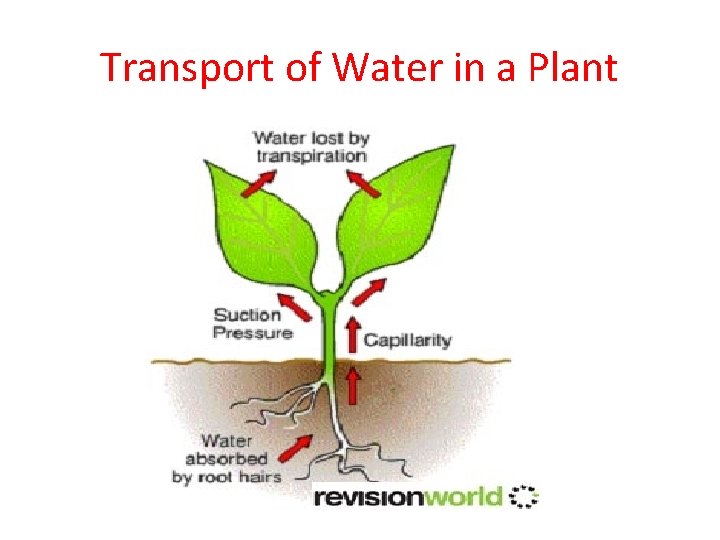
Transport in Flowering plants • Water is present in tiny tubes throughout the plant. These tubes called the Xylem allow continuous flow of water from the roots to the leaves. • Tiny openings in the leaf called Stomata allow water to evaporate from leaves into the air. This loss of water is called Transpiration.
Experiment showing the path of water in a Plant • Place the celery stalk into a beaker with food colourings • Leave for a few days • Cut a section through the plant and observe the location of the coloured water
Food Transport • Food is made in the leaves of the plant by photosynthesis. Some of this food is used by the leaves. • The rest of this food travels to other parts of the plant i. e. stem and root. • Food is transported around the plant by a different type of tube to those of water • The tubes that transport food and around the plant are called the Phloem.
Transport of Water in a Plant
The Flow of Water in a Plant Involves the following stages • Water enters into the roots • Water enters a plant tissue called Xylem (hollow tubes found throughout the plant) • Water passes up the stem in the Xylem. • Water passes out through openings called Stomata on the underside of the leaf
The Difference between Xylem and Phloem • Xylem is the tissue that carries water and dissolved minerals in plants. • Phloem is the tissue that carries food in plants • Some of the dissolved minerals transported by the Xylem include Nitrogen, Phosphorus, and Potassium
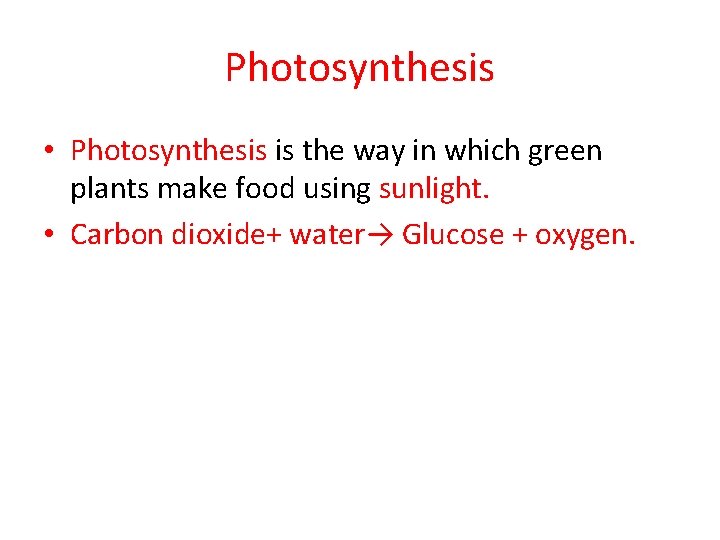
Photosynthesis • Photosynthesis is the way in which green plants make food using sunlight. • Carbon dioxide+ water→ Glucose + oxygen.
Take a minute to think about these Questions • Why do think plants need to carry out photosynthesis • Can you name the green pigment plants need to convert sunlight to food? • How is food transported around the plant after photosynthesis • Why are there so few plants in the desert when there is so much sunlight?
More Questions! • Why do you think it is so important to plant lots of trees in large cities and other areas where there a lot of people living? • How does photosynthesis benefit us humans?
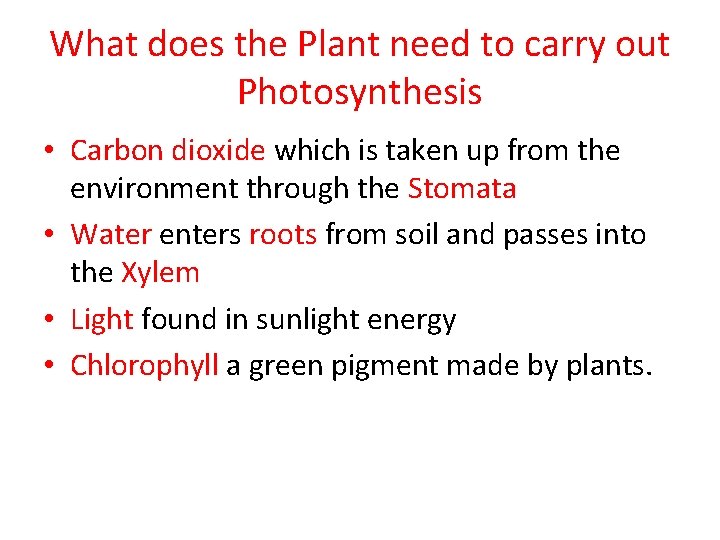
What does the Plant need to carry out Photosynthesis • Carbon dioxide which is taken up from the environment through the Stomata • Water enters roots from soil and passes into the Xylem • Light found in sunlight energy • Chlorophyll a green pigment made by plants.
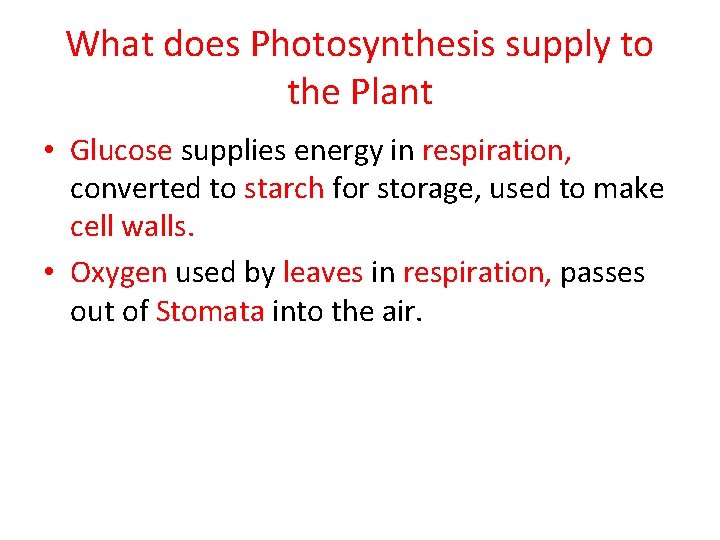
What does Photosynthesis supply to the Plant • Glucose supplies energy in respiration, converted to starch for storage, used to make cell walls. • Oxygen used by leaves in respiration, passes out of Stomata into the air.
To Test leaves for Starch 1. Boil some leaves in water (to kill and soften them 2. Place the leaves in hot alcohol (to remove chlorophyll) 3. Boil the leaves in water again (to wash off any alcohol and to prevent the leaves from hardening) 4. Test the leaves by adding iodine 5. If the leaves remain a red-yellow-brown colour, starch is not present. If the leaves turn a blueblack colour, starch is present.
Experiment to show starch is made by a plant in photosynthesis • Place a plant in the dark for 2 days, this allows all the starch present to be used up • Cover some o the leaves with aluminium foil, this blocks out sunlight and these leaves acts as a control • Place the plant in strong light for a few hours, this allows photosynthesis to occur • Test for starch
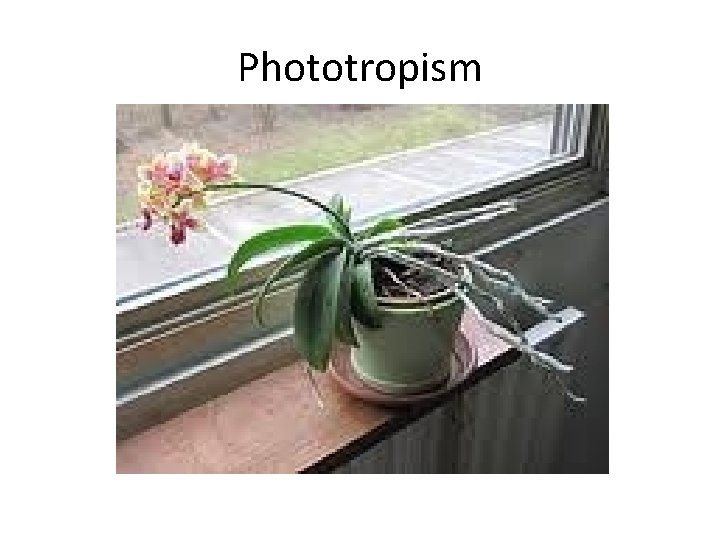
Plant Responses • A Tropism is the change in growth of a plant in response to an out side Stimulus • Phototropism: Plants grow towards sunlight so they absorb the most sunlight and produce more food.
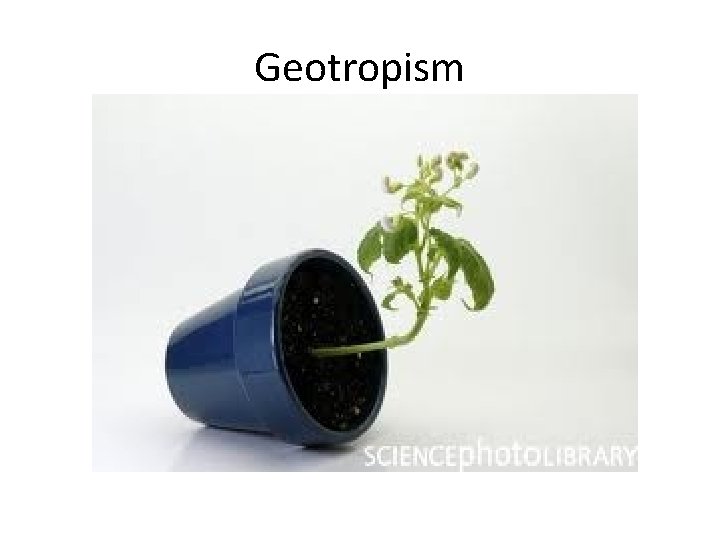
Geotropism • Geotropism is the way in which a plant changes its growth in response to gravity. • The shoots of a plant respond by growing away from gravity. As a result the leaves can get more sunlight • The roots of a plant grow towards gravity. The roots grow down in the soil and can collect and minerals.
Phototropism
Geotropism
Experiment to Investigate Phototropism • Place seedlings in 3 separate compartments of a shoe box • One compartment allows light in only through a side opening • One compartment only allows light in directly above the plant • One compartment allows no light to enter • What do you think will happen?