
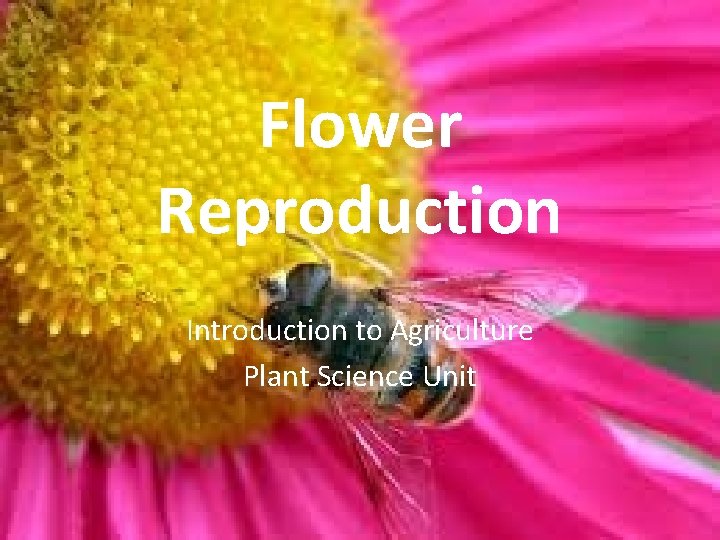
Flower Reproduction Introduction to Agriculture Plant Science Unit
- Slides: 10
Flower Reproduction Introduction to Agriculture Plant Science Unit
Flowers • The entire industry of agriculture is built around the reproduction of plants… plants must multiply in order to be useful • Flower: a shoot of a higher plant that is modified for reproduction and consists of a shortened axis bearing modified leaves
Plant Reproduction • Plants reproduce in 2 different ways – Sexually – Asexually • Plants may propagate (to create new plants from old plants) themselves naturally or the producer may induce propagation
Sexual Reproduction • Involves gametes, the ______ and ______ – The female sex cell is known as the egg (or _______) and is produced in the ovary of a flower – The male sex cell is the pollen, contains the ____ that mature during pollination – Process takes place in the plant’s flower
Pollination • Pollination: the transfer of pollen from an anther to a stigma of a flower of the same species – Pollen transportation may be through wind, insects, birds, or other natural means – Wind transport involves the wind blowing across the flower and carrying the pollen to another flower
Pollination – Insect pollination • Involves the flower attracting the insect • As the insect crawls or flies into the flower to collect nectar, grains of pollen are caught on their legs and other body parts • At the next flower, grains of pollen are knocked off and remain in the flower • Honeybees are especially adept at pollinating
Fertilization • Fertilization must occur: the union of the pollen cell with the ovule in the plants, the union of the male and female sex cells – Ovules develop into seed after being fertilized – Usually takes place in the plant’s flower – Results in the formation of a zygote (fertilized ovule) that grows into the seed
Growth • Initiation of growth of the seed and fruit – An ovary that has been fertilized forms a fruit • Can be very large and has a seed inside (watermelon, cucumbers, green peppers, and tomatoes) – A seed contains the tiny embryo (immature plant) of a new plant • Seed-germ • Uses the seed to propagate plants • Sexual reproduction involves the creation of a genetically new individual
Seed Dispersal • • • Seeds are dispersed many ways in nature Birds Wild animals Seed structure Domesticated plants have humans to disperse and plant seeds…methods of planting are designed to allow plants to grow and produce large quantities of fruit
Asexual Reproduction • Also called vegetative reproduction • Reproduce vegetatively, without the joining of an egg and sperm • Use part of the parent plant to start a new plant • Results in new plants that are genetically the same as the parents