
FLOW SYNTHESIS OF COMBRETASTATIN A4 Ines Cazin Laurent
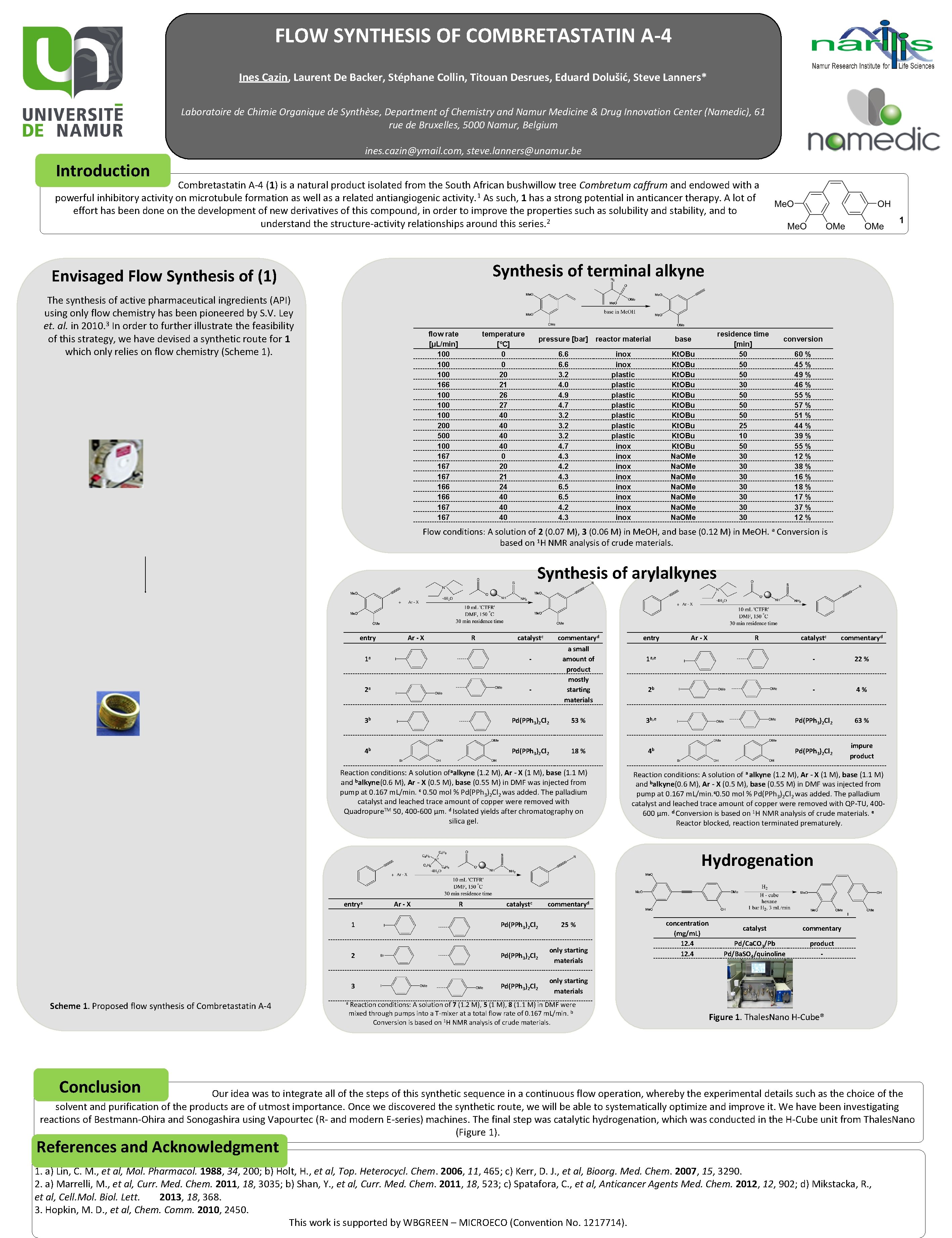
FLOW SYNTHESIS OF COMBRETASTATIN A-4 Ines Cazin, Laurent De Backer, Stéphane Collin, Titouan Desrues, Eduard Dolušić, Steve Lanners* Laboratoire de Chimie Organique de Synthèse, Department of Chemistry and Namur Medicine & Drug Innovation Center (Namedic), 61 rue de Bruxelles, 5000 Namur, Belgium ines. cazin@ymail. com, steve. lanners@unamur. be Introduction Combretastatin A-4 (1) is a natural product isolated from the South African bushwillow tree Combretum caffrum and endowed with a powerful inhibitory activity on microtubule formation as well as a related antiangiogenic activity. 1 As such, 1 has a strong potential in anticancer therapy. A lot of effort has been done on the development of new derivatives of this compound, in order to improve the properties such as solubility and stability, and to understand the structure-activity relationships around this series. 2 Synthesis of terminal alkyne Envisaged Flow Synthesis of (1) The synthesis of active pharmaceutical ingredients (API) using only flow chemistry has been pioneered by S. V. Ley et. al. in 2010. 3 In order to further illustrate the feasibility of this strategy, we have devised a synthetic route for 1 which only relies on flow chemistry (Scheme 1). flow rate [µL/min] 100 100 166 100 100 200 500 167 167 166 167 temperature [ºC] 0 0 20 21 26 27 40 40 0 20 21 24 40 40 40 pressure [bar] reactor material 6. 6 3. 2 4. 0 4. 9 4. 7 3. 2 4. 7 4. 3 4. 2 4. 3 6. 5 4. 2 4. 3 inox plastic plastic inox inox residence time [min] 50 50 50 30 50 50 50 25 10 50 30 30 base Kt. OBu Kt. OBu Na. OMe Na. OMe conversion 60 % 45 % 49 % 46 % 55 % 57 % 51 % 44 % 39 % 55 % 12 % 38 % 16 % 18 % 17 % 37 % 12 % Flow conditions: A solution of 2 (0. 07 M), 3 (0. 06 M) in Me. OH, and base (0. 12 M) in Me. OH. a Conversion is based on 1 H NMR analysis of crude materials. Synthesis of arylalkynes entry Ar - X R catalystc 1 a - 2 a - 3 b Pd(PPh 3)2 Cl 2 4 b Pd(PPh 3)2 Cl 2 commentaryd a small amount of product mostly starting materials entry catalystc commentaryd 1 a, e - 22 % 2 b - 4% 53 % 3 b, e Pd(PPh 3)2 Cl 2 63 % 18 % 4 b Pd(PPh 3)2 Cl 2 impure product Reaction conditions: A solution ofaalkyne (1. 2 M), Ar - X (1 M), base (1. 1 M) and balkyne(0. 6 M), Ar - X (0. 5 M), base (0. 55 M) in DMF was injected from pump at 0. 167 m. L/min. c 0. 50 mol % Pd(PPh 3)2 Cl 2 was added. The palladium catalyst and leached trace amount of copper were removed with Quadropure. TM 50, 400 -600 µm. d Isolated yields after chromatography on silica gel. Ar - X R Reaction conditions: A solution of a alkyne (1. 2 M), Ar - X (1 M), base (1. 1 M) and balkyne(0. 6 M), Ar - X (0. 5 M), base (0. 55 M) in DMF was injected from pump at 0. 167 m. L/min. c 0. 50 mol % Pd(PPh 3)2 Cl 2 was added. The palladium catalyst and leached trace amount of copper were removed with QP-TU, 400600 µm. d Conversion is based on 1 H NMR analysis of crude materials. e Reactor blocked, reaction terminated prematurely. Hydrogenation entrya 1 2 3 Scheme 1. Proposed flow synthesis of Combretastatin A-4 a Ar - X R catalystc commentaryd Pd(PPh 3)2 Cl 2 25 % Pd(PPh 3)2 Cl 2 only starting materials Reaction conditions: A solution of 7 (1. 2 M), 5 (1 M), 8 (1. 1 M) in DMF were mixed through pumps into a T-mixer at a total flow rate of 0. 167 m. L/min. b Conversion is based on 1 H NMR analysis of crude materials. concentration (mg/m. L) 12. 4 catalyst commentary Pd/Ca. CO 3/Pb Pd/Ba. SO 4/quinoline product - Figure 1. Thales. Nano H-Cube® Conclusion Our idea was to integrate all of the steps of this synthetic sequence in a continuous flow operation, whereby the experimental details such as the choice of the solvent and purification of the products are of utmost importance. Once we discovered the synthetic route, we will be able to systematically optimize and improve it. We have been investigating reactions of Bestmann-Ohira and Sonogashira using Vapourtec (R- and modern E-series) machines. The final step was catalytic hydrogenation, which was conducted in the H-Cube unit from Thales. Nano (Figure 1). References and Acknowledgment 1. a) Lin, C. M. , et al, Mol. Pharmacol. 1988, 34, 200; b) Holt, H. , et al, Top. Heterocycl. Chem. 2006, 11, 465; c) Kerr, D. J. , et al, Bioorg. Med. Chem. 2007, 15, 3290. 2. a) Marrelli, M. , et al, Curr. Med. Chem. 2011, 18, 3035; b) Shan, Y. , et al, Curr. Med. Chem. 2011, 18, 523; c) Spatafora, C. , et al, Anticancer Agents Med. Chem. 2012, 902; d) Mikstacka, R. , et al, Cell. Mol. Biol. Lett. 2013, 18, 368. 3. Hopkin, M. D. , et al, Chem. Comm. 2010, 2450. This work is supported by WBGREEN – MICROECO (Convention No. 1217714).
- Slides: 1