
Flow of Accounting entries in Oracle Applications By
Flow of Accounting entries in Oracle Applications By Sivakumar Ganesan E-Mail: sivakumar 3009@gmail. com
Agenda • Understanding the Accounting Flow in Oracle Applications • Transaction Flow • Modules Covered • Set up required in Oracle Applications • Defaulting Accounts • Posting to General Ledger from Sub-Ledger • Posting in General Ledger • Viewing the Trial Balance
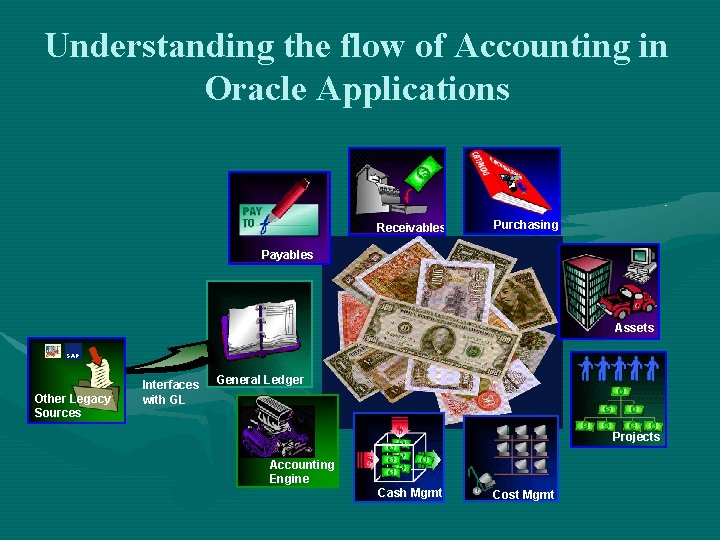
Understanding the flow of Accounting in Oracle Applications Receivables Purchasing Payables Assets SAP Other Legacy Sources Interfaces with GL General Ledger Projects Accounting Engine Cash Mgmt Cost Mgmt
Transaction Flow • • • • Create Opening Balances in General ledger and Subledger Place Purchase order Receive the Materials into Stores Receive the Supplier Invoice from Supplier Match the Supplier invoice with PO and make Payment Issue Materials to Production Complete the Production Order and Build Inventory Ship the Material to Customer Raise invoice on Customer Receive Cash from Customer Reconcile the Payment and Receipt in Cash Management Post Sub Ledger Transactions into GL Run Trial Balance and Financial Statements (Profit & Loss Account & Balance Sheet
Modules Covered • • Oracle Purchasing Oracle Payables Oracle Inventory Oracle Manufacturing (WIP Accounting) Oracle Order Management Oracle Receivables Oracle Cash Management Oracle General Ledger
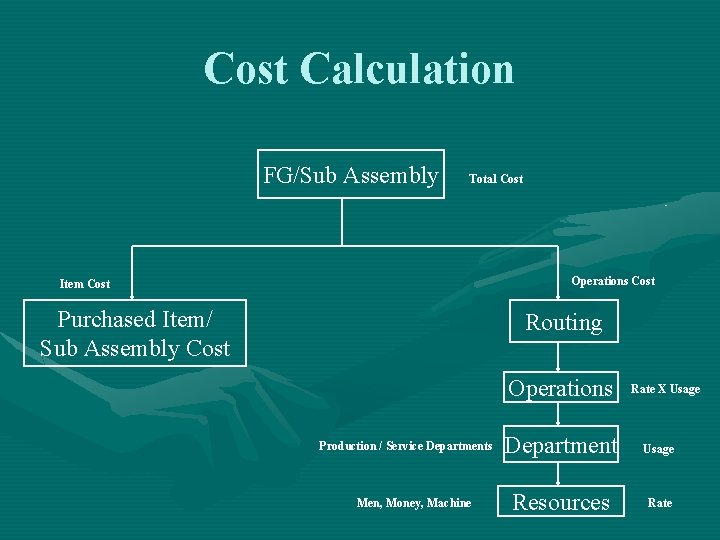
Cost Calculation FG/Sub Assembly Total Cost Operations Cost Item Cost Purchased Item/ Sub Assembly Cost Routing Operations Production / Service Departments Men, Money, Machine Rate X Usage Department Usage Resources Rate
Set up Required in Oracle Applications • Each Module has a Parameter screen or Controlling Screen through which the Accounts are Defaulting – Ex (Inventory Organization for Materials in Inventory Module, Receiving options for Inventory Receipt in Purchasing Module, Financial Options for Payables) • There are other places also where we can define the Accounts and there is an inbuilt hierarchy within the Applications as to where from the Accounts need to be defaulted • Each Module Needs to set the Accounts for an Accounting Event Happening in that Module
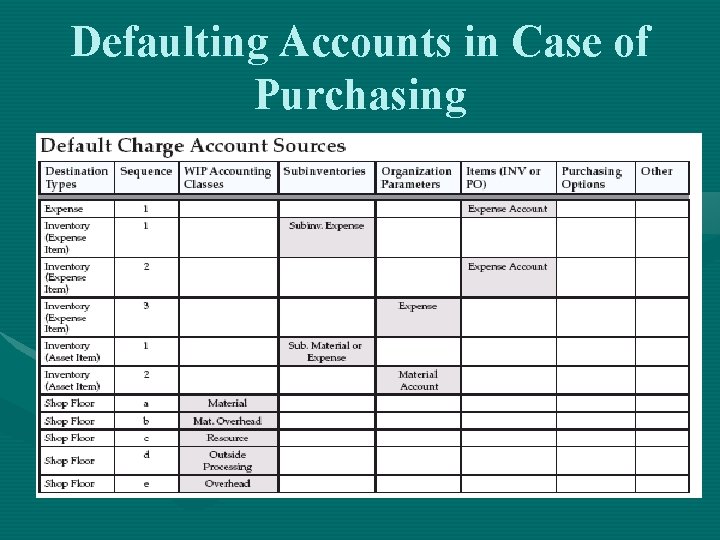
Defaulting Accounts in Case of Purchasing
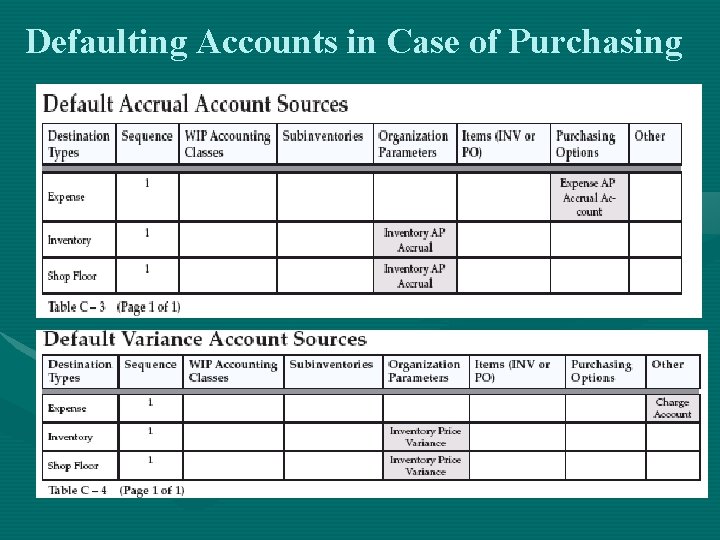
Defaulting Accounts in Case of Purchasing
Posting to General Ledger from Sub-Ledger • Sub-Ledger Accounting Entries are Transferred to General Ledger Interface table through the Concurrent Programs • We can schedule the concurrent Process to Transfer Data to GL instead of manually running the concurrent Programs. • You can run the Process Daily, Weekly, Monthly • You can transfer the data either in – Summary or (Total Transaction for an Account Combination per day) – Detail (Each Transaction)
Posting in General Ledger • This Process Transfers Data from GL Interface Tables to GL Main Tables – (i. e) From GL_JE_INTERFACE table to GL_JE_HEADERS and GL_JE_LINES • Once the Data is Posted No further changes to the Data is permitted
Accounting Events – Oracle Purchasing • Oracle Purchasing ØInventory Accruals ØTransfer to Sub Inventory ØPurchase Price Variance ØInvoice Price Variance (IPV) and Exchange Rate Variance ØReturn to Supplier From Receipt of Materials ØInter-organization Transfer
Accounting Events – Oracle Payables • Invoices Ø Invoice adjustment Ø Invoice cancellation Ø Prepayment application Ø Prepayment un-application • Payments Ø Payment Ø Future dated payment maturity Ø Payment adjustment Ø Payment cancellation Ø Payment clearing Ø Payment un-clearing
Accounting Events – Manufacturing (WIP) • Oracle Inventory ØMaterial Transfer from Stores to WIP ØWIP Completions and Material Consumption Entry ØOperations Completion Entry ØFinished Goods Stock Creation Entry ØInter-Org Transfer ØSub-Inventory Transfer
Accounting Events – Order Management • Order Management ØCost of Goods Sold Entry in Inventory Module
Accounting Events – Oracle Receivables • Transactions ØInvoices ØDebit Memos ØCommitments ØInvoices Against a Deposit ØInvoice Against guarantee ØCredit Memos ØOn Account Credit Memo
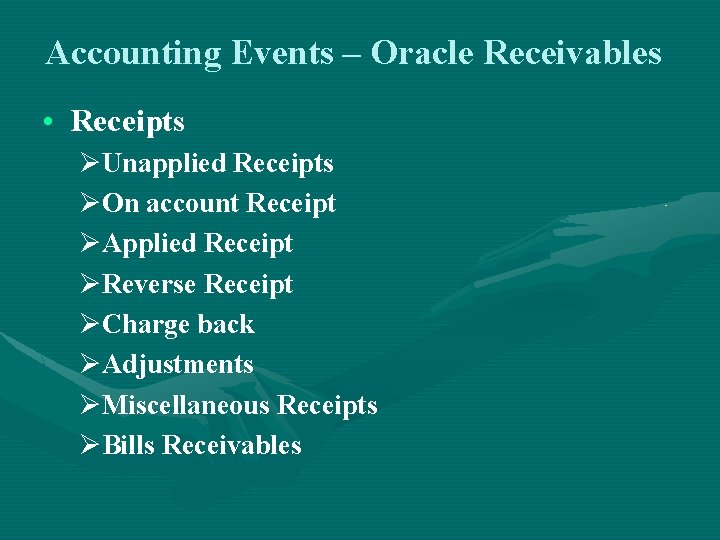
Accounting Events – Oracle Receivables • Receipts ØUnapplied Receipts ØOn account Receipt ØApplied Receipt ØReverse Receipt ØCharge back ØAdjustments ØMiscellaneous Receipts ØBills Receivables
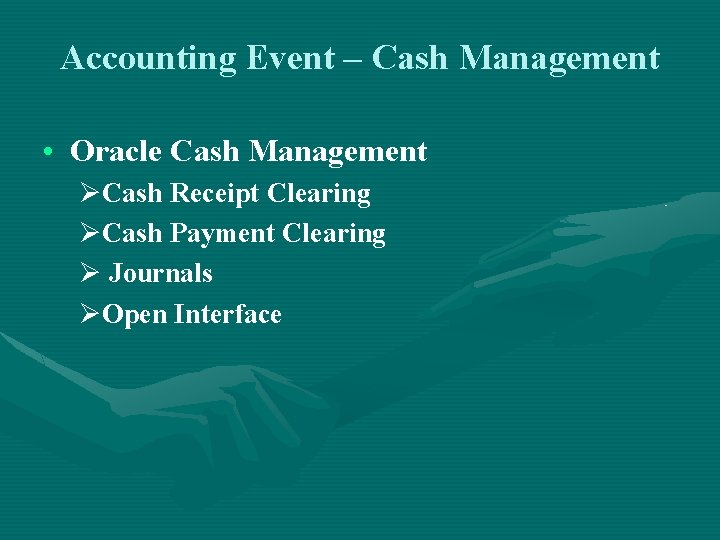
Accounting Event – Cash Management • Oracle Cash Management ØCash Receipt Clearing ØCash Payment Clearing Ø Journals ØOpen Interface
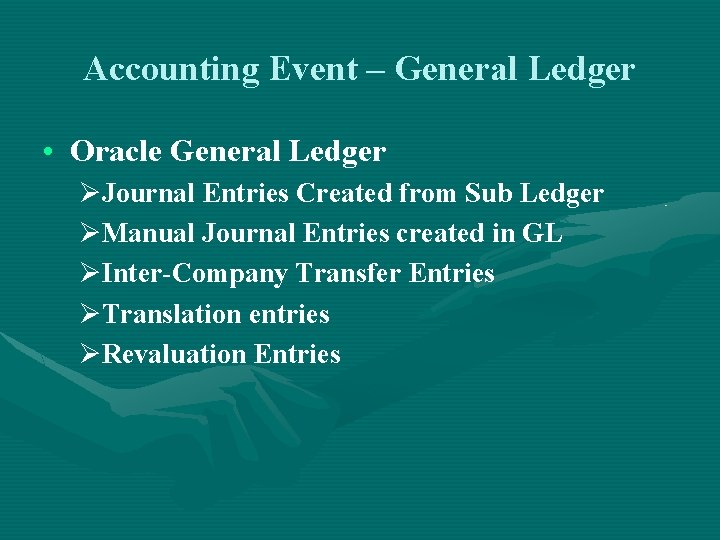
Accounting Event – General Ledger • Oracle General Ledger ØJournal Entries Created from Sub Ledger ØManual Journal Entries created in GL ØInter-Company Transfer Entries ØTranslation entries ØRevaluation Entries
Flow of Accounting in oracle Applications Case Study
- Slides: 20