
Flow Measurement Objective To determine chemical dosage air
Flow Measurement Objective To determine chemical dosage, air supply into the aeration basins, sludge volume to return into the biological reactors, to provide daily flow records required by regulatory agencies, and to evaluate infiltration/inflow during wet weather Locations Within an interceptor or manhole At the head of the plant Downstream of bar screen, grit channel, or primary sedimentation In the force main of pumping station Before the outfall 1
Flow Measurement - continued Basic types of measurement · Differential pressure producers · Direct discharge measurement · Positive volume displacement measurement · Flow velocity-area measurement Flow meters Venturi type meter, orifice meter, propeller type meter, magnetic flow meter, ultrasonic flow meter, vortex meter, rotameter (variable-area meter), flumes, and weirs Liquid chemical flow Measured by positive displacement pumps (or rotameters) 2
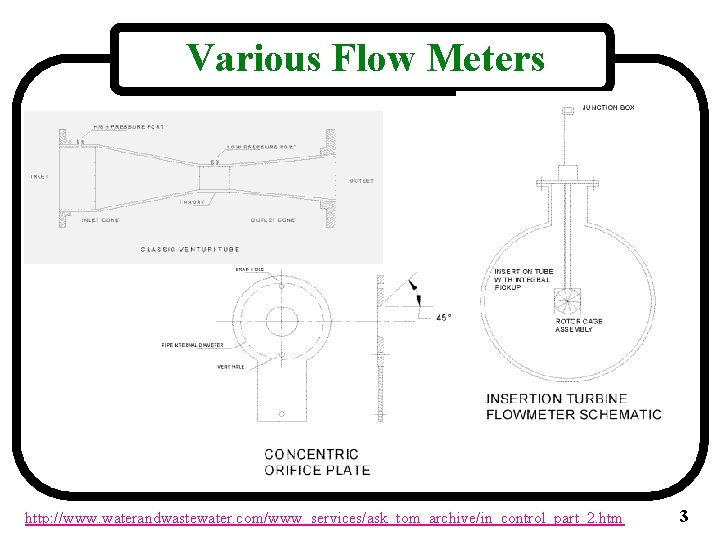
Various Flow Meters http: //www. waterandwastewater. com/www_services/ask_tom_archive/in_control_part_2. htm 3
Flow Measurement - continued Ø Selection Criteria ü Type of application: open channel/closed conduits ü Proper sizing: range of flow ü Fluid composition: compatibility, solids, passage ü Accuracy (±%) and repeatability ü Headloss or hydraulic head available ü Installation requirements: straight length, accessibility, disconnection method ü Operating environment: explosion proof, resistance to moisture and corrosive gases, temp. range ü Ease of maintenance: provision for flushing/rodding ü Cost ü Type and accessibility of the conduit 4
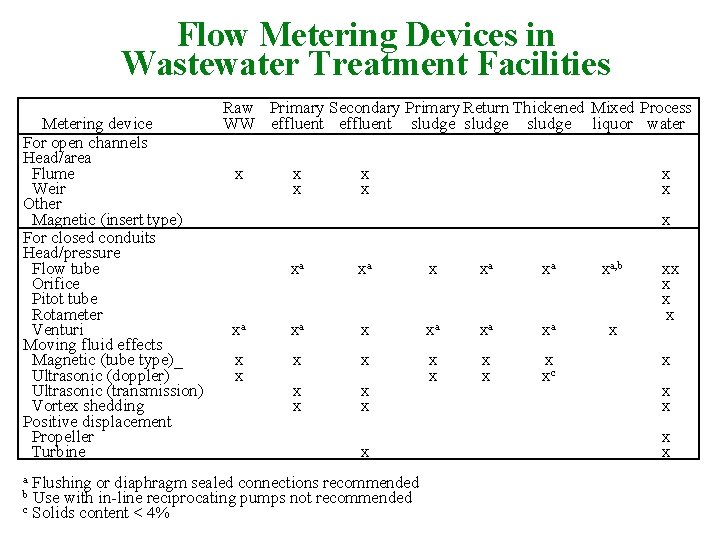
Flow Metering Devices in Wastewater Treatment Facilities Metering device For open channels Head/area Flume Weir Other Magnetic (insert type) For closed conduits Head/pressure Flow tube Orifice Pitot tube Rotameter Venturi Moving fluid effects Magnetic (tube type)_ Ultrasonic (doppler) Ultrasonic (transmission) Vortex shedding Positive displacement Propeller Turbine a b c Raw Primary Secondary Primary Return Thickened Mixed Process WW effluent sludge liquor water x x x x xa xa xa, b xa xa xa x x x xc x Flushing or diaphragm sealed connections recommended Use with in-line reciprocating pumps not recommended Solids content < 4% xx x x x x
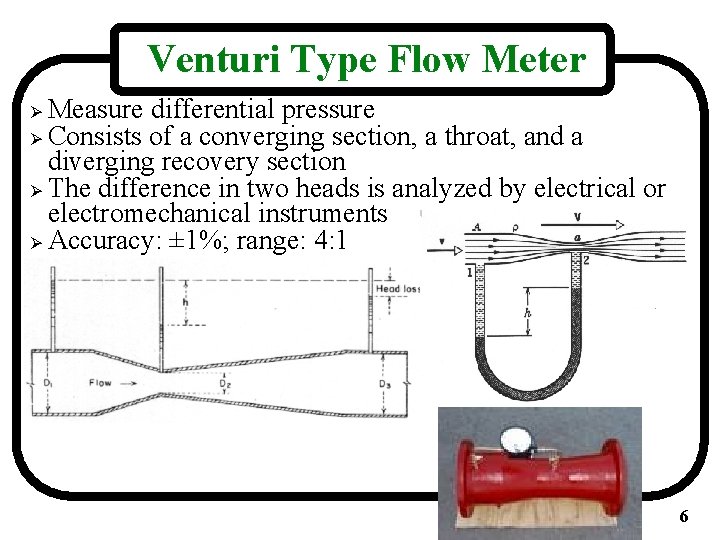
Venturi Type Flow Meter Measure differential pressure Ø Consists of a converging section, a throat, and a diverging recovery section Ø The difference in two heads is analyzed by electrical or electromechanical instruments Ø Accuracy: ± 1%; range: 4: 1 Ø 6
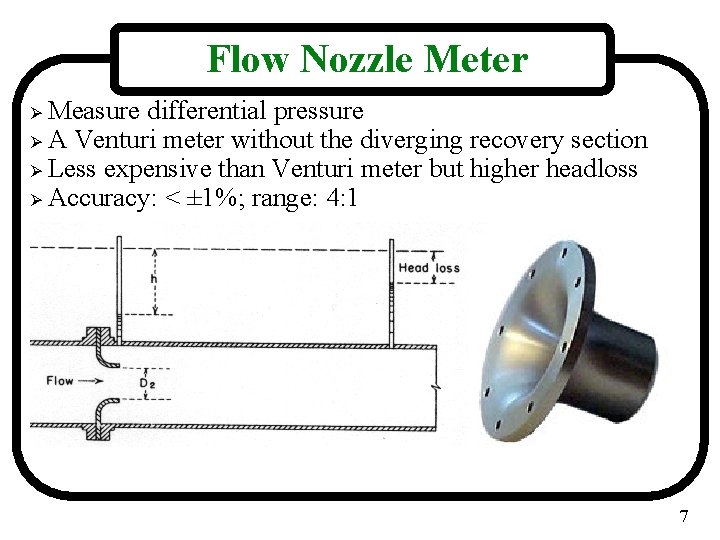
Flow Nozzle Meter Measure differential pressure Ø A Venturi meter without the diverging recovery section Ø Less expensive than Venturi meter but higher headloss Ø Accuracy: < ± 1%; range: 4: 1 Ø 7
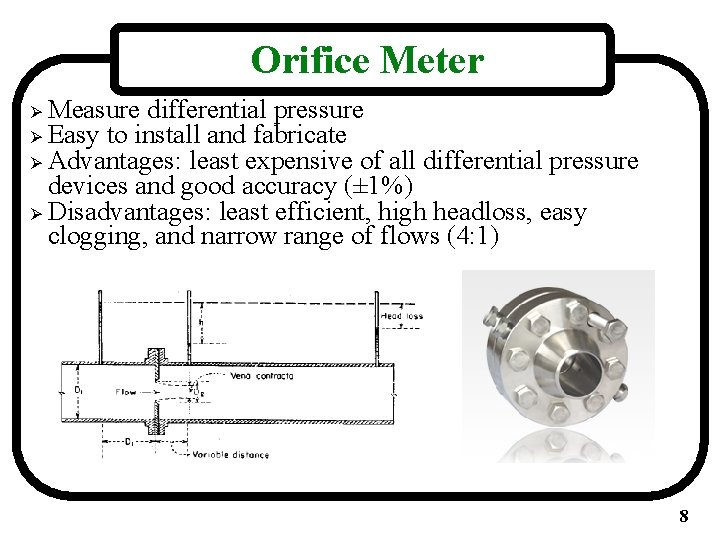
Orifice Meter Measure differential pressure Ø Easy to install and fabricate Ø Advantages: least expensive of all differential pressure devices and good accuracy (± 1%) Ø Disadvantages: least efficient, high headloss, easy clogging, and narrow range of flows (4: 1) Ø 8
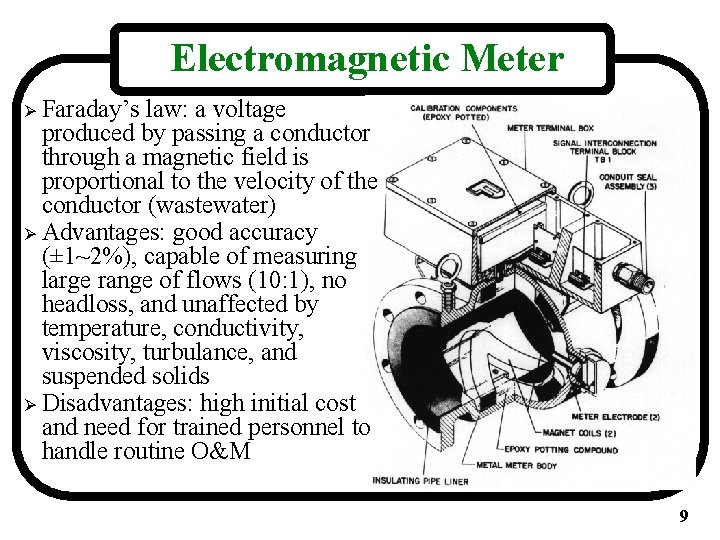
Electromagnetic Meter Faraday’s law: a voltage produced by passing a conductor through a magnetic field is proportional to the velocity of the conductor (wastewater) Ø Advantages: good accuracy (± 1~2%), capable of measuring large range of flows (10: 1), no headloss, and unaffected by temperature, conductivity, viscosity, turbulance, and suspended solids Ø Disadvantages: high initial cost and need for trained personnel to handle routine O&M Ø 9
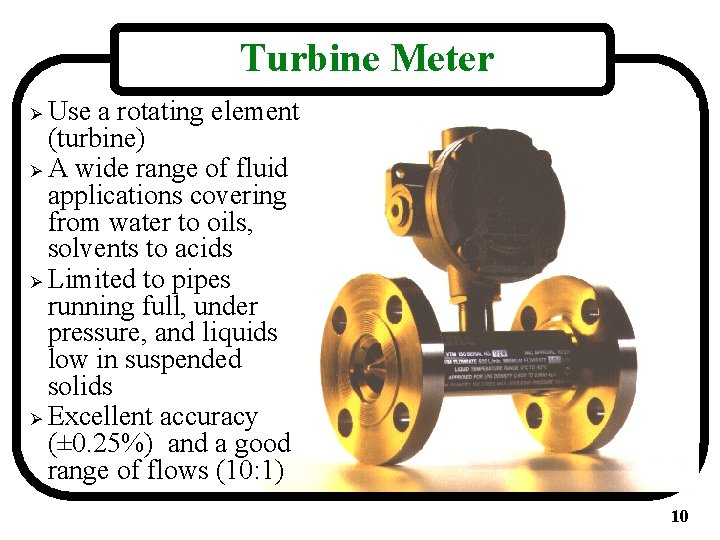
Turbine Meter Use a rotating element (turbine) Ø A wide range of fluid applications covering from water to oils, solvents to acids Ø Limited to pipes running full, under pressure, and liquids low in suspended solids Ø Excellent accuracy (± 0. 25%) and a good range of flows (10: 1) Ø 10
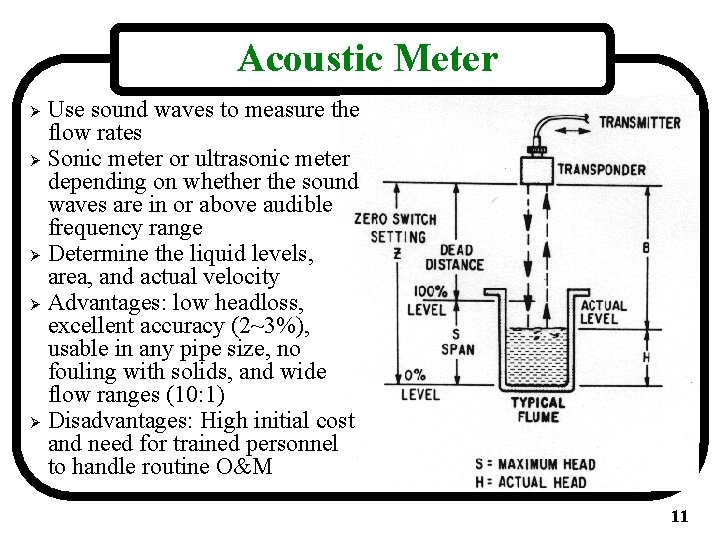
Acoustic Meter Use sound waves to measure the flow rates Ø Sonic meter or ultrasonic meter depending on whether the sound waves are in or above audible frequency range Ø Determine the liquid levels, area, and actual velocity Ø Advantages: low headloss, excellent accuracy (2~3%), usable in any pipe size, no fouling with solids, and wide flow ranges (10: 1) Ø Disadvantages: High initial cost and need for trained personnel to handle routine O&M Ø 11
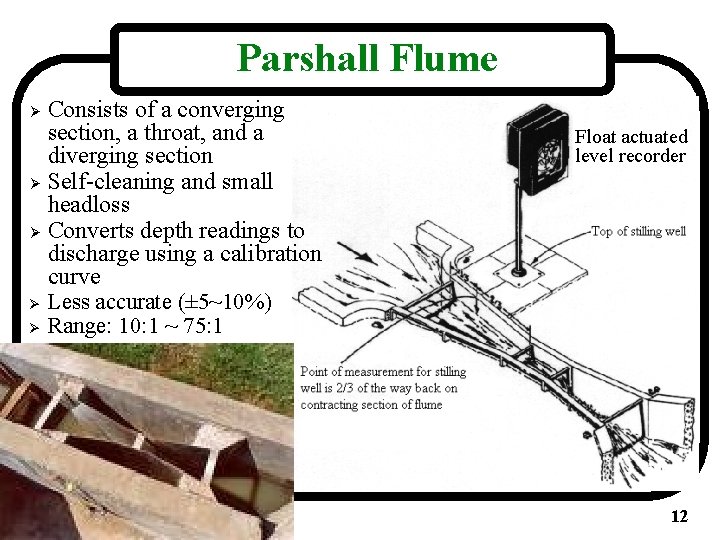
Parshall Flume Consists of a converging section, a throat, and a diverging section Ø Self-cleaning and small headloss Ø Converts depth readings to discharge using a calibration curve Ø Less accurate (± 5~10%) Ø Range: 10: 1 ~ 75: 1 Ø Float actuated level recorder 12
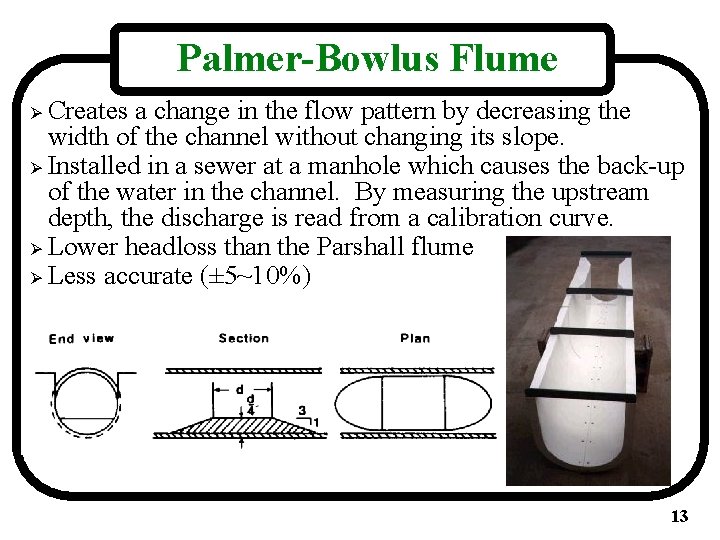
Palmer-Bowlus Flume Creates a change in the flow pattern by decreasing the width of the channel without changing its slope. Ø Installed in a sewer at a manhole which causes the back-up of the water in the channel. By measuring the upstream depth, the discharge is read from a calibration curve. Ø Lower headloss than the Parshall flume Ø Less accurate (± 5~10%) Ø 13
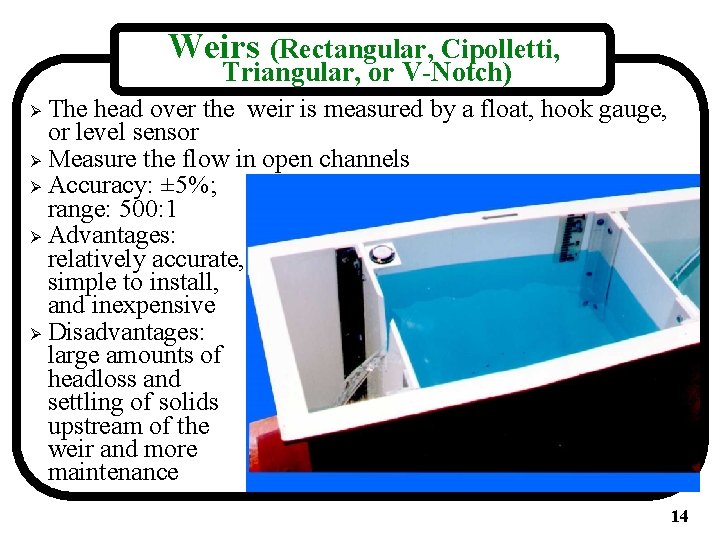
Weirs (Rectangular, Cipolletti, Triangular, or V-Notch) The head over the weir is measured by a float, hook gauge, or level sensor Ø Measure the flow in open channels Ø Accuracy: ± 5%; range: 500: 1 Ø Advantages: relatively accurate, simple to install, and inexpensive Ø Disadvantages: large amounts of headloss and settling of solids upstream of the weir and more maintenance Ø 14
Miscellaneous Flow Measurement Devices Ø Ø Depth Measurement ü Need to measure the flow depth and sewer slope and use Manning equation for flow estimation. ü Frequently used for interceptor flow estimation Open Flow Nozzle ü Crude devices used to measure flow at the end of freely discharging pipes. ü Must have a section of pipe that has a length of at least six times the diameter with a flat slope preceding the discharge. ü Examples: Kennison nozzle and the California pipe 15
Checklist for Design of Flow-Measuring Device Characteristics of the liquid (SS, density, temp. , pressure, etc. ) Ø Expected flow range (max. and min. ) Ø Accuracy desired Ø Any constraints imposed by regulatory agencies Ø Location of flow measurement device and piping system (force main, sewer, manhole, channel, or treatment unit) Ø Atmosphere of installation (indoors, outdoors, corrosive, hot, cold, wet, dry, etc. ) Ø Headloss constraints Ø Type of secondary elements (level sensors, pressure sensors, transmitters, and recorders) Ø Space limitations and size of device Ø Compatibility with other flow measurement devices if already in operation at the existing portion of the treatment facility Ø Equipment manufacturers and equipment selection guide Ø 16
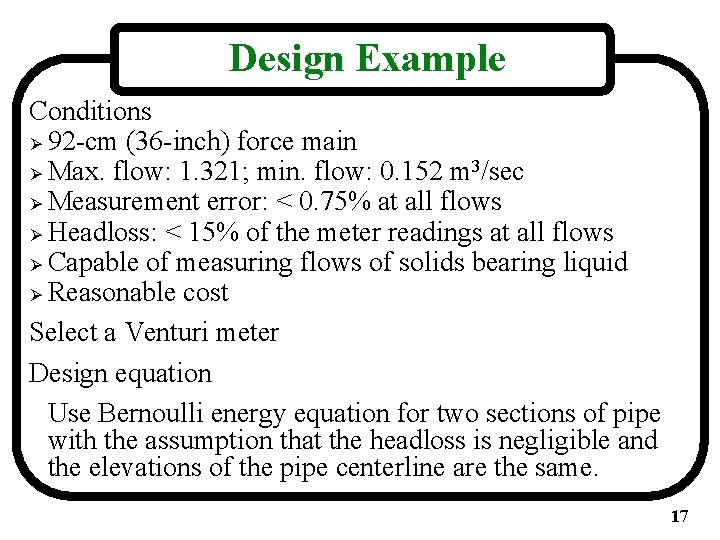
Design Example Conditions Ø 92 -cm (36 -inch) force main Ø Max. flow: 1. 321; min. flow: 0. 152 m 3/sec Ø Measurement error: < 0. 75% at all flows Ø Headloss: < 15% of the meter readings at all flows Ø Capable of measuring flows of solids bearing liquid Ø Reasonable cost Select a Venturi meter Design equation Use Bernoulli energy equation for two sections of pipe with the assumption that the headloss is negligible and the elevations of the pipe centerline are the same. 17
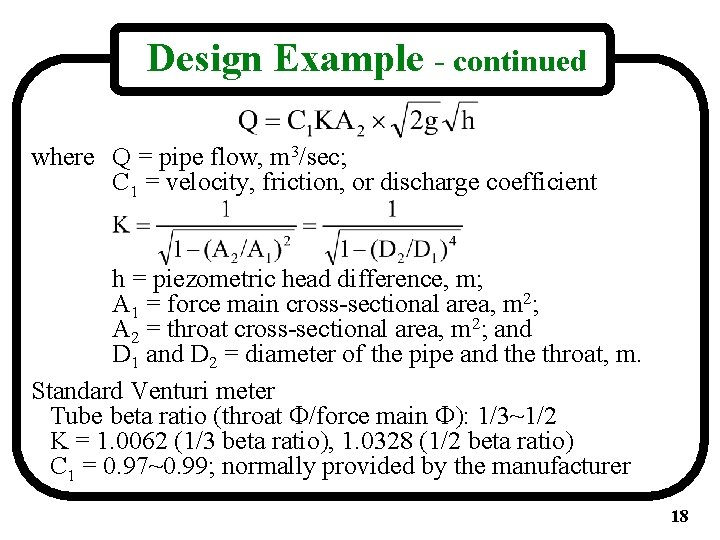
Design Example - continued where Q = pipe flow, m 3/sec; C 1 = velocity, friction, or discharge coefficient h = piezometric head difference, m; A 1 = force main cross-sectional area, m 2; A 2 = throat cross-sectional area, m 2; and D 1 and D 2 = diameter of the pipe and the throat, m. Standard Venturi meter Tube beta ratio (throat /force main ): 1/3~1/2 K = 1. 0062 (1/3 beta ratio), 1. 0328 (1/2 beta ratio) C 1 = 0. 97~0. 99; normally provided by the manufacturer 18
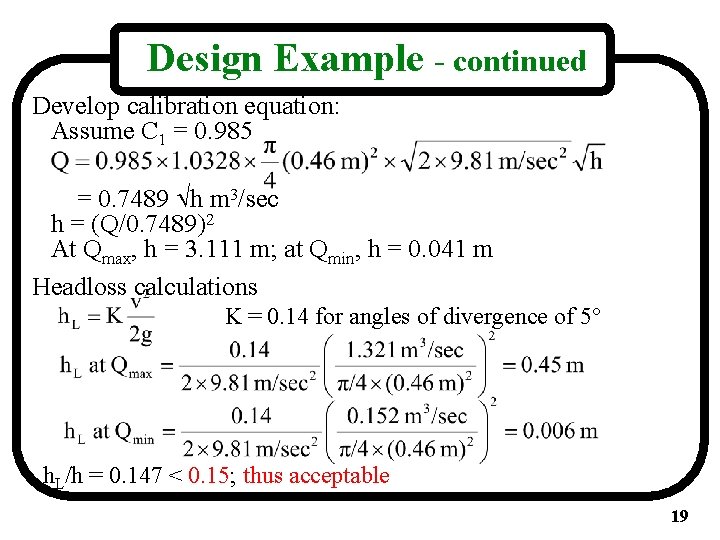
Design Example - continued Develop calibration equation: Assume C 1 = 0. 985 = 0. 7489 h m 3/sec h = (Q/0. 7489)2 At Qmax, h = 3. 111 m; at Qmin, h = 0. 041 m Headloss calculations K = 0. 14 for angles of divergence of 5° h. L/h = 0. 147 < 0. 15; thus acceptable 19
- Slides: 19