
Flow Control by Tailored Magnetic Fields Context Basic
Flow Control by Tailored Magnetic Fields Context, Basic Ideas, Some Examples Sino-German Workshop on Electromagnetic Processing of Materials (EPM) Shanghai University, Oct. 11 -13, 2004 G. Gerbeth Forschungszentrum Rossendorf (FZR), Dresden, Germany Sino-German Workshop on EPM Shanghai, Oct. 11 -12, 2004 Forschungszentrum Rossendorf
Introduction: Sino-German Workshop on EPM Magnetic Fields: Contactless influence on Processes and Materials Attractive R&D topic for the future Powerful research programs in China and Germany: Cooperation between Chinese and German teams (serious basis exists already) Exchange of students, Ph. D. ’s, postdoc’s Joint R&D projects, joint industrial projects (? ) Support by Sino-German Center for Research Promotion (founded by NSFC and DFG) is gratefully acknowledged Sino-German Workshop on EPM Shanghai, Oct. 11 -12, 2004 Forschungszentrum Rossendorf
Introduction: MHD in Dresden (Germany) Basic - and applied studies on Magnetohydrodynamics (MHD): 20 years tradition at FZR 10 years tradition at Dresden University (TUD) Local network in Dresden (IFW, Uni Freiberg, Fh. G, MPI) Traditional cooperation and Twinning Agreement with Institute of Physics Riga (Latvia) Since 2002: Collaborative Research Centre SFB 609 at TUD “Electromagnetic flow control in metallurgy, crystal growth and electrochemistry” supported by DFG supposed to last 11 years with ~ 1. 7 Mio €/a Sino-German Workshop on EPM Shanghai, Oct. 11 -12, 2004 Forschungszentrum Rossendorf
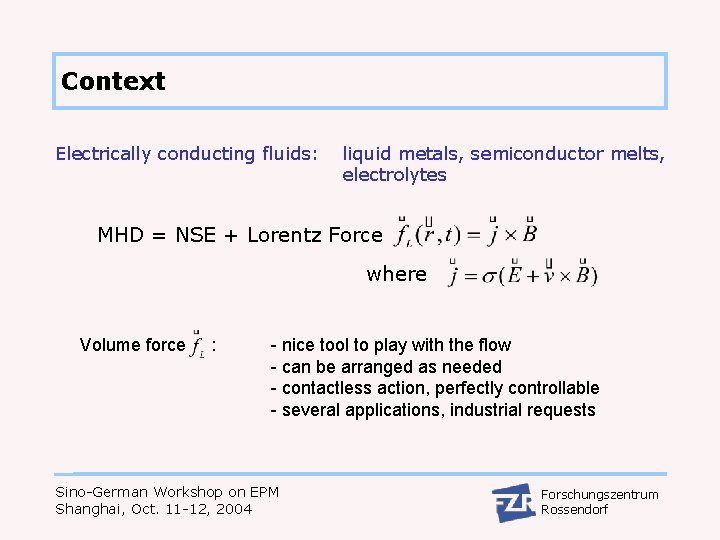
Context Electrically conducting fluids: liquid metals, semiconductor melts, electrolytes MHD = NSE + Lorentz Force where Volume force : - nice tool to play with the flow - can be arranged as needed - contactless action, perfectly controllable - several applications, industrial requests Sino-German Workshop on EPM Shanghai, Oct. 11 -12, 2004 Forschungszentrum Rossendorf
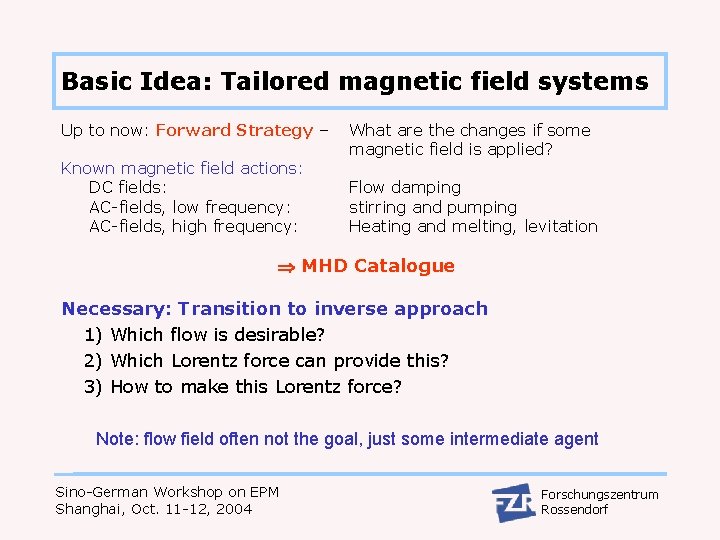
Basic Idea: Tailored magnetic field systems Up to now: Forward Strategy – Known magnetic field actions: DC fields: AC-fields, low frequency: AC-fields, high frequency: What are the changes if some magnetic field is applied? Flow damping stirring and pumping Heating and melting, levitation MHD Catalogue Necessary: Transition to inverse approach 1) Which flow is desirable? 2) Which Lorentz force can provide this? 3) How to make this Lorentz force? Note: flow field often not the goal, just some intermediate agent Sino-German Workshop on EPM Shanghai, Oct. 11 -12, 2004 Forschungszentrum Rossendorf
Basic Idea: Tailored magnetic field systems Why now? 1) Strong request from applied side for smart solutions with low effort (Tesla cost money!) 2) powerful community for optimization, control theory, inverse strategies 3) new computer capabilities 4) MHD catalogue is well filled 5) new level of velocity measuring techniques for liquid metal MHD flows (liquid metal model experiments up to T 400°C) 6) new level of experimental tools for superposition of AC and DC magnetic fields Sino-German Workshop on EPM Shanghai, Oct. 11 -12, 2004 Forschungszentrum Rossendorf
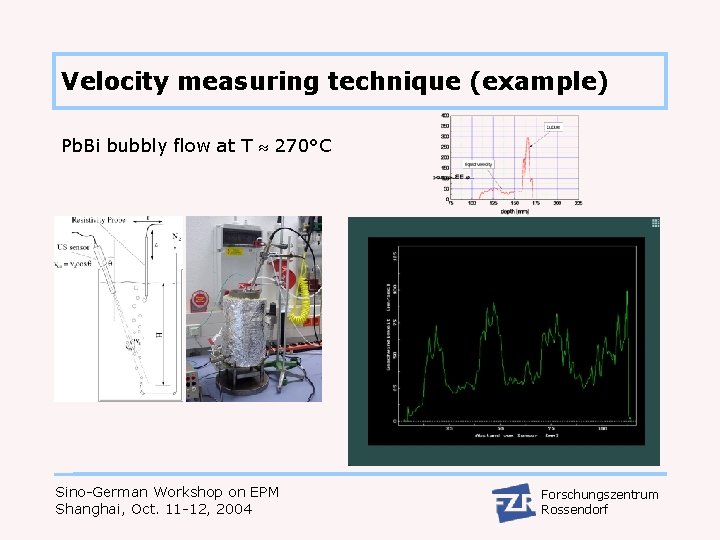
Velocity measuring technique (example) Pb. Bi bubbly flow at T 270°C Sino-German Workshop on EPM Shanghai, Oct. 11 -12, 2004 Forschungszentrum Rossendorf
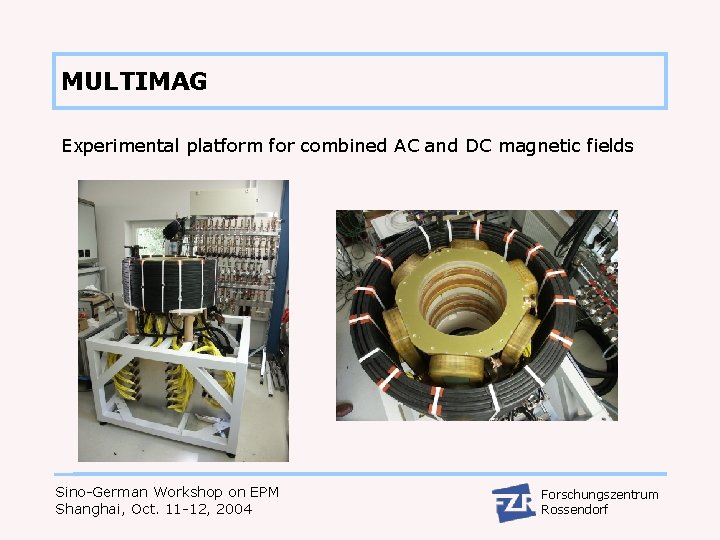
MULTIMAG Experimental platform for combined AC and DC magnetic fields Sino-German Workshop on EPM Shanghai, Oct. 11 -12, 2004 Forschungszentrum Rossendorf
Examples for partly going the inverse way 1) Industrial Cz-growth of single Si crystals 2) Float-zone crystal growth 3) Industrial Al investment casting Dr. Eckert 4) Melt extraction of metallic fibers 5) Seawater flows 6) Electromagnetic levitation Sino-German Workshop on EPM Shanghai, Oct. 11 -12, 2004 Dr. Priede Forschungszentrum Rossendorf
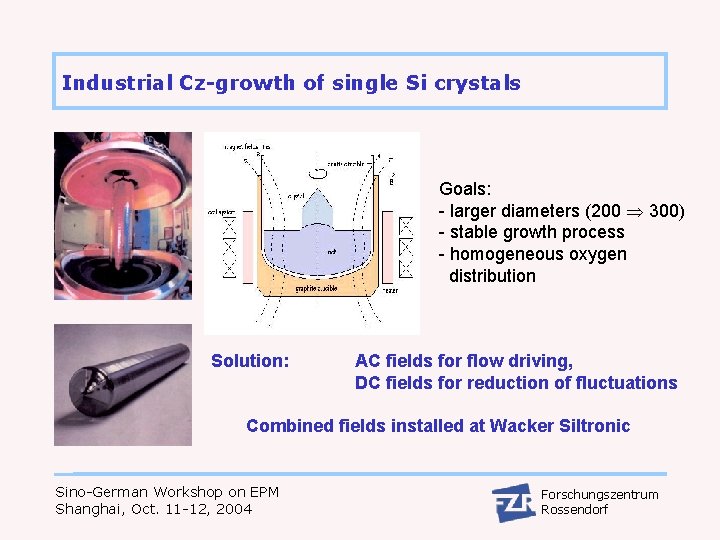
Industrial Cz-growth of single Si crystals Goals: - larger diameters (200 300) - stable growth process - homogeneous oxygen distribution Solution: AC fields for flow driving, DC fields for reduction of fluctuations Combined fields installed at Wacker Siltronic Sino-German Workshop on EPM Shanghai, Oct. 11 -12, 2004 Forschungszentrum Rossendorf
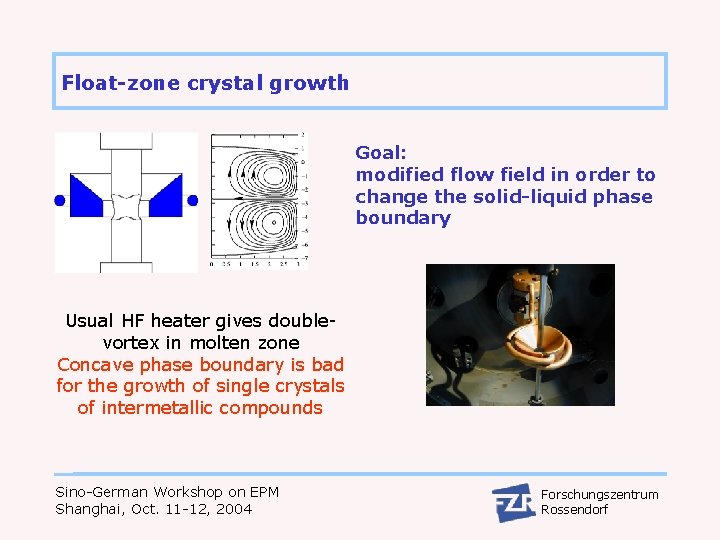
Float-zone crystal growth Goal: modified flow field in order to change the solid-liquid phase boundary Usual HF heater gives doublevortex in molten zone Concave phase boundary is bad for the growth of single crystals of intermetallic compounds Sino-German Workshop on EPM Shanghai, Oct. 11 -12, 2004 Forschungszentrum Rossendorf
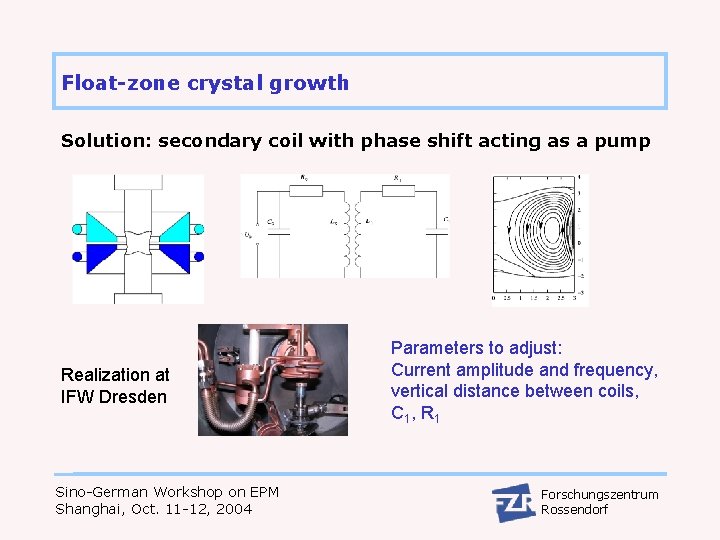
Float-zone crystal growth Solution: secondary coil with phase shift acting as a pump Realization at IFW Dresden Sino-German Workshop on EPM Shanghai, Oct. 11 -12, 2004 Parameters to adjust: Current amplitude and frequency, vertical distance between coils, C 1 , R 1 Forschungszentrum Rossendorf
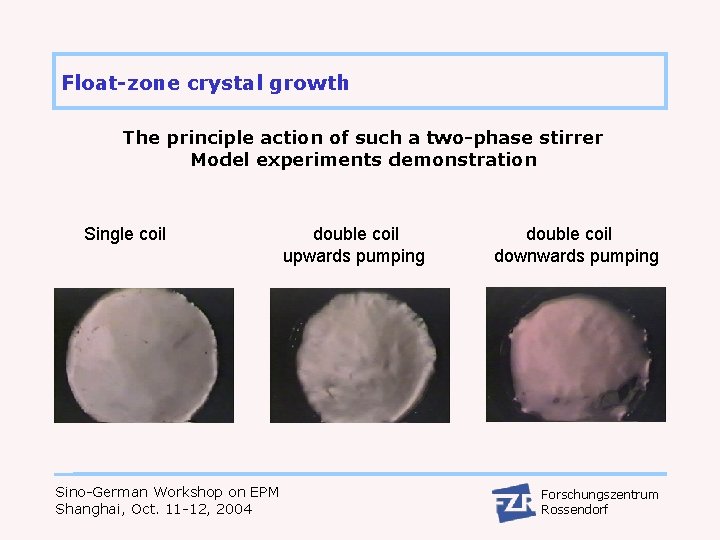
Float-zone crystal growth The principle action of such a two-phase stirrer Model experiments demonstration Single coil Sino-German Workshop on EPM Shanghai, Oct. 11 -12, 2004 double coil upwards pumping double coil downwards pumping Forschungszentrum Rossendorf

Float-zone crystal growth Numerical simulations: electromagnetic fields, flow, temperature field Example: Variation of the vertical distance of the coils h = 1 mm h = 3 mm h = 5 mm Optimum: distance crystal radius Sino-German Workshop on EPM Shanghai, Oct. 11 -12, 2004 Forschungszentrum Rossendorf
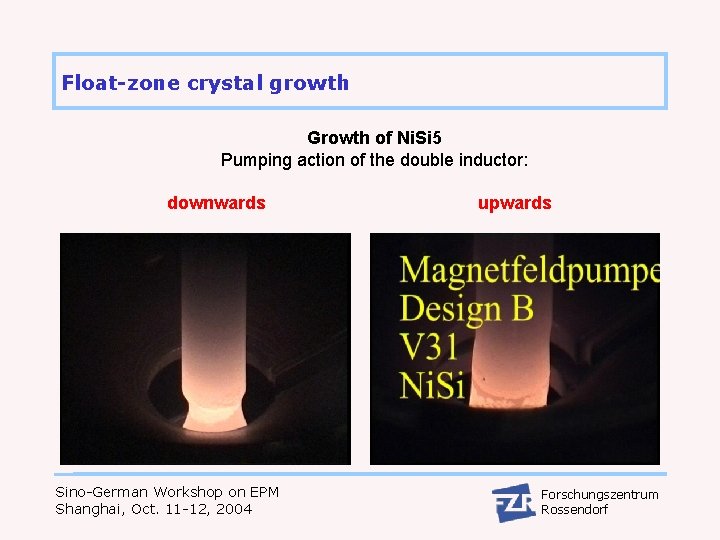
Float-zone crystal growth Growth of Ni. Si 5 Pumping action of the double inductor: downwards Sino-German Workshop on EPM Shanghai, Oct. 11 -12, 2004 upwards Forschungszentrum Rossendorf
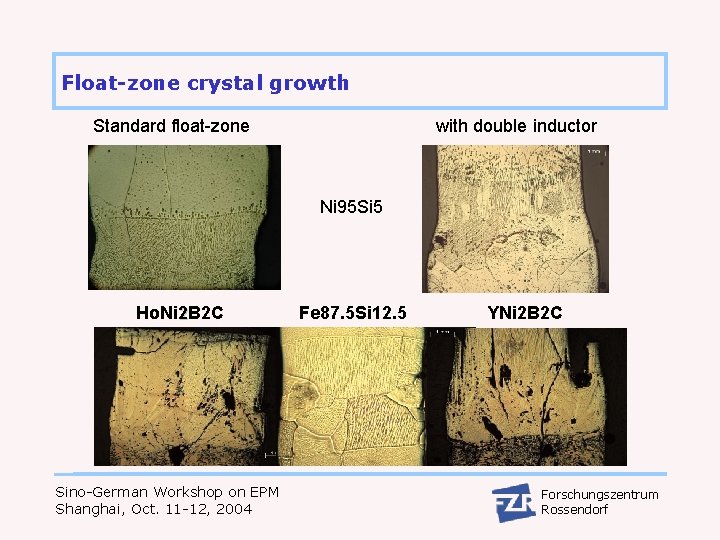
Float-zone crystal growth Standard float-zone with double inductor Ni 95 Si 5 Ho. Ni 2 B 2 C Sino-German Workshop on EPM Shanghai, Oct. 11 -12, 2004 Fe 87. 5 Si 12. 5 YNi 2 B 2 C Forschungszentrum Rossendorf
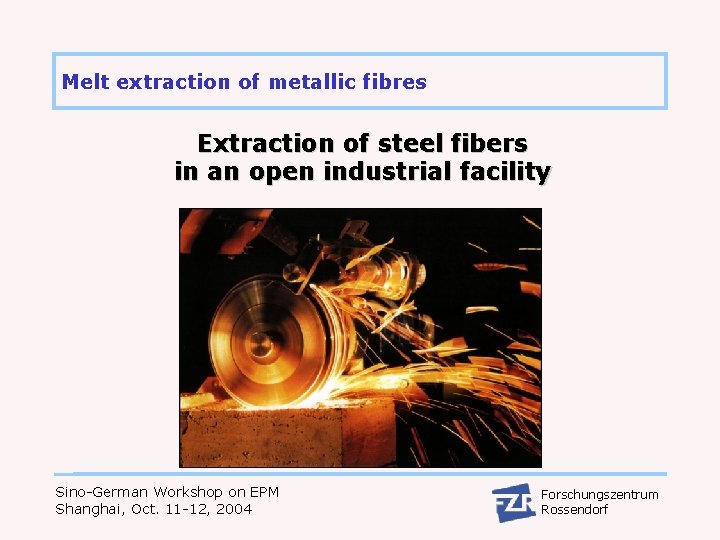
Melt extraction of metallic fibres Extraction of steel fibers in an open industrial facility Sino-German Workshop on EPM Shanghai, Oct. 11 -12, 2004 Forschungszentrum Rossendorf
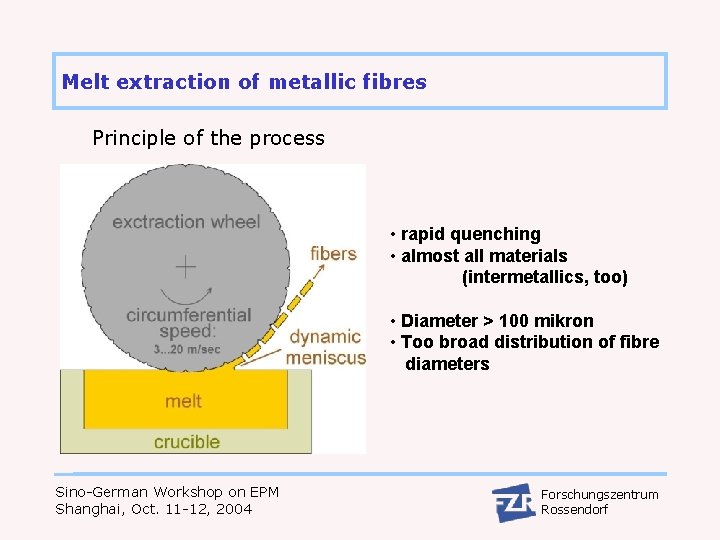
Melt extraction of metallic fibres Principle of the process • rapid quenching • almost all materials (intermetallics, too) • Diameter > 100 mikron • Too broad distribution of fibre diameters Sino-German Workshop on EPM Shanghai, Oct. 11 -12, 2004 Forschungszentrum Rossendorf
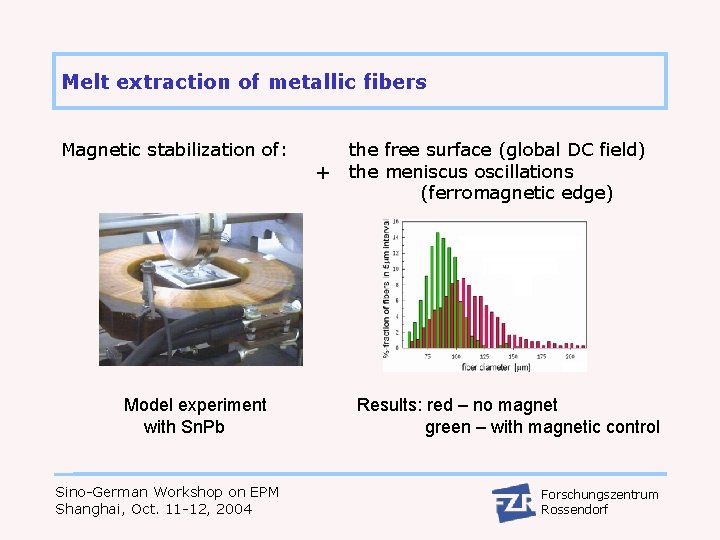
Melt extraction of metallic fibers Magnetic stabilization of: Model experiment with Sn. Pb Sino-German Workshop on EPM Shanghai, Oct. 11 -12, 2004 + the free surface (global DC field) the meniscus oscillations (ferromagnetic edge) Results: red – no magnet green – with magnetic control Forschungszentrum Rossendorf
Summary Flow control by magnetic fields: nice tool to modify velocity fields inverse approach: challenging task Several industrial requests, short bridge to applications Essential tools: numerical simulations new class of velocity measuring techniques for liquid metals „cold“ model experiments Attractive basis in China and Germany Right time for a Sino-German Workshop on EPM Shanghai, Oct. 11 -12, 2004 Forschungszentrum Rossendorf
Outlook for 2005 Joint 15 th Riga and 6 th PAMIR International Conference on Fundamental and Applied MHD Riga (Latvia), June 27 – July 1, 2005 http: //www. ipul. lv/pamir German-Chinese Workshop in Dresden: to be discussed Sino-German Workshop on EPM Shanghai, Oct. 11 -12, 2004 Forschungszentrum Rossendorf
- Slides: 21