
Florida State HOPWA Program Webinar Series Part 1
Florida State HOPWA Program Webinar Series Part 1: Update and General Overview August 18, 2015 10: 30 -12: 00 PM EDT 1

Florida State HOPWA Program Webinar Series Part 1: Housekeeping: Call-in toll-free number: 877 -223 -6370 Conference Code: 718 687 7411 Link: https: //tdaevent. webex. com/tdaevent/onstage/g. php? MTID=e 3510 eb 2 e 739 c 030 b 8 d ec 5 ff 5 b 5 a 954 b 7 Password: HOPWA 2
Presenters • Craig Reynolds, State HOPWA Program Coordinator • Dr. Rusty Bennett, CEO, Collaborative Solutions, Inc. 3
Florida State HOPWA Program Where We’ve Been Where We’re Headed 4
HOPWA Review Outline Part I – HOPWA Overview • Program Origin • Statutory Purpose • Strategic Objectives • Current Use of HOPWA Funds Part II – Funding • Overview • Formula • Competitive • Technical Assistance • Obligation & Expenditure Requirements 5
HOPWA Outline, cont. Part III – Client Eligibility & Qualifications • Establishing Income Eligibility • Documenting HIV/AIDS Status • Confidentiality Requirements • Termination of Assistance Part IV – Allowable Activities • Direct Housing Assistance • Supportive Services • Other Program Activities • Administrative Expenses 6
HOPWA Outline, cont. Part V – Improving Housing Stability and Housing Resources • Housing-focused Case Management • Housing Care Plans • Accessing/Leveraging Non-HOPWA Housing Resources 7
l Program Origin l Statutory Purpose l Strategic Objectives l Current Use of HOPWA Funds PART 1: HOPWA OVERVIEW 8
Program Origin • More than one million Americans are living with HIV, with an estimated 56, 300 Americans becoming infected with HIV each year. • The households affected by the disease are typically among the lowest income households. • The lack of stable housing by persons with HIV/AIDS prevents their ability to participate in HIV care, resulting in devastating health consequences and contributing to increased mortality rates. 9
Program Origin (cont. ) • The Housing Opportunities for Persons with AIDS (HOPWA) program was created to address these realities. – Established by the AIDS Housing Opportunity Act of 1990 (42 U. S. C. 12901). – Administered by the Office of Community Planning and Development. • Headquarters, Office of HIV/AIDS Housing • HUD State and Local Field Offices 10
Statutory Purpose • “To provide states and localities with resources and incentives to devise long-term comprehensive strategies for meeting the housing needs of persons with acquired immunodeficiency syndrome and families of such persons…. ” (42 U. S. C. 12901) 11
U. S. Department of Housing and Urban Development -- Mission Create strong, sustainable, inclusive communities and quality affordable homes for all. HUD Strategic Plan FY 2010 -2015 May 12, 2010 www. hud. gov and espanol. hud. gov. 12
HUD Strategic Plan 2010 -2015 HOPWA-Related Goals: Goal 2: Meet the Need for Quality Affordable Rental Homes • End Homelessness and Substantially Reduce the Number of Families and Individuals with Severe Housing Needs Goal 3: Utilize Housing as a Platform for Improving Quality of Life • Improve health outcomes; • Improve housing stability through supportive services for vulnerable populations including seniors, persons with disabilities, homeless persons and those at risk of being homeless 13
HOPWA Performance Measures HOPWA assisted households will: • establish or maintain a stable living environment. • have a reduced risk of homelessness, • have improved access to care and support. 14
HOPWA Performance Measures – Outcome Targets 2012 National Outcome Targets: 1. At least 90% of HOPWA households in permanent housing will maintain housing stability. 2. At least 70% of clients in short-term or transitional housing will have reduced risks of homelessness. 15
HOPWA Performance Measures HOPWA beneficiaries will have improved access to care: • • • Access or maintain qualification for sources of income. Access or maintain medical insurance/assistance. Has contact with a primary health care provider. Has contact with a case manager/benefits counselor. Has a housing plan for maintaining or establishing stable on-going housing. 16
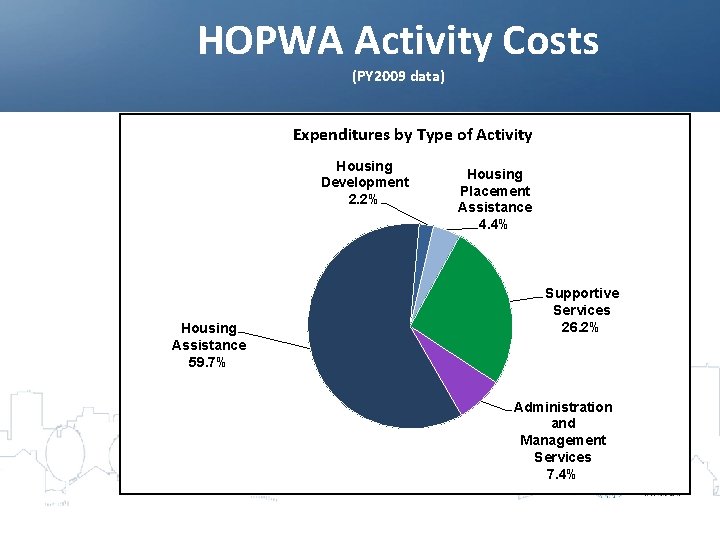
HOPWA Activity Costs (PY 2009 data) Expenditures by Type of Activity Housing Development 2. 2% Housing Placement Assistance 4. 4% Supportive Services 26. 2% Housing Assistance 59. 7% Administration and Management Services 7. 4% 17
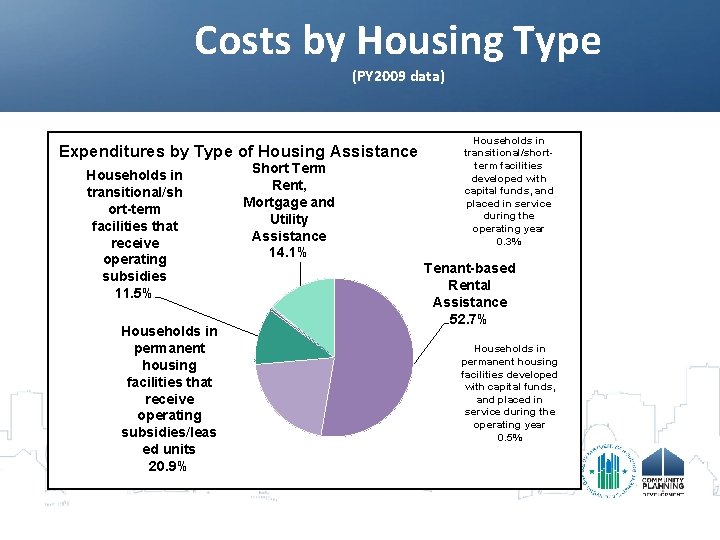
Costs by Housing Type (PY 2009 data) Expenditures by Type of Housing Assistance Households in transitional/sh ort-term facilities that receive operating subsidies 11. 5% Short Term Rent, Mortgage and Utility Assistance 14. 1% Households in transitional/shortterm facilities developed with capital funds, and placed in service during the operating year 0. 3% Tenant-based Rental Assistance 52. 7% Households in permanent housing facilities that receive operating subsidies/leas ed units 20. 9% Households in permanent housing facilities developed with capital funds, and placed in service during the operating year 0. 5% 18
l Overview l Formula l Competitive l Technical Assistance l Obligation & Expenditure Requirements PART 2: FUNDING 19
Formula Program: Key Definitions Grantees: l Eligible Metropolitan Statistical Area (EMSA): Metropolitan areas with a population greater than 500, 000 and having more than 1, 500 cumulative AIDS cases. – The largest city in the EMSA serves as the grant recipient Eligible States: More than 1, 500 cumulative cases of AIDS (outside of eligible EMSAs). A community’s Consolidated Plan serves as its application to HUD for HOPWA (formula) funds – l 20
Formula Program: Administration of Funds • A Project Sponsor is a nonprofit organization or governmental housing agency that receives funds under a contract with a grantee to carry out eligible activities. – Each grantee awards funds to project sponsors based on the needs and priorities outlined in its Consolidated Plan and Annual Action Plan. – Grantees are responsible for monitoring and oversight of project sponsors. – Grantees are responsible for collecting performance data from project sponsors and reporting to HUD. 21
Questions on these sections? HOPWA OVERVIEW AND FUNDING Q&A 22
l Establishing Income Eligibility l Documenting HIV/AIDS Status l Confidentiality Requirements l Termination of Assistance PART 3: CLIENT ELIGIBILITY & ADDITIONAL REQUIREMENTS 23
State Program Eligibility • Patient Care Programs Eligibility Rule • HOPWA-Specific Qualifications • HOPWA Income Exception – When 80% AMI > 400% of FPL, and the potential client’s income as above 400% FPL but below 80% AMI, an income exception can be made. 24
Client Eligibility • The HOPWA program serves low-income persons, and their families, living with HIV/AIDS. – Households must be at or below 80% of Area Median Income. – HIV/AIDS status must be documented. 25
Establishing Income Eligibility • Income can be no greater than 80% of Area Median Income (AMI). – See http: //www. huduser. org/datasets/il. html for income limits by county. • Annual re-determination of income eligibility is required. • Income of all family members over age 18 included in the calculation. • The HUD earned income disregard applies (see 24 CFR 5. 617). 26
Documenting HIV/AIDS Status • Documentation must come from HIV test conducted by a physician, HIV counseling center, or community health center. • HIV/AIDS diagnosis must be made by health professional competent to make determination. – Case manager statement is not sufficient. 27
Client Confidentiality • Information on the HIV/AIDS status of a client is subject to confidentiality requirements. – Mandated by Section 856 of the AIDS Housing Opportunity Act. – 24 CFR 574. 440 states that “the grantee shall agree, and shall ensure that each project sponsor agrees, to ensure the confidentiality of the name of any individual assisted under this part and any other information regarding individuals receiving assistance. ” 28
Client Confidentiality (cont. ) • Information related to HIV/AIDS status only to be used for purpose of determining eligibility. • Information should only be accessible to staff who determine eligibility or provide support. • Paper files should be maintained in locked cabinets; security software required for electronic files. • Important to conduct staff training and periodic monitoring of procedures. • Be careful about inadvertent disclosures (e. g. , checks, caller ID, fax ID, housing quality inspections, publicity for project-based developments) 29
Client Confidentiality (cont. ) Some ways to protect confidentiality: • Incorporate a subsidiary organization with a generic name to handle housing payments to landlords or mask the parent organization on IRS documentation sent to landlords. • Create a separate bank account with checks that do not list the sponsor’s name, using a generic name such as “Rental Assistance Program. ” • Rent a P. O. Box for receiving mail related to housing assistance and to use as the address on payments to landlords. • Use a dedicated phone number and line for dealing with landlords, answering it with a generic program name. 30
Termination of Assistance • Death: Surviving family members may continue to receive housing assistance and/or supportive services for a grace period following the death of the family member with AIDS. – The grantee or project sponsor establishes the grace period. – Grace period cannot exceed one year. • Violation of requirements: Clients may be terminated from the program for failing to meet program or occupancy requirements. – Grantees must have a formal written process which follows due process law. – Process must include, at a minimum, written notice with a clear statement of reasons for termination, allowance for review and rebuttal by tenant, and prompt written notice of final decision. 31
Discussion - Eligibility 1. Are sufficient documentation standards in place in your system/your agency for income eligibility and HIV status? 2. What else is needed – at the grantee, project sponsor and partner agency levels – to assure a high level of confidentiality? 32

Questions on this section? CLIENT QUALIFICATIONS Q&A 33
l Direct Housing Assistance l Supportive Services l Other Program Activities l Administrative Expenses PART 4: ALLOWABLE ACTIVITIES 34
Direct Housing Assistance • Facility-Based Housing Development and Operations – Not in FL State HOPWA Program Portfolio • Tenant-Based Rental Assistance (TBRA) • Short-Term Supported Housing • Short-Term Rent, Mortgage, and Utility (STRMU) Assistance 35
Facility-Based Housing Development • Costs associated with the acquisition, rehabilitation, conversion, or repair of facilities to provide housing to HOPWA-eligible households. • Minimum use periods: – 10 years for acquisition and/or substantial rehab – 3 years for non-substantial rehab & repairs • Construction and rehab projects must go through an environmental review 36
Facility-Based Housing Operations Activities include: • Leasing a building or scattered site units • General housing operations (e. g. , maintenance, security, insurance, utilities, furnishings, equipment/supplies). • Provision of project-based rental assistance (PBRA) – Rental subsidy stays with housing facility/units. – Requires a “blended management” approach, integrating housing management with the provision of supportive services. – HOPWA TBRA and Section 8 regulations apply (e. g. , tenant rent payment, HQS/habitability standards) 37
Tenant-Based Rental Assistance (TBRA) • • • Monthly rental subsidy that stays with client in housing of their choice within the HOPWA EMSA. The subsidy covers the difference between the Fair Market Rent (or other rent standard) and the tenant’s contribution. – Tenant must pay greater of 10% of gross monthly income, 30% of monthly adjusted income, or the designated welfare housing assistance amount. – Annual income recertification is required to assure ongoing eligibility. – Tenants may request interim rental adjustment based on increases or decreases in income. HOPWA housing quality standards apply (see 24 CFR 574. 310(b)). 38
Short-Term Supported Housing • • • Transitional housing facilities that provide temporary shelter. Assistance is limited to 60 days during a 6 -month period. – The 60 days do not have to be consecutive. Facilities may not provide housing for more than 50 individuals or families at any time. Programs must, to the extent possible, provide individuals with the opportunity for placement in permanent housing. Programs must also provide an opportunity to receive case management and supportive services. 39
Emergency Vouchers • • HOPWA funds can be used for emergency housing vouchers to place homeless individuals or families in temporary housing, such as short-term use of hotel/motel units. Guidance on use of emergency vouchers: – Short-term housing activities should include efforts to connect – – • beneficiaries to other needed housing and support; Costs should be classified as facility-based housing assistance for leasing a transitional/short-term housing facility or unit; Time limit is generally up to 30 days, while other more permanent housing is being identified; For more information, see HOPWA FAQs Update on Using and Reporting on Emergency Vouchers – 5/19/09 http: //www. hudhre. info/documents/HOPWAFAQEmergency. Vouchers. pdf 40
Short-Term Rent, Mortgage, and Utility Assistance (STRMU) • Time-limited housing assistance designed to prevent homelessness and increase housing stability. – Assistance is provided to help homeowners and renters remain in their current place of residence. – STRMU cannot be used to assist a client with locating a housing unit, security deposits, first months rent, or other move-in support. – Designed as a short-term intervention. Other types of assistance (rental assistance or residency in community facility) should be used for clients with ongoing needs. 41
STRMU (cont. ) • Grantees may provide assistance for rent, mortgage, and/or utilities for up to 21 weeks in any 52 -week period (weeks do not have to be consecutive). – Amount of assistance varies per client depending on funds available, – – • tenant need, and program guidelines. Grantees may authorize project sponsors to cap payments, though caps must be applied uniformly. STRMU cannot be provided if assistance is also being received from any other HOPWA, Federal, state, or local housing subsidy program. HQS inspection not required initially if assistance is needed to prevent homelessness and unit is safe and decent. – However, providers are required to assess whether unit is decent, safe, and sanitary as part of their responsibility to provide ongoing assessment of housing needs/stability. Any deficiencies should be addressed through housing service plan. 42
Supportive Services • • Services which complement the provision of housing assistance to beneficiaries, thereby helping promote housing stability, reduce the risk of homelessness, and improve access to healthcare. Examples include: – – – – Assessment & Case Management Drug and Alcohol Abuse Treatment and Counseling Mental Health Day Care Personal Assistance Nutritional Services Intensive Care (when required) Assistance in Accessing Other Federal/State/Local Benefits and Services. 43
Supportive Services (cont. ) • HOPWA funding should generally be coordinated with other health services for beneficiaries. • HUD advises that health care payments may only be made in the case that no other funds or likely means of compensation for health care purposes are available in a jurisdiction or to a client. – If HOPWA funds are used to make health care payments under this authorization, the grantee must document evidence that the client would not otherwise receive health care assistance. 44
Other Program Activities • • Permanent Housing Placement – Expenditures that help establish eligible persons in a housing unit where ongoing occupancy is expected to continue – Eligible expenses include application fees, credit checks, and reasonable security deposits (not to exceed 2 months rent). Housing Information Services – Information and referral services to assist eligible persons with locating, acquiring, financing, and maintaining housing. Resource Identification – Activities to identify, coordinate, and develop housing assistance resources for eligible persons. Technical Assistance (Local) – Resources used to assist in establishing/operating a community residence. 45
Administrative Expenses • Costs for general management, oversight, coordination, evaluation, and reporting on eligible activities. Administrative expenses include: – Staff for program coordination, management, and evaluation – Travel for official business – Contracted services (legal, audit, accounting) – Goods and services needed for admin (e. g. , equipment • rental/purchase) Limits – 3% allowable for HOPWA grantee – 7% allowable for Project Sponsor (of amount received by sponsor) – Competitive grantees who also carry out program activities are limited to 3% 46
Administrative Expenses (cont. ) What are the administrative requirements? • Grantees are responsible for: – Ensuring that grants are administered in accordance with applicable laws and regulations. – Ensuring that project sponsors carry out activities in compliance with all applicable requirements. – Reporting to HUD on use of funds and programs accomplishments. 47
Questions on this section? ALLOWABLE ACTIVITIES Q&A 48
l Housing-Focused Case Management l Housing Care Plans l Accessing Non-HOPWA Housing Resources PART 5: IMPROVING HOUSING STABILITY AND INCREASING HOUSING RESOURCES 49
CLIENT ASSESSMENT & HOUSING PLANS Slide 50
Client Assessment: Is Rental Assistance What is Needed? n Through assessment clients can be connected to the housing resource that best fits their need. n Determine the source of the problem. n Is it a chronic (long-term) problem? n Is it episodic (short term)? § Develop an on-going housing plan which outlines a path to permanent housing. § People living with HIV/AIDS are a dynamic population, thus their needs and situations are constantly changing. Slide 51
Client Assessment for Rental Assistance • May be a stand-alone document or incorporated into a broader client psychosocial assessment. • Should collect information that will help make a successful housing placement: ü ü Housing readiness Housing support needs Housing preferences Barriers to housing stability Slide 52
Client Assessment for Rental Assistance Determining Housing Stability • Calculate client’s current housing burden: Example: § Monthly rent & utilities = $600 § Monthly household income = $1, 200 § $600/$1, 200 = 50% Example household is well above the 30% considered to be affordable! Slide 53
Client Assessment for Rental Assistance Determining Housing Readiness: • Review/discuss common barriers: • No rental history • Large family (3+ children) • Past evictions • Broken leases • Sporadic employment history • Recent history of substance abuse • History of homelessness • Criminal history • Insufficient/No income • No or poor credit history Slide 54
Housing Plan What: The plan identifies tenant’s housing objectives, short and long-term housing goals, and plan for housing stability. All HOPWA clients are required to have a housing plan. Goal: Helping clients to secure and maintain stable, affordable housing § For clients not currently in safe, decent, affordable housing, the primary goal is to develop a strategy to assist them in securing housing § For those already housed, the goal is to assure that adequate supportive services are in place so the client can maintain housing Slide 55
Assessment & Housing Plans Case managers for clients receiving TBRA should maintain a focus on housing stability and future planning with their clients, including: • Development/management of housing plan • Identification of service needs to keep client stable in housing • Identification of mainstream rental assistance opportunities for long-term support • Strategies to avoid long-term dependence on HOPWA rental assistance Slide 56
Assessment and Housing Plans Case managers for clients receiving TBRA should be alert for signs of housing instability, such as: • Failure to make timely rent and utility payments. • Inability to physically maintain unit in sanitary and safe condition. • Non-compliance with housing rules and lease. • Violation of HOPWA program agreement. Slide 57
Promoting HOPWA Outcomes • For all households assisted with TBRA, increasing housing stability and access to care should be focus. • Housing stability and access to care is measured and reported annually to HUD. (i. e. , CAPER) • Through the case management process, project sponsors should access and monitor progress toward meeting the programs outcomes. Slide 58
Questions on this section? IMPROVING HOUSING STABILITY Q&A 59

ADDITIONAL RESOURCES 60
HOPWA Resources • HOPWA Consolidated Annual Performance & Evaluation Report (CAPER) Form, APR and Annotated Versions https: //www. hudexchange. info/resource/1011/hopwa-caper-formhud-40110 -d/ • HOPWA Oversight Resource Guide (2010 update) https: //www. hudexchange. info/resource/1003/hopwa-granteeoversight-resource-guide/ 61
HOPWA Resources • Notice CPD 06 -07: Standards for HOPWA STRMU – https: //www. hudexchange. info/resource/2781/notice-cpd-06 -07 standards-hopwa-strmu-payments-permanent-housing/ • STRMU Frequently Asked Questions (FAQs) – https: //www. hudexchange. info/resource/1031/hopwa-strmufrequently-asked-questions/ 62
HOPWA Resources • HOPWA Confidentiality User Guide – https: //www. hudexchange. info/resource/3296/hopwa-confidentialityuser-guide/ • HOPWA Rental Assistance Guidebook – https: //www. hudexchange. info/resource/2818/hopwa-rentalassistance-guidebook/ Slide 63
HOPWA Resources • Notice CPD 06 -10: Implementing Risk Analyses for Monitoring CPD Grant Programs – https: //www. hudexchange. info/resource/2289/notice-cpd-02 -11 -risk-analyses-monitoring-cpd-programs-fy-2003/ • CPD Monitoring Guide (see chapter 10 HOPWA) – https: //www. hudexchange. info/resource/290/hud-communityplanning-and-development-monitoring-handbook-65092 -rev 6/ • Homeless Management Information System (HMIS) Resources – https: //www. hudexchange. info/hmis/ 64
HOPWA Resources • Consolidated Planning Resources (including regs) – https: //www. hudexchange. info/consolidated-plan/ • Information on the Continuum of Care process, HUD’s homeless programs, HOPWA, etc. – https: //www. hudexchange. info/manage-a-program/ • Information about the Ryan White Program – http: //hab. hrsa. gov/ 65
HOPWA Resources HOPWA Financial Management Training The Office of HIV/AIDS Housing is pleased to announce the availability of a new online training course on Financial Management for HOPWA Grantees. This is an interactive online course that allows users to access the training any time at their own pace, and includes exercises and module exams. Topics include: financial management standards; cost principles; handling of both personnel and nonpersonnel costs; rental assistance; grantee financial reporting; grantee audits; and training and oversight of project sponsors. HOPWA Financial Management Online Training: https: //www. hudexchange. info/training-events/courses/hud-hopwafinancial-management-online-training/ 66
For More Information Collaborative Solutions, Inc. P. O. Box 130159 Birmingham, AL 35213 Phone: 205. 939. 0411 Visit us at: http: //www. collaborative-solutions. net Slide 67
- Slides: 67