
Florida Red Tide Mitigation and Technology Development Initiative


- Slides: 21
Florida Red Tide Mitigation and Technology Development Initiative Kevin Claridge Mote Marine Laboratory Associate Vice President Sponsored Research and Coastal Policy Programs May 15, 2020
Florida Red Tide Mitigation and Technology Development Initiative
Webinar Agenda • • • Initiative Overview Reporting Requirements Year 1 (July 2019 – June 2020) - Progress Technical Advisory Council Initiative Infrastructure Year 1 Mote Led Projects Year 1 Partner Led Projects Year 2 Partner Led RFP and Proposal Guidelines Q&A
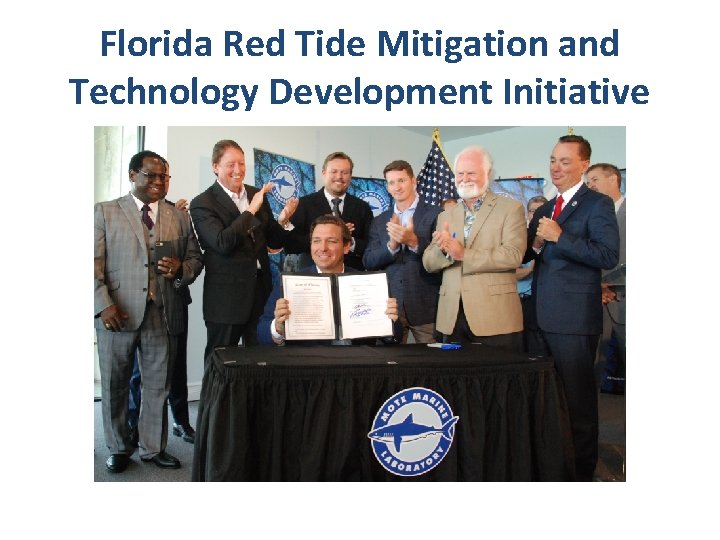
Red Tide Initiative Overview • Signed into law by Florida Governor De. Santis in June 2019 – 379. 2273 Florida Statutes – Mote partnership with Florida Fish and Wildlife Conservation Commission, Fish and Wildlife Research Institute • $18 million over 6 years ($3 million per year) contracted by FWC-FWRI to Mote • Legislative intent: – develop prevention, control, and mitigation technologies and approaches to address the impacts of red tide on coastal environments and communities in Florida • Year 1 (July 2019 - June 2020) and Year 2 (July 2020 - June 2021): – Infrastructure at Mote – lab space, culture lab, and mesocosms for: – Mote led projects – Partner led projects
Initiative Reporting Requirements • Beginning January 15, 2021, and each January 15 thereafter until its expiration, the initiative shall submit a report that contains an overview of its accomplishments to date and priorities for subsequent years to the Governor, the President of the Senate, the Speaker of the House of Representatives, the Secretary of Environmental Protection, and the executive director of the Fish and Wildlife Conservation Commission. • Annual Workplans, Reports, and Invoices to FWRI • Website, Public Records, and Meeting Minutes
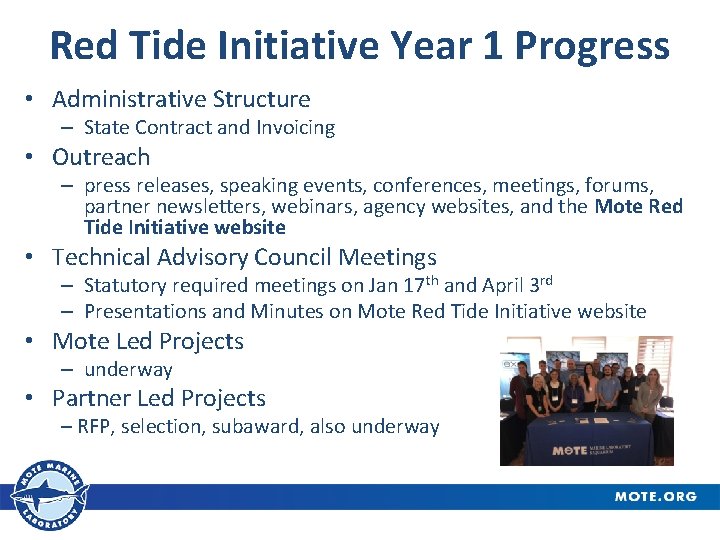
Red Tide Initiative Year 1 Progress • Administrative Structure – State Contract and Invoicing • Outreach – press releases, speaking events, conferences, meetings, forums, partner newsletters, webinars, agency websites, and the Mote Red Tide Initiative website • Technical Advisory Council Meetings – Statutory required meetings on Jan 17 th and April 3 rd – Presentations and Minutes on Mote Red Tide Initiative website • Mote Led Projects – underway • Partner Led Projects – RFP, selection, subaward, also underway
Technical Advisory Council Dr. Michael P. Crosby – Mote President and CEO Dr. James Powell – House Speaker Appt Dr. James Sullivan – Senate President Appt Dr. Katherine Hubbard – FWC Appt David Whiting – DEP Appt Governor Appt Pending
Mote Led Project Overviews • Facilities at Mote’s Sarasota Aquaculture Park – Mesocosm Facility – Karenia brevis Culture Facility • Technology Development in Support of Mitigation – Programmable Hyperspectral Seawater Scanner (PHy. SS) – UAV (Unmanned Aerial Vehicle, Drone) based Detection System – Beach Conditions Reporting System (BCRS) – Quantitative Polymerase Chain Reaction (q. PCR) • Mitigation Projects – Compounds (Natural, Clay, Chemicals) – Laboratory and Mesocosm
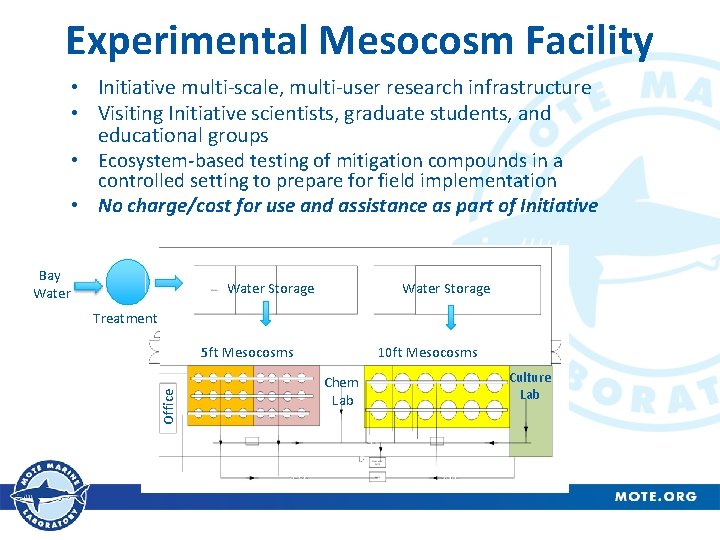
Experimental Mesocosm Facility • Initiative multi-scale, multi-user research infrastructure • Visiting Initiative scientists, graduate students, and educational groups • Ecosystem-based testing of mitigation compounds in a controlled setting to prepare for field implementation • No charge/cost for use and assistance as part of Initiative Bay Water Storage Treatment Office 5 ft Mesocosms 10 ft Mesocosms Chem Lab Culture Lab
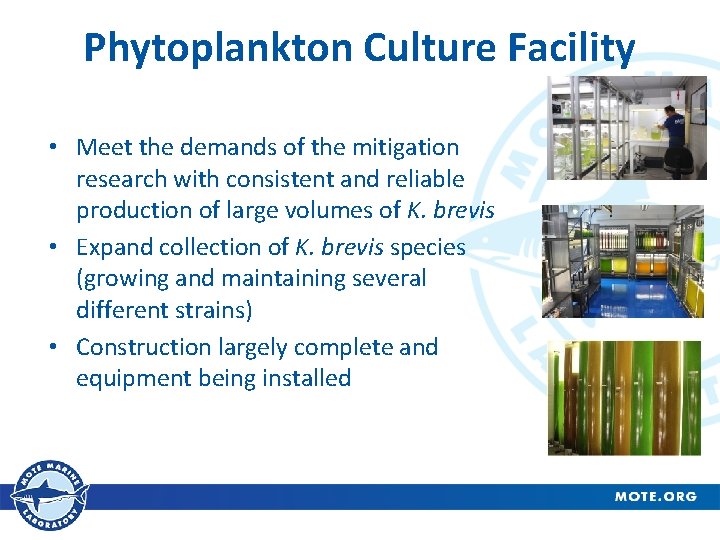
Phytoplankton Culture Facility • Meet the demands of the mitigation research with consistent and reliable production of large volumes of K. brevis • Expand collection of K. brevis species (growing and maintaining several different strains) • Construction largely complete and equipment being installed
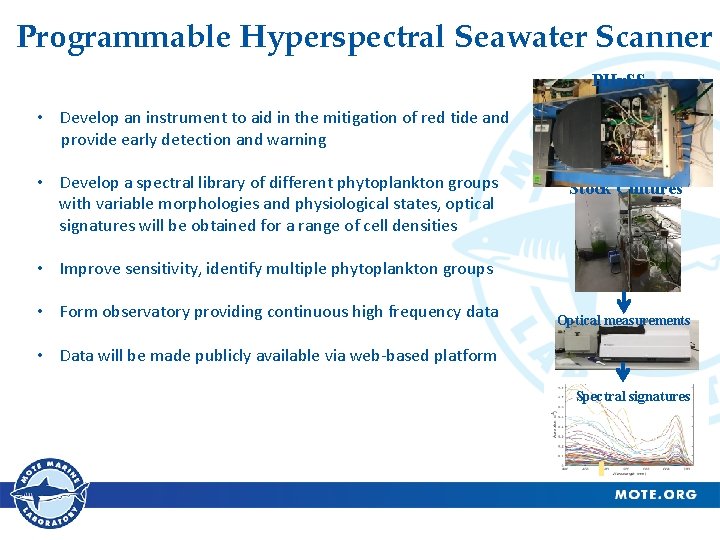
Programmable Hyperspectral Seawater Scanner PHy. SS • Develop an instrument to aid in the mitigation of red tide and provide early detection and warning • Develop a spectral library of different phytoplankton groups with variable morphologies and physiological states, optical signatures will be obtained for a range of cell densities Stock Cultures • Improve sensitivity, identify multiple phytoplankton groups • Form observatory providing continuous high frequency data Optical measurements • Data will be made publicly available via web-based platform Spectral signatures
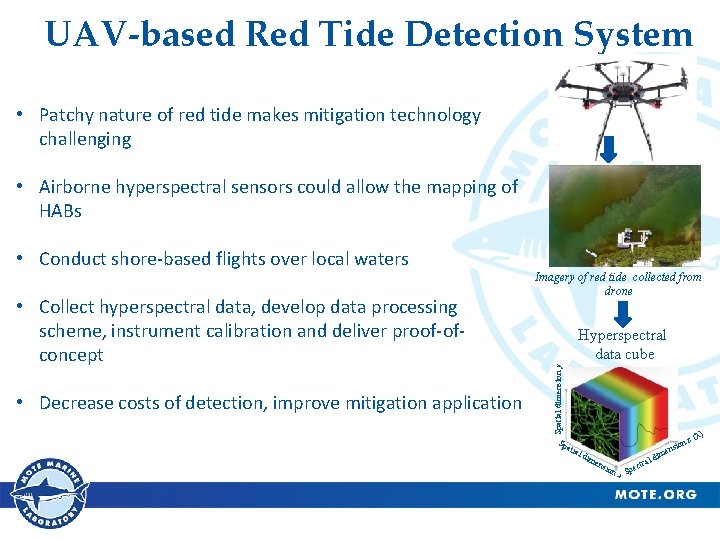
UAV-based Red Tide Detection System • Patchy nature of red tide makes mitigation technology challenging • Airborne hyperspectral sensors could allow the mapping of HABs • Collect hyperspectral data, develop data processing scheme, instrument calibration and deliver proof-ofconcept • Decrease costs of detection, improve mitigation application Imagery of red tide collected from drone Hyperspectral data cube Spatial dimension y • Conduct shore-based flights over local waters Sp at ial d nz im e nsi on x ct Spe ral dim io ens (λ )
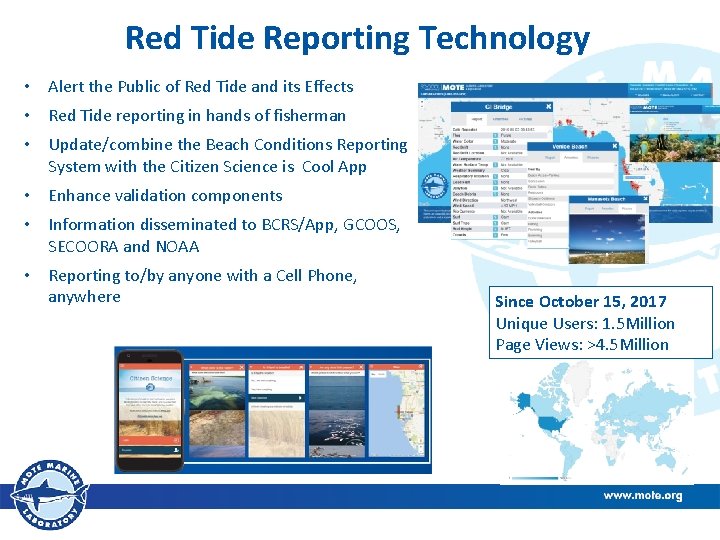
Red Tide Reporting Technology • Alert the Public of Red Tide and its Effects • Red Tide reporting in hands of fisherman • Update/combine the Beach Conditions Reporting System with the Citizen Science is Cool App • Enhance validation components • Information disseminated to BCRS/App, GCOOS, SECOORA and NOAA • Reporting to/by anyone with a Cell Phone, anywhere Since October 15, 2017 Unique Users: 1. 5 Million Page Views: >4. 5 Million
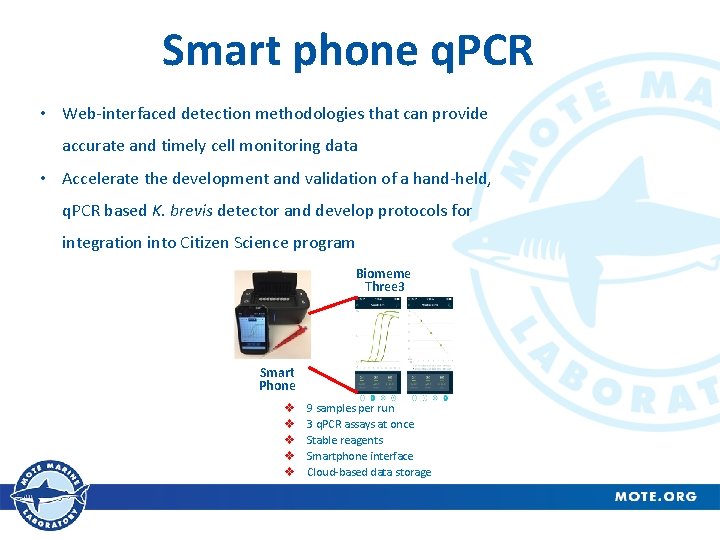
Smart phone q. PCR • Web-interfaced detection methodologies that can provide accurate and timely cell monitoring data • Accelerate the development and validation of a hand-held, q. PCR based K. brevis detector and develop protocols for integration into Citizen Science program Biomeme Three 3 Smart Phone v v v 9 samples per run 3 q. PCR assays at once Stable reagents Smartphone interface Cloud-based data storage
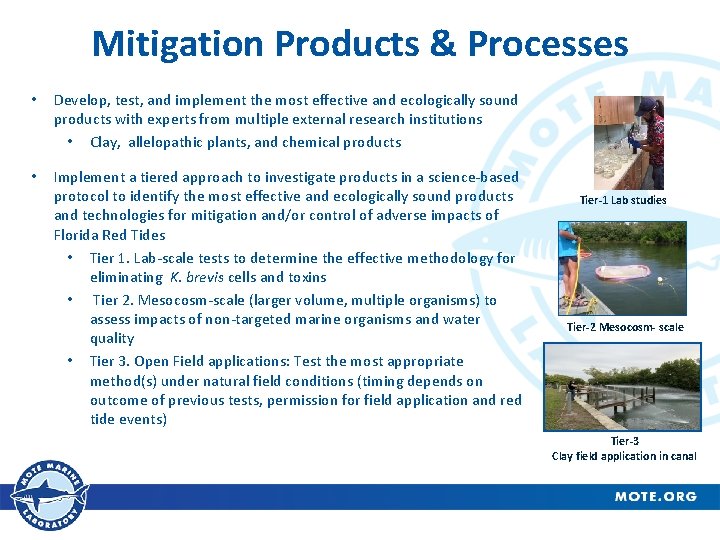
Mitigation Products & Processes • Develop, test, and implement the most effective and ecologically sound products with experts from multiple external research institutions • Clay, allelopathic plants, and chemical products • Implement a tiered approach to investigate products in a science-based protocol to identify the most effective and ecologically sound products and technologies for mitigation and/or control of adverse impacts of Florida Red Tides • Tier 1. Lab-scale tests to determine the effective methodology for eliminating K. brevis cells and toxins • Tier 2. Mesocosm-scale (larger volume, multiple organisms) to assess impacts of non-targeted marine organisms and water quality • Tier 3. Open Field applications: Test the most appropriate method(s) under natural field conditions (timing depends on outcome of previous tests, permission for field application and red tide events) Tier-1 Lab studies Tier-2 Mesocosm- scale Tier-3 Clay field application in canal
Partner Led Projects Red Tide Initiative Engagement • Mote will facilitate funding engagement (as stated in Initiative statute): – Leverage state funds with private and federal funds – Mote may use a portion of appropriation to fund other marine science and technology development organizations in Florida and around the world to pursue applied research and technology
Partner Led Proposals • • Open to any/all interested parties ~$1 Million in funding for partner led projects – Support not to exceed 1 year, but may request longer in next RFP – Anticipated $150 K-$250 K for 4 or 5 awards Year 1: – Announced Nov 7, Closed Jan 31 – 5 Projects Selected for $1, 018, 000 – Subawarded in April and May Year 2: – Announced May 1, Closes June 30 – Proposal Guidelines on Mote. org – Submit Proposals to proposal@redtidemtdi. org Use of Mote facilities/infrastructure is encouraged Partnership with Mote is encouraged Partner Led Proposal Review Process: – Diverse set of red tide Ph. D level expertise – Additional Non-Conflicted Mote Scientist Review » Organized and provide all reviews together for Dr. Crosby’s review » Presentations to Technical Advisory Council Meeting in Sept/Oct
Year 1 Partner Led Projects 1. Dr. Kathryn J. Coyne, University of Delaware: Optimizing production of a dinoflagellate–specific algicide for control of Karenia brevis 2. Dr. Allen Place, University of Maryland: Pushing Karenia Over the Edge with Beer Derived Flavonoids 3. Dr. Vijay John, Tulane University: A Thin Shroud with Integrated Algaecide to Flocculate and Sink Karenia brevis 4. Dr. Don Anderson, Woods Hole Oceanographic Institute: Fate and Effects of Karenia brevis Cells, Toxins, and Nutrients Following Clay Application for Bloom Control 5. Dr. Michael Parsons, Florida Gulf Coast University: Examining the Feasibility of Removing and Composting Fish Carcasses to Mitigate Red Tide
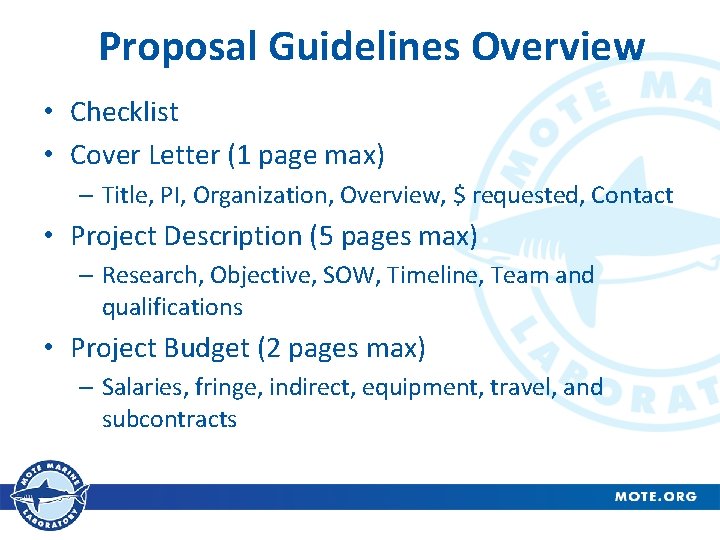
Proposal Guidelines Overview • Checklist • Cover Letter (1 page max) – Title, PI, Organization, Overview, $ requested, Contact • Project Description (5 pages max) – Research, Objective, SOW, Timeline, Team and qualifications • Project Budget (2 pages max) – Salaries, fringe, indirect, equipment, travel, and subcontracts
Questions? (Type your question in the Chat Box or Contact Kevin) Kevin Claridge 941 -388 -4441 ext 275 or kclaridge@mote. org
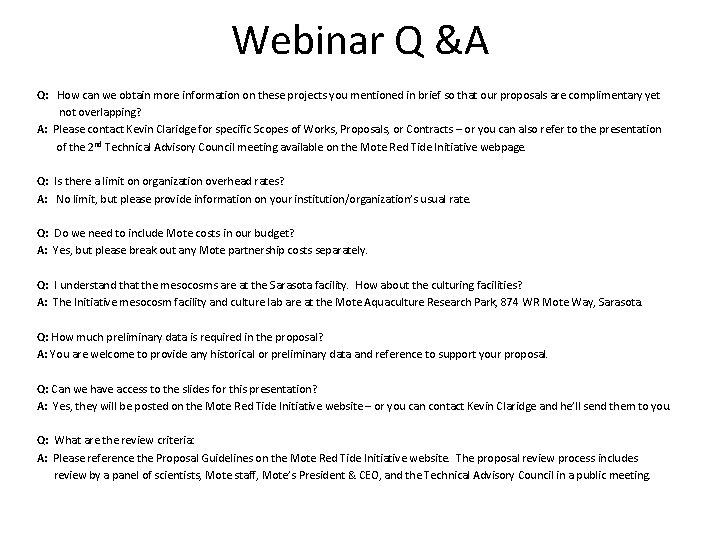
Webinar Q &A Q: How can we obtain more information on these projects you mentioned in brief so that our proposals are complimentary yet not overlapping? A: Please contact Kevin Claridge for specific Scopes of Works, Proposals, or Contracts – or you can also refer to the presentation of the 2 nd Technical Advisory Council meeting available on the Mote Red Tide Initiative webpage. Q: Is there a limit on organization overhead rates? A: No limit, but please provide information on your institution/organization’s usual rate. Q: Do we need to include Mote costs in our budget? A: Yes, but please break out any Mote partnership costs separately. Q: I understand that the mesocosms are at the Sarasota facility. How about the culturing facilities? A: The Initiative mesocosm facility and culture lab are at the Mote Aquaculture Research Park, 874 WR Mote Way, Sarasota. Q: How much preliminary data is required in the proposal? A: You are welcome to provide any historical or preliminary data and reference to support your proposal. Q: Can we have access to the slides for this presentation? A: Yes, they will be posted on the Mote Red Tide Initiative website – or you can contact Kevin Claridge and he’ll send them to you. Q: What are the review criteria: A: Please reference the Proposal Guidelines on the Mote Red Tide Initiative website. The proposal review process includes review by a panel of scientists, Mote staff, Mote’s President & CEO, and the Technical Advisory Council in a public meeting.