
Florida Public Hurricane Loss Model Personal Residential Model
Florida Public Hurricane Loss Model Personal Residential Model FPHLM
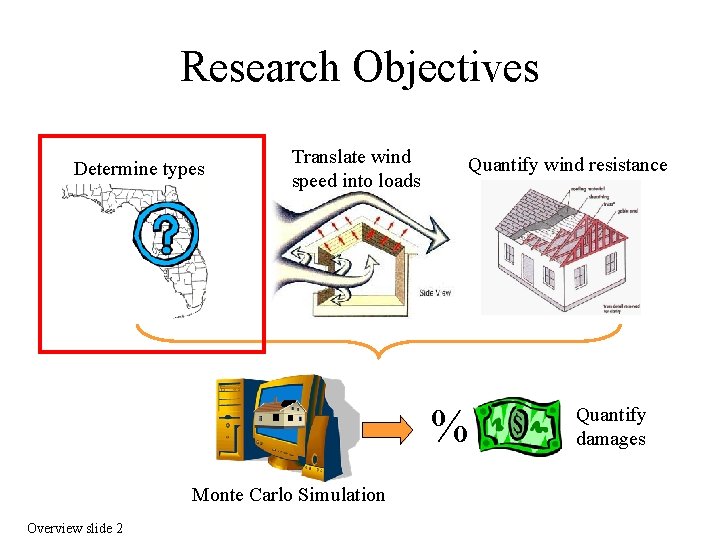
Research Objectives Determine types Translate wind speed into loads Quantify wind resistance % Monte Carlo Simulation Overview slide 2 Quantify damages
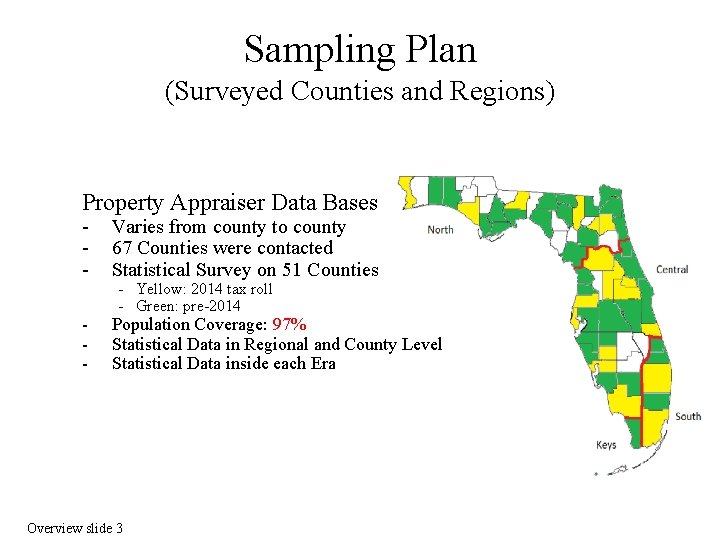
Sampling Plan (Surveyed Counties and Regions) Property Appraiser Data Bases - Varies from county to county 67 Counties were contacted Statistical Survey on 51 Counties - Population Coverage: 97% Statistical Data in Regional and County Level Statistical Data inside each Era - Yellow: 2014 tax roll - Green: pre-2014 Overview slide 3
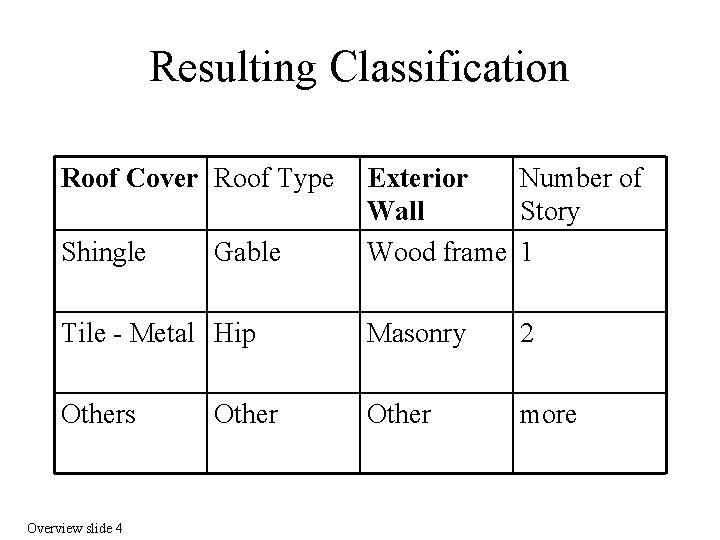
Resulting Classification Roof Cover Roof Type Shingle Gable Exterior Number of Wall Story Wood frame 1 Tile - Metal Hip Masonry 2 Others Other more Overview slide 4 Other
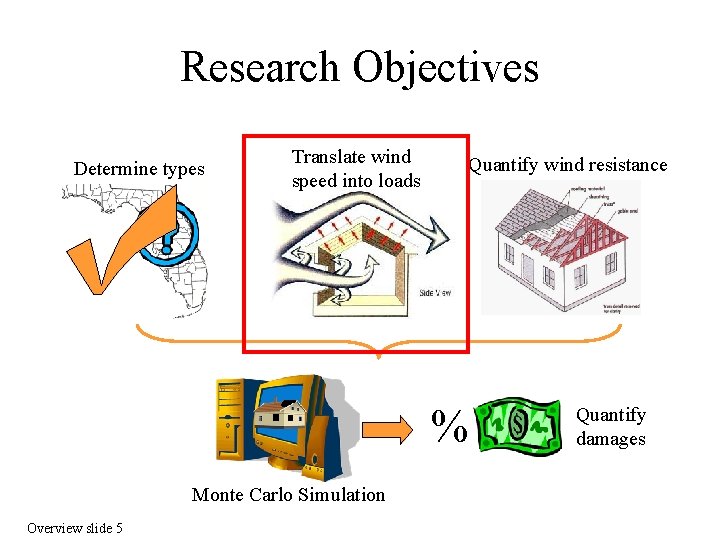
Research Objectives Determine types Translate wind speed into loads Quantify wind resistance % Monte Carlo Simulation Overview slide 5 Quantify damages
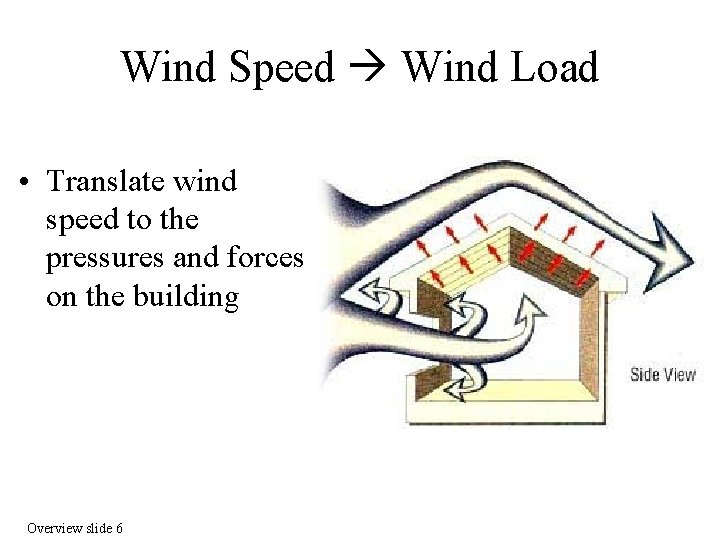
Wind Speed Wind Load • Translate wind speed to the pressures and forces on the building Overview slide 6
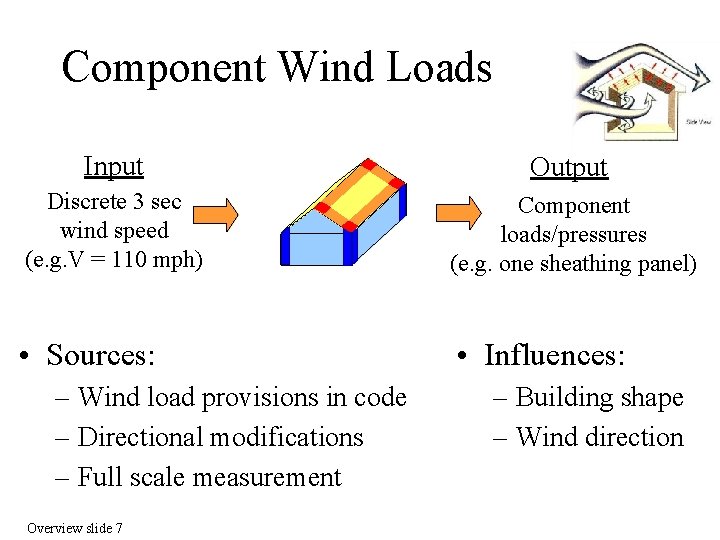
Component Wind Loads Input Output Discrete 3 sec wind speed (e. g. V = 110 mph) Component loads/pressures (e. g. one sheathing panel) • Sources: • Influences: – Wind load provisions in code – Directional modifications – Full scale measurement Overview slide 7 – Building shape – Wind direction
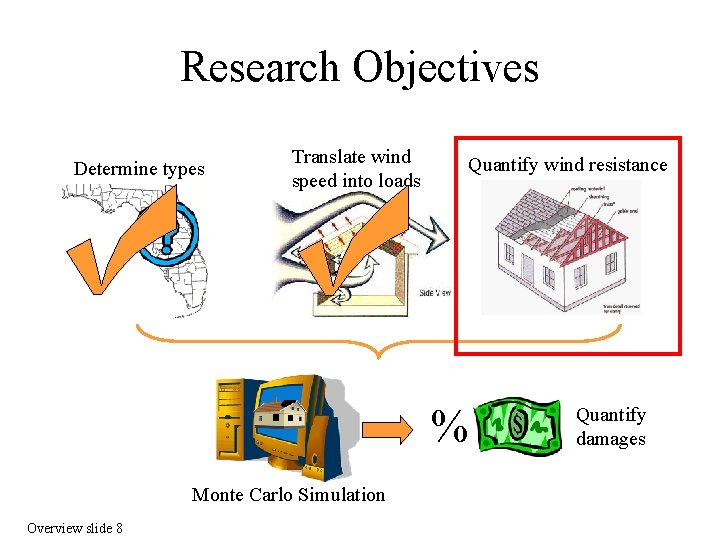
Research Objectives Determine types Translate wind speed into loads Quantify wind resistance % Monte Carlo Simulation Overview slide 8 Quantify damages
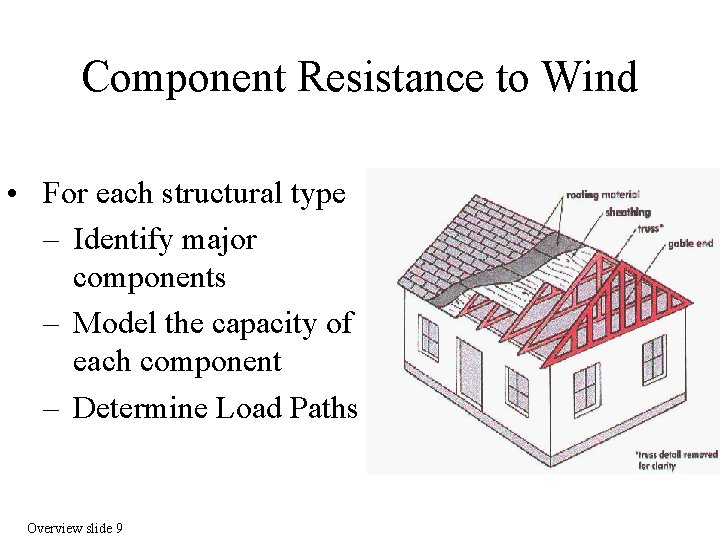
Component Resistance to Wind • For each structural type – Identify major components – Model the capacity of each component – Determine Load Paths Overview slide 9
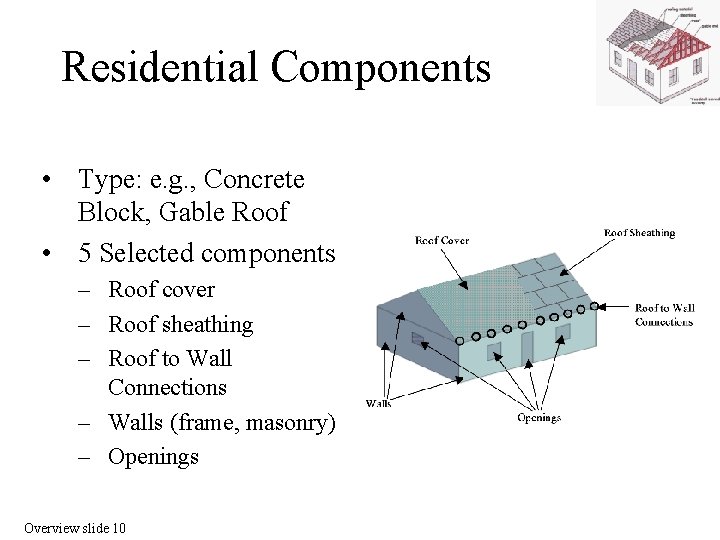
Residential Components • Type: e. g. , Concrete Block, Gable Roof • 5 Selected components – Roof cover – Roof sheathing – Roof to Wall Connections – Walls (frame, masonry) – Openings Overview slide 10
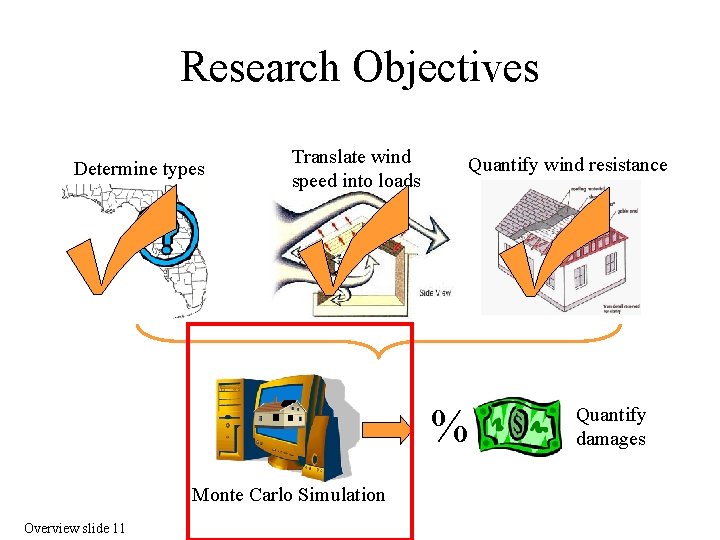
Research Objectives Determine types Translate wind speed into loads Quantify wind resistance % Monte Carlo Simulation Overview slide 11 Quantify damages
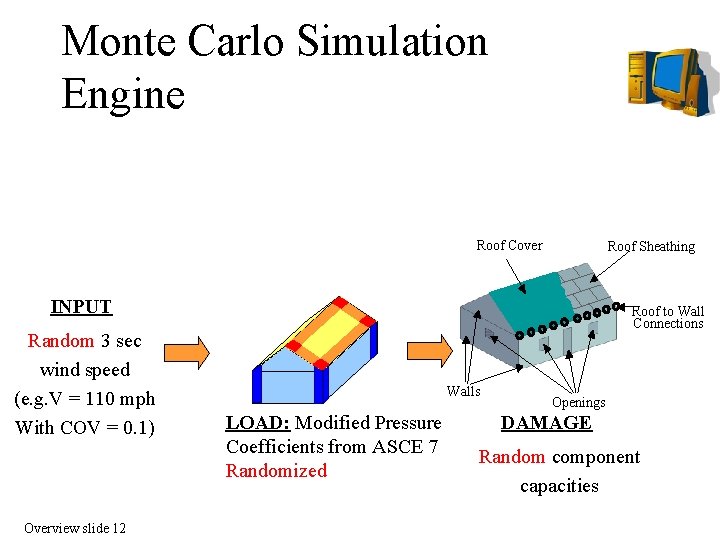
Monte Carlo Simulation Engine Roof Cover Roof Sheathing INPUT Random 3 sec wind speed (e. g. V = 110 mph With COV = 0. 1) Overview slide 12 Roof to Wall Connections Walls LOAD: Modified Pressure Coefficients from ASCE 7 Randomized Openings DAMAGE Random component capacities
Damage Prediction • Damage Matrix for: – Each structural type – Wind speeds 50 – 250 mph in steps of 5 mph – Eight wind directions Overview slide 13
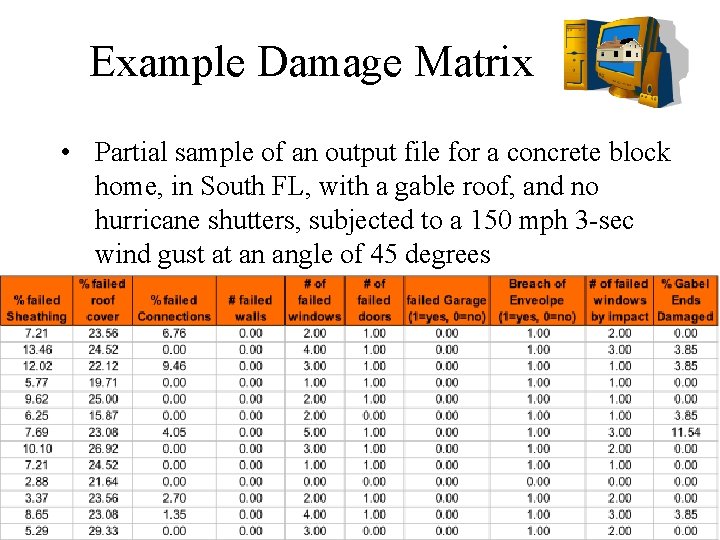
Example Damage Matrix • Partial sample of an output file for a concrete block home, in South FL, with a gable roof, and no hurricane shutters, subjected to a 150 mph 3 -sec wind gust at an angle of 45 degrees
Research Objectives Determine types Translate wind speed into loads Quantify wind resistance % Monte Carlo Simulation Overview slide 15 Quantify damages
Cost Estimation Model % • From the Damage Matrices – Convert modeled physical damages into monetary damages – Define the vulnerability of different homes types – Provide a logical method for prediction damage to other coverage’s – Validate the damage predictions – Input from experts (adjusters, etc. ) Overview slide 16
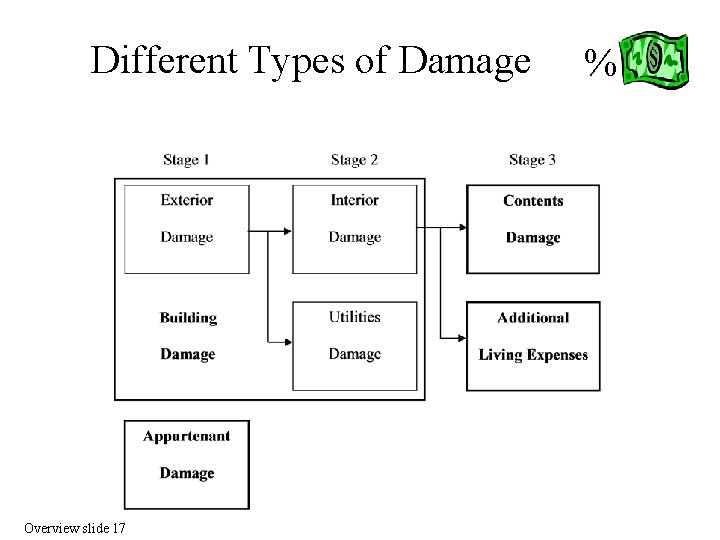
Different Types of Damage Overview slide 17 %
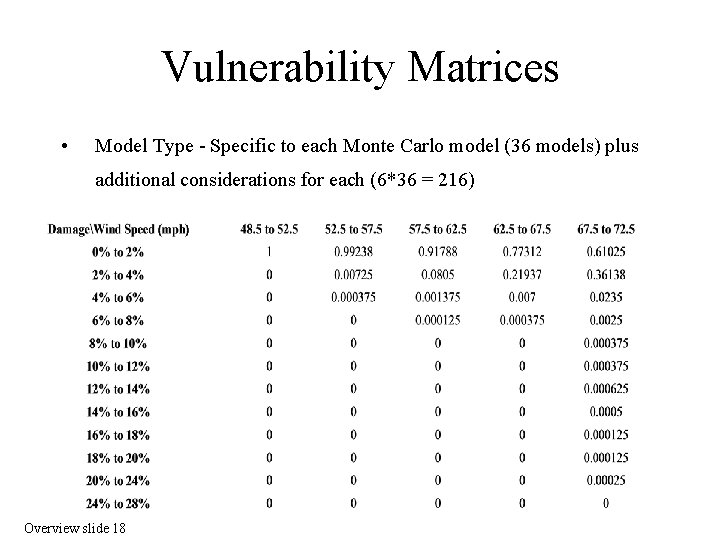
Vulnerability Matrices • Model Type - Specific to each Monte Carlo model (36 models) plus additional considerations for each (6*36 = 216) Overview slide 18
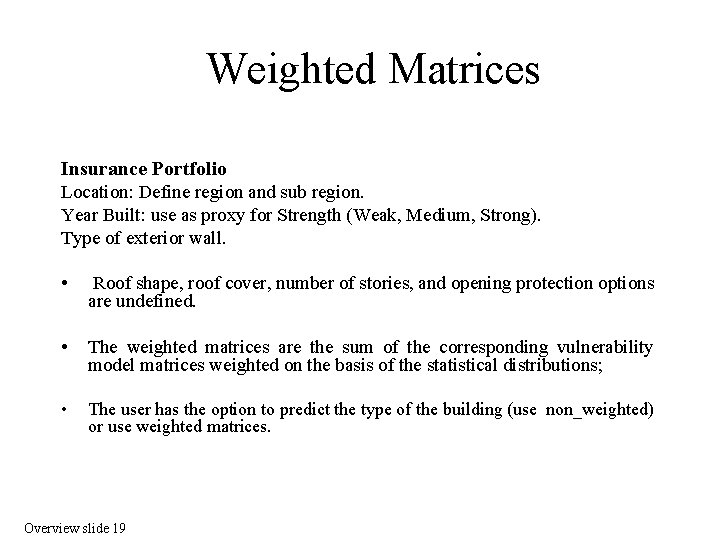
Weighted Matrices Insurance Portfolio Location: Define region and sub region. Year Built: use as proxy for Strength (Weak, Medium, Strong). Type of exterior wall. • Roof shape, roof cover, number of stories, and opening protection options are undefined. • The weighted matrices are the sum of the corresponding vulnerability model matrices weighted on the basis of the statistical distributions; • The user has the option to predict the type of the building (use non_weighted) or use weighted matrices. Overview slide 19
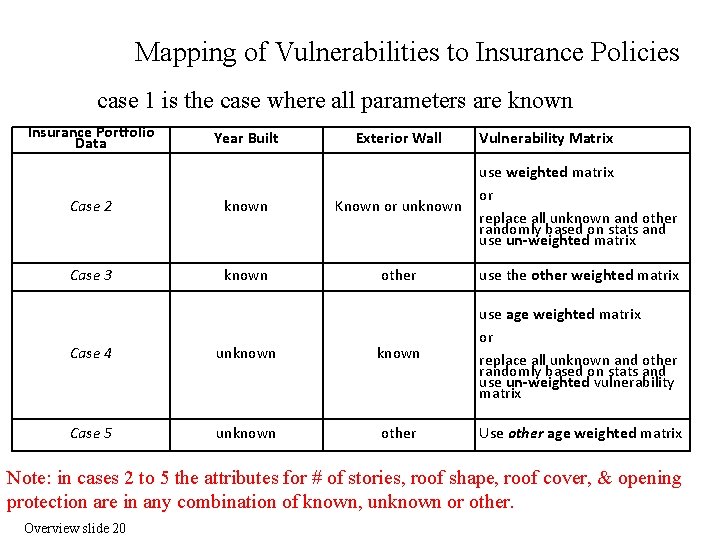
Mapping of Vulnerabilities to Insurance Policies case 1 is the case where all parameters are known Insurance Portfolio Data Year Built Exterior Wall Vulnerability Matrix Case 2 known Known or unknown use weighted matrix or replace all unknown and other randomly based on stats and use un-weighted matrix Case 3 known other use the other weighted matrix Case 4 unknown use age weighted matrix or replace all unknown and other randomly based on stats and use un-weighted vulnerability matrix Case 5 unknown other Use other age weighted matrix Note: in cases 2 to 5 the attributes for # of stories, roof shape, roof cover, & opening protection are in any combination of known, unknown or other. Overview slide 20
Mitigation • The model has the capacity to model different mitigation measures either individually or in combinations • Details are provided in discussion of form V -2 Overview slide 21
Florida Public Hurricane Loss Model Commercial Residential Model FPHLM Low-Rise
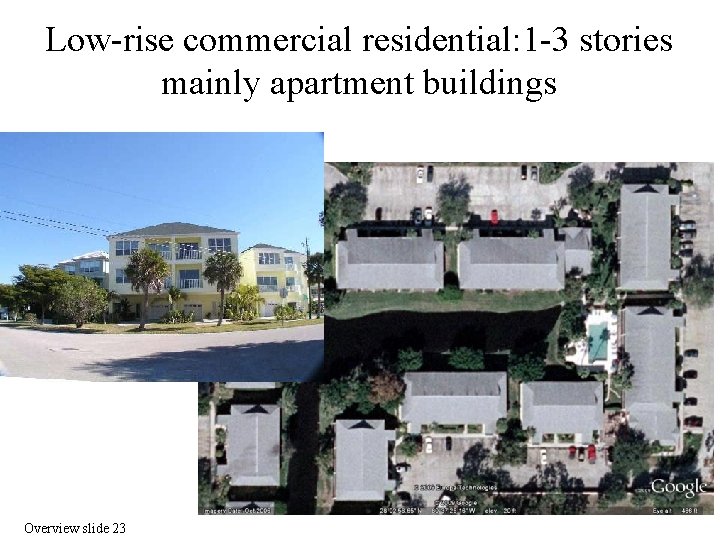
Low-rise commercial residential: 1 -3 stories mainly apartment buildings Overview slide 23
Low-rise Modeling • Low-rise buildings are very similar to single -family-homes – Can be categorized in a few typical generic buildings – Can suffer substantial external structural damage (in addition to envelope and interior damage) including complete collapse – Modeling approach is similar to single family homes: the building is modeled as a whole Overview slide 24
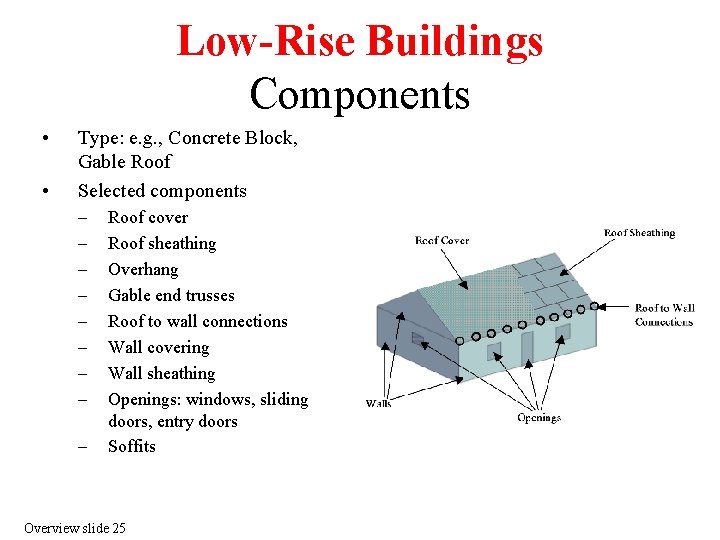
Low-Rise Buildings Components • • Type: e. g. , Concrete Block, Gable Roof Selected components – – – – – Roof cover Roof sheathing Overhang Gable end trusses Roof to wall connections Wall covering Wall sheathing Openings: windows, sliding doors, entry doors Soffits Overview slide 25
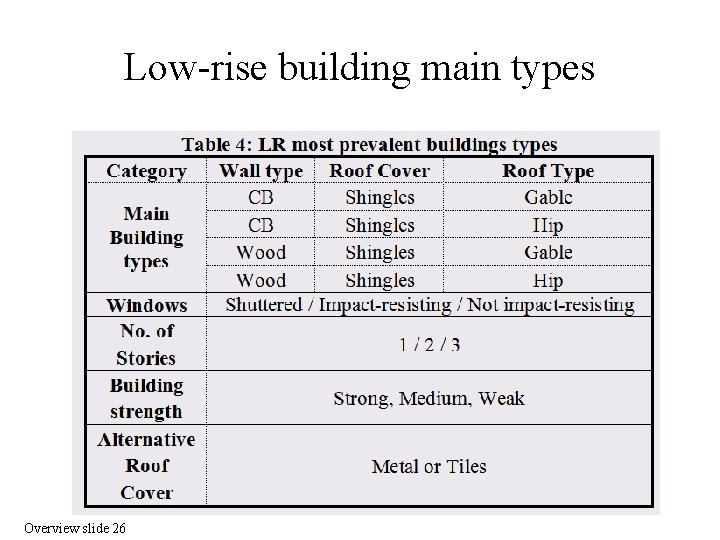
Low-rise building main types Building Types Overview slide 26
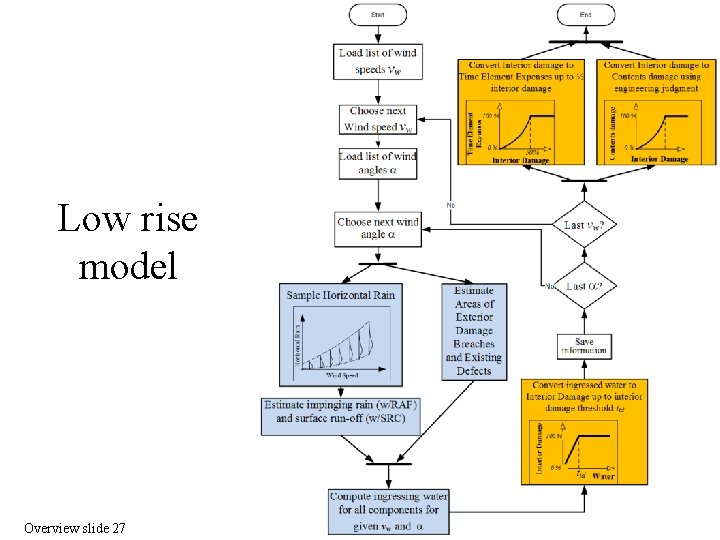
Low rise model Overview slide 27
Florida Public Hurricane Loss Model Commercial Residential Model FPHLM Mid/High-Rise
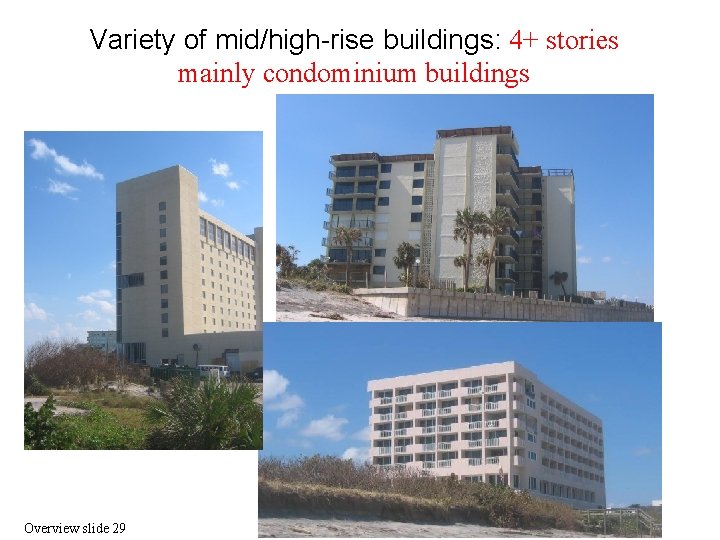
Variety of mid/high-rise buildings: 4+ stories mainly condominium buildings Overview slide 29
Mid-rise Modeling • Mid-rise buildings are very different to singlefamily-homes – They are highly variable in shape, height, material, etc – Cannot be categorized in a few generic building types – Engineered structures that suffer little external structural damage and are unlikely to collapse – Can suffer extensive cladding and opening damage leading to water penetration and interior damage – FPHLM adopts a modular approach : the building is treated as a collection of apartment units Overview slide 30
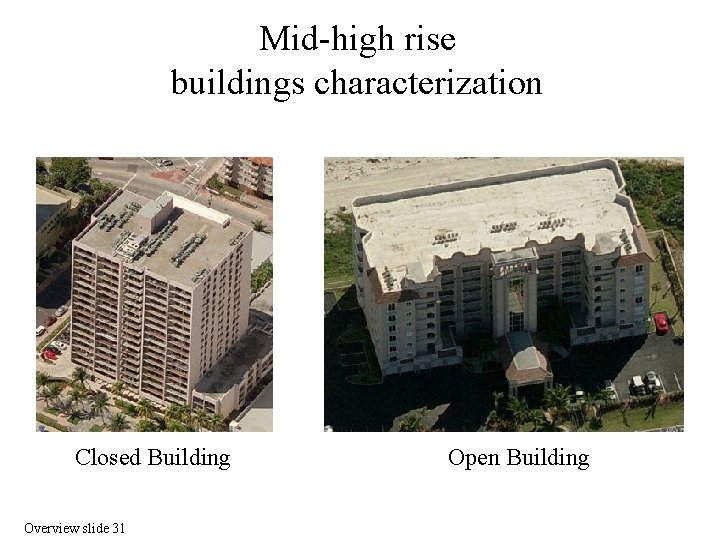
Mid-high rise buildings characterization Closed Building Overview slide 31 Open Building
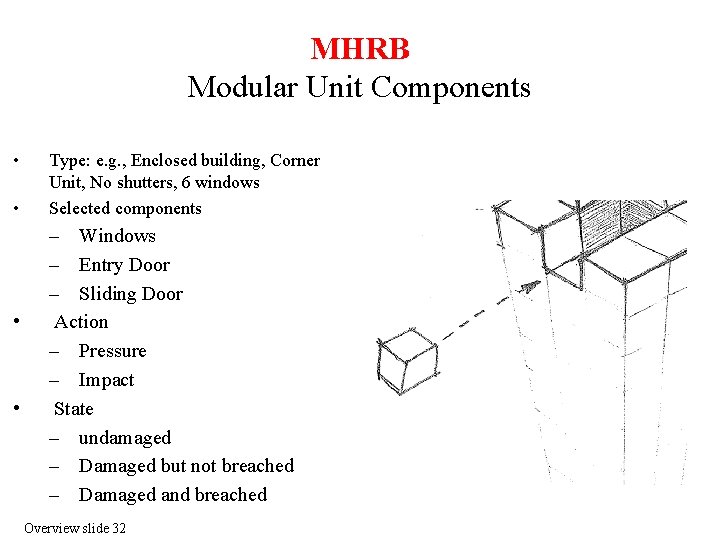
MHRB Modular Unit Components • • Type: e. g. , Enclosed building, Corner Unit, No shutters, 6 windows Selected components – Windows – Entry Door – Sliding Door Action – Pressure – Impact State – undamaged – Damaged but not breached – Damaged and breached Overview slide 32
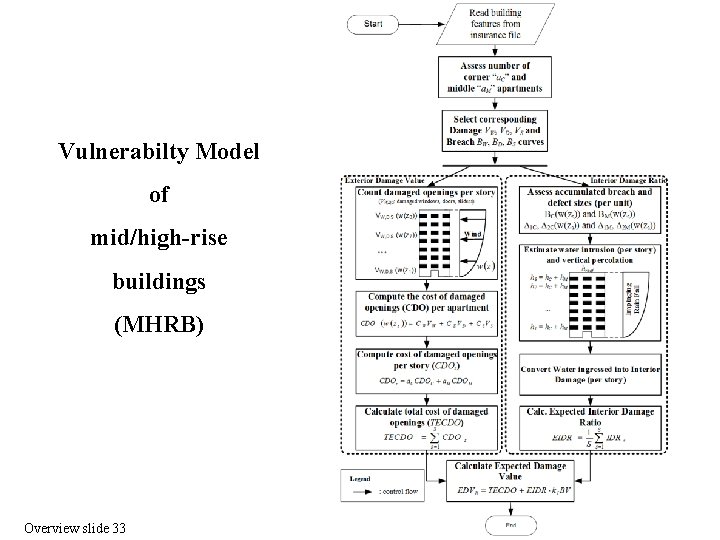
Vulnerabilty Model of mid/high-rise buildings (MHRB) Overview slide 33

Florida Public Hurricane Loss Model Vulnerability Model Changes
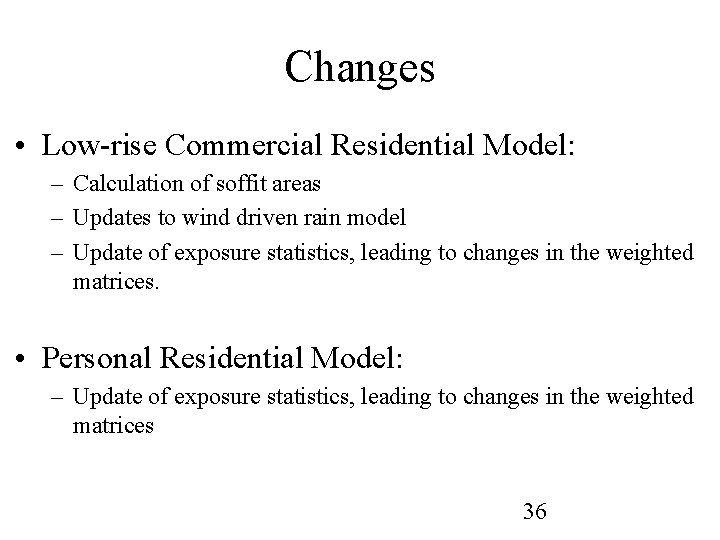
Changes • Low-rise Commercial Residential Model: – Calculation of soffit areas – Updates to wind driven rain model – Update of exposure statistics, leading to changes in the weighted matrices. • Personal Residential Model: – Update of exposure statistics, leading to changes in the weighted matrices 36
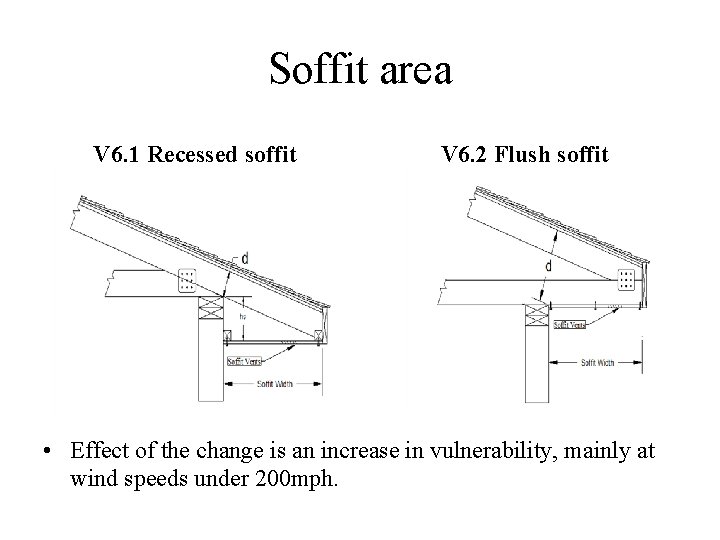
Soffit area V 6. 1 Recessed soffit V 6. 2 Flush soffit • Effect of the change is an increase in vulnerability, mainly at wind speeds under 200 mph.
Wind Driven Rain Model • Two minor adjustments made to the method of sampling wind driven rain parameters • Effects: the two changes come close to cancelling each other out, with minimal change in overall loss 38
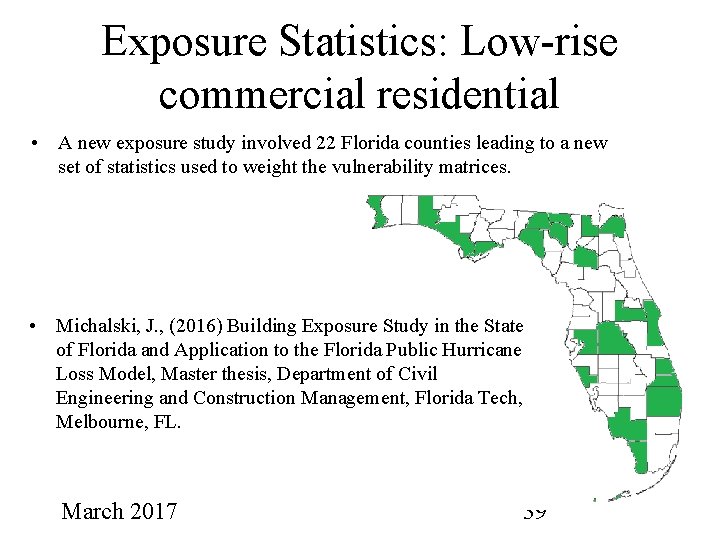
Exposure Statistics: Low-rise commercial residential • A new exposure study involved 22 Florida counties leading to a new set of statistics used to weight the vulnerability matrices. • Michalski, J. , (2016) Building Exposure Study in the State of Florida and Application to the Florida Public Hurricane Loss Model, Master thesis, Department of Civil Engineering and Construction Management, Florida Tech, Melbourne, FL. March 2017 39
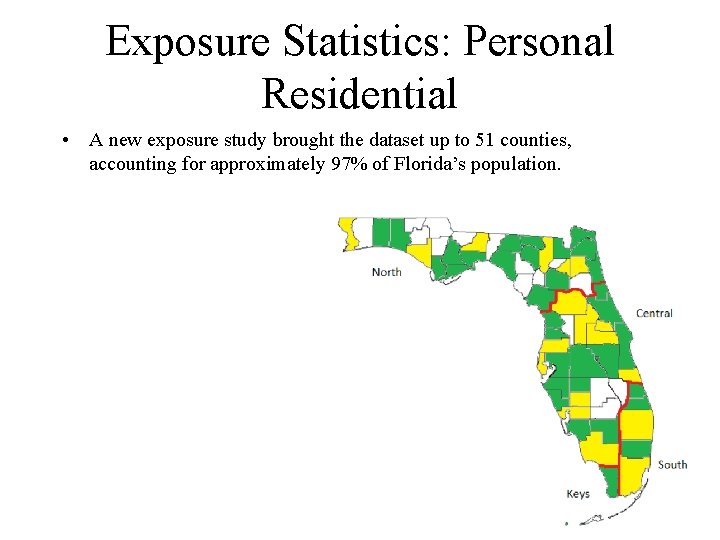
Exposure Statistics: Personal Residential • A new exposure study brought the dataset up to 51 counties, accounting for approximately 97% of Florida’s population. 40
Florida Public Hurricane Loss Model Standard V-1 Derivation of Vulnerability Functions
Florida Public Hurricane Loss Model Standard V-1 A. Development of the building vulnerability functions shall be based on at least one of the following: (1) insurance claims data (2) laboratory or field testing, (3) rational structural analysis, and (4) post-event site investigations. Any development of the building vulnerability functions based on rational structural analysis, post-event site investigations, and laboratory of field testing shall be supported by historical data. The development of the vulnerabilities is based on a component approach that combines engineering modeling, simulations with engineering judgment, and insurance claim data. The determination of external damage to buildings is based on structural calculations, tests, and Monte Carlo simulations. The wind loads and strength of the building components in the simulations are based on laboratory and in-situ tests, manufacturer’s data, expert opinion based on post-hurricane site inspections of actual damage, and codes and standards, and are calibrated and validated against insurance claim data. The internal and content damage are extrapolated from the external damage on the basis of expert opinion and site inspections of areas impacted by recent hurricanes and are confirmed using insurance claims data. V-1 slide 42
Florida Public Hurricane Loss Model Standard V-1 B. The derivation of the building vulnerability functions and their associated uncertainties shall be theoretically sound and consistent with fundamental engineering principles. The method used in the derivation is based on extrapolating the results of Monte Carlo simulations of physical exterior damage through simple equations based on engineering judgment, expert opinion, and claims data. Uncertainties at each stage are accounted for by distributing the damage according to reasonable probability distributions and are validated with claims data. The Monte Carlo component models take into account many variations in structural characteristics, and the result clearly filters through the cost estimation model. There also different and clearly defined costing considerations applied to each structural type. These adjustments come directly from resources developed exclusively for defining repair costs to structures and therefore are theoretically sound. V-1 slide 43
Florida Public Hurricane Loss Model Standard V-1 C. Residential building stock classification shall be representative of Florida construction for personal and commercial residential buildings. A detailed exposure study was carried out to define the most prevalent construction types and characteristics in the Florida residential building stock. Models were built for each of the identified common structural types. The low-rise models include differing wall types, roof shapes, roof-to-wall connections, window types, opening protection, garage doors, and story options. Models of varying combinations of the above characteristics were created. The probabilistic capacities of the various components were determined by a variety of sources, including test results in the literature, in-field data collection, manufacturer’s specifications and manufacturer’s test data. In the case of the mid-/high-rise commercial residential model, the models include different apartment units corresponding to different building layouts, different locations within the floor plan, different heights, and different openings and protection options. V-1 slide 44
Florida Public Hurricane Loss Model Standard V-1 D. Building height/number of stories, primary construction material, year of construction, location, building code, and other construction characteristics, as applicable, shall be used in the derivation and application of building vulnerability functions. The models include options that represent building code revisions. Three models were derived for each structural type: weak, medium, and strong construction. The assignment of a given strength is based on the age of the home and the available information on construction practice in that era of construction. FBC requirements that apply to the repair of existing homes are also taken implemented. Separate models were also developed for manufactured housing constructed based on pre- and post-1994 HUD regulations and for different wind zones. In addition to the construction type, region, and era of construction options, each model has additional strength features that can be adjusted to represent combinations of mitigation features. For example the model is capable of reflecting weak original construction and new, strong roof sheathing and roof cover mitigation. V-1 slide 45
Florida Public Hurricane Loss Model Standard V-1 E. Vulnerability functions shall be separately derived for commercial residential building structures, personal residential building structures, manufactured homes, and appurtenant structures. The commercial and personal residential building structures, mobile homes, and appurtenant structures are independently derived. V-1 slide 46
Florida Public Hurricane Loss Model Standard V-1 F. The minimum windspeed that generates damage shall be consistent with fundamental engineering principles. The minimum one-minute average sustained wind speed at which some damage is observed is 38 mph (3 -second gust 50 mph) for appurtenant structures. Site-built and manufactured homes have a very small probability of some very minor damage at 42 mph (3 -second gust 55 mph). This probability becomes more significant at 46 mph (3 second gust 60 mph) and increases with higher wind speed. Simulations are run for 3 second gusts from 50 mph to 250 mph in 5 mph increments. V-1 slide 47
Florida Public Hurricane Loss Model Standard V-1 G. Building vulnerability functions shall include damage as attributable to windspeed and wind pressure, water infiltration, and missile impact associated with hurricanes. Building vulnerability functions shall not include explicit damage to the building due to flood, storm surge, or wave action. The vulnerability functions do not explicitly include damage due to flood, storm surge, or wave action. The vulnerability functions for all models (site-built residential, manufactured homes, low-rise commercial residential, and mid-/high-rise commercial residential) include damage due to wind pressure, missile impact and water infiltration. V-1 slide 48
Florida Public Hurricane Loss Model Standard V-2 Derivation of Contents and Time Element Vulnerability Functions FCHLPM
Florida Public Hurricane Loss Model Standard V-2 A. Development of the contents and time element vulnerability functions shall be based on at least one of the following: (1) insurance claims data, (2) tests, (3) rational structural analysis, and (4) post-event site investigations. Any development of the contents and time element vulnerability functions based on rational structural analysis, post-event site investigations, and tests shall be supported by historical data The development of the vulnerabilities is based on a component approach that combines engineering modeling, simulations with engineering judgment, and insurance claims data. The content and time element vulnerabilities are extrapolated from the building damage on the basis of expert opinion and post-events site investigations of areas impacted by recent hurricanes and are confirmed using historical claims data. V-2 slide 50 FCHLPM
Florida Public Hurricane Loss Model Standard V-2 B. The relationship between the modeled building and contents vulnerability functions and historical building and contents losses shall be reasonable. The relationship between the modeled structure and the contents vulnerability functions is reasonable, on the basis of the relationship between historical structure and contents losses. V-2 slide 51 FCHLPM
Florida Public Hurricane Loss Model Standard V-2 C. Time element vulnerability function derivations shall consider the estimated time required to repair or replace the property. Time element vulnerability function derivations consider the estimated time required to repair or replace the property. V-2 slide 52 FCHLPM
Florida Public Hurricane Loss Model Standard V-2 D. The relationship between the modeled building and time element vulnerability functions and historical building and time element losses shall be reasonable. For Personal Residential risks the model uses time element vulnerability functions derived from the relationship between building damage and additional living expense. The vulnerability functions have been calibrated using historical claims data on building and additional living expense. For Commercial Residential risks the relationship between modeled structure and time element loss costs is reasonable. Since no historical loss data were available for calibration, the relationship combines engineering and actuarial judgment. V-2 slide 53 FCHLPM
Florida Public Hurricane Loss Model Standard V-2 E. Time element vulnerability functions used by the model shall include time element coverage claims associated with wind, flood, and storm surge damage to the infrastructure caused by a hurricane. The time element vulnerability functions produced by the model consider time element claims arising from wind, flood, and storm surge damage to the infrastructure. The model does not distinguish explicitly between direct and indirect loss. For Personal Residential risks the time element vulnerability functions were calibrated against claims data that include both types of losses. For Commercial Residential risks the recognition of claims due to indirect loss is based on judgment since no historical loss data were available for calibration. V-2 slide 54 FCHLPM
Florida Public Hurricane Loss Model Standard V-3 Mitigation Measures
Florida Public Hurricane Loss Model Standard V-3 A. Modeling of mitigation measures to improve a building’s hurricane wind resistance, the corresponding effects on vulnerability, and their associated uncertainties shall be theoretically sound and consistent with fundamental engineering principles. These measures shall include fixtures or construction techniques that enhance the performance of the building and its contents and shall consider: • Roof strength • Roof covering performance • Roof-to-wall strength • Wall-to-floor-to-foundation strength • Opening protection • Window, door, and skylight strength. Modeling of mitigation measures to improve a building’s hurricane wind resistance, the corresponding effects on vulnerability, and their associated uncertainties is theoretically sound and consistent with fundamental engineering principles. V-3 slide 56
Standard V-3 Part A: Continued The following structures were modeled: Base case as defined by Commission Mitigated case as defined by Commission Base plus one mitigation at a time The mitigations included gable bracing, rated shingles, metal roof, stronger sheathing capacity, stronger roof-to-wall connections, stronger wall-to-sill connections, reinforced masonry walls, multiple opening protection options, and wind/missile resistant glass. V-3 slide 57
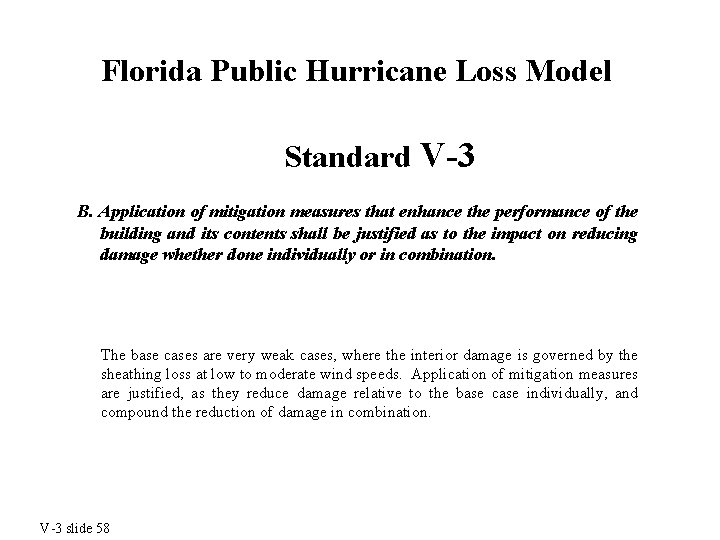
Florida Public Hurricane Loss Model Standard V-3 B. Application of mitigation measures that enhance the performance of the building and its contents shall be justified as to the impact on reducing damage whether done individually or in combination. The base cases are very weak cases, where the interior damage is governed by the sheathing loss at low to moderate wind speeds. Application of mitigation measures are justified, as they reduce damage relative to the base case individually, and compound the reduction of damage in combination. V-3 slide 58
Florida Public Hurricane Loss Model Response to Commission issues Reference Document: FPM Deficiency Letter 15 Standards December 14, 2016
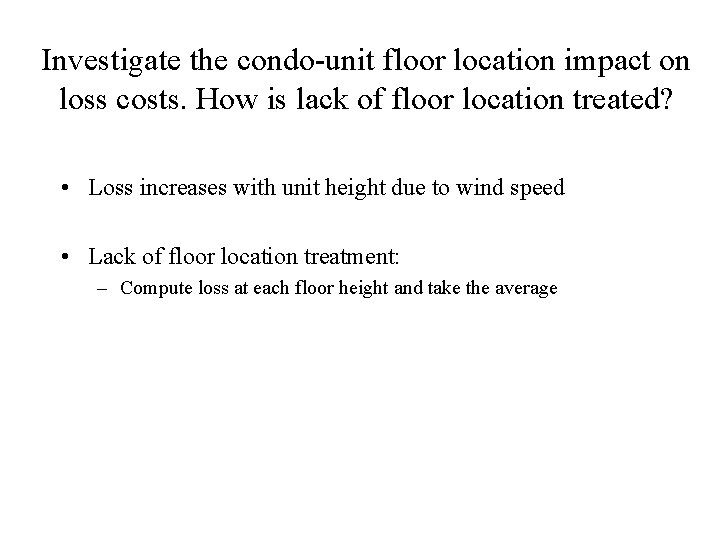
Investigate the condo-unit floor location impact on loss costs. How is lack of floor location treated? • Loss increases with unit height due to wind speed • Lack of floor location treatment: – Compute loss at each floor height and take the average
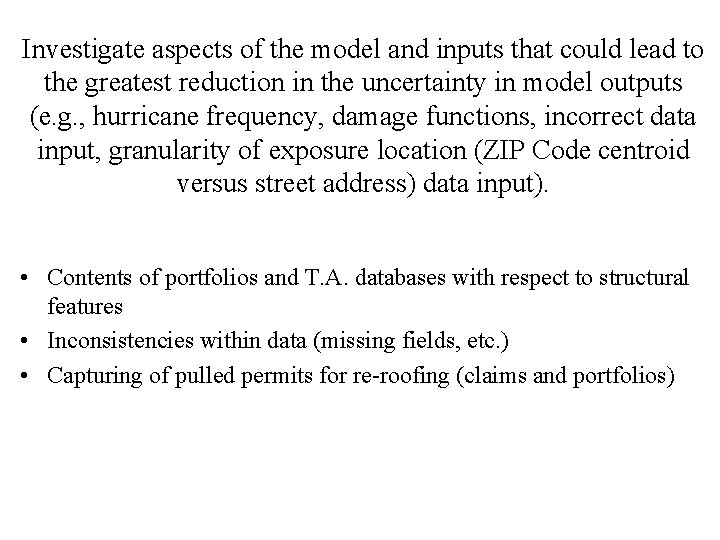
Investigate aspects of the model and inputs that could lead to the greatest reduction in the uncertainty in model outputs (e. g. , hurricane frequency, damage functions, incorrect data input, granularity of exposure location (ZIP Code centroid versus street address) data input). • Contents of portfolios and T. A. databases with respect to structural features • Inconsistencies within data (missing fields, etc. ) • Capturing of pulled permits for re-roofing (claims and portfolios)
Investigate how contamination of claims data (flood loss counted as wind loss) impacts validation and model output. Wind claims data with contamination from flood damage are excluded from the validation sets. For example, Hurricane Ivan in certain regions of the panhandle are very likely contaminated, and therefore not used.
Investigate how the treatment of inland versus coastal exposures has an effect on the spatial evaluation of vulnerability functions. The spatial distribution of appropriate vulnerability functions vary by region according to the county-by-county exposure study. Primarily the age of the structure is used to assign an appropriate vulnerability model with strength consistent with construction in that era. The distribution of age varies among regions. With respect to coastal vs inland, coastal vulnerability models are more heavily weighted toward window protection versions. Miami-Dade HVHZ is accounted for with its own high-strength model to reflect code requirements.
- Slides: 63