
Florence L Goodenough and Dale B Harris DrawAMan
Florence L. Goodenough and Dale B. Harris Draw-A-Man Test By: Alexandria Graziano and Chelsea Nabors
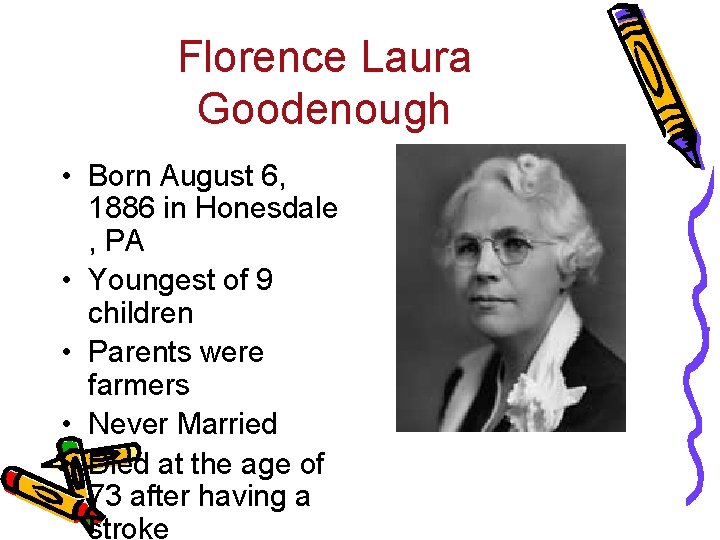
Florence Laura Goodenough • Born August 6, 1886 in Honesdale , PA • Youngest of 9 children • Parents were farmers • Never Married • Died at the age of 73 after having a stroke
Goodenough’s Education • 1908 – Bachelor of Pedagogy: Millersville, PA, Normal School • 1920 – Bachelor of Science: Columbia University • 1921 – Master of Arts with Leta Hollingworth: Columbia University • 1924 – Doctor of Psychology: Stanford University
Goodenough’s Accomplishments • • 1921 - helped Lewis Terman conduct studies with the Stanford-Binet I. Q. test for children he had developed Contributed to Terman’s book Genetic Studies of Genius. 1924 - relocated to Minneapolis, Minnesota and worked in the Minneapolis Child Guidance Clinic 1925 - appointed an assistant professor at the University of Minnesota (During this time she wrote her first book, Measurement of Intelligence by Drawings) • • • 1931 - appointed full professor (During this time she published Anger in Young Children) 1933 - wrote her Handbook of Child Psychology 1942 - appointed president of the National Counsel of Women Psychologists 1946 - became president of the Society for Research in Child Development 1947 - Retired early due to a degenerative disease which eventually caused her blindness
Draw-A-Man Test “The nature and content of children’s drawings are dependent primarily upon intellectual Florence L. Goodenough development. ”
Nature of the Draw-A-Man Test • Goodenough believed that the drawings of young children present a close relationship between concept development and general intelligence. • For children, drawing is a way to express themselves and they are more likely to draw from what they know than from what they see. • In their drawings, what they see as more important or interesting they draw bigger. • • • Her test was developed to test a child’s intellectual maturity. This would distinguish their intellectual state of maturity as separate from their behavioral maturity. Goodenough’s experimental basis for the test relies upon the belief that the child’s intellectual development determines the nature and content of their drawings.
Developing the Goodenough Scale • Was developed through much trial and error. • 1926 - current scale was finished. • Age and school grade were used to establish norms. • Standard subject matter and instructions were developed.
Dale B. Harris “Of the many tests of intelligence, the Goodenough Draw-a-Man Test is perhaps the most unusual in basic conception, brevity, and general convenience. ” -Harris
Dale B. Harris • Harris worked with Goodenough on the completion of his book: Children’s Drawings as Measures of Intellectual Maturity. • His purpose was to revise, not change, Goodenough’s scale, put certain uncompleted aspects of Goodenough’s research in order, and extend the knowledge of the psychology of children’s drawings.
How Harris Extended Goodenough’s Scale • • Harris expanded Goodenough’s scoring scale to include adolescent years making the scale range from 3 -15 year old children. He added items like the drawings of a female figure and the drawings of the self to be accomplished in that order with the man coming first. This increased the reliability and validity of the scale by having three drawings to sample in order to gain further knowledge of each child’s cognitive ability. • • He developed extended or alternative forms of the scale. For example, different scales are assigned to the boys and girls and included tables that relate the raw score and chronological age to a standard score for the Draw-A -Man and Draw-A-Woman Tests. Harris’ new scale included 73 elements that are included in the scoring rather than Goodenough’s 51 elements.
Research Question Will the scores of a random group of 4 th graders and the scores of a random group of 6 th graders reveal the same differences as indicated in Goodenough’s scale?
Hypothesis We hypothesize that the scores of the 4 th and 6 th graders will be similar to each other and will NOT reflect the differences indicated in the Goodenough scale.
Setting • Holy Family School • Date: March 24 th • The 4 th graders were in their music class. Each student was sprawled out on the floor sitting next to whomever he/she wanted. Students made their drawings while in this position. • The 6 th graders were in P. E. Students sat outside the gym in a room with several round tables. Students made their drawings while they sat at these big round tables with about 2 to 3 to a table.
Administering the Test - Sixth Grade • We started with a group of 12 6 th grade students ranging in ages from 11 to 13. • We passed out a pencil and a sheet of blank white printing paper to each child. • Then we gave them theses directions. “We need your help today. Would you mind helping us? We need you to draw a picture of a man for us. Please draw a whole man from head to toe. Draw the best man that you can. When you are done write down whether you are a boy or a girl, and raise your hand your paper will be collected. You have ten minutes. Go. ”
Administering the Test - 4 th Grade • Next we went to a class of 9 4 th grade students ranging in age from 9 to 10 • Again we handed out the materials, and gave them the same exact directions. • Some of the fourth graders became very emotional about their drawing. • Upon leaving we decided to randomly select 8 drawings from each group to score, to make up for the children who were upset after our experiment. A few of the boys became discouraged and said that they could not draw a man as well as the rest of their fellow students.
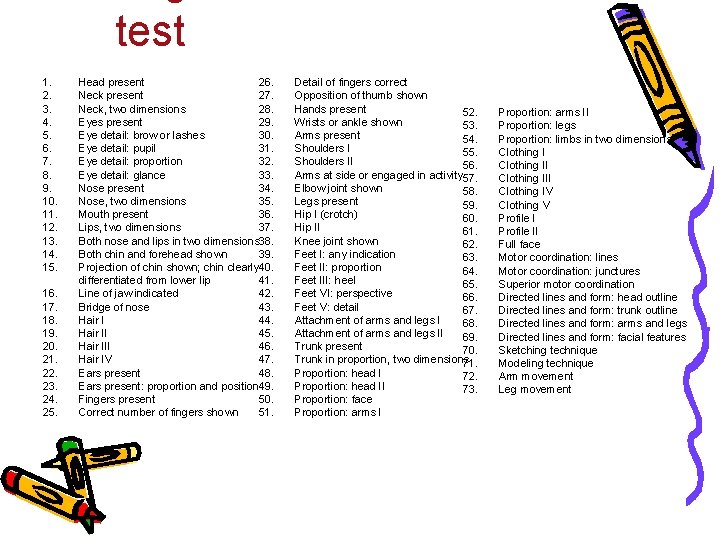
test 1. 2. 3. 4. 5. 6. 7. 8. 9. 10. 11. 12. 13. 14. 15. 16. 17. 18. 19. 20. 21. 22. 23. 24. 25. Head present 26. Neck present 27. Neck, two dimensions 28. Eyes present 29. Eye detail: brow or lashes 30. Eye detail: pupil 31. Eye detail: proportion 32. Eye detail: glance 33. Nose present 34. Nose, two dimensions 35. Mouth present 36. Lips, two dimensions 37. Both nose and lips in two dimensions 38. Both chin and forehead shown 39. Projection of chin shown; chin clearly 40. differentiated from lower lip 41. Line of jaw indicated 42. Bridge of nose 43. Hair I 44. Hair II 45. Hair III 46. Hair IV 47. Ears present 48. Ears present: proportion and position 49. Fingers present 50. Correct number of fingers shown 51. Detail of fingers correct Opposition of thumb shown Hands present 52. Wrists or ankle shown 53. Arms present 54. Shoulders I 55. Shoulders II 56. Arms at side or engaged in activity 57. Elbow joint shown 58. Legs present 59. Hip I (crotch) 60. Hip II 61. Knee joint shown 62. Feet I: any indication 63. Feet II: proportion 64. Feet III: heel 65. Feet VI: perspective 66. Feet V: detail 67. Attachment of arms and legs I 68. Attachment of arms and legs II 69. Trunk present 70. Trunk in proportion, two dimensions 71. Proportion: head I 72. Proportion: head II 73. Proportion: face Proportion: arms II Proportion: legs Proportion: limbs in two dimensions Clothing III Clothing IV Clothing V Profile II Full face Motor coordination: lines Motor coordination: junctures Superior motor coordination Directed lines and form: head outline Directed lines and form: trunk outline Directed lines and form: arms and legs Directed lines and form: facial features Sketching technique Modeling technique Arm movement Leg movement
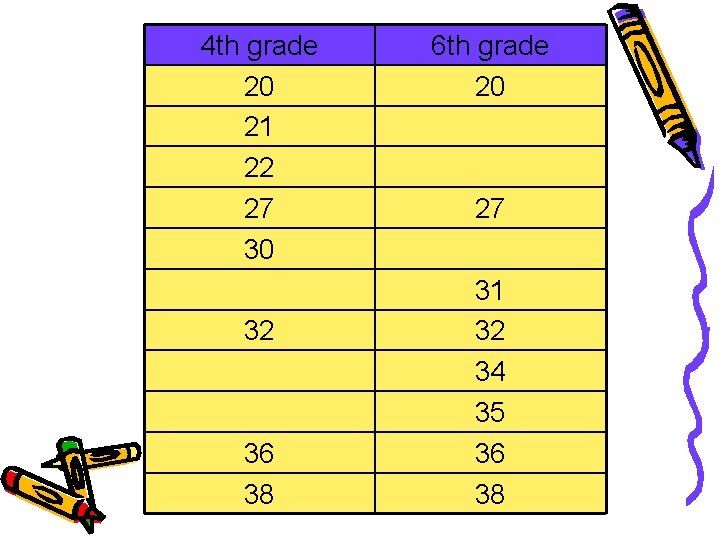
4 th grade 20 21 22 27 30 32 36 38 6 th grade 20 27 31 32 34 35 36 38

Raw Score

Raw Score
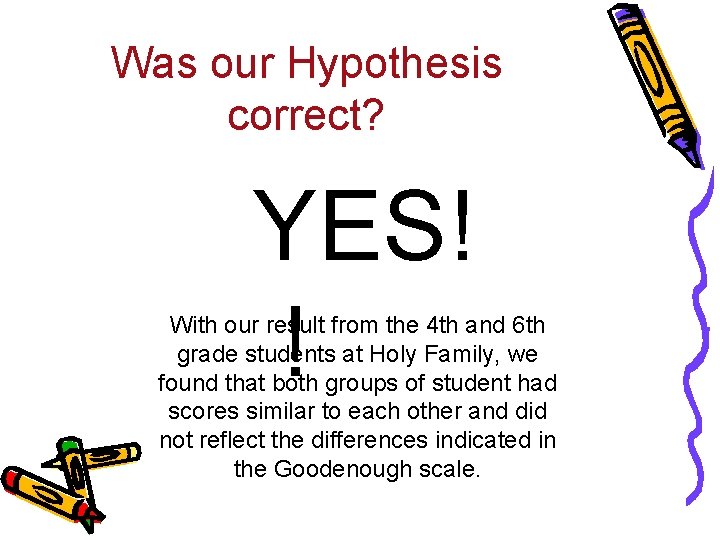
Was our Hypothesis correct? YES! ! With our result from the 4 th and 6 th grade students at Holy Family, we found that both groups of student had scores similar to each other and did not reflect the differences indicated in the Goodenough scale.
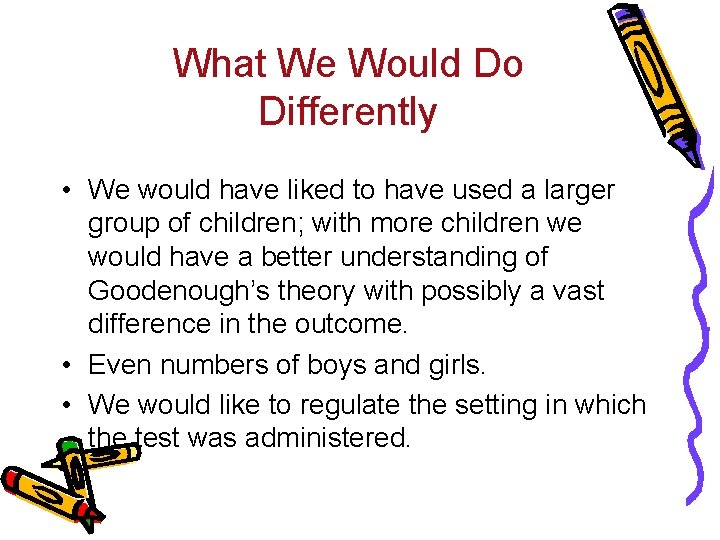
What We Would Do Differently • We would have liked to have used a larger group of children; with more children we would have a better understanding of Goodenough’s theory with possibly a vast difference in the outcome. • Even numbers of boys and girls. • We would like to regulate the setting in which the test was administered.
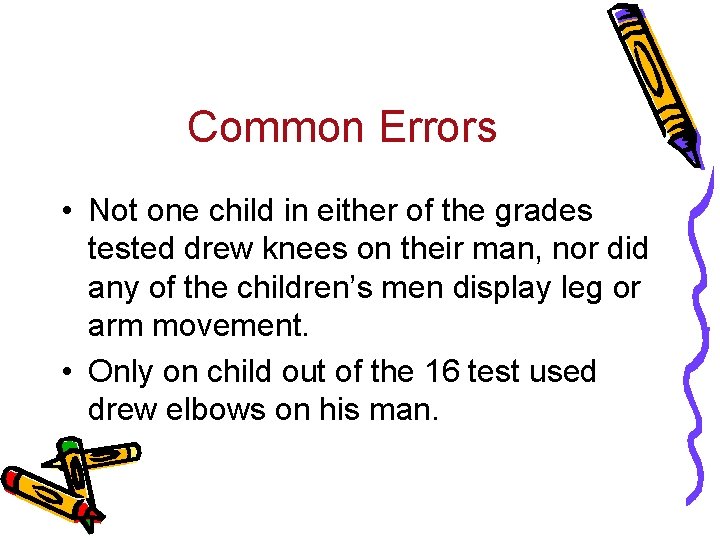
Common Errors • Not one child in either of the grades tested drew knees on their man, nor did any of the children’s men display leg or arm movement. • Only on child out of the 16 test used drew elbows on his man.
- Slides: 22